An Experimental Study On Effect Of Ratio Of Different Sized Coarse Aggregates On Compressive Strength Of Self Compacting Concrete
GEORGE LEO ANAND.G
PG Student,Department of Civil Engineering, PRIST University,
Thanjavur, Tamil Nadu, India.
ABSTRACT
Concrete is the most widely used man made material, with constituents of cement, fine aggregate, coarse aggregate and water. In which the coarse aggregate occupies three fourth of the volume of concrete and influences the properties and performance of concrete with various physical, chemical and thermal properties. In this study an attempt is made to investigate experimentally, the effect of various nominal maximum sizes of coarse aggregate (10mm, 12.5mm, 16mm and 20mm) in concrete. Specimens were prepared with concrete designed using IS method. To study the fresh concrete properties tests are conducted such as slump, Vee-Bee and Compacting Factor. To determine the properties of hardened concrete, tests such as Compression, Tension and Flexure are conducted. It is concluded that the fresh and hardened concrete properties are increased with the increase in nominal maximum size of coarse aggregate.
INTRODUCTION
Concrete is the most widely used manmade construction material and studies indicate that this trend will continue to be so in the years to come. The constituents of concrete are cement, fine, coarse aggregate and water. Coarse aggregates which occupy nearly 70 to 75% volume of concrete are some times referred as ingredients in more than one sense. Aggregates are in general cheaper than cement and impart greater volume stability and durability to concrete. However it is now well recognised that
physical, chemical and thermal
properties of aggregates substantially influence the properties and performance of concrete. Hence selection and use of
aggregates are important considerations in economical as well as technical aspects.
aggregate is inevitable. In case of marginal aggregate, the record of performance of concrete made with them may be the best guide. In general the aggregate which brings about the desired quality in concrete with economy should be selected.
The maximum size of aggregate to handle under a given set of conditions should be as large as possible. Perhaps 80mm size is the maximum size which can be used for concrete making. Using the largest possible maximum size will result in reduction of cement content,
reduction in water requirement,
reduction in drying shrinkage. But the usage of maximum size aggregate is limited by thickness of section, spacing of reinforcement, clear cover, mixing, handling and placing techniques.
IS 456-2000, stipulates that the nominal maximum size of coarse aggregate should be as large as possible within the limits specified but, in no case greater than one fourth of the minimum thickness of the member. For most work 20mm aggregate is suitable. Where there is no restriction to the flow of concrete into sections, 40mm or large size may be permitted. In concrete elements with thin sections, closely spaced reinforcements, or small cover consideration should be given the use of 10mm nominal maximum size. An attempt is made to study the influence of
aggregates with various nominal
maximum sizes in concrete, both in fresh and hardened state.
Materials
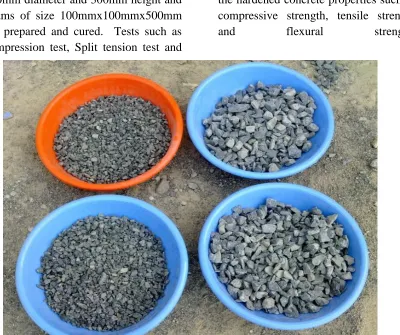
Concrete specimens are prepared with cement, fine aggregate and coarse aggregate of various nominal maximum sizes of 10mm, 12.5mm, 16mm and 20mm and designated as CI, CII, CIII and CIV for which design mix proportion is arrived as shown in table 1. Basic tests are conducted as per IS standards on the materials used for concrete, such as specific gravity, fineness, consistency, and initial setting time for cement. For fine and coarse aggregates tests such as sieve analysis, specific gravity, impact value, crushing value and abrasion value (Los Angeles and Deval’s) are conducted as per standards and results are tabulated. To
study the properties of concrete
constituting with coarse aggregate of various nominal maximum sizes, four types of concrete namely
i) C I - Concrete with coarse
aggregate of nominal
maximum size 10mm
ii) C II - Concrete with coarse
aggregate of nominal
maximum size 12.5mm
iii) C III - Concrete with coarse
aggregate of nominal
maximum size 16mm
iv) C IV - Concrete with coarse
aggregate of nominal
maximum size 20mm
are prepared and tests such as slump, Compacting Factor, Vee-Bee time are conducted to find the properties of fresh
150mmx150mmx150mm, cylinders of 150mm diameter and 300mm height and beams of size 100mmx100mmx500mm are prepared and cured. Tests such as compression test, Split tension test and
flexure test are conducted to determine the hardened concrete properties such as compressive strength, tensile strength
and flexural strength.
Fig. 1 Aggregates of different nominal maximum sizes (10mm, 12.5mm, 16mm and 20mm)
Table 1: Test on Fresh Concrete Type Slump,
mm
Compacting Factor
Vee-Bee time, s
C I 15 0.81 8
C II 20 0.85 7
C III 30 0.87 6
C IV 50 0.89 5
Compressive Strength
The compression test on cubes of size 150 x 150 x 150 mm cast with concrete of types CI, CII, CIII and CIV, are
conducted for both 7 days and 28 days and the values are tabulated in table 2.
Table 2: Compression test on Concrete cubes
Type Compressive
Strength,N/mm2 (7 days)
Compressive Strength,N/mm2
(28 days)
C I 20.49 26.10
C II 21.94 26.16
C III 23.10 28.34
Flexural Strength
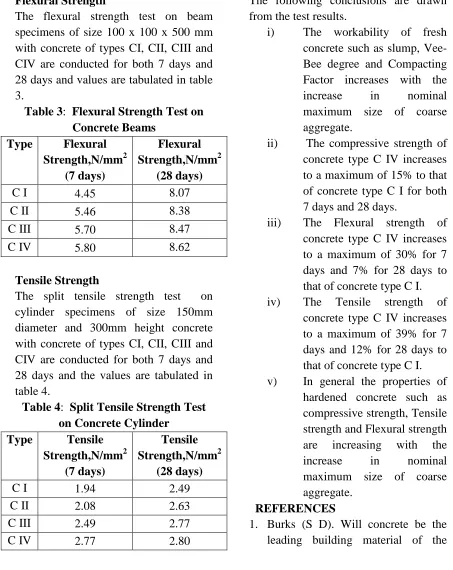
The flexural strength test on beam specimens of size 100 x 100 x 500 mm with concrete of types CI, CII, CIII and CIV are conducted for both 7 days and 28 days and values are tabulated in table 3.
Table 3: Flexural Strength Test on Concrete Beams
Type Flexural
Strength,N/mm2 (7 days)
Flexural Strength,N/mm2
(28 days)
C I 4.45 8.07
C II 5.46 8.38
C III 5.70 8.47
C IV 5.80 8.62
Tensile Strength
The split tensile strength test on cylinder specimens of size 150mm diameter and 300mm height concrete with concrete of types CI, CII, CIII and CIV are conducted for both 7 days and 28 days and the values are tabulated in table 4.
Table 4: Split Tensile Strength Test on Concrete Cylinder
Type Tensile
Strength,N/mm2 (7 days)
Tensile Strength,N/mm2
(28 days)
C I 1.94 2.49
C II 2.08 2.63
C III 2.49 2.77
C IV 2.77 2.80
CONCLUSIONS
The following conclusions are drawn from the test results.
i) The workability of fresh
concrete such as slump, Vee-Bee degree and Compacting Factor increases with the
increase in nominal
maximum size of coarse aggregate.
ii) The compressive strength of
concrete type C IV increases to a maximum of 15% to that of concrete type C I for both 7 days and 28 days.
iii) The Flexural strength of
concrete type C IV increases to a maximum of 30% for 7 days and 7% for 28 days to that of concrete type C I.
iv) The Tensile strength of
concrete type C IV increases to a maximum of 39% for 7 days and 12% for 28 days to that of concrete type C I.
v) In general the properties of
hardened concrete such as compressive strength, Tensile strength and Flexural strength
are increasing with the
increase in nominal
maximum size of coarse aggregate.
REFERENCES
1. Burks (S D). Will concrete be the
future? Pr. J. ACI 68, 5; 1971; 321-26.
2. IS: 456 -2000, “Plain and Reinforced
Concrete – Code of Practice”, Indian Standards Institution, 2000.
3. Chengzhi Zhang, Aiqin Wang,
Mingshu Tang, Bingqin Wu,
Ningsheng Zhang, “Influence of aggregate size and aggregate size grading on ASR expansion”, Cement and Concrete Research 29 (1999) 1393–1396.
4. Krishna A V, Krishna Rao B and
Rajagopal A, “Effect of different sizes of coarse aggregate on the properties of NCC and SCC”, International Journal of Engineering
Science and Technology, Vol.2 (10), 2010, 5959-5965.
5. IS: 2386 (Part I – IV) - 1963,
“Methods of Test for Aggregates for
Concrete”, Bureau of Indian
Standard, 1963.
6. IS: 383-1970, Coarse and fine
aggregate from natural sources for
concrete, Indian Standards
Institution, 1970.
7. IS: 10262-1982, Recommended
guidelines for concrete mix design, Indian Standards Institution, 1982.
8. IS: 516 – 1959 (Reaffirmed 1999)