SUB-ENTIRE-DOMAIN BASIS FUNCTION METHOD FOR IRRECTANGULAR PERIODIC STRUCTURES
W. B. Lu, Q. Y. Zhao, andT. J. Cui
Institute of Target Characteristic and Identification State Key Laboratory of Millimeter Waves
School of Information Science and Engineering Southeast University
Nanjing 210096, P. R. China
Abstract—The Sub-Entire-Domain (SED) basis function method has been applied to solve electromagnetic problems of irrectangular periodic structures with finite sizes efficiently. Three typical irrectangular periodic structures such as parallelogrammic periodic structures, triangular periodic structures, and trapeziform periodic structures are investigated using the SED basis function method. Just as the SED basis functions for rectangular periodic structures, the new SED basis functions for irrectangular periodic structures are defined on the support of each single cell, and the corresponding dummy cells are introduced to obtain the new SED basis functions. Using the proposed SED basis function method, the original large-scale problem is decomposed into two small-size problems. One is the determination of new SED basis functions, and the other is to solve the whole problem using MoM and SED basis functions. Numerical examples are given to prove the validity and efficiency of the new method.
1. INTRODUCTION
Fast and accurate analysis of large-scale periodic structures with finite sizes becomes more and more important due to their large variety of applications [1–11]. Among the full-wave analysis methods, the fast algorithm based on MoM [12], such as the fast multipole method (FMM) and the multilevel fast multipole algorithm (MLFMA), can solve very large problems [13–15]. By the use of MLFMA, the complexity of the matrix-vector multiplication can be reduced from
Recently, some physically-based entire-domain (ED) and sub-entire-domain (SED) basis functions have been developed to solve the challenging problem [16–23]. For example, the Macro basis function (MBF) [16], synthetic functions (SFs) [17], characteristic basis function (CBF) [18–20], and sub-entire-domain (SED) basis functions [21–23] have been proposed. Among those physically-based basis functions, the SED basis functions have been proved to be efficient and can be implemented more easily [21–23]. But in the early records [21– 23], problems solved by SED functions are all confined to rectangular periodic structures. In fact, the shape of the periodic structures is not always rectangular.
In order to handle the irrectangular periodic structures, a new SED basis function is proposed, which can analyze large-scale irrectangular periodic structures with finite sizes efficiently. The new SED basis function for irrectangular periodic structures is referred as irrectangular SED basis function (ISED). In this paper, three typical irrectangular periodic structures, parallelogrammic periodic structures, trapeziform periodic structures, and triangular periodic structures, are presented for the implementation of the ISED basis function method. Similar to the SED basis function, the ISED basis function are also defined on each single cell of the periodic structure, and the mainly mutual coupling effects are considered in each single cell by using dummy cells. According to the relative position, three kinds of ISED basis functions are involved, which are defined on supports of interior cells, edge cells and corner cells. Further study has shown that all kinds of ISED basis functions can be obtained by solving a single small problem. Numerical results are given to test the accuracy and efficiency of the proposed method.
2. BRIEF INTRODUCTION OF ISED BASIS FUNCTION METHOD
type ISED basis function at then-th cell is defined as
hkn(r) = M
m=1
Inmk fm(r), (1)
wherefm(r) is the conventional RWG basis function as defined in [12], andInmk is the corresponding coefficient. As a consequence, the current distribution in the whole structure can be expressed as
J(r) = NC
n=1
αnhkn(r). (2)
When illuminated by electromagnetic plane waves, the electric field integral equation (EFIE) for the surface electric current J(r) in the periodic structure can be written as
ˆ
t·L¯E·J(r) =−ˆt·Einc, (3) where ˆt is a unit tangential vector on surface S of the periodic structure. The operator ¯LE is defined as
¯
LE·J(r) =iωµ0
S
drG¯(r,r)·J(r), (4) in which ¯G(r,r) as introduced in [22] is the electric field dyadic Green’s function in free space. After using the Galerkin’s procedure based on the ISED basis function instead of conventional RWG basis functions, the EFIE (3) is converted into a matrix equation
¯
Z·I=V, (5)
where I = (I1, I2,· · ·, INC)
t is the expansion-coefficient vector, the
elements of vector, andV is given by
Vm =−
Sm
drhm(r)·Einc(r). (6) The impedance matrix ¯Z is an N ×N matrix, in which the element
Zmn can be expressed as [23]
Zmn=
hkm∗(r),L¯E·hln(r), (k, l= 1,2,· · ·, K), (7) in which m, n = 1,2,· · ·, NC, , denotes an inner product, and
impedance matrix in the conventional MoM can be extremely reduced from NCM × NCM to NC ×NC using the ISED basis function, which can make a great reduction of the memory requirement and computational complexity. The key step in the above ISED basis function method is how to define the ISED basis functions accurately and how to determine the ISED basis functions efficiently.
3. DEFINITION AND DETERMINATION OF ISED BASIS FUNCTIONS
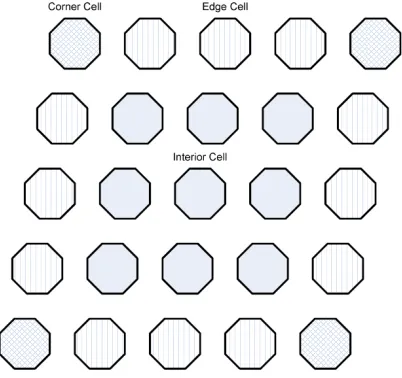
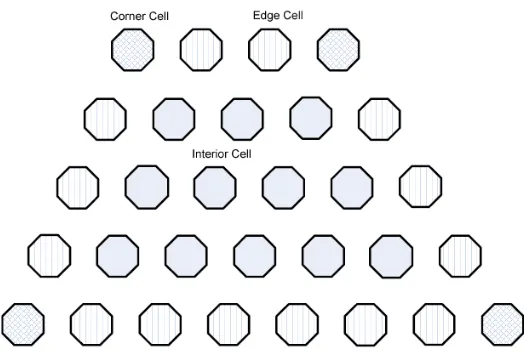
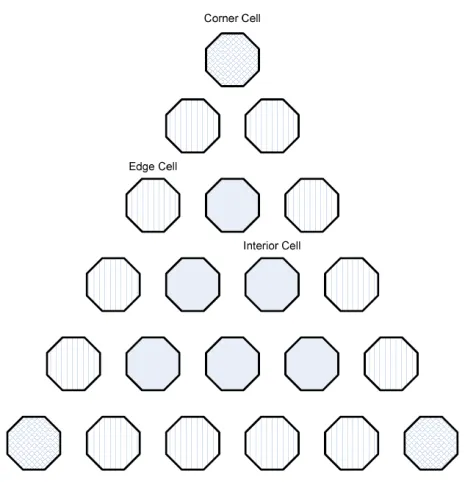
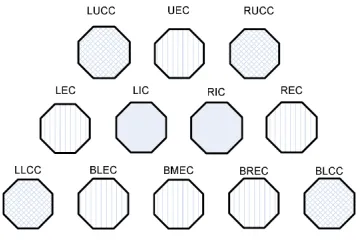
The definition and determination of ISED basis functions are similar to those of SED basis functions for rectangular periodic structures [21]. Here the parallelogrammic, trapeziform, and triangular periodic structures are consedered. For each of the three irrectangular periodic structures, the unit cells are classified as interior cell, edge cell, and corner cell, according to their relative positions, as shown in Figs. 1– 3. In the parallelogrammic periodic structure, edge cells include the left-edge cell (LeEC), the right-edge cell (REC), the upper edge cell (UEC) and the lower edge cell (LoEC), and corner cells include the left-upper corner cell (LUCC), the right-upper corner cell (RUCC), the left-lower corner cell (LLCC), and the right-lower corner cell (RLCC), as illustrated in Fig. 1. Hence, for parallelogrammic periodic structure,
nine kinds of ISED basis functions are required, which are defined on the nine different types of cells.
Similarly, for the trapeziform periodic structure, twelve kinds of ISED basis functions are involved, which are defined on the supports of the upper-edge cell (UEC), the left edge cell (LEC), the right edge cell (REC), the bottom-left edge cell (BLEC), the bottom-middle edge cell (BMEC), and bottom-right edge cell (BLEC), the left-upper corner cell (LUCC), the right-upper corner cell (RUCC), the left-upper corner cell (LUCC), the right-lower corner cell (RLCC), the left interior cell (LIC), and the right interior cell (RIC), as shown in Fig. 2.
Figure 2. Supports of different types of ISED basis functions in the trapeziform periodic structure.
Figure 3. Supports of different types of ISED basis functions in the triangular periodic structure.
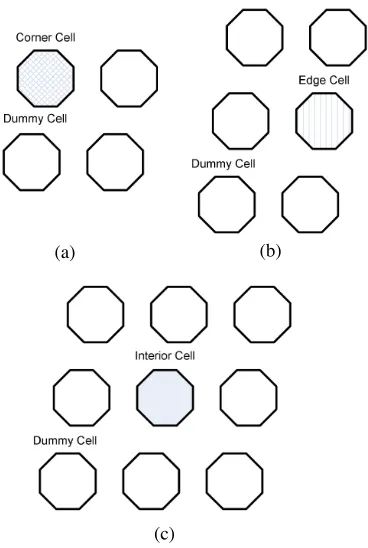
trapeziform periodic structure, the corner edge, and interior ISED basis functions requires three, five, and six dummy cells, respectively. For the triangular periodic structures, the corner edge, and interior ISED basis functions requires two, four, and six dummy cells, respectively, as shown in Figs. 6(a)–(c).
Therefore, for parallelogrammic periodic structure, only nine small problems need to be involved to obtain all kinds of ISED basis functions no matter how large the number of total elements N is. For the trapeziform and triangular periodic structures, the number of small problems is twelve and ten, respectively. In the actual implementation, all the ISED basis functions can be obtained by solving a single small-size problem. As shown in Fig. 7, the single small-size problem resulting from parallelogrammic periodic structures includes 9 cells and contains 9M unknowns. For the trapeziform periodic structures and triangular periodic structures, single small problems with 12M
(a) (b)
(c)
Figure 4. Dummy cells for different types of ISED basis functions in the parallelogrammic periodic structure.
functions can be performed to solve the whole problem, which has been introduced in [16].
4. NUMERICAL RESULTS
(a) (b)
(c)
Figure 5. Dummy cells for different types of ISED basis functions in the trapeziform periodic structure.
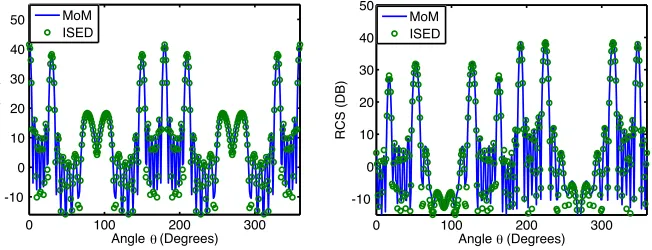
are involved, where the first problem contains 9M = 585 unknowns to solve the ISED basis functions, and the second problem contains 36 unknowns to obtain the current distributions on all patches. The radar cross sections (RCS) computed by the conventional MoM and the ISED basis function method under the normal illumination of plane waves are illustrated in Fig. 11, and RCSs computed by such two methods under the oblique incidence of plane waves atθi = 45 degrees are shown in Fig. 12. Obviously, the two methods give nearly the same results under both normal and oblique incidences. However, the CPU time has been reduced from 150 seconds to 34 seconds in solving the small problem in a personal computer.
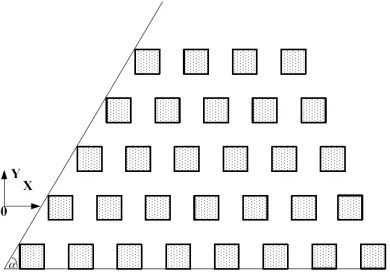
Next we consider the trapeziform periodic structure. As illustrated in Fig. 13, one of the bottom angle of the parallelogram,
α, is equal to 45 degree, and the gap between two unit cells is 1λ. The number of the cells along the x direction in the lower edge is
(a) (b)
(c)
Figure 6. Dummy cells for different types of ISED basis functions in the triangular periodic structure.
Figure 7. Small problem containing all kinds of ISED basis functions in the par-allelogrammic periodic struc-ture.
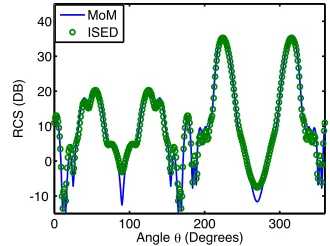
Hence the total number of cells isNC = (4+8)×5/2 = 30, and the total number of unknowns in the conventional MoM isN =NC×M = 1950. The RCSs computed by the conventional MoM and the ISED basis function method under the normal and oblique incidences of plane waves at θi = 45 degrees are shown in Figs. 14 and 15, respectively.
Figure 9. Small problem con-taining all kinds of ISED basis functions in the triangular pe-riodic structure.
Figure 10. Parallelogrammic peri-odic structure where the square PEC patch element has a size of λ× λ, the gap between two cells is equal 1λ, and α = 45◦, Nx = 6, Ny = 6, NC =
Nx×Ny = 36.
0 100 200 300
-10 0 10 20 30 40 50
Angle (Degrees)
RCS (DB)
MoM ISED
θ
Figure 11. Radar cross-sections of the parallelogrammic periodic structure shown in Fig. 10 under the normal incidence of plane waves.
0 100 200 300
-10 0 10 20 30 40 50
Angle (Degrees)
RCS (DB)
MoM ISED
θ
We clearly see that the numerical results from MoM and ISED method have a good agreement. However, the CPU time has been reduced from 92 seconds to 24.3 seconds.
Figure 13. Trapeziform periodic structure where the square PEC patch element has a size ofλ×λ, the gap between two cells is equal 1λ, andα= 60◦,Nxl= 8,Nxu= 4,Ny = 5,NC = (Nxl+Nxu)Ny/2 = 30.
0 100 200 300
0 10 20 30 40 50 60
Angle (Degrees)
RCS (DB)
MoM ISED
θ
Figure 14. Radar cross-sections of the trapeziform periodic struc-ture shown in Fig. 13 under the normal incidence of plane waves.
0 100 200 300
-10 0 10 20 30 40 50
Angle (Degrees)
RCS (DB)
MoM ISED
θ
Figure 15. Radar cross-sections of the trapeziform periodic struc-ture shown in Fig. 13 under the oblique incidence of plane waves (θi = 45◦).
At last we consider a trapeziform periodic structure consisting of
ISED basis function method, however, only two smaller problems are involved, where the first problem contains 10M = 650 unknowns to solve the ISED basis functions, and the second problem contains 21 unknowns to obtain the current distributions on all patches. The RCSs computed by the conventional MoM and ISED basis function method under the normal and oblique incidences of plane waves are shown in Figs. 17 and 18. The CPU time has been reduced from 93 seconds
Figure 16. Triangular periodic structure where the square PEC patch element has a size ofλ×λ, the gap between two cells is equal 1λ, and
α= 60◦,Nx= 6, Ny = 6,NC = (Nx+ 1)Ny/2 = 21.
0 100 200 300
-10 0 10 20 30 40
Angle (Degrees)
RCS (DB)
MoM ISED
θ
Figure 17. Radar cross-sections of the triangular periodic struc-ture shown in Fig. 16 under the normal incidence of plane waves.
0 100 200 300
-10 0 10 20 30 40
Angle (Degrees)
RCS (DB)
MoM ISED
θ
to 12.2 seconds. Hence the accuracy and efficiency of the ISED basis function method have been validated.
5. CONCLUSIONS
In this paper, we have applied the ISED basis function method to analyze irrectangular periodic structures with finite sizes. Using the ISED basis function, the original problem can be divided into two small problems, which makes a great reduction of unknown numbers. Numerical examples have verified the validity and efficiency. If we combine the ISED basis functions with fast algorithms such as FMM and the conjugate-gradient fast Fourier transform, both computational complexity and memory requirement can be further reduced.
ACKNOWLEDGMENT
This work was supported in part by the National Natural Science Foundation of China under Grants 60601002, 60496317, and 60621002, and in part by the National Basic Research Program (973) of China under Grant 2004CB719802.
REFERENCES
1. Eldek, A. A., A. Z. Elsherbeni, and C. E. Smith, “Rectangular slot antenna with patch stub for ultra wideband application and phased array systems,” Progress In Electromagnetics Research, PIER 53, 227–237, 2005.
2. Toyama, H. and K. Yasumoto, “Electromagnetic scattering from periodic arrays of composite circular cylinder with internal cylindrical scatterers,” Progress In Electromagnetics Research, PIER 52, 321–333, 2005.
3. Qing, A., “Vector spectral-domain method for the analysis of frequency selective surfaces,” Progress In Electromagnetics Research, PIER 65, 201–232, 2006.
4. Yousefzadeh, N., C. Ghobadi, and M. Kamyab, “Consideration of mutual coupling in a microstrip patch array using fractal elements,” Progress In Electromagnetics Research, PIER 66, 41– 49, 2006.
6. Pirhadi, A., M. Hakkak, and F. Keshmiri, “Bandwidth enhance-ment of the probe fed microstrip antenna using frequency selec-tive surface as electromagnetic bandgap superstrate,”Progress In Electromagnetics Research, PIER 61, 215–230, 2006.
7. Ran, L., J. Huangfu, H. Chen, X. M. Zhang, K. Cheng, T. M. Grzegorczyk, and J. A. Kong, “Experimental study on several left-handed matamaterials,” Progress In Electromagnetics Research, PIER 51, 249–279, 2005.
8. Yao, H. Y., L. W. Li, Q. Wu, and J. A. Kong, “Macroscopic per-formance analysis of metamaterials synthesized from microscopic 2-D isotropic cross split-ring resonator array,” Progress In Elec-tromagnetics Research, PIER 51, 197–217, 2005.
9. Du, P., B.-Z. Wang, H. Li, and G. Zheng, “Scattering analysis of large-scale periodic structures using the sub-entire domain basis function method and characteristic fucntion method,”J. of Electromagn. Waves and Appl., Vol. 21, No. 14, 2085–2094, 2007. 10. Lu, W. B. and T. J. Cui, “Efficient method for full-wave analysis of large-scale finite-sized periodic structure,” Journal of Electromagnetic Waves and Applications, Vol. 21, No. 14, 2157– 2168, 2007.
11. Li, D., Y. J. Xie, P. Wang, and R. Yang, “Applications of split-ring resonances on multi-band frequency selective surfaces,”J. of Electromagn. Waves and Appl., Vol. 21, No. 11, 1551–1563, 2007. 12. Rao, S. M., D. R. Wilton, and A. W. Glisson, “Electromagnetic scattering by surfaces of arbitrary shape,”IEEE Trans. Antennas Propagat., Vol. 30, 409–418, May 1982.
13. Rokhlin, V., “Rapid solution of integral equations of scattering theory in two dimensions,” J. Comput. Phys., Vol. 86, 414–439, February 1990.
14. Song, J. M. and W. C. Chew, “Multilevel fast multipole algorithm for solving combined field integral equations of electromagnetic scattering,”Microwave Opt. Technology Lett., Vol. 10, No. 1, 14– 19, September 1995.
15. Cui, T. J., W. C. Chew, G. Chen, and J. M. Song, “Efficient MLFMA, RPFMA and FAFFA algorithms for EM scattering by very large structures,”IEEE Trans. Antennas Propagat., Vol. 52, 759–770, March 2004.
17. Matekovits, L., G. Vecchi, G. Dassano, and M. Orefice, “Synthetic function analysis of large printed structures: The solution space sampling approach,” 2001 IEEE AP-S Int. Symp., 568–571, Boston, MA, July 2001.
18. Yeo, J. and R. Mittra, “Numerically efficient analysis of microstrip antennas using the characteristic basis function method (CBFM),” 2003 IEEE AP-S Int. Symp., Columbus, Ohio, June 2003. 19. Yeo, J., V. V. S. Prakash, and R. Mittra, “Efficient analysis of a
class of microstrip antennas using the characteristic basis fucntion method (CBFM),”Microwave Opt. Technology Lett., Vol. 39, 456– 464, December 2003.
20. Prakash, V. V. S. and R. Mittra, “Characteristic basis function method: A new technique for efficent solution of method of moments matrix equations,” Microwave Opt. Technology Lett., Vol. 36, 95–100, January 2003.
21. Lu, W. B., T. J. Cui, Z. G. Qian, X. X. Yin, and W. Hong, “Accurate analysis of large-scale periodic structures using an efficient sub-entire-domain basis function method,”IEEE Trans. Antennas Propagat., Vol. 52, No. 11, 3078–3085, November 2004. 22. Lu, W. B., T. J. Cui, X. X. Yin, Z. G. Qian, and W. Hong, “Fast algorithms for large-scale periodic structures using subentire domain basis functions,” IEEE Trans. Antennas Propagat., Vol. 53, No. 3, 1154–1162, March 2005.