Argument of knowledge of a bounded error
Vadym Fedyukovych
August 18, 2008
Abstract
A protocol is introduced to show knowledge of a codeword of Goppa code and Goppa polynomial. Protocol does not disclosure any useful information about the codeword and polynomial coefficients. A related protocol is introduced to show Hamming weight of an error is below a threshold. Protocol does not disclosure codeword and weight of the error. Verifier only uses commitments to codeword components and coefficients while testing validity of statements. Both protocols are honest verifier zero knowledge.
1
Introduction
Approximate matching over hidden data is an important practical prob-lem. In particular, it may be challenging to show validity of a statement about some data while keeping the data private. We are interested in pro-ducing verifiable statements about private data. The well-known tech-nique to produce verifiable statements is electronic signatures. However, most signatures require exact matching for data signed and signing keys.
We introduce protocols to show that values committed are a codeword of Goppa code and coefficients of Goppa polynomial, and that error weight in a damaged codeword is below a threshold.
2
Preliminaries
Letqbe a large prime,Fqbe a finite field,Fq[z]be polynomial ring over Fq. Letg(z)∈Fq[z]be a non-zero polynomial of degreeT.
A codeword of Goppa code[8] is aN-tupleB= {b1. . .bN},bj ∈Fq such that
N
∑
j=1bj
z−aj
for a setA={a1, . . .aN}of differentaj ∈Fq. Polynomialg(z)isGoppa
polynomial, andAis asupport set.
Leth,f ∈Gbe two elements of orderqsuch thatlogf(h)is not known
to Prover. Pedersen commitment [9] to a valuex∈ Fqwith an accessory
valuer∈ Fqis (multiplicative notation)
M =hxfr (2)
A variant of Schnorr protocol [10] with two responses (for x and for r) can be used to show knowledge of values committed. This commitment scheme is computationally binding and information-theoretic hiding.
Aninteractive proof system [7] for a language L is an interactive
pair of Turing machines with a wordXon common input tape such that
completenessandsoundness holds. A party ishonestif it follows the
protocol. Completeness is honest Verifier always accepts for an honest Prover and a word from language. Soundness is honest Verifier accepts for any Prover and a word not from language with only a negligible proba-bility. Aninteractive argument[3, 4] is a proof system with an additional auxiliary input tape for Prover with awitnessto language membership on it, and with soundness depending on infeasibility for a polynomial Prover to solve a hard problem. A proof system isof knowledge[1] if an extrac-toralgorithm exists that outputs the witness from Prover responses given oracle access to Prover. A proof system iszero knowledgeif asimulator algorithm exists for Verifier that outputs asimulated transcript indistin-guishable from a transcript of a protocol with a Prover for any word from language. A proof system ishonest verifier zero knowledge[2] if sim-ulated transcript is indistinguishable from all protocol transcripts having the same challenge. Protocols withbinarychallenges require repeating to achieve small probability of cheating, while protocols with challenges chosen from a set of a large cardinality achieve soundness in constant round.
We observe Prover can only produce acceptable responses of Schnorr protocol as estimates of a polynomial linear in challenge. We choose an appropriate verification polynomial to test language membership for values committed. Verification polynomial can be evaluated only using responses and challenges of Schnorr protocol.
3
A protocol to show a codeword
Consider an equation equivalent to definition of Goppa codeword (1):
N
∑
j=1bj T
∑
k=1gk
zk−akj z−aj
∏
i6=jT
∑
m=0gmami ≡0 (3)
g(z) = T
∑
k=0gkzk (4)
where{bj}are codeword components, and{gk}are coefficients of poly-nomialg(z).
We verify that (3) holds by choosing some nonzerod∈Fqat random
as a challenge, and testing that it holds forz=d.
We consider a bivariateverification polynomialproduced by substi-tuting responses of Schnorr protocol in place of codeword components and coefficients:
Γ(z,y) = N
∑
j=1(ybj+βj) T
∑
k=1(ygk+αk)
zk−akj z−aj
∏
i6=jT
∑
m=0(ygm+αm)ami
(5)
Verification polynomial is of powerN+1iny. This polynomial is of power at mostNif, and only if equation (3) holds for({bj},{gk}). We test that
Γ(d,y)can be reproduced with exactlyNcoefficients fory=cchosen as another challenge. See protocol for multiplication [6] as a background.
Common input is group description, two group elements, support set and Pedersen commitments: X = (q,h,f,{Vk},{Wj}). Auxiliary input of Prover is({gk},{θk},{bj},{φj})such that:
Vk =hgkfθk, k=0 . . .T (6)
Wj =hbjfφj, j=1 . . .N (7)
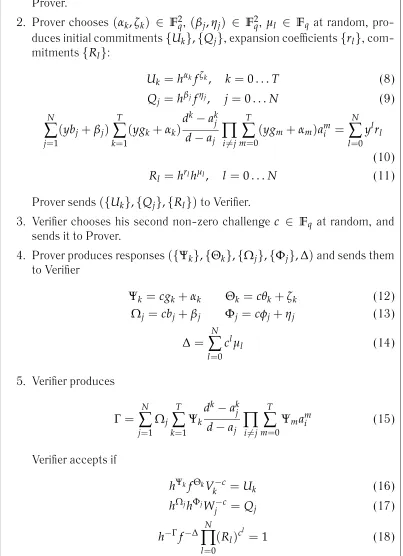
Prover shows that values committed constitute Goppa polynomial and a codeword with a protocol shown on Figure 1.
It can be shown that probability for an honest Verifier to accept for any polynomial Prover and for any data committed that do not satisfy Goppa codeword definition is at most T+qN (over choices of Verifier).
4
A protocol to show a bounded error
(S≤ T). Verifier tests thaterror verification polynomial
Γ′(y) = N
∏
j=1(ybj+βj−ywj) (19)
is of power at mostSiny. See protocol for set membership [6] as a back-ground.
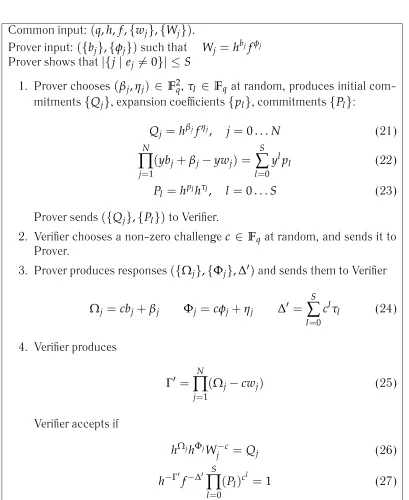
Common input is (q,h,f,{wj},{Wj}), auxiliary input of Prover is ({bj},{φj})such that equations (6, 7) hold. Prover shows that
|{j|wj−bj 6=0}| ≤S (20)
for a codeword committed with a protocol shown on Figure 2.
It can be shown that probability for an honest Verifier to accept for any polynomial Prover and an error of Hamming weight of more thanSis at most Nq (over choices of Verifier), on condition of taking logarithms is hard for Prover.
5
Properties of protocols
Consider a case that (1) does not hold for {gk},{bj} committed. Ac-cording to Schwartz-Zippel lemma, probability for a Verifier to choose some d ∈ Fqsuch that (1) holds for z = d is at most T−1
q ; verification polynomial is of power N+1otherwise. It follows−Γ(d,y) +∑lN=0ylr
l is a non-zero polynomial for any {rl}. According to Schwartz-Zippel lemma, probability for an honest Verifier to choose somec∈Fqsuch that
Γ(d,c) =∑lN=0clr
lfor any{rl}chosen by Prover is at most N+q1.
Any Prover capable of producing a pair of responses (Ψ′k,Θ′k) that pass (16) and are not estimates of linear polynomials
Ψ′k 6=Ψk(c), Ψk(y) =ygk+αk (28)
Θ′k 6=Θk(c), Θk(y) =yθk+ζk (29) is also capable to solve forlogh(g). The same holds for(Ωj,Φj)and (17). We conclude protocol introduced achieve negligible soundness error N+qT without repeating.
Consider a case with an error {ej} of more than S weight. It fol-lows −Γ′(y) +∑Sl=0ylpl is non-zero for any choice of{pl}. According to Schwartz-Zippel lemma, probability for an honest Verifier to choose somec ∈ Fqsuch thatΓ′(c) = ∑Sl=0clp
l for any{pl}chosen by Prover is at most Nq (over random coins of Verifier).
to produce two sets responses to two different challenges without choos-ing another set of initial random coins.
Consider a simulator candidate algorithm for ’codeword’ protocol. Given
challenges(c,d), Verifier chooses some field elements for responses{Ψk},{Ωj},{Θk},{Φj},∆
uniformly at random, and some group elements for Rl,l = 1 . . .N uni-formly at random. Verifier producesΓaccording to (15). Verifier produces
Uk =hΨkfΘkVk−c Qj =hΩjhΦjWj−c R0=hΓf∆ N
∏
l=1(Rl)−c
l
(30)
Simulated transcript is(d,{Uk},{Qj},{Rl},c,{Ψk},{Ωj},{Θk},{Φj},∆). It is clear that distribution of transcript components is flat and is iden-tical to that of any transcript with a Prover with the same challengesd,c. Consider a simulator candidate algorithm for ’bounded error’ proto-col. Given a challenge c, Verifier chooses some field elements for re-sponses {Ωj},{Φj},∆′ uniformly at random and some group elements for Pl,l = 1 . . .S uniformly at random. Verifier producesΓ′ according to (25). Verifier produces
Qj =hΩjhΦjWj−c P0 =h
Γ′ f∆′
S
∏
l=1(Pl)−c
l
(31)
Simulated transcript is({Qj},{Pl},c,{Ωj},{Φj},∆′).
It is clear that distribution of transcript components is flat and is iden-tical to that of any transcript with a Prover with the same challengec.
6
Discussion
Protocols introduced can be useful for watermarking.
References
[1] Mihir Bellare and Oded Goldreich. On defining proofs of knowledge.
InCRYPTO, pages 390–420, 1992.
[2] Mihir Bellare, Silvio Micali, and Rafail Ostrovsky. The (true) com-plexity of statistical zero knowledge. In STOC, pages 494–502, 1990.
[4] Gilles Brassard, Claude Cr ´epeau, and Moti Yung. Everything innp can be argued in perfect zero-knowledge in a bounded number of rounds. InICALP, pages 123–136, 1989.
[5] Ronald Cramer, Ivan Damg ˚ard, and Berry Schoenmakers. Proofs of partial knowledge and simplified design of witness hiding protocols.
InCRYPTO, pages 174–187, 1994.
[6] Vadym Fedyukovych. Proving polynomial identities (a presenta-tion in Russian). InInformation Security conference, Kiev, 2008. Presentation available.
[7] Shafi Goldwasser, Silvio Micali, and Charles Rackoff. The knowl-edge complexity of interactive proof systems. SIAM J. Comput., 18(1):186–208, 1989.
[8] F. J. MacWilliams and N. J. A. Sloane. The theory of error-correcting codes. North-Holland, 1977.
[9] Torben P. Pedersen. Non-interactive and information-theoretic se-cure verifiable secret sharing. InCRYPTO, pages 129–140, 1991.
[10] Claus-Peter Schnorr. Efficient identification and signatures for smart cards. InCRYPTO, pages 239–252, 1989.
Common input:
(
q,h, f,{
aj}
,{
Vk}
,{
Wj}
)
.Prover input:
(
{
gk}
,{
θk}
,{
bj}
,{
φj}
)
such that Vk=
hgkfθk Wj
=
hbjfφjProver shows that∑Nj=1 z−abj
j
≡
0(
mod g(
z))
for g(
z) =
∑T
k=0gkzk
1. Verifier chooses a non-zero challenged
∈
Fq at random, and sends it toProver.
2. Prover chooses
(
αk,ζk)
∈
F2q,
(
βj,ηj)
∈
F2q, µl∈
Fq at random,pro-duces initial commitments
{
Uk}
,{
Qj}
, expansion coefficients{
rl}
,com-mitments
{
Rl}
:Uk
=
hαkfζk, k=
0 . . .T (8)Qj
=
hβjfηj, j=
0 . . .N (9)N
∑
j=1
(
ybj+
βj)
T∑
k=1
(
ygk+
αk)
dk
−
ak j d−
aj∏
i6=jT
∑
m=0
(
ygm+
αm)
ami=
N∑
l=0 ylrl
(10) Rl
=
hrlhµl, l=
0 . . .N (11)Prover sends
(
{
Uk}
,{
Qj}
,{
Rl}
)
to Verifier.3. Verifier chooses his second non-zero challenge c
∈
Fq at random, andsends it to Prover.
4. Prover produces responses
(
{
Ψk}
,{
Θk}
,{
Ωj}
,{
Φj}
,∆)
and sends them to VerifierΨk
=
cgk+
αk Θk=
cθk+
ζk (12) Ωj=
cbj+
βj Φj=
cφj+
ηj (13)∆
=
N
∑
l=0
clµl (14)
5. Verifier produces
Γ
=
N
∑
j=1
Ωj
T
∑
k=1
Ψkd
k
−
ak j d−
aj∏
i6=jT
∑
m=0
Ψmami (15)
Verifier accepts if
hΨkfΘkV−c
k
=
Uk (16)hΩjhΦjW−c
j
=
Qj (17)h−Γf−∆ N
∏
l=0
(
Rl)
cl=
1 (18)Common input:
(
q,h, f,{
wj}
,{
Wj}
)
.Prover input:
(
{
bj}
,{
φj}
)
such that Wj=
hbjfφjProver shows that
|{
j|
ej6
=
0}| ≤
S1. Prover chooses
(
βj,ηj)
∈
F2q,τl
∈
Fq at random, produces initialcom-mitments
{
Qj}
, expansion coefficients{
pl}
, commitments{
Pl}
:Qj
=
hβjfηj, j=
0 . . .N (21)N
∏
j=1
(
ybj+
βj−
ywj) =
S
∑
l=0
ylpl (22)
Pl
=
hplhτl, l=
0 . . .S (23)Prover sends
(
{
Qj}
,{
Pl}
)
to Verifier.2. Verifier chooses a non-zero challengec
∈
Fq at random, and sends it toProver.
3. Prover produces responses
(
{
Ωj}
,{
Φj}
,∆′)
and sends them to VerifierΩj
=
cbj+
βj Φj=
cφj+
ηj ∆′=
S
∑
l=0
clτl (24)
4. Verifier produces
Γ′
=
N
∏
j=1
(
Ωj−
cwj)
(25)Verifier accepts if
hΩjhΦjW−c
j
=
Qj (26)h−Γ′f−∆′ S
∏
l=0