Available Online atwww.ijcsmc.com
International Journal of Computer Science and Mobile Computing
A Monthly Journal of Computer Science and Information Technology
ISSN 2320–088X
IMPACT FACTOR: 6.199IJCSMC, Vol. 8, Issue. 6, June 2019, pg.165 – 171
Hierarchal Polynomial
Coding of Grayscale
Lossless Image Compression
1
Dr. Ghadah Al-Khafaji;
2Abdullah Abdulhussain;
3Uhood S. Al-hasani
1
Dept. of Computer Science, Baghdad University, College of Science
2
Dept. of Computer Science, Baghdad University, College of Science
1
[email protected], [email protected]
2
[email protected], 3 [email protected]
Abstract- In this paper, a hierarchical scheme and liner polynomial coding is utilizing to compress image losslessly which is based on implementing the even/odd decomposition more than once, by exploring the mixing of image information, polynomial coefficients and residual. The test results showed best performance of the hierarchal polynomial coding compared to the traditional polynomial coding.
Keywords: Hierarchal Scheme, Polynomial Coding, and Even\Odd Decomposition. I. INTRODUCTION
Data compression systems have become an increasingly intensive and important research area over the last thirty years. Currently, data compression is a vast field encompassing many approaches and techniques [1]. Image compression techniques generally fall into two categories: lossless and lossy depending on the redundancy type exploited, where lossless is also called information preserving or error free techniques, in which the image is compressed without losing information as they rearrange or reorder the image content, they are based on the utilization of statistical redundancy alone (i.e., exploits coding redundancy and/or inter pixel redundancy) such as Huffman Coding, Arithmetic Coding and Lempel-Ziv Algorithm. While lossy
removes content from the image, which degrades the compressed image quality, they are based on the utilization of psycho-visual redundancy, either solely or combined with statistical redundancy such as Vector quantizer, Fractal, and JPEG [2]. Reviews of lossless and lossy techniques can be found in [3-7]
Polynomial coding one of the modern image compression techniques remains in development, based on utilizing modelling concept of prediction and differentiation. The techniques characterized by its simplicity, symmetry of encoder and decoder and efficiency of use the coefficients and residual image [8], for more details see [9-12].
utilization of predictive coding once or multiple times to remove the rest of the redundancy embedded between the estimated coefficients that developed by Das and Lin (1996) [16].Several adaptations adopted by Ghadah (2014) [17] and Ghadah et al.,(2017) [18] to improve the predictive coding performance with extended into three layers block base, whole image coefficients base, and correlated coefficients base only, respectively. The third methodology is based on exploited the interpolation base that used by Athraa (2015) [19], to constructed an adaptive polynomial compression system of nearest neighbour interpolation techniques through shrinking/enlarging base. The results showed an improvement of the adaptive techniques in terms of compression performance with high preserving the image quality. Lastly, the forth methodology is based on utilizing the separation base that differentiated the image into two sub images, namely an even sub image and an odd sub image using the row and/or column representation, this concept adopted by a number of refreshers such as [20-24], where the efficient performance indicated.
This paper is concerned with improving the polynomial coding techniques using the hierarchal scheme to compress gray scale images losslessly efficiently, that presents the mixing of even and odd hierarchal decomposition effectively along the input image, the coefficients, the residual and the combination between them.
The rest of paper organized as follows, section 2 contains comprehensive clarification of the proposed system; the results for the proposed system and the conclusions, is given in sections 3 and 4, respectively.
II. THE PROPOSED COMPRESSION SYSTEM
The steps below illustrated the suggested system implementation in more details; Figure (1) shows the basic steps clearly:
Step 1: Load the input uncompressed image I of size N×N that corresponds to layer0 or the root of the
hierarchal representation.
Step 2: decompose I image into even odd / sub-images (Ie &Io) corresponding to the first layer hierarchal
scheme layer1
.
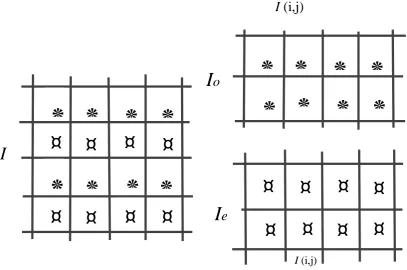
Here the separation representation of even/odd or row/column base is adopted to remove theredundancy embedded within the input image, as illustrated in Figure (2).
Step 3: Utilize the polynomial coding techniques to compress either even sub-image or odd sub-image representation corresponds to layer2, such as:
1. Partition the even sub-image Ieinto non-overlapping blocks of fixed sized n×n (i.e., 4×4, 8×8).
2. Compute the coefficients of the linear approximation model, using the equations below [8]:
1 0 1 00 (, ) (1)
1 n
i n
j
e i j
I n n a ) 2 ( ) ( ) ( ) , ( 1 0 1 0 2 1 0 1 0 1 n i n j c n i c n j e x j x j j i I a
) 3 ( ) ( ) ( ) , ( 1 0 1 0 2 1 0 1 0 2 n i n j c n i c n j e y i y i j i I a
Where Ie(i,j) is the even original sub image block of size (n×n) and
) 4 ( 2 1 yc n xc
Here the (j-xc) and (i-yc) corresponds to the variables of the polynomial that measure the distance of pixel coordinates to the block center (xc, yc). The a0 coefficients represents the block mean, the a1 and a2
coefficients represents the ratio of sum pixel multiplied by the distance from the center to the squared distance in i and j coordinates respectively[8].
3. Create the predicted image value I~e using the computed polynomial coefficients for each encoded block representation: ) 5 ( ) ( ) ( ~ 2 1
0 c c
e a a j x a i y
I
4. Find the residual or prediction error as difference between the original Ie and the predicted oneI~e.
) 6 ( ) , ( ~ ) , ( ) , (
Resi j Iei j Ie i j
Step 4: Extend the hierarchal scheme into two layers corresponding to layer3 and layer4 respectively, by
exploring the residual image(s) of the preceding layer. In other words, third layer constructed by partition the residual image into even odd / sub-images (Rese1 &Reso1), then the even sub image exploited hierarchally to
represents the fourth layer scheme (Rese2 &Reso2).
I
I
o
I
e
¤
*
*
I
(i,j)
*
*
*
*
*
*
¤ ¤ ¤ ¤
¤ ¤
¤
*
*
*
*
*
*
*
*
¤ ¤ ¤ ¤
¤
¤
¤
¤
I (i,j)
Fig.(2): Input image that decomposed into even and odd sub-images [20].
Original image Ia0 a1 a2
Layer 0
Layer 2
Layer 3
Rese1
Reso1
Fig. (1): The hierarchal polynomial scheme of the proposed system.
Res
Layer 1
Ie
Io
Layer 4 Rese2
Reso 1
III. EXPERIMENTAL RESULTS
For testing the proposed system performance; it is applied on three standard images, they are shown in figure 3 (a) ‘Lena’, 3 (b) ‘Rose’ and 3 (c) ‘Brain MRI’. Lena is characterized by a wide variety of image
details, making it a complex highly detailed image, while Rose small or less variation in image detail, having large smooth areas with low detail. Brain lies somewhere between the two. All the images are a square of the same size, 256×256, and gray of 256 gray levels (8 bits/pixel).
Fig. (3): The three tested images of size 256×256, gray scale images, (a) Lena (b) Rose and (c) Brain.
The compression ratio (CR), which is the ratio of the original image size to the compressed size, was adopted as a packing measure. Since, there is no degradation need to be evaluated in lossless compression where the decoded compressed image is identical to the original image, so the only guide here to the efficiency of proposed system is compression efficiency [15].
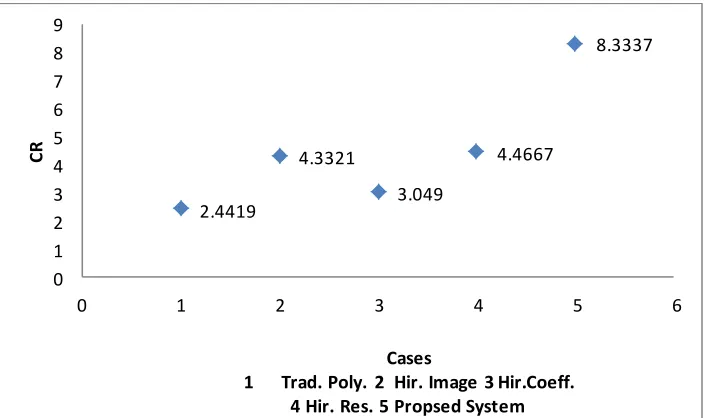
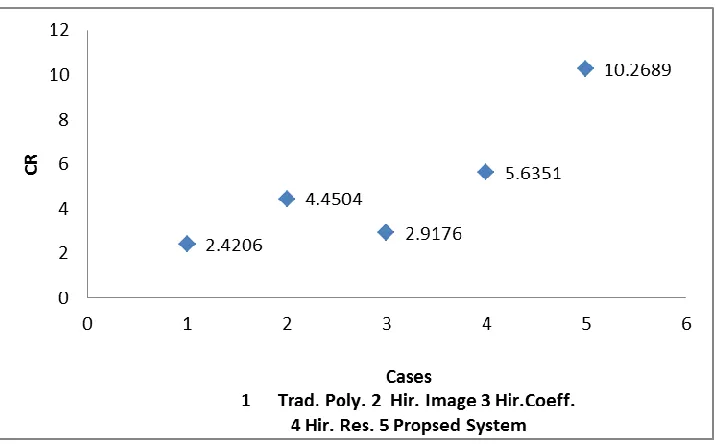
The results shown in tables (1-3) illustrate the comparison between the traditional polynomial coding and proposed hierarchal scheme of input image, polynomial coefficients, residual and the proposed system of extended layers using block sizes of 4×4. It is clear that the high performance compression ratio is attained of the proposed system due to utilization of effective hierarchal scheme of separation even/odd base compared to the traditional polynomial coding technique, due to removal of embedded redundancy efficiently.
Table (1): Comparison performance between polynomial coding and proposed techniques of Hierarchal scheme for Lena image.
Table (2): Comparison performance between polynomial coding and proposed techniques of Hierarchal scheme for Rose image.
a b
a
c b a
Tested Image
Traditional Linear Polynomial
Coding
Hierarchal scheme decomposition
input image
Hierarchal scheme decomposition
polynomial coefficients
Hierarchal scheme decomposition
on residual
Proposed
Hierarchal scheme decompositi
Lena
CR CR CR CR CR
2.1489 3.8420//even 2.5984 4.3696 7.4950 3.8460//odd
Tested Image
Traditional Linear Polynomial
Coding
Hierarchal scheme decomposition
input image
Hierarchal scheme decomposition
polynomial coefficients
Hierarchal scheme decomposition
on residual
Proposed
Hierarchal scheme decompositi
Rose CR CR CR CR CR
Table (3): Comparison performance between polynomial coding and proposed techniques of Hierarchal scheme for Brain MRI image.
Figures (4-6) summarizes the performance of the traditional polynomial coding and the proposed hierarchal scheme of the tested images.
2.1489
3.842
2.5984
4.3696
7.495
0 1 2 3 4 5 6 7 8
0 1 2 3 4 5 6
CR
Cases
1 Trad. Poly. 2 Hir. Image 3 Hir.Coeff. 4 Hir. Res. 5 Propsed System
2.4419
4.3321
3.049
4.4667
8.3337
0 1 2 3 4 5 6 7 8 9
0 1 2 3 4 5 6
CR
Cases
1 Trad. Poly. 2 Hir. Image 3 Hir.Coeff. 4 Hir. Res. 5 Propsed System
Tested Image
Traditional Linear Polynomial
Coding
Hierarchal scheme decomposition
input image
Hierarchal scheme decomposition
polynomial coefficients
Hierarchal scheme decomposition
on residual
Proposed
Hierarchal scheme decompositi
on
Brain
CR CR CR CR CR
2.4206 4.4504//even 2.9176 5.6351 10.2689 4.4655//odd
Fig. (4): Comparison between the linear polynomial coding and the proposed techniques for Lena tested image.
Obviously, the compression ratio is directly affected by the image's characteristics or details, where for highly detailed images less compression ratio archived compared to images with small and moderate details.
IV. CONCLUSIONS
The proposed hierarchal scheme exploits the even/odd separation representation of the mixed between the image, coefficients and residual to improve the performance results compared to traditional polynomial coding technique of linear base is characterized by the simplicity, with low compression results that directly affected by the symbol encoder techniques. The results clearly shows the better hierarchal performance than the traditional polynomial coding, more compression ratio achieved (i.e., four times on average) with identical image quality.
REFERENCES
1. David, S. 2007. Variable-Length Codes for Data Compression. Springer Science & Business Media. First edition.
2. Ghadah, Al-K. 2013. Image Compression based on Quadtree and Polynomial. International Journal of Computer Applications, 76(3),31-37.
3. Furht, B. 1995. A Survey of Multimedia Compression Techniques and Standards. Real-Time Imaging, 1, 49-67.
4. Singh, S. K. and Kumar, S. 2010. Mathematical Transforms and Image Compression: A Review. Maejo International Journal of Science and Technology, 4(02), 235-249.
5. Anitha, S. 2011. 2D Image Compression Technique-A Survey. International Journal of Scientific & Engineering Research, 2(7), 1-6.
6. Dhawan, S. 2011. A Review of Image Compression and Comparison of its Algorithms. International Journal on Electronics & Communication Technology (IJECT), 2(1), 22-26.
7. Vrindavanam, J., Chandran, S. and Mahanti, G. K. 2012. A Survey of Image Compression Methods. Proceedings on International Conference and Workshop on Emerging Trends in Technology 12-17. 8. Rash, AL-T. 2015. Intra Frame Compression using Adaptive Polynomial Coding. MSc. thesis, Baghdad University, Collage of Science.
9. George, L. and Sultan, B. 2011. Image Compression based on Wavelet, Polynomial and Quadtree, Journal of Applied Computer Science & Mathematics, 11(5), 15-20
10. Ghadah, Al-K. and George, L. 2013. Fast Lossless Compression of Medical Images based on Polynomial. International Journal of Computer Applications, 70(15), 28-32.
11. Ghadah, Al-K. and Hazeem, Al-K. 2014. Medical Image Compression using Wavelet Quadrants of Polynomial Prediction Coding & Bit Plane Slicing. International Journal of Advanced Research in Computer Science and Software Engineering, 4(6), 32-36.
12. Ghadah, Al-K. and Maha, A. 2016. Lossless and Lossy Polynomial Image Compression. IOSR Journal of Computer Engineering (ISO-JCE), 18(4), 56-62.
13. Burgett, S. and Das, M. 1991. Multiresolution Multiplicative Autoregressive Coding of Images. Proceedings of the IEEE International Conference on System Engineering, 276-279.
14. Burgett, S. and Das, M. 1993. Predictive Image Coding using Multiresolution Multiplicative Autoregressive Models. Proceedings of the IEEE, 140(2), 127-134.
15. Ghadah, Al-K. and Haider, Al-M. 2013. Lossless Compression of Medical Images using Multiresolution Polynomial Approximation Model. International Journal of Computer Applications, 76(3),38-42.
16. Das, M. and Lin, C. 1996. Lossless Compression of Medical Images Using Hierarchical Autoregressive Models. 9th IEEE Symposium on Computer-Based Medical Systems, 6-11.
17. Ghadah, Al-K. 2014. Hierarchal Autoregressive for Image Compression. The Proceeding of the 4th Conference of College of Education for Pure Science, Thi-Qar University, 4(1), 235-241.
18. Ghadah, Al-K., Taha, M., and Salam, A. 2017. Correlated Hierarchal Autoregressive Models Image
Compression. Diyala Journal for Pure Sciences. 13(3), 1-14.
19. Athraa, T. 2015. Adaptive Polynomial Image Compression. Diploma Dissertation, Baghdad University,
Collage of Science.
20. Ann, C. and Cinly, T. 2015. A Lossless Image Compression based on Hierarchical Prediction and Context Adaptive Coding. International Journal of Engineering Research and General Science, 3(4), 517-521.
21. Suresh Babu, P. and Sathappan, S. 2015. Efficient Lossless Image Compression using Modified
Hierarchical Prediction and Context Adaptive Coding.Indian Journal of Science and Tecnonlogy,8(34),1-6.
22. Muhammed, H. and Jaseena, T. 2015. Hierarchical Prediction for Lossless Colour Image Compression
and Transmission using OFDM. International Journal of Science and Reaseach, 4(6), 1792-1798.
23. Bhuvaneshwari, G. and Balaji, R. 2015. Lossless Color Image Compression based on RCT and Context
Adaptive Coding. International Journal of Computer Science and Mobile Computing, 4(1), 449-454.
24. Swarup, J. and Venkateswara, C. 2016. Lossless Image Compression based on Prediction and