Available Online atwww.ijcsmc.com
International Journal of Computer Science and Mobile Computing
A Monthly Journal of Computer Science and Information Technology
ISSN 2320–088X
IJCSMC, Vol. 4, Issue. 11, November 2015, pg.117 – 124
RESEARCH ARTICLE
Cloud Computing Architecture & Services
Manan D. Shah
Information Technology Department, Assistant Professor, Charusat University, Changa, India
Charusmita Dhiman
Computer Engineering Department, Assistant Professor, MBICT, New V.V.Nagar, Anand, India
Abstract— One of the most promising distributed field cloud computing has given the new face to the distributed computing. While delivering services over the internet cloud computing plays an important role. In this research paper we are going to discuss about architecture and the different services provided by the cloud computing. The three main services provided by the cloud computing are Infrastructure as a Service (IaaS), Software as a Service (SaaS) and Platform as a Service (PaaS). This paper includes more importance about Software as a service (SaaS), for efficient cloud computing in organizations and its applications. SaaS applications are service centric cloud computing delivery model used as IT Infrastructure, which is multi-tenant architecture used to provide rich user experience with desired set of features requested by the cloud user. This research paper also discusses the importance of SaaS application architecture, functionality, efficiency, advantages and disadvantages.
Keywords — Cloud Computing architecture, SaaS, PaaS, IaaS
I.INTRODUCTION
A. Motivation for research work
Figure 1 A Client having access to services provided by cloud
B. Objective of the research work
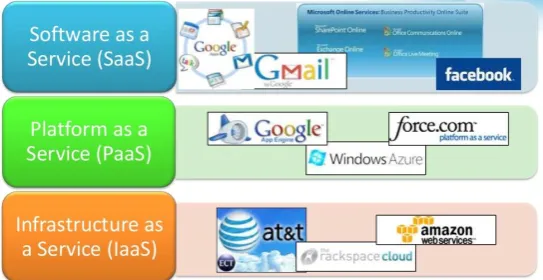
The diagram below depicts the Cloud Computing stack – it shows three distinct categories within Cloud Computing: Software as a Service, Platform as a Service and Infrastructure as a Service.
Figure 2.Services provided by cloud computing
In this report we look at all three categories in detail, however a very simplified way of differentiating these flavors of Cloud Computing is as follows:
SaaS applications are designed for end-users, delivered over the web
PaaS is the set of tools and services designed to make coding and deploying those applications quick and efficient IaaS is the hardware and software that powers it all – servers, storage, networks, operating systems
To help understand how these 3 components are related, some have used a transportation analogy:
II.BACKGROUND THEORY
One of the most on demand requirement of the 21st century computing is that users should have access to the internet over the portable devices rather than through some desktop pc. As the users won’t have powerful machines. In such case cloud computing services can be used from wide spread resources, rather than remote server or local machines. Let us make it clear the concept of cloud computing. Now suppose if I am an, End user I need an application s/w to do my job [A Computer]. As a Businessman I need an infrastructure to run my website such as server and if suppose I am a web application developer I need a perfect platform that suits me. In short we can say that (i) End user: - Application (ii) Businessman: - Infrastructure (iii) Web Developer: - Platform.
While providing such services some drawbacks took place such as up gradations, server maintenance and many such things. Thus to overcome such drawback cloud computing took place. It is nothing but a Metaform of the internet.
Thus the standard definition given for the cloud computing by NIST is that, ―cloud computing is a model for enabling convenient, on demand network access to a shared pool of configurable computing resources (e.g., network, server, storage, applications and services) that can be rapidly provisioned and released with minimal management efforts or service provider interaction‖ [9] [1]].
Thus the three main services provided by the cloud are Infrastructure as a service (IaaS), Platform as a service (PaaS) and Software as a service (SaaS).
A. Cloud computing architecture
Cloud computing consist of four different layers, each layer having their own functionalities, moreover we can able to know the services provided by the cloud computing are also mentioned in the below figure. Let us have a look to all the four layers with the help of diagram.
Figure 3 Cloud Computing Architecture [1] .
Hardware Layer
Infrastructure Layer
The basic purpose of infrastructure is to delivering basic storage and compute capabilities as standardized services over the internet. It is also known as the virtualization layer. The infrastructure layer creates cluster of storage and computing resources by partitioning the physical resources using virtualization technologies such as Xen, KVM and VMware. This layer is an essential component of cloud computing, since many key features, such as dynamic resource assignment, are only made available through virtualization technologies [1].
The services provided by this layer to the consumer is to storage, networks, and other fundamental computing resources, where different arbitrary software can be run or deploy by the consumer, which can include operating systems and applications. The underlying cloud infrastructure are not manage by the consumer but has control over operating systems, storage, and deployed applications and possibly limited control of select networking components (e.g., host firewalls). IaaS refers to on-demand provisioning of infrastructural resources, usually in terms of VMs. The cloud owner who offers IaaS is called an IaaS provider. An example of IaaS provider includes Amazon EC2, GoGrid and Flexiscale.
Platform layer
It is built on top of the infrastructure layer. It consists of operating systems and application frameworks. The main purpose of the platform layer is to minimize the burden of deploying applications directly into VM containers. For example, Google App Engine operates at the platform layer to provide API support for implementing storage, database and business logic of typical web applications.
Application layer
At the highest level of the hierarchy, the application layer consists of the actual cloud applications. Different from traditional applications, cloud applications can leverage the automatic-scaling feature to achieve better performance, availability and lower operating cost [1].
B. Types of cloud
As per the different requirements of the different users, cloud is being categorized into 3 different types of clouds they are, Private cloud, Public cloud and Hybrid cloud.
Private Cloud: - Also known as internal clouds, private clouds are designed for exclusive use by a single organization. A private cloud may be built and managed by the organization or by external providers. A private cloud offers the highest degree of control over performance, reliability and security. However, they are often criticized for being similar to traditional proprietary server farms and do not provide benefits such as no up-front capital costs. For E.g. A cloud for the private organization.
Public Cloud: - A cloud in which, service providers offer their resources as services to the general public. Public clouds offer several key benefits to service providers, including no initial capital investment on infrastructure and shifting of risks to infrastructure providers. However, public clouds lack fine-grained control over data, network and security settings, which hampers their effectiveness in many business scenarios. For E.g. A cloud for more than one organization.
Hybrid Cloud: - A hybrid cloud is a combination of public and private cloud models that tries to address the limitations of each approach. In a hybrid cloud, part of the service infrastructure runs in private clouds while the remaining part runs in public clouds. Hybrid clouds offer more flexibility than both public and private clouds.
III.STUDY OF CLOUD SERVICES
A. Services provided by the cloud computing
Figure 4. Cloud Computing Services
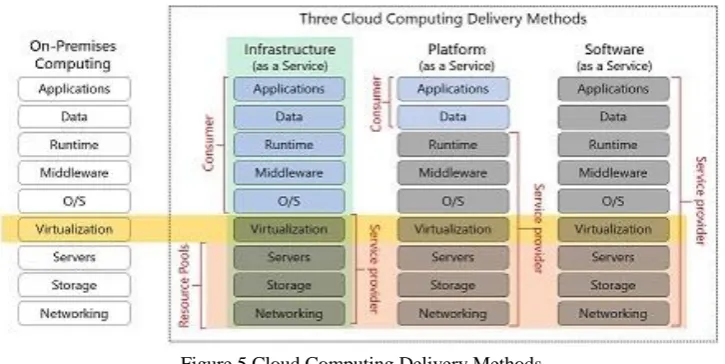
However, in practice, clouds offer services that can be grouped into three categories: software as a service (SaaS), platform as a service (PaaS), and infrastructure as a service (IaaS) [1].
Figure 5 Cloud Computing Delivery Methods
Platform as a service: - PaaS provides all the resources that are required for building applications and services completely from the Internet, without downloading or installing software [1]. Service provided by the PaaS is software design, development, testing, deployment, and hosting. Other services can be team collaboration, database integration, web service integration, data security, storage and versioning etc. PaaS refers to providing platform layer resources, including operating system support and software development frameworks. Examples of PaaS providers include Google App Engine, Microsoft Windows Azure and Force.com.
Infrastructure as a service: - It is also known as Hardware as a service (HaaS). It offers hardware as service to a organization so that it can put anything into the hardware as per the requirements of the users. HaaS allows the user to rent resources [1] as server space, network equipment, memory, CPU cycles and storage space.
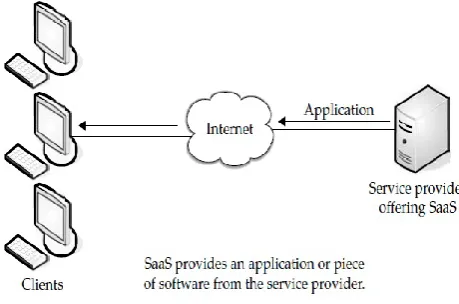
Software as a service: - It plays a role while providing services on demand over the internet. Different applications are provided by the different servers through the internet which are used as a service to the users. While using the software user has no need to make lots of changes or doesn’t require integration to other system.
IV.SOFTWARE AS A SERVICE
growth. This rapid growth indicates that SaaS will soon become commonplace within every organization and hence it is important that buyers and users of technology understand what SaaS is and where it is suitable.
Figure 6 Software as a Service (SaaS)
A. Characteristics of SaaS:-
Like other forms of Cloud Computing, it is important to ensure that solutions sold as SaaS in fact comply with generally accepted definitions of Cloud Computing. Some defining characteristics of SaaS include:
• Web access to commercial software. • Software is managed from a central location. • Software delivered in a “one to many” model.
• Users not required to handle software upgrades and patches.
• Application Programming Interfaces (APIs) allow for integration between different pieces of software.
B. Where SaaS Makes Sense
Cloud Computing generally, and SaaS in particular, is a rapidly growing method of delivering technology. That said, organizations considering a move to the Cloud will want to consider which applications they move to SaaS. As such there are particular solutions we consider prime candidate for an initial move to SaaS:
• “Vanilla” offerings where the solution is largely undifferentiated. A good example of a vanilla offering would include email where many times competitors use the same software precisely because this fundamental technology is a requirement for doing business, but does not itself confer a competitive advantage.
• Applications where there is significant interplay between the organization and the outside world. For example, email newsletter campaign software.
• Applications that have a significant need for web or mobile access. An example would be mobile sales management software. • Software that is only to be used for a short term need. An example would be collaboration software for a specific project. • Software where demand spikes significantly, for example tax or billing software used once a month.
SaaS is widely accepted to have been introduced to the business world by the Salesforce10 Customer Relationship Management (CRM) product. As one of the earliest entrants it is not surprising that CRM is the most popular SaaS application area,11 however e-mail, financial management, customer service and expense management have also gotten good uptake via SaaS [7].
C. Where SaaS May Not be the Best Option
While SaaS is a very valuable tool, there are certain situations where we believe it is not the best option for software delivery. Examples where SaaS may not be appropriate include:
• Applications where extremely fast processing of real time data is required.
• Applications where legislation or other regulation does not permit data being hosted externally. • Applications where an existing on-premise solution fulfills all of the organization’s needs.
D. Case Study: SaaS Allows Groupon to Scale Customer Service
Launched in November 2008, Groupon13 features a daily deal on the best stuff to do, see, eat and buy in more than 500 markets and 40 countries. The company has thousands of employees spread across its Chicago and Palo Alto offices, regional offices in Europe, Latin America, Asia and Africa with local account executives stationed in many cities. Groupon seeks to sell only quality products and services, be honest and direct with customers, and provide exceptional customer service.
“Within a few months of our founding, our customer base exploded,” says Joe Harrow, Director of Customer Service, Groupon. “At first, I was spending 10 percent of my time responding to customer requests. It gradually became a job for several agents. We realized we simply couldn’t go on without a real ticketing solution.”
Convinced that Groupon’s rapid growth would continue, Harrow researched several enterprise-level support solutions. But he didn’t find a good fit.
“The enterprise-level solutions seemed complicated and difficult to set up,” Harrow recalls. “They would have increased our efficiency, but at the cost of hampering the customer experience”. Harrow then searched the web for online support software and found Zendesk. After a quick evaluation of Zendesk, Harrow knew he had the right solution.
“Right off the bat, Zendesk was intuitive to use,” Harrow says. “It seemed more powerful and robust than other online support solutions, and it had been rated very highly in reviews we’d read. Plus, we knew that because it was a web-based solution, it could easily scale to support our increasing volume.”
Groupon now employs more than 150 customer support agents, who handle nearly 15,000 tickets per day. Zendesk’s macros, which are predefined answers to FAQs, are Groupon’s favorite Zendesk feature. These macros help Groupon train its agents to deliver one of the company’s customer service hallmarks: one-touch resolution.
Groupon has also found it easy to integrate Zendesk with other solutions. By integrating Zendesk with GoodData, Groupon has extended and enhanced its reporting – going well beyond the limits of its old spreadsheets. As an example of the sort of scalability that SaaS brings, Groupon recently processed its millionth customer ticket.[7].
V.CHALLENGES
A. challenge that software vendors need to solve for sustainable growth in the SaaS market
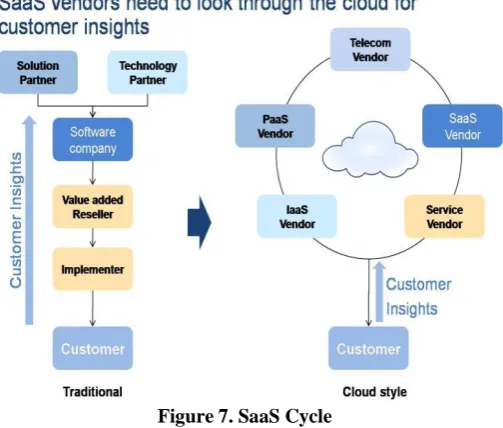
Maintaining and increasing customer insights.
SaaS vendors must collect customer insights for innovation and compliance.
As per the survey carried out by author " Holger Kisker" the end of last year, about 30% of companies from our Forrsights Software Survey, 2011 were using some software-as-a-service (SaaS) solution; that number will grow to 45% by the end of 2012 and 60% by the end of 2013. The public cloud market for SaaS is the biggest and fastest-growing of all of the cloud markets ($33 billion in 2012, growing to $78 billion by the end of 2015).
Figure 7. SaaS Cycle
competition. This is no easy task, however. Implementing a cloud strategy involves a lot of changes for a software company in terms of products, processes, and people.
A successful SaaS strategy requires an open architecture (note: multitenancy is not a prerequisite for a SaaS solution from a definition point of view but is highly recommended for vendors for better scale) and a flexible business model that includes the appropriate sales incentive structure that will bring the momentum to the street.
VI.CONCLUSION
As the main purpose of cloud computing is to provide services to the client on demand. Cloud computing is a general term which provides a variety of services from Infrastructure as a service at the base, through Platform as a Service as a development tool, through Software as a Service providing licenses an application to customers either as a service on demand, through a subscription, in a “pay-as-you-go” model, or (increasingly) at no charge when there is opportunity to generate revenue from streams other than the user, such as from advertisement or user list sales. It’s more important to understand the concept of cloud computing for the organizations, and select an appropriate service provider as per their requirement.
REFERENCES
[1] Zhang, Q., Cheng, L., & Boutaba, R. (2010). Cloud computing: state-of-the-art and research challenges. Journal of Internet Services and
Applications, 1(1), 7–18. doi:10.1007/s13174-010-0007-6
[2] Marios D. Dikaiakos and George Pallis (University of Cyprus), Dimitrios Katsaros (University of Thessaly), Pankaj Mehra
(Hewlett-Packard Labs) and Athena Vakali (Aristotle University of Thessaloniki),Cloud Computing Distributed Internet Computing for IT and Scientific Research.
[3] Armbrust, M., Fox, A., Griffith, R., Joseph, A. D., Katz, R., Konwinski, A., Lee, G., et al. (2009). Above the Clouds : A Berkeley View of
Cloud Computing Cloud Computing : An Old Idea Whose Time Has ( Finally ) Come, 7–13.
[4] Xu, Y., Wu, L., Guo, L., & Chen, Z. (2011). An Intelligent Load Balancing Algorithm Towards Efficient Cloud Computing, 27–32.
[5] Mr.M.D.Shah, Mr.D.L.Agrawal, Mr.A.Kariyani, Allocation Of Virtual Machines In Cloud Computing Using Load Balancing Algorithm,
(IJCSITS), ISSN: 2249-9555 Vol. 3, No.1, February 2013
[6] Manan D.Shah, Harshad B.Prajapati, “Reallocation and Allocation of Virtual machines in cloud computing”, arxiv preprint arxiv:
1304.3978, 2013.
[7] Understanding the Cloud Computing Stack: PaaS, SaaS, IaaS 3 © Diversity Limited, 2011 Non-commercial reuse with attribution
permitted
[8] Calheiros, R. N., Ranjan, R., Rose, C. A. F. De, & Buyya, R. (n.d.). CloudSim : A Novel Framework for Modeling and Simulation of
Cloud Computing Infrastructures and Services, 1–9.
[9] Mell, P., Grance, T., & Grance, T. (n.d.). The NIST Definition of Cloud Computing Recommendations of the National Institute of
Standards and Technology
[10]Tsai, W.-T., Sun, X., & Balasooriya, J. (2010). Service-Oriented Cloud Computing Architecture. 2010 Seventh International Conference
on Information Technology: New Generations, 684–689. doi:10.1109/ITNG.2010.214
![Figure 3 Cloud Computing Architecture [1] .](https://thumb-us.123doks.com/thumbv2/123dok_us/1937365.1254574/3.595.114.485.338.578/figure-cloud-computing-architecture.webp)