Western University Western University
Scholarship@Western
Scholarship@Western
Electronic Thesis and Dissertation Repository
11-30-2018 2:00 PM
Propane Oxidative Dehydrogenation Under Oxygen-free
Propane Oxidative Dehydrogenation Under Oxygen-free
Conditions Using Novel Fluidizable Catalysts: Reactivity, Kinetic
Conditions Using Novel Fluidizable Catalysts: Reactivity, Kinetic
Modeling and Simulation Study
Modeling and Simulation Study
Samira Rostom
The University of Western Ontario
Supervisor Hugo I. de Lasa
The University of Western Ontario
Graduate Program in Chemical and Biochemical Engineering
A thesis submitted in partial fulfillment of the requirements for the degree in Doctor of Philosophy
© Samira Rostom 2018
Follow this and additional works at: https://ir.lib.uwo.ca/etd
Part of the Catalysis and Reaction Engineering Commons
Recommended Citation Recommended Citation
Rostom, Samira, "Propane Oxidative Dehydrogenation Under Oxygen-free Conditions Using Novel Fluidizable Catalysts: Reactivity, Kinetic Modeling and Simulation Study" (2018). Electronic Thesis and Dissertation Repository. 5875.
https://ir.lib.uwo.ca/etd/5875
This Dissertation/Thesis is brought to you for free and open access by Scholarship@Western. It has been accepted for inclusion in Electronic Thesis and Dissertation Repository by an authorized administrator of
ii
Abstract
Propane oxidative dehydrogenation (PODH) was studied using VOx/γAl2O3 and VOx/ZrO2-γAl2O3 (1:1 wt. %) catalysts, as well as consecutive propane injections under oxygen-free conditions. These catalysts were synthesized with 2.5, 5 and 7.5 wt. % vanadium loadings, and prepared using a wet saturation impregnation technique. Different characterization techniques were used to establish catalyst properties including NH3-TPD, pyridine FTIR and NH3-TPD kinetics. As well, PODH runs in the CREC Riser Simulator were developed under oxygen free atmospheres at 500-550°C, close to 1 atm., 10-20 s and 44.0 catalyst/propane weight ratio (g/g). Propylene selectivity obtained were up to 94%, at 25% propane conversion.
Using this data, a “parallel-series” model was established based on a Langmuir-Hinshelwood rate equation. Adsorption constants were defined independently, with this leading to a 6-independent intrinsic kinetic parameter model. These parameters were calculated via numerical regression with reduced spans, for the 95% confidence interval and low cross-correlation coefficients. A larger 2.82×10⁻⁵ mol.gcat-1s-1 frequency factor for propylene formation versus the 1.65×10⁻⁶ mol.gcat-1s -1 frequency factorfor propane combustion was obtained. The calculated energies of activation (55.7 kJ/mole for propylene formation and 33.3 kJ/mole for propane combustion) appeared to moderate this effect, with the influence of frequency factors prevailing. Furthermore, propylene conversion in COx oxidation appeared as a non-favoured reaction step, given the 98.5 kJ/mole activation energy and 4.80×10⁻⁶ mol.gcat-1s-1 frequency factor.
iii
iv
Dedication
This dissertation is dedicated to:
My Father (Md. Rostom Ali)
And
My Mother (Shaheen Afroz)
v
Acknowledgements
I would like to thank to the Almighty Allah who has blessed me and gave me the opportunity, strength, courage and patience to finish my PhD.
I owe much gratitude to my supervisor Dr. Hugo de Lasa who gave me this opportunity to join his group and work on an interesting project. His knowledge, experiences, guidance and encouraging discussions made this study successful.
I gratefully acknowledge the contribution of the Natural Sciences and Engineering Research Council of Canada who supported this research financially. Also my thanks go to Florencia de Lasa for helping me in the editing of the final version of my all publications.
My appreciations go to my colleagues at CREC, for their inspirations during my hard time. My sincere gratitude goes to Jose Munoz and Pastor Solano from CREC Lab, for their valuable technical support. I am especially thankful and indebted to Imtiaz Ahmed, my husband and also my colleague, who was always with me and provided support through fruitful technical discussion. His love, patience, understanding and care allowed me to finish this journey smoothly.
vi
Table of Contents
Abstract ... ii
Acknowledgements ... v
List of Figures ... x
List of Tables ... xiii
Nomenclatures ... xiv
Chapter 1: Introduction ... 1
1.1 Propylene Demand ... 1
1.2 Traditional Processes for Propylene Productions ... 1
1.3 Oxidative Dehydrogenation (ODH) Process ... 2
1.3.1 ODH with Molecular Oxygen ... 2
1.3.2 ODH with Mild Oxidants... 3
1.3.3 ODH with Catalyst’s Lattice Oxygen ... 4
Chapter 2: Literature Review on Propane Oxidative Dehydrogenation under Gas Phase Oxygen-free Conditions ... 5
2.1 Thermodynamics Study ... 5
2.2 Vanadium-Based Catalyst Development for Propane ODH ... 9
2.2.1 VOx Surface Coverage ... 10
2.2.2 Active Lattice Oxygen Species ... 11
2.2.3 Effect of Support (Acid/Base Properties) ... 11
2.2.4 Red-Ox Properties of Supported VOx Catalysts ... 12
2.2.5 Vanadium-based Propane ODH Catalysts under Oxygen-free Atmosphere ... 13
2.3 Kinetics and Reaction Mechanisms of Propane ODH over Vanadium-based Catalysts ... 14
2.4 Reactor Concepts for ODH ... 16
vii
2.4.2 Twin Circulating Fluidized-bed Reactors for PODH ... 17
2.4.3 Circulating Fluidized-bed Reactors Models for PODH ... 17
2.4.4 Experimental Laboratory Reactor for PODH ... 18
2.5 PODH Industrial Prospects ... 19
2.6 Computational Particle Fluid Dynamic Study for Propane ODH Process ... 20
2.7 Conclusions ... 22
Chapter 3: Scope of Research ... 24
3.1 Objectives ... 24
3.2 Accomplishments of Research Objectives... 25
Chapter 4: Experimental Methods and Apparatus ... 26
4.1 Catalysts Preparation ... 26
4.2 Catalyst Characterizations ... 27
4.2.1 Brunauer−Emmett−Teller (BET) Surface Area ... 27
4.2.2 X-ray Diffraction (XRD) ... 27
4.2.3 Temperature-Programmed Reduction (TPR) ... 27
4.2.4 Temperature-Programmed Desorption of Ammonia (NH3-TPD) ... 27
4.2.5 Pyridine Fourier Transform Infrared Spectroscopy (FTIR) ... 28
4.2.6 Laser Raman Spectroscopy (LRS) ... 28
4.2.7 X-ray Photoelectron Spectroscopy (XPS) ... 28
4.3 PODH Catalytic Test ... 29
4.3.1 Experimental Apparatus... 29
4.3.2 Experimental Procedures ... 31
4.3.3 Thermal Runs ... 32
4.3.4 Analytical System ... 32
viii
4.4 Conclusions ... 33
Chapter 5: Results and Discussion of the Experiments ... 34
5.1 Catalyst Characterizations ... 34
5.1.1 BET Surface Area ... 34
5.1.2 XRD ... 37
5.1.3 H2-TPR and Degree of Reduction ... 39
5.1.4 NH3-TPD... 42
5.1.5 Pyridine FTIR ... 45
5.1.6 Laser Raman Spectroscopy ... 46
5.1.7 X-Ray Photoelectron Spectroscopy (XPS) ... 47
5.2 TPD Kinetics and Heat of Desorption ... 49
5.3 PODH in the CREC Riser Simulator ... 52
5.3.1 Thermal Runs ... 53
5.3.2 Consecutive Propane Injections in PODH Experiments ... 54
5.4 Conclusions ... 64
Chapter 6: Kinetic Modeling ... 66
6.1 Kinetic Model Development ... 67
6.2 Kinetic Modeling in the CREC Riser Simulator ... 70
6.3 Estimation of Kinetic Parameters ... 72
6.4 Conclusions ... 77
Chapter 7: CPFD Simulation of the PODH Process... 78
7.1 Catalysts Used ... 78
7.2 Computational Particle Fluid Dynamic (CPFD) Modeling ... 79
7.2.1 CPFD Model Description ... 79
ix
7.2.3 Drag Model Used ... 86
7.2.4 Chemical Reactions ... 87
7.3 Results and Discussion ... 87
7.3.1 Mesh and Discrete Time Selection and Model Validation ... 87
7.3.2 Entry and Exit Cyclones in the Downer Model ... 88
7.3.3 Radial Velocity and Solid Concentration Profiles in Downer with Entry and Exit Cyclones ... 91
7.3.4 Particle Cluster and Gas Flows and PODH in a Downer Reactor ... 94
7.3.5 Temperature Changes due to Reactions ... 97
7.3.6 Downer Simulation Results with the “Single Particle” Model ... 99
7.4 Conclusions ... 102
Chapter 8: Conclusions and Recommendations ... 103
8.1 Conclusions ... 103
8.2 Recommendations ... 105
9 Appendices ... 123
9.1 Appendix A: GC Calibration Curves ... 123
9.2 Appendix B: Conversion and Products Distribution Results... 126
9.3 Appendix C: Internal and External Mass Transfer Limitations ... 127
9.4 Appendix D: Adsorption Constant Calculation ... 130
9.5 Appendix E: Grid Discretization Analysis ... 132
9.6 Appendix F: Gas and Particle Cluster Flow in Entry and Exit Cyclones ... 133
9.7 Appendix G: Copyright/Permission from Journals ... 134
x List of Figures
Figure 1: Chemical Equilibrium Constant as a Function of Temperature for Propane ODH under
an O2-Free Atmosphere. Total pressure: 1 atmosphere. ... 8
Figure 2: (a) Isolated VO4 species on support (s); (b) Polymeric VO4 species on support (s). .... 11
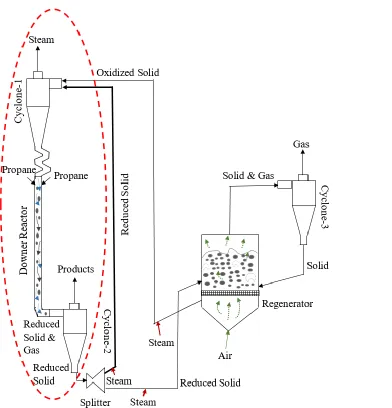
Figure 3: Schematic PODH Process Flow Sheet 59. The process components inside the red marked section are considered in the simulation study (Details in Chapter 7). ... 22
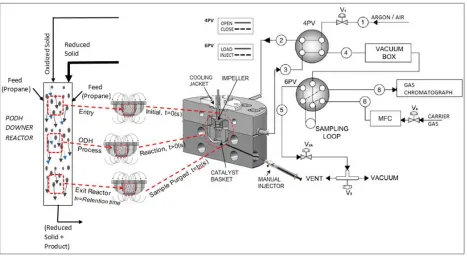
Figure 4: Schematic diagram of CREC Riser Simulator reactor system59. ... 30
Figure 5: Schematic of GC column connections. ... 32
Figure 6: N2 Adsorption-desorption isotherms for VOx/γAl2O3 catalysts. ... 34
Figure 7: N2 Adsorption-desorption isotherms for VOx/ZrO2-γAl2O3 catalysts. ... 34
Figure 8: Pore Size Distribution of the γAl2O3 Support and the VOx/γAl2O3 Catalyst Samples as determined from Nitrogen Desorption Isotherms. ... 36
Figure 9: Pore Size Distribution of the γAl2O3 and ZrO2-γAl2O3 Supports and the VOx/ZrO2 -γAl2O3 Catalyst Samples as Determined from Nitrogen Desorption Isotherms. ... 36
Figure 10: XRD patterns for the γAl2O3 and the ZrO2- γAl2O3 supports as well as those for the VOx/ZrO2-γAl2O3 catalysts with different vanadium loadings. ... 37
Figure 11: XRD patterns for the spent VOx/γAl2O3 catalysts with different vanadium loadings after 10 consecutive propane injections. ... 38
Figure 12: XRD patterns for the spent VOx/ZrO2-γAl2O3 catalysts with different vanadium loadings after 10 consecutive propane injections. ... 38
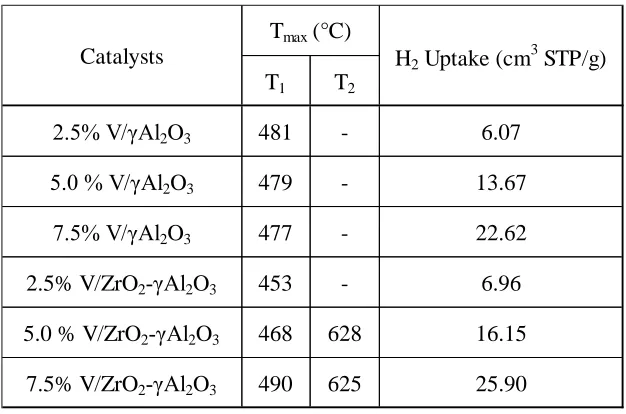
Figure 13: H2-TPR profile of calcined VOx/γAl2O3 catalyst samples for the first reduction cycle. ... 39
Figure 14: H2-TPR profile of the calcined VOx/ZrO2-γAl2O3 catalyst samples for the first reduction cycle. ... 40
Figure 15: Consecutive TPR/TPO for the 7.5%V/ZrO2-γAl2O3 Catalyst. ... 42
Figure 16: NH3-Temperature Programmed Desorption profiles for γAl2O3 and various VOx/γAl2O3 Catalyst Samples (Heating rate: 15°C/min; NH3 adsorbed at 100°C). ... 43
Figure 17: NH3-Temperature Programmed Desorption profiles for γAl2O3, ZrO2-γAl2O3 and various VOx/ZrO2-γAl2O3 Catalyst Samples (Heating rate: 15°C/min; NH3 adsorbed at 100°C). ... 43
xi
Figure 19: Dehydrated Raman Spectra for γAl2O3,7.5%V/γAl2O3, ZrO2-γAl2O3 and
7.5%V/ZrO2-γAl2O3. Note: All reported intensity data are in the same linear scale. ... 47
Figure 20: XPS Analysis of the 7.5%V/γAl2O3 Catalyst (fresh and spent catalysts). ... 48
Figure 21: XPS Analysis of the 7.5%V/ZrO2-γAl2O3 Catalyst (fresh and spent catalysts). ... 48
Figure 22: Pressure Profile in the CREC Riser Simulator for a Propane ODH Reaction. ... 53
Figure 23: Propane Conversions during consecutive ODH Cycles over Various VOx/γAl2O3 Catalysts. ... 55
Figure 24: Propylene and COx Selectivities during consecutive ODH injections using various VOx/γAl2O3 Catalysts. ... 55
Figure 25: Propane Conversion during Consecutive ODH Cycles over VOx/ZrO2-γAl2O3 Catalysts. ... 57
Figure 26: Propylene and COx Selectivities during Consecutive ODH Cycles using VOx/ZrO2 -γAl2O3 Catalysts... 57
Figure 27: Propane Conversion during 10 Consecutive PODH Cycles using a 7.5V/ZrO2-γAl2O3 Catalyst at T=500, 525 and 550ºC and Reaction Time= 20 sec. ... 61
Figure 28: Propylene and COx Selectivities during 10 Consecutive PODH Cycles using a 7.5V/ZrO2-γAl2O3 Catalyst at T=500, 525 and 550ºC and Reaction Time= 20 sec. ... 62
Figure 29: Propane Conversions Obtained with Different Reaction Times and Temperatures. Reported data are the average of 4-10 injections. ... 63
Figure 30: Propylene Selectivities Obtained with Different Reaction Times and Temperatures. Reported data are the average of 4-10 injections. ... 63
Figure 31: COx Selectivities Obtained with Different Reaction Times and Temperatures. Reported data are the average of 4-10 injections. ... 64
Figure 32: Proposed Reaction Network for Propane Oxidative Dehydrogenation using a VOx/ZrO2-γAl2O3 Catalyst in the CREC Riser Simulator. ... 66
Figure 33: Comparison between Experimental Data and Model Predictions over a 7.5V/ZrO2 -γAl2O3 Catalyst at T=500, 525 and 550ºC. ... 75
Figure 34: Overall Comparison between the Experimental Results and Model Predictions. Data points for three repeats are reported. Standard deviation on repeats is 1.5%. ... 76
xii
Figure 36: Distribution of the Number of Particles in Clusters for Ug=1.5 m/s, Gs=34 kg/m2 s 154 ... 79 Figure 37: Schematic Dimensions of the Entry Cyclone (Feeding Cyclone) of the Downer Unit. ... 82 Figure 38: Schematic Diagram of Downer Unit Showing the Boundary Conditions for CPFD Calculations and the Propane Injector. ... 84 Figure 39: Axial Fluid and Particle Cluster Velocities along the Downer Length; (A) Downer unit only and (B) Downer unit Equipped with Feeding and Terminator cyclones. ... 89 Figure 40: Average Axial Particle Cluster Volume Fraction along the Downer. (A) Downer unit only and (B) Downer equipped with entry and exit cyclones. ... 89 Figure 41: Simulated Average Pressure Profile along the Downer for a Particle Cluster Flow. (A) Downer unit only and (B) Downer equipped with entry and exit cyclones... 90 Figure 42: Average Pressure Gradient Profile along the Downer with Entry and Exit Cyclones. 90 Figure 43: (a) Radial Velocity Profile for Both Gas and Particle Clusters and (b) Radial Particle Volume Fraction Profile for Particle Clusters. ... 93 Figure 44: Propane Mass Flowrates through a Downer Bottom at Various Simulation Times. .. 94 Figure 45: Products Molar Flowrates at the Downer Bottom at Various Simulation Times. ... 95 Figure 46: Chemical Special Molar Fractions along the Downer unit. ... 96 Figure 47: Total Fluid Mass Flowrates at the Downer Reactor Top and Bottom at Various
xiii List of Tables
Table 1: Gibbs Free Energy and Enthalpy Changes for propane DH and ODH Reactions... 7 Table 2: Vanadium-based Propane ODH Catalysts under Oxygen-free Atmosphere. ... 14 Table 3: Activation Energies and Activity Decay Parameter Values for the Main Products from PODH Reported in Literature. ... 15 Table 4: BET Specific surface area, pore volume and average pore diameter for the bare γ-Al2O3 and the various prepared catalysts. ... 35 Table 5: TPR data comparing hydrogen consumption in the first reduction cycle using catalysts with varying amounts of vanadium (wt. %). All TPR analyses were repeated at least 3 times. .. 41 Table 6: Temperature Programmed Desorption of NH3 for VOx/γAl2O3 and VOx/ZrO2-γAl2O3 catalyst samples. The γ-Al2O3 and ZrO2-γAl2O3 Supports are provided as a reference. ... 44 Table 7: Acid Properties of 7.5%V/γAl2O3 and 7.5%V/ZrO2-γAl2O3 Catalyst Samples Using Pyridine FTIR. ... 46 Table 8: XPS Data of the 7.5%V/γAl2O3 and 7.5%V/ZrO2-γAl2O3 Catalysts (fresh and spent) .. 49 Table 9: Estimated Desorption Kinetic Parameters for NH3-TPD Kinetics (NH3 adsorption at 100°C). Activation energies and kdes0 are reported with the spans for the 95% confidence
intervals. ... 52 Table 10: Propane Conversions and Product Selectivities during Thermal Runs. ... 54 Table 11: Performance of the VOx/γAl2O3 catalysts after 10 consecutive cycles. ... 56 Table 12: Performance of Various VOx/ZrO2-γAl2O3 Catalysts after the 10th Consecutive Cycle. ... 58 Table 13: Carbon Content Analysis on a per Injection Basis for the 7.5% V/γAl2O3 and 7.5% V/ZrO2-γAl2O3 Catalysts. Reported coke values represent average values. ... 59 Table 14: Adsorption Parameters for Various Species. ... 73 Table 15: Intrinsic Kinetic Parameter Summary for the Proposed Kinetic Model with 95%
Confidence Intervals (CIs). ... 74 Table 16: Governing Equations for an Adapted CPFD Model Including the PODH Reaction. .. 80 Table 17: Input Parameters in the CPFD Simulation... 85 Table 18: Drag Models Used in the CPFD Simulation... 86 Table 19: Reactions, Kinetic Parameters and Thermodynamics Properties for the PODH
xiv
Table 20: Reaction Enthalpies and Chemical Species Specific Heats. ... 97
Nomenclatures
Ap Particle acceleration Cd Drag coefficient
Ci Concentration (mol/cm3) of species “i” COx Carbon Oxides
CC3H8b Propane concentration in the bulk fluid (mol/m3)
CC3H8s Propane concentration at the catalyst outer surface (mol/m3)
CWP Weisz-Prater criterion (dimensionless) DAB Diffusivity of propane in argon (m2/s)
D Turbulent mass diffusion rate which is related to viscosity D’ Diameter of the oxygen carrier particle (μm)
Deff Effective diffusivity (m2/s) Dp Drag function
Edes Activation Energy of Desorption (KJ/mol) Ei Activation energy (kJ/mol)
fp Function of the particle spatial location
F Rate of momentum exchange per unit volume between the gas and solid phase g Acceleration due to gravity
hg Gas enthalpy
kd Desorption Constant, ( cm3
gcat× min) kdes0 Pre-Exponential Factor, ( cm3
gcat× min)
ki Reaction rate constant (mol/gcat.sec)
ki0 Intrinsic kinetics constant pre-exponential factor (mol/gcat.sec) Ki Adsorption constant for component ‘i’ (atm-1)
xv mp Mass of the particle
ni Moles of gaseous carbon containing product ‘i’; npropane Moles of unconverted propane in the product stream;
NC3H80 Number of moles of propane injected (mole)
pg Gas pressure (Pa)
Pi Partial pressure of species “i” (atm)
−rC3H8obs Observed rate of the reduction reaction (mol/m2 s)
q Gas heat flux
q.D Enthalpy diffusion term
Q̇ Energy source per unit volume rdes Rate of Desorption,( cm3
gcat× min) ri Reactionrate (mol/gcat.sec) rp Particle radius
R Universal gas constant
Re Reynolds number (dimensionless)
ρOC Oxygen carrier particle density (kg/m3)
SBET Brunauer–Emmet–Teller Specific Surface area (m2/g) Sc Schmidt number (dimensionless)
Sh Sherwood number (dimensionless)
Si Selectivity of Component i (%) based on propane conversion into gas phase carbon containing products
Tm Centering Temperature which Minimizes the Cross-Correlation between Parameters (k)
t-ZrO2 Tetragonal Zirconia ug Fluid velocity (m/s) up Particle velocity (m/s)
𝐮p Local mass averaged particle velocity (m/s) Vdes Volume of ammonia desorbed (cm3/gcat)
Vm Volume of monolayer coverage (cm3/g cat)
xvi Vpore Pore Volume (cm3/g)
VOx Vanadium Oxide Surface Species V 2p3/2 XPS spectra for vanadium 2p3/2
w Weight of the oxygen carrier sample tested (g)
WC3H8r Radial flux of propane (mol/m2 s)
XC3H8 Propane Conversion (%) based on gas phase carbon containing products
YC3H6 Propylene Yield (%) based on propane conversion into gas phase carbon containing products
Greek Symbols
β Degree of Reduction of Catalyst β’ Rate of temperature increase, °C/min
δmṗ Gas mass production rate per volume
δmi,chem. Net production rate of species due to gas phase chemical reactions εg Gas volume fraction
εp Particle volume fraction
γ Cross-Correlation Coefficient in Cross-Correlation Matrix λ Decay Constant (-)
μg Fluid viscosity (Pa.s)
νi Number of carbon atoms in gaseous carbon containing product ‘i’; φ Degree of Oxidation of the Catalyst
ρg Fluid density (kg/m3) ρp Particle density (kg/m3)
θads Fraction of surface covered by adsorbed species τg Stress tensor
τp Contact normal stress
−ΔHi Heat of Adsorption (kJ/mol)
Abbreviations
xvii CPFD Computational Particle Fluid Dynamics CREC Chemical Reactor Engineering Center DH Dehydrogenation
FCC Fluid Catalytic Cracking FID Flame Ionization Detector
FTIR Fourier Transform Infrared Spectroscopy MP-PIC Multi-Phase Particle-in-Cell
LRS Laser Raman Spectroscopy
PODH Propane Oxidative Dehydrogenation PSD Particle Size Distribution
1
Chapter 1: Introduction
1.1 Propylene Demand
Propylene is one of the most important building blocks in the petrochemical industry 1–3. It is employed industrially to produce polypropylene, which is used extensively for packaging and labeling, textile products, laboratory equipment, loudspeakers and automotive components. Propylene is also used for the manufacturing of acrylonitrile, propylene oxide derivatives and other substances 4,5. According to the IHS Chemical World Analysis, the current global propylene demand is the range of 90 million metric tons (MMT) per year. It is estimated this demand will rise up to 130 MMT per year by 2023. 6,7
1.2 Traditional Processes for Propylene Productions
The traditional olefin processes involve steam cracking, fluid catalytic cracking (FCC) and catalytic dehydrogenation (CDH) 1,3,8–10. Typical feedstocks for the steam cracking are ethane, LPG (light petroleum gas) and naphtha. These olefin production processes include homogeneous reactions where the hydrocarbon species are steam cracked into smaller olefins3. For FCC, commonly used feedstocks are vacuum gas oil, residues and de-asphalted oil, which are converted into light and higher value products such as gasoline. Cracking processes are endothermic, consume large amounts of heat and require adequate designs to be operated at high temperatures.9 As well, significant undesirable amounts of coke are formed, imposing severe operating constraints with frequent plant shutdown 1,10,11.
2
reactor design employed, and the selected operating conditions. These processes include a dehydrogenation section and a catalyst regeneration section 18,19. CDH display however, similar constrains such as steam cracking and FCC do, with these being: a) involve endothermic reactions and b) require operating temperatures in the 450-700°C range. At these high temperatures, cracking and coking can occur, limiting the use of potentially valuable catalysts such as Cr2O3/Al2O3 and Pt/Sn/Al2O3. Due to these issues, and given that in catalytic cracking (FCC), olefins are by-products only, existing processes are insufficient to satisfy increasing olefin market demands. 8,14
1.3 Oxidative Dehydrogenation (ODH) Process
1.3.1 ODH with Molecular Oxygen
Thus and to alleviate the issues associated with the dehydrogenation process, oxygen can be added to the reaction medium, promoting ODH (oxidative dehydrogenation)2. As a result the reaction becomes exothermic and irreversible reaction overcoming the thermodynamic limitations of dehydrogenation (DH) 5,8,20,21. Here, water is formed as a stable product. ODH displays large and positive equilibrium constants, with these equilibrium constants decreasing at higher temperatures. Furthermore, the presence of oxygen limits coking and therefore extends catalyst usage. It is in fact at the 650C thermal level where ODH provides an opportunity versus thermal or the non-oxidative catalytic dehydrogenation (CDH)9.
3
Other than COx formation, a comparatively important product in ODH is H2 20,34. Non-oxidative dehydrogenation becomes thermodynamically favored at 650°C and above, with hydrogen formation yielding coke and free radicals 34,35. In this respect, when O2 is near depletion, non-oxidative processes dominate ODH, with the CO2 and H2O formed also being consumed. These conditions enhance the overall H2 yields observed 36.
Regarding the contribution of homogeneous gas phase reactions to the ODH of light alkanes, it has been shown that they can play a significant role above 600°C 15,20,36–38. Thus, the heterogeneous and homogeneous ODH reactions may be highly coupled at such conditions. Furthermore, it has also been suggested that, catalytic surface reactions may also contribute to accelerating ignition, supplying heat to the gas phase propylene formation. Reactions are initiated at the catalyst surface via C−H bond splitting with the formation of radicals. These radicals may subsequently undergo homogeneous gas phase reactions39.
The oxidative dehydrogenation of light alkanes does not have many of the disadvantages of the endothermic pyrolytic processing of hydrocarbons with high energy consumption, coking and the formation of a considerable amount of by-products 2. Major challenges in its implementation at the pilot and demonstration scale remain however, the following: i) removal of the heat of reaction, ii) control of consecutive oxidation reactions leading to the formation of undesired by-products 29,40,41, iii) keeping paraffins and oxygen mixtures under explosive limits, preventing reaction run-aways 2,42.
1.3.2 ODH with Mild Oxidants
While gas phase molecular oxygen may oxidize the deposited carbon on the catalyst surface, it also decreases olefin selectivity via deep oxidation to COx. As a result, and due to these various issues, alternative processes converting paraffins more efficiently in the absence of gaseous oxygen are highly desirable 13. To avoid total oxidation of alkanes, the use of mild oxidants have also been proposed 43–48.
Among all the mild oxidants recently studied, carbon dioxide (CO2) has been used as a soft oxidant for the ODH of various alkanes (ethane, propane) 15,30,44,49,50, ethylbenzene51 and methane coupling for ethene production 44. CO
4
reaction52 and due to its role as a chemical species diluent. Furthermore, it offers high equilibrium conversion conditions, improving olefin selectivity, reducing coke formation and maintaining longer catalyst life. Such a strategy for the utilization of CO2 for commercial purposes is attractive and promising, as CO2 can be used for the synthesis of valuable products rather than releasing it into the atmosphere 44,53.
However, the use of CO2 suffers from its inherent inertness 30. It is anticipated that the application of a suitable catalyst instead could help to overcome the unfavorable thermodynamics and kinetic barrier of CO2 activation. In this respect, the foremost challenging aspect of CO2 utilization is the activation of a CO2 molecule with a Gibbs Energy of Formation of -394.4 kJ/mole 30. Furthermore, a kinetic barrier also plays a key role due to its inertness. Therefore, it is anticipated that the interaction of the CO2 with a metal complex in a homogeneous reactor or with a solid surface in a heterogeneous reaction may help to overcome the kinetic barrier. In spite of these findings, even mild oxidants are proposed to replace gaseous oxygen, as they still lead to a significant deep oxidation of alkanes.
1.3.3 ODH with Catalyst’s Lattice Oxygen
Several researchers 3,9,10,12,54–59 have studied ethane and propane ODH. These researchers 12,59–63 have investigated light alkane ODH under an oxygen-free atmosphere with the source of oxygen being the catalyst lattice oxygen only. Catalyst lattice oxygen instead of gas phase molecular oxygen or other mild oxidants prevents deep oxidation, limiting COx. This process can lead in principle to higher olefin selectivity.
5
Chapter 2: Literature Review on Propane Oxidative Dehydrogenation under
Gas Phase Oxygen-free Conditions
2.1 Thermodynamics Study
At chemical equilibrium, a reacting system achieves a condition where the total Gibbs Free Energy is minimized 69. To assess chemical equilibrium, stoichiometric approach is the one considered for PODH. The “stoichiometric” approach requires a defined stoichiometry involving all reactants and products with their molecular formulae70,71.
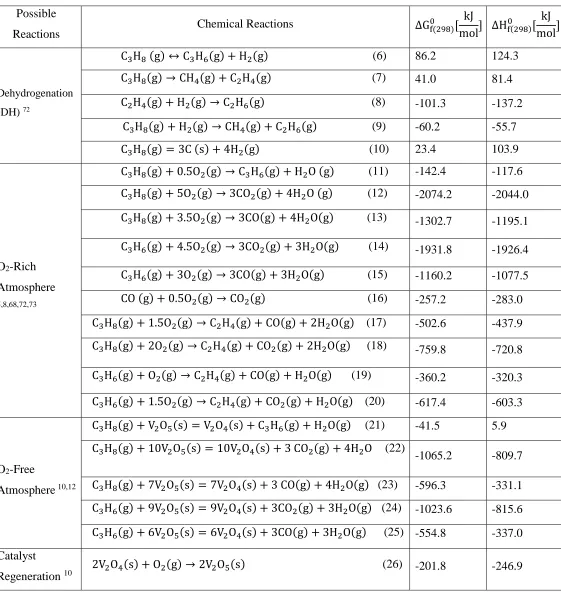
One can notice in this respect that, if the PODH with gaseous oxygen, Equation (11) of Table 1 is the reaction driving the ODH, the equilibrium constant can be calculated as:
Kr= [C3H6][H2O] [C3H8][O2]
1 2
(1)
where, [C3H6], [H2O], [C3H8] and [O2] represent thermodynamic activities of the gaseous products and reactants. At high temperatures and low pressure conditions however, the activities of gaseous reactants/products can be considered as equivalent to their partial pressures. Therefore, the equilibrium constant Kr can be expressed as:
Kr= [PC3H6][PH2O] [PC3H8][PO2]
1 2
(2)
The partial pressures can further be expressed in terms of total pressure P and the gases mole fractions as:
Kr= [yC3H6][yH2O] [yC3H8][yO2]12
P(1+1−1−0.5) (3)
Kr= [yC3H6][yH2O] [yC3H8][yO2]
1 2
P0.5 (4)
Therefore, for each independent reaction, one equilibrium expression can be formulated. Following the above sequence, the equilibrium constant for the PODH reaction, involving a lattice oxygen is mentioned below where the dominant equation is Equation (21) in Table 1:
6
Kr=
[yC3H6][yH2O] [yC3H8]
P (5)
As the activities of the solid reactants and products under standard conditions considered one, we can therefore ignore the solids in Equation (5).
Thus, one can notice as well that these differences in equilibrium constants not only influence the main PODH reaction, yielding propylene, but also affect all the other secondary reactions.
7
Table 1: Gibbs Free Energy and Enthalpy Changes for propane DH and ODH Reactions. Possible
Reactions Chemical Reactions ΔGf(298)
0 [ kJ
mol] ΔHf(298)
0 [ kJ
mol]
Dehydrogenation
(DH) 72
C3H8 (g) ↔ C3H6(g) + H2(g) (6) 86.2 124.3
C3H8(g) → CH4(g) + C2H4(g) (7) 41.0 81.4
C2H4(g) + H2(g) → C2H6(g) (8) -101.3 -137.2
C3H8(g) + H2(g) → CH4(g) + C2H6(g) (9) -60.2 -55.7
C3H8(g) = 3C (s) + 4H2(g) (10) 23.4 103.9
O2-Rich Atmosphere 5,8,68,72,73
C3H8(g) + 0.5O2(g) → C3H6(g) + H2O (g) (11) -142.4 -117.6
C3H8(g) + 5O2(g) → 3CO2(g) + 4H2O (g) (12) -2074.2 -2044.0
C3H8(g) + 3.5O2(g) → 3CO(g) + 4H2O(g) (13) -1302.7 -1195.1
C3H6(g) + 4.5O2(g) → 3CO2(g) + 3H2O(g) (14) -1931.8 -1926.4
C3H6(g) + 3O2(g) → 3CO(g) + 3H2O(g) (15) -1160.2 -1077.5
CO (g) + 0.5O2(g) → CO2(g) (16) -257.2 -283.0
C3H8(g) + 1.5O2(g) → C2H4(g) + CO(g) + 2H2O(g) (17) -502.6 -437.9
C3H8(g) + 2O2(g) → C2H4(g) + CO2(g) + 2H2O(g) (18) -759.8 -720.8
C3H6(g) + O2(g) → C2H4(g) + CO(g) + H2O(g) (19) -360.2 -320.3
C3H6(g) + 1.5O2(g) → C2H4(g) + CO2(g) + H2O(g) (20) -617.4 -603.3
O2-Free
Atmosphere 10,12
C3H8(g) + V2O5(s) = V2O4(s) + C3H6(g) + H2O(g) (21) -41.5 5.9
C3H8(g) + 10V2O5(s) = 10V2O4(s) + 3 CO2(g) + 4H2O (22) -1065.2 -809.7
C3H8(g) + 7V2O5(s) = 7V2O4(s) + 3 CO(g) + 4H2O(g) (23) -596.3 -331.1 C3H6(g) + 9V2O5(s) = 9V2O4(s) + 3CO2(g) + 3H2O(g) (24) -1023.6 -815.6
C3H6(g) + 6V2O5(s) = 6V2O4(s) + 3CO(g) + 3H2O(g) (25) -554.8 -337.0
Catalyst
8
The equilibrium constant Kr for each of these reactions can be related to the ΔGr, according to the following equation:
Kr= ex p [−ΔGr RT]
(27)
where, R is the universal gas constant 8.314 J/(mol K).
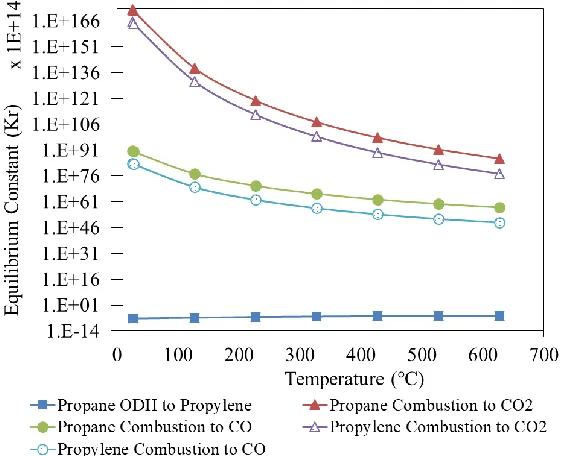
Figure 1 reports the changes of the equilibrium constants for PODH (propane ODH) under an oxygen-free atmosphere.
Figure 1: Chemical Equilibrium Constant as a Function of Temperature for Propane ODH under an O2-Free Atmosphere. Total pressure: 1 atmosphere.
One can observe from Figure 1 that, the reactions involved in the PODH under oxygen-free atmospheres are all thermodynamically favored, with equilibrium constants not being hindered by thermodynamics.
9
2.2 Vanadium-Based Catalyst Development for Propane ODH
Catalyst development for ODH reactions has focused on variety of metal oxides alone or metal oxides combined with additives (alkali metals and halides), supported on a variety of metal oxide supports. First, research studies used metal oxides as catalysts. However, supported catalysts show several advantages over the unsupported catalysts 74 given that they provide : a) better control of metal loading and metal dispersion, and b) added flexibility to adjust physicochemical properties. For example, TiO2 supported VOPO4 catalysts give higher ethylene selectivity than the unsupported VOx and (VO)2P2O7 catalysts 75. Authors 28,50 focused on the addition of promoters, that can also improve the catalyst performance. The promoters isolate the active species and form secondary metal oxides on the support surface.
Research on the catalysts of the ODH process usually fall into two operating thermal levels: above or below the temperatures at which significant gas phase reactions take place. High temperature catalysts mainly contain alkali-metal and/or alkaline-earth-metal oxides supported on transition-metal oxides, rare-earth-transition-metal oxides and other catalytic materials. Low temperature catalysts on the other hand, usually consist of reducible transition metal oxides.12,59
As alkali and alkaline earth-based catalysts contain non-reducible ions and oxides, temperatures in excess of 600°C are needed. However, higher reaction temperatures are less favorable for high olefin selectivity. Therefore, reducible transitional metal oxide catalysts are considered. This catalyst group can activate the paraffins at low temperatures. However, while catalytic activity is usually higher with this class of catalysts, lower alkene selectivities are frequently found. The oxides of these metals contain removable oxygen (lattice oxygen) which participates in the ODH reactions under oxygen-free atmosphere conditions. However, lattice oxygen is also involved in the unselective pathways of ODH, forming carbon oxides. Therefore, different catalyst groups are analyzed to find the optimum catalyst that will give high selectivity of olefins.10,12,27,54,59,76–78
10
have attracted much attention due to their higher performance, better thermal stability, and large specific surface areas.
In this respect, the stoichiometric equation for the conversion of propane ODH to propylene over vanadium-based catalysts (this reaction occurs in the downer reactor which is described later) can be represented as:
C3H8+ VOx → C3H6+ H2O + VOx−1 (28)
This reduced vanadium species is regenerated via molecular oxygen (this reaction occurs in the regenerator) following the stoichiometry described below:
VOx−1+1
2O2(air) → VOx
(29)
So, by adding (28) and (29) equations, for the complete downer and regenerator PODH process, overall reaction will be: C3H8+1
2O2(air) → C3H6 + H2O
The redox behavior of supported vanadia catalysts in ODH is generally controlled by three main factors: (i) the VOx surface structure (ii) the acid-base character of the metal and support and (iii) the redox properties of the VOx species. These three properties are influenced by the support type and vanadium loading 80,81.
2.2.1 VOx Surface Coverage
11
accepted in alkane ODH, that isolated tetrahedral VOx species (which are obtained at low vanadium loading) are more selective but less active than polymeric VOx species.
2.2.2 Active Lattice Oxygen Species
Other than the ODH catalyst structure, the variation of the binding strength of the surface lattice oxygen in the VOx surface species is a main parameter that governs activities and selectivities of alumina-supported vanadia catalysts. In extensive structural studies of supported vanadium oxide catalysts 84,89,90, three types of lattice oxygen bonds were identified (Figure 2): a) terminal V=O bonds, b) bridging V–O–V bonds, and c) V–O– support bonds. Each type of lattice oxygen has a different binding strength. The studies were aimed at determining which type is responsible for the oxidation activity which occurs in various catalytic oxidation reactions 89,91. It was determined that, the oxygen in the V-O-Support bond rather than the terminal V=O or V-O-V bonds is the one involved in this catalytic oxidation reaction.
Figure 2: (a) Isolated VO4 species on support (s); (b) Polymeric VO4 species on support (s).
2.2.3 Effect of Support (Acid/Base Properties)
Metal oxides are composed of redox metal cations and lattice oxygen anions which are Lewis acid and basic sites, respectively. The acid-base support characteristics contribute with several effects, namely on:
(a) The dispersion of the active species;
(b) The specific structure of the active species; (c) The reactant molecule activation;
(d) The rates of competitive pathways of transformation;
12
Furthermore, the support acid-base can influence the vanadium-based catalyst reactivity or selectivity 80,90–93. For instance, the interaction between the acidic V2O5 species and a basic support may be strong (e.g., MgO, La2O3, Sm2O3). This may lead to the formation of highly dispersed VOx species, which are responsible for the high selectivities to alkenes. In contrast, the interaction between the acidic V2O5 and an acidic support (e.g., SiO2, Al2O3) may be weak. This may lead to a less dispersed vanadium species, which favors formation of a less active V2O5 crystalline phase 92,94,95.
Moreover, on acidic catalysts, basic reactant adsorption and acidic product desorption are favored. This thereby protects chemical species from further oxidation to carbon oxides. For instance, higher selectivities to ethylene have been obtained using acidic based catalysts like the VOx /γ-Al2O3 catalysts. These findings were justified given that higher support acidity decreases the interaction between the ethylene product and the catalyst 55,94. In addition, dominant Brønsted acid sites was considered desirable and this to facilitate rapid olefin desorption, limiting the complete alkane oxidation to COx. Thus, catalyst acidity and acid site type have to be kept at acceptable levels and this not to interfere with overall catalytic activity and selectivity 93.
2.2.4 Red-Ox Properties of Supported VOx Catalysts
The reducibility of vanadium oxide is considered as one of the main factors influencing its activity in partial oxidation and in the ODH reactions of alkanes. There is a parallel relationship between catalyst reducibility and VOx surface structure on a given metal oxide support. In this respect, the reducibility of the surface VOx species increases with surface VOx coverage. Thus, the following trend for the reducibility of the different supported vanadia species can be considered: polymeric surface VOx > isolated surface VOx > crystalline V2O5 nanoparticles 80,93,96. Moreover, the extent of the reducibility of supported vanadium oxide catalysts is affected by the type of support used.
13
oxide supports could be related to the reducibility of the different V-O-Support bonds existing on different support types 80,94,97.
Thus, one can conclude that the catalytic activity and selectivity of the supported vanadium oxide catalysts are significantly affected by the properties of the support oxide material, the interaction of the surface VOx species with the oxide support and the vanadium loading. The redox sites are in charge of transferring the lattice oxygen to the adsorbed propane to form propylene. The acid sites catalyze the condensation of the intermediates. Therefore, to enhance the efficiency of such a process, it is necessary to investigate the synergistic effect of the redox and acidic properties of a catalyst as well as their dependence on the catalyst composition and reaction conditions.
2.2.5 Vanadium-based Propane ODH Catalysts under Oxygen-free Atmosphere
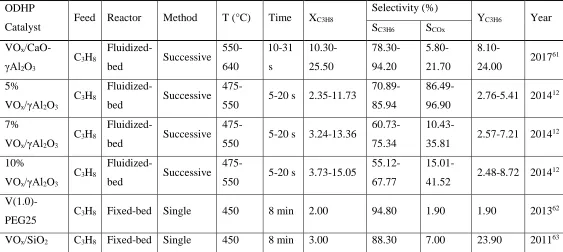
Several vanadium-based catalysts have been studied so far for PODH where the only oxygen source is the catalyst lattice oxygen. Table 2 shows literature reported reaction conditions and conversion, selectivities value from propane ODH under oxygen-free atmosphere.
Hossain et al. 61,98 developed a vanadium-based CaO-γAl2O3 support for propane ODH. They prepared CaO to γAl2O3 weight ratios of 1:4 and 1:1 and achieved best results with the 1:1 weight ratio. They performed ODH at a 550-640°C temperature range and achieved 25.5% propane conversion, 94.2% propylene selectivity and 5.8% COx selectivity at 640°C. At this high temperature, the thermal reaction has a negative impact on the ODH reaction.
Ghamdi et al. 12 reported different PODH catalysts prepared with different vanadium loadings on γAl2O3 (5, 7 and 10 wt. % V) of catalysts for propane ODH at a reaction temperature range of 475-550°C and reaction times of 5-20 sec. As γ-Al2O3 is acidic in character, re-adsorption of propylene product was assigned to methane, ethane and ethylene cracking. Therefore, the maximum selectivity of propylene that these authors achieved was 85.94% at 11.73% propane conversion. The rest of the products were COx, CH4, C2H4 and C2H6.
Fukudome et al. 62,63 incorporated VO
14
researchers found that VOx incorporated into SiO2 showed higher propylene selectivity than VOx loaded onto SiO2. This could be ascribed to the isolated VO43- species in the silica framework.
Table 2: Vanadium-based Propane ODH Catalysts under Oxygen-free Atmosphere. ODHP
Catalyst Feed Reactor Method T (°C) Time XC3H8
Selectivity (%)
YC3H6 Year SC3H6 SCOx
VOx
/CaO-γAl2O3
C3H8
Fluidized-bed Successive 550-640 10-31 s 10.30-25.50 78.30-94.20 5.80-21.70
8.10-24.00 2017 61
5%
VOx/γAl2O3
C3H8
Fluidized-bed Successive
475-550 5-20 s 2.35-11.73
70.89-85.94
86.49-96.90 2.76-5.41 2014 12
7%
VOx/γAl2O3
C3H8
Fluidized-bed Successive
475-550 5-20 s 3.24-13.36
60.73-75.34
10.43-35.81 2.57-7.21 2014 12
10%
VOx/γAl2O3
C3H8
Fluidized-bed Successive
475-550 5-20 s 3.73-15.05
55.12-67.77
15.01-41.52 2.48-8.72 2014 12
V(1.0)-PEG25 C3H8 Fixed-bed Single 450 8 min 2.00 94.80 1.90 1.90 2013 62
VOx/SiO2 C3H8 Fixed-bed Single 450 8 min 3.00 88.30 7.00 23.90 201163
2.3 Kinetics and Reaction Mechanisms of Propane ODH over Vanadium-based Catalysts
Baerns et al. reported 99 the mechanism for the initial activation of the free radicals in the alkane ODH reaction over transitional metal oxides catalysts (i.e. VOx, MoOx etc.). According to this, oxygen of the metal oxide abstracts hydrogen from the alkane. The OH groups formed are then removed from the surface by dehydration. Thus, in the formation of propylene and total oxidation products, the catalyst surface is reduced. Thus, and as a result the catalyst has to be subsequently re-oxidized by gas phase oxygen. This type of mechanism is known as ODH redox-mechanism as described by Equation (30).
CnH2n+2 MeOx
→ CnH2n+1+ MeOxH → CnH2n+ MeOx−1+ H2O
1 2O2
→ CnH2n+ MeOx+ H2O (30)
15
PODH. Mars van Krevelen method has little controversy for this kind of reaction whereas Langmuir-Hinshelwood can fit rate data better than Mars van Krevelen rate expression 107. It was hypothesized that the dominant reaction mechanism for catalytic alkanes ODH reactions is with transition metal oxides. These reaction intermediates involve the reduction of the catalyst by adsorbed alkanes, from the gas phase with the participation of the lattice oxygen and forming olefins through several possible intermediate species. Gas phase molecular oxygen can then re-oxidize the reduced catalyst surface.
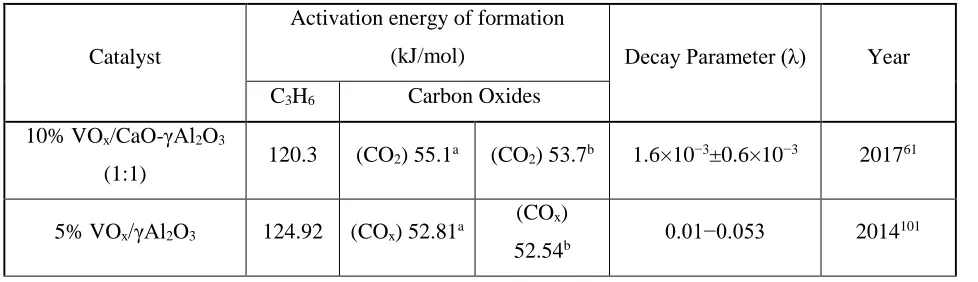
Table 3 displays literature reported activation energies value for propane ODH reactions under gas-phase oxygen-free conditions. Hossain 61 compared the kinetics of oxidative dehydrogenation (ODH) of propane to propylene over VOx/CaO and VOx/CaO-γAl2O3 catalysts in the absence of gas phase oxygen through the Langmuir−Hinshelwood mechanism. This author found that propylene formation using a VOx/CaO-γAl2O3 catalyst involves a lower activation energy (120.3 kJ/mol) than the one for the VOx/CaO (126.7 kJ/mol) catalyst. In contrast, VOx/CaO-γAl2O3 requires higher activation energies (55.2 kJ/mol) for the undesired CO2 formation and this while compared to the ones for VOx/CaO catalyst (32.8 kJ/mol). These values are consistent with the product selectivity as observed in the catalyst evaluation experiments.
Ghamdi et al. 101 reported the kinetic modeling of propane oxidative dehydrogenation (ODH) via a Mars van Krevelen mechanism. The calculated pre-exponential factors (k10, k20, and k30) increased as the vanadium loading was augmented. In addition, the activation energies for COx formation (E2 and E3) were consistently smaller than the one for propylene formation (E1).
Table 3: Activation Energies and Activity Decay Parameter Values for the Main Products from PODH Reported in Literature.
Catalyst
Activation energy of formation
(kJ/mol) Decay Parameter (λ) Year
C3H6 Carbon Oxides
10% VOx/CaO-γAl2O3
(1:1) 120.3 (CO2) 55.1
a (CO
2) 53.7b 1.6×10⁻³±0.6×10⁻³ 201761
5% VOx/γAl2O3 124.92 (COx) 52.81a
(COx)
52.54b 0.01−0.053 2014
16 7% VOx/γAl2O3 115.08 (COx) 51.07a
(COx)
52.73b 0.017-0.056 2014
101
10% VOx/γAl2O3 109.42 (COx) 45.58a
(COx)
53.75b 0.015-0.047 2014
101
a Formation from propane; b Formation from propylene.
2.4 Reactor Concepts for ODH
Adsorption and desorption during PODH reactions are governed by phases residence time, chemical species interaction with each other and with the catalyst. These matters are in turn determined by the reactor type and the operation mode. Given that PODH is an exothermic reaction, efficient heat removal from the PODH process is a major concern for the reactor operation.
2.4.1 Fixed-bed Reactors
Most of the literature studies considered fixed-bed type reactors for ODH reactions, mainly due to their simplicity 8,40,73,108–110. For instance, temperature gradients can hardly be eliminated in a traditional fixed-bed reactor unless the catalyst bed is diluted with inert particles using a large inert particles/catalyst particle ratio. This would greatly increase the fixed cost and would be a significant challenge for the economic industrial scale production of propylene based on the PODH process.
To overcome the exothermicity of ODH fixed-bed reactors, researchers analyzed multi-tubular reactors with periodic air injection 111, membrane reactors 112 and wall-cooled catalytic reactors 113. The aim is to efficiently remove the generated heat from the catalyst bed. To reduce the fixed-bed reactor cost, a micro-channel reactor was utilized 21. It is reported that the micro-channel reactor can achieve the same reactor productivity as a traditional fixed-bed reactor with less than 20% of fixed bed reactor volume. This is the case given the inherently suitable of micro-channel reactors to be used for highly exothermic reactions due to its excellent heat transfer and removal capabilities.
17
was investigated 21. This comparison was carried out to demonstrate the advantages of the micro-channel reactors for improved heat management. XRD, SEM and ICP characterization indicated that the M1-PVA catalyst plate has a high stability in the micro-channel system.
2.4.2 Twin Circulating Fluidized-bed Reactors for PODH
Due to the several shortcomings of the fixed-bed reactors, the use of circulating fluidized bed reactors and more specifically downer reactors for ODH have received much attention recently 3,60,114. Downer reactors if operated with fine particles in the 60-100 micron range, provide controlled thermal change and narrow particle and residence times, allowing ODH with high olefin selectivity 67.
In ODH, under oxygen-free atmospheres and once the surface lattice oxygen has been exhausted, the rate of water formation decreases. This occurs with a gradual increase in the formation of molecular H2, which in turn slows down the ODH reaction. Therefore, catalyst re-oxidation (regeneration) is necessary 45,61,93,108,115,116. In ODH, periodic catalyst re-oxidations are required and as a result the ODH process can be viewed as a system of twin fluidized reactors: an oxidative dehydrogenation reactor and a re-oxidation reactor 12,59,61. In these ODH systems, the gas phase oxygen is never allowed to reach the oxidative dehydrogenation unit, thus limiting the possibility of complete combustion of the propane feed and propylene product.
Thus, a remaining outstanding challenge for ODH is to have available fluidizable catalysts with high selective towards propylene formation and catalyst able to supply oxygen for dehydrogenation. Therefore, the most important characteristics of a successful ODH catalyst is their activity in the ODH reactor and their reactivity in the re-oxidation cycle. In addition the fluidizable ODH catalysts should be stable under repeated reduction/oxidation cycles, be resistant to agglomeration, be able to withstand the friction stress associated with high circulation of particles and be environmentally benign and affordable.
2.4.3 Circulating Fluidized-bed Reactors Models for PODH
18
were all factors affecting propane conversion and selectivity. The model was validated using previously published experimental data of circulating fluidized bed reactor unit.
Recently, Rostom et al. as described in Chapter 7: CPFD Simulation, reported a downer fluidized bed reactor simulation using a hybrid CPFD Barracuda which represents the catalyst particles as particle clusters. A kinetic model established using experimental data, was incorporated in the simulation. Data showed the good propane conversion and propylene selectivity prospects in an industrial scale unit.
2.4.4 Experimental Laboratory Reactor for PODH
The CREC Riser Simulator 117, is a bench-scale mini-fluidized bed reactor (50 cm3). It provides conditions equivalent to those of a twin circulating fluidized reactor process (reactor–regenerator). Promising paraffin conversions and olefin selectivities have already been demonstrated by CREC researchers by using this reactor. In the CREC Riser Simulator, VOx/c-Al2O3 78, VOx-MoOx /γ-Al2O3 3, VOx-Nb/La-γ-Al2O39, VOx/ γ-Al2O3-ZrO2 54,56,118 catalysts were used for ethane ODH. VOx/ γ-Al2O3 12 and VOx/CaO- γ-Al2O3 10,61 catalysts were used in propane ODH in the same reactor in the absence of gas phase oxygen. This reactor operates under batch conditions and is designed for catalyst evaluation and kinetic studies under fluidized bed (riser/downer) reactor conditions. One of the main advantages of this unit is its capability to simulate fluidized bed reactions conditions by using a very small amount of catalyst. Details of this reactor is discussed in Chapter 4: Experimental Methods and Apparatus.
Regarding the studies with the CREC Riser Simulator, two modes of operation can be considered: a) Single injections with catalyst regeneration in between cycles and b) Successive multiple injections without catalyst regeneration. These types of possible operation are discussed in the upcoming sections.
2.4.4.1 Single Propane Injection
19
air. Therefore, every time the catalyst is regenerated, the PODH is mainly driven by non-selective oxygen species on the catalyst surface. This could involve loosely bound lattice oxygen from the catalyst surface or weakly adsorbed oxygen species 59,61. This loosely bound lattice oxygen is considered more reactive, and thus, likely to cause carbon-carbon bond breakage and promote total oxidation. As a result, both types of oxygen species may contribute to the total oxidation of propane and lead to the low propylene selectivity. Therefore, it can be concluded that fully oxidized (fresh) catalysts are active but not selective for propane ODH reactions 12. Thus, single injections followed by catalyst re-oxidation show the value of using an optimized catalyst, where the density of the oxygen species on the catalysts surface is controlled. This is significant to achieve higher propylene selective.
2.4.4.2 Successive Propane Injection
To overcome the problem of single injection experiments where propylene selectivity is an issue, successive propane injections can be implemented. Here, the PODH catalyst is progressively reduced via the consecutive alkane injections and propylene selectivity is gradually augmented. As mentioned, there is no catalyst regeneration between the injections.
With this data and for each of the injections, the instantaneous conversion and selectivities for the main products can be calculated. Furthermore, the degree of reduction of the catalyst can be defined as the ratio of the remaining oxygen in the catalyst after each injection to the original oxygen content of the catalyst. The former can be determined by analyzing the various oxygen-containing products resulting from each alkane injection. The latter can be calculated from the oxygen uptake of the O2-chemisorption characterization technique.
In this respect, researchers reported high propylene selectivity and good propane conversion following the second and third successive injection12,59,61. This is the result given that, due to successive injections, weakly adsorbed oxygen depletes quickly. Furthermore, only the catalyst lattice oxygen drives the PODH reaction.
2.5 PODH Industrial Prospects
20
divided into two parts using a splitter. Using this device, a major portion of the catalyst is recirculated back to the PODH reactor with a smaller fraction going to the regenerator (1/10 times) to be reactivated. In this way, a partially reduced catalyst is always maintained circulating in between the systems. This reactor configuration helps to overcome the influence of combustion reactions, which increases as a result of overall propylene selectivity. It is envisioned that this industrial scale downer reactor for PODH will involve a 20-m length with 2.8-3.5 m/s particle cluster velocities and contact times in the 5-7 s range.
2.6 Computational Particle Fluid Dynamic Study for Propane ODH Process
Circulating fluidized beds (CFB) have been used as an efficient gas-solid contact reactors in a broad range of applications, namely, coal combustion, biomass gasification, fluid catalytic cracking (FCC) and others 119,120. Regarding downer units, gas and particulates move concurrently downwards, in the same direction as gravity. As a result, a more uniform radial gas and a solid flow structure are expected 121–123. Downer reactors offer significant advantages over concurrent up-flow CFBs (risers).This is the case given that downer reactors overcome the severe solid back-mixing occurring in riser reactors 124 (back-mixing in riser due to non-uniform gas and solid flow).
The use of downer reactors in fluid catalytic cracking processes is reported in the literature 121,125, indicating flow field with limited phase segregation. In a downer, different phases (gas and solids) can aggregate to form transient structures. These structures designated as “particle clusters” can be affected by system boundaries and by particle interactions. Lanza et al. reported "individual clusters” in downer reactors 126, with radial and axial solid distributions. To clarify this issue, CREC-GS-Optiprobes 127–129 were implemented to study the gas-solid concurrent downflow reactor hydrodynamics. In particular and with the help of CREC-GS-Optiprobes, particle/cluster velocities as well as cluster sizes were measured.
21
phase is accounted for by using a particle probability distribution function. The particle momentum equation is based on a multiphase particle-in-cell (MP−PIC) method 131–133. In this regard, the use of CPFD, for downer simulations, has significant advantages as it describes the particle-fluid patterns and special flow features including inherent rotational flow properties 134 .
22
Figure 3: Schematic PODH Process Flow Sheet 59. The process components inside the red marked section are considered in the simulation study (Details in Chapter 7).
2.7 Conclusions
Based on the information provided in this review chapter, it can be concluded that:
a) Propane oxidative dehydrogenation reactions under gas phase oxygen-free atmosphere are thermodynamically favored;
23
c) A variety of reaction mechanisms and kinetic models can be considered for PODH. However, if one aims to develop a PODH leading to high propylene selectivity, special experimental devices such as the CREC Riser Simulator must be used.
d) This approach provides kinetic models that will represent the PODH, under the conditions of successive propane injections, which are the most favorable ones for high propylene selectivity.
e) An appropriate reactor selection for PODH is also an important aspect to establish PODH at the commercial scale. In this respect, special reactor configurations involving downer reactors with partial catalyst regeneration are favored to achieve high propylene selectivities in a continuous process.
24
Chapter 3: Scope of Research
3.1 Objectives
The goal of this study is to provide an in-depth study on a novel vanadium-based fluidizable catalyst for the propane oxidative dehydrogenation under the gas phase oxygen free atmosphere. This will include the reactivity of the ODH catalysts, its stability, its propane conversion kinetics and also the behavior in the large scale simulation.
As a result, the specific proposed objectives for this PhD research are set as follows:
1) The preparation of new fluidizable VOx/ZrO2-γAl2O3 (1:1 wt. %) catalysts with varying vanadium content (2.5, 5 and 7.5 wt. % Vanadium) for propane ODH and compare those with the corresponding VOx/γAl2O3 catalysts. The catalysts will be prepared by wet-saturation impregnation technique with a close control of acidity and Brønsted sites. 2) The prepared catalysts will be characterized by various techniques to understand the
surface properties. For that, most advanced surface characterization techniques such as BET, XRD, H2-TPR, NH3-TPD, Pyridine FTIR, LRS, and XPS will be used.
3) The development of reaction runs to establish various VOx/ZrO2-γAl2O3 (1:1 wt. %) catalysts performances for propane ODH under fluidized bed reaction conditions in the CREC Riser Simulator reactor. The experimental runs will be developed to examine the effects of reaction temperature and contact times on the ODH reactions.
4) The effect of vanadium loading and their molecular structures on PODH reactions will be analyzed.
5) Mechanistic steps involved in the catalytic propane oxidative dehydrogenation with pure propane feed under molecular oxygen free conditions will be studied.
6) The development of heterogeneous kinetic model that describes the product gas compositions during catalytic PODH will be established.
7) Intrinsic kinetic parameters (i.e. activation energies and pre-exponential factors) for the proposed kinetic models will be estimated using non-linear regression analysis.
25
reaction and adsorption phenomena, and allows the rigorous coupling of gas and catalyst phases in the downer unit.
3.2 Accomplishments of Research Objectives
The accomplishments of the research objectives of the present PhD dissertation are reflected in two published manuscripts and one submitted manuscript in reputed chemical engineering journals as follows:
a) Manuscript 1: Rostom, S.; de Lasa, H. I. Propane Oxidative Dehydrogenation Using Consecutive Feed Injections and Fluidizable VOx/γAl2O3 and VOx/ZrO2–γAl2O3 Catalysts. Ind. Eng. Chem. Res. 2017, 56 (45), pp 13109–13124, DOI: 10.1021/acs.iecr.7b01369, Publication Date (Web): May 22, 2017
This manuscript considers, as reported in Chapter 4 and 5 of this thesis, catalysts preparation, characterizations and reactivity studies in the CREC Riser Simulator.
b) Manuscript 2: Rostom, S.; de Lasa, H. High Propylene Selectivity via Propane Oxidative Dehydrogenation Using a Novel Fluidizable Catalyst: Kinetic Modeling. Ind. Eng. Chem. Res. 2018, 57 (31), pp 10251–10260, DOI: 10.1021/acs.iecr.8b01891, Publication Date (Web): July 12, 2018
This paper considers the development of a heterogeneous kinetic model based on Langmuir-Hinshelwood for catalytic propane ODH. Details of this model are reported in Chapter 6.
c) Manuscript 3, entitled “Downer Fluidized Bed Reactor Modeling for Catalytic Propane Oxidative Dehydrogenation with High Propylene Selectivity”. This article was recently submitted to Chemical Engineering and Processing: Process Intensification Journal and is now under review.
26
Chapter 4: Experimental Methods and Apparatus
This chapter describes the experimental procedures of catalyst synthesis, characterizations and evaluation techniques for propane oxidative dehydrogenation (PODH).
4.1 Catalysts Preparation
Several PODH catalysts were prepared with different vanadium loadings (2.5, 5 and 7.5 wt. %). Vanadium was dispersed over γAl2O3 and ZrO2-γAl2O3 by a wet saturation impregnation technique. This technique allows VOx species to be highly dispersed on the catalyst surface. This method has been demonstrated as preferable for industrial catalyst applications135.
In the case of the VOx/ZrO2-γAl2O3 catalyst, before the vanadium loading, the γAl2O3 (10 g) (SASOL, Catalox® SSCa 5/200) was wet impregnated with ZrO2 (ZrO2:γAl2O3=1:1 wt. %). To accomplish this, the γAl2O3 support was dried at 140°C to remove the moisture. Then, in a beaker, the desired amount of ZrCl4 (20 g) (Sigma Aldrich, 99.5%) was dissolved with ethanol (33.0 ml) (Commercial Alcohols, Anhydrous). Following this, γAl2O3 was contacted with this mixture, under continuous stirring. The solvent was then evaporated under a vacuum and the resulting cake was dried in a vacuum at 120°C for 8 h. Finally, the particles were calcined under an air stream at 650°C for 8 h.
27
loading. In this way, different percentages (2.5, 5.0 and 7.5 wt. %) of vanadium were loaded on the γAl2O3 and ZrO2-γAl2O3 (1:1) supports.
4.2 Catalyst Characterizations
4.2.1 Brunauer−Emmett−Teller (BET) Surface Area
Specific surface areas and pore size distributions of the prepared catalysts were calculated using the Brunauer, Emmett and Teller method (BET). Nitrogen adsorption-desorption was developed at 77K in an ASAP 2010 Analyzer. Before each measurement, a 0.15-0.25 g catalyst sample was degassed at 250°C for 2 h. Adsorption isotherms were measured in the relative pressure range of 0.04-1 at 77 K.
4.2.2 X-ray Diffraction (XRD)
XRD patterns were obtained by using an Ultima IV instrument from Rigaku Instruments. This XRD diffractometer is equipped with a monochromatic Cu Kα radiation source (wavelength=0.15406 nm, 40 kV, 40 mA). It provides a scan rate of 2° per minute, in the 10° to 80° 2θ scale with a 0.02° resolution.
4.2.3 Temperature-Programmed Reduction (TPR)
Temperature programmed reduction (TPR) was performed by using a Micromeritics Autochem II 2920 Analyzer. During each experiment, 140-150 mg of catalyst sample was in contact with a 10% H2/Ar gas mixture at a flow rate of 50 ml/min. The sample was heated at a 15°C/min rate until it reached 900°C. Hydrogen consumption was monitored using a thermal conductivity detector (TCD). The amount of hydrogen uptake by the sample can be calculated via numerical integration of the TPR area. TPR analysis allows establishing available lattice oxygen for PODH.
4.2.4 Temperature-Programmed Desorption of Ammonia (NH3-TPD)
28
flow was switched off. Then, 50 ml/min of pure inert gas (He) at 100°C was contacted with the catalyst for 1h extra, to remove the physically adsorbed ammonia. The temperature was then raised up to 650°C at a rate of 15°C/min, with ammonia being desorbed progressively. Regarding NH3 concentration in the effluent gas, it was monitored by using a thermal conductivity detector (TCD). On this basis the total acidity was established by accounting for the total amount of ammonia desorbed from the catalyst.
4.2.5 Pyridine Fourier Transform Infrared Spectroscopy (FTIR)
Catalyst surface acid site type can be determined using Fourier Transform Infrared Spectroscopy (FTIR) and by utilizing pyridine as probe molecule. Before the analysis, the catalyst sample was dried for 2 h under N2 flow at 550°C and then cooled to 100°C. The samples was kept at 100°C and saturated with pyridine using a N2 stream containing pyridine. The adsorption of pyridine was allowed for 1 h. Then, the samples were flushed with pure N2 at 100°C for 90 min, in order to remove weakly adsorbed pyridine. The catalyst samples were dispersed on a sodium chloride window. Following this, samples were analyzed by Fourier Transform Infrared Spectroscopy (FTIR) using a Bruker Hyperion 2000 microscope attached to a Tensor II main box.
4.2.6 Laser Raman Spectroscopy (LRS)
Laser Raman Spectroscopy (LRS) was employed to establish vanadium oxide surface species (VOx) state on γAl2O3 and ZrO2-γAl2O3. Laser Raman spectra were obtained using a Renishaw InVia Reflex Raman spectrometer equipped with a 633 nm laser and an 1800 I/mm grating. The spectra were collected in the static mode with the spectra centre placed at 775 cm-1 (~ 8mW at the sample). Spectra were recorded for 10 seconds or 30 seconds periods, with these periods being a function of the signal strength.
4.2.7 X-ray Photoelectron Spectroscopy (XPS)
29
of 20 eV, with the main line of the carbon 1s spectrum (adventitious carbon) set to 284.8 eV. Spectra were analyzed using a CasaXPS software (version 2.3.14).
4.3 PODH Catalytic Test
The catalytic reaction runs of propane oxidative dehydrogenation over supported vanadium oxide catalyst samples were developed using the Chemical Reactor Engineering Center (CREC) Riser Simulator 117.
Thermal and catalytic runs of propane ODH were carried out at three different temperatures (500, 525 and 550°C), three contact times (10, 15 and 20 seconds) and a 44.0 catalyst/propane weight ratio (g/g). Catalytic propane ODH runs were studied under an O2-free atmosphere where the only oxygen source was the catalyst lattice oxygen. To achieve this, successive injection experiments were considered. These experiments were used to change the catalyst state from completely oxidized to partially reduced.
All thermal and catalytic runs were repeated three times. This was done to ensure the re-producibility of results. The carbon mass balance closures, which considered all carbon containing products such as carbon monoxide, methane, carbon dioxide, ethylene, ethane, propylene, propane and carbon deposited over the catalyst, were found in all cases to be higher than 95%.
4.3.1 Experimental Apparatus