On Constructing Homomorphic Encryption Schemes
from Coding Theory
Frederik Armknecht1, Daniel Augot2, Ludovic Perret3, and Ahmad-Reza Sadeghi4
1 Universit¨at Mannheim, Germany 2
LIX - INRIA Saclay-Ile de France
3
UPMC, University Paris 06/INRIA, France
4
Technische Universit¨at Darmstadt, Germany.
Abstract. Homomorphic encryption schemes are powerful cryptographic primi-tives that allow for a variety of applications. Consequently, a variety of proposals have been made in the recent decades but none of them was based on coding theory. The existence of such schemes would be interesting for several reasons. First, it is well known that having multiple schemes based on different hardness assumptions is advantageous. In case that one hardness assumption turns out be wrong, one can switch over to one of the alternatives. Second, fo some codes decoding (which would represent decryption in this case) is a linear mapping only (if the error is known), i.e., a comparatively simple operation. This would make such schemes interesting candidates for constructing of fully-homomorphic schemes based on bootstrapping (see Gentry, STOC’09).
We show that such schemes are indeed possible by presenting a natural construc-tion principle. Moreover, these possess several non-standard positive features. First, they are not restricted to linear homomorphism but allow for evaluating multivariate polynomials up to a fixed (but arbitrary) degreeµon encrypted field elements. Second, they can be instantiated with various error correcting codes, even for codes with poor correcting capabilities. Third, depending on the de-ployed code, one can achieve very efficient schemes. As a concrete example, we present an instantiation based on Reed-Muller codes where forµ= 2andµ= 3 and security levels between 80 and 128 bits, all operations take less than a second (after some pre-computation).
However, our analysis reveals also limitations on this approach. For structural reasons, such schemes cannot be public-key, allow for a limited number of fresh encryptions only, and cannot be combined with the bootstrapping technique. We argue why such schemes are nonetheless useful in certain application scenarios and discuss possible directions on how to overcome these issues.
Keywords:Homomorphic Encryption, Coding Theory, Efficiency, Provable Se-curity
1 Introduction
is homomorphic with respect to a set of functions F if for any f ∈ F one can compute Ek(f(x1, . . . , xn)) from Ek(x1), . . . , Ek(xn) without knowing
x1, . . . , xn. Even if F contains only functions based on one operation, e.g., linear operations, such schemes have been used in various applications, such as electronic voting [14, 5, 18, 19], private information retrieval (PIR) [33], oblivi-ous polynomial evaluation (OPE) [37], or multiparty computation [17].
A variety of different approaches (and according hardness assumptions and proofs of security) have been investigated in the last decades. The set of con-sidered underlying problems include the Quadratic Residuosity Problem (e.g. Goldwasser and Micali [28]), the Higher Residuosity Problem (e.g., Benaloh [5]), the Decisional Diffie-Hellman Problem (e.g., ElGamal [22], Gentry et al. [27], Prabhakarany and Rosuleky [40]), and the Decisional Composite Residu-osity Class Problem (e.g. Paillier [39], Damg˚ard and Jurik [20]). With respect to homomorphic schemes that support more than one operation, a variety of different assumptions have been considered as well: the Ideal Coset Problem (e.g. Gentry [25]), the Approximate-GCD problem (e.g. van Dijk et al. [46]), the Polynomial Coset Problem (Smart and Vercauteren [42]), the Approximate Unique Shortest Vector Problem, the Subgroup Decision Problem, the Differ-ential Knapsack Vector Problem (all of them have been considered in Aguilar Melchor et al. [36]) To the best of our knowledge, no scheme exists so far whose the security is based on the hardness of a problem from coding theory. Such schemes would be interesting for at least the following two reasons.
1) Alternative Security Assumption.As the overview above indicates, most schemes are based on assumptions from number theory. For the case that these turn out to be wrong, e.g., due to quantum computers, it would be important to have schemes at hand that are based on alternative assumptions. As summed up in [2], in general promising candidates as alternatives to number theoretic prob-lems include: the problem of solving multivariate equations over a finite field, the problem of finding a short vector in a lattice, and the problem of decoding a linear code. While homomorphic encryption schemes have been built on the first two problems. e.g., cf. [21, 36], none are known for the third.
However, all them are up to now rather proofs of concepts although some efforts have been made to improve the efficiency of the schemes [43, 26].
Smart and Vercauteren [42] estimated that to evaluate a circuit of depth2−3 the size of the public key ranges from262,144bits (with a security level of280) to741,455bits (with a security level of2100). This is actually not sufficient to achieve full-homomorphism. According to [42], this would require to evaluate deeper circuits of level7or8and to consider lattices of dimension227.
Van Dijk et al. [46] proposed a scheme that impresses with its conceptual simplicity. To the best of our knowledge, no concrete instantiation has been discussed so far. The authors give for the basic scheme an estimation of the asymptotic size of the involved parameters: for example the ciphertext size is in
˜
O(s5)and the complexity of the scheme inO˜(s10)wheresdenotes the security parameter. As this variant is not bootstrapple, the authors explain a variation of the scheme that allows for bootstrapping, but at the price of a larger ciphertext.
Recently, Gentry and Halevi [26] have been able to implement all aspects of the scheme [25], including the bootstrapping functionality. They also improved [42] in the sense that the scheme only needs to consider lattices of dimension 215 to achieve full-homorphism. Interestingly enough, they proposed several challenges5with different level of security. It is worth to mention that the cor-responding public-key size ranges from70MBytes for the smaller setting to2.3 GBytes for the larger setting and the time effort for one bootstrapping operation from 30s (small setting) to 30mins (large setting).
Currently, all known schemes share the same problem: due to the inherent complexity of the corresponding decryption operation, large parameters need to be chosen to enable the bootstrapping technique, leading to impractical schemes. Therefore, one is highly interested into schemes with a decryption operation as simple as possible. This makes code-based schemes particularly interesting as for some codes decryption is simply a linear operation over the underlying field. Indeed, Gentry states by himself, that he views ”a code-based construction as an interesting possibility” [24, p. 11].
Contribution. In this paper, we make the following contribution:
Generic construction. We present a generic homomorphic encryption scheme that supports the evaluation of polynomials up to a fixed but arbitrary degreµ
on encrypted field elements. The construction is based on coding theory, more precisely on evaluation codes. This comprises a large set of known codes such as Reed-Solomon codes, Reed-Muller codes, or Algebraic Geometric codes [29,
5https://researcher.ibm.com/researcher/view_project.php?id=
34]. Although we have to lay some additional conditions on these codes, we expect that many different instantiations are possible. Furthermore, we do not require the existence of efficient decoding algorithms (for the case that the error locations are unknown). Hence, evaluation codes that are not useful for practical error correction might be applicable for our construction.
Impossibility Results.The construction is based on the following (from our point of view) natural design decisions:
1. Ciphertexts are erroneous codewords where the secret key allows to deter-mine the error.
2. As the set of codewords forms an additive group, we preserve this property for directly achieving linear homomorphism.
We show that for structural reasons, these imply a set of limitations: (i) the scheme can never be public-key, (ii) the number of encryptions needs to be restricted, and (iii) the application of Gentry’s bootstrapping technique is not possible, thus negatively answering the raised question. In Sec. 4.4, we argue that such schemes can still be useful and discuss in Sec. 7 several strategies on how to overcome these limitations.
Security analysis.We show that under the assumption that the attackerknows
the deployed code, the semantic security can be reduced to the known Deci-sional Synchronized Codeword Problem (DSCP). The security reduction makes use of the fact that the scheme is similar to a (generalized version) of a scheme developed by Kiayias and Yung [31]. Considering DSCP allows for determin-ing parameter choices for concrete instantiations. Moreover, it turns out that all efficient attacks known so far on DSCP require the knowledge of the code. Thus, by keeping the codesecret (which is possible without losing the homo-morphic properties) a security margin is present in our scheme that might allow for even more efficient realizations. Indeed, the problem of recovering an un-known code from erroneous codewords only, called Noisy Code Recognition Problem(NCRP), has been investigated before and seems to be hard.
Efficiency and Concrete instantiation. As opposed to other constructions, our scheme works over finite fields. More precisely, ciphertexts are vectors of length
As an example, we describe an instantiation based on Reed-Muller codes and determine both concrete values and formulas for the asymptotic complexity under the assumption that the attacker knows the code, that is recovered part of the secret key already. The asymptotic ciphertext lengthnis inO(µ3s)where
s is the security parameter and µ the degree of the polynomials that can be evaluated. We present a concrete implementation where the size of the key and ciphertexts range from 591 Byte and 9.81 KByte, resp., forµ= 2and a security level of 280 to 3.21 KByte and 60.95 KByte, resp., for µ = 3 and a security level of2128. In all test cases, all operations take less than a second (after some pre-computation). Due to the additional security margin (gained by keeping the code secret), more efficient parameter choices are expected to be possible (as soon as the hardness of the NCRP is better understood).
Outline.We start with a high level description of our construction in Sec. 2. Af-terwards, we provide the necessary notation and preliminaries in Sec. 3. Then, we present our generic encryption scheme in Sec. 4 and discuss some properties. In Sec. 5 we explain the underlying decoding problem and reduce the semantic security of our scheme to its hardness. In Sec. 6, we discuss a concrete instan-tiation based on Reed-Muller codes and analyze its efficiency. Finally, Sec. 7 concludes the paper. App. A contains omitted proofs and App. B an exact de-scription of how the parameters are derived.
2 The Idea of Our Scheme
related to decoding an erroneous codeword withunknownbad positions which is assumed to be as hard as decoding in a random code.
Our scheme follows in principle this idea and can be seen as an extension of a scheme proposed by Kiayias and Yung [30–32]. Encryption consists of two steps: (i) encode a plaintextm∈Finto an error-free codewordwand (ii) insert some random errors at fixed positions given by the secret key to get an erro-neous codeword c. At this end, we make use of the fact that for linear codes, the sum (being the vector sum) of two codewords yields a codeword again. Moreover, if the the encoding procedure is defined appropriately, the resulting codeword is an encoding of the sum of the two messages connect to the two pre-vious codewords. Finally, as the bad positions are the same for each encryption, component-wise combination of the ciphertexts preserves the good positions. This ensures that an arbitrary sum of codewords still remains uniquely decod-able. We call these codewordssynchronized. This altogeter allows for exploiting the additive structure of linear codes in a natural way to get an additively homo-morphic encryption scheme.
Encryption
z }| {
Decryption
z }| {
Plaintext Codeword Ciphertext Plaintext m Encode−→ w Add errors−→ c=w+e Decode−→ m
◦ ◦
m0 Encode−→ w0 Add errors−→ c0=w0+e0 Decode−→ m0
= =
(w◦w0) +ee Decode−→ m◦m0 Table 1.Diagram of our encryption scheme.
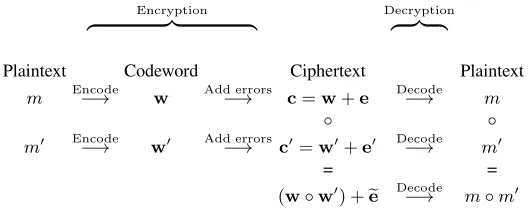
For a better understanding, take a look at the diagram in Table 1 and let us consider a simpler case. The first two rows of the diagram (starting withmand
m0, respectively) express exactly the relation between encoding/decoding on the one hand and encryption/decryption on the other hand. Now, let assume that the deployed code is a linear code. This means that the (component-wise) sum of two codewords is a codeword again. Furthermore let◦=00 +00and assume that Encodeis a linear operation. Then,c+c0 =w+w0+ (e+e0)where the bad positions given byee:= (e+e
0)are a subset of the fixed bad positions indicated
Summing up, using a linear code and a certain condition onEncodewould give an additively homomorphic encryption scheme.
The above approach does not necessarily give multiplicatively homomor-phic encryption. For a general linear code, it is not clear how two synchronized codewords could be combined to get an encoding of the product of plaintexts. Therefore, to get multiplicative homomorphic encryption as well, we consider in this paper a special subclass of linear codes, called “evaluation codes”. These codes are defined by evaluating certain functions and comprise a large set of known codes, e.g., Reed-Solomon codes, Reed-Muller codes, or Algebraic Ge-ometric codes [29, 34]. In this work we show that under certain conditions, such codes can be used to get additive and multiplicative homomorphic encryption with the same principle as above. We prove that the security of such schemes can be reduced to a decoding problem, called Decisional Synchronized Codewords Problem (DSCP). Observe that this problem has been investigated before for certain codes, e. g., for Reed-Solomon codes [7, 15] and Algebraic Geometric Codes [12].
3 Preliminaries
Notation. For an integern ≥1, we denote by[n]the set of integers1, . . . , n. In the following,swill be a security parameter andFsome arbitrary finite field. Vectorsvwill be expressed in bold letters. We denote byF[x1, . . . , xt]the ring of multivariate polynomials in the indeterminates x1, . . . , xt with coefficients overF. For a polynomial p ∈ F[x1, . . . , xt] and a sequence of vectorsV = (v1, . . . ,v`)∈ Ft
`
, we definep(V) := (p(v1), . . . , p(v`))∈F`.
|v|denotes the Hamming weight of a vectorv, that is the number of non-zero entries, andsupp(v)the indices of the non-zero entries. For two vectors vandw, the expressionv·wstands for the component wise product: ifv = (v1, . . . , vn)andw= (w1, . . . , wn), thenv·w= (v1·w1, . . . , vn·wn).
A functionf :N→Ris called negligible if for any polynomialp(x)over the real numbers there exists an integern0∈Nsuch that|f(n)|<|1/p(n)|for alln≥ n0. We sometimes writef = negl(n). For two setsS andS0 equipped of a binary operator◦, we defineS◦S0 :={s◦s0|s∈S, s0∈S0}.
Linear Codes and Evaluation Codes. In this paper, we aim for constructing homomorphic encryption schemes based on evaluation codes. Note that such codes are a special sub-class of linear codes. First, we recall their definition:
is, it holds for allw,w0 ∈ Cthatw+w0∈ Cand|w+w0| ≥d. We call vectors
w∈ Caserror-free codewordsand vectorsw∈Fn\Caserroneous codewords.
Erroneous codewords can be written asw+ewheree∈ Fn\0is called the error vector. The bad locations, that is where an error occurred, are supp(e)
and thegood locations, that is the error-free locations, are[n]\supp(e). For a subsetI ⊆[n], we define
C(I) :={w+e|w∈ C,e∈Fn,supp(e)⊆[n]\I}. (1)
In other words,C(I)is the set of all erroneous codewords where the positions specified inI are good locations. In particular, we haveC([n]) =C.
In addition, there exist two efficient (that is polynomial in the input length) algorithmsEncode :F→ C(encoding) andDecode :Fn× {I|I ⊆[n]} →F
(decoding) such thatDecode(Encode(m) +e,supp(e)) = mfor allm ∈ F
ande∈Fnwith|e|< d. This means that erroneous codewords can be decoded
efficiently possibleif the bad locations are known.6
By choosing an encryption scheme where the ciphertexts are codewords from a linear code and where the errors are at fixed, but secret locations I, yields di-rectly a linear homomorphic encryption scheme. However, to get multiplicative homomorphism as well, we need codes such that the product of two codewords is a codeword again. For this reason, we focus on a special class of linear codes, called evaluation codes.
Definition 2 (Evaluation Codes).LetX be a geometric object7 together with a tuple x := (x1, . . . , xn) ofndistinct points in X. LetFX denote the set of
all mappings fromX toF. We assume that we have a vector space(L,+)over F, withL ⊆ FX, of dimensionk. An evaluation code C is obtained by using
Encode = ex◦evwhere
Expression: ex : F → L, m 7→ p is a mapping that expresses a message
m∈Fk0 (withk0 ≤k) as a functionp∈ Land
Evaluation: evx:L →Fn, p7→p(x) = p(x1), . . . , p(xn)
is theevaluation mappingthat maps a functionp∈ Lto its evaluation onx.
We callL(C) :=Lthefunction spaceof the codeCand the vectorxthe code-word support. For a codewordw=p(x), we callpw:=pthesolution function
ofw.
6
This is a natural prerequisite for any practical error correction codes. Moreover, as we do not assume efficient decoding if the bad locations areunknown, some codes may be suitable for our scheme although they are not interesting for error correction.
7Typically,Xwill be the affine line
Evaluation codes are useful for our goal as (under certain conditions) the product of two codewords is a codeword again. Let the product of two functionsp, p0 ∈
FX be defined by(p·p0)(x) := p(x)·p0(x) ∈ Ffor allx ∈ X. Now assume two codesCandCbsuch thatp1·p2 ∈ L(Cb)for allp1, p2 ∈ L(C). Then, it holds for any two codewordsw1,w2 ∈ C:
w1
|{z}
∈C
· w2
|{z}
∈C
= pw1 |{z}
∈L(C)
(x)· pw2 |{z}
∈L(C)
(x) = (pw1·pw2) | {z }
∈L(Cb)
(x)∈Cb. (2)
We generalize this concept in the following definition:
Definition 3 (µ-multiplicative Codes).An evaluation codeCis calledµ-multiplicative
if there exists a codeCbwith the same codeword support such thatL(C)`⊆ L(Cb)
for all`∈[µ]. We use the notationCµ⊆ b
Cin this case.
We will later show that such codes exist in practice. Using µ-multiplicative codes, we get a situation where the sum and the product of codewords yield a codeword again. However, this does not automatically imply that decoding the product of two codewords yields the product of the underlying messages. This actually depends on how the expression mapping ”ex” in Def. 2 is realized. One approach is to incorporate the evaluation of functions here as well. More pre-cisely, we will use in the paper the following instantiation of evaluation codes that we will callspecial evaluation codes:
Definition 4 (Special Evaluation Codes).A special evaluation code is an eval-uation code as defined in Def. 2 where the expression mapping “ex” is realized as follows. We fix an element y ∈ X, called themessage support, whose role is to encode a message into a codeword. We require thatyis distinct from the entries of the codeword supportx. For any given messagem ∈F, we define a subset ofLas follows: Ly7→m := {p ∈ L|p(y) = m}.We assume that there
exists for any m a function p ∈ L such that p(y) = m. That is, Ly7→m is
non-empty. Given this, we consider an expression functionexthat on inputm
outputs a randomp∈ Ly7→m.
From now on, we will consider special evaluation codes only. Observe that we consider here only encoding of one field element although up to k elements would be possible. The main reason is that it simplifies some security arguments and ensures that there exist many different encodings for the samem∈Fwhich provides probabilistic encoding (= encryption). This is a necessary prerequisite for secure algebraic homomorphic encryption (see Boneh and Lipton [8]). We leave the extension to larger plaintext spaces to future work.
Theorem 1 (Additive and Multiplicative Homomorphism).LetCµ ⊆ b
C for some special evaluation codes C andCb. We consider a selection of at mostµ
encodingswj ∈ C(Ij)of messagesmj ∈FwhereIj ⊆[n]and setI :=TjIj.
It holds
Closed under addition and multiplication: P`j=1wj ∈Cb(I), and Q`
j=1wj ∈
b
C(I).
Additive homomorphism: Decode(P`j=1wj, I) = P`j=1mj, if |I| good
locations are sufficient for unique decoding.
Multiplicative homomorphism: Decode(Q`j=1wj, I) =Q`j=1mj, if|I|good
locations are sufficient for unique decoding.
4 The Encryption Scheme
4.1 Description
In this section, we formally describe the construction of our encryption scheme. The scheme is symmetric and encrypts plaintexts m ∈ Fto erroneous code-wordsc ∈ C(I) where the key consists ofI, the set of good locations, and the used supports (which in fact determines the used code instantiations). Regard-ing its homomorphic properties, it permits unlimited number of additions and a fixed but arbitrary number of multiplications. The scheme is composed of five algorithms:Setup, Encrypt, Decrypt, Add, Mult.
– (C,Cb,I)←Setup(s, µ,L) : The input are three positive integerss,L, and
µwheresdenotes the security parameter,Lthe expected total number of encryptions8, andµthe maximum degree of the supported polynomials. The
Setupalgorithm chooses a codeword supportx, a message supporty, and two special evaluation codesCandCbsuch thatCµ⊆Cband the length of the codewords is at leastL. How to choose appropriate codes and parameters highly depends on the considered coding scheme. We will describe in Sec. 6 a concrete instantiation where this is possible.Setup also generates a set
I ⊂ [n]of size T whereT depends on the parameter from above and the deployed code.I denotes the good locations for the generated encryptions and represents the secret key of the scheme. The output is the secret key k= (x,y, I).
– (c,1)←Encrypt(m,k) :The inputs are a plaintext messagem ∈Fand a
secret keyk = (x,y, I).Encryptfirst chooses a random encodingw ∈ C
ofm, using the Encode algorithm and the knowledge of the supports x
8This means an upper bound on the value on how many messages are going to be ”freshly”
andy. Then, it samples a uniformly random error vectore ∈Fnsuch that supp(e) ⊆ [n]\I and computes c := w+e. Finally, the ciphertext is defined as the pair(c,1)where the first entry is an erroneous codeword in
C(I) that encodes the plaintextm while the second entry, the integer, is a counter to keep track of the number of multiplications.
– m←Decrypt (c, γ),k:Decryptgets as input the secret keyk= (x,y, I) and a pair(c, γ)withc ∈ C(I)andγ ≤µ. It returnsm := Decode(c, I) whereDecodeis used with respect toxandy.
– (c00, γ00)←Add (c, γ),(c0, γ0)
:Addgets as input get as input two cipher-texts(c, γ)and(c0, γ0)and generates an encryption of the sum of the plain-texts c+c0,max(γ, γ0).
– (c00, γ00)←Mult((c, γ),(c0, γ0)) :This procedure get as input two cipher-texts(c, γ) and(c0, γ0) with γ +γ0 ≤ µand generates an encryption of the product of the plaintexts(c·c0, γ+γ0)where “·” is the componentwise vector product as explained in Section 3.
Correctness.The correctness for the case that neitherAddnorMulthave been used can be checked straightforwardly. Let(c, γ)and(c0, γ0)be two encryptions ofmandm0, respectively, withc,c0∈ C(I). Then, by Theorem 1 it follows that c+c0 ∈ C(I)and that Decode(c+c0, I) = m+m0. Analogously, we have c·c0 ∈ C(I) andDecode(c·c0, I) = m·m0 by Theorem 1 ifc·c0 does not result from more thanµmultiplications. Observe that it is not necessary to know the deployed codes, more precisely the supportsxandy, for executingAddor
Mult. Only the knowledge of the underlying field is mandatory.
4.2 Alternative Description in Terms of Linear Algebra
Observe that the scheme actually represents a group homomorphic encryption scheme between the additive groupsFandFn. This allows an alternative, pos-sibly simpler description in terms of linear algebra (cf. Armknecht et al. [1] for a comprehensive treatment of this subject). LetV0 ⊂ Fn denote the subspace
that contains all encryptions of 0, letc∗∈Fndenote an arbitrary encryption of 1 ∈ F, and letVerr ⊂ Fn denote the vector space of the error vectors. Then, encryption can be equivalently expressed by: given a plaintextm ∈F, sample
v0 ∈V0andve∈Verrand outputc:=v0+m·c∗+ve.
Furthermore, there exists a vectorvkey ∈ Fnsuch that decryption can be performed as follows: given a ciphertextc, computem = ct×vkey where×
denotes the usual matrix-vector product.
Effort. One benefit of the proposed scheme is that encryption and decryption processes are simple operations. Assume in the following that bases forV0and
Verrare known and likewise the vectorvkey. In some cases, these can be directly
written down. Alternatively, they can be computed by solving systems of linear equation based on outputs from the scheme, giving an effort in O(n3) in the worst case. Using this and the description from Sec. 4.2, one can easily validate that the efforts for encryption and decryption are inO(n2)andO(n), respec-tively. Furthermore,Add andMultare simply the componentwise addition and multiplication, respectively, of two vectors of length n. Thus, both operations are in O(n) as well. Furthermore, the schemes work over any (finite) field as long as the field size is not too small. In particular, this allows to use computer-friendly fieldsGF(2`)for a further speed-up.
Structural Limitations. The fact that the ciphertexts are inFnyields several limitations as we will elaborate now. For example an attacker who hasnpairs of plaintext/ciphertext at her disposal can compute the vectorvkeyfrom Sec. 4.2 on her own by solving a system of linear equations. This imposes a natural upper bound on the number of encryptions: not more than n−1 known plaintexts should be encrypted under the same key as otherwise security is lost.9This also shows that Gentry’s bootstrapping technique cannot be applied. As the keyvkey
is composed ofnfield elements and as each ciphertext represents the encryption of one field element, one would require at leastnciphertexts, thus exceeding the bound explained above.
For similar reasons, no public-key variant can exist. Assume the opposite and letV00denote the set of all possible encryptions of0∈ F(including linear combinations). One checks easily thatV00 forms a sub-vectorspace ofFn. Fur-thermore, one can show (e.g., cf. [1]) that the scheme is IND-CPA secure if and only if it is hard to decide for a given vectorv ∈ Fn whetherv ∈ V0
0 (also
called thesubspace membership problem(SMP)). However, the latter is easy in this case. Given sufficiently many samples fromV00, one can compute a basis and then solve the SMP using basic linear algebra techniques.
Observe that all limitations are consequences of the fact that the underlying algebraic structure isFn. Thus, by switching over to another structure, e.g., a ring, it might be possible to neutralize these.
9
4.4 Possible Applications
Before we analyze the security of the schemes, we argue why such schemes are interesting for certain applications despite their limitations. Let us consider some examples. In the Private Information Retrieval scenario a user wants to re-trieve data from an untrusted (honest but curious) server without the server being able to learn the data. If the stored data would be encrypted with an appropriate homomorphic encryption scheme, applying polynomials on the encrypted data could be used to filter out relevant data without revealing any useful information about the plaintext to the server.
Another example applies to Oblivious Polynomial Evaluation where one partyAholds a secret inputxand another partyB a secret polynomialP. The goal is to allowAto obtainP(x)such that no party learns anything about the se-cret of the other party (beyond what can already be deduced fromxandP(x)). Although solutions based on additively homomorphic encryption schemes has been discussed for the case of univariate polynomials, these become highly in-efficient for the multivariate case. The deployment of schemes that support both operations would help to enormously reduce the effort.
Observe that both examples mentioned above have in common that it would be sufficient if the deployed scheme is symmetric and supports only a limited number of multiplications and a limited number of encryptions. Of course a variety of other two party applications can be envisaged where deploying such schemes is sufficient as long as there is a gain in efficiency. In other words, the crucial factor here is notflexibilitybutefficiency.
5 Security Reduction to Coding Theory
In this section, we discuss the security of the proposed scheme. Recall that ac-cording to the limitations due to the usage of Fn, it is necessary to use the scheme as a symmetric-key encryption scheme and that the number of encryp-tions is limited to some value belown. In this section, we show that under these conditions, a security reduction to a known decoding problem is possible.
scheme.10More precisely, we consider a variant where the used code is known to the attacker, i.e., the attacker is given (eventually) a basis for the vector space
V0whileVerrremains secret. This allows for the following insights:
1. The security of the weaker scheme can be reduced to a known decoding problem, called Decisional Synchronized Codewords Problem (DSCP). 2. We give an overview of the most efficient algorithms for solving DSCP so
far. It will turn out that all of them need to know the used code instantiation.
Furthermore, as we will argue later, the problem of figuring out the code seems to be hard according to the current state of knowledge. This indicates that keep-ing the code secret provides an additional security margin. Whether this margin is sufficient is subject to future research.
Similar to the the Kiayias-Yung-scheme [31], recovering the plaintext from
oneciphertext of the weaker scheme without knowing the secret key is equiva-lent to decoding an erroneous codeword. But in contrast to [31], where the error locations alter from encryption to encryption, in our scheme the positions of the error free entries remain the same for all encryptions. This is a necessary prereq-uisite for the homomorphic property. Therefore, recovering the plaintexts from
several ciphertexts (under the assumption that the code is known) is equiva-lent to decoding several codewords where the errors are always at the same locations. This is a special decoding problem which is known as the decod-ing synchronized codes problem (DSCP). For a formal definition, note that the problem of decoding codes is equivalent to identifying the good (resp. bad) lo-cations: once a codeword is decoded, the good and bad locations can be easily identified, and vice versa. We use this fact for defining the following problem (see also [31]).
Definition 5. [Decisional Synchronized Codewords Problem (DSCP)]Let Cˇ
denote a[n, k, d]code. We consider a samplerSthat on input( ˇC;T, L)proceeds as follows:
1. Choose uniformly random a subsetI ⊂[n]of sizeT
2. SampleLpairwise distinct codewordswˇ1, . . . ,wˇL∈Cˇ.
3. SampleLpairwise distinct vectorse`∈Fnsuch thatsupp(e`) = [n]\I.
4. Computec` := ˇw`+e`∈Fn.
5. OutputCˇ := (c1, . . . ,cL)∈(Fn)L.
In addition, we consider two modifications ofS,SbadandSgood.Sbadoperates
analogously toS but chooses in additioniat random from the set[n]\I, and
10
outputs(i;C)ˇ .Sgoodis defined similarly butiis selected at random from the set I instead. We call an output(i;C)ˇ asDSCPinstance.
TheDecisional Synchronized Codewords ProblemDSCPis to distinguish between the two samplerSbadandSgood. For any probabilistic polynomial-time
(PPT) algorithmAwe define
AdvDSCPCˇ;T ,L,A :=
P r[A(S
good( ˇC;T, L)) = 1]−P r[A(Sbad( ˇC;T, L)) = 1] (3)
where the probability is taken over the random coins fromAand the samplers. TheDSCP[ ˇC;T, L]assumption holds with respect to a security parametersif
AdvDSCPCˇ;T ,L(s) := maxAAdvCDSCPˇ;T,L,Ais negligible ins.
Security Reduction. Next, we prove that the semantic security of the weaker scheme can be reduced to the hardness of DSCP with appropriate parameters. In a nutshell, semantic security requires that it should be infeasible for an adver-sary to gain, for a given ciphertext, any partial information about the underlying plaintext, even if the set of possible plaintexts is reduced to two different mes-sages which have been chosen by the attacker before. This is formally captured by a game where the adversary can request encryptions of adaptively chosen plaintexts. Her task is to tell apart encryptions of two plaintexts that where cho-sen by her. For a formal definition, we refer to [31].
For the proof of security, we make use of the following theorem on the pseudorandomness of sampled instances:
Theorem 2. For any distinguisherAbetween the distributionsDCˇ;T ,L(induced
by the samplerS from Definition 5) and the uniform distributionULnon(Fn)L,
it holds that
|P r[A(C) = 1ˇ |Cˇ ←DCˇ;T,L]−P r[A(C) = 1ˇ |Cˇ ←ULn]|
≤ T ·L·(n−T+ 3)
|F| +T·Adv DSCP
ˇ
C−;T ,L+ 8T ·Adv
DSCP ˇ
C;T ,L. (4)
where Cˇ− denotes the code obtained from Cˇby removing one point from the supportx.
This theorem is an adaptation of Theorem 3.4 given in [31]. Despite of some subtle differences due to the fact that we are dealing with a DSCPinstance here, the proof is very similar. For this reason and because of space limitation, we omit the proof and refer to the full version of this paper and/or [31].
Definition 6 (Special Encoding of0).A special evaluation codeCˇallows for a special encoding of0if there exists a codewordwˇ = ( ˇw1, . . . ,wˇn)∈Cˇsuch
thatwˇi 6= 0for alli∈[n]andDecode( ˇw) = 0.
We will show later a concrete instantiation, namely Reed-Muller codes, that allows a special encoding of 0. Furthermore, it is easy to show that a special encoding of 0 exists for Reed-Solomon codes. Given a special encoding of 0, one can construct a transformation on vectors that will play a crucial role in the reduction.
Proposition 1 (Transformation).LetCˇ2 ⊆ Cbe such thatCˇpermits a special
encoding of0, i.e., there exists a codeword wˇ = ( ˇw1, . . . ,wˇn) ∈ Cˇsuch that ˇ
wi 6= 0for alli ∈[n]andDecode( ˇw) =0. Then, there exists a probabilistic
mappingτ :Fn×Fk→Fnsuch that it holds for allm∈Fk:
1. For a uniformly random vector v ∈ Fn, the output τ(v, m) is uniformly
random inFnas well.
2. For a codeword wˇ ∈ Cˇ(I), the output w := τ( ˇw, m) is a codeword in
C(I), that is the error-free locations ofwˇ andware the same. It holds that
pw(y) =m, that iswdecodes to the second inputm, andwis uniformly
distributed in the set of encodings ofm.
In other words,τ(., m)transforms (erroneous) encodings underCˇof arbitrary (possibly unknown) messages to (erroneous) encodings ofmunderCand trans-forms otherwise random vectors to random vectors.
The proof of this result is given in App. A.
Theorem 3. The encryption scheme from Section 4 is semantically secure for parameters(C,Cb;T, L)if theDSCP[ ˇC;T, L]and theDSCP[ ˇC−;T, L]
assump-tions hold for some codeCˇwithCˇ2 ⊆ C that has a special encoding of0and if
T·L·(n−T+3)
|F| = negl(s).
Proof. LetASS be a PPT algorithm that breaks the semantic security for pa-rameters(C,Cb;T, L)with at mostLqueries (including the challenge). We show how to turnASSdirectly into a distinguisherAdstwhich distinguishes between the two distributions specified in Th. 2. If both assumptionsDSCP[ ˇC;T, L]and DSCP[ ˇC−;T, L]hold and if T·L·(n|F−|T+3) = negl(s), then it follows from equa-tion (4) in Theorem 2 that the advantage ofAdst is negligible. Consequently, this must be true forASS as well which proves the semantic security.
the transformation τ defined in Prop. 1. For each encryption query m` from
ASS, Adst responds with c
` := τ( ˇw`, m`). When ASS makes its challenge (m0,e m1e ) ∈ F2, Adst uniformly random picksb ∈ {0,1} and responds with e
c:=τ( ˇw`,meb)for some unused codewordwˇ`.
IfCˇ is distributed according toULn, then eachwˇ`is uniformly random from
Fnand hence each responsec`is some random vector inFnas well by Propo-sition 1. In particular, the response ec from A
dst to the challenge of ASS is
independent of the challenge(m0,e m1e ). ThusA
SS gains no information on the
value ofbwhich shows that its advantage is zero in this case.
Now assume thatCˇ is distributed according toDCˇ;T ,L. That iswˇ` ∈ Cˇ(I) for a common setI of good locations. By Proposition 1, each responsec`is an encoding ofm`inC(I). Furthermore, this procedure yields a uniformly random encryption of a given plaintext (by Prop. 1). Therefore,ASS’s view is that it received valid encryptions and any encryption for a chosen plaintext is possible. Hence, it observes no difference to communicating with an encryption oracle
OSS. In particular,ASS has by assumption a non-negligible advantage to guess
bcorrectly.
The remainder of the proof follows the usual arguments.AdstrunsASS suf-ficiently often to estimateASS’s advantage with sufficient precision. If the ad-vantage is negligible,Adstassumes thatCwas uniformly sampled from(Fn)L. Otherwise, it assumes thatCwas sampled byDCˇ;T ,L. ut
On the Gap between the Known Code and Secret Code Cases.Obviously, additionally knowing the code ease the attacks explained in Sec. 4.3. For ex-ample, as the attacker can use her additional knowledge to compute a basis of
V0and a choice forc∗, getting aboutdim(Verr)ciphertexts would be sufficient for deriving a basis ofVerr. Even worse, the specific algebraic structure of the
deployed code can allow more refined attacks (see our analysis in App. B as an example).
words in the dual, the more probably it is for them to be correct words of the dual code of the code.
Due to the limited allowed number of encryptions in the presented scheme, an attacker would not able to collect many codewords, which in particular pre-vents the low weight dual codewords attack. Furthermore, we discuss in App. B concrete instantiation how parameters can be chosen such that the expected number of low weight codewords in the dual codeword is negligible.
6 A Concrete Instantiation based on Reed-Muller Codes
In this part, we present a concrete instantiation of our scheme based on punc-tured Reed-Muller (RM) codes. RM codes are based on evaluating multivariate polynomials on certain points. Adopting the notation from Def. 2, the geometric objectX is a vector spaceFt over a finite fieldFof size q. The vector space
Lt,ρof functions is obtained by taking multivariate polynomials inF[v1, . . . , vt] of total degree strictly less than ρ with coefficients over F: Lt,ρ := {f ∈
F[v1, . . . , vt] | deg(f) < ρ}.The code support x = (x1, . . . , xn) is a vec-tor ofndistinct elements ofFt. Theq-ary RM code of orderρ < q, denoted by RMq(t, ρ), is defined by RMq(t, ρ) :=
f(x1), . . . , f(xn)
∈Fn |f ∈ L t,ρ} whereq denotes the size of the deployed field. The usualfullRM code is ob-tained when the code supportx = (x1, . . . , xqt) contains all elements of Ft. For the sake of efficiency and security, we considerpuncturedRM codes where
n < qt (i.e. some positions are removed). In the sequel, punctured codes are denoted by RMq(t, ρ)?.
In what follows, we consider only RM codes that are special evaluation codes, that is where the encoding is realized as specified in Def. 4. Furthermore, we have
Corollary 1. Let1 ≤ µ ≤ q be arbitrary. Then there exist RM codes Cˇ,C,Cb
such that (i)Cµ⊆ b
Cand (ii)Cˇ2⊆ CandCˇallows for a special encoding of0.
Thus, RM codes can be used to instantiate our scheme. The proof is given in App. A.
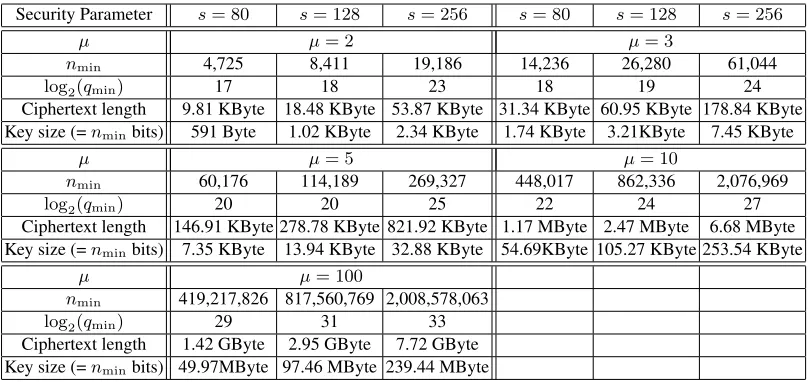
Security Parameter s= 80 s= 128 s= 256 s= 80 s= 128 s= 256
µ µ= 2 µ= 3
nmin 4,725 8,411 19,186 14,236 26,280 61,044
log2(qmin) 17 18 23 18 19 24
Ciphertext length 9.81 KByte 18.48 KByte 53.87 KByte 31.34 KByte 60.95 KByte 178.84 KByte Key size (=nminbits) 591 Byte 1.02 KByte 2.34 KByte 1.74 KByte 3.21KByte 7.45 KByte
µ µ= 5 µ= 10
nmin 60,176 114,189 269,327 448,017 862,336 2,076,969
log2(qmin) 20 20 25 22 24 27
Ciphertext length 146.91 KByte 278.78 KByte 821.92 KByte 1.17 MByte 2.47 MByte 6.68 MByte Key size (=nminbits) 7.35 KByte 13.94 KByte 32.88 KByte 54.69KByte 105.27 KByte 253.54 KByte
µ µ= 100
nmin 419,217,826 817,560,769 2,008,578,063
log2(qmin) 29 31 33
Ciphertext length 1.42 GByte 2.95 GByte 7.72 GByte Key size (=nminbits) 49.97MByte 97.46 MByte 239.44 MByte
Table 2.Computation of the minimum lengthnminof the ciphertexts and the minimum field size
log2qminin respect to the security parametersand the number of multiplications..
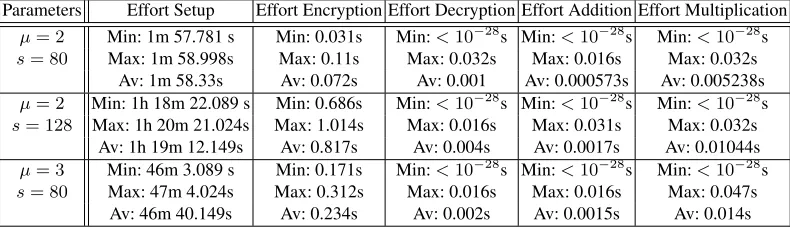
Of course, for practical instantiations concrete values are more meaningful. In Table 2, we list the valuesnminandlog2qmin(referring to the smallest possi-ble choices ofnandq) for different selections ofsandµ. With these parameters, both the identified attacks on DSCP (see App. B.2) and the approaches for re-covering the code become infeasible. Observe that the choice of these values concerned only the DSCP but not the (non-tight) upper bound in eq. (4). If one wants to choose parameters such thatT·L·(n−T+ 3)/|F| ≤2−s, then bigger fields need to be chosen. This yields an increase of the ciphertext length by a factor between 6 and 10 (depending ons). We implemented our scheme in the algebra system Magma V2.11-1 and did let it repeatedly run for several param-eters (on a W500 Thinkpad laptop with 4GB RAM). The results can be found in Table 3. There, ”setup” includes the precomputations mentioned in Sec. 4.3. As the estimated effort for the precomputation is inO(n3) =O(µ9·s3)it is not surprising that it takes by far the most time. However, our tests indicated that the bottleneck is actually the memory consumption. Observe that the major step of the precomputation is to find the linear mapping
λI :F|I|→F,(p(xi))i∈I 7→p(y) (5)
(compute the kernels of different submatrices in parallel and intersect them at the end).
Parameters Effort Setup Effort Encryption Effort Decryption Effort Addition Effort Multiplication µ= 2 Min: 1m 57.781 s Min: 0.031s Min:<10−28
s Min:<10−28
s Min:<10−28
s s= 80 Max: 1m 58.998s Max: 0.11s Max: 0.032s Max: 0.016s Max: 0.032s
Av: 1m 58.33s Av: 0.072s Av: 0.001 Av: 0.000573s Av: 0.005238s µ= 2 Min: 1h 18m 22.089 s Min: 0.686s Min:<10−28
s Min:<10−28
s Min:<10−28
s s= 128 Max: 1h 20m 21.024s Max: 1.014s Max: 0.016s Max: 0.031s Max: 0.032s
Av: 1h 19m 12.149s Av: 0.817s Av: 0.004s Av: 0.0017s Av: 0.01044s µ= 3 Min: 46m 3.089 s Min: 0.171s Min:<10−28s Min:<10−28s Min:<10−28s
s= 80 Max: 47m 4.024s Max: 0.312s Max: 0.016s Max: 0.016s Max: 0.047s Av: 46m 40.149s Av: 0.234s Av: 0.002s Av: 0.0015s Av: 0.014s
Table 3.Run time of the proposed encryption scheme for different parameters. The entries rep-resent the minimum (Min) time, the maximum (Max) time, and the average (Av) time in the experiments.
Furthermore, some kind of ”global” precomputation is possible. More pre-cisely, given the mappingsλIj for sufficient many linearly independent vectors
Ij ∈ FT, one can compute any other mapping λI from them. In other words, the results from precomputations done for one key can be used to accelerate the precomputations for another key.
On the good side, it turns out that once the precomputation is accomplished, all other operations (e.g., encryption, decryption, etc.) are comparatively effi-cient (1 second or less for the considered test cases). Given the novelty of this approach and the fact that the implementation is by no means optimized, we consider these results as quite promising. Especially in comparison with other schemes that provide additive and multiplicative homomorphism (e.g., see the overview in Sec. 1), our scheme is highly efficient.11
7 Discussion and Conclusions
We gave the first encryption scheme based on coding theory that is homomor-phic wrt. two operations: addition and multiplication. For structural reasons, the scheme has to be secret-key and the number of encryptions needs to be limited. Nonetheless, applications exist where such schemes can be useful. This is in
par-11
ticular true as we could describe concrete instantiations that are comparatively highly efficient.
The most important question is probably whether other code-based con-structions exist without the identified limitations. One approach could be to look for more involved constructions where linear codes are not directly represented. However, caution must be paid to not loose the advantages with respect to ef-ficiency, e.g., the linear decryption algorithm. Another approach could be to replace the fieldFby a weaker algebraic structure, e.g., a ring. This certainly avoids the straightforward application of methods from linear algebra. How-ever, one has to pay attention that the decoding procedure, e.g., interpolation of polynomials, is still possible.
Another question is the investigation of the secret code case. Keeping the code secret should add a further security margin, but how much and what is the impact on the parameter sizes? But even for the known code scenario, interest-ing problems remain. Although we picked Reed-Muller codes for our concrete instantiations, other codes might yield even better results. As also codes with a low correction capacity might be used, the code might be chosen from a wide set of possible codes. Another possible extension is to remove the condition of fixed error locations. This may allow a reduction to a hard decoding problem. Of course, this likewise means that the noise can grow but similar holds for all presented bootstrappable schemes as well.
Another research direction is whether the schemes can be made KDM (key dependent message) secure. Informally, KDM security means that a scheme re-mains secure even if an encryption of the deployed key is given, that isEk(k), and is crucial for Gentry’s bootstrapping technique. However, the KDM secu-rity of the proposed bootstrappable schemes is an open question and needs fur-ther investigation. Interestingly, the proposed scheme (in its ”linear-algebra”-description from Sec. 4.2) has some striking similarities with a scheme by Boneh et al. [11]. The latter has been one of the first schemes for which KDM security could be proven using standard assumptions. Indeed, similar arguments may be used here but the underlying problem, the rank problem, is easy in Fn. This immediately raises the question whether variants of the scheme may exist for which KDM security can be shown.
References
1. Frederik Armknecht, Andreas Peter, and Stefan Katzenbeisser. A cleaner view on IND-CCA1 secure homomorphic encryption using SOAP. Cryptology ePrint Archive, Report 2010/501, 2010.http://eprint.iacr.org/.
3. M. Baldi, M. Bodrato, and G.F. Chiaraluce. A new analysis of the McEliece cryptosystem based on QC-LDPC codes. InSecurity and Cryptography for Networks (SCN), pages 246– 262, 2008.
4. A. Barg. Complexity issues in coding theory. In V. S. Pless and W. C. Huffman, editors,
Handbook of Coding Theory, volume I, chapter 7, pages 649–754. North-Holland, 1998. 5. J. Benaloh.Verifiable secret-ballot elections. PhD thesis, Yale University, New Haven, CT,
USA, 1987.
6. T. Berger and P. Charpin. The automorphism group of Generalized Reed-Muller codes.
Discrete Math., 117:1–17, 1993.
7. D. Bleichenbacher, A. Kiayias, and M. Yung. Decoding of interleaved reed solomon codes over noisy data. In Jos C. M. Baeten, J. Karel Lenstra, Joachim Parrow, and Gerhard J. Woeginger, editors,ICALP, volume 2719 ofLecture Notes in Computer Science, pages 97– 108. Springer, 2003.
8. D. Boneh and R. Lipton. Algorithms for black-box fields and their application to cryptog-raphy (extended abstract). InCRYPTO ’96: Proceedings of the 16th Annual International Cryptology Conference on Advances in Cryptology, pages 283–297, London, UK, 1996. Springer-Verlag.
9. Dan Boneh and David Mandell Freeman. Linearly homomorphic signatures over bi-nary fields and new tools for lattice-based signatures. Cryptology ePrint Archive, Report 2010/453, 2010. Accepted to PKC’11.
10. Dan Boneh and David Mandell Freeman. Homomorphic signatures for polynomial func-tions. Cryptology ePrint Archive, Report 2011/018, 2011. Accepted to EUROCRYPT’11. 11. Dan Boneh, Shai Halevi, Michael Hamburg, and Rafail Ostrovsky. Circular-secure
encryp-tion from decision diffie-hellman. InCRYPTO, pages 108–125, 2008.
12. A. Brown, L. Minder, and A. Shokrollahi. Improved decoding of interleaved ag codes. In Nigel P. Smart, editor,IMA Int. Conf., volume 3796 ofLecture Notes in Computer Science, pages 37–46. Springer, 2005.
13. Mathieu Cluzeau, Matthieu Finiasz, and Jean-Pierre Tillich. Methods for the reconstruction of parallel turbo codes.CoRR, abs/1006.0259, 2010.
14. J. Cohen and M. Fischer. A robust and verifiable cryptographically secure election scheme (extended abstract). InFOCS, pages 372–382. IEEE, 1985.
15. D. Coppersmith and M. Sudan. Reconstructing curves in three (and higher) dimensional space from noisy data. InSTOC ’03: Proceedings of the thirty-fifth annual ACM symposium on Theory of computing, pages 136–142, New York, NY, USA, 2003. ACM.
16. N. T. Courtois, M. Finiasz, and N. Sendrier. How to achieve a McEliece-based digital signa-ture scheme.Lecture Notes in Computer Science, 2248:157–174, 2001.
17. R. Cramer, I. Damgaard, and J. Nielsen. Multiparty computation from threshold homomor-phic encryption. InEUROCRYPT ’01: Proceedings of the International Conference on the Theory and Application of Cryptographic Techniques, pages 280–299, London, UK, 2001. Springer-Verlag.
18. R. Cramer, M. Franklin, L. Schoenmakers, and M. Yung. Multi-authority secret-ballot elec-tions with linear work. Technical report, CWI (Centre for Mathematics and Computer Sci-ence), Amsterdam, The Netherlands, The Netherlands, 1995.
19. R. Cramer, R. Gennaro, and B. Schoenmakers. A secure and optimally efficient multi-authority election scheme. European Transactions on Telecommunications, 8(5):481–490, September 1997.
21. M. Fellows and N. Koblitz. Combinatorial cryptosystems galore!Contemporary Mathemat-ics, 168:51–61, 1993.
22. T. El Gamal. A public key cryptosystem and a signature scheme based on discrete loga-rithms.IEEE Transactions on Information Theory, 31(4):469–472, 1985.
23. Olav Geil. On the second weight of generalized Reed-Muller codes. Designs, Codes and Cryptography, 48(3):323–330, September 2008.
24. Craig Gentry. A fully homomorphic encryption scheme. PhD thesis, Stanford University, 2009.crypto.stanford.edu/craig.
25. Craig Gentry. Fully homomorphic encryption using ideal lattices. In Michael Mitzenmacher, editor,STOC, pages 169–178. ACM, 2009.
26. Craig Gentry and Shai Halevi. Implementing Gentry’s fully-homomorphic encryption scheme. Accepted to EUROCRYPT’11, 2011.
27. Craig Gentry, Shai Halevi, and Vinod Vaikuntanathan. i-hop homomorphic encryption and rerandomizable yao circuits. In Rabin [41], pages 155–172.
28. S. Goldwasser and S. Micali. Probabilistic encryption. Journal of Computer and System Sciences, 28:270–299, 1984.
29. T. Hø oholdt, J. H. van Lint, and R. Pellikaan. Handbook of Coding Theory, volume I, chapter Algebraic geometry codes, pages 871–961. Elsevier, 1998.
30. A. Kiayias and M. Yung. Cryptographic hardness based on the decoding of Reed-Solomon codes with applications. Electronic Colloquium on Computational Complexity (ECCC), 2002.
31. A. Kiayias and M. Yung. Cryptographic hardness based on the decoding of Reed-Solomon codes. Cryptology ePrint Archive, Report 2007/153, 2007. http://eprint.iacr. org/.
32. A. Kiayias and M. Yung. Cryptographic hardness based on the decoding of reed-solomon codes.IEEE Transactions on Information Theory, 54(6):2752–2769, 2008.
33. E. Kushilevitz and R. Ostrovsky. Replication is not needed: single database, computationally-private information retrieval. InFOCS ’97: Proceedings of the 38th An-nual Symposium on Foundations of Computer Science (FOCS ’97), page 364, Washington, DC, USA, 1997. IEEE Computer Society.
34. F. J. Macwilliams and N. J. A. Sloane. The Theory of Error-Correcting Codes. North-Holland Mathematical Library. North North-Holland, January 1983.
35. R. J. McEliece. A Public-Key System Based on Algebraic Coding Theory, pages 114–116. Jet Propulsion Lab, 1978. DSN Progress Report 44.
36. Carlos Aguilar Melchor, Philippe Gaborit, and Javier Herranz. Additively homomorphic encryption with -operand multiplications. In Rabin [41], pages 138–154.
37. M. Naor and B. Pinkas. Oblivious polynomial evaluation. SIAM J. Comput., 35(5):1254– 1281, 2006.
38. H. Niederreiter. A public-key cryptosystem based on shift register sequences. In EURO-CRYPT, volume 219 ofLNCS, pages 35–39, 1985.
39. P. Paillier. Public-key cryptosystems based on composite degree residuosity classes. In
EUROCRYPT, pages 223–238, 1999.
40. Manoj Prabhakaran and Mike Rosulek. Homomorphic encryption with cca security. In
ICALP ’08: Proceedings of the 35th international colloquium on Automata, Languages and Programming, Part II, pages 667–678, Berlin, Heidelberg, 2008. Springer-Verlag.
41. Tal Rabin, editor.Advances in Cryptology - CRYPTO 2010, 30th Annual Cryptology Confer-ence, Santa Barbara, CA, USA, August 15-19, 2010. Proceedings, volume 6223 ofLecture Notes in Computer Science. Springer, 2010.
Key Cryptography, volume 6056 ofLecture Notes in Computer Science, pages 420–443. Springer, 2010.
43. Damien Stehl´e and Ron Steinfeld. Faster fully homomorphic encryption. In Masayuki Abe, editor,ASIACRYPT, volume 6477 ofLecture Notes in Computer Science, pages 377–394. Springer, 2010.
44. Antoine Valembois. Detection and recognition of a binary linear code. Discrete Applied Mathematics, 111(1-2):199–218, 2001.
45. Antoine Valembois. D´ecodage, D´etection et Reconnaissance des Codes Lin´eaires Binaires. PhD thesis, Universit´e Limoges, 2004.
46. Marten van Dijk, Craig Gentry, Shai Halevi, and Vinod Vaikuntanathan. Fully homomorphic encryption over the integers. In Henri Gilbert, editor,EUROCRYPT, volume 6110 ofLecture Notes in Computer Science, pages 24–43. Springer, 2010.
A Proofs
A.1 Proof of Theorem 1
Proof (Theorem 1). We show the multiplicative property only. The additive property can be showed analogously. Let wj = (wj,1, . . . , wj,n) ∈ C(Ij) be as described. Setw:= (w1, . . . , wn) :=Qjwj = (Qjwj,1, . . . ,Qjwj,n)and
pw := Q
jpwj. Choose i ∈ I := T`
j=1Ij be arbitrary. As any wj ∈ C(Ij) by assumption withI ⊆ Ij, it holds that wj,i = pwj(xi). In particular, wi = Q
jwj,i = Q
jpwj(xi) = pw(xi). This shows that the i-th position ofw is a good position. Asi∈Iarbitrary, this shows thatw∈Cb(I).
By assumption, Q jpwj
∈ L(Cb). Hence, if I provides sufficient many
good locations for unique decoding, thenDecode(w, I) = pw(y). By defini-tion, it holds thatpwj(y) = Decode(wj, I). This implies
Decode(Y j
wj, I) = Decode(w, I) =pw(y) =
Y
j
pwj
(y) = Y
j
pwj(y) = Y
j
Decode(wj, I).
u t
A.2 Proof of Proposition 1
Proof (Proposition 1).Let(v, m) denote the input. The transformationτ works as follows. First, a uniformly random encodingw0 ∈ Cofmis chosen. Then, the output is computed byw:=v·wˇ +w.0
Next, consider the case that v ∈ Cˇ(I), that is a possibly noisy encoding underCˇof some maybe unknown messageme. AsCˇ
2 ⊆ C, Theorem 1 tells that
v·wˇ ∈ C(I). Hence, thanks to the additive property of Theorem 1, it follows thatw∈Cb(I). Regarding its decoding, Theorem 1 implies that
Decode (v·w) = Decode(v)ˇ ·Decode( ˇw) =me ·0 = 0. (6)
Again with Theorem 1 we have that
Decode(w) = Decode(v·w+wˇ 0) = Decode(v·w)+Decode(wˇ 0) =0+m=m.
(7) The fact thatwb is merely a constant shift of a uniformly random encoding ofm
concludes the proof. ut
A.3 Proof of Corollary 1
Proof (Corollary 1). Recall that Cµ ⊆ b
C means that L(C)` ⊆ L(Cb) for any
`∈[µ]. It is easy to see thatL`
t,ρ⊆ Lt,`·ρfor allt,ρ, and`such that`·ρ≤q. Thus, any choice ofCˇ:=RMq(t, ρ)∗,C:=RMq(t,2·ρ)∗andCb:=RMq(t, ρ0)∗ with2·µ·ρ≤ρ0≤qmeet the first property.
Next, we show that the parameters can be adjusted such that a special en-coding on 0is possible. Recall that this means that there exists a multivariate polynomialpof degree< ρsuch that:
– None of the entries ofp(x)is equal to zero. – p(y) = 0.
Letρ≥2(the case ofρ≤1is cryptographically weak anyway). We denote the components of the code supportxand the message supportyas follows:
– x=
x(1)1 , . . . , x(1)t
, . . . ,
x(1n), . . . , x(tn)
∈(Ft)n,
– y= (y1, . . . , yt)∈Ft.
Since n < |F|, we can choose xarbitrary andyalmost completely arbitrary. The only condition onyis that the first entry,y1, does not coincide with any of the first indices inx. More formally, it must holds thaty1 6∈ {x(1)1 , . . . , x
(n) 1 }.
Actually, the following arguments would hold as well if we consider other in-dices. Now, we can consider the following multivariate polynomial intvariables
v1, . . . , vt:
p(v1, . . . , vt) :=v1−y1.
It holds thatp(y) =p(y1, . . . , yt) =y1−y1= 0. Furthermore, asy16=x(1i)for
alli∈ {1, . . . , n}, it follows that none of thenentries ofp(x)is equal to zero. Thus, wˇ := p(x) satisfies is a special encoding of 0. This shows the second
B Concrete Parameters for the Instantiation based on Reed-Muller Codes
In the following, we explain the derivation of the parameters given in Sec. 6. We will first give the conditions that the parameters need to meet and analyze afterwards how appropriate parameters can be chosen.
B.1 Obvious Conditions.
Assume that the following parameters are given: the number of supported en-cryptionsL, the number of supported multiplicationsµ, and a security parame-ters. The task is to find three RM codesCˇ,C,Cband an integerT =|I|such that the scheme is secure and that the lengthnof the codes and the size of the field are minimized (for efficiency). First, we list up all conditions that are necessary for correctness and security. We explain afterward how to choose concrete val-ues such that the lengthnof the ciphertexts and the field size are minimized. We argued already in Cor. 1 how to choose the supportsxandyso that a special encoding of0exists. As this has no impact on the other parameters, e.g., length or dimension, and no impact on the hardness of the DSCP (as far as we know), we ignore this part in the following (but recall that this choice needs to be kept secret).
Due to the correctness condition, we must haveCµ ⊆ b
CandCˇ2 ⊆ C. Thus,
we setCˇ:= RMq(t, ρ)?,C :=RMq(t,2ρ)?, andCb:=RMq(t,2µρ)? forρ ≥2 with dimensionsˇk= t+tρ,k= t+2tρandbk= t+2tµρ
, respectively. To allow unique decoding, the number of good locations must be at least the dimension ofCb, that is:
|I| ≥bk=
t+ 2µρ
2µρ
. (8)
Furthermore, the number of good locations can be at most the number of entries and the elements of the supports must be pairwise distinct. Therefore, we need to have:
|I| ≤n≤qt−1. (9)
Regarding the security, one bound follows directly from the limitation explained in Sec. 4 and 5, namely that the length of the ciphertext has to exceed the number of encryptions and that the number of encryptions needs to be less than the number of bad locations, i.e.,
n≥L+ 1 andn−T ≥L+ 1. (10)
B.2 On the Hardness of the DSCP for RM Codes.
Regarding the hardness of the DSCP for RM codes, we identified two methods (apart of the generic attacks described in Sec. 4 and 5) which seem to be the most powerful ones. The first is the so-calledInformation Set Decoding (ISD) algorithmwhich is widely considered as the most efficient for random codes. Here, an attacker pickskposition at random (withkbeing the dimension of the code), and hopes that there are no errors in these positions, i.e. they belong toI
(using the notation of our scheme). In case of success, she can reconstruct the whole codeword. We refer to [4] for a detailed review of this method.
We can estimate the probability of successpISDof this algorithm as follows:
pISD=
|I|
k
n k
≤
|I| n
k
. (11)
If|I|is close ton, an attacker might try to guess the bad positions instead of guessingkgood positions. As this represents in a certain sense the opposite approach of ISD, we denote it byISD. The success probability of this approach is
pISD = 1n
|I|
. (12)
The second attack, which we callLow Weight Dual Codewords (LWC) at-tack, relies on a specific property of RM, i.e., the fact that low dimensional RM codes admit small weight codewords in their duals. Recall that the dual of a codeC, denoted byC⊥, is defined as the set of vectors which are orthogonal to
the error-free codewords inC. That is
C⊥={w⊥∈Fn|w⊥×w=0, ∀w∈ C}
where ”×” is the usual scalar product. The dual code of a (full-length) RM code RMq(t, ρ), denoted by RMq(t, ρ)⊥, is again a RM code. More precisely it holds that
RMq(t, ρ)⊥=RMq(t, ρ⊥),
withρ⊥ = t(q−1)−1−ρ. One can show that the minimum distance of the dual code is d⊥ = (q−v⊥)qt−u⊥−1 = ρ + 2. Thus the dual code contains codewords of extremely low weight. For example, if ρ = 2 (polynomials of degree 2), there exist codewords of weight 4 in the dual which can make the following attack dangerous.
Consider first the full length RM code, and letw⊥be a codeword of weight
d⊥belonging to its dual. We distinguish between two cases: (i)supp(w⊥)⊆I
must hold thatw⊥×c = 0as only the error-free locations ofc are involved in the computation. In the second case, the computation ofw⊥×cdepends on some random values (at the bad locations). Thus,w⊥×c= 0holds only with a probability of1/q. Thus, if the scalar productw⊥×cis equal zero, then the attacker can assume thatsupp(w⊥) ⊆ I with a probability of1−1/q. Even more, ifL is the number of observed ciphertexts, this probability increases to 1−1/qL. The attack now is to sample low weight codewordsw⊥and check if w⊥×c= 0for all ciphertextsc. In the positive case, assume thatsupp(w⊥)⊆ I.
Now observe that a codewordw⊥in the truncated dual RM code is useful for the attack if its support is contained in the good locations determined byI
(see condition (i) above). The probability that this holds for a random codeword of weightω⊥is
pLWC(ω⊥) =
|I|
ω⊥
n ω⊥
. (13)
IfE?
ω⊥ denotes the expected number of codewords in the truncated dual code,
then we can expect
Eω⊥=pLWC(ω⊥)·Eω?⊥ (14)
codewords on average that can be used for this attack.
Remark 1. It is clear that the ISD attack needs to know the deployed code. Fur-thermore, the success probability for ISD given in (11) implicitly assumes that any set ofkgood positions allows unique decoding which is not true in general. Likewise, for the LWC attack one needs to know the code as well for deter-mining the dual code. Moreover, the attack requires a very strong attacker who can efficiently find codewords w⊥ in the punctured dual code (RMq(t, ρ)⊥)? of weightω⊥with only a negligible effort. To the best our knowledge, no such algorithm is known so far.
B.3 Parameters
Possible parameter choices have to meet on the one hand the conditions summed up in App. B.1 and on the other hand ensure that the attack identified in App. B.2 are infeasible. More precisely, we will choose the parameter such that the effort for each attack is at least 2s. We derive from (11) the following (sufficient) condition to thwart the ISD attack:
|
I| n
ˇk
Concerning theISDattack, we put the following condition:
|I| ≤n/2. (16)
Thanks to this condition, the success probability of the ISDattack is smaller that the one for the ISD attack as we will show now. First of all, we have
|I|(8)≥bk=
t+ 2µρ t
≥
t+ρ t
= ˇk. (17)
Together with (16), this implies that nˇk
≤ |nI|
as the value niis maximal for
i=n/2. As a consequence, it holds that
pISD = 1n
|I|
≤ 1 n
ˇ
k ≤
|I|
ˇ
k
n
ˇ
k
=pISD. (18)
Thus, we can ignore the ISDattack and concentrate on the ISD attack if we require that|I| ≤n/2.
The last attack is the LWC attack. Here, we will use the following approach. LetX be the random variable giving the number of truncated dual codewords of weightω⊥that are useful for the attack. Using Markov’s inequality, it holds thatp(X ≥1)≤Eω⊥.Thus, we aim for parameters such that
Eω⊥ ≤2−s. (19)
For reasons that will become clear later, we additionally require
t:= 3 and n≤q. (20)
Parameter Selection. Given the conditions above, we present now a possible strategy to select the parameters. Due to (16), we write|I|/n= 2−r, withr≥1. Then, (15) translates to the following condition
2−r·kˇ≤2−s⇔r·ˇk≥s⇔ 3+sρ
ρ
≤r (21)
As the value in (15), the upper bound forpISD, increases with the key length|I|.
It is then reasonable to minimize this value and set|I|:=bk(see condition (8)). Sincen= 2r·bk, we have
n= 2r·
3 + 2µρ
3
≥2 s (3+ρ
ρ )
3 + 2µρ
3
We define
nmin := min
ρ
2 s (3+ρ
ρ )
3 + 2µρ
3
(23)
and setρmin to be the value forρsuch that the above expression is minimized.
To derive an asymptotic estimation ofnmin, we use thatr ≥1and (21). We get
3 +ρ
3
≥s⇔(ρ+ 1)(ρ+ 2)(ρ+ 3)≥6s⇒ρmin ≤√3 6s. (24)
It follows
nmin ≤2 s (3+√36s
3 )·
3 + 2µ√36s
3
≤2 6s
(√36s)3·(3+2µ3
√
6s)3∈ O(µ3·s). (25)
Thus, the lengthngrows asymptotically asµ3·sand linearly withL.
So far, we ignored the LWC attack and condition (19). First of all, we need to derive a formula forEω?⊥, that is the expected number of codewords of weight
ω⊥in the truncated dual code. Letw⊥denote an arbitrary codeword of weight
ω⊥ in thefull dual code.w⊥ is a codeword in the truncated code if and only if supp(w⊥) is contained in the code support x. To compute the probability
ptrunc that this happens, we can assume that the code support x is uniformly
random chosen (see Corollary 1). Then, there exist qnt−−ωω⊥⊥
different choices for x that contain supp(w⊥) (ω⊥ positions of x are fixed and the remaining
n−ω⊥positions can be freely distributed onqt−ω⊥positions). In total, there are qntpossible choices forx. Thus, we have
ptrunc(ω⊥) =
qt−ω⊥ n−ω⊥
qt n
. (26)
This leads to
Eω?⊥ =
qt−ω⊥
n−ω⊥
qt n
·Nω⊥, (27)
whereNω⊥, the number of codewords in the full dual code of weightω⊥. For
ω⊥ =d⊥(the minimal possible weight), the numberNd⊥ has been figured out
by Berger and Charpin [6]:
Nd⊥=qu ⊥t
−u⊥−1
Y
i=0
qt−i−1
qt−u⊥−i
−1Nv⊥, whereNv⊥=
q v⊥
qt−u⊥−1