Western University Western University
Scholarship@Western
Scholarship@Western
Electronic Thesis and Dissertation Repository
12-4-2019 3:30 PM
A New Method to Solve Same-different Problems with Few-shot
A New Method to Solve Same-different Problems with Few-shot
Learning
Learning
Yuanyuan Han
The University of Western Ontario
Supervisor Charles Ling
The University of Western Ontario Graduate Program in Computer Science
A thesis submitted in partial fulfillment of the requirements for the degree in Master of Science © Yuanyuan Han 2019
Follow this and additional works at: https://ir.lib.uwo.ca/etd
Part of the Other Computer Sciences Commons
Recommended Citation Recommended Citation
Han, Yuanyuan, "A New Method to Solve Same-different Problems with Few-shot Learning" (2019). Electronic Thesis and Dissertation Repository. 6716.
https://ir.lib.uwo.ca/etd/6716
This Dissertation/Thesis is brought to you for free and open access by Scholarship@Western. It has been accepted for inclusion in Electronic Thesis and Dissertation Repository by an authorized administrator of
Abstract
Visual learning of highly abstract concepts is often simple for humans but very challenging
for machines. Same-different (SD) problems are a visual reasoning task with highly abstract
concepts. Previous work has shown that SD problems are difficult to solve with standard deep
learning algorithms, especially in the few-shot case, despite the ability of such algorithms to
learn abstract features. In this paper, we propose a new method to solve SD problems with
few training samples, in which same-different visual concepts can be recognized by
exam-ining similarities between Regions of Interest by using a same-different twins network. Our
method achieves state-of-the-art results on the Synthetic Visual Reasoning Test SD tasks and
outperforms several strong baselines, achieving accuracy above 95% on several tasks and above
85% on average with only 10 training samples. On a few of these challenging SD tasks, our
approach even outperforms reported human performance [30]. We further evaluate the
per-formance of our method outside of the synthetic tasks and achieve good perper-formance on the
MNIST, FashionMNIST and Face Recognition datasets.
Keywords: Few-shot Learning, Deep Learning, Same-Different, Regions of Interest
Summary for Lay Audience
In recent years, computer vision has witnessed many significant breakthroughs in standard
recognition tasks such as image classification, image segmentation, or object detection. Most
of these gains are a result of applying deep convolutional neural networks (CNNs). However,
visual learning tasks requiring attention to highly abstract concepts such as ”sameness” and
”difference” have proven especially difficult for standard deep CNNs, although it may be
sim-ple and obvious for humans. The ability to recognize visual tasks with highly abstract concepts
is a ubiquitous human skill that has not seen significant progress for the machine.
Besides, humans can learn these highly abstract visual concepts such as ”sameness” and
”difference” with little supervision. When one person only met someone once, he can
remem-ber who they are when he meets them on the street next time. In this thesis, we primarily deal
with the same-different classification through few-shot learning. In particular, we try to solve
SVRT same-different visual reasoning problems by using few-shot learning and then apply our
model to solve more complex same-different problems in real life.
Acknowlegements
To my supervisor, Dr. Charles Ling, I owe an immense debt of gratitude for his support,
men-torship, scientific insights and contagious enthusiasm during my studies. His consistent, patient
confidence in me was essential in the performance of the work described in this thesis. He
pro-vides much help since I came to Canada, I believe he considerably exceeded the expectations
of his role as supervisor.
I would like to thank Xuezhi, Yining, Xinxu and Tanner for their encouragement and
ad-vices during this research and the life in Canada.
I would also like to show special gratitude to my parents for their constant support
through-out my research and life.
Contents
Abstract i
Summary for Lay Audience ii
Acknowlegements ii
List of Figures vii
List of Tables x
1 Introduction 1
1.1 Background . . . 1
1.2 Research Question . . . 3
1.2.1 SVRT Visual Reasoning Tasks . . . 3
1.2.2 Other Same-different Problems . . . 5
1.3 Contributions . . . 5
1.4 Structure of this Thesis . . . 7
List of Appendices 1 2 Related Work 8 2.1 Research on Same-different Problems . . . 8
2.1.1 Same-different Visual Reasoning Tasks . . . 8
2.1.2 Standard Same-different Classification Tasks . . . 13
2.2 Few-shot Learning Methods . . . 14
2.2.1 Few-shot Learning based on Fine-Tuning . . . 15
2.2.2 Few-shot Learning based on RNN Memory . . . 16
2.2.3 Few-shot Learning based on Embedding and Metric Learning . . . 17
2.3 Regions of Interest Selection . . . 19
3 Methodology 20 3.1 Problem Definition . . . 20
3.2 Model . . . 21
3.2.1 Regions of Interest Selection Module . . . 22
3.2.2 Same-different Twins Network . . . 24
3.2.3 Pattern Recognition Module . . . 25
3.3 Learning . . . 26
4 Experiments 29 4.1 Datasets . . . 29
4.1.1 Meta-training datasets . . . 29
4.1.2 SVRT datasets (meta-testing datasets) . . . 31
4.2 Performance Evaluation Method . . . 32
4.3 Implementation Details for Our Method . . . 32
4.4 Baselines . . . 33
4.4.1 Fine-tune deep CNNs . . . 34
4.4.2 Model-Agnostic Meta-Learning . . . 34
4.4.3 Prototypical Network . . . 35
4.4.4 Relation Network . . . 35
4.5 Experiment results . . . 36
4.5.1 Experiment Results for Meta-training . . . 36
4.5.2 Experiment Results for SVRT SD Problems . . . 37
4.6 Experiment Results Analysis . . . 37
5 Applications 40 5.1 MNIST . . . 40
5.1.1 10-way one-shot tasks . . . 41
5.1.2 MNIST same-different visual reasoning tasks . . . 42
5.2 Fashion-MNIST . . . 43
5.2.1 10-way one-shot tasks . . . 44
5.2.2 Fashion-MNIST SD visual reasoning tasks . . . 46
5.3 Facial Similarity . . . 47
6 Conclusion 49 6.1 Conclusion . . . 49
6.2 Future Work . . . 51
Bibliography 52
A Summaries of the Same-different Twins Network 57
B Summaries for the Baselines 60
C Examples for Regions of Interest Selection 66
Curriculum Vitae 67
List of Figures
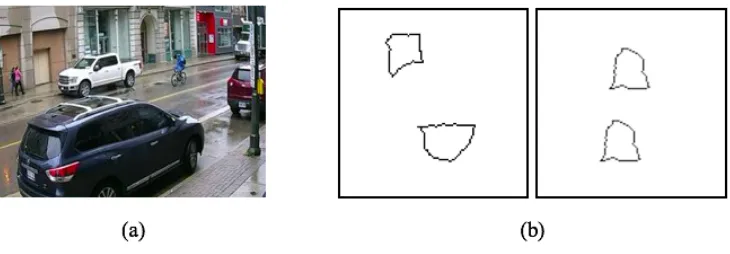
1.1 The image in (a) can be classified as containing the car by CNNs with high
confidence. However, CNN fails to learn the concept of “sameness” and
“dif-ference”: the first image in (b) has two different curves and the second image
in (b) has two same curves. The image in (b) is from the Synthetic Visual
Reasoning Test tasks [10]. . . 2
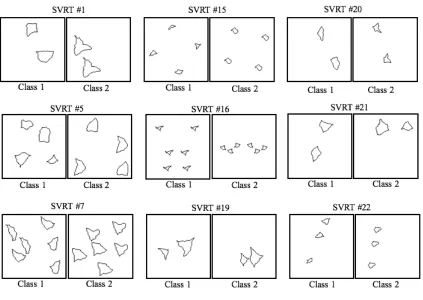
1.2 A few same-different examples from the SVRT tasks. . . 4
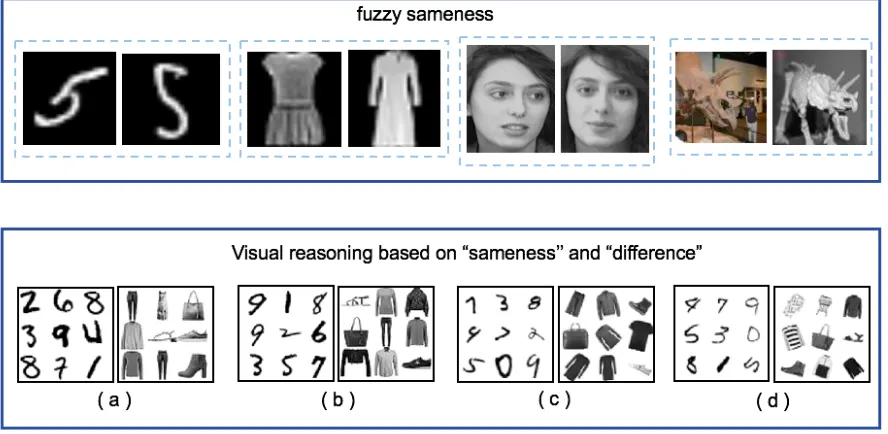
1.3 A few “sameness” examples generated by MNIST, Fashion-MNIST,
miniIm-agenet and Face datasets. The first line of images needs to deal with fuzzy
“sameness” and the second line needs to solve visual reasoning. In second line,
(a) contains one exact duplicate. (b) contains one fuzzy duplicate. (c)
con-tains one exact duplicate with some transformations (scaling and rotating). (d)
contains one fuzzy duplicate with some transformations . . . 6
2.1 Examples for several abstract visual reasoning tasks . . . 9
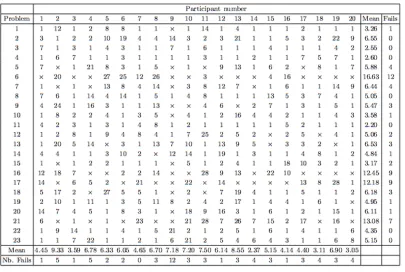
2.2 Completed experimental results with humans (taken from the source:
Compar-ing machines and humans on a visual categorization test, Fleuret et al. [10]).
Each row corresponds to one of the 23 problems and each column to one of the
20 participants. Each cell contains the number of attempts before seven
con-secutive correct categorizations were made. Entries containing “X” indicate
that the participant failed to solve the problem, and those cells are not included
in the marginal means [10]. . . 10
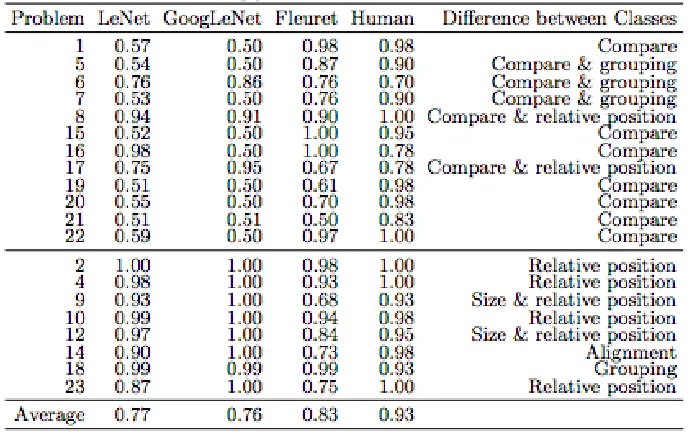
2.3 Experiment results on the SVRT classification tasks (taken from the source: 25
years of cnns: Can we compare to human abstraction capabilities?, Stabinger
et al. [30]) . . . 11
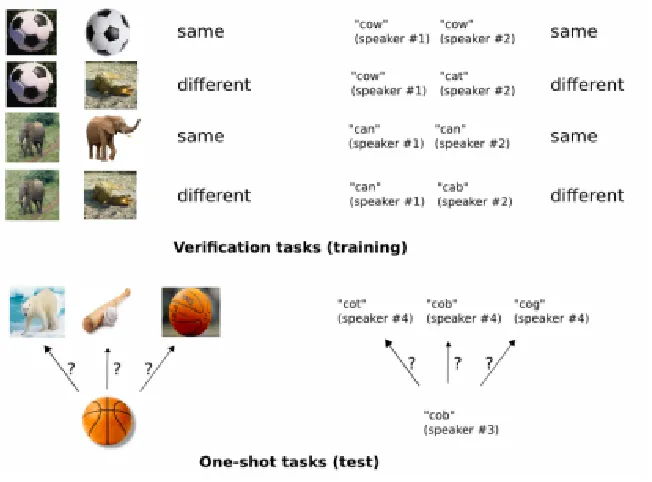
2.4 General strategy for siames neural network(taken from the source: Siamese
neural networks for one-shot image recognition, Koch et al. [18]). . . 12
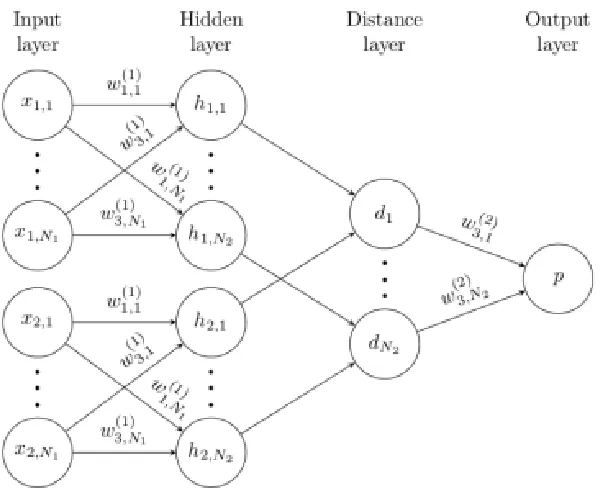
2.5 A sample 2 hidden layer siamese network for binary classification with logistic
prediction p (taken from the source: Siamese neural networks for one-shot
image recognition, Koch et al. [18]). . . 13
2.6 An example for meta-learning (learn to learn) based few-shot learning method. 14
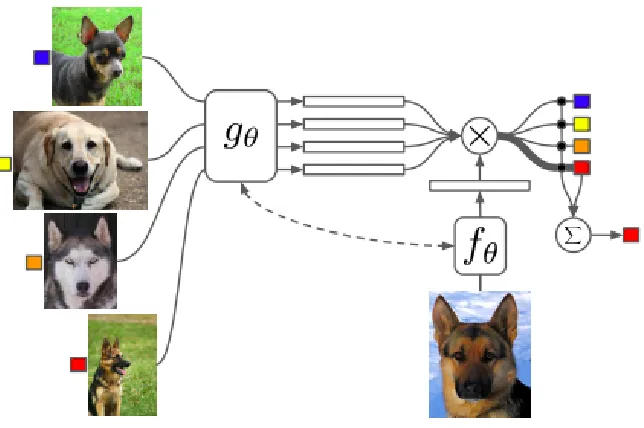
2.7 Matching Networks architecture(taken from the source: Matching networks for
one shot learning, Vinyals et al. [34]) . . . 16
2.8 Prototypical Networks in the few-shot and zero-shot (no labeled example)
sce-narios (taken from the source: Prototypical networks for few-shot learning,
Jake Snell et al. [29]). . . 17
2.9 Relation Network architecture for a 5-way 1-shot problem with one query
ex-ample (taken from the source: Learning to compare: Relation network for
few-shot learning, Flood Sung et al. [31]). . . 18
3.1 A few samples in “sameness” class for SVRT #1 . . . 21
3.2 The simplified process in solving the SVRT SD problems through our approach 22
3.3 The method of calculating IoU in the field of image . . . 23
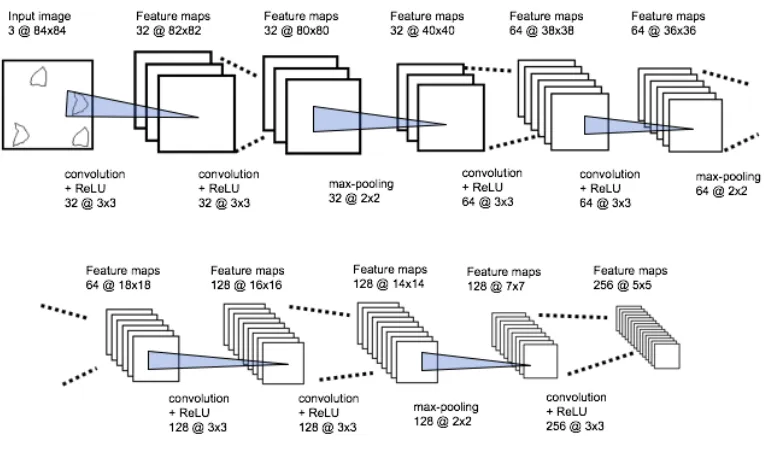
3.4 Convolutional architecture for the embedding module . . . 25
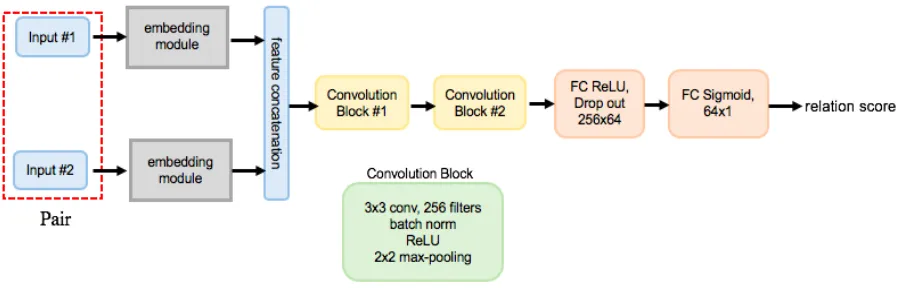
3.5 Relation module for few-shot learning SD problems . . . 26
4.1 The Omniglot dataset contains different images from alphabets across the world. 30
4.2 A few samples of random data augmentation generated for three images in the
Omniglot data set . . . 31
4.3 Examples of the fifth-layer convolutional filters learned by same-different twins
network. . . 36
5.1 Generalize to evaluate 10-way one-shot task on MNIST based on learned fea-tures from Omniglot . . . 41
5.2 A few examples for MNIST same-different visual reasoning tasks . . . 42
5.3 Generalize to evaluate 10-way one-shot task on Fashion-MNIST based on learned features . . . 44
5.4 A few examples from Fashion-MNIST SD visual reasoning tasks . . . 45
5.5 A sample for the generated pairs using AT&T Database of Faces . . . 47
5.6 One-shot task on facial recognition . . . 48
A.1 Summary for Same-different Twins Network (input size: 84 x84) . . . 58
A.2 Summary for Same-different Twins Network (input size: 28 x28) . . . 59
B.1 Summary for Fine-tune deep CNNs (Vgg-16) . . . 61
B.2 Summary for Model-Agnostic Meta-Learning . . . 62
B.3 Summary for Prototypical Network . . . 63
B.4 Summary for Relation Network . . . 64
B.5 Summary for Convolutional Siamese Network . . . 65
List of Tables
4.1 Comparing the one-shot accuracy between the Siamese network and
Same-different twins network. . . 36
4.2 A summary of the test results on the SVRT SD problems for different methods. 38 5.1 Experiment results for MNIST 10-way one-shot classification tasks. . . 42
5.2 Experiment results for MNIST same-different visual reasoning tasks. . . 43
5.3 Results for Fashion-MNIST 10-way one-shot classification task. . . 45
5.4 Experiment results for FashionMNIST SD visual reasoning tasks. . . 46
5.5 Experiment results for one-shot facial recognition task. . . 48
Chapter 1
Introduction
In this chapter, we provide some background on same-different problems and discuss the
im-portance of the research question and our contribution toward solving it. The thesis layout is
introduced at the end.
1.1
Background
In recent years, computer vision has witnessed many significant breakthroughs in standard
recognition tasks such as image classification [19], image segmentation [6] (the process of
par-titioning a digital image into multiple segments) or object detection [26]. Most of these gains
are a result of applying deep convolutional neural networks (CNNs). However, visual learning
tasks requiring attention to highly abstract concepts such as “sameness” and “difference” have
proven especially difficult for standard deep CNNs [30,17].
Considering the two images in Figure 1.1, the image on the left (a) could have been
cor-rectly classified as containing the cars by the deep convolutional neural network after the
net-work was trained on thousands of images. However, similar algorithms struggle to learn the
concepts of “sameness” and “difference” for the image on the right (b) even after seeing
mil-lions of training examples, although it may be simple and obvious for humans. The ability to
recognize visual tasks with highly abstract concepts is a ubiquitous human skill that has not
2 Chapter1. Introduction
Figure 1.1: The image in (a) can be classified as containing the car by CNNs with high con-fidence. However, CNN fails to learn the concept of “sameness” and “difference”: the first image in (b) has two different curves and the second image in (b) has two same curves. The image in (b) is from the Synthetic Visual Reasoning Test tasks [10].
seen significant progress for the machine.
The study of same-different problems has many practical implications. One of the popular
applications is face similarity recognition [15]. Face recognition can help us verify identity or
do some face analysis. In modern mobile devices, there are many features developed based
on face recognition, such as the ability to turn on our phone or open our bank app via face
recognition. Face recognition can also help us target people from many people. The research
of same-different problems can significantly improve the performance of face recognition.
Besides, humans can learn these highly abstract visual concepts such as “sameness” and
“difference” with little supervision. When a person meets someone once, they can usually
remember who the person is when they meet on the street next time. In the Synthetic Visual
Reasoning Test tasks (SVRT) [10], it has also been proven that humans can learn the concepts
of “sameness” and “difference” with only few examples [30, 10]. However, for most deep
learning models, they need large amounts of labeled training data to train their large number
of parameters. Considering that (1) there aren’t many labeled dataset in real life and much
annotation is needed for new classes which is very time-consuming and labor-intensive, (2) in
some cases, numerous annotated images may simply never exist for newly emerging categories
1.2. ResearchQuestion 3
essential and helpful.
All these motivate the study we are interested in: few-shot learning same-different tasks,
which aims to recognize “sameness” and “difference” visual categories based on very few
labeled examples. It would be a huge challenge to solve the same-different problems due to
that: (1) Previous work shows that standard deep learning methods are not capable of solving
same-different problems even when provided with millions of training samples [30, 17]. (2)
The availability of only one or very few examples challenges the standard ‘fine-tuning’ practice
in deep learning [9] and more easily causes over-fitting.
1.2
Research Question
In this thesis, we primarily deal with the same-different classification through few-shot
learn-ing. In particular, we try to solve SVRT same-different problems by using few-shot learning
and then apply our model to solve more complex same-different problems in real life.
1.2.1
SVRT Visual Reasoning Tasks
Synthetic Visual Reasoning Test tasks include 23 tasks. The 23 SVRT tasks can be split into
two groups based on the type of patterns: spatial relation (SR) problems (ex. shapes in a line vs.
not in a line) and same-different (SD) problems (ex. two pairs of unique shapes vs. two pairs of
identical shapes) [30]. Previous attempts on SVRT problems show deep learning approaches
are capable of solving SR problems, at least when provided with plenty of training data (20K
training images in [30] and 1 million used in [17]), but fail to solve SD problems even when
provided with millions of training samples [30,17].
A few examples of SD problems taken from the SVRT tasks are given in Figure 1.2. Each
pair of images stands for one SVRT task, and the pair is divided into two classes: “sameness”
(Class2) and “difference” (Class1). In the “sameness” class, in addition to determining
4 Chapter1. Introduction
Figure 1.2: A few same-different examples from the SVRT tasks.
and “invariant on scaling and rotating” are also included. Therefore, we not only need to deal
with “sameness” and “difference”, but also need to solve the visual reasoning based on
“same-ness” and “difference”. Some same-different problems in the SVRT tasks are even very difficult
for human beings such as SVRT #5, #7, #16, #21 [10]. These tasks need to deal with some
highly abstract visual reasoning such as“grouping”, “reflection”, and “invariant on scaling and
rotating”.
For SVRT #5, both classes contain four random objects. Class 1 contains four different
objects, while class 2 contains two pairs of the same objects. For SVRT #7, both classes
contain six objects. In class 1, objects can be organized into three groups, each containing
two same objects. In class 2, objects can be organized into two groups, each consisting of
three same objects. SVRT #16 requires the agent to decide whether shapes on the right side
1.3. Contributions 5
very challenging task. Each image contains two objects. One of the objects in class 2 can be
obtained from the other by scaling, translating, and rotating.
Francois Fleuret et al. studied SVRT tasks. In their experiment of few-shot learning for
SVRT SD problems, the prediction accuracy remained virtually at 50% for every problem [10].
Many SD tasks only have about 50% accuracy, even trained by plenty of training samples [30].
So it would be a huge challenge to solve the same-different problems with few training samples.
In this thesis, we will study how to use few training samples to determine whether two objects
the same or different and how to make visual reasoning based on “sameness” and “difference”,
so as to correctly classify the new image into its category.
1.2.2
Other Same-di
ff
erent Problems
We also apply our model to solve more other SD problems in real life. These problems are
gen-erated through other datasets such as MNIST, Fashion-MNIST, and Face datasets, and need to
deal with some fuzzy “sameness” and visual reasoning based on “sameness” and “difference”.
Figure 1.3 shows several “sameness” examples for these same-different problems. Chapter 5
introduces these problems in detail and shows how we solve them by using our model. Through
these applications, it has been shown that our model can be used in a wider variety of
same-different problems.
1.3
Contributions
In this thesis, we proposed a new method to solve SD visual classification problems when a
few training samples are provided. Our new approach is inspired by research on object
de-tection and few-shot learning. This method is divided into three parts: (1) Regions of Interest
(RoIs) are obtained through selective search method; (2) Similarities between RoIs are learned
through the same-different twins network. (3) The class labels for new images are recognized
6 Chapter1. Introduction
Figure 1.3: A few “sameness” examples generated by MNIST, Fashion-MNIST, miniImagenet and Face datasets. The first line of images needs to deal with fuzzy “sameness” and the second line needs to solve visual reasoning. In second line, (a) contains one exact duplicate. (b) con-tains one fuzzy duplicate. (c) concon-tains one exact duplicate with some transformations (scaling and rotating). (d) contains one fuzzy duplicate with some transformations
abstract visual reasoning of “sameness” and ”difference” into the problem of calculating the
similarities between the Regions of Interest. Therefore, the classification tasks of “sameness”
and “difference” can be solved more directly and efficiently. By using the region comparison
methods, we are able to achieve accuracies above 90% on several tasks and above 85% on
av-erage with only ten training samples. Our method even surpasses reported human performance
on some SD tasks such as SVRT #5, #15, and #16 [10]. We also evaluate the performance of
our approach on other SD tasks generated by using MNIST, Fashion-MNIST, and face dataset.
These tasks need to deal with some fuzzy “sameness” and our method also achieves good
performance on these tasks.
The main contribution of this thesis is as following:
• We developed a same-different twins network that can be used to solve the same-different
1.4. Structure of thisThesis 7
3.2.2.
• We built a novel model to solve SVRT SD problems with few-shot learning through
com-bining regions of interest module, same-different twins network, and pattern recognition
module together, achieving state-of-the-art performance on all SVRT SD problems,
see-ing Chapter 3.
• We benchmarked several popular few-shot learning algorithms on the SVRT SD
prob-lems and demonstrated the strength of our approach on few-shot learning of SD visual
tasks, outperforming the previous state-of-the-art as well as several strong baselines,
seeing Chapter 4. We believe this work will inspire future development in solving the
same-different problems.
• We evaluated the performance of our method on several other SD tasks generated by
using MNIST, Fashion-MNIST, and Face dataset, showing that our method could be
applied to a broader variety of same-different problems, seeing Chapter 5.
1.4
Structure of this Thesis
This thesis aims to solve the same-different problems through few-shot learning. This Chapter
has introduced the background and the research problems in this thesis. The rest of the thesis
is organized as follows. In Chapter 2, we provide an overview of the related work, including
research on SD visual reasoning tasks and few-shot learning methods and Regions of Interest
selection. In Chapter 3, we describe our new approach to solving the same-different visual
reasoning problems. In Chapter 4, we discuss the experiments, including the datasets that we
use, baseline models, and experiment results. In Chapter 5, we use our model to solve more
other SD tasks generated through other datasets such as MNIST, Fashion-MNIST, and Face
Chapter 2
Related Work
In this chapter, we will briefly review the previous work done on same-different problems,
describe various few-shot learning methods in image classification, and provide an overview
of approaches for selection of Regions of Interest.
2.1
Research on Same-di
ff
erent Problems
Same-different problems contain standard same-different classification tasks (whether two
im-ages belong to the same category) in a broad sense and same-different visual reasoning task
(some highly abstract visual concepts are contained in one image).
2.1.1
Same-di
ff
erent Visual Reasoning Tasks
There are several potential sources of abstract visual reasoning tasks. These embody the
CLEVER dataset (answer queries based on a scene with multiple objects) [16], Bongard
prob-lems (classify the new images through seeing six labeled pictures in each class) [4], Raven’s
Progressive Matrices (given several patterns, identify the missing pattern) [24], and Synthetic
Visual Reasoning Test tasks (SVRT) (given N labeled images, classify unseen new images) [10].
Figure 2.1 shows several examples of these abstract visual reasoning tasks. Unlike Ravens
2.1. Research onSame-differentProblems 9
Figure 2.1: Examples for several abstract visual reasoning tasks
gressive Matrices and CLEVR datasets that have seen significant progress [2,14], SVRT tasks
and Bongard problems only have seen partial success. SVRT tasks can be divided into two
kinds of tasks: spatial relation tasks and same-different visual reasoning tasks. Perhaps due
to the difficulty in learning to solve same-different problems in SVRT tasks, most work in this
same-different visual reasoning task has focused on examining how and why machine learning
approaches have failed.
Francois Fleuret et al. [10] first introduced the SVRT tasks and showed that humans are
much more proficient at these tasks than the presented machine learning approaches. They
used SVRT tasks to compare the efficiency in binary image classification between human and
machine learning and demonstrated that the SVRT tasks were easy to spot and characterize
for humans, but those tasks were challenging to learn for generic machine learning systems.
Figure 2.2 shows the human performance on SVRT tasks tested by Fleuret et al [10]. 20 people
who participated in Fleuret’s experiments would be randomly given one image from the two
10 Chapter2. RelatedWork
Figure 2.2: Completed experimental results with humans (taken from the source: Comparing machines and humans on a visual categorization test, Fleuret et al. [10]). Each row corresponds to one of the 23 problems and each column to one of the 20 participants. Each cell contains the number of attempts before seven consecutive correct categorizations were made. Entries containing “X” indicate that the participant failed to solve the problem, and those cells are not included in the marginal means [10].
correctly identified the class 7 times in a row, it proved that he/she learned this rule, and when
35 consecutive failures occurred to the classification, it proved that he/she failed to learn the
rule.
For machine learning methods, Fleuret et al. [10] paired three different feature groups with
two classification algorithms, and found that the best performing pair combined Fourier and
wavelet coefficients derived from the images with Adaboost [11]. However, in their few-shot
experiments (with only ten labeled examples of each problem), the performance on most of
the 23 tasks was roughly random, with accuracy about 50%. With a large number of training
samples, the difficulty between same-different and spatial relation tasks became more
2.1. Research onSame-differentProblems 11
Figure 2.3: Experiment results on the SVRT classification tasks (taken from the source: 25 years of cnns: Can we compare to human abstraction capabilities?, Stabinger et al. [30])
on average on same-different tasks and 88% accuracy on average on spatial relation tasks.
Some same-different problems could not be solved with even 10,000 training examples with a
performance of around 60%.
A unique approach to solving SVRT tasks is presented by Kevin Ellis et al. [7]. They
introduced an unsupervised learning algorithm to solve SVRT tasks. Their method synthesized
programs from data. First, their model parsed the images into symbolic forms by locating
distinct shapes (SVRT tasks are particularly amenable to this). Then, using a grammar tuned for
the task, their algorithm searched over a space of drawing programs, looking for those that best
reproduce the original image over the space. Once a program had been found for each training
image, a classifier was trained to map drawing programs to class labels, where it demonstrated
strong performance. The algorithm could learn how abstract structures are represented in vision
and achieve excellent performance on SVRT tasks. However, this approach is quite slow, and
some images may take hundreds of seconds to synthesize the program.
When studying the SVRT problems with more modern computer vision approaches,
12 Chapter2. RelatedWork
Figure 2.4: General strategy for siames neural network(taken from the source: Siamese neural networks for one-shot image recognition, Koch et al. [18]).
and GoogLeNet [32] CNNS. Figure 2.3 shows the experimental results on the SVRT
classifi-cation tasks from Stabinger et al. They found that near-perfect performance was achievable on
roughly half of the tasks, with the other half being significantly more difficult (near-random).
By observing the abstract concepts required to solve each SVRT task, they noticed that the
easy-difficult split closely corresponded to whether or not tasks required same-different
com-parisons, with a couple of exceptions (they determined that a couple of same-different problems
could be solved by exploiting simple pixel distribution patterns). The authors found that both
CNNs perform very similarly, working well on spatial relation problems and not seem to have
made much progress on same-different problems, despite training each network on 20,000
im-ages per class. Many same-different tasks only achieved about 50% accuracy even when CNNs
were trained by plenty of training sets. The general inability for CNNs to learn to solve SD
tasks is also supported by [17], where a more systematic examination of the performance of an
2.1. Research onSame-differentProblems 13
Figure 2.5: A sample 2 hidden layer siamese network for binary classification with logistic prediction p(taken from the source: Siamese neural networks for one-shot image recognition, Koch et al. [18]).
2.1.2
Standard Same-di
ff
erent Classification Tasks
Koch et al. [18] built a Convolutional Siamese Neural Network to solve same-different image
recognition problems by one-shot learning. Figure 2.4 shows the general strategy for Siamese
Neural Network. The author first trained a model to discriminate between a collection of
same/different pairs, and then made the model generalize to evaluate new categories based
on learned feature mappings for verification. A Siamese Neural Network consists of twin
networks that accept distinct inputs but are joined by an energy function at the top. This
function computes some metric between the highest-level feature representation on each side,
as shown in Figure 2.5. In this thesis, we developed our same-different twins network based
on the Siamese Neural Network by changing the feature embedding layer and distance metric
14 Chapter2. RelatedWork
Figure 2.6: An example for meta-learning (learn to learn) based few-shot learning method.
2.2
Few-shot Learning Methods
The study of few-shot learning has become a hot research direction for some time. Few-shot
classification [22,20,18] is a task in which a classifier must be trained to recognize new classes
not seen in the training samples when few training examples are given. A simple method, such
as re-training the model on the new training samples, would lead to severe over-fitting. While
the problem is quite tricky for the machine, it is straightforward for human beings. It has
been demonstrated that humans can perform even one-shot classification where only a single
example of each new class is given with high accuracy [20].
Earlier work on few-shot learning mainly introduced generative models by using some
complex strategies such as probabilistic models based on the Bayesian approach [8,20]. With
the success of deep learning on large-scale data sets [19,12, 28], many people contributed to
generalizing deep learning-based approaches to solve few-shot learning problems. Many of
those approaches use a meta-learning or learning-to-learn strategy, which means that they
ex-tract some transferable knowledge from previous tasks or some auxiliary tasks, such as
transfer-learning method. This transferable knowledge can help to learn the target few-shot problems
well without suffering from the over-fitting that often occurs when applying deep learning
2.2. Few-shotLearningMethods 15
Meta-learning can be divided into two phases: meta-training phase and meta-test phase. In
the meta-training phase, the training data sets are decomposed into different meta tasks, which
help the model to learn the generalization ability in the case of category change. If a meta-task
containsCdistinct classes andKexamples in each class, the target few-shot problem is called
C-wayK-shot. In the meta-test phase, classification for the new class can be completed without
changing the existing model. Figure 2.6 shows an example for meta-learning (learn to learn)
based few-shot learning method. There are mainly three kinds of meta-learning models in
modern few-shot learning methods: Fine-Tune based, RNN based, and Embedding and Metric
Learning based.
2.2.1
Few-shot Learning based on Fine-Tuning
Deep CNNs have recently shown outstanding image classification performance in large-scale
visual recognition challenges. However, to train a CNN requires a large number of labeled
image samples because CNN has millions of parameters that need to be estimated. For
few-shot learning tasks, it is obviously not feasible. A solution is to use a pre-trained CNN as a
feature extractor [23]. Transfer Learning is the reuse of a pre-trained model on a new problem.
When solving a new problem, most of the layers in front of the model are frozen, and we only
need to fine-tune the last few layers. It is currently popular in the field of deep learning because
it enables us to train deep neural networks with comparatively little data.
C. Finn et al. [9] proposed Model-Agnostic Meta-Learning (MAML) approach, which
aimed to train a given neural network model on a variety of learning tasks to obtain the initial
weight configuration, such that it can solve new tasks using only few training samples. The
strategy here is to meta-learn an initial set of neural network weights (the parameters of the
model), so the neural network models can be effectively fine-tuned to produce excellent
gener-alization performance on the new few-shot learning tasks within few gradient-descent update
steps. S Ravi et al. [25] further proposed the few-shot optimization method, which used an
net-16 Chapter2. RelatedWork
Figure 2.7: Matching Networks architecture(taken from the source: Matching networks for one shot learning, Vinyals et al. [34])
.
work weights but an LSTM-based optimizer. The optimizer can be trained to be specifically
effective for fine-tuning. The biggest problem for the fine-tune based meta-learning methods is
that these approaches need to fine-tune on the target problems.
2.2.2
Few-shot Learning based on RNN Memory
Adam Santoro et al. proposed meta-learning with memory-augmented neural (MANN)
net-works [27] that uses recurrent neural networks (RNN) with memories. Meta-learning means
that the weights of the RNN are trained by learning many distinct meta tasks. The strategy
here is to use RNN to accumulate the knowledge in its hidden activations or external memory
through iterating on the meta-training examples. The stored knowledge can help to solve the
target few-shot problems. When classifying new classes, it can be done by comparing them
with historical information stored in the memory. The main challenge for MANN is to
en-sure that all the relevant historical information has been reliably stored in the RNN without
2.2. Few-shotLearningMethods 17
Figure 2.8: Prototypical Networks in the few-shot and zero-shot (no labeled example) scenarios (taken from the source: Prototypical networks for few-shot learning, Jake Snell et al. [29]).
2.2.3
Few-shot Learning based on Embedding and Metric Learning
Another kind of popular meta-learning based few-shot learning method is the embedding and
metric learning approach. This method aims to learn a set of projection functions that take
C-way K-shot tasks from the target problem and classify new images in a feed-forward
man-ner [34,29, 3]. The meta-learning here is to train a metric net through learning many distinct
meta tasks. The metric net will learn how to parameterize a classifier to classify the new
classes in terms of the sparse support training set. Metric-learning based approaches aim to
learn a set of projection functions such that when images are represented in this embedding,
they are easy to recognize using simple nearest neighbor or linear classifiers [34, 29, 18]. In
this case, the meta-learned transferable knowledge is the projection function, and the target
few-shot problem is a simple feed-forward computation. Matching Networks [34],
Prototypi-cal Networks [29], Relation Network [31], and Convolutional Siamese Network [18] belong to
embedding and metric learning approach.
Vinyals et al. [34] proposed Matching Networks, which uses an attention mechanism over
the embeddings of the labeled training sets (support set) to predict new classes for the unlabeled
test sets (query set). Figure 2.7 shows the Matching Networks architecture. The architecture
learns a network that maps a small labeled supporting set and an unlabeled example to its label,
18 Chapter2. RelatedWork
Figure 2.9: Relation Network architecture for a 5-way 1-shot problem with one query example (taken from the source: Learning to compare: Relation network for few-shot learning, Flood Sung et al. [31]).
Jake Snell et al. [29] proposed the Prototypical Networks, which is based on the idea that
each class can be represented by the mean of its supporting examples in a representation space
learned by a neural network. When one query comes, its classification can be performed by
computing distances to prototype representations of each class. Figure 2.8 shows the
Prototyp-ical networks in the few-shot and zero-shot scenarios.
Flood Sung et al. [31] proposed the Relation Network, which is designed to learn a deep
distance metric to conduct few-shot learning within episodes. In each episode, the network
is designed to simulate the few-shot setting. After training, the relation network is able to
classify images of new classes by computing relation scores between query images and the few
supporting examples of each new class. Figure 2.9 shows the relation network architecture for
a 5-way 1-shot problem with one query example.
The most related methods to ours are the Relation Networks [31] and the Convolutional
Siamese Networks [18]. These approaches focus on learning embeddings in which images are
represented, such that it can be easily recognized using a fixed nearest-neighbor [29] or linear
2.3. Regions ofInterestSelection 19
Network, replacing the fixed metric on the top of the Convolutional Siamese Network for the
relation classifier CNN in Relation Network. Therefore, our method can provide a learnable
rather than fixed metric, or non-linear rather than linear classifier.
2.3
Regions of Interest Selection
Regions of Interest selection is also called object proposal in some papers. It has been widely
used in the object detection area. Comprehensive surveys and comparisons about RoIs
selec-tion methods can be found in these papers [13, 5]. To sum up, Regions of Interest selection
methods could be divided into two approaches: one method is based on grouping superpixels
(e.g., selective search [33]). Another method is based on sliding windows (e.g., objectness
in windows [1], EdgeBoxes [35]). Many object proposal methods, like selective search, have
been used as an independent detector module. In this paper, we use selective search method to
obtain the Regions of Interest because selective search that is used as an independent detector
Chapter 3
Methodology
In this chapter, we explain our approach for few-shot learning same-different visual problems
in detail. Firstly, we analyze the problem that we need to solve and define it as one-shot
learning in a broad sense, and then we describe our model and each module in the model in
detail. Lastly, we briefly introduce how our model learns on training samples.
3.1
Problem Definition
We try to solve the same-different problems with few-shot learning. According to the previous
research on few-shot learning, we need to use three datasets: a training set, a supporting set,
and a testing set. The support set and testing set share the same label space. They are from
the target few-shot problems. With the support set only, we can, in principle, train a classifier
to predict a class labelyfor each sample xin the test set. However, due to the lack of labeled
samples in the support set, it will cause over-fitting, and the performance of such a classifier
is usually not satisfactory. Therefore, we need to use the training set to perform the
meta-training tasks in advance. The meta-training set has its own label space that is different from the
support and testing set, and is mainly used to perform the meta-training such that transferable
knowledge can be learned to help to perform better few-shot learning on the support set and
classify the test set more effectively. When the support set contains C distinct classes and
3.2. Model 21
K examples in each class, the target few-shot problem is called C-wayK-shot. Considering
SVRT SD problems consisting of randomly generated objects in each class of each task (e.g.
for SVRT #1, although Class 2 contains two same objects in each image, the same objects are
different among the images, as shown in Figure 3.1), we need to learn the similarity between
the objects for each image when solving this problem. Therefore, we can define the problem
we are studying as one-shot learning, which means that the machine needs to predict whether
another object is the same as this object that machine only saw once.
Figure 3.1: A few samples in “sameness” class for SVRT #1
3.2
Model
In order to solve the SVRT SD problems, we built a novel model. Our model consists of three
parts: 1) Regions of Interest selection module. 2) same-different twins network. 3) pattern
recognition module. Figure 3.2 illustrates the simplified process in solving the SVRT
same-different problems through our approach. Firstly, samples xi are entered into the regions of
interest selection module, resulting in a set of regions of interest (ri, rj,...). Then randomly
grouping these regions of interest into pairs and feeding each pair into the same-different twins
network. Same-different twins network is developed based on the Convolutional Siamese
Neu-ral Network [18] through replacing the fixed L1 distance metric on the top of the siamese
network to a learnable CNN metric. Same-different twins network contains two modules: an
22 Chapter3. Methodology
embedding module fϕ, which produces feature maps fϕ(ri) and fϕ(rj). The feature maps fϕ(ri)
and fϕ(rj) are combined with operatorC(fϕ(ri), fϕ(rj)). In this work, we assume C(., .) to be
the concatenation of feature maps in depth. The combined feature map of the pair is fed into
the relation modulegφ, which eventually produces a scalar in range of 0 to 1 representing the
similarity for each pair such as ri and rj, which is called relation score. The relation score
betweenri andrj is gφ(C(fϕ(ri), fϕ(rj))). After that, we use the pattern recognition module to
determine which class samplesxibelongs to based on these relation scores. The pattern
recog-nition module includes a filter module p and a k-nearest classifier. The filter module p sets
the relation scores below the threshold to 0 and then adds all theses relation scores to obtain a
similarity value. Finally, we use a k-nearest neighbor classifier to predict the class label based
on the similarity value for each test image.
Figure 3.2: The simplified process in solving the SVRT SD problems through our approach
3.2.1
Regions of Interest Selection Module
To locate the objects in the image, we use the selective search method [33] to obtain
3.2. Model 23
Python-OpenCV. Selective search combines the advantages of both an exhaustive search and
segmentation, and it can capture all possible object locations with high recall. Selective search
has been developed as an independent detector. There are three hyper-parameters in the
se-lective search method: scale, sigma and minSize. Objects can be effectively located through
configuring reasonable parameters for the hyper-parameters sigma, scale, minSize. In all
de-tection results, some dede-tection results are inaccurate and highly repetitive. In order to remove
duplicate regions and improve detection accuracy, we calculate the Intersection-over-Union
(IoU) among regions. In mathematics, IoU is a statistic used for gauging the similarity and
diversity of sample sets. In the field of the image, IoU is a standard for measuring the detection
accuracy of a corresponding object. The method of calculating IoU in the field of the image is
showed in Figure 3.3. It means that the area where the two detection regions overlap is divided
by the total area. We set a threshold to remove the inaccurate detection results for SVRT SD
problems. When the IoU between two regions is greater than the threshold, the region with the
smaller area is removed. Each bounding box is defined by a four-tuple (r,c,h,w) that specifies
its top-left corner (r,c) and its heighthand widthw.
24 Chapter3. Methodology
3.2.2
Same-di
ff
erent Twins Network
Same-different twins network is developed based on the Convolutional Siamese Neural
net-work [18]. As we have known, metric-learning based approaches aim to learn a set of
projec-tion funcprojec-tions such that when images are represented in the embedding space, they are easy to
recognize using simple nearest neighbor or linear classifiers [34,29,18]. In the Convolutional
Siamese Neural network [18], the authors used theL1 distance metric to compute the distance
between the highest level feature representations of each pair. In this work, we use a
learn-able CNN metric called relation module to replace the L1 distance metric. Compared withL1
distance that focuses on learning a shallow (linear) Mahalanobis metric for fixed feature
rep-resentation, the CNN metric can learn a deep non-linear metric (similarity function) that can
better identify matching/mismatching pairs. This has been shown in [31]. We also developed
a new embedding module that can accommodate the 84 x 84 SVRT images.
Figure 3.4 shows the convolutional architecture for the embedding module. VGG16 is a
convolutional neural network model proposed by K. Simonyan and A. Zisserman from the
University of Oxford in [28]. The model achieves 92.7% top-5 test accuracy in ImageNet,
which is a dataset of over 14 million images belonging to 1000 classes. We developed a
VGG-like architecture for the embedding module. The embedding module consists of a sequence
of convolutional layers and max-pooling layers. The convolutional layers have filters of size
three and a fixed stride of 1. The number of convolutional filters is specified as a multiple of
16, which refers to the Convolutional Siamese Neural network [18]. This setting can optimize
the performance of extracting features. The embedding applies a rectified linear units (ReLU)
activation function to the outputted feature maps. Each set of convolutional layers is followed
by a 2x2 max-pooling layer with the stride of 2.
After obtaining the feature maps of the twin pairs through the embedding module, the
fea-ture maps are concatenated in-depth and inputted into the relation module. Figure 3.5 shows the
relation module for few-shot learning same-different problems. The relation module consists
con-3.2. Model 25
Figure 3.4: Convolutional architecture for the embedding module
tains a convolution layer with 256 filters followed by batch normalization, ReLU non-linearity
activation function, and a 2x2 max-pooling layer. Each filter in the convolution layer has the
kernel size of 3x3. Two convolutional blocks are followed by two fully-connected layers. The
two fully-connected layers are 64 and 1 dimensional, respectively. The first fully-connected
layer uses the ReLU activation function, and the output layer uses the Sigmoid activation
func-tion (logistic funcfunc-tion) in order to generate relafunc-tion scores in a reasonable range for each twin
pair. Between the two fully connected layers, we added a dropout layer that helps alleviate
over-fitting.
3.2.3
Pattern Recognition Module
Some SVRT tasks contain more than two objects and need to solve the highly abstract concept
of “grouping” such as SVRT #5 and SVRT #7. For SVRT #7, objects in the positive class can
be organized into three groups, each containing two same objects. Objects in the negative class
26 Chapter3. Methodology
Figure 3.5: Relation module for few-shot learning SD problems
to identifying the sameness and difference for each pair, we also need to learn the pattern in
each class. As discussed, through a same-different twins network, we can obtain the relation
score for each pair and finally get all relation scores for all pairs. Based on the relation scores, a
simple method to recognize the pattern for each class is to get the sum of these relation scores.
However, due to that SVRT images are too simple, just composed of lines, many pairs that
belong to different classes also have very high relation scores. Therefore, we need to use a
threshold, which is obtained through training set and validation set, to distinguish the relation
scores. When relation score is below the threshold, this pair has a high probability of belonging
to a different class, and we set the relation score of this pair to 0. After that, we obtain the sum
of all the relation score as the similarity value. In this way, we can use simple nearest neighbor
or linear classifiers to recognize the class due to that the similarity is one-dimensional and can
reflect the pattern for each class. Finally, we train a k-nearest neighbor classifier to predict
class labels based on the similarities.
3.3
Learning
Loss function. Letiindexes theith mini-batch (the number of training data during one
itera-tion). Suppose the min-batch size ism. Lety(xi
1,x
i
3.3. Learning 27
vector refers to the true label of the mini-batch. When x1 andx2 belong to the same category,
y(xi1,xi2) = 1, otherwisey(xi1,xi2) = 0. Let vector p(xi1,xi2) withm length represents the
pre-dicted results for the mini-batch. We used the binary cross-entropy as the loss function. Binary
cross-entropy can be calculated as:
L(xi1,xi2) = −y(xi1,xi2)logp(xi1,xi2)−(1−y(xi1,xi2))log(1− p(xi1,xi2)) (3.1)
Optimization. Backpropagation is an algorithm widely used in the training of feedforward
neural networks for supervised learning. In this work, we also use the standard
backpropaga-tion algorithm to optimize our object funcbackpropaga-tion by calculating the gradient. We set the
mini-batch size to 128 with learning rateαj, momentumβjand regulation weightsλj, so the update
rule at epochT is as follows:
wkTj(x i
1,x
i
2) = wkTj + ∆wkTj(x i
1,x
i
2)+2λj|wk j| (3.2)
∆wkTj(x i
1,x
i
2) = −αj5wkTj +βj∆wkTj−1 (3.3)
where5wk j is partial derivative with respect to the weight between the jth neuron in some
layer and thekth neuron in the successive layer.
Weight initialization. Before the training, we initialized the weights and biases for all
convolution layers and fully-connected layers. For all convolution layers, the weights were
drawn from a normal distribution with zero mean and a standard deviation of 10−2. The biases
were initialized from a normal distribution with the mean 0.5 and a standard deviation of 10−2.
The fully-connected layers were initialized in the same way as the convolution layer, but the
weights were initialized using a normal distribution with zero mean and a standard deviation
of 2x10⁻¹.
Learning rate. In this work, we set the initial learning rate to α, and the learning rate is
gradually decreased following the method of dividing by 10. For example, assume that the
28 Chapter3. Methodology
monitored the one-shot validation error when training the same-different twins network. When
the validation accuracy did not increase for 50 iterations, we stopped and used the parameters
of the model at the best iteration step according to the one-shot validation accuracy. Then we
updated the learning rate to continue to train the network.
Hyperparameter optimization. For the learning rate and regularization
hyperparame-ters, we set the initial learning rateα[10−2,10−1], momentumβ[0,1], and regulation weights
λ[0,0.1]. For neural network hyperparameters, we set the number of convolution filters in
each layer from 16 to 256 using multiples of 16. For the fully connected layer
hyperparam-eters, we set the units from 16 to 256, also in multiples of 16. These hyperparameters are
Chapter 4
Experiments
In this chapter, we first discuss the experimental setup, including the datasets that we used and
the performance evaluation method, several strong baselines, and some experiment
implemen-tation details. Then, we present the experimental results of our approach and compare them
against the strong baselines. After that, we analyze the experimental results in detail.
4.1
Datasets
We use the meta-learning (learn to learn) strategy to solve the same-different problems with
few-shot learning. According to the previous research on meta-learning, we need to use two
kinds of datasets. The first data set is used for meta-training to extract some transferable
knowledge from some auxiliary tasks such that it can help the model to learn the generalization
ability. The second data set is the dataset for meta-testing, which is the SVRT problems that
we currently need to solve.
4.1.1
Meta-training datasets
In this thesis, we use the Omniglot dataset as the meta-training dataset to extract some
transfer-able knowledge. Omniglot dataset was collected by Brenden Lake and his collaborators [20]
30 Chapter4. Experiments
Figure 4.1: The Omniglot dataset contains different images from alphabets across the world.
and was used for studying one-shot learning and for developing more human-like learning
al-gorithms. Omniglot contains over 1600 handwritten characters from 50 different alphabets
ranging from familiar Latin to unfamiliar local dialects. Figure 4.1 shows a few examples from
the Omniglot dataset. Omniglot dataset can be obtained from the github1or downloaded from
www.omniglot.com.
The number of characters (classes) in each alphabet varies considerably from about 15 to
upwards of 40 characters. Each class contains 20 samples drawn by different people. Lake split
the 50 different alphabets into a 40 alphabet background set and a 10 alphabet evaluation set.
The background set is used for developing the same-different twins network by learning
hyper-parameters and feature mappings. The evaluation set is used to test the one-shot classification
performance of the network. Each image in Omniglot dataset is a 105x105 binary-valued image
which was drawn by hand on an online canvas. In order to transfer the developed twins network
to solve the SVRT problems, we resize the Omniglot dataset to 84x84 to keep consistent with
SVRT tasks. We also change the binary-valued image to the RGB image due to images in
SVRT tasks have an RGB image format.
Besides, considering that each class only contains 20 samples, we also augmented the
4.1. Datasets 31
Figure 4.2: A few samples of random data augmentation generated for three images in the Omniglot data set
ground set (training set) with the data augmentation, which is a strategy that can significantly
increase the diversity of data available for training models, without actually collecting new
data. The data augmentation techniques include scaling, rotation, horizontal flipping, and
translation. Figure 4.2 shows a few samples of random data augmentation generated for three
images in the Omniglot data set.
4.1.2
SVRT datasets (meta-testing datasets)
In this thesis, we try to solve the SVRT same-different visual reasoning problems. This series
of synthetic image recognition problems is developed by Fleuret and Don Geman. The code
to generate these SVRT tasks is publicly available at2. Figure 1.2 in Chapter 1 shows a few
examples of the SVRT SD problems. For each task, we use ten labeled training samples, 1000
validation sets, and 10000 test samples in order to compare our method with the published
results by Fleuret et al. [10] where the authors used ten training samples. We also augmented
the training sets with small affine distortions. The affine distortions include scaling and rotation.
The augmented training sets are mainly for training the pattern recognition module.
2
32 Chapter4. Experiments
4.2
Performance Evaluation Method
There are various metrics that can be used to evaluate machine learning algorithms. These
metrics include classification accuracy, F1 Score, confusion matrix, and so on. In this thesis,
we use the classification accuracy to evaluate the performance of our model. Classification
accuracy is the ratio of the number of correct predictions to the total number of input samples.
For every SVRT SD task, we conducted ten testing trials and used 1000 test samples for each
test trial (including 500 positive samples and 500 negative samples). The final performance is
the mean of classification accuracy for ten testing trials.
4.3
Implementation Details for Our Method
We solved the SVRT SD problems in three steps. The first step is to select the Regions of
Interest by the selective search. The second step is to meta-training the same-different twins
network. The last step is to use the trained same-different twins network to do one-shot learning
and predict the relation score for each pair of regions of interest. After that, the pattern
recog-nition module is used to do the classification task for SVRT same-different problems based on
the predicted relation scores.
For the selection of Regions of Interest, we set the hyper-parameters scale to 1000, sigma
to 0.3, and min size to 10, which helps to locate the objects effectively. For the IoU, we set
the threshold to 0.9, which means that when the IoU between two regions of Interest is greater
than 0.9, the region with the smaller area is removed.
For the same-different twins network, we used the Omniglot dataset for meta-training,
which helped the same-different twins network learn some transferable knowledge. Firstly,
randomly grouping the Omniglot background set into pairs, and then these pairs were fed into
the same-different twins network to train this network. Hyper-parameters follow the setting
below: batch size 128, Adam optimizer (the initial learning rate 0.06, momentum 0.6,
4.4. Baselines 33
network [18], and we set 1000 validation tasks for each evaluation to help us select the optimal
parameters. The network with the maximum classification accuracy was used to predict the
similarity of Regions of Interest on SVRT SD tasks. The same-different twins network was
implemented with PyTorch.
Finally, the pattern recognition module was used to predict the class for new SVRT SD
samples based on the similarities of Regions of Interest. Firstly, the pattern recognition module
filtered the relation scores and set the relation scores below the threshold to 0. The threshold
was learned through the SVRT SD validation set, selecting the value which had maximum
classification accuracy on the validation set. After that, the similarity value for each image was
obtained by adding the relation scores of all these pairs of regions of interest. Then we trained
a k-nearest neighbors classifier to predict class labels for each new SVRT image based on the
similarities. The value fork was chosen from{1,2,3,4,5}and the best value was found to be
k= 2.
4.4
Baselines
Apart from comparing to the few-shot learning results for SVRT same-different tasks obtained
by Fleuret et al. [10], we also compare our method against several other approaches known
to perform well at other few-shot classification tasks, including fine-tune deep CNNs,
Model-Agnostic Meta-Learning (MAML) [9], Prototypical Nets [29], and Relation Nets [31]. For
all these models, we used SVRT images of size 84x84, ten training samples,1000 validation
samples, and 10000 test samples. Performance is measured with classification accuracy. To
produce all experimental results, we average across ten trials, with 1000 different unseen test
images each trial. For hyper-parameter tuning, we used 1000 validation images for every task.
In addition, for meta-learning methods Model-Agnostic Meta-Learning (MAML) [9],
Pro-totypical Nets [29], and Relation Nets [31], we also used Omniglot datasets to do the
34 Chapter4. Experiments
SD tasks in the meta-testing phase. Due to that each SVRT task is a binary classification
ques-tion and has 10 training samples (5 positive, 5 negative), we defined the meta-learning tasks as
2-way 5-shot. The 2-way 5-shot meta-training tasks were generated through Omniglot datasets.
2-way 5-shot meta-testing tasks were also generated by SVRT SD problems(10 training
sam-ples, 10000 testing samples).
4.4.1
Fine-tune deep CNNs
Fine-tune deep CNNs is mainly the reuse of a pre-trained model on a new problem. When
solving a new problem, most of the layers in front of the model are frozen, and we only need to
fine-tune the last few layers. For this method, we fine-tuned the Vgg-16 architecture pre-trained
on ImageNet [28]. Other architectures are also possible such as ResNet, InceptionV3,
Xcep-tion. The fully connected layers in Vgg-16 architecture were replaced by two fully-connected
layers with width 256 and 64 activated by sigmoid function. The softmax classifier was trained
with the Adam optimizer provided by Keras, and the loss function used binary cross-entropy
loss. We trained the deep CNNs for 200 epochs, and the optimal number of epochs for each
SVRT same-different task was chosen based on the classification accuracy on validation set.
The optimal number of epochs for each task was chosen from{8,16,32,64}.
4.4.2
Model-Agnostic Meta-Learning
MAML aims to meta-learn an initial set of neural network weights (the parameters of the
model are explicitly trained), so the neural network models can be effectively fine-tuned to
pro-duce good generalization performance on the new few-shot learning tasks within few
gradient-descent update step. We used the same architecture for this approach, as in Finn’s article. The
implement process is publicly available in 3. 2-way 5-shot meta-training tasks are generated
through Omniglot datasets. We set 60000 meta-train iterations and used 1000 validation
im-ages for each task. Finally, we selected the model that maximized the prediction accuracy on
4.4. Baselines 35
SVRT SD validation images to test the 10000 different unseen SVRT SD images for each task
for ten trials (1000 test samples for one trial).
4.4.3
Prototypical Network
Prototypical network is developed based on the idea that each class can be represented by the
mean of its supporting examples in a representation space learned by a neural network on the
meta-training tasks. We used the same architecture for this approach, as in Snell’s article [29].
The implement process is publicly available in4. Omniglot datasets were used to do the 2-way
5-shot meta-learning task for the Prototypical network. Ten training samples in SVRT tasks
were used as the supporting set. Finally, we predict the class for the 10000 SVRT SD test
samples for ten trials (1000 test samples for one trial). The optimal number of epochs for each
task was chosen from{8,16,32,64}.
4.4.4
Relation Network
Relation network is designed to learn a deep distance metric through simulating the few-shot
setting in each episode. For this model, we used the same CNN architecture and Relation
Network architecture in Sung’s article [31]. The implement process is publicly available in5.
Omniglot datasets were used to do the 2-way 5-shot meta-learning task for the Relation
Net-work. Ten training samples in SVRT tasks were used as the supporting set. Finally, the class
was predicted for the 10000 test samples in SVRT SD tasks for ten trials (1000 test samples for
one trial) by using the trained model. The batch number for each class is set to 5. The training
episode and test episode are separately 10000 and 1000.
4https://github.com/jakesnell/prototypical-networks
36 Chapter4. Experiments
Figure 4.3: Examples of the fifth-layer convolutional filters learned by same-different twins network.
4.5
Experiment results
Our experimental results include two parts: one is for meta-training on Omniglot dataset, and
another part is for meta-testing on SVRT same-different problems.
4.5.1
Experiment Results for Meta-training
As mentioned before, we used the meta-learning strategy to train the same-different twins
network. Table 4.1 shows the meta-training experiment results for the same-different twins
network on Omniglot dataset. Due to that our same-different twins network was developed
based on the Siamese network [18], we also compared the 20-way one-shot performance of
our network to the Siamese network, as showed in Table 4.1. It can be observed that our
same-different twins network greatly improves the one-shot classification accuracy for nearly 5%,
compared with the Siamese network.
Method Test
Siamese network 92.0
Same-different twins network 96.7
Table 4.1: Comparing the one-shot accuracy between the Siamese network and Same-different twins network.
4.6. ExperimentResultsAnalysis 37
can be noticed that different filters have different effects. Some filters may look for very small
point-wise features, while some filters may act as the larger scale edge detectors.
4.5.2
Experiment Results for SVRT SD Problems
Table 4.2 contains the performance for each method on the SVRT same-different problems.
All results are averaged across ten trials except the results from Fleuret et al. [10], where the
number of trials is unknown. All results, except GoogLeNet and Human performance, were
obtained with only ten training samples. GoogLeNet used 20000 training examples. The
human performance showed in Table 4.2 was estimated by Stabinger et al. [30] based on the
original data reported by Fleuret et al. [10]. The average numbers of images required to learn
the rules for humans for each SVRT SD task were reported by Fleuret et al. [10] and shown in
the Figure 2.2 in Chapter 2.
The meanings of model acronyms in table 4.2 are as follows: Fleuret: The Adaboost and
spectral features model from Fleuret et al. [10]. PN: Prototypical Network. RN: Relation
Network. Vgg-16: Fine-tune deep CNNs, pre-trained Vgg-16 for feature extraction. MAML:
Model-Agnostic Meta-Learning. GoogLeNet: Performance of GoogLeNet on the SVRT SD
problems, published results from the paper [30]. Human: Estimated accuracy of participants,
and human tests were done by Fleuret et al. [10].
4.6
Experiment Results Analysis
The most immediate observation from Table 4.2 is the performance difference between our
approach and all other models we compare against. It can be observed that our model greatly
outperforms other models on all SVRT same-different problems with an average advantage
of above 35% when only provided with ten training samples. On some SD problems such
as SVRT #5, #15, and #16, our method even surpasses the reported performance of human