Available Online atwww.ijcsmc.com
International Journal of Computer Science and Mobile Computing
A Monthly Journal of Computer Science and Information Technology
ISSN 2320–088X
IMPACT FACTOR: 6.017IJCSMC, Vol. 7, Issue. 11, November 2018, pg.8 – 19
Student’s Perceptions on Mobile Learning
Ali Kawo Mohammed
1, Shamsudeen Lawal
21,2
Department of Mathematical Sciences, Federal University Gusau, P.M.B 1001 Zamfara State, Nigeria 1
[email protected], 2 [email protected]
Abstract: The rapid growth of technological equipments in our societies has eased the educational system by means of using mobile learning. Mobile Learning is a sort of learning that happens when the learner is not in a specific location or learning that happens when the learner takes advantage of the learning opportunities offered by mobile technologies. This paper is based on design implementation where survey will be conducted in some selected institutions in Northern Nigeria to determine the efficiency and trends in using mobile learning in academic environments and also to review the essential mobile applications used in enhancing these activities. Keywords: Mobile Learning, Dynabook, Pedagogical, Student perception, Mobile devices
1. INTRODUCTION
The terms “mobile learning” has been classified as the use of wireless devices by any individual to access information and learning materials at any given time and from anywhere. The dignified attribute of our social advancement has brought rapid rate of social and technological transformation. Technological advancement that allows fast communication and information processing that sustain the new social motives irrespective of time and location. Based on that, societies are no longer interested in geographical closeness [16].
Mobile learning is expected to be motivating and offer the Advantages of learning anywhere and anytime. The main reason for choosing mobile learning in this research is its popularity especially with young students today. Almost every person in an institution has at least one mobile phone.
The communication and data flow created by mobile technologies has tremendously reduced the dependence on fixed locations for work and study. However, individuals prefer training that it just in time, just for them and just enough that would convey pedagogical support outside the convention classroom settings. [10], suggested an alternative approach to mobile learning design to decrease the technical expertise required for mobile learning implementation and increase transferability, while unambiguously using a social constructivist pedagogical foundation, focusing upon the potential of mobile web.
This paper aimed in finding out the importance of mobile learning in academic environment and the trends of it essential application in respect to student’s field of studies and the magnitude of it ubiquity.
2. LITERATURE REVIEW
flawlessly along several dimensions, including location, time, pedagogy, and device type. This concept would have accomplished the required technicality.
Mobile learning is in many ways a new phenomenon; with its practical, technical and current development in organization structure. It is also a new observable fact in respect to the case study; with its convenient and technological innovation to developing countries, teaching and learning become easier and accessible at all time. [32], states that mobile learning is considered as the latest introduced type of learning where new learning strategies provided through mobile devices and applications. Many distance teaching and learning as well as residential institutions in developed countries have already started experimenting with mobile learning through parallel projects as part of their e-learning and information and communication (ICT) enhanced learning environments [21].
During the 1970’s, as American computer scientist Alan Kay spearheaded the initiative to use Dynabooks for learning and education Kay, along with his fellow colleagues from the Xerox Palo Alto Research Center anticipated that book-sized computers would be “a personal computer for children of all ages (Kay, 1972 )”[27]. The concept of the Dynabook with the elements of a graphical user interface (GUI), laid the foundation for the modern laptop computer. Although the Dynabook was never quite created, it led to the creation of the Xerox Alto and offered children access to learning in the form of digital media. It was to be an interactive machine that would be small and light enough to be carried everywhere by learners. [Wikipedia contributors. "Dynabook]. Mobile learning is about self-actuated personalization, the accessible wide range of mobile devices and wireless technologies gave an opportunity to realize different systems for mobile education and the ability of mobile technology to deliver synchronous communication and knowledge sharing that can provide benefit to human or systems. Evidence of these benefits has been reported by [9], who found that mobile learning persuade individual mutualization, such as networking and socialization in a normal and relaxing manner. [13,27], reported on a mobile learning study where majority of the students deliberated that it is vital to learn anytime at anywhere. [34] developed a study, in which participated 20 middle school teachers, enrolled in a Midwestern university’s mathematics teacher preparation course. the purpose of the study was to train the teachers on inquiry based mathematics content integrating PDAs’ (Personal Digital Assistants) to teach middle school mathematics students. The content of the training was based on the National Council of Teachers of Mathematics (NCTM 2000) including data analysis, ratios, geometry and measurement. at the end of the sessions, students were given a questionnaire to express their perceptions of this new project. most of the teachers agreed that PDA was a valuable educational technology tool and would like to learn more on how to use PDAs for instructional activities[34].
The reviews on mobile learning documents students’ usage and perceptions of mobile learning. It denotes that some researchers used the mobile device as an organizer to assist learning; some used SMS (text messaging) for learning while others developed devoted learning environments on the mobile device itself. Projects in which the existing features of the mobile device were used for learning, reported that students were excited to use the mobile device for learning. For example, [12] experiment on learning mathematics in an authentic mobile environment, which took place in an Arab middle school in Umelfahn, Israel, where the students responded enthusiastically by mathematics concepts through exploration and investigation.
The emerging technology such as mobile learning has immense promises for creating a new learning environment that enables better personalization of the learning process and empowers them to explore knowledge with an unregulated type of curiosity that is not available in the traditional classroom settings. [5]
3. TYPES OF MOBILE LEARNING
• Learners' physical mobility: people are continuously moving from one place to another and they can find extra time to learn. The physical context can be a determinant in the learning process or it can represent only a background for it [30].
• Technology mobility: many mobile devices can be carried around as the learner is moving from one place to another, and they can be exchangeable, depending on the context and needs [30].
• Mobility in conceptual space: learning topics and subjects contend for each learner. Experience of inestimable daily situations that may create learning and attention to be shared among interested individual [30].
• Social/interactional mobility: people learn at different levels and in different social groups, including family and workplace or formal education groups [30].
• Temporal mobility: a learning process develops over time as it involves momentous and connections between a wide variety of learning experiences, both temporal and informal.
3.1 CHARACTERISTICS OF MOBIILE LEARNING
Friendly: Mobile learning is more nature than other learning types, due to it impulsiveness it signifies a tremendous characteristic that allow individual to learn with mobile device regardless of where you are. It allow learner to get immediate fit back of any learning question at anywhere via online mobile browser.
Personal: Mobile learning is confident, it does not mean that the information cannot be shared with others or data is accessible only to you. Rather, it means that only one person at a time usually has access to the mobile device and that you may access the data he/she want independently from other learners.
Informal: Mobile learning is friendly and personal in nature, it is also casual. Every individual learner can schedule course according to their time. If one becomes curious about a specific topic, than he/she may explore that specific topic at his/her leisure time.
Interactive: Mobile learning like all e-learning is interactive, it is a derived learning experience rather than sitting passively and having someone else provide data for you. Mobile learning must be interactive because it relies on data from servers. The functions of your mobile applications are what allow changeable levels of interactivity.
3.2 ESSENTIAL APPLICATIONS OF MOBILE LEARNING
The indispensable applications of mobile technologies play an important role in current classroom settings, particularly when it involves applications that will get professors organize and keep students learning. There are some research related to the design of applications for mobile learning, such as [17], which deals with more abstract patterns and differentiate the types of mobile learning depending on the modalities of training.
Everyone seems to talk endlessly about Smartphone or tablet these days and the following listed below are some of the essential applications being used by most of the students and professors for their daily academic activities [40].
Fig.1: TED Mobile Learning Application
Twitter: It assists as an online resource for materials search, it has customizes itself as an important means for the new century classroom application.
Fig. 2: twitter Mobile Learning Application
Quick Graph: This is a mathematical tool used by most professors; Quick Graph grants mobile computing and thorough visual graphics when it comes to manipulative equations in two and three magnitude.
Fig. 3: Quick Graph Mobile Learning Application
Keynote: keynote is a tool that admits users to bullwhip multimedia presentations for classes, seminars, conferences on their Devices.
Google Apps: As the name implies google boost most classroom application with ways to window phones, Android Phones, Blackberry, or other mobile devices for fast and immediate operations.
Fig. 5: Google Mobile Learning Application
Wikipedia: Wikipedia usually anchor the most precise obtainable information that allows researchers and educators to carry out lecture notes accurately.
Fig. 6: Wikipedia Mobile Learning Application
Quick Office Pro: Most mobile device and Smartphone owners benefit from full Microsoft Office collection that allow manipulation, creation, editing and share of documents with other colleagues at any time.
3.3 ADVANTAGES OF MOBILE LEARNING
Mobile learning bundles numerous advantages. Some of these advantages are outlined below:
Acquiring knowledge is not limited to a permanent location any more. Mobile learning devices allow learners to access learning contents, interactions with tutors and peer groups anywhere at any time.
Individuals while roaming and traveling can have access to their learning content and study without any time wastage.
It is remarkable to realize the capability of mobile device, regardless of its weight, size and figure; it carries much data and information as required.
As being always said mobile facilitate the bond between peer groups, international partner, tutors and classmates worldwide.
3.4 DISADVANTAGES OF MOBILE LEARNING
Mobile learning needs to consider the limitations below while preparing the learning content. Acknowledging the present day situation, there are wide varieties of devices available in the market with a range of technical configurations like PDA, Smart Phones, multimedia players, I-phones, portable gaming consoles etc. all of these have some common constraints.
Most of the devices have limited input capabilities like small number pad and several keys, even the devices with keyboard are small which are not suitable for broad usage
Screens are generally too small for use of any stylish applications.
Inadequate memory on the mobile devices stress for a smaller application and it required “battery-friendly” applications since the devices run on battery as well.
Creating unified solutions can be challenge because the mobile industries are solidly divided and they have their own measures, platforms and languages.
The internet bandwidth is another barrier for mobile learning, even with the introduction of high speed and high bandwidth services; internet usage in mobile phone is still very expensive compared to fixed line internet services.
Despite the fact, the essential application of mobile learning and how effective it will be when implement fully in academic environments is examined. A survey was conduct in some selected high institutions in Northern Nigeria where questionnaires was administered.
The analysed and interpreted data from the questionnaires determines the essentiality and effectiveness in using mobile learning in academic environments.
3.5 TYPES OF DEVICES USE FOR MOBILE LEARNING
There are many types of mobile devices use for learning activities as said above; mobile devices or handhelds are electronic device that enable some variety of computing activities, which are small enough to be easily carried around. These frequently use mobile devices are as follows:
Cell Phones
PDAs
Smart phones
Tablets and notebooks
3.5.1 Types of Mobile Phone Programming Languages
java Script programming with different version that support mobile phone (J2ME etc) and the Symbian SiS programming which is a bit more complicated, it runs both old .Jar files as well as the new file of SiS files.
3.5.2 Implementation of Mobile learning
Mobile learning is comparatively a new and popular sphere that is hastily evolving in educational phenomenon, which makes its accomplishment a bit difficult to implement. There are some steps needed to be considered to attain the objectives.
A. Establish the Need
The need and benefit of mobile learning should be acknowledge in other to implement it in organizations or institutions, because the learning initiative using mobile learning lacks more understanding compare to the traditional way of learning. In this case, needs for establishment should arise for better implementation.
B. Decide on Devices & Platforms to Support
Mobile platforms (or operating systems) are jostling for larger share of the pie with apple’s iOS and Android together ruling the market as of now and even the Blackberry with its new release versions will only depend on the user capabilities and interest on what device to use and to put into consideration the mobile learning applications that will be used during the learning processes.
4. METHODOLOGY
Methodology is a part in every research that can be qualitative, quantitative or mixed. The research at hand is a quantitative research which deals with the approach of testing objective theories by examining the relationship among variables. These variables, in turn , can be measured, typically on instruments, so that numbered data can be analysed using statistical procedures [11]. In every research there are things to be considered, this research is realized to be an exploratory case study with questionnaire distributed to respondents for accurate and further analysis.
As mobile learning (m-learning) is becoming accepted due to the rapid technological revolution, the need to examine its momentous trends to the academic environment and how well it could aid students in their academic fields is obligatory to scrutinize. Some random selected institutions in Northern Nigeria are main spotlight in content to these research questions, which are:
i. What are the mobile technologies uses as learning aids?
ii. Whether mobile technologies present opportunities for innovative ways in delivery teaching and learning process?
iii. What kind of students are most likely to use mobile devices for variety of learning purposes, such as interacting with peers and communicating with teachers, lecture time change or doing research/homework?
iv. What are the impact of mobile technologies on teaching and learning, the development and growth
of mobile learning?
The main purpose of this research is to ascertain how well mobile learning aids students in their academic fields with use of its essential applications and the trends of its existence in the academic environment.
4.1 DEMOGRAPHY
The responded and retuned questionnaires were inserted into statistical product and service solutions (SPSS). This software is a mathematical modelling technique used to perform quantitative analysis and is used as a complete statistical package that is based on a point and click interface. This software has been widely used by researchers to perform quantitative analysis since its development. Without exception, the returned data from the questionnaire undergo thorough test such as the mean, average, percentage and reliability test as well, due to the fact that every data collected should be tested for data validation and reliability.
Table 1 below shows the percentage result on the type of mobile devices owned by respondents, 56% of the respondents owned valid mobile phones, 2% owned PDA/ pocket pc/Palmtop while 42% owned both mobile phones PDA respectively.
Mobile Devices Own Frequency
(n)
Percentage (%)
Mobile Phones 28 56.0
PDA/Pocket/Palmtop 1 2.0
Both Mobile Phones and PDA 21 42.0
Total 50 100.0
Table 1: Types of Mobile Devices Owned
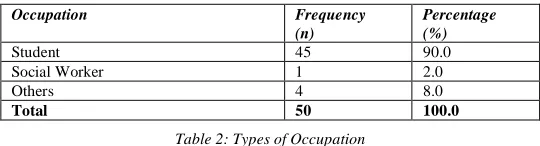
Table 2 below also displays the percentage on the type of occupation that the respondents are into, where 90% of the respondents are mainly students, while 2% of the respondents are social workers and 8% of the rest are from other collective occupation.
Occupation Frequency
(n)
Percentage (%)
Student 45 90.0
Social Worker 1 2.0
Others 4 8.0
Total 50 100.0
Table 2: Types of Occupation
In term of usage, table 3 below shows the percentage of respondents in respect of how frequent they use their mobile phones, where 66% of the respondents always use their mobile phones and 34% of the respondents sometimes use mobile phones.
Usage of Mobile Device Frequency
(n)
Percentage (%)
Always 33 66.0
Sometimes 17 34.0
Total 50 100.0
Table 3: Usage of Mobile devices
Table 4 below shows the percentage of where the respondent uses their mobile phones at home 42% of the respondents use their mobile phones at home, 40% uses their mobile device at school, 8% of the respondents use their mobile at work while 10% of the respondents represent other usage of mobile phones.
Mobility Frequency
(n)
Percentage (%)
Home 21 42.0
School 20 40.0
Work 4 8.0
Others 5 10.0%
Total 50 100.0
Table 4: Place of mobile Usage
WiFi Connection Frequency (n)
Percentage (%)
Yes 41 82.0
No 9 18.0
Total 50 100.0
Table 5: WiFi connection
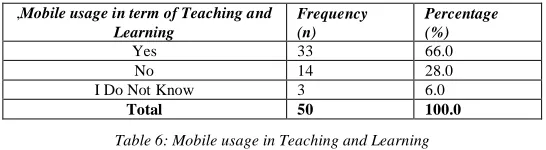
Table 6 below shows the percentage of mobile usage in term of teaching and learning 33% of the respondents accepted that mobile device is use as a tool for teaching and learning while 28% disagreed and 6% of the respondents do not have any idea about learning tools.
,Mobile usage in term of Teaching and Learning
Frequency (n)
Percentage (%)
Yes 33 66.0
No 14 28.0
I Do Not Know 3 6.0
Total 50 100.0
Table 6: Mobile usage in Teaching and Learning
Table 7 below shows the percentage of how mobile devices are use in developing lesson plan, 54% of the respondents accepted that mobile device are use to develop lesson plans and 46% of other respondents disagreed.
Mobile Devices are use in developing Lesson Plan
Frequency (n)
Percentage (%)
Yes 27 54.0
No 23 46.0
Total 50 100.0
Table 7: Mobile usage in Developing Lesson plan
4.2 Perception on Mobile Learning
Tables 8 below shows the respondents results, from the data statistical analysis preformed, the perception is the total summation of retuned response from the questionnaires of the respondents, where the mean of 48.5% is derived as the average of the response compare to the whole questions answered in the questionnaire while the minimum percentage of 35% is the value of the lower response in the questionnaire and maximum percentage of 60% is the highest value of response in the questionnaire. Figure 8 below also shows the satisfactory perception of the respondents.
Mean Min Max
48.5 12 60
Table 8: Perception of Respondents
48.5
12 60
0
Mean
Min
5. RECOMMENDATIONS
The major aspect of mobile learning recognized in this research is its capability to present learning at any place and anytime; knowledge that is positioned either at the field or place of work. Mobile devices are making knowledge transmission easier, it has the ability to convey different types of learning that could not be achieved in previous time.
This research conducted so far with the encouraging results has aspired to commend and report the use of mobile technologies in learning. To make mobile learning effective and useful in comparison with other methods, there is a need for an understanding of the way in which the learner uses the mobile devices. For example, Mobile learners often utilize the system for learning usually for shorter periods unlike other learning methods.
Mobile learning has been recognized by most academicians including it significant benefits that emerge to be partial accepted for didactic use. Although, with individuals motivating the uptake of mobile devices and tremendous growth in functionality, it shows that mobile learning will surely have a place in middle of the road in term of education and training in future.
5.1 CONCLUSION
Most research carried out on mobile learning declare that students using mobile phones are moving away from the known traditional messaging to the newer technology like the e-mail, SMS and IM. [13].These trends persuade learners to be more occupied with course material outside the classroom and made conversing far more efficient. [1], shows in a research that learners were typically passionate about mobile learning, which incorporate immediate messaging, and accessing web learning material through mobile devices. In order for the learning process to be flourishing, awareness is needed to develop a well-built strategy of mobile learning and online education setting as well [9]. In addition to student’s perceptions on mobile learning there is a need for future research due to the rapid technological transition in global nation and the hasty advancement in mobile technologies really demand for potential exploitation.
REFERENCES
[1] Ali, A., Ouda, A., & Capretz, L. F, (2012). “A Conceptual Framework for Measuring the Quality Aspects of Mobile Learning”, Bulletin of the IEEE Technical Committee on Learning Technology, vol. 14, no 4. (ref 15) [2] Allen, R. (2011). Can mobile devices transform education? Education Update, 53(2), 2–7.
[3] Amarolinda Z. K., Angilberto F., Eliane S. & Jorge B. F. (2013) Mobile Learning: Definition, Uses and Challenges, in Laura A. Wankel, Patrick Blessinger (ed.) Increasing Student Engagement and Retention Using Mobile Applications: Smartphones, Skype and Texting Technologies (Cutting-edge Technologies in Higher Education, Volume 6 Part D) Emerald Group Publishing Limited, pp.47 – 82.
[4] A summary and critique of mlearning research and practice. Available from: https://www.researchgate.net/publication/255483912_A_summary_and_critique_of_mlearning_research_and_practi ce [accessed Oct 28 2018].
[5] Blackboard. (2011). Learning in the 21st century: 2011 trends update. Routledge. Retrieved from
http://www.blackboard.com/Markets/K-12/Learn-for-K12/LeadershipViews/Education-in-the-21st-Century.aspx
[6] Bowen, J. A. (2011). Rethinking Technology outside the Classroom. Journal of Music History Pedagogy, 2(1): 43-59
[7] Brown, A., & Green, T. (2010). Issues and trends in instructional technology: Growth and maturation of web-based tools in a challenging climate; Social networks gain educators’ attention. In M. Orey, S.A. Jones, and R. M. Branch (Eds.), Educational media & technology yearbook(pp. 29–43). New York: Springer
[8] Cheon, J., Lee, S., Crooks, S., M & Song, J. (2012). "An investigation of mobile learning readiness in higher education based on the theory of planned behavior," Computers & Education, vol. 59, no. 3, p. 1054–1064, https://doi.org/10.1016/j.compedu.2012.04.015
[9] Clark W, Luckin R. What the research says. iPads in the classroom. London: Institute of Education University of London; 2013 (ref 7)
[10] Cochrane, T., & Bateman, R. (2010). Smartphones give you wings: Pedagogical affordances of mobile web 2.0. Australasian Journal of Educational Technology, 26(1),1-14.
[12] Daher, W. (2009). Students’ Perceptions of Learning Mathematics with Cellular Phones and Applets. International Journal of Emerging Technologies in Learning (iJET), 4(1). http://dx.doi.org/10.3991/ijet.v4i1.686 [13] Dede, C., & Bjerede, M. (2011). Mobile learning for the 21st century: Insights from the 2010 Wireless
EdTech Conference. San Diego, CA: Qualcomm
[14] Eisele-Dyrli, K. (2011a). Mobile goes mainstream. District Administration, 47(2), 46–48.
[15] El-Gayar O, Moran M, Hawkes M. Students’ acceptance of tablet PC’s and implications for educational institutions. Journal of Educational Technology & Society. 2011; 14(2), 58–70.
[16] Hashemi, M. et.al (2011). What is Mobile Learning? Challenges and Capabilities. Procedia- Social and Behavioral Sciences, 30:2477-2481
[17] Hsu, Y. C., & Ching, Y. H (2015). “A Review of Models and Frameworks for Designing Mobile Learning Experiences and Environments”, Canadian journal of learning & technology, vol. 41 (3). (Ref23)
[18] Johnson, L., Adams, S., & Haywood, K. (2011). The NMC horizon report: 2011 K–12 edition. Austin, Texas: The New Media Consortium.
[19] Kafyulilo, A., 2012. Access, Use and Perceptions of Teachers and Students Towards Mobile Phones as a Tool for Teaching and Learning in Tanzania. Education and Information Technologies, 19(1),pp.115–127.Available at: http://link.springer.com/10.1007/s10639-012-9207-y.
[20] Kolb, L. (2011). Adventures with cell phones. Educational Leadership, 68(5), 39.
[21] Kukulska-Hulme, A. et.al (2009). Innovation in Mobile Learning: An European perspective. International Journal of mobile and blended learning. 1(1), 13-35.
[22] Looi, C. & Toh, Y. (2014) "Orchestrating the flexible mobile learning classroom," in Increasing access through mobile learning (pp.161- 174). , Canada:, M. Ally and A. Tsinakos, Eds., Vancouver, Commonwealth of Learning and Athabasca University,4, pp. 161-174
[23] Mackey, T.P., & T.E. Jacobson. (2011). Reframing Information Literacy as a Metaliteracy. College & Research Libraries, 72(1), 62-78.
[24] Mobile learning for teachers in Europe: Exploring the Potential of Mobile Technologies to Support Teachers and Improve Practice. Paris: UNESCO, 2012
[25] Park, Y. (2011) A Pedagogical Framework for Mobile Learning: Categorizing Educational Applications of Mobile Technologies into Four Type. International Review of Research in Open and Distance Learning. Vol. 12.2. Pp.79-101 http://www.irrodl.org/index.php/irrodl/article/view/791/1699
[26] Parsons, D. (2014). The Future of Mobile Learning and Implications for Education and Training. In Ally, M. & Tsinakos, A., Editors, Perspectives on Open And Distance Learning: Increasing access through mLearning. Published by the Commonwealth of Learning and Athabasca University, Vancouver, Canada.
[27] Perlow, Jason.( 2008). “Can We Finally Realize Alan Kay’s Dynabook for $100?”. ZDNet.
http://www.zdnet.com/article/can-we-finally-realize-alan-kays-dynabook-for-100/ [28] Quillen, I. (2010). Left to their owned devices. Digital Directions, 4(Fall), 30–35
[29] Rossing J. P, . et.al ( 2012) i-Learning: the Future of Higher Education? Student perceptions on learning with mobile tablets. Journal of the scholarship of teaching and learning.; 12(2), 1–26.
[30] Sharples, M. . et.al (2007). Mobile Learning: Small devices, Big issues. Recuperado em 21 deoutubro,2008 de http://telearn.noe-kaleidoscope.org/warehouse/KAL_Legacy_Mobile_Learning_(001143v1).pdf
[31] Shuler, C. (2009). Pockets of potential: Using mobile technologies to promote children’s learning. New York: The Joan Ganz Cooney Center at Sesame Workshop.
[32] Seyed E. H., Ezzadeen, K., & Alhazmi, A. K. (2014). "Acquiring Knowledge through Mobile Applications," International Journal of Interactive Mobile Technologies (iJIM), vol. 9, no. 3
[33] University Goes Mobile: Techniques and Case Study for a Mobile Information portal, http://fgb.informatik.unibas.ch/fgb/sa/akt_sa/mobileportal/UMP.pdf.
[34] Wachira, P., Keengwe, J., & Onchwari, G.(2009). Personal Digital Assistants (PDAs) in Mathematics Teacher Education. AACE Journal, 17(2), pp.113-125.
[35] Wishart, J. (2009). Use of Mobile Technology for Teacher Training Mobile Learning: Transforming the
delivery of education and training Ally M. Athabasca University Press Edmonton Canada 26578
http://www.aupress.ca/index.php/books/120155 [Google Scholar]
[36] Wikipedia contributors. "Dynabook." Wikipedia, The Free Encyclopedia. Wikipedia, The Free Encyclopedia, 15 Sep. 2017. Retrieved October 28, 2018 from: https://en.wikipedia.org/wiki/Dynabook
[37] Wong, L.-H. (2012). A learner-centric view of mobile seamless learning. British Journal of Educational Technology, 43(1), E19–E23. doi:10.1111/j.1467-8535.2011.01245.x
[39] Young, M. F. et.al (2012). Our Princess is in Another Castle: A review of trends in serious gaming for
education. Review of Educational Research, 82(1), 61–89. doi:10.3102/0034654312436980
[40] http://www.knowledgeanywhere.com/mobile.htm [41] http://www.navowave.com/mlearning.html