Available online: https://edupediapublications.org/journals/index.php/IJR/ P a g e | 1424
Implementation of CDMA Encoding/Decoding Method for
On Chipusing Verilog
Avinash 1, B.Raja Rao21P.G Student, VLSI
2 Associate Professor, Department of Electronics and Communication Engineering, Kits engineering College,divili.
Abstract
Code Division Multiple Access (CDMA) is proposed as the physical layer empowering influence of Network-On-Chip (NoC) interconnects for its conspicuous highlights, for example, settled idleness, ensured benefit, and diminished framework multifaceted nature. CDMA interconnects have been received by the NoC people group as it begins in remote correspondences where each piece in a CDMA encoded information word is transmitted on a different channel to maintain a strategic distance from obstruction. Be that as it may, the remote obstruction issue can be productively moderated in on-chip interconnects dispensing with the requirement for imitating the CDMA channel. Also, remote channels are successive ordinarily which isn't the situation in on-chip interconnects where parallel transports are the default correspondence implies. After CDMA was received by the NoC people group, a similar remote CDMA plot has been kept up where every datum bit is encoded in a different CDMA channel and the encoding/deciphering rationale is duplicated for information parcels. In this work, we present a novel CDMA encoding/deciphering plan called Aggregated CDMA (ACDMA) for NoC interconnects in which all bundle bits are encoded in a solitary CDMA channel, thusly, wiping out the zone and vitality overheads came about because of imitating the channel encoding/translating rationale.
I. INTRODUCTION
Available online: https://edupediapublications.org/journals/index.php/IJR/ P a g e | 1425 framework multifaceted nature [3]. Using CDMA in NoC interconnects is embraced from the remote interchanges writing, where the information is spread by symmetrical codes at the transmitters, the spread information are included the remote channel, and the gotten total is decoded at the beneficiaries. Established CDMA frameworks depend on the Walsh symmetrical code family to empower medium sharing. Many research bunches have examined a few parts of CDMA in NoCs, including our gathering which introduced the Overloaded CDMA for on-chip Interconnects (OCI) [4] [5] [6]. A 14-hub CDMA-based system has been produced in [7]. The system uses 7 Walsh codes and task of the Walsh codes to the system hubs is dynamic dependent on the demand from every hub. Two structures have been presented in [7]: a sequential CDMA organize where every datum contribute the spreading code is sent in one clock cycle; and a parallel CDMA arrange where all information chips are sent in a similar cycle. The sequential and parallel CDMA-based systems have been contrasted with an ordinary CDMA organize, a meshbased NoC, and a Time Division Multiple Access (TDMA) transport. For a similar system region, the throughput of the parallel CDMA arrange is higher than that of the work based NoC and the TDMA transport because of the concurrent medium access nature of CDMA. Standard-premise codes are proposed as a substitution to Walsh CDMA codes in [8]. Standard-Standard-premise codes look like TDMA flagging on the grounds that each code comprises of just a solitary chip of one and the rest of the chips are zeros. The TDMA codes' symmetry empowers them to supplant the Walsh codes as spreading and despreading CDMA codes, which decreases the multifaceted nature of the channel viper and decoder as the whole of TDMA codes is restricted to zero or one for each clock cycle.
2.Existing method
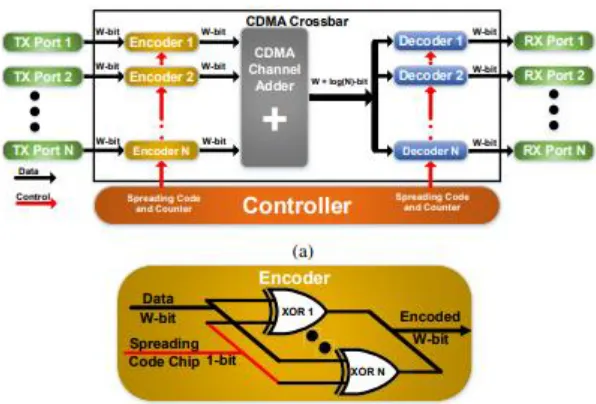
Figure 1. Conventional CDMA crossbar .
Available online: https://edupediapublications.org/journals/index.php/IJR/ P a g e | 1426 spreading code. The connection activity is executed utilizing an aggregator and a multiplexer since the despreading code chips are unipolar ("0" or "1"). In the majority of the CDMA interconnect related work, every datum bit in an information word is encoded and transmitted in a different CDMA channel and the encoding/translating rationale is repeated W times for information bundles of width W which is an immediate use of the remote CDMA standards in NoC interconnects. Be that as it may, remote correspondence channels are successive essentially because of the impedance issue. Different access and MIMO procedures can empower simultaneous information transmission on a similar remote channel to the detriment of expanding the transmitter/collector unpredictability. in on-chip interconnects, then again, a solitary channel can be effectively used to empower parallel information transmission as clamor and obstruction impacts can be proficiently relieved [9]. In this work, we present a solitary channel, multi-bit CDMA crossbar in particular Aggregated CDMA (ACDMA) NoC crossbar.
3. PROPOSED NOC CROSSBAR ARCHITECTURE
Available online: https://edupediapublications.org/journals/index.php/IJR/ P a g e | 1428 Figure 2. (c) ACDMA channel adder, (d)ACDMA decoder
The decoders execute the cross-connection of (4) in a cost productive way; the decoder comprises of just a viper/subtracter and an enlist arranged as an up/down gatherer as appeared in Figure 2(d). Since the despreading code Ck comprises of ±1 chips, cross connection is decreased to basic expansion and subtraction tasks of resulting wholes Si . Along these lines, the decoder is executed as an up/down aggregator; the snake/subtracter includes or subtracts the entirety Si from the outcome spared in the registers as per the benefit of despreading chip Ci k. Specifically, when the despreading chip is '1', the snake adds Si to the substance of the enroll however subtracts Si from the substance of the enlist when the despreading chip is '- 1'. Toward the finish of the disentangling cycle, the collector enlist holds N dk as indicated by (5), and on the grounds that N = 2n and n is a number, information dk is decoded by moving the gatherer content by log2(N) bits.
Available online: https://edupediapublications.org/journals/index.php/IJR/ P a g e | 1429 quantity of channel viper wires; in the traditional CDMA crossbar, the quantity of the snake wires for the single-piece channel is expanded by one in each phase because of the extra convey bit. Along these lines, the quantity of viper wires in stage I is equivalent to 1+log2(N)−i. For a W-bit word, the quantity of viper wires is expanded to W+W(log2(N)−i), and since there are 2i adders at each stage, at that point the aggregate number of wires is equivalent to log2N−1 i=0 2i (W +W(log2N −i)). In the ACDMA crossbar, on the other hand, the quantity of snake wires for a W-bit word is W +log2(N)−i, which makes the aggregate number of wires equivalents to log2N−1 i=0 2i (W +log2N −i) which is a factor of W not as much as that of the regular CDMA crossbar. The lessened number of convey bits of the ACDMA crossbar is the prime explanation behind its prevalence. The quantity of wires for the decoder aggregator and the quantity of flip-slumps in the decoder registers is relative to the quantity of channel wires—the last phase of the viper. This pursues the multifaceted nature of the ACDMA crossbar is in a request of W not as much as that of the ordinary CDMA crossbar.
Simulation RESULTS
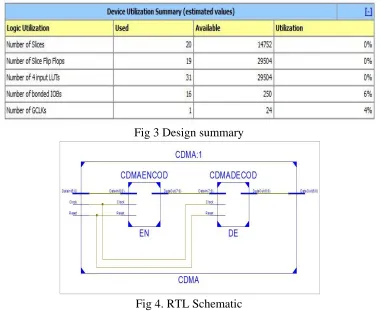
Fig 3 Design summary
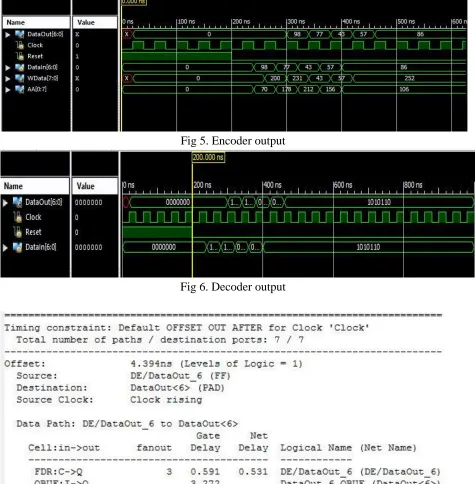
Available online: https://edupediapublications.org/journals/index.php/IJR/ P a g e | 1430 Fig 5. Encoder output
Available online: https://edupediapublications.org/journals/index.php/IJR/ P a g e | 1431 Fig 7. Encoder output
V. CONCLUSION
In this work, we exhibited the ACDMA NoC crossbar to empower parallel transmission of multi-bit information bundles on a solitary CDMA channel. The overhead of channel replication is moderated which results in up to 60.5% territory and 55% power funds with 124% enhancement in throughput per region contrasted with the traditional CDMA crossbar. As a future work, we intend to construct and assess a full ACDMA-based NoC under various remaining tasks at hand and steering conventions.
REFERENCES
[1] L. Wang, J. Hao, and F. Wang. Transport based and NoC framework execution imitating and correlation. In Information Technology: New Generations, 2009. ITNG '09. 6th International Conference on, pages 855– 858, April 2009.
[2] R. H. Chime, Chang Yong Kang, L. John, and E. E. Swartzlander. CDMA as a multiprocessor interconnect procedure. In Signals, Systems and Computers, 2001. Meeting Record of the Thirty-Fifth Asilomar Conference on, volume 2, pages 1246– 1250 vol.2, Nov 2001.
[3] B. C. C. Lai, P. Schaumont, and I. Verbauwhede. CT-transport: a heterogeneous CDMA/TDMA transport for future SOC. In Signals, Systems and Computers, 2004. Meeting Record of the Thirty-Eighth Asilomar Conference on, volume 2, pages 1868– 1872 Vol.2, Nov 2004.
[4] K. E. Ahmed and M. M. Farag. Over-burden CDMA transport topology for MPSoC interconnect. In 2014 International Conference on ReConFigurable Computing and FPGAs (ReConFig14), pages 1– 7, Dec 2014.