Improvement of Das’s Two-Factor Authentication
Protocol in Wireless Sensor Networks
DaeHun Nyang and Mun-Kyu Lee
Abstract— User authentication is essential for customized ser-vices and privileged access control in wireless sensor network. In 2009, Das proposed a novel two-factor authentication scheme for wireless sensor network, where a user must prove the possession of both a password and a smart card. His scheme is well-designed for sensor nodes which typically have limited resources in the sense that its authentication procedure requires no public key operations but it utilizes only cryptographic hash function. In this letter, we point out that Das’s protocol is vulnerable to an off-line password guessing attack, and also show a countermeasure to overcome the vulnerability without sacrificing any efficiency and usability. Besides the patch, we suggest a method to protect query response messages from wireless a sensor node to a user, which is necessary in serving a user in a confidential and authentic way.
Index Terms— Wireless sensor network, authentication, pass-word, smart card
I. INTRODUCTION
Wireless Sensor Networks (WSNs) have many promising applications including environmental monitoring, traffic mon-itoring, fire alarming, logistics, military sensing and tracking, and so on. In most of these cases, real-time transmission of sensed data is critical and it will be preferable for users to access directly the sensed data without involving the gate-way node. For allowance of sensed data only to privileged users, user authentication and authorization are mandatory, which also provide each individual with customized services. Although there are already many well-known authentication mechanisms in the literature, two-factor authentication which requires the proof of possession of both a password and a smart card achieves effectively the purpose of authentic delivery of sensed data while minimizing the amount of user-specific authentication information in the gateway node. This is because the tamper-proof smart card that a user possesses plays the role of secure storage of authentication information instead of the gateway node. To this end, Das proposed an efficient two-factor user authentication scheme, which requires only a small number of applications of cryptographic hash functions [2]. In this letter, however, we point out that Das’s protocol has a weakness against an off-line password guessing attack, and propose a countermeasure to this problem without any additional operations. We also present a method for protection of query responses from sensor nodes, which is necessary for a confidential and authenticated service.
This letter is organized as follows: Section II reviews Das’s two-factor authentication protocol, and we analyze the security of Das’s protocol in Section III. Section IV presents our
The authors are with the School of Computer and Information Engineering, Inha University, Incheon, 402-751, Korea
security-enhanced protocol and in Section V we evaluate our protocol in terms of security and performance. Section VI concludes this letter.
II. REVIEW OFDAS’STWO-FACTORUSER
AUTHENTICATIONPROTOCOL
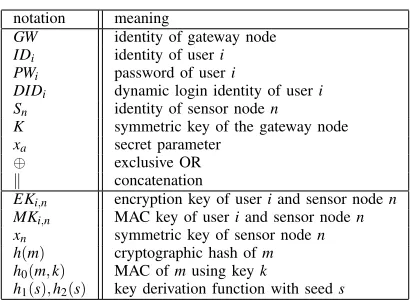
In this section, we will briefly review Das’s two-factor user authentication protocol which uses both a smart card and a password. The notations used throughout this letter are shown in Table I. The upper part of the table shows Das’s original notations and added notations are given in the lower part.
Das’s protocol is composed of two phases: the registration phase and the authentication phase. In the registration phase, the gateway node computes and storesNi=h(AUTHi)⊕h(K),
where the authentication information AUTHi is defined as
AUTHi=IDi||PWi. Then the user’s tamper-proof smart card
is customized withIDi,h(PWi),Ni andxa, wherexais a secret
key generated by the gateway node and is shared with sensor nodes that are responsible to exchange data with users. Here,
xais not known to the user.
The authentication phase consists of the login stage and the verification stage. In the login stage, the user’s smart card authenticatesIDi andPWi provided by the user usingh(PWi),
and sendsDIDiandCito the gateway node at timeT as shown
in Fig. 1. The login stage is followed by the verification stage which begins by checking if T∗−T is within the predefined interval ∆T, where T∗ is its current time. After successful verification of the authentication tag Ci, the gateway node
transmits DIDi,T0,Ai to the nearest sensor node Sn at time
T0. ThenSnvalidatesT0 and verifies Ai which guarantees the
request has come from the legitimate gateway node. If it is successful,Snresponds toUi’s query with sensed data.
TABLE I: Notation
notation meaning
GW identity of gateway node IDi identity of useri PWi password of useri
DIDi dynamic login identity of useri Sn identity of sensor noden
K symmetric key of the gateway node
xa secret parameter
⊕ exclusive OR
k concatenation
EKi,n encryption key of useriand sensor noden MKi,n MAC key of useriand sensor noden xn symmetric key of sensor noden h(m) cryptographic hash ofm h0(m,k) MAC ofmusing keyk
ClientIDi Gateway Node Sensor NodeSn
DIDi=
h(AUTHi)⊕h(xa||T) Ci=h(Ni||xa||T)
hDIDi,Ci,Ti −−−−−−−−→
VerifyT
Z=DIDi⊕h(xa||T) Ci∗=h((Z⊕h(K))||xa||T) VerifyCi=Ci∗
Ai=h(DIDi||Sn||xa||T0)
hDIDi,T0,Aii −−−−−−−−−→
VerifyT0 A∗i =
h(DIDi||Sn||xa||T0) VerifyAi=A∗i query response / data
←−−−−−−−−−−−−−−−−−−−−−−−
Fig. 1: Two Factor Authentication Protocol: AUTHi = IDi||PWi for Das’s protocol [2] and AUTHi=IDi||PWi||xa
for the patched protocol
III. SECURITYCONSIDERATION ONDAS’SPROTOCOL
A. Password Guessing Attack by Insiders
The author in [2] claimed that password guessing is not possible because a password is transmitted implicitly inDIDi
as a digest of some secret components. However, we show that a password guessing attack is possible, that is, the password of the target user i may be guessed by another user who is an insider with his or her own password and smart card. Our attack is based on the observation that DIDi is not exactly
a digest of PWi and some secret components, but it is the
XOR-ed value of a digest of PWi and that of other secret
components. The problem is that the secret components are commonly shared among all the users. Note that the timestamp
T is necessarily given to a smart card by the user’s system, because the smart card cannot synchronize its time without any external power. To be more precise, the password guessing attack can be implemented as follows:
1) The attacker (say, user j) eavesdrops the victim’s (say, useri’s) authentication session from whichDIDi andT
can be extracted.
2) The attacker computes his ownDIDjwithIDj,PWj, and
T, where T is the timestamp from the captured session above.
3) B=h(IDjkPWj)can be prepared because IDj andPWj
are the attacker’s ID and password, respectively, and h
is a publicly-known cryptographic hash function. 4) Now the attacker can computeh(IDikPWi)by
calculat-ingDIDi⊕B⊕DIDj.
5) Now the attacker is ready to mount an off-line password guessing attack withh(IDikPWi).
Usually ID’s are open to public. In this case, the search space for the guessing attack is |PW|, where PW is the set of possible passwords and| · | represents the cardinality of a set. Even though the ID is hidden, the search space is|ID| × |PW|,
whereIDis the set of possible ID’s. Note that generally |ID|
is not so big unlike a space for cryptographic key.
The author’s idea that a password must be transmitted as a digest of some secret components is correct and ap-propriate, but its implementation failed to accommodate the idea. We will present an improved implementation adopting the author’s idea. Our patch to the original protocol is to use h(IDikPWikxa) instead of h(IDikPWi), which prevents
the attacker from completing step 3 becauseh(IDjkPWjkxa)
requires knowledge of xa hidden in the tamper-proof smart
card. The revised protocol uses newly-defined AUTHi and
accordingly-modified Ni=h(IDi||PWi||xa)⊕h(K), which is
shown in Fig. 1.
B. Protection of Query Response
It is desirable that a user authentication protocol should be followed by some specific security services such as secure and authentic delivery of sensed data. However, the original protocol in [2] did not care about those security services and omitted the necessary steps such as encryption and authenticity verification of query response. Thus we will add mechanisms that provides those security services by making the gateway node play a role of key distribution center and providing a unique secure channel between a user and a sensor node.
These mechanisms can be realized by establishing a distinct session key for every session and for every pair of a user and a sensor node to frustrate inside attackers and node-capturing attackers. Using the information shared with user
i, the gateway node computes those keys, EKi,n and MKi,n,
which are an encryption key and a MAC key for user i
and sensor node Sn, respectively. The keys will be
com-puted asEKi,n=h1(DIDi||Sn||(Z⊕h(K))||xa||T)andMKi,n=
h2(DIDi||Sn||(Z⊕h(K))||xa||T). Userican computeEKi,nand
MKi,n by itself, but sensor node Sn cannot. So the gateway
node must send these keys toSnin a secure manner. To achieve
this secure key transport,Snand the gateway node are assumed
to have a shared keyxn. Now the sensor nodeSncan give user
iits response in a secure and authentic way.
C. Node Compromise Attack
Das [2] claimed that a sensor node must be equipped with a tamper-proof module to be strong against various attacks caused by node compromise. We show that even with the tamper-proof module, careless implementation of Das’s protocol may also cause other security problems such as password guessing attack by outsiders and impersonation of the gateway node. We exemplify a ‘careless implementation’ as follows:
• The tamper-proof module in a sensor node externally outputs A∗i so that the sensor node may compare it with
Ai.
• The tamper-proof module does not validate its input properly. For example, it does not check ifDIDi andSn
are null or not. Also, it does not examine if the givenSnis
the correct ID of the sensor node in which it is installed.
Password guessing attack: An attacker from outside who captures sensor node Sn can derive A∗=h(xa||T) =
h(null||null||xa||T)by giving null instead of the original values
of DIDi andSnto the tamper-proof module inSn. Recall that
the timestampT is necessarily given to a smart card and thus, the attacker may control its value. Consequently, someone who does not have xa can mount an off-line password guessing
attack after computing h(IDi||PWi) =DIDi⊕h(xa||T).
Impersonation of the gateway node: An attacker who
cap-tures a sensor node Sn or an insider who has a sensor node
Sn can pretend to be the gateway node and then can gather
sensed data from an arbitrary sensor node Sm.
1) First, the attacker composes a message using Sn as
follows: (s)he setsDIDias a random stringRof a proper
length and gives Sm instead of Sn to the tamper-proof
module inSn, the captured node. Note that the
tamper-proof module cannot recognize these invalid inputs because we are assuming that it does not check the validity of input values. Then the tamper-proof module will returnA∗i =h(R||Sm||xa||T0).
2) Now the attacker sends(R,T0,A∗i)toSm. The target node
Smwill accept this request and then reply to the attacker
with sensed data.
As a result, an attacker can impersonate the gateway node to retrieve information from any node of its own choice. Even if the attacker repeats this attack using the same captured node, the source of this attack, i.e.,Sn, cannot be identified or traced
because a random string Ris refreshed for every trial. Therefore, we remark that care must be taken so that the authentication protocol may not have security flaws in its implementation.
IV. SECURITY-ENHANCEDPROTOCOL
We present a security-enhanced two-factor authentication protocol which has the following security properties:
• Prevention of the off-line password guessing attack using
h(IDikPWikxa)instead of h(IDikPWi).
• Protection of query responses by establishing a unique secure channel between a user and a sensor node. We remark that our protocol must be implemented carefully so that the node compromise attack explained in Section III-C may not be applicable.
Our authentication protocol is composed of two phases; the registration phase and the authentication phase. The registra-tion phase is the same as that of Das’s protocol except thatNiis
computed as Ni=h(IDi||PWi||xa)⊕h(K). The authentication
phase begins by user’s submittingIDiandPWito his/her smart
card, and the following steps are performed:
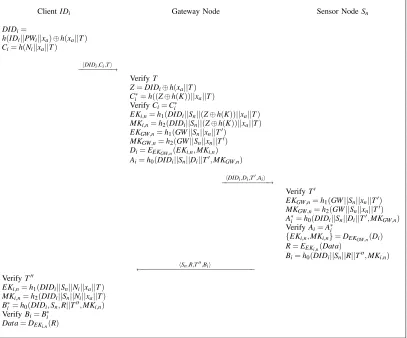
1) The user’s smart card authenticates IDi andPWi.
2) The smart card computes DIDi =h(IDi||PWi||xa)⊕
h(xa||T)andCi=h(Ni||xa||T)to sendDIDi,Ci,T to the
gateway node.
3) Upon receiving the request from the user, the gateway node validates T and authenticatesCi by comparing it
withCi∗=h((DIDi⊕h(xa||T)⊕h(K))||xa||T).
4) The gateway node computes an encryption key
EKi,n=h1(DIDi||Sn||(DIDi⊕h(xa||T)⊕h(K))||xa||T)
and a MAC key
MKi,n=h2(DIDi||Sn||(DIDi⊕h(xa||T)⊕h(K))||xa||T)
between useriand sensor nodeSnto play the role of a
key distribution center.
5) To provide a secure channel forEKi,nandMKi,nbetween
Snand itself, the gateway node computes the encryption
key EKGW,n=h1(GW||Sn||xn||T0) and the MAC key
MKGW,n=h2(GW||Sn||xn||T0), respectively, wherexn is
a predistributed symmetric key between the gateway node andSnandT0 is the current time.
6) The gateway node encrypts EKi,n and MKi,n using the
key EKGW,n computed in the previous step and
pro-duces Di=EEKGW,n(EKi,n,MKi,n). It also computes a
MAC Ai=h0(DIDi||Sn||Di||T0,MKGW,n) using the key
MKGW,n.
7) The gateway transmitsDIDi,Di,T0,Ai toSn.
8) WhenSnreceives these data, it first verifiesT0and
com-putesA∗i =h0(DIDi||Sn||Di||T0,MKGW,n)usingMKGW,n.
Then it checks ifAi=A∗i.
9) Sn decrypts Di with EKGW,n and recovers EKi,n and
MKi,n.
10) Sensed data to be transmitted is encrypted withEKi,nas
R=EEKi,n(Data)and a MAC is computed withMKi,nas
Bi=h0(DIDi||Sn||R||T00,MKi,n), whereT00is the current
time.
11) Sn,R,T00 andBi are sent to useri.
12) The user verifies T00 and checks Bi by comparing it
with B∗i =h0(DIDi,Sn,R||T00,MKi,n), where MKi,n =
h2(DIDi||Sn||Ni||xa||T).
13) If this verification is successful, the sensed
data is recovered by decrypting R using
EKi,n=h1(DIDi||Sn||Ni||xa||T).
V. ANALYSIS OF THEPROTOCOL
This section treats the security and performance aspects of our protocol.
A. Security Analysis
We follow the same threat model as that of Das’s protocol, where all parties involved in the protocol communicate over an insecure channel and each party is equipped with a tamper-proof module [3]. To be precise, each user has a tamper-tamper-proof smart card which storesIDi,h(PWi),Niandxa, and each sensor
node stores xa and xn in the tamper-proof module. Because
our protocol is an augmentation of Das’s protocol, it enjoys the strength against replay attacks, impersonation attacks and stolen-verifier attacks, and also has the same drawbacks such as the vulnerability to denial-of-service attacks. We will ex-plain in detail that the augmentation does not degrade the security related to those attacks, but it will enhance the security of communication channel between a user and a sensor node and the immunity on password guessing attacks. Note that we augmented Das’s protocol in two aspects.
• We redefinedNiasNi=h(IDi||PWi||xa)⊕h(K)instead of
Ni=h(IDi||PWi)⊕h(K). Also,DIDiandCi are changed
ClientIDi Gateway Node Sensor NodeSn
DIDi=
h(IDi||PWi||xa)⊕h(xa||T) Ci=h(Ni||xa||T)
hDIDi,Ci,Ti −−−−−−−−→
VerifyT
Z=DIDi⊕h(xa||T) Ci∗=h((Z⊕h(K))||xa||T) VerifyCi=Ci∗
EKi,n=h1(DIDi||Sn||(Z⊕h(K))||xa||T) MKi,n=h2(DIDi||Sn||(Z⊕h(K))||xa||T) EKGW,n=h1(GW||Sn||xn||T0)
MKGW,n=h2(GW||Sn||xn||T0) Di=EEKGW,n(EKi,n,MKi,n)
Ai=h0(DIDi||Sn||Di||T0,MKGW,n)
hDIDi,Di,T0,Aii −−−−−−−−−−−→
VerifyT0
EKGW,n=h1(GW||Sn||xn||T0) MKGW,n=h2(GW||Sn||xn||T0) A∗i =h0(DIDi||Sn||Di||T0,MKGW,n) VerifyAi=A∗i
{EKi,n,MKi,n}=DEKGW,n(Di)
R=EEKi,n(Data)
Bi=h0(DIDi||Sn||R||T00,MKi,n)
hSn,R,T00,Bii
←−−−−−−−−−−−−−−−−−−−−−−−−−−
VerifyT00
EKi,n=h1(DIDi||Sn||Ni||xa||T) MKi,n=h2(DIDi||Sn||Ni||xa||T) B∗i =h0(DIDi,Sn,R||T00,MKi,n) VerifyBi=B∗i
Data=DEKi,n(R)
Fig. 2: Security-enhanced Two Factor Authentication
• We introduced a secure channel between a user and a sensor node by defining xn, a symmetric key shared
between the gateway node and sensor node Sn.
First, we consider the effect of redefinition of Ni. Because
h(xa||T) is a random sequence, it plays the role of a key
for a one-time pad. Even if h(IDi||PWi) is replaced by
h(IDi||PWi||xa), the resulting DIDi remains random. Ci also
remains random because it is the output of a cryptographic hash function even if its input is modified. Therefore, a passive attacker who does not have any valid smart card cannot distinguish the message DIDi,Ci,T in our protocol from the
original one in Das’s protocol, which means the level of security of both protocols are the same under the existence of a passive attacker. On the other hand, our protocol is much stronger than the original one with respect to a password gussing attacker who is an insider with a valid smart card, as shown in Section III-A. It is also easy to see that an active attacker does not have any advantage due to the one-wayness of cryptographic hash functions. We remark that most threats regarding a node compromise attack can be frustrated with a careful implementation explained in Section III-C.
Now we consider the effect of introduction of new keysxn.
Our method to protect messages from a sensor node to a user usingxncan be viewed as a variation of traditional approaches
used in many key distribution systems such as Kerberos [6].
Therefore the aim to protect the messages is achieved by making the gateway node play a role of key distribution center.
B. Performance Analysis
To defeat the password guessing attack by insiders in section III-A, it is enough to change the definition of AUTHi
inDIDiand inNi, so the number of hash calculations and the
amount of communication remain the same as those of Das’s protocol.
Con-sequently, all the operations added to protect query responses can be implemented using a block cipher such as AES [7]. Also, note that most of the recently developed sensor nodes, e.g., TMote, TelosB and Micaz, already have a built-in AES module and thus, no additional hardware is required [4].
On the other hand, additional messages for securing query responses are only one encrypted value of keys (Di) from the
gateway node to the sensor node, and one MAC (Bi) from
the sensor node to the user, assuming that the sensor node’s identity and a timestamp are already included in the original message.
VI. CONCLUSION
In this letter, we pointed out that Das’s two-factor user authentication protocol is weak against the off-line password guessing attack by insiders, and showed that a simple patch that appendsxato the authentication information can eliminate
this weakness without sacrificing any efficiency and usability. Also, to protect query responses from wireless sensor nodes to a user, we proposed an efficient method which can be easily implemented using a built-in AES function in sensor nodes. Finally, we gave a guideline for secure implementation of authentication protocols which prevents the outsider who captures a sensor node from mounting password guessing attack and from impersonating the gateway node.
REFERENCES
[1] Lily Chen. NIST Special Publication 800-108, Recommendation for Key Derivation Using Pseudorandom Functions, 2009.
[2] Manik Lal Das. Two-factor user authentication in wireless sensor networks.IEEE Trans. Wireless. Comm., 8(3):1086–1090, 2009. [3] D. Dolev and A.C. Yao. On the security of public key protocols. IEEE
Trans. Inform. Theory, 29:198–208, 1983.
[4] Texas Instruments. CC2420: 2.4 GHz IEEE 802.15.4 / ZigBee-ready RF Transceiver, 2006.
[5] J. Lee JH. Song and T. Iwata. The AES-CMAC algorithm, IETF Request for Comments RFC-4493, 2006.
![Fig. 1: Two Factor Authentication Protocol: AUTH =iID| |i PWi for Das’s protocol [2] and AUTH =iID| |i PW| |i xafor the patched protocol](https://thumb-us.123doks.com/thumbv2/123dok_us/1863215.1242164/2.612.47.303.54.246/factor-authentication-protocol-auth-protocol-xafor-patched-protocol.webp)