Efficient Verifiable Escrow and Fair Exchange with Trusted
Hardware
∗Stephen R. Tate, Roopa Vishwanathan Department of Computer Science Univ. of North Carolina at Greensboro
Greensboro, NC 27402
[email protected],[email protected] May 29, 2013
Abstract
At the heart of many fair exchange problems is verifiable escrow: a sender encrypts some value using the public key of a trusted party (called the recovery agent), and then must convince the receiver of the ciphertext that the corresponding plaintext satisfies some property (e.g., it contains the sender’s signature on a contract). Previous solutions to this problem are interactive, and often rely on communication-intensive cut-and-choose zero-knowledge proofs. In this paper, we provide a solution that uses generic trusted hardware to create an efficient, non-interactive verifiable escrow scheme. Our solution allows the protocol to use a set of recovery agents with a threshold access structure, theverifiable group escrow
notion which was informally introduced by Camenisch and Damgard and which is formalized here. Finally, this paper shows how this new non-interactive verifiable escrow scheme can be used to create an efficient optimistic protocol for fair exchange of signatures.
Keywords:fair exchange, verifiable encryption, verifiable escrow, trusted hardware
∗
1
Introduction
Consider the following problem: Alice and Bob agree to a contract that is encoded in a messagem, and Alice wants to assure Bob that she will provide a signed contract at some date in the future. To commit to providing a signed contract, Alice will go ahead and signmto create signatureσ, and she gives Bob a copy that can be opened by a trusted party (called a recovery agent) if she does not follow through. To do this, both agree on a specific trusted party Trent with public keyP KT, and Alice sends to Bobc =EP KT(σ).
Bob then has a problem: he has received a ciphertext from Alice, who claims it will decrypt to a contract signature — however, if the encryption scheme is secure, how can Bob have any assurance that Alice is not deceiving him? Of course, Bob could contact Trent and ask Trent to verify the contents ofc, but we would like to complete this transaction between Alice and Bob independently, only involving Trent if there is a dispute to resolve. This is called the problem of providing averifiable encryption of a signature, and it has applications as a component of larger problems such as the well-known fair exchange problem.
At the core of this problem is a zero-knowledge proof: Both Alice and Bob know public values m,
c, P KT, and V KA (Alice’s public signature verification key), and Alice additionally knows σ and the randomnessr used when performing the encryption. Alice needs to prove to Bob (without revealing any information about σ or r) that she knows a σ that verifies under V KA as a signature onm, and σ en-crypts under P KT with randomness r to c. Due to general results we know that it is possible to prove this property in zero-knowledge [GMW91], but these possibility results do not give practical algorithms. Researchers have devised some practical zero-knowledge solutions that are specific to this problem, with existing solutions using either interaction-intensive cut-and-choose proofs [ASW98, CD00] or custom en-cryption schemes [CS03]. In this paper we explore the idea of using trusted hardware to support verifiable encryption, which allows us to give a non-interactive solution using standard encryption schemes. Our use of trusted hardware is very generic, and essentially involves generating random values that are vouched for by the trusted hardware — nothing in the trusted hardware requirements is tied to the verifiable encryption problem, and the hardware in fact never sees any sensitive values such as the signatureσ. Furthermore, we do this in a model that includes multiple recovery agents and a general access structure that defines what subsets are allowed to recover the encrypted signature, formalizing ideas that were introduced by Camenisch and Damgard [CD00]. Finally, the technique we use for replacing cut-and-choose is based on an intriguing and general idea: we replace trust that is built up over multiple rounds of cut-and-choose (“statistical trust”) with trust in the manufacture of hardware devices (the “trust” in “trusted platform module”). We believe this is a powerful idea that can find application in other problems as well.
In the next section we give an overview of basic cryptographic concepts and definitions that we use in this paper, which is followed by information on trusted hardware in cryptographic protocols, and then by a statement of our results and comparison with prior work. Subsequent sections fully develop our results and provide security analysis and proofs.
2
Basic Cryptographic Notation and Relevant Concepts
decryption operations are specified byEandD, respectively, where we assume that the specific algorithm is determined by the type key provided (ifP Kis an RSA key, thenEP K(x)denote the RSA encryption ofx). As any CPA secure encryption scheme will incorporate some randomness into the encryption, we allow for explicitly stating the randomness as a first parameter to the encryption function, asEP K(r, x)for example. We will always userfor this randomness as a reminder of its purpose.
For digital signatures, we denote public verification keys with V K and private signing keys by SK, with optional party-specific subscripts as above. The digital signature functions are denotedSignSK(m) andV erV K(m, σ), so for matched keypair(V K, SK)we should always haveV erV K(m, SignSK(m))be true.
2.1 Zero-Knowledge Proofs
Zero-knowledge proofs were first introduced by Goldwasser et al. [GMR89] and have applications in a wide range of cryptographic protocols such as fair exchange [ASW98], identification protocols [FS87], and group signatures [BP02]. A zero-knowledge proof for a languageLis a protocol in which a proverP and verifier
V both know an inputx(and possibly additional inputs private toP and/orV), and the two parties engage in a protocol in whichP tries to convinceV thatx∈L. Informally speaking, to be a zero-knowledge proof forL, this protocol most satisfy three conditions: for anyx ∈Lit must be the case thatP can convince an honestV of this (this is calledcompleteness); for anyx 6∈Lit must be the case that no possibly dishonest prover can convince an honestV thatx∈L(this is calledsoundness); and for any input, a dishonest verifier cannot extract any information fromP and the protocol than it could have computed on its own, without engaging in the protocol (this is thezero-knowledgeproperty).
For all of the problems in this paper, we are interested in languages that are defined in terms of a relation R, where we denote the languageLR ={x| ∃wsuch thatxRw}. For anyx∈LR, awthat satisfiesxRw
is called awitnessforx ∈LR. If there is a polynomial bound on the length of witnesses forx ∈ LRand
the relationRcan be decided in polynomial time, then it follows thatLRis in the complexity class NP. It
is known that all suchLRhave zero-knowledge proofs when the prover is provided a witnesswas a private
input for eachx ∈ LR. Note that the zero-knowledge property implies that in such a protocol the verifier
cannot learn anything about the private witnesswthat it could not have learned on its own.
as the Fiat-Shamir identification scheme [FS87, BP02], non-malleable commitments [Gen04], concurrent zero-knowledge protocols [BPS06], and verifying secret shuffles [Gro03], among other protocols.
While cut-and-choose must be interactive, the advantages of having a non-interactive protocol are huge in many settings, so the possibility of non-interactive zero-knowledge proofs (NIZKPs) has been extensively studied. Blum, Feldman and Micali [BFM88] showed that, given a common randomly chosen string shared by the prover and verifier, one can non-interactively prove knowledge of a secret [BFM88], and they used this to construct the first CCA-secure public key encryption scheme. Additional properties such as non-malleability and better efficiency were later added to the original paradigm [DP92, DDP99, FLS99, Sah99]. NIZKPs seemingly present a good solution to the problem of eliminating cut-and-choose in interactive zero knowledge protocols. While NIZKPs eliminate multiple rounds of interaction between prover and verifier, use of these results comes at a significant cost in terms of the computation required at the prover’s side for constructing the proof, as the generic results require expensive reductions to proofs on Boolean circuits. We elaborate on this is Section 5.
2.2 Verifiable Encryption
Verifiable encryption is a problem that actively involves two parties, a prover and a verifier, and passively involves one or more additional parties. Verifiable encryption has been used as an integral part of solutions for a variety of problems, including fair exchange [ASW98, BDM98], escrow schemes [PS00], signature sharing schemes [FR95] and publicly verifiable secret sharing [Sta96]. In its simplest version, with a single trusted third party T, the prover P uses public key P KT to encrypt a secret values that is supposed to satisfy some specific property (e.g., a signature on some message), and sends the encrypted valueEP KT(s)
to the verifierV. The protocol is such thatV is convinced that the received ciphertext will decrypt to a value
swhich satisfies the necessary property, butV is not able to discover any additional information about the values. In a typical application, an honest prover will later reveal the secret, and the trusted party is only involved if the protocol does not complete andV needs to recover the secret without the assistance ofP.
Specifically, given a polynomial time relation R, the prover and verifier share a public value x, and the prover also knows a secret s such that (x, s) ∈ R. The prover and verifier agree on a trusted third party with public encryption keyP KT, and the prover sends the verifier ciphertextEP KT(s)and proves in
zero-knowledge that the ciphertext is a properly-encrypted valid secret. For example, xcould be a public message, and scould be a digital signature made by the prover on that message — while the verifier is convinced that the prover has indeed signed the message and provided an encrypted version of this signature asEP KT(s), the verifier cannot retrieve the actual signature until either the prover provides it later or the
recovery agentT decrypts the signature for the verifier (e.g., at a specific “release time”).
The exact relation R depends on the application of verifiable encryption. In some protocols, the se-cret is simply the pre-image of the public valuexunder some one-way function f(s) = x, meaning that R = {(f(s), s)}— this is the case in the work by Asokanet al.[ASW98], wheref is additionally a ho-momorphism. Camenisch and Damgard [CD00] consider a generalized problem in which the relationRis any relation possessing a 3-move proof of knowledge which is an Arthur-Merlin game, which they call a Σ-protocol, and includes all of the relations considered by Asokanet al.’s earlier work.
doing so can verify that the prover honestly constructed that set of encryptions. Thus if the prover attempts to cheat on one (or both) sets of shares, this will be discovered with probably of at least 1/2. Camenisch and Damgard then repeat this process multiple times to decrease the chance of being cheated to a negligible probability.
Camenisch and Shoup [CS03] consider a restricted version of single-agent verifiable encryption, where the secret sis the discrete log of the public valuex (this is the relation we consider in this paper). Their solution avoids cut-and-choose, significantly improving upon the efficiency of the previous solutions. In order to accomplish this, they design a new encryption scheme whose security depends on Paillier’s decision composite residuosity assumption, which they then use in constructing a verifiable encryption protocol. While this is a significant improvement, it relies on a custom encryption scheme rather than the well-studied standard schemes used by previous protocols. Furthermore, it does not remove all interaction: the verifiable encryption scheme still requires a three-round protocol, so is not suitable for “send-and-forget” schemes like emailing a verifiable encryption. Finally, there is no clear way to convert their single-agent verifiable encryption scheme into a verifiable group encryption scheme — in particular, the same modulus could not be used by multiple independent third parties as it is in schemes based on the standard discrete log problem over a prime-order cyclic group.
The problem we address in this paper is a cross between this verifiable group encryption problem of Camenisch and Damgard [CD00] and the verifiable escrow problem of Asokanet al.[ASW98]. The dif-ference between verifiable encryption and verifiable escrow is that verifiable escrow attaches an arbitrary “condition” (sometimes called a label), given as a binary string, to an encryption such that the same condi-tion must be supplied to the trusted third party when requesting a decrypcondi-tion. As described by Asokanet al., verifiable encryption and verifiable escrow are equivalent in the sense that a solution to either one can be used in a straightforward way to create a solution for the other. Our solutions all take a condition, so are escrow schemes, but parties can use a simple constant condition (such as a string of zeroes) if the condition is not needed.
2.3 Fair Exchange
An important application of verifiable encryption is the fair exchange problem: Two partiesAandB have values that they would like to exchange (e.g.,Ahas a credit card number andBhas a downloadable song), and after executing a fair exchange protocol either both parties receive the value they are entitled to, or neither does. Fair exchange is a central problem in various e-commerce transactions, such as online credit card transactions, online stock trading, and e-checks, and a large number of businesses depend on these transactions being executed fairly. In addition to financial transactions, medical data and software are also exchanged over the Internet, and ensuring fair exchange in various kinds of online transactions is important. There are a number of protocols that are based on fair exchange, each addressing a different kind of transac-tion, including financial transaction protocols [LMP94, LMP96, MB93], and non-repudiation in exchange of digital signatures [ZG96].
Fair exchange protocols can be broadly classified into three categories: Protocols requiring a third party that is always online, protocols that do not need a third party but which rely on “gradual fair exchange,” and protocols that work with an offline third party. Offline trusted third party-based protocols are also known asOptimistic Fair Exchangeprotocols, where the third party is only engaged in the protocol in cases where one of the two parties cheats. In such a case, the honest party can go to the third party, who will resolve the transaction.
for exchanging digital signatures. Synchronizing messages between the parties so that the fair exchange properties are met is challenging, but the heart of this protocol is their solution to the verifiable escrow problem. Thus, in case one of the parties cheats, the other (honest) party can get the signature or the promised item from the third party. In a somewhat simplified view of this protocol, the parties first exchange encrypted versions of their signatures and then in the second step exchange plaintext signatures. In case either of them refuse to reveal their plaintext signature, the other party can take the encrypted version to the third party who will resolve the transaction. The trusted party ensures that the exchange is fair, and there are built-in constructs to deal with the situation where one party unfairly accuses the other of cheating and asks the third party to intervene. As is common in many other fair exchange protocols, this protocol employs a cut-and-choose zero-knowledge proof between the prover and verifier.
3
Trusted Hardware and Assumptions
The main goal of this paper is to explore how trusted hardware can be used to improve protocols for veri-fiable encryption of signatures and related problems such as fair exchange, and in this section we provide basic information on trusted hardware and the assumptions we make when mathematically modeling such hardware. The hardware we consider is similar to that specified by the Trusted Computing Group (TCG) in its specification of the Trusted Platform Module (TPM) [Grob]. TPMs are designed to be very cheap (under $5 each), and are intended to be easily embedded on the motherboard of a standard system, which has led to their widespread presence in current systems of all levels (from portable computing devices to servers) and all major manufacturers. While the trusted hardware that we use in this work is not a standard TPM, it is best viewed as a standard TPM with minor extensions, and therefore we refer to this trusted hardware generically as a TPM. Our focus is on TPMs primarily because of their pervasiveness, but we don’t require the tight system integration that TPMs provide, so many smartcards also have the necessary functionality.
3.1 TPM Functionality
A TPM is a chip that is embedded in the motherboard of a computing device. It maintains certain internal protected values and can perform standard cryptographic operations on both internal data and externally-supplied data. The functionality provided by TPMs is tightly controlled through a specified set of TPM commands [Grob], and so cryptographic keys can be restricted to use under specific circumstances. Exam-ples of protected data include system measurement information (stored as hash values in “Platform Config-uration Registers, or PCRs), hardware-maintained monotonic counters, and TPM-generated cryptographic keys. In some cases, the confidentiality of protected data must be protected (as in the case of private keys), and in other cases the values may be public but the integrity of the data must be protected (as in the case of PCRs or monotonic counters).
In addition to operations with measurements and AIKs, TPMs provide a variety of other capabilities, including the ability to generate random numbers (or at least cryptographically secure pseudo-random num-bers), support for common cryptographic algorithms including RSA (for encryption and digital signatures), SHA-1 (for generating hashes), and HMAC (hashed message authentication code), as well as more spe-cialized operations such as a privacy-oriented authentication technique known as direct anonymous attesta-tion [BCC04].
3.2 TPM Security Assumptions
In order to reason rigorously about the security of protocols that use TPMs, we need to specify how to model the security properties of TPMs, and make explicit assumptions about TPM security. Like any physical de-vice, TPMs are not perfectlytamper-proof, so to keep this clear we refer totamper-resistanceof TPMs. The physical protection of secrets within a TPM is an explicit design goal of TPMs, reflected in the requirement from the TPM Protection Profile [Groa] that “the [TPM Security Functions] shall resist physical manipula-tion and physical probing.” The interface between the TPM and the system provides an avenue for attacks on operations that rely on this interface (such as system integrity measurement [Kau07, Tar]), but we only require the basic protection of internal secrets as described in the Protection Profile. TPMs manufactured today by major hardware manufacturers such as ST Microelectronics, Atmel, Broadcom, Infineon, and Intel have a high level of tamper resistance with regard to protection of secrets, so we believe that our security assumptions are realistic.
We formalize our assumptions in the following definition. This definition uses standard cryptographic security notions which are defined in asymptotic terms, such as CCA-security of encryption algorithms and unforgeability of signature schemes; therefore, while real TPMs use fixed size keys, the theoretical TPMs that we consider in this paper are generalized devices that can use arbitrarily long keys.
Definition 3.1 TheTrusted Platform Security Assumptionis the assumption that TPMs are built by a honest manufacturer according to an open specification, and satisfy the following properties:
1. Tamper-resistant hardware: It is infeasible to extract or modify secret data or keys that are stored in protected locations in the TPM, except through well-defined interfaces given in the TPM specification.
2. Secure Encryption:The asymmetric encryption algorithm used by the TPM is CCA-secure.
3. Secure Signatures:The digital signature algorithm used by the TPM is existentially unforgeable under adaptive chosen message attacks.
4. One-way Functions: For generating hash digests, the TPM uses strongly collision-resistant one-way functions.
5. Trustworthy PrivacyCA:Only valid TPM-bound keys are certified by a trusted PrivacyCA.
3.3 Related Work in Hardware-Assisted Security
that are used as part of a protocol for realizing multiple commitment functionality in the universal compos-ability (UC) framework. An important contribution of Katz’s paper is that to reduce or possibly eliminate the need for trusted third parties in the UC model, Katz presents a new setup assumption using tamper-proof hardware tokens. Similar to our work, the hardware tokens provide a fairly generic functionality, but to remove the necessity of trust in a third party Katz assumes that each party is responsible for the complete construction of its hardware token, and tokens are specific to each pair of parties.
Independently, Chandran, Goyal and Sahai [CGS08], and Damgardet al.[DNW08] improve on Katz’s results by making the token independent of the parties using it, resettable, and relying on general assump-tions like trapdoor permutaassump-tions. More recently Moran and Segev [MS08] have improved upon all of the above results by requiring that only one of the two parties involved needs to build a tamper-proof token as opposed to the previous results which require that both parties have to construct their own hardware tokens. Our work is clearly related to this line of work on hardware tokens, but rather than using tokens created by a participant in the protocol we trust a hardware manufacturer to produce a trustworthy TPM that provides generic, non-application and non-user-specific functionality. In other work looking at standard hardware, Hazay and Lindell look at secure protocol design using standard smartcards [HL08], with solutions for oblivious set intersection and various database search operations.
A similar approach using TPMs for a different problem was taken by Gunupudi and Tate [GT07], who show how a TPM with some slight modifications can be used to act in a way indistinguishable from a random oracle, which can then be used in multi-party protocols. This is accomplished by using a Certifiable Migratable Key (CMK), which is supported by current TPMs, as a seed for an HMAC function (which is also supported by current TPMs). The resulting functionality is called a “TPM-Oracle,” and Gunupudi and Tate proved that any protocol secure in the random oracle model is also secure when using a TPM-Oracle.
Sarmentaet al.[SvDO+06] introduced the notion of hardware-based virtual monotonic counters, and designed two schemes to implement this concept using TPMs. Sarmenta et al. then show how virtual monotonic counters can be used to produce several interesting applications such as digital wallets, virtual trusted storage, and offline payment protocols. In addition, they also introduced the concept of Count-limited objects(or clobs), which are cryptographic keys or other TPM-protected objects that are tied to a virtual monotonic counter, and are limited in the number of times that they can be used.
Using the foundation created by Sarmentaet al., Gunupudi and Tate [GT08] used clobs to create non-interactive protocols for oblivious transfer, designing a particularly efficient technique for a set of concurrent
k-of-noblivious transfers. In particular, a large set of general oblivious transfers can be performed using just a single clob, resulting in a very efficient protocol for a wide range of applications that use oblivious transfer, including secure function evaluation (SFE). In addition, Gunupudi and Tate give an application of this protocol to secure mobile agents, removing interaction requirements that were present in all previous secure agent protocols.
4
Contributions of This Paper
We investigate ways in which limited trusted hardware, such as TPMs, can be used to support non-interactive zero knowledge proofs for problems seen in verifiable encryption of digital signatures, and design proto-cols that improve upon the standard cut-and-choose constructions. Interestingly, we show that a signifi-cant benefit can be gained from constructions that we design around two very generic TPM commands:
decrease the number of rounds required in the relevant zero-knowledge proof systems. We have identified two applications of such extensions: verifiable group encryption (or escrow) and fair exchange. Using our TPM-based protocols, we construct a verifiable group escrow scheme and solve an open problem in Asokan
et al.’s paper [ASW98]: making their protocol non-interactive and bringing down the cost of the verifiable escrow operation. Compared to prior work by Camenisch and Shoup [CS03], our protocols use standard public key constructions, and work in the multiple recovery agent setting. We provide a detailed comparison of our construction with prior work in Section 7.3. Even beyond direct comparisons as solutions to the veri-fiable encryption problem, our motivation is to study how trusted hardware can replace cut-and-choose, and the insights provided here may benefit other applications, including applications such as group signatures and identity escrow schemes.
4.1 Relation to Previous Work
Katz’s paper and the subsequent papers on tamper-proof hardware [CGS08, DNW08, Kat07] all demon-strate the power of hardware-assisted security. We note that the work in [Kat07, CGS08, DNW08, MS08] is in the UC model, which provides very strong security guarantees, but typically results in protocols that aren’t efficient enough to be implemented in practice. The TPM commands we propose in this paper provide a practical way in which users could directly use these primitives in their applications. Previous work [GT07, GT08, SvDO+06] has shown that minor and realistic extensions to the TPM specification are worth considering, because simple extensions can provide significant improvements in the protocols in which they are used.
As a solution to the verifiable encryption problem, our solution has several advantages over previous so-lutions, albeit with the requirement of hardware additions. While Camenisch and Shoup [CS03] present an efficient solution that does not require cut-and-choose, their solution required the development of a new encryption scheme, while ours can use standard well-studied encryption methods. Previous work by Asokan et al. [ASW98] and Camenisch and Damgard [CD00] also used standard encryption, but re-quired cut-and-choose. There are additionally some other advantages of our solution when compared to the Camenisch-Shoup solution, including working over a smaller modulus and producing more compact cipher-texts. Furthermore, our solution is the only one that is non-interactive: the cut-and-choose solutions require a large amount of interaction, and the Camenisch and Shoup solution is a three-round protocol. As a result, our solution is the only one appropriate for an e-mail like setting, where the ciphertext and zero-knowledge proof can be sent off and require no further input from the prover. Finally, like the Camenisch-Damgard protocol for verifiable group encryption, our solution can also handle general settings with sets of trusted third parties, and it is not clear that the Camenisch-Shoup protocol can support this more general access structure.
5
Using Generic Non-interactive Zero Knowledge Proofs
Groth [Gro10] proposes an NIZKP construction based on trapdoor permutations for the circuit satisfi-ability problem with a proof size that grows quasi-linearly in the size of the circuit. Additionally, an even more efficient NIZKP based on a specific number-theoretic assumption, the Naccache-Stern [NS98] cryp-tosystem, is proposed in the paper which is the most efficient circuit-based NIZKP construction known. Unfortunately, the construction involves large constants and is unclear whether one can practically instan-tiate it. In subsequent work, Groth [Gro11] presented an efficient NIZKP based on bilinear maps and homomorphic commitments where the size of the proof is linear in the size of the circuit times the security parameter. Furthermore, as NIZKPs require a common random string (CRS) between prover and verifier, it is important to note that the length of the CRS is linear in the security parameter. In order to achieve their efficiency improvements, Groth [Gro11] makes use of fully homomorphic encryption [Gen09] as a building block to aid in the construction of efficient circuit-based NIZKPs, and it is unclear whether fully homomor-phic encryption (as presented in Gentry’s scheme [Gen09] and subsequent improvements [SS10, SV10]) is practically realizable as of this writing. The advantage of using fully homomorphic encryption is that we get a proof whose size is linear in the size of the witness, as opposed to being linear in the size of the circuit.
5.1 Verifiable Encryption of Signatures as a Non-interactive Zero Knowledge Proof
As just described, it is possible to construct NIZKPs for general NP-complete languages by first reducing the problem to Boolean circuit satisfiability, followed by a NIZKP for the induced problem. In this section we consider the reduction step for verifiable encryption, and analyze the size of the resulting circuit.
Recall that Alice is creating a signature on a messagemasσ = SignSKA(m), and then encryptingσ
using the recovery agent’s public keyP KT. We need to explicitly have access to the randomization used in this encryption, so we denote the randomness asr and then the encryption isy = EP KT(r, σ). Thus,
considering this as a zero-knowledge proof, the public shared variables arem,y,P KT, andV KA, Alice (the prover) has private variablesrandσ, and the claim that Alice needs to prove in zero knowledge is
∃r, σs.t.EP KT(r, σ) =yand VerV KA(m, σ) = 1.
If one were to prove this claim by reduction to a circuit-based NIZKP, the relationRis defined as:
(m, y, P KT, V KA)R(r, σ) iff ((EP KT(r, σ) =y)∧(VerV KA(m, σ)))
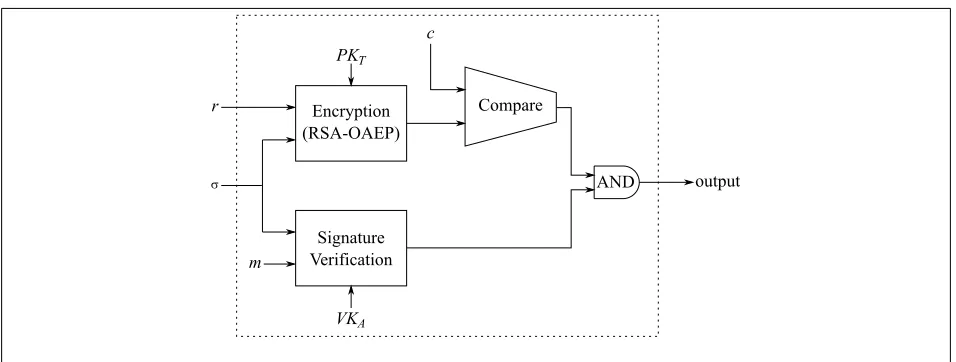
LetC(r, σ)be a circuit that hard-codesm,y,P KT, andV KA, takesr, σas inputs, and outputs true iff the relation holds for this(r, σ). Then saying that “Alice knows a satisfying input toC” is equivalent to saying that “cis the ciphertext of a valid signatureσ, encrypted withP KT.” This Boolean circuit is illustrated in Figure 1.
r
m
c PKT
VKA
�
Encryption (RSA-OAEP)
Signature Verification
Compare
AND output
Figure 1:The circuitCfor verifiable encryption of a signature
5.2 Discussion
From the above survey of results in NIZKPs, one can see that while it is certainly possible for one to avoid cut-and-choose using NIZK proofs, for typical public-key encryption and signature verification, it is far too expensive to use generic Cook-Levin NP-reductions. This motivates the need to explore targeted solutions that do not depend on such reductions. One of the questions that arises is whether we can remove the interactivity requirements more efficiently by using problem-specific zero knowledge proofs. That is, can we restrict the generic relationRwe are considering and then try to remove interactivity requirements? In this paper we restrictRto be a relation based on discrete logarithms,R ={(gs, s)|s∈Zq}such that for any pair(x, s)∈R,sis the discrete log ofx. This line of thinking was explored by Asokan et al. [ASW98], where they provide an efficient zero knowledge proof for the same definition forR, but in an interactive way. We answer this question positively by using secure hardware, and remove interactivity requirements.
6
Preliminaries and Protocol Primitives
In this section we describe the TPM-style operations that we propose in this paper and preview some con-cepts relevant to our work. For constructing our protocols, we use the ability of the TPM to generate random (secret) numbers, create signatures using one of the TPM’s Attestation Identity Keys (AIKs), and do basic encryption. Recall that an AIK is a signing key that is certified by a PrivacyCA as usable only inside a TPM, so we trust that values signed by an AIK were correctly and honestly produced (assuming an uncompromised TPM).
To support the cryptographic operations required by the TPM specification, TPMs are able to perform modular arithmetic, including modular powering, and we use these capabilities to perform operations over a particular cyclic group. In particular, letpandqbe primes such thatq|p−1, and letgbe a generator for the subgroup ofZ∗pof orderq. These values can be global for all TPMs, although it is advisable that these values be modifiable in case particular primes are discovered to have undesirable properties. The operations we require of the TPM will be modulopand moduloqarithmetic, and consistent with existing TPM parameters
6.1 Secret Sharing Schemes
Secret sharing is a fundamental part of our work, so we review the concepts and establish notation in this section. Specifically, we look atthreshold secret sharing, in which a secret is divided among a group ofn
members who have decided on a threshold value, say,k. Each member gets a share of the secret, and only groups ofkor more members can reconstruct the secret. We require the generated shares to be random and (k−1)-wise independent, and thus concentrate onperfectsecret sharing schemes. Shamir’s scheme [Sha79] was one of the first such perfect secret sharing schemes, and is secure in the information theoretic sense (not depending on any complexity assumptions). Another possible option is the secret sharing scheme due to Blakely [Bla79], which is not perfect in its raw form, but can be modified to achieve perfect security. In general, threshold secret sharing for secrets inZqcan be defined by the following two functions.
SHARE(x, k, n)→(x1, x2, . . . , xn): Splits a secretx ∈ Zq intonshares, with eachxi ∈ Zq, so that the secret can be reconstructed from anykshares but not from any fewer thankshares.
RECOVER(v1, v2, . . . , vk, k, n)→y: Ifv1, v2, . . . , vkarekdifferent shares produced by the SHARE oper-ation, then the valueythat this produces is the original secret value (xin the SHAREoperation).
6.2 Our Protocol Primitives
The following are two proposed TPM commands which we will use in this paper, which correspond to generating a random secret and creating certified encryptions of shares of this secret. While not necessary for all applications, the commands provide the capability to attach a “condition” to the certified randomness produced by these commands, similar to a verifiable escrow scheme — the condition may be arbitrary, but a fixed-length hash is passed to the first command and then included in each encrypted share by the second command (e.g., if SHA-1 is used, like many other TPM commands, this would be a 160-bit parameter). This condition is vital for verifiable escrow and more involved protocols, such as the fair exchange protocol that we describe in Section 7.4, where a party uses the condition to commit to certain values when starting the verifiable escrow process.
TPM MakeRandomSecret(hCond, k, n)→(secHandle, r): This operation generates a randomr ∈Zq
that will be shared in a k-of-n secret-sharing scheme, and provides the value and a handle to an internal protected storage version of the secret. The valuehCondis the hash of a “condition” tied to this random secret, as described above.
TPM EncryptShare(secHandle, AIKHandle, i, P K)→
hv = (EP K(hCond k ri), P K, k, n, gr, hCond), SignAIK(h(v))i: Gives a signed, hashed, en-crypted version of thei-th share of random secretr(referred to bysecHandle). If this is called with
i= 1, . . . , n, the shares that are encrypted,r1, . . . , rnshould be the shares output by SHARE(r, k, n) for some secret sharing scheme.
applications of this technique would use small values ofk(two or three), and so this is in fact quite efficient to implement within a TPM. Moreover the share generation operation requires only polynomial evaluation, and can be done withk−1modular multiplications and additions by using Horner’s rule [CLRS02, Section 30.1].
In a TPM, structures that store information about objects, such as keys, monotonic counters, and internal registers, are each given a tag which identifies what structure is in use. This is useful in differentiating between structures. So when the TPM needs to store data generated by the above commands, such as thek
coefficients and the random valuer, it does so in an internal protected storage structure, and each structure will be tagged with a unique value that distinguishes it from all other structures.
In some applications, such as the optimistic fair exchange protocol that we describe later, we don’t need secret sharing at all. Instead, we simply need to be able to encrypt the secret random value using the public key of one or more trusted parties so that the secret can be recovered later if necessary. This is a degenerate “1-of-n” case of the generic operation above, but we describe it here separately as this might be the most useful form of the certified randomness operations.
TPM MakeRandomSecret1(hCond)→(secHandle, r): Randomr ∈Zqis selected, stored internally withsecHandleto refer to it, and returned to the user.hCondis the hashed condition, as before.
TPM EncryptShare1(secHandle, AIKHandle, P K)→
hv= (EP K(hCondkr), P K, gr, hCond), SignAIK(h(v))i: The previously generatedris bundled with the conditionhCondand encrypted for a trusted party whose public key is denoted byP K, and signed by the Attestation Identity Key (AIK).
7
TPM-based Verifiable Group Escrow Protocol
In this section we show how the TPM operations defined above can be used to implement a form of verifiable group escrow, a problem described by Camenisch and Damgard [CD00]. In verifiable group escrow, there is a sender (prover), a receiver (verifier), andnsemi-trusted parties (recovery agents, or simply “agents” in this work). The sender has a public valuexthat it claims satisfies some property, which can be verified using a secret witnesssknown to the sender. The sender wants to sendxalong with additional information to the receiver such that the receiver (a) has assurance that it can recover the secretsif it has the cooperation of an authorized subset of the agents and (b) without the cooperation of an authorized subset of agents the receiver gets no information abouts(of course, the sender can also revealsto the receiver at any time). There are several ways to define an “authorized subset” of agents, but the most generic way is to use a monotone access structure Γ, which is a set of subsets of authorized agents that is monotone (so that ifA ∈ Γand
A ⊆ B thenB ∈ Γ). To simplify notation, we refer to encryption and decryption algorithms which have embedded public and private keys as different algorithms, even though in practice these would all be the same core algorithm but with different embedded keys. Specifically, we simply writeEi andDi for the encryption and decryption functions of agenti ∈ {1, . . . , n}, where keys are understood to be part of that notation. We will refer to the set of all recovery agent encryption and decryption algorithms with notation
E = (E1, . . . , En)andD= (D1, . . . , Dn).
While expressed formally, the properties in the definition have simple intuitive descriptions: The Com-pletenessproperty states that if the prover and verifier are honest, the verifier always accepts. TheSoundness
property says that no dishonest prover can trick a verifier into accepting something that will not allow recov-ery of a valid witnesssif the verifier uses a set of agents that are included in the access control structureΓ. TheComputational Zero Knowledgeproperty states that no dishonest verifier can recover any information about a valid witnesss, and this is true even if the verifier uses an arbitrary set of agents that is not in the access control structure.
Definition 7.1 (Generic Verifiable Group Escrow) Letλbe a security parameter, and letRbe a relation that defines languageLR = {x| ∃s: (x, s) ∈ R}. There existnagents with encryption/decryption
algo-rithms denoted(Ei, Di)fori= 1, . . . , n, and denote the full set with notation(E,D) = ((E1, E2, . . . , En), (D1, D2, . . . , Dn)). Given a monotone access structureΓoverD, aVerifiable Group Escrow Schemefor relationRand access structureΓconsists of a two-party protocol(P, V)and a recovery algorithmR. Let VP(s)(E, x,Γ, hCond, λ) denote the output of the verifierV when interacting with prover P on common input(E, x,Γ, hCond, λ), wherehCondis an arbitrary condition andP is additionally given private input s. The following properties must hold:
1. Completeness: IfP andV are honest, then for all sets of agents(E,D)and all(x, s)∈R,
VP(s)(E, x,Γ, hCond, λ)6=⊥ .
2. Soundness: For all polynomial timeP˜with supplemental inputs, all(E,D), all supportedΓ, and all integersc≥1, ifα=VP˜(s)(E, x,Γ, hCond, λ)6=⊥then for recovery algorithmRwhich has access
to some setD˜ ∈Γof recovery agents, for all sufficiently largeλ
P rob[(x, R(α))6∈R]<1/λc.
3. Computational Zero Knowledge: For any polynomial time V˜, which accesses some set of agents
˜
D /∈Γ, there exists an expected polynomial time simulatorSV˜ with black-box access toV˜ such that for all polynomial time distinguishersA, all integersc≥1, allx ∈LR, and all sufficiently largeλ,
we have
P rob[A(E, x, αi) =i:α0 =SV˜(E, x, λ, hCond); α1= ˜VP(s)(E,D, x, λ, hCond˜ ); i∈R{0,1}]
< 1
2 + 1
λc .
Definition 7.1 describes a generic form of verifiable group escrow, but in order to produce algorithms that can be realized with the help of trusted hardware, we restrict two general parameters in the above definition — we fix the relationRto be a specific relation based on the discrete log problem, and we restrict the access control structureΓto be a threshold structure so that we can use simple threshold secret sharing schemes. Specifically, we make the following two restrictions:
1. R⊆(Zp,Zq)is defined so thatR={(gs, s)|s∈Zq}. In other words, for any pair(x, s)∈R, the secretsis the discrete log ofx.
Assuming we have a trusted platform that provides the operations defined in Section 6.2 and satisfies the Trusted Platform Security Assumption, we define the following protocol for the verifiable group escrow problem — since our protocol is non-interactive, we define it as a pair of algorithms, one for the sender which produces the verifiably-escrowed secret, and one for the receiver which verifies that the values produced by the sender are properly formed.
In the following algorithms,P K1, . . . , P Kndenote the public encryption keys of thenagents, so then -tuple(P K1, . . . , P Kn)is the realization of the abstract set of encryption routinesEgiven in Definition 7.1. Furthermore, since the abstract access structureΓis restricted to be a threshold structure, it is fully specified by the pair(k, n), which represents a “k-of-n” threshold structure. Finally, we assume that the AIK used in this protocol is loaded into the TPM before VESENDER is called and is referenced by TPM handle
AIKH, and we have a certificateCert(AIK)for this AIK signed by a trusted PrivacyCA. The condition
hCondassociated with this escrow is the same as described in Section 6.2, and can be used as needed by applications.
AlgorithmVESENDER((P K1, . . . , P Kn), s,(k, n), hCond, λ)
x←gsmodp
(secHandle, r)←TPM MakeRandomSecret(hCond, k, n) d←s+rmodq
t←grmodp
fori∈1, . . . , ndoCi←TPM EncryptShare(secHandle, AIKHandle, i, P Ki)
returnB=hd, x, t, C1, C2, . . . , Cn, Cert(AIK)i
AlgorithmVERECVERIFY(B=hd, x, t, C1, C2, . . . , Cn, Cert(AIK)i, hCond)
ifCert(AIK)is not certified by a trusted PrivacyCAthen return⊥
ifC1, . . . , Cnare not tupleshci, h(P Ki), k, n, t, hisigned byAIKthen return⊥
ifhk, n, t, hiare not identical in all tuples withh=hCondthen return⊥ ifgd6=xtthen return⊥
returnα=B
If it is necessary to use these encryptions to recover the secrets, the following algorithm can be used:
AlgorithmVERECOVER(α=hd, x, t, C1, C2, . . . , Cn, Cert(AIK)i, hCond)
Selectk Ci’s:Ci1, Ci2, . . . , Cik, and use recovery agents to decrypt eachhCondikkrik
ifanyhCondikdoes not match parameterhCondthen return⊥
r←RECOVER(ri1, ri2, . . . , rik, k, n)
s0 ←(d−r) modq returns0
Note that none of the TPM operations used by the algorithms depend on the secretsin any way, but only deal with a generic random valuer. We will prove that this scheme is a secure verifiable group escrow scheme in Section 7.2, and that VERECOVERwill succeed in recovering the originals, but first we demonstrate a useful application.
7.1 Application to Verifiable Group Escrow of Signatures
parties can recover the signature if necessary. We would like to verifiably escrow the signature so that the receiver has assurance that the ciphertexts which it receives (and which are unintelligible to it) are in fact shares of the requested signature.
Our verifiable escrow protocol can be used with several signature schemes, including Digital Signa-ture Standard (DSS) signaSigna-tures [NIS92], but for concreteness we instantiate it here with Schnorr signa-tures [Sch91]. Techniques for using other signature schemes are similar to the techniques described in Section 4 of Asokanet al.[ASW98]. Note that the TPM operations used are independent of the signature scheme used, and the security of the verifiable escrow is in no way related to the security of the underlying signature scheme. The Schnorr signature scheme is briefly described below:
SETUP OFSYSTEMPARAMETERS: There is a prime moduluspwith a generatorgof a subgroup ofZ∗pof prime orderq. A random valueζ ∈ Zq is the private key of the signer, Alice, and her public key is
y=gζ. Let Bob be the verifier.
SCHNORRSIGN(m, ζ): To create her signature, Alice picks a randomr ∈ Zqand computes u = gr,c = h(u k m), andz = r+ζcmodq, wherehis a cryptographic hash function. Her signature is then (c, z).
SCHNORRVERIFY((c, z), m, y): Bob, who knows Alice’s public keyy, checks ifh(gzy−c k m) =c, and accepts if it is true, rejects otherwise.
Next we show the sender and receiver portions of our verifiable group escrow of a Schnorr signature. Since the Schnorr signature is a pair(c, z), wherecis random (in the random oracle model), we transmitcin the clear and use the verifiable escrow for only the second componentz (note thatz ∈ Zq as required by our TPM operations).
AlgorithmSIGSENDER((P K1, . . . , P Kn), m,(k, n), ζ, hCond)
(c, z)←SCHNORRSIGN(m, ζ)
B ←VESENDER((P K1, . . . , P Kn), z,(k, n), hCond, λ)
returnh(c, z),Bi
AlgorithmSIGVERIFIER(y, m, c,B=hd, x, t, C1, C2, . . . , Cn, Cert(AIK)i, hCond)
ifyis not an acceptable public keythen return⊥ ifh(xy−c km)6=cthen return⊥
returnVERECVERIFY(B, hCond)
If it is necessary to recover the signature from the encrypted shares, we first do a recovery from the verifiable group escrow to recoverz. Since SIGVERIFIER has verified that h(xy−c k m) = c, and the recovered z is such that x = gz, we haveh(gzy−c k m) = c, which is exactly the property that must be verified in SCHNORRVERIFY. Therefore,(c, z)is a valid Schnorr signature on messagem.
AlgorithmSIGRECOVER(c,B, hCond) z←VERECOVER(B, hCond) ifz=⊥then return⊥ return(c, z)
7.2 Security Properties
In this section we prove that VESENDER and VERECVERIFY provide a secure verifiable group escrow scheme.
Theorem 7.1 LetRbe a relationR ⊆(Zp,Zq)such thatR ={(gz, z)|z ∈ Zq}. The protocol outlined above, when the prover uses a system that satisfies the Trusted Platform Security Assumption, is a secure verifiable group escrow scheme forR.
Proof: We consider the three properties required by Definition 7.1.
1. Completeness: Follows directly from the protocol.
2. Soundness: First, assume that allCi’s were produced by a valid TPM using theTPM EncryptShare function (we will return to this assumption later), and thus we are guaranteed that agent ican use valueCito recover its correct sharesi of the secrets. Recall that in our setting, the monotone access structureΓ from Definition 7.1 is defined to be a threshold access structure, where anyD˜ from the Soundness condition of the definition is simply a set ofkor more agents. For any suchD˜ we selectk
correspondingCi’s in the first step of the VERECOVERfunction, use the agents to decrypt the shares from which the secret sharing RECOVERfunction recovers the secretr such thatt = gr. Since the TPM guarantees that the recoveredris such thatt=gr, and we have verified thatgd=xt, we have
gd = xgr, sos0 is such thatgs0 = gd−r = x. Sincesis the unique value in0, . . . , q−1 such that
gs=x, we must haves0 =s, and we have recovered the original secrets.
Next, consider our assumption that all theCi’s were produced by a valid TPM. Soundness requires thatBfrom the protocol pass the VERECVERIFYtest, which means (by parts 1 and 5 of the Trusted Platform Security Assumption) that allCi’s have been signed by a valid AIK, i.e., a key that only exists in usable form inside the TPM, and hence is unavailable to an attacker. Therefore, the only way an adversary could produce aCi that was not produced by a valid TPM is to forge a signature, which can only be done with negligible probability by Part 3 of the Trusted Platform Security Assumption. The soundness property follows.
3. Computational Zero Knowledge: For any probabilistic polynomial time (PPT) verifierV˜, we need a PPT simulatorSV˜ that can simulateV˜’s view of the transaction with just the common input variables,
and without access to the prover. The common input variables are public, and consist of the values that are given to both the prover and verifier prior to the interaction, and include the general system parameters as well as the public keys ofnagents,P K1, P K2, . . . , P Kn, the valuexthat is the one-way image of secrets, asx =gs(note thatsis only known to the real prover, not the verifier or the simulator), as well as any global conditionhCond. We need a modified, perfect secret sharing scheme in which we prependhCondto every share, but this is a straightforward extension. Any perfect secret sharing scheme (e.g., Shamir’s scheme) can be modified to accommodate this, and will still retain perfect security.
real TPM is that the keySKCdoes not belong to a legitimate PrivacyCA, so we have violated Trusted Platform Security Assumption part 5. This matters only in theSoundnessproperty of the proof, and not in the computational zero knowledge property.
Next, the simulator selects random valuesd,r˜ ∈R Zq, and computesnshares of r˜ : ˜r1, . . . ,r˜n ∈
Zq. The simulator computes t = gdx−1 and then creates values Ci = hv = (EP Ki(hCond k
˜
ri), P Ki, k, n, t, hCond), SignSKA(h(v))ifori= 1, . . . , n, whereP Kiis the public encryption key
of recovery agent i. Finally, the simulator creates the tuple
B = hd, x, t, C1, C2, . . . , Cn, CertV KC(V KA)i. Since t was computed so thatg
d = xt, this
tu-ple will be verified by the VERECVERIFYfunction. The simulator runsV˜, using up tok−1recovery agents to decrypt ciphertexts, including up tok−1of the shares contained in theCi’s.
Consider whatV˜ would see from a real prover at this point: some shares of secret r, as well ast
which depends onr — however, since we use a perfect secret sharing scheme with thresholdkand the number of shares will be less thank, the decrypted shares are random and independent of both each other andr. This is the exact same as the distribution over the decrypted shares when we use the simulator. In addition to the decrypted shares which are random and independent,V˜ also has access to all ciphertextsCi. WhenV˜ interacts with the real prover, the corresponding plaintexts are shares of r. In the simulator case, the corresponding plaintexts are shares of an independent random value, so do not contain any information related to the secretrfrom the real protocol. Below we show that the views ofV˜ andSV˜ are computationally indistinguishable to any polynomial time distinguisher,A.
Indistinguishability ofV˜andSV˜ toA:We cannot use the L-R oracle model of Bellareet al.[BBM00]
to reduce the hardness of distinguishing shares ofV˜ andSV˜ to CCA2 security of the underlying PKE
scheme, since the decryption oracle in the standard L-R model will disallow all queries over the chal-lenge ciphertexts obtained from the encryption oracle, and we need to allow up tok−1decryptions of the challenge ciphertexts (kis the threshold number of agents required to reconstruct the secret). Looking beyond L-R and other methods [CS01], we complete this proof using a reduction from the encrypted secret sharing problem from Tateet al.[TVW13], defined in Figure 2.
In our problem, the goal ofAis to distinguish between the views ofV˜ (which interacts with the real prover), andSV˜ with non-negligible probability. We show that if such a distinguishingAexists, then
thatAcan also be used to construct an adversary that wins the encrypted secret sharing (ESS) game. Letr1, r2,· · · , rnbe the shares the real prover creates when interacting withV˜, and letr˜1,˜r2,· · · ,r˜n be the shares created by simulatorSV˜. Given a distinguisherAand verifierV˜, we construct anESS
adversaryA∗. Note thatOhas access to the agents’ public/secret keypairs,(pk
i, ski)∀i∈[1. . . n].
ESSwill use a plaintext-samplable PKE scheme, andA∗ will have oracle access toESS. A∗ then plays theESSgame thus:
(a) Since we are usingnagents, each with their own keypair,A∗will first generate a key-mapping function K : [n] → [n], with K(i) = i, and will create a description Desc(Γ) of a k-of-n
threshold access structure.A∗will then callOESS.Initialize(1λ, n, n,KDesc(Γ)). The oracle will internally generate keypairs to be used in anESSgame, pick an internal bitb, and return public keyspk1, . . . , pkn.
(b) A∗ will pick randoms¯ ∈R Zq, x0, x1 ∈R Zq, and call OESS.Challenge(x0, x1). The oracle
will return encryptions of nshares of xb: c1, c2, . . . , cn. For i ∈ [1. . . n], A∗ will compute Ci = hvi = (ci, pki, k, n, gx0, hCond), SignSKA(h(v))i. Note that SKA is generated in the
Consider anns-way perfect secret sharing scheme with monotone access structureΓfor which we will use nkdifferent keypairs (numbered 1 tonkfor convenience) to encrypt these shares according to a key mapping functionK: [ns]→[nk]so that shareiwill be encrypted using key numberK(i). The scheme may depend on the access structure, and may in fact only work for some specific subset of access structures (such as threshold access structures), and we assume there is some appropriate and compact descriptionDesc(Γ)of validΓ’s for a particular scheme. LetSbe a generic PKE scheme.
• ESSS.Initialize(1λ, n
k, ns,K,Desc(Γ)): If this scheme does not support access structure Γ, return
⊥ and do not answer any further queries. Otherwise, the oracle generates keypairs (pki, ski) =
S.KeyGen(1λ) for i = 1, . . . , nk, picks a random bitb ∈ {0,1}, and saves ns, K, andDesc(Γ) for later use. γ, used to track the set of shares that have been decrypted, is initialized to the empty set. Finally, set flagctofalse, indicating that no challenge has yet been made, and return public keys
pk1, . . . , pkn.
• ESSS.Challenge(x
0, x1): If c is true, then return ⊥. Otherwise, the oracle generates ns shares s1, . . . , sns for xb, creates share ciphertexts by computing ci = S.Encrypt(pkK(i), si) for i =
1, . . . , ns, sets flag c totrue, and returns the vector (c1, . . . , cns) to the adversary (keeping a copy
for future reference).
• ESSS.Decrypt(i, x)(wherei∈[nk]is a key number andxis a ciphertext): Ifx6∈ {cj| K(j) =i}(so cj was not produced by encrypting with keyi), then simply compute and returnS.Decrypt(ski, x). Otherwise,x=cj for somejwithK(j) =i, so test whetherγ∪ {j} ∈Γ: if it is, return⊥; otherwise, setγ ←γ∪ {j}and returnS.Decrypt(ski, x).
• ESSS.IsWinner(a): Takes a bitafrom the adversary, and returnstrueif and only ifa=b.
Note that the test in ESSS.Decrypt(i, x) disallows decrypting shares for a share set that would allow
re-construction of the secret, while still allowing some decryptions. Furthermore, sinceΓis monotone, if the ultimate set of shares that have been decrypted are from a setγ 6∈Γ, then every subset ofγ is also not inΓ and so this test does not restrict adversaries in any way other than not allowing them to receive a full share set.
(c) A∗ generatesB = hx
0 + ¯s, gs¯, gx0, C1, C2, . . . , Cn, CertV KC(V KA)i, and gives Bto a
sim-ulation ofV˜. During its execution, V˜ can adaptively query up tok−1recovery agents of its choice decryptingCi’s or other chosen ciphertexts. For queries of ciphertextCi,V˜ will query
OESS.Decrypt(i, c
i), wherei∈n.
(d) V˜ will then outputαwhich is provided to the distinguisherA, who will output a guessi∈ {0,1}. The output ofAis returned as the output ofA∗. There are two cases to consider:
i. b = 0: If the internal bitbof theESSoracle is 0, then the distribution of Bcorresponds exactly to the distribution of the input ofV˜ in the real world, since the realV˜Ps’s input will
be(B=hs+r, x, gr, C1, . . . , Cn, Cert(AIK)i, hCond). In the case of theESSgame, the distribution will be over(B=hx0+ ¯s, gs¯, gx0, C1, . . . , Cn, CertV KC(V KA)i, hCond).
ii. b = 1: If the internal bit b of the ESS oracle is 1, then the distribution of B corre-sponds exactly to the distribution of the input of V˜ given by SV˜, since SV˜’s input will
be(B=hd, x, t, C1. . . , Cn, CertV KC(V KA)i, hCond). In the case of theESSgame, the
distribution will be over(B=hx1, x, t, C1, . . . , Cn, CertV KC(V KA)i, hCond).
We can see thatA∗wins theESSgame if and only ifAdistinguishes between the output of the real world and simulator, so for the verifiable group encryption, VGE adversary,A,
AdvA∗,ESS=AdvA,VGE
Since the advantage of the adversary in theESSgame is negligible, the simulator,SV˜ presents a view
toAthat is indistinguishable fromV˜, and hence our protocol is computationally zero-knowledge.
The above arguments show that the desired properties of a secure verifiable group encryption scheme are all met.
7.3 Comparison to Non-Trusted Platform Protocols
We now compare the costs of our protocol to two prior verifiable encryption protocols: that of Camenisch and Damgard [CD00] (the “CD” protocol), and Camenisch and Shoup [CS03] (the “CS” protocol). We first consider the CD protocol, as it is the only one to support verifiable group encryption, and hence is the most directly comparable to our TPM-based verifiable group escrow protocol. For simplicity of comparison, we fix a constanthCondfor our escrow scheme, turning it into a verifiableencryptionprotocol. Note that we could also look at turning CD into a verifiable escrow protocol, but that is slightly more complex.
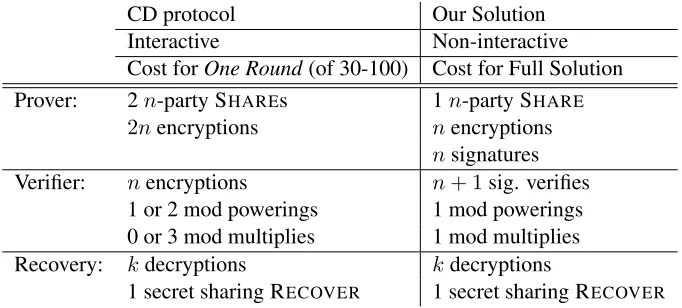
We compare costs in Table 1. Our TPM-based protocol is patterned after the CD protocol, with the cut-and-choose proof replaced by a TPM signature, so the costs can be compared fairly simply. Looking at one round of the CD protocol, the cut-and-choose technique requires that the prover actually create two sets of values: one will be used to answer a challenge to honesty from the verifier, and the other to actually use in the encryption. Because of this duplication of effort, the CD protocol requires twice the number of encryptions as our protocol; however, trust in our protocol is built by the hardware signing values, so we must donsignatures, and so the number of public key operations is the same. We note thatnrefers to the number of recovery agents, which in most cases is just one, or may be a small number (e.g., below 10). In any case, it is unlikely that the number of trusted third parties will be an exceedingly large number. For the CD protocol this round must be repeated in order to build trust: a dishonest prover can get away with cheating on a single iteration of the prover’s phase with probability 1/2, and by repeating the protocola
CD protocol Our Solution Interactive Non-interactive Cost forOne Round(of 30-100) Cost for Full Solution Prover: 2n-party SHAREs 1n-party SHARE
2nencryptions nencryptions
nsignatures Verifier: nencryptions n+ 1sig. verifies
1 or 2 mod powerings 1 mod powerings 0 or 3 mod multiplies 1 mod multiplies Recovery: kdecryptions kdecryptions
1 secret sharing RECOVER 1 secret sharing RECOVER
Table 1: Comparison of the cost of Camenisch-Damgard (CD protocol) to our TPM-based solution forn
agents, with a threshold ofk. Note that the Camenisch-Damgard protocol has a probability of 1/2 of being “tricked” each round, so is repeated 30-100 times in order to build up trust in a statistical sense.
without detection is about one in a billion, and a very high degree of assurance can be obtained by repeating the protocol 80-100 times. The main issue in the CD protocol is that both prover and verifier need to have an open, synchronous communication channel while they perform all the rounds of communication. This is not suitable for situations when both parties cannot or may not want to necessarily make themselves available at the same time, or may want to store and process data at their convenience.
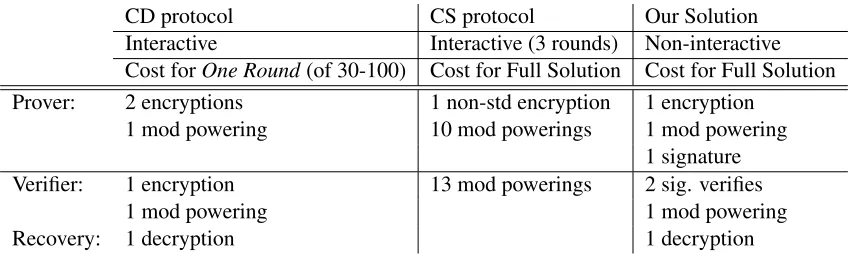
The CS protocol improves on the CD protocol when there is a single agent, removing the cut-and-choose and reducing the amount of interaction substantially; however, the CS protocol is not directly applicable to the multiple-agent problem. We compare all three schemes in this restricted single-agent setting in Table 2. While the CS protocol does not require the high interaction of the cut-and-choose proof used by the CD pro-tocol, it is nonetheless still an interactive protocol. The TPM-based protocol is completely non-interactive: the prover computes some values, sends them off, and then is no longer involved. In an e-mail setting (send and forget), this is a vital property that our protocol achieves but earlier solutions do not.
In addition, the CS protocol requires the use of a custom-designed encryption scheme, which is less well-studied than the standard encryption schemes which can be used in the CD protocol or in our solution. While providing some nice properties, this new encryption scheme requires significantly more work than traditional public key encryption schemes: Modular operations are performed modulon2, so are approximately twice as large, and a single encryption requires 5 modular powerings and several modular multiplies, compared to a single modular powering for RSA-based methods (both methods also require some hashing and lower-complexity operations as well).
CD protocol CS protocol Our Solution Interactive Interactive (3 rounds) Non-interactive Cost forOne Round(of 30-100) Cost for Full Solution Cost for Full Solution Prover: 2 encryptions 1 non-std encryption 1 encryption
1 mod powering 10 mod powerings 1 mod powering 1 signature Verifier: 1 encryption 13 mod powerings 2 sig. verifies
1 mod powering 1 mod powering
Recovery: 1 decryption 1 decryption
Table 2: Comparison of major costs of single-agent solutions: Camenisch-Damgard (CD protocol), Camenisch-Shoup (CS protocol), and our TPM-based solution.
7.4 Fair Exchange of Digital Signatures
Fair exchange is an important application of the verifiable group encryption protocol outlined above, where additional operations are included in order to synchronize the actions and ensure that the fair exchange property is satisfied. One of the open problems left by Asokanet al.[ASW98] was to improve the efficiency of the verifiable escrow operation by avoiding cut-and-choose. Camenisch and Shoup showed that this was indeed possible by introducing a new encryption scheme [CS03]. By using TPMs, we have shown an alternative method that can make use of standard, well-studied encryption schemes, and further can make the verifiable escrow operation fully non-interactive.
In fair exchange of signatures, two parties have messages that they have pledged to sign, and at the end of the protocol either both have received the other’s signature, or neither has. As we did in Section 7.1, we assume Schnorr signatures (as we used in our SIGSENDERfunction), but this can easily be adapted to other supported signature schemes as mentioned in Section 7.1. At the beginning of the protocol, partiesAandB
have agreed to sign messagesmAandmB, respectively, and along with the publicly-known messages both parties know each other’s signature public keysyAandyB(corresponding private keysζAandζBare known only toAandB, respectively). Asokanet al.’s protocol is an “optimistic fair exchange protocol,” meaning that the trusted third party is not involved unless there is a dispute, but the third party does require a single, consistent database of tuples to keep track of any requests that have been made of it. The generality of our solutions for verifiable encryption in this paper, using multiple trusted parties and a threshold scheme, causes complications for the fair exchange problem — unless a single globally-consistent database is maintained, it might be possible for a party to cheat the controls that the trusted party is supposed to enforce. While we could potentially do this with some distributed database of tuples, we simplify the problem back to a single trusted party in this section. The trusted party has public encryption keyP K, which is known to all parties. First we give a brief summary of Asokan et al.’s fair exchange protocol in Figure 3 and then give our modified version in Figure 4. In addition to inserting our signature escrow functions SIGSENDER, SIGVERIFIER, and SIGRECOVER, a few changes come from the fact that we are using a specific signature scheme rather than a generic homomorphic reduction scheme.
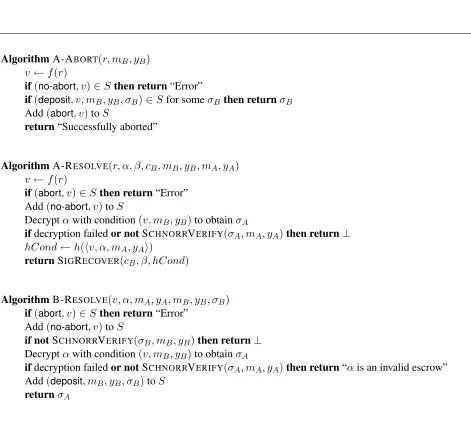
Functions A-ABORT, A-RESOLVE, and B-RESOLVE are used in the fair exchange protocol in order to coordinate actions with the trusted third party, when such interaction is necessary. They are executed atomically by the trusted party, and are straightforward adaptations of the functions designed by Asokanet al.[ASW98] following changes we made in the base exchange protocol, and are given in Figure 5.
Asokan et al.’s protocol involves two parties, A andB and a offline trusted third party which acts as a recovery agent in case either party cheats.AsendsBan encrypted signature over a message (e.g., a contract or string commitment) whichB wishes to verify before sending its own signature to A. The steps of the protocol are briefly summarized below:
1. AsendsBan regular, non-verifiable escrow of its signature with an attached condition that describes the signature thatBis expected to give in return toA.
2. IfBreceives the escrow fromA,BsendsAa verifiable escrow of its signature, attaching a condition that includesA’s escrow from the previous step and a description of the content of the escrow. IfB
does not receiveA’s escrow,Bquits.
3. Areceives and verifies the escrow fromB. If the escrow verifies correctly,AsendsB its signature, elseAcontacts the recovery agent and requests to A-ABORTthe transaction and quits.
4. B receives and verifies the signature from A. If this succeeds,B sends Aits signature, outputs the signature fromAand quits. Else,B contacts the recovery agent, and requests it to B-RESOLVEthe transaction.
5. Areceives and verifies the signature fromB. If this succeeds,A outputs the signature fromB and quits. Else,Acontacts the recovery agent and requests it to A-RESOLVEthe transaction.
The fair exchange protocol makes use of three sub-protocols: A-ABORT, A-RESOLVE and B-RESOLVE. The A-ABORTprotocol can only be called by partyA. The abort protocol is basically a request by party
Ato block any attempt byBto resolve the transaction (i.e., ifB takesA’s escrowed signature and tries to resolve the protocol with the trusted third party, while not supplying its own signature). However ifB has already resolved the transaction,Awill getB’s signature which was deposited with the recovery agent as part of the resolve-B protocol. Also, onceAhas invoked abort, it cannot invoke resolve and vice-versa. In the B-RESOLVEprotocol,Brequests that the recovery agent decrypt the escrow thatB received fromAin Step 2. The recovery agent will not release the decrypted signature unlessB deposits the contents of the escrow as described in the attached condition. In the A-RESOLVE protocol,Arequests that the recovery agent decrypt the verifiable escrow thatAreceived in Step 3. Before this, the recovery agent first checks that the escrowAsent toBin Step 1 was correct by checking the condition attached to the verifiable escrow.
1. Achoosesr ∈ Domain(f)at random, and computesv = f(r), wheref is a one-way function. A
then computes its signatureσA, encrypts it using a regular escrow scheme with condition(v, mB, yB), giving an escrowαwhich it sends along withvtoB.
2. B receives v and α from A, and computes hCond = h(hv, α, mA, yAi), then h(cB, zB), βi = SIGSENDER(P K, mB, ζB, hCond). B’s signature onmBis thenσB = (cB, zB).B sendscBandβ toA.
3. A receives cB and β from B, computes it’s own copy of hCond and checks that β is a proper signature escrow using SIGVERIFIER(yB, mB, cB, β, hCond)— if this does not verify, Acalls A-ABORT(r, mB, yB)and quits the protocol (perhaps having receivedB’s signatureσB); otherwise,A creates signatureσAfor messagemAand sendsσAtoB.
4. BreceivesσAfromAand verifies that this is a valid signature onmA. If this is a valid signature, then Bsends signatureσBtoA; otherwise,B calls B-RESOLVE(v, α, mA, yA, mB, yB, σB)which either returnsσA(ifαis a valid escrow) or an error message.
5. AreceivesσB fromB and verifies that this is a valid signature onmB. If this is a valid signature, then the protocol halts, with both parties having received valid signatures; otherwise, A calls A-RESOLVE(s, α, β, cB, mB, yB, mA, yA)to getσB.
Figure 4:Our fair exchange protocol
using Theorem 7.1 in this paper for the security of our verifiable encryption scheme, resulting in the follow-ing theorem. The proof of this theorem is a simple modification to the proof in Asokanet al.[ASW98], so is not given here. Note that only one side needs to be equipped with a TPM, and due to symmetry of the fair exchange protocol, it could be either side.
Theorem 7.2 Given partiesAandB, in whichB has access to a TPM that satisfies the Trusted Platform Security Assumption, the protocol described above is a secure optimistic fair exchange protocol.
The most expensive operation in Asokanet al.’s protocol is the verifiable escrow operation which makes the cost of the protocol grow witha, whereais the number of rounds between prover and verifier. Using our functions in place of the verifiable escrow, we only need a single round, reducing the computational cost, and more importantly makes that part of the fair exchange protocol non-interactive.
8
Conclusion and Future Work
AlgorithmA-ABORT(r, mB, yB) v ←f(r)
if(no-abort, v)∈Sthen return“Error”
if(deposit, v, mB, yB, σB)∈Sfor someσBthen returnσB Add(abort, v)toS
return“Successfully aborted”
AlgorithmA-RESOLVE(r, α, β, cB, mB, yB, mA, yA) v ←f(r)
if(abort, v)∈Sthen return“Error” Add(no-abort, v)toS
Decryptαwith condition(v, mB, yB)to obtainσA
ifdecryption failedor notSCHNORRVERIFY(σA, mA, yA)then return⊥ hCond←h(hv, α, mA, yAi)
returnSIGRECOVER(cB, β, hCond)
AlgorithmB-RESOLVE(v, α, mA, yA, mB, yB, σB) if(abort, v)∈Sthen return“Error”
Add(no-abort, v)toS
if notSCHNORRVERIFY(σB, mB, yB)then return⊥ Decryptαwith condition(v, mB, yB)to obtainσA
ifdecryption failedor notSCHNORRVERIFY(σA, mA, yA)then return“αis an invalid escrow” Add(deposit, mB, yB, σB)toS
returnσA