Available Online atwww.ijcsmc.com
International Journal of Computer Science and Mobile Computing
A Monthly Journal of Computer Science and Information Technology
ISSN 2320–088X
IMPACT FACTOR: 5.258
IJCSMC, Vol. 5, Issue. 6, June 2016, pg.561 – 568
Multimedia Data Recommendation using
Semantic Web Based Network Model
Prashank Bhosale
1, Arti Mohanpurkar
2¹Department of Computer Engineering, Dr. D. Y. Patil College of Engineering and Technology, Pune, Pune University, India
²Department of Computer Engineering, Dr. D. Y. Patil College of Engineering and Technology, Pune, Pune University, India
1
[email protected]; 2 [email protected]
Abstract— The recent era is of sharing multimedia data globally. Every second thousands of images get uploaded over social network. It’s becoming very challenging issue to search proper multimedia data over the internet. Big Data is an immense dataset, connected to usually utilized software tools, whose size is huge, which is past the capacity of hardware regarding catch, oversee, and handle the information inside a satisfactory passed time. As multimedia is increasing rapidly so that to manage this large amount of multimedia data there is urgent requirement of the system to handle and process this data in an efficient way. Proposed framework utilizing a search engine, which joins both text and information based forms to enhance picture recovery execution. In the search, there is a superior probability to admission description and textual components firstly, text background are organized. In proposed system web image tagging as well as image description are considered to re-arrange the multimedia data. Here system is implemented in which number of user can request for the data and admin has privilege to add the data to the dataset. Then finally images gets rearranged according to the semantic signatures. To get the result, number of images are taken as input and processed on it. The outcome is produced by contrasting the client query, information present in server of pictures and the tags given by administrator while transferring the picture. Last result demonstrates that this framework is having better execution and gives exact result.
Keywords— ―Big Data‖, ―Multimedia Resources‖, ―Semantic Link Network‖, ―Semantics‖, ―Annotation‖, ‖Tag‖.
I. INTRODUCTION
not found to be labelled. Online tagging is costly which leads to several users referring annotations that will portrays the picture content i.e., objects (e.g. animal") or ideas (e.g., forest"). From two alternate point of view the image auto-tagging has been addressed in [9] [11] [12]. By a managed learning problem firstly annotation is defined and words are associated to images, this is done by defining classes, each one is corresponding to a word, or a set of words which defines a concept, followed by manually given label to images, and lastly annotating by inseminating the related class words This methodology separates the textual part from the visual segments [13]. In this way understanding crude media solely in perspective of their visual appearance, transforms into a crucial yet troublesome issue.
II. LITERATURE SURVEY
An entire model [1] for producing the association connection between media assets utilizing semantic join system model is proposed. The definitions, modules of the semanticconnection system are utilized as a part of this strategy. The integration between the semantic connection system and multimedia assets gives another prospect to sorting out them with their semantics. The labels and the surrounding texts of multimedia assets are utilized to gauge their semantic affiliation. The various levelled semantic of multimedia assets is defined by their commented on labels and encompassing writings.
In [2] labelling is an imperative methodology for the recovery of pictures in different applications. These are used to oversee individual media information. There are different procedures implemented for the picture recovery, for example, highlight based, histogram based and change based yet these systems are not effective as far as grouping proportion and precision. Here in this paper different tag based picture strategy are discussed.
In [3] introduces another dominant part voting procedure that joins the two essential modalities of web pictures textual and visual components of picture in a re-annotation and search based structure. This system considers every website page as a voter to vote the relatedness of keyword to the web picture, this methodology is not just pure combination between picture low level element and picture element yet it take over the semantic importance of each keyword that expected to upgrade the recovery exactness. This methodology is not utilized just to upgrade the recovery precision of web pictures, additionally ready to comment on the unlabelled pictures.
In [4] presents a video annotation and browser stage with two online tools: Annomation and SugarTube. Annomation empowers clients to semantically clarify video assets utilizing vocabularies characterized as a part of the Linked Data cloud. SugarTube permits clients to scan semantically connected educational video assets with upgraded web data from various online assets. These creates the semantic association among video resources and allow their metadata to be understood globally. These facilities make the semantic associations among video assets and permit their metadata to be seen all inclusive.
In [5] the vast measure of client produced metadata encourage clients during sharing and sorting out multimedia content and give valuable data to enhance media recovery and administration. The web search experience is enhanced by producing the returned list as indicated by the modified client search goals utilizing customized look. In this paper, author has developed, simultaneously considering the client and query importance to figure out how to customized picture search. This fundamental work is to implant the client inclination and query related search expectation into client particular topic spaces. Personalization scheme requires user data. But because of isolation issues users are not attentive in sharing user profiles. Another issue with user profile is to restore these user profiles. In this case social communication plays very important role.
III.EXISTING SYSTEM
In the existing system [1] each tag is seen as a concept with explicit meaning. Thus some equations are used based on co-occurrence of two concepts to measure their semantic relatedness. In existing system they have only considered about the tags in the datasets and estimated the similarity between the tags and retrieved the relevant images.
IV.PROPOSED SYSTEM
The basic idea is to add the user concern and query search into user-specific point spaces. The proposed system is implemented as three tier architecture. First is client site where users search for different images by submitting query, then server site where tags similarity is calculated and then MySQL database where dataset is stored. Above framework is also verified for double word query. The tags and surrounding texts of multimedia assets are used to represent the semantic content. The relatedness between tags and surrounding texts are calculated in the Semantic Link Network model. Client send the query to the system which is then sent to the server and the server calculates the similarity and cluster result into groups by using K-Means clustering and finally client can view the results.
A. System Overview
Server
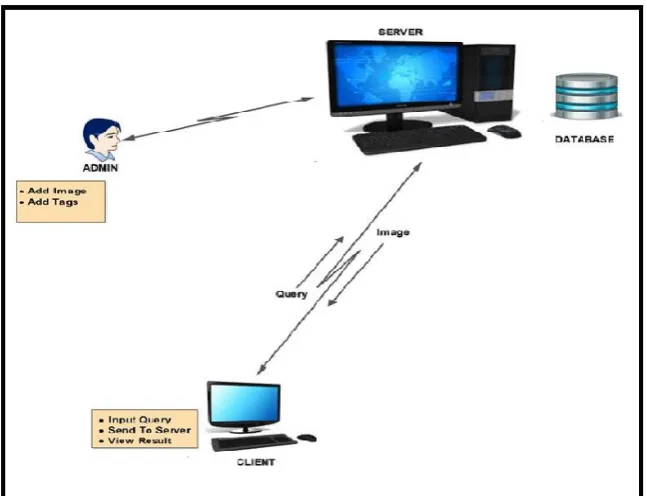
Admin can add the details relate to search items. Here admin has rights to add the images and its tagging and depiction to the dataset. Admin needs to add image path, image tag and image depiction.
Client
Client framework is a framework which asks for a query to the server to discover a picture from database.
Working
At the point when administrator signs into server for embedding the images, it stores label and description of image alongside the image on the server as shown in fig. 1. At the point when any client wants to get the image utilizing tag as an input, the server contrasts the query with the description and the image name using TF-IDF (Term Frequency and Inverse Document Frequency), cosine calculation, parsing and tokenization as shown in fig. 2. Based upon this correlation, the outcome is clustered by using K-Means algorithm and sent to the customer which is depends upon comparison threshold. Thus word net is used to determine similarity between different words. Also images gets recommended to clients according to their search history for that Apriori algorithm is used for recommendation.
Database Description
Fig. 2. Pre-processing Operations
V. MATHEMATICAL MODEL System S is represented as S= {I, T, A, R, S, F}
A.Input:
Input Data: I= {i1, i2, …, in}
Where „I‟ is the set of input query, i1, i2 is the number of input queries in the dataset.
B.Process
i. Tokenization T = {t1, t2, t3, …, tn} Where, „T‟ is represented as a set of tokenization process and t1, t2, t3, ...., tn are the number of processes of tokenization.
ii. Evaluate TF-IDFA= {a1, a2, a3, ...., an } Where, „A‟ is represented a set of TF-IDF process and a1, a2, a3, ..., an are number of TF-IDF process.
Where, Term Frequency (TF) is defined as,
tf(t, d) = Where, ft(t, d) is the frequency of each term „t‟ in document „d‟
N(t, d) is the total number of terms „t‟ in document „d‟.
Inverse Document Frequency (IDF) is defined as
IDF(t, D) = log
Where N: total number of documents in the corpus N=|D|.
: Number of documents where the term appears (i.e.). If the term is not in the corpus, this will lead to a division-by-zero.
iii. Similarity Measure R= {r1, r2, r3, ..., rn}
Where, „R‟ is represented as a set of similarity measure and r1, r2, r3, ..., rn are different process of similarity measure.
C. Final Result
i. Success S = {s1, s2, ..., sn}>M in 1st Cluster.
Where, „S‟ is represented as a set of final success results and s1, s2, s3, ..., sn are number of final success output.
ii. Failure F = {f1, f2, ..., fn}<M in 1st Cluster. Where „M‟ is mean.
VI.ALGORITHMS
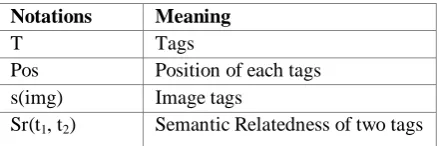
TABLE 1 NOTATIONS USED
Notations Meaning
T Tags
Pos Position of each tags s(img) Image tags
Sr(t1, t2) Semantic Relatedness of two tags
A. MaxRel Algorithm
Algorithm 1 MaxRel Algorithm
Input: The tags set of two images img1 and img2 which is s(img1) and s(img2). Output: The semantic relatedness of two images img 1 and img2.
1: For each ti → s(img 1) 2: Pos(s(img 1))←Pos(ti); 3: For each tj → s(img 2) 4: Pos(s(img 2))←Pos(s(tj)); 5: For each ti → s(img 1) 6: For each tj → s(img 2)
7: If (ti= =tj) sr(ti, tj)=0;/*return result*/
8: return MaxRel(img 1, img 2)=f(Pos(ti), Pos(tj), sr(tj,ti));
B. Apriori Algorithm
Algorithm 2 Apriori Algorithm
Apriori (T, minSupport) L1= {frequent items}; for (k= 2; Lk-1 !=∅; k++) {
Ck= candidates generated from Lk-1
for each transaction t in database do{
#increment the count of all candidates in Ck that are contained in t
Lk = candidates in Ck with minSupport
}//end for each }//end for return UKLK;
Where, „T’ is the database and minSupport is the minimum support
C. K-Means Algorithm
Algorithm 3 K-Means Algorithm
Replace „mi‟ with the mean of all of the samples for cluster „i‟.
end-for.
end until.
Where, m1, m2, ..., mn are means., ‟K‟= different clusters, ‟i‟= cluster.
VII. EXPERIMENTAL RESULTS
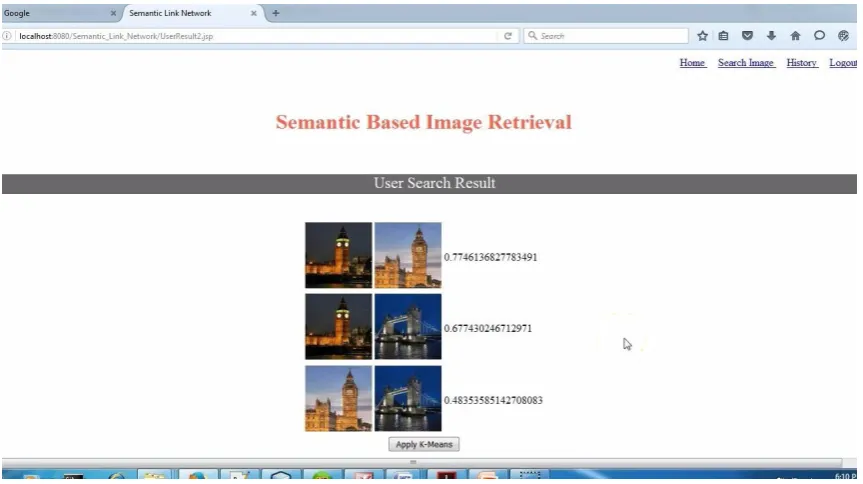
Thus system is tested by taking dataset of images of different objects and as per the search content details are displayed. Then for this result, k-means algorithm is applied on the tags and image depiction to group this result into clusters. Here user has search result for tower images and here result are generated as shown in fig. 3. Fig. 2 demonstrates the different operations performed in pre-processing. Stemming is the procedure for lessening regulated words to their pledge stem, root or base. Stop word is word which is filtered through before or after the preparing of common dialect content. Tokenization is the procedure of breaking a stream of printed content up into words, terms, images, or some other important components called tokens.
Fig 3. User search result
Above fig. 4 shows the time analysis result of existing and proposed system to search the different query images. The search time required is in seconds. It totally depends on the number of images presented in the dataset. Also it depends on the frequently occurred keywords in the image description.
Fig. 5. Accuracy Analysis Result
Above fig. 5 show the accuracy of the result. In this different objects of images have used to get output. The accuracy of the existing system is about 80-85 percentage and proposed system is giving output 90-95 percentage accurate result.
VIII. CONCLUSION ANDFUTURESCOPE
Today clients of web make lots of information, furthermore produce huge quantity of metadata. This metadata is as tags and social organizations, groups to which pictures are submitted. Effectively utilizing this rich user metadata in the social sharing sites for customized look is challenging task as well as important enough to merit attention. In this paper a framework is proposed which gives highly accurate result to user and also exploit the users „social activities for personalized picture look. These exercises incorporate annotations and the participation of user in groups of interest. The query relevance and user preference both together at a time are combined into the final rank list in order to achieve result as per expectation. In proposed system image tag as well as image description have used which has increased accuracy of image retrieval. Also according to user search history images are recommended to user. The future enhancement of the system can be extended to work on every kind of multimedia data such as video and audio also. Also this framework is designed only for data mining domain it can be extend for image processing and can use image semantic signature for image recommendation.
References
1. Chuanping HU, Zheng XU, Yunhuai LIU, Lin MeI, Lan Chen, and Xiangfeng LUO, „„Semantic Link Network-Based Model for Organizing Multimedia Big Data", IEEE Transactions on emerging topics in computing, volume 2, No. 3, April 2014.
2. Shrikant Badghaiya and Atul Barve, “Image Classification using Tag and Segmentation based Retrieval”, International Journal of Computer Applications (IJCA), Volume 103, No.15
,
Oct. 2014. 3. Alaa Riad, Hamdy Elminir and Sameh Abd-Elghany, “Web Image Retrieval Search Engine based on5. Poonam Bhusari, Rashmi Gupta and Amit Sinahal, “Personalized Image Search from Photo Sharing Websites Using Ranking Based Tensor Factorization Model (RMTF)”, International Journal of
Advanced Research in Computer Science and Software Engineering, Volume 3, Issue 8, 2013.
6. Raviraj Kasture and Dr. A. M. Dixit, “Internet Image Search Based On User Intentional”, International Journal of Advance, Volume 2, Issue 6, June 2014.
7. L.Wu and Y.Wang, “The process of criminal investigation based on grey hazy set”, in Proc. IEEE Int. Conf. Syst. Man Cybern, Oct. 2010.
8. Xiangfeng Luo, Zheng Xu, Jie Yu, and Xue Chen, “Building Association Link Network for Semantic Link on Web Resources”, IEEE transactions on automation science and engineering, vol. 8, NO. 3, July 2011.
9. L. Wang, D. Chen, Y. Hu, Y. Ma, and J. Wang, “Towards enabling cyber- infrastructure as a service in clouds”, Comput. Electr. Engg. , vol. 39, 2013.
10. X. Zhang, T. Yang, C. Liu, and J. Chen, “A scalable two phase top- down specialization approach for data anonymization using MapReduce on cloud”, IEEE Trans. Parallel Distributed System, vol. 25, Feb. 2014.
11. X. Liu, Y. Yang, D. Yuan, and J. Chen, “Do we need to handle every temporal violation in scientific workflow systems, ACM Trans. Software Engineering Methodology, vol. 23, Feb 2014.
12. D. Yuan, Xiao Liu, Wenhao Li, “A highly practical approach toward achieving minimum data sets storage cost in the cloud”, IEEE Trans. Parallel Distrib. Syst, vol. 24, Jun. 2013.
13. L. Wang, Jie Tao, Rajiv Ranjan, Holger Marten, Achim Streit and Jingying Chen, “G-Hadoop: MapReduce across distributed data centers for data-intensive computing”, Future Generat. Comput.
System, vol. 29, 2013.
14. L. Wang and S. U. Khan, “Review of performance metrics for green data centers: A taxonomy study”,