Computing Elliptic Curve Discrete Logarithms
with the Negation Map
⋆Ping Wang and Fangguo Zhang
School of Information Science and Technology, Sun Yat-Sen University, Guangzhou 510275, China
Abstract. It is clear that the negation map can be used to speed up the computation of elliptic curve discrete logarithms with the Pollard rho method. However, the random walks defined on elliptic curve points equivalence class {±P}used by Pollard rho will always get trapped in fruitless cycles. We propose an efficient alternative approach to resolve fruitless cycles. Besides the theoretical analysis, we also examine the per-formance of the new algorithm in experiments with elliptic curve groups. The experiment results show that we can achieve the speedup by a factor extremely close to√2, which is the best performance one can achieve in theory, using the new algorithm with the negation map.
Keywords:Pollard rho method, negation map, fruitless cycles, elliptic curve discrete logarithm, random walk.
1
Introduction
The discrete logarithm problem(DLP) is an important problem in modern cryp-tography. The security of various cryptographic systems and protocols relies on the presumed computational difficulty of solving the discrete logarithm problem, such as the ElGamal signature and encryption schemes [7], the U.S. governments Digital Signature Algorithm(DSA) [8], the Schnorr signature scheme [18], etc. Originally, they worked with multiplicative groups of finite prime fields. Once elliptic curve cryptosystems were proposed by Koblitz [13] and Miller [15], anal-ogous practical systems based on the DLP in groups of points of elliptic curves over finite fields were designed [14].
For elliptic curve discrete logarithm problem(ECDLP), Pollard rho method [17] and its parallelized variant [21] are at present known as the best generic algorithms. These methods work for any cyclic groups and do not make use of any additional structure present in elliptic curve groups. By exploiting the group structure of elliptic curves over finite fields, Gallant, Lambert and Vanstone [9], and Wiener and Zuccherato [22] pointed out that Pollard rho method can be speedup by defining the random walk on the equivalence classes.
⋆
For pointPof elliptic curves over finite fieldsGF(p) or binary extension fields GF(2m), it is trivial to determine its inverse−P. Therefore, we can consider the
negation map as the equivalence relation∼, and define the random walk on the equivalence classes to halve the search space. Theoretically, one can achieve a speedup by a factor of √2 when solving ECDLP. Furthermore, for the elliptic curves overGF(2m) with coefficients inGF(2), called anomalous binary curves
or Koblitz curves, it is suggested to define the equivalence relation by combining the Frobenius endomorphism and the negation map to get a speedup of √2m [9] [22]. For the Jacobian group of hyperelliptic curves over finite fields, one can obtain a speedup of√t if there is an automorphism of ordert [6].
However, when computing ECDLP with the Pollard rho method, one define random walks on the equivalence classes to make use of the negation map, which always leads to fruitless cycles. Several works [3] [6] [9] [22] have analyzed the appearance of fruitless cycles, and various methods have been proposed to deal with them. Methods from previous works can be summarized into the following aspects: 1) look ahead technique to reduce the short fruitless cycles, 2) iteration functions with doubling to reduce the occurrence and recurrence of the cycles, 3) cycle detection approaches and 4) cycle escape techniques. In practice, one may combine these methods to achieve the best performance.
The purpose of using the negation map is to obtain a speedup, hopefully by a factor of√2. However, currently the general result reported in the literature is the speedup by a factor of 1.29 [3], except for the case of combining the Frobenius endomorphism and the negation map for the Koblitz curves. We analyze the previously published methods to deal with the fruitless cycles, and show their inefficiency. This may explain why it is seldom to make use of the negation map to solve ECDLPs in practice, such as Certicom ECC challenges, except for the cases of Koblitz curves. We note that similar efforts to achieve the speedup by a factor close to √2 for SIMD (single instruction, multiple data) architectures with similar strategy but different approach has been independently done by Bernstein, Lange and Schwabe [2].
We describe effective alternative approaches based on cycle detection and escape strategy to resolve fruitless cycles. More precisely, we analyze the precise probabilities for appearance of the fruitless 2t-cycles, and discuss the previous methods, then propose alternative iteration functions for the rho method based on an efficient cycle detection and escape method. Besides the theoretical analy-sis, we also compare their performances in experiments with elliptic curve groups. The experiment results show that we can achieve the speedup by a factor ex-tremely close to √2, which is the best performance one can achieve in theory, using the new algorithm with the negation map.
2
Preliminaries
In this section, we describe the Pollard rho method for elliptical curve discrete logarithm computation and fruitless cycles, and then discuss the previous meth-ods to handle these cycles.
LetEbe an elliptic curve defined over a finite fieldFq. LetP ∈Ebe a point
of prime order n, and let ⟨P⟩ be the prime order subgroup ofE generated by P. If Q ∈ ⟨P⟩, then Q = kP for some integer k, 0 ≤ k < n, called the loga-rithm ofQto the baseP, denoted logPQ. The problem of findingk, givenP, Q,
and the parameters ofE, is known as theelliptic curve discrete logarithm prob-lem(ECDLP). In elliptic curve cryptography, the major security consideration is the intractability of the ECDLP.
2.1 Pollard rho Method
Pollard [17] proposed an elegant generic algorithm for the discrete logarithms based on the Birthday Paradox and called it the rho method, which is an im-provement over the well-known “baby-step giant-step” algorithm, attributed to Shanks [5]. Shanks’ method allows one to compute discrete logarithms in a cyclic group G of order n in deterministic time O(√n) and space for √n group ele-ments. Pollard rho method also has time complexityO(√n) with only negligible space requirements; it is thus preferable.
Pollard rho method works by first defining a sequence of elements that will be periodically recurrent, then looking for amatch in the sequence. Thematch
will lead to a solution of the discrete logarithm problem with high probability. The two key ideas involved are the iteration function for generating the sequence and the cycle-finding algorithm for detecting amatch.
IfGis any finite set andF :G→Gis a mapping and the sequence (Xi) in
Gis defined by the rule:
X0∈G, Xi+1=F(Xi)
this sequence is ultimately periodic. Hence, there exist unique integersµ≥0 and λ≥1 such that X0, ..., Xµ+λ−1 are all distinct, butXi =Xi+λ for alli≥µ. A
pair (Xi, Xj) of two elements of the sequence is called amatchifXi=Xj where
i ̸= j. Under the assumption that an iteration function F : G → G behaves like a truly random mapping and the initial value X0 is a randomly chosen
group element, the expected number of evaluations before a match appears is E(µ+λ) =√π|G|/2 [11].
Pollard rho method can be easily generalized to compute discrete logarithms in arbitrary finite abelian groups, such as in groups of points of elliptic curves over finite fields. Here, we describe Teske’s r-adding walk [19], a modified version of the rho method to compute ECDLPs.
equal size, and the r-adding walk define the iteration function F : G → G as follows:
Yi+1=F(Yi) =Yi+ (mjP+njQ) forYi∈Sj andj∈[1, r]
where mj and nj randomly chosen from [0, n−1] and (mjP +njQ) can be
precomputed for j = 1,2,· · ·, r. Let the initial value Y0 = a0P +b0Q where
a0 and b0 are two random numbers in [0, n−1]. Then each Yi has the form
aiP+biQ, and the sequences of (ai) and (bi) can be updated as follows,
ai+1= (ai+mj) modnandbi+1= (bi+nj) mod n.
Hence, as soon as we have a match (Yi, Yj), we have the following equation:
aiP+biQ=ajP+bjQ
SinceQ=kP, this gives
ai+bik≡(aj+bjk) modn
Now, if gcd(bi−bj, n) = 1, we getk= (aj−ai)(bi−bj)−1 modn. Due to the
method of Pohlig and Hellman [16], in practice applications the group order n is prime, so that it is very unlikely that gcd(bi−bj, n)>1 ifn is large. Teske
[19] found experimentally that r-adding walk withr≥20 perform very close to a random walk.
2.2 Negation Map and Fruitless Cycles
Notice that given a point P = (x, y) on an elliptic curve over finite field, it is trivial to determine its negative. That is −P = (x,−y) for the elliptic curveE overGF(p) wherepis an odd prime, and−P = (x, x+y) for the elliptic curve EoverGF(2m). Thus, at every step of the iteration for the Pollard rho method, bothYi and−Yi could be easily computed.
Therefore, we can consider the negation map as the equivalence relation∼, and define the random walk of the rho method on the equivalence classes to reduce the size of the space that is being searched by a factor of 2. We can do this by replacing Yi with ±Yi at each step in a canonical way. A simple way
to do this is to choose the one that has smallesty coordinate when its binary representation is interpreted as an integer. Because the extra computational effort in determining which of Yi and −Yi to accept is negligible, theoretically,
the expected running time of the algorithm will be reduced by a factor of √2. This improvement is valid for any elliptic curve.
Fruitless Cycles. However, define the iteration function on such equivalence classes always leads to trivial fruitless cycles. Suppose that Yi ∈Sj andYi+1=
−(Yi+mjP+njQ) (with probability12, for somej), ifYi+1∈Sj(with probability
1
random walk falls into a useless 2-cycle. It follows that a fruitless 2-cycle starts from a random point with probability 21r [6]. LetRj=mjP+njQ, then we can
denote this 2-cycle as follows,
Pi→ −(Pi+Rj)→Pi.
Similarly, the random walk may also fall into fruitless 4-cycle, 6-cycle, 8-cycle and so on with different probabilities. Typically, a fruitless 4-cycle without proper sub-cycle may have the form,
Pi→Pi+Rj → −(Pi+Rj+Rl)→ −(Pi+Rl)→Pi.
The cycle may be entered at any of its four point. We will discuss in detail the probabilities for a random point falls into these fruitless cycles in next section.
Using Frobenius Endomorphism. Notice that for Koblitz curves, the map ϕ : E(F2m) → E(F2m) defined by ϕ(x, y) = (x2, y2) is called the Frobenius endomorphism. There exists an integerλsuch thatϕ(P) =λP for all pointsP inG. Hence, one can define the equivalence relation by combining the Frobenius endomorphism and the negation map to get a speedup of√2m[9] [22].
Based on Harley’s work on ECC2K-95/ECC-2K108 [10] and [9], Bailey et al. [1] proposed an efficient and practical alternative iteration function for the rho method, which can successfully avoid the fruitless cycles. The new iteration function is given by
Yi+1=Yi+ϕl(Yi)
wherelis a function defined on the equivalence classes, which ensure that points from the same equivalence class have the same valuel. For example, [1] define it as l= ((HW(xYi)/2) mod 8 + 3,where HW(xYi) is the Hamming weight of the x-coordinate ofYi.
Obviously, such variant iteration function has unique properties. For some integer i,j,t, we have
ifYi=ϕt(Yj), thenYi+1=ϕt(Yj+1);
ifYi=−Yj, thenYi+1=−Yj+1.
That is the variant iteration function is well defined on equivalence classes, and can combine with the distinguished points technique to achieve a speedup of√2m. However, this method can only work with Koblitz curves.
the probability that two successive points belong to the same partition. More precisely, forYi∈Sj define the next point as follows,
Yi+1=
∼(Yi+Rj) ifYi+1∈/ Sj (1)
∼(Yi+R(j+t) mod r) ifYi+1∈/ S(j+t) modr for the minimal
tin [1, r−1] (2)
a new random point otherwise (3)
The third case is a very low probability event, expected to happen once every rr steps. The expected cost per step of the walk is increased by a factor, which
lies between 1 +1r and 1 + r−11.
Although the look-ahead technique reduces the frequency of 2-cycles, they may still occur [22]. Furthermore, Bos et al. [3] pointed out that this 2-cycles reduction technique introduces new 2-cycles and 4-cycles, which occurs with probability 21r3 and
r−1
4r3, respectively. Hence, they suggested the following alter-native iteration function to avoid recurring fruitless cycles. IfYi∈Sj, then
Yi+1=
{
∼(Yi+Rj) ifYi+1∈/ Sj (1)
∼2Yi otherwise (2)
However, it is well known that just addressing 2-cycles does not solve the problem of fruitless cycles, because longer cycles will occur as well. Reducing their occurrence requires additional overhead on top of what is already incurred to reduce 2-cycles. Given that fruitless cycles are unavoidable, they must be effectively dealt with when they occur.
Gallantet al.[9] proposed a general approach to detect cycles and to escape from them: after α steps record a length β sequence of successive points and compare the next point to theseβ points. If a cycle is detected a cycle represen-tative point Yi′ is chosen deterministically. We named this method as αβ-cycle detection method. There are several possible ways to escape the cycle from Yi′ by a modified iteration. One may set Yi+1 = Yi′+R′ where R′ is a distinct
precomputed value that does not depend on the escape-point, or one may set Yi+1 = Yi′+R′j where Yi′ ∈ Sj and R′j from a distinct list of r precomputed
values R′1, R2′, . . . , R′r. Bos et al. [3] analyze these cycle escape methods, and suggested that it is better to setYi+1= 2Yi′.
Because 2-cycles are more frequent, in practice one may combine the 2-cycle reduction method with theαβ-cycle detection and escape method to deal with fruitless cycles.
3
New Alternative Approaches
3.1 Motivation
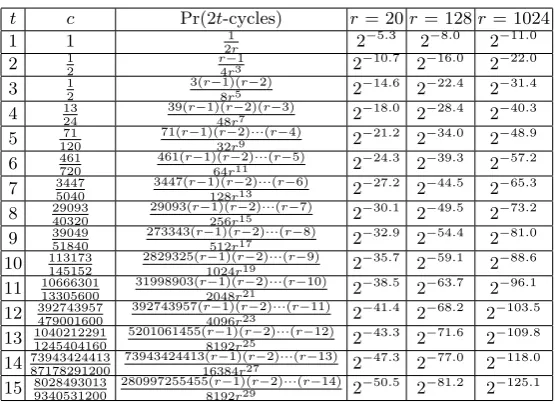
To better understand the issue of fruitless cycles, we need to know the exact probabilities for a random point falls into fruitless 2t-cycles, where t equal to 1,2,3, . . . ,and so on. More precisely, we have the following fact.
Theorem 1. When computing discrete logarithms with Pollard rho method, de-fine the r-adding walk on equivalence of the negation map, then the probability for a random point falls into fruitless2t-cycle is c2trt2t!(−r−1(1)!r−t)!, where c ∈[
1 2,1]
is a constant for each positive integer t.
Proof. It is clear that the probability for a random point falls into a fruitless 2t-cycle without considering excluding certain sub-cycles is
P r(2t-cycle with sub-cycles) = r−1 r ·
r−2 r · · ·
r−(t−1)
r ·
t 2r ·
t−1 2r · · ·
1 2r
= t!(r−1)! 2tr2t−1(r−t)!
However, the above probability for a random point falls into a fruitless 2t -cycle include the cases that the point falls into certain sub--cycles with the -cycle length less than 2t. The sub-cycles accounts for a certain proportion of the total cases, thus
P r(2t-cycle) =c·P r(2t-cycle with sub-cycles), wherec∈(0,1].
For the trivial caset= 1, there is no sub-cycle, thenc= 1.
For the casest= 2 and 3, the sub-cycles accounts for half of the total cases, that is c= 12.
For the rest of casest≥4, there is always sub-cycles, hence c <1. For each t≥4, let N2, N4,N6,. . .,N2(t−1) be the numbers of sub-2-cycles, sub-4-cycles,
sub-6-cycles,. . ., sub-2(t−1)-cycles, and letAm n denote
n!
(n−m)!. Then we have
N2 = Att−−21
N4 = Att−−32(A 1 2−A
0 1),A
t−3
t−2M4
N6 = Att−−43(A 2 3−A
1 2−A
0
1M4),Att−−43M6
N8 = Att−−54(A 3 4−A
2 3−A
1
2M4−A01M6),Att−−54M8
· · ·
N2(t−1) = A01(A
t−2
t−1−A
t−3
t−2−A
t−4
t−3M4−. . .−A12M2(t−3)−A01M2(t−2))
It is easy to check that, fort≥4
t−1
∑
i=1
N2i <
thus, we have
c= A
t−1
t − ∑t−1
i=1N2i
Att−1
> 1 2
Combine all the above cases, we have
P r(2t-cycle) =c t!(r−1)!
2tr2t−1(r−t)!, wherec∈[
1 2,1].
According to Theorem 1, we present the precise probabilities for a random point falls into fruitless 2t-cycles in Table 1, wheret can be 1, 2, 3 and so on, andrequals to 20, 128 and 1024, the typical values suggested by the literature.
Table 1.Probabilities to fall into fruitless 2t-cycles with differentr. t c Pr(2t-cycles) r = 20r= 128r = 1024
1 1 1
2r 2
−5.3
2−8.0 2−11.0
2 1
2
r−1
4r3 2− 10.7
2−16.0 2−22.0 3 12 3(r−81)(r5r−2) 2−
14.6
2−22.4 2−31.4 4 2413 39(r−1)(48rr−72)(r−3) 2−
18.0
2−28.4 2−40.3
5 71
120
71(r−1)(r−2)···(r−4)
32r9 2−21
.2 2−34.0 2−48.9
6 461
720
461(r−1)(r−2)···(r−5)
64r11 2− 24.3
2−39.3 2−57.2 7 50403447 3447(r−1)(128rr−132)···(r−6) 2−
27.2
2−44.5 2−65.3 8 29093
40320
29093(r−1)(r−2)···(r−7)
256r15 2−30
.1 2−49.5 2−73.2 9 39049
51840
273343(r−1)(r−2)···(r−8)
512r17 2− 32.9
2−54.4 2−81.0 10 145152113173 2829325(r1024−1)(rr19−2)···(r−9) 2−
35.7
2−59.1 2−88.6 11 10666301
13305600
31998903(r−1)(r−2)···(r−10) 2048r21 2−
38.5 2−63.7 2−96.1 12 392743957
479001600
392743957(r−1)(r−2)···(r−11) 4096r23 2−41
.4 2−68.2 2−103.5 13 1040212291
1245404160
5201061455(r−1)(r−2)···(r−12)
8192r25 2− 43.3
2−71.6 2−109.8 14 8717829120073943424413 73943424413(16384r−1)(r27r−2)···(r−13) 2−
47.3
2−77.0 2−118.0 15 8028493013
9340531200
280997255455(r−1)(r−2)···(r−14) 8192r29 2−50
.5 2−81.2 2−125.1
Notice that the probability to enter a fruitless cycle decrease with increasing r. However, it [3] shows that increasingr-values always leads to poor performance for the iteration functions. Generally,r cannot be chosen large enough to both avoid fruitless cycles and achieve adequate performance. Therefore, we need certain techniques to deal with fruitless cycles.
to achieve a speedup by a factor of 1.29 using the negation map, which is less than the speedup factor of √2 in theory. Bos et al. [3] concluded that “We measured to what extent our failure to achieve a speedup by a factor of√2 can be blamed on cycle detection and escape and other overheads”. Therefore, we are expected to provide a better cycle detection method.
3.2 The Main Algorithm
To solve the fruitless cycles, our basic idea is quite simple. The random walk proceeds as usual, whenever it falls into a fruitless cycle, it can escape the cycle from certain escape-point. IfYi∈Sj, then our iteration function can be defined
as follows,
Yi+1=
{
∼2Yi ifYi is an escape point (1)
∼(Yi+Rj) otherwise (2)
To make the above iteration function efficient, one needs an effective method to detect the fruitless cycles of various length with different probabilities and an efficient way to determine proper escape point. The main algorithm for the solution works as follows: We fix an integerN and use two auxiliary variables, say Ymin and Ynew, whereYmin is the minimum point of N successive points
produced by the iteration functionF, andYnewis the newly computed minimum
point of nextN successive points, here the minimum point means the point has the minimumx-coordinate (ory-coordinate). IfYnew=Ymin, which means the
random walk has fall into certain fruitless cycle, we can assign the minimum point as the escape point and escape the cycle by doubleYmin. Otherwise, replaceYmin
byYnew, and continue to find the nextYnew. That is, during the random walk
we keep the minimum point ofN successive points, if the random walk entered certain fruitless cycle, we will get collision between the minimum points very soon. By properly set the integerN, one can detect and escape these fruitless cycles whose length less than or equal toN.
Generally, one can determine the parameterN according to Table 1, which meansN varies with differentrand the size of the groupG. Typically, one may setN = 12,16,20. However, we will show later that when the random walk falls into fruitless cycles, on average it needs about 2.75N additional iterations before we detect it using the above algorithm. Hence it will be inefficient to detect the more frequent fruitless 2-cycles and 4-cycles, especially when ris small.
Therefore, it is necessary to improve the above algorithm to detect the short cycles more efficiently, and we illustrate as follows: For efficiency, generally we as-sumeNis multiple of 4, here we demonstrate by settingN = 16. For instance, we want to find the minimum pointYnewfrom 16 successive points{Y1, Y2, . . . Y16}.
We proceed as follows, first we compareY1andY2,Y3andY4, respectively. Let
Y1,2 =min(Y1, Y2), and Y3,4=min(Y3, Y4). Then we compare Y1,2 and Y3,4, if
Y1,2=Y3,4, the random walk has entered fruitless cycle, we just set Y1,2 be the
escape point, otherwise let Y1,4 =min(Y1,2, Y3,4), which is the minimum point
Similarly, we then compare Y5 and Y6, Y7 and Y8, respectively. Let Y5,6 =
min(Y5, Y6), and Y7,8 = min(Y7, Y8). If Y5,6 =Y7,8, we set Y5,6 be the escape
point, otherwise let Y5,8 =min(Y5,6, Y7,8), which is the minimum point ofY5,
Y6, Y7 and Y8. Then we compare Y1,4 and Y5,8, if Y1,4 = Y5,8, the random
walk has entered fruitless cycle, we set Y1,4 be the escape point, otherwise let
Y1,8=min(Y1,4, Y5,8), which is the minimum point of {Y1, Y2, . . . Y8}.
We show the above procedures in the following Fig. 1.
Fig. 1.Find the minimum point of{Y1, Y2, . . . Y8}and detect the fruitless 2-cycles or 4-cycles, simultaneously. For efficiency, whenr is small, e.g.r= 20, it is necessary to check whether Y1,4 = Y5,8 to detect the possible 4-cycles. However, one may ignore such check and just setY1,8=min(Y1,4, Y5,8) whenr is big, e.g.r= 1024, where the possible 4-cycles are rare.
In the same way, we can get Y9,16 the minimum point of {Y9, Y10, . . . Y16},
and letYnew=min(Y1,8, Y9,16), which is the minimum point of{Y1, Y2, . . . Y16}.
Now, ifYnew=Ymin, which means the random walk has fall into certain fruitless
cycle, we set the minimum point Ymin be the escape point. Otherwise, replace
Ymin byYnew, and continue to find the nextYnew, which is the minimum point
of next 16 successive points.
Remark 1. In fact to find the minimum one from two points, it is not necessary to find the one with exact minimumx-coordinate (ory-coordinate). For the new algorithm, one can define the minimum point as the point whose least 32 bits is the minimum when interpreted as an integer. Hence the cost of operation to choose the minimum one from two points is much cheaper than compare two points or find the one with exact minimumx-coordinate (ory-coordinate).
Obviously, when we set certain pointYi as the minimum point or the escape
point, we need track the corresponding indices ai andbi, such thatYi=aiP+
biQ. Note that the above algorithm leads to the new iteration function we have
defined in this section. More important,Yi+1 still depends solely onYi, which is
a requirement for distinguished point method to work.
Here, we demonstrate the new iteration function with the parallelized Pol-lard rho, that is on input an initial point Y0, the algorithm proceed with the
F(Yi) =∼(Yi+Rj). LetDP be the set of distinguished points and EP be a
variable to keep escape point. Then we have the following Algorithm 1 for the typical caseN = 16.
Algorithm 1New Algorithm for Pollard rho with the Negation Map
Input: Initial valueY0
Output: A distinguished point∈DP 1: Ymin←0,Ynew←0,EP ←0
2: whileTruedo
3: if EP ̸= 0then
4: Y0←2EP,EP ←0 5: end if
6: if Y0∈DP then
7: returnY0 8: end if
9: fori= 1 to 4do
10: forj= 1 to 4do
11: Yj←F(Yj−1) 12: if Yj∈DP then
13: returnYj
14: end if
15: end for
16: Y1i←min(Y1, Y2),Y2i←min(Y3, Y4)
17: if Y1i=Y2ithen
18: EP←Y1i
19: break
20: else
21: Y3i←min(Y1i, Y2i)
22: end if
23: if i= 2then
24: Y41←min(Y31, Y32)
25: end if
26: end for
27: Y42←min(Y33, Y34),Ynew ←min(Y41, Y42)
28: if Ynew =Yminthen
29: EP←Ymin
30: break
31: else
32: Y0←Y4 33: end if
34: end while
3.3 Analysis
For the new algorithm, there is a probability that we can not detect the colli-sion or cycle immediately when it happens. On average it needs to compute 3 additional points to detect a fruitless 2-cycle and about 7 additional points to detect a fruitless 4-cycle when the random walk reachs certain cycle.
For the rest fruitless 2t-cycles with much smaller probabilities, where 4 < 2t ≤ N, the new algorithm detect them by checking whether Ynew = Ymin.
Generally with high probability, the new algorithm will detect such cycles within certain additional points. More precisely, we have the following theorem.
Theorem 2. Under the assumption that the iteration function F : G → G
is a random mapping, one detect fruitless 2t-cycles with 4 ≤ 2t ≤ N using Algorithm 1. When the random walk reach certain fruitless cycle, the number of additional iterations before finding and escaping the cycle is (k+12)N with probability 1−12(23)(k−1) where k= 0,1,2,· · ·. That is, the expected number of
additional iterations is 2.75N.
Proof. LetIi be the set that consists of theith N successive values generated
by iteration functionF. That is,
Ii={Yj |iN ≤j≤(i+ 1)N−1, j≥0}, fori= 0,1,2,· · ·,⌈|
G| N ⌉ −1.
For finite group G, the sequence produced by F is eventually period. That is, for any fixedF andY0, there exist certain integersmand n, such that
Im ∩
In̸=∅, m < n.
and
Ii ∩
Ij=∅, for 0≤i, j < nandi̸=j.
and also
Im+i ∩
In+i̸=∅, fori≥0.
To prove the theorem, we divide it into two cases, that is k = 0 and k = 1,2,· · ·. For k = 0, let minm and minn be the minimum value of Im and In,
then
P r(minm=minn) =
1 N
N∑−1
i=0
(1 N +
2
N +· · ·+ N−i
N ) 1 N−i
= N
2+ 3N+ 3
4N2
≈ 1
4
For each ofk= 1,2,· · ·, we notice that, for two (intersected) setsIi andIj,
letmini andminj be the minimum value ofIi andIj, respectively, we have
P r(mini=minj) =|Ii ∩
Ij|2/N2, where|Ii ∩
Ij|denotes the cardinality ofIi ∩
Ij.
Therefore, we have
P r(minm+k =minn+k) =
1 N(
1 N2 +
22
N2 +· · ·+
(N−1)2
N2 )
=2N
2−3N+ 1
6N2
≈1
3
Combining the above two cases, under the assumption that the iteration function F : G→ G is a random mapping, one detect fruitless 2t-cycles with 4≤2t≤N using Algorithm 1, the number of additional iterations before finding and escaping the cycle from the minimum values is (k+1
2)N with probability
1−1 2(
2 3)
(k−1) wherek= 0,1,2,· · ·.
Hence, the expected number of additional iterations is
(1−1 2(
2 3)
−1)1
2N+ ∞
∑
k=1
((1−1 2(
2 3)
k−1)−(1−1
2( 2 3)
k−2))(k+1
2)N ≈2.75N
Therefore, the new algorithm is a probabilistic algorithm. There is a proba-bility that we can not detect the collision or cycle immediately when it happens. However, with high probability, the random walk will escape the cycle within certain additional iterations.
Compare to the traditional iteration function without negation map, on av-erage the new algorithm introduce one integer comparison for each iteration to track certain minimum point. For each 2-cycle and 4-cycle, on average it needs 3 additional iterations and 7 additional iterations to detect and escape the cycle. For the rest 2t-cycles, where 2t≤N, it is expected to compute 2.75N additional iterations to detect and escape the cycle. As a result, we resolved the fruitless cycles with negligible additional operations, that is we can achieve the speedup by a factor extremely close to √2 using the new algorithm with the negation map.
4
Experiments
performances of the new algorithm with different rand N. In this section, we describe these experiments and analysis the results.
For our experiments, we briefly introduce the elliptic curve groups over prime fields and the notation we use in the following. Letqbe a prime and letFq denote
Fqdenote the fieldZqof integers moduloq. Leta, b∈Fqsuch that 4a3+27b2̸= 0.
Then the elliptic curveFq is defined through the equation
Ea,b:y2=x3+ax+b.
The set of all solutions (x, y) ∈ Fq ×Fq of this equation, together with the
element Ocalled the “point at infinity”, forms a finite abelian group which we denote by Ea,b(Fq). Usually, this group is written additively. Let P ∈Ea,b(Fq)
be a point of prime order n, letG denote the subgroup of E generated by P. GivenQ∈G, determine the integer 0≤k < nsuch thatQ=kP.
The parameters can be found online on Certicom’s website [4]. For the iter-ation function, we use the Teske’s r-adding walk, and setrbe 20, 128 and 1024, respectively.
LetW = (x, y) be any point ofG, we define the partition ofGintorsubsets S1, S2,· · · , Sr as follows. First we compute a rational approximation A of the
golden ratio √52−1, with a precision of 2 +⌊log10(qr)⌋decimal places. Let
u∗:G→[0,1), (x, y)→
{
Ax− ⌊Ax⌋ ifW ̸=O
0 ifW =O (1)
whereAx− ⌊Ax⌋is the non-negative fraction part ofAx. Then let
u:G→ {1,2,· · · , r}, u(W) =⌊u∗(W)·r⌋+ 1
and
Si={W ∈G:u(W) =i}
This method is originally from Knuth’s multiplicative hash function [12] and suggested by Teske [20]. From the theory of multiplicative hash functions we know that among all numbers between 0 and 1, choosingAas a rational approx-imation of √52−1 with a sufficiently large precision leads to the most uniformly distributed hash values, even for non-random inputs.
The purpose of our experiments is to examine the impact of additional oper-ations to resolve fruitless cycles on the performance of the rho method. In more detail, we evaluate the numbers of iterations until a distinguished point is found for the parallelized Pollard rho method with the negation map and without the negation map, respectively. Generally, we first define the distinguishing property, and compute certain number of distinguished points using the two different ways, and then count the mean value of the numbers of iterations until a distinguished point is found for each way.
the distinguishing property as the Hamming weight of the least 32 bits of the x-coordinate of the point less than 8. Each point has probability almost exactly ((320)+(321)+· · ·+(327))/232≈2−9.8937of being a distinguished point. That is, it
is expected to take about 951.26 iterations to find a distinguished point. In our experiments, we collect 1 million distinguished points for each way and count the corresponding mean value of the numbers of iterations until a distinguished point is found.
For Pollard rho with the negation map, we set r = 20, 128 and 1024, and chooseN = 14, 8 and 6, respectively. The experiment results are given in Table 2. It confirms our theoretic analysis that the additional iterations introduced by dealing with the fruitless cycles can be neglected.
Table 2.The mean value of the numbers of iterations for each million samples r Iterations without Negation Map Iterations with Negation Map
20 951.17 951.66
128 949.94 952.37
1024 951.02 949.53
In the experiment, we also examined the performances of the new algorithm to detect 2-cycles and 4-cycles withinN iterations, it shows that whenris big, e.g. r = 1024, it is not necessary to detect the fruitless 4-cycles within theN iterations.
5
Conclusion
In this paper, we examined the exact probabilities for a random point falls into fruitless 2t-cycles when computing ECDLPs using Pollard rho method with the negation map. We proposed effective alternative approaches based on cycle de-tection and escape strategy to resolve fruitless cycles. In conclusion, we resolved the fruitless cycles with negligible additional operations, one integer comparison for each iteration to track certain minimum point, that is we can achieve the speedup by a factor extremely close to √2 using the new approach with the negation map.
References
1. D. V. Bailey, L. Batina, D. J. Bernstein, P. Birkner, J. W. Bos, H. Chen, C. Cheng, G. V. Damme, G. Meulenaer, L. J. D. Perez, J. Fan, T. Guneysu, F. Gurkaynak, T. Kleinjung, T. Lange, N. Mentens, R. Niederhagen, C. Paar, F. Regazzoni, P. Schwabe, L. Uhsadel, A. V. Herrewege, and B. Yang, “Breaking ECC2K-130”, Cryptology ePrint Archive, Report 2009/541, 2009.
3. J. W. Bos, T. Kleinjung, A. K. Lenstra, “On the Use of the Negation Map in the Pollard Rho Method”, In Algorithmic Number Theory (ANTS) 2010, volume 6197 of LNCS, pp. 67-83, 2010.
4. Certicom, Certicom ECC Challenge, http://www.certicom.com/pdfs/cert ecc cha-llenge.pdf, 2009.
5. H. Cohen, “A Course in Computational Algebraic Number Theory”, volume 138 of Graduate Texts in Mathematics. Springer-Verlag, 1993.
6. I. Duursma, P. Gaudry and F. Morain, “Speeding up the discrete log computation on curves with automorphisms”, ASIACRYPT 1999, LNCS 1716, pp. 103-121, Springer, Heidelberg, 1999.
7. T. ElGamal, “A public-key cryptosystem and a signature scheme based on discrete logarithms”, IEEE Transactions on Information Theory, volume 31, pp. 469-472, 1985.
8. FIPS 186-2, “Digital signature standard”, Federal Information Processing Stan-dards Publication 186-2, February 2000.
9. R. Gallant, R. Lambert and S. Vanstone, “Improving the parallelized Pollard lambda search on binary anomalous curves”, Mathematics of Computation, Vol-ume 69, pp. 1699-1705, 1999.
10. R. Harley, Elliptic curve discrete logarithms project, Avaliable from http://pauillac.inria.fr/∼harley/ecdl/.
11. B. Harris, “Probability Distribution Related to Random Mappings”, Ann. Math. Statist. 31, pp. 1045-1062, 1960.
12. D. E. Knuth, “The Art of Computer Programming”, Vol. 3, 2nd ed, Addison-Wesley, Reading, Mass, 1981.
13. N. Koblitz, “Elliptic curve cryptosystems”, Mathematics of Computation, 48, pp. 203-209, 1987.
14. A. Menezes, P. van Oorschot, and S. A. Vanstone, “Handbook of applied cryptog-raphy”, CRC Press, 1996.
15. V. Miller, “Use of elliptic curves in cryptography”, Advances in Cryptology: pro-ceedings of Crypto’85, LNCS 218, pp. 417-426, New York: Springer-Verlag, 1986. 16. S. C. Pohlig and M. E. Hellman, “An improved algorithm for computing logarithms
over GF(p) and its cryptographic significance”, IEEE-Transactions on Information Theory 24, pp. 106-110, 1978.
17. J. Pollard, “Monte Carlo methods for index computation mod p”, Mathematics of Computation, 32, pp. 918-924, 1978.
18. C. P. Schnorr, “Efficient signature generation by smart cards”, Journal of Cryp-tology, volume 4, pp. 161-174, 1991.
19. E. Teske, “Speeding up Pollard’s rho method for computing discrete logarithms”, in Algorithmic Number Theory Symposium (ANTS IV), LNCS 1423, Springer-Verlag, pp. 541-553, 1998.
20. E. Teske, “On random walks for Pollard’s rho method”, Mathematics of Compu-tation 70(234), pp. 809-825, 2001.
21. P. van Oorschot and M. Wiener, “Parallel collision search with cryptanalytic ap-plications”, Journal of Cryptology, 12, pp. 1-28, 1999.