Yet Another Ultralightweight Authentication
Protocol that is Broken
Gildas Avoine, Xavier Carpent
Universit´e catholique de Louvain B-1348 Louvain-la-Neuve
Belgium
Abstract
Eghdamian and Samsudin published at ICIEIS 2011 an ultralightweight mu-tual authentication protocol that requires few bitwise operations. The sim-plicity of the design makes the protocol very suitable to low-cost RFID tags. However, we demonstrate in this paper that the long-term key shared by the reader and the tag can be recovered by an adversary with a few eavesdropped sessions only.
Keywords: Authentication, Ultralightweight protocol, RFID.
1. Introduction
predecessors. We show in this paper how a passive attack can recover the 96-bit secret of a tag, using only 20 authentication sessions on average.
2. Eghdamian and Samsudin’s Protocol
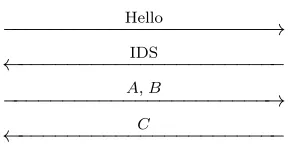
The protocol designed by Eghdamian and Samsudin [3] consists of four messages, represented on Fig. 1. First of all, the reader sends an hello
Reader Tag
Hello
−−−−−−−−−−−−−−−−−−−−−−→ IDS
←−−−−−−−−−−−−−−−−−−−−−− A, B
−−−−−−−−−−−−−−−−−−−−−−→ C
←−−−−−−−−−−−−−−−−−−−−−−
Figure 1: Eghdamian and Samsudin’s Protocol
message, then the tag sends its IDS, and finally the reader sendsA and B, and the tagC. The content ofA,B, andC is as follows:
A=K⊕N (1)
B = Rot(K, N)∧Rot(N, K)∧Rot(N, N) (2)
C= Rot((K+ Rot(N, N)),(Rot(K, K)∨N)) (3)
where Rot(X, Y) means that X is rotated of H(Y) bits to the left, where
H(Y) denotes the Hamming weight ofY. The symbolN represents a random value. After a successful authentication, the tag updates its key and session identifier as follows:
Knext = Rot(N + Rot(K, K),Rot(N, N)∧K) (4)
IDSnext =K∧Rot(N, K∨N) (5)
LetL denote the length of all the variables (recommended to be 96 in [3]):
|K|=|N|=|A|=|B|=|C|=|IDS|=L.
3. Attack
3.1. Discovering the Hamming weight ofN
The first step of the attack aims to recover H(N). Below Bi denotes
the bit at index iof B, withB0 being the least significant bit ofB. From
Eq (2), we know that:
∀i,0≤i < L,(Bi = 1)⇒(Ki−H(N) modL=Ni−H(N) modL= 1).
Using Eq (1), we deduce:
∀i,0≤i < L,(Bi = 1)⇒(Ai−H(N) modL= 0). (6)
Consequently, a candidater forH(N) is discarded if Eq (6) is not satisfied. If only one candidater among thenpossible ones remains, thenH(N) =r. Experimentally, we observed that this case occurs with a probability close to 0.9 whenL= 96. When more that one candidate remain, the adversary can keep the few candidates and discard the wrong ones later in the attack, or she can simply eavesdrop another authentication session in order to be luckier and obtain a single candidate.
We consider from now on that the adversary knowsH(N).
3.2. Recovering half of the secret bits
The adversary assumes that H(K) = H(N). This assumption will be denoted H1 in the following. WheneverH1 is true, Eq (2) yields:
B = Rot(K, N)∧Rot(N, N),
and so:
Rot−1(B, N) =K∧N. (7)
where Rot−1 means the right-rotation. We will denote below:
e
B := Rot−1(B, N).
From Eq (1), we know that Ai = 0 implies that either Ki = Ni = 0 or
Ki=Ni= 1. Consequently:
∀i,0≤i < L,(Ai= 0)⇒(Ki=Bei).
This technique allows the adversary to recover half of the secret bits on aver-age. Given thatH follows a binomial distribution, Vandermonde’s identity allows to demonstrate that the assumptionH1 actually occurs with
3.3. Recovering more secret bits
The adversary can increase the number of revealed bits of the secret key by exploiting the IDS following the session whereH1 is satisfied. Indeed, we
know from Eq (5) that:
IDSnext =K∧Rot(N, K∨N).
We conclude that
∀i,0≤i < L, IDSnexti = 1⇒(Ki = 1). (8)
3.4. Recovering still more secret bits
Once some bits ofK and N are known, the adversary can exploit them to recover more bits ofK. For that, we can first trivially notice that:
K∨N = (K∧N)∨(K⊕N). (9)
WhenH1 holds, we deduce, by inserting Eq (1) and Eq (7) in Eq (9):
K∨N =A∨B.e (10)
Therefore, Eq (5) can be rewritten using Eq (10) as:
IDSnext =K∧Rot(N, A∨Be). (11)
If the adversary already knows i such that Ki = 1 then using Eq (1) and
Eq (11), we deduce:
Ki−H(A∨
e
B)=Ai−H(A∨Be)⊕IDS next
i . (12)
Likewise, if the adversary already knowsisuch thatKi−H(A∨
e
B)⊕Ai−H(A∨Be)=
1 then using Eq (1) and Eq (11), we deduce:
Ki = IDSnexti . (13)
These two last steps can further be iterated a few times, until no more information can be gathered. At that point, most of the bits of K are known. We have observed experimentally that an average of 73 bits of K
are discovered.
3.5. Recovering the remaining secret bits with a passive adversary
3.6. Recovering the remaining secret bits with an active adversary
An active adversary can block the message C in order to cancel the update on the reader side, and thus force the tag to use the same IDS and
K in the following session. This allows her to collect A, B,C messages for the sameK, but differentN, and therefore guess all the bits of K, with no exhaustive search required.
4. Conclusion
We have showed in this paper that Eghdamian and Samsudin’s ultra-lightweight protocol is not secure, since a passive adversary can recover the key of a tag in an average of 20 authentication sessions. Although this num-ber depends on L, the attack remains very efficient, even for bigger values of L than the recommended 96. This attack is an additional example of the lack of security of ultralightweight protocols, and it questions about the relevance of this approach to design authentication protocols.
References
[1] Gildas Avoine, Xavier Carpent, and Benjamin Martin. Privacy-friendly synchronized ultralightweight authentication protocols in the storm. Journal of Network and Computer Applications, 2011.
[2] Carl Bosley, Kristiyan Haralambiev, and Antonio Nicolosi. HBN: An HB-like protocol secure against man-in-the-middle attacks. Cryptology ePrint Archive, Report 2011/350, 2011.
[3] Aras Eghdamian and Azman Samsudin. A secure protocol for ultra-lightweight radio frequency identification (RFID) tags. In Informat-ics Engineering and Information Science – ICIEIS 2011, volume 251 of Communications in Computer and Information Science, pages 200–213, Kuala Lumpur, Malaysia, November 2011. Springer.