Revocable Identity-Based Encryption from Lattices
Jie Chen, Hoon Wei Lim, San Ling, Huaxiong Wang, and Khoa Nguyen
Nanyang Technological University, Singapore
{hoonwei,lingsan,hxwang}@ntu.edu.sg [email protected]
Abstract. In this paper, we present an identity-based encryption (IBE) scheme from lattices with efficient key revocation. We adopt multiple trapdoors from the Agrawal-Boneh-Boyen and Gentry-Peikerty-Vaikuntanathan lattice IBE schemes to realize key revocation, which in turn, makes use of binary-tree data structure. Using our scheme, key update requires logarithmic complexity in the maxi-mal number of users and linear in the number of revoked users for the relevant key authority. We prove that our scheme is selective secure in the standard model and under the LWE assumption, which is as hard as the worst-case approximating short vectors on arbitrary lattices. Moreover, our key revocation techniques from lattices can be applied to obtain revocable functional encryption schemes in the similar setting.
Keywords: Lattice-based Cryptography, Identity-based Encryption, Key Revocation, Functional En-cryption.
1 Introduction
The concept ofidentity-based encryption(IBE) was proposed by Shamir [36]. It allows a sender to encrypt a message using the recipient’s identity as a public key. The private key corresponding to the public key or identity is generated by a key authority (or private key generator). IBE began to be studied extensively only after the seminal work of Boneh and Franklin [12] on practical pairing-based IBE systems, see for example [14, 38, 39]. Meanwhile, there also exist proposals on IBE systems based on quadratic residuosity [18, 15], although it is still not known how to build such systems that are secure in the standard model. In recent years, however, lattice-based IBE [22, 17, 1, 2] has received considerable attention from the cryptographic research community. Lattices have becoming an attractive and powerful tool to build a broad range of cryptographic primitives [7, 27, 9, 32, 33, 21]. This is so as many lattice-based constructions are quite efficient and typically simple to implement. Moreover they are all believed to be secure against attacks using quantum computers, a property not achievable by cryptographic primitives based on factoring or discrete logarithm.
revocable IBE (RIBE) scheme that significantly reduces the key authority’s workload (in terms of key revocation) to logarithmic (instead of linear) in the number of users, while keeping the scheme efficient for senders and receivers. Their RIBE scheme uses key revocation techniques based on binary-tree data structure, also used in [6, 29], and builds on a fuzzy IBE (FIBE) scheme introduced by Sahai and Waters [34] that is secure in the selective-ID model. Note that Boldyreva et al’s RIBE is the first IBE scheme that supports non-interactive key revocation (in the sense that non-revoked users need not interact with the key authority in order to update their keys). Prior to their work, all revocation techniques require interactions between users and the key authority or some kind of trusted hardware. Moreover, the use of a binary-tree reduces the amount of work in key update from being proportional to logarithmic complexity in the maximal number of users. Libert and Vergnaud [26] subsequently proposed an RIBE scheme in the adaptive-ID model using similar key revocation techniques as with [11]. However, instead of making use of an FIBE scheme, they adopt a variant [25] of the Waters IBE scheme [38]. Nevertheless, all the above RIBE schemes are constructed from bilinear pairings.
In the spirit of expanding the study of lattice-based IBE, we show, in this paper, how to construct an RIBE scheme in the lattice setting.
1.1 Our Results
Our construction of RIBE from lattices makes use of the following building blocks: (i) lattice IBE proposed by Agrawal, Boneh, and Boyen [1]; (ii) trapdoors for lattice IBE proposed by Gentry, Peikerty, and Vaikuntanathan [22]; and (iii) the binary-tree data structure for key update used in [6, 29, 11, 26]. More specifically, we extend the lattice IBE scheme of [1] with trapdoors from [22] to enable non-interactive key revocation. As with prior work, the binary-tree data structure is used to improve the efficiency of secret key update, allowing us to achieve key update with logarithmic complexity in the maximal number of users and linear in the number of revoked users for the key authority.
We note that our RIBE scheme is not a straightforward combination of the aforementioned building blocks because we require that our user public key comprises two components: identity and time, in order to obtain the “non-interactive” property. Hence, our construction requires two instances of Agrawal et al.’s IBE scheme to deal with users’ identities and times respectively. Further, we require a random n-vector u to be part of the public parameters that plays the role of linking identity to time for each node associated to the binary-tree. Briefly speaking, this can be achieved by randomly splitting the vector u into two vectors u1,u2 for each node to indicate
identity and time, respectively.
We prove that our RIBE scheme is selective secure in the standard model and under the LWE assumption, which is as hard as the worst-case approximation of short vectors on arbitrary lat-tices [33, 31]. Simply applying the simulation techniques of [1] to our lattice setting does not work, since the trapdoors can respond to only all key (short vector) queries for all identities id6= id∗ and times t 6= t∗. We address this by adopting the simulation trapdoors of [22]. That is, we sample a short vector from some distribution to generate u1 oru2 instead of generating both u1 and u2
randomly for each node in the simulation. Suchu1 oru2 is indistinguishable from the uniform
Our key revocation techniques from lattices can be extended to functional encryption schemes [16, 34, 23, 24, 30] in the lattice setting, for example the inner product encryption (IPE) scheme of [5].
1.2 Related Work
Our work, which focuses on how to construct revocable IBE from lattices, is concurrent but inde-pendent from the very recent proposal of lattice FIBE in [4]. There is some similarity between [4] and our work, that is, attributes are embedded in the sharesui of vectoruin the construction and
the shares ui of the challenge attributes are generated by sampling random short vectors in the
simulation. However, our approach is different in the sense that we directly and randomly split the vectoruinstead of using the Shamir secret-sharing scheme and the Lagrange interpolation formula. This makes our system more efficient. Another difference is that we make use of only one matrix associated with a trapdoor basis instead of`matrices, where`is the maximal number of attributes. Our method could also be applied to their large universe scheme and this significantly reduces the size of the master secret key.
We note that the idea of using more than one trapdoor in the keys has also been mentioned in Agrawal et al.’s hierarchical IBE (HIBE) scheme [3] and in the completely non-malleable public-key encryption scheme by Sapehi et al. [35].
2 Definitions
2.1 Notation
Throughout the paper we say that a function :R≥0 → R≥0 is negligible if (n) is smaller than
all polynomial fractions for sufficiently large n. We say that an event happens with overwhelming probability if it happens with probability at least 1−(n) for some negligible function . We say that integer vectors v1, . . . ,vn ∈Zm are Zq-linearly independent if they are linearly independent
when reduced moduloq.
The statistical distance of two random variablesXandY over a discrete domainΩis defined as
∆(X;Y) := 12P
s∈Ω|Pr[X=s]−Pr[Y =s]|. We say thatX is δ-uniform over Ω if∆(X;UΩ)≤δ
where UΩ is a uniform random variable over Ω. Let X(λ) and Y(λ) be ensembles of random
variables, we say that X and Y are statistically close if d(λ) := ∆(X(λ);Y(λ)) is a negligible function of λ.
2.2 Syntax of RIBE
Here, we recall the definitions of security for RIBE as defined in [11].
Definition 1. An identity-based encryption with efficient revocation or simply revocable IBE scheme has seven probabilistic polynomial-time (PPT) algorithmsSetup,PriKeyGen,KeyUpd,
Setup(1λ, N) takes as input a security parameterλand a maximal number of usersN. It outputs a public parameters PP, a master key MK, a revocation list RL (initially empty), and a state
ST. (This is run by the key authority.)
PriKeyGen(PP,MK,id,ST) takes as input the public parameters PP, the master key MK, an identity id∈ I, and the state ST. It outputs a private keySKid and an updated state ST. (This
is stateful and run by the key authority.)
KeyUpd(PP,MK,t,RL,ST) takes as input the public parameters PP, the master key MK, a key update time t∈ T, the revocation listRL, and the state ST. It outputs a key updateKUt. (This
is run by the key authority.)
DecKeyGen(SKid,KUt) takes as input a private key SKid and key update KUt. It outputs a
decryption key DKid,tor a special symbol⊥indicating thatidwas revoked. (This is deterministic
and run by the receiver.)
Enc(PP,id,t,m) takes as input the public parameters PP, an identity id∈ I, an encryption time
t ∈ T, and a message m∈ M. It outputs a ciphertext CTid,t. (This is run by the sender. For
simplicity and wlog we assume that id,t are efficiently computable fromCTid,t.)
Dec(PP,DKid,t,CTid,t) takes as input the public parameters PP, a decryption key DKid,t, and a
ciphertext CTid,t. It outputs a message m∈ M. (This is deterministic and run by the receiver.)
KeyRev(id,t,RL,ST)takes as input an identity to be revokedid∈ I, a revocation timet∈ T, the revocation list RL, and the state ST. It outputs an updated revocation list RL. (This is stateful and run by the key authority.)
The consistency condition requires that for all λ∈ N and polynomials (in λ) N, all PP and MK
output by setup algorithm Setup, all m ∈ M,id ∈ I,t ∈ T and all possible valid states ST and revocation listsRL, if identity id was not revoked before or, at time t then the following experiment returns 1 except for a negligible probability:
(SKid,ST) $
←PriKeyGen(PP,MK,id,ST); KUt
$
←KeyUpd(PP,MK,t,RL,ST) DKid,t←DecKeyGen(SKid,KUt);CTid,t
$
←Enc(PP,id,t,m) If Dec(PP,DKid,t,CTid,t) = m then return 1 else return 0.
Boldyreva et al. formalized and defined the selective-revocable-ID security in the following experiments. Their definition captures not only the standard notion of selective-ID security but also takes into account key revocation:
Initial: The adversary first outputs the challenge identity id∗and time t∗, and also some information state it wants to preserve.
Setup: It is run to generate public parameters PP, a master keyMK, a revocation listRL (initially empty), and a stateST. ThenPP is given toA.
Query:Amay adaptively make a polynomial number of queries of the following oracles (the oracles share state):
– The private key generation oracle PriKeyGen(·) takes as input an identity id and runs PriKeyGen(PP,MK,id,ST) to return a private keySKid.
– The revocation oracle KeyRev(·) takes as input an identity id and time t and runs KeyRev(id,t,RL,ST) to update RL.
Challenge:A outputs the same length challenge m(0),m(1) ∈ M. A random bit β is chosen.A is given Enc(PP,id∗,t∗,m(β)).
Guess: The adversary may continue to make a polynomial number of queries of the following oracles as in query phase and outputs a bitβ0, and succeeds if β0 =β.
The following restrictions must always hold:
1. KeyUpd(·) and KeyRev(·,·) can be queried on time which is greater than or equal to the time of all previous queries, i.e., the adversary is allowed to query only in non-decreasing order of time. Also, the oracle KeyRev(·,·) cannot be queried at time t if KeyUpd(·) was queried on t.
2. IfPriKeyGen(·) was queried on identity id∗ thenKeyRev(·,·) must be queried on (id∗,t) for some t≤t∗, i.e., identity id∗ must be in RLwhen KeyUpd(·) is queried at time t∗.
We define the advantage of Aas the quantity
AdvIND-sRID-CPAA (λ) := Pr[β0 =β]−1/2.
Definition 2. The scheme RIBE is said to be IND-sRID-CPA secure if the function
AdvIND-sRID-CPAA (λ) is negligible inλ for any efficient A and polynomial n.
3 Background on Lattices
In this section, we describe the required concepts from lattices.
3.1 Integer Lattices
LetB:= [b1|. . .|bm]∈Rm×mbe anm×mmatrix whose columns are linearly independent vectors
b1, . . . ,bm ∈Rm. The m-dimensional full-rank lattice Λ generated byB is the set,
Λ:=L(B) :=
(
y∈Rm s.t.∃s∈
Zm,y=Bs= m X
i=1
sibi )
Here, we are interested in integer lattices, i.e, whenL is a subset of Zm.
Definition 3. For a prime q, A∈Zn×m
q and u∈Znq, define:
3.2 The Gram-Schmidt Norm and Trapdoors for Lattices
LetS be a set of vectorsS :={s1, . . . ,sk}inRm, we usekSkto denote the Euclidean norm of the
longest vector inS, i.e.,kSk:=maxi q
s2i,1+. . .+s2i,mfor 1≤i≤k, wheresi:= (si,1, . . . , si,m). We
use ˜S:={˜s1, . . . ,˜sk} ⊂Rm to denote the Gram-Schmidt orthogonalization of the vectorss1, . . . ,sk
in that order. We refer to kS˜k as the Gram-Schmidt norm ofS. The problem of generating a random lattice A ∈ Zn×m
q together with a full short basis TA
of Λ⊥q(A) has been previously investigated by [8, 10]. Here we use a better result with tighter parameters which was recently discovered by Micciancio and Peikert [28].
Theorem 1. Letn≥1,q ≥2be integers and m=d2nlogqe. There is an efficient PPT algorithm
TrapGen(q, n) that outputs a pair (A∈Zn×m
q ,TA ∈ Zmq ×m) such that A is statistically close to a uniform matrix inZnq×m andTA is a basis forΛ⊥q(A) satisfyingkgTAk ≤ O(
√
nlogq) and kTAk ≤
O(nlogq) with all but negligible probability in n.
3.3 Discrete Gaussians
Let Λ be an m-dimensional lattice. For any vector c ∈ Rm and any positive parameter σ ∈ R>0,
define:
– ρσ,c(x) := exp
−πkx−σ2ck2
: a Gaussian-shaped function onRm with centercand parameter σ,
– ρσ,c(Λ) :=Px∈Λρσ,c(x): the (always converging) sum of ρσ,coverΛ,
– DΛ,σ,c: the discrete Gaussian distribution over Λ with parametersσ and center c,
∀y∈Λ, DΛ,σ,c(y) :=
ρσ,c(y)
ρσ,c(Λ)
.
For notational convenience, we abbreviateρσ,0 and DΛ,σ,0 asρσ and DΛ,σ.
The following lemmas from [22] is essential for our security proof.
Lemma 1. There is an efficient PPT algorithm SampleGaussian that, given a basis B of an m-dimensional lattice Λ =L(B), a parameterσ ≥ kBk ·e ω(
√
logm), and a center c ∈Rm, outputs a sample from a distribution that is statistically close to DΛ,σ,c.
LetBz be the standard basis forZm, we use theSampleGaussian(Bz, σ,0) algorithm to sample from
distributionDZm,σ.
Lemma 2. Let n and q be positive integers with q prime, and let m ≥ 2nlogq. Then for all but a 2q−n fraction of all A ∈ Zn×m
q and for any σ ≥ ω(
√
logm), the distribution of the syndrome
u=Ae mod q is statistically close to uniform over Zqn, where e is from DZm,σ.
3.4 Sampling Algorithms
The followingSampleLeft[17, 1] andSampleRight[1] algorithms will be used to sample short vectors in our construction and in the simulation, respectively. Let A and Cbe matrices inZnq×m and let
R be a matrix in {−1,1}m×m. By using either a trapdoor for Λ⊥
q(A) or a trapdoor Λ⊥q(C), we
can sample a short vectore inΛ⊥q(F) for some u inZnq, where F:= (A|AR+C)∈Znq×2m. With
Theorem 2. Letq >2andm > n. Then there is an efficient PPT algorithmSampleLeftthat takes as input a ranknmatrixAinZnq×m, a matrixMinZnq×m1, a “short” basisTA ofΛ⊥q(A), a vector
u ∈Znq, and a gaussian parameter σ >kgTAk ·ω( p
log(m+m1)). It outputs a vector e∈Zm+m1 distributed statistically close to DΛu
q(F1),σ where F1 := (A|M). In particular, e∈Λ
u
q(F1).
Theorem 3. Let q > 2 and m > n. There is an efficient PPT algorithm SampleRight that takes as input matrices A,C in Znq×m where C is rank n, a uniform random matrix R ∈ {−1,1}m×m, a basis TC of Λ⊥q(C), a vector u ∈ Znq, and a gaussian parameter σ > kgTCk ·
√
mω(log(m)). It outputs a vector e∈ Z2m distributed statistically close to D
Λu
q(F2),σ where F2 := (A|AR+C). In particular, e∈Λuq(F2).
We will also need the following lemma, generalization of the left over hash lemma due to Dodis et al. [20], in our proof.
Lemma 3. Suppose that m > (n+ 1) logq+ω(logn) and that q is prime. Let A,B be matrices chosen uniformly in Znq×m and let R be an m×m matrix chosen uniformly in {1,−1}m×m mod q. Then, for all vectors w in Zmq , the distribution of (A,AR,R
>
w) is statistically close to the distribution of (A,B,R>w).
3.5 The LWE Hardness Assumption
The security of our construction can be reduced to the LWE (learning with errors) problem defined by Regev [33].
Definition 4. Consider a prime q, a positive integer n, and a distribution χ over Zq, all public. An (Zq, n, χ)-LWE problem instance consists of access to an unspecified challenge oracle O, being, either, a noisy pseudo-random sampler Os carrying some constant random secret key s∈Znq, or, a truly random sampler O$, whose behaviors are respectively as follows:
– Os: outputs samples of the form(ui, vi) = (ui,u>is+xi)∈Znq×Zq, where,s∈Znq is a uniformly distributed persistent value invariant across invocations, xi ∈Zq is a fresh sample from χ, and
ui is uniform in Znq.
– O$: outputs truly uniform random samples fromZnq ×Zq.
The (Zq, n, χ)-LWE problem allows repeated queries to the challenge oracle O. We say that an
algorithm A decides the (Zq, n, χ)-LWE problem if |Pr[AOs = 1]−Pr[AO$ = 1]| is non-negligible
for a random s∈Zn q.
Regev [33] and Peikert [31] showed that for some noise distribution χ, denoted Ψα, the LWE
problem is at least as hard as the worst-case SIVP and GapSVP under a quantum reduction if the parameters are appropriately set.
3.6 Encoding Identities as Matrices
In our construction and proof of security, we require an injective encoding functionH:Znq →Znq×n
to map identities inZnq to matrices inZnq×n. Concrete construction of such a function can be found
in [1, 19].
Definition 6. Let q be a prime and n a positive integer. We say that a function H:Znq → Znq×n is an encoding with full-rank differences (FRD) if:
1. for all distinct u,v∈Zn
q, the matrixH(u)−H(v)∈Znq×n is full rank; 2. H is computable in polynomial time in nlogq.
4 Lattice RIBE
4.1 The Binary-tree Data Structure
Our construction makes use of binary-tree data structure, as with [6, 29, 11, 26]. We denote the binary-tree by BT and its root node by root. If ν is a leaf node then Path(ν) denotes the set of nodes on the path from ν to root (both ν and root inclusive). If θ is a non-leaf node then θ`,θr
denote the left and right child ofθ, respectively. We assume that all nodes in the tree are uniquely encoded as strings, and the tree is defined by all of its node descriptions.
Each user is assigned to a leaf node ν. Upon registration, the key authority provides the user with a set of distinct private keys for each node in Path(ν).
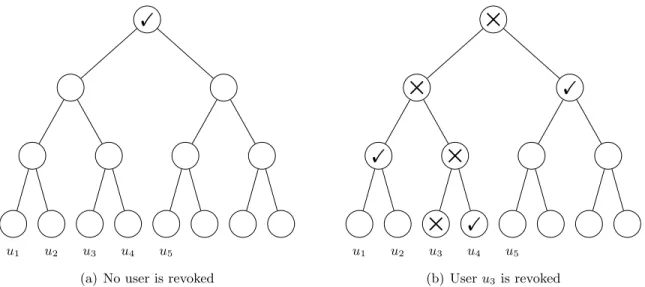
At time t, the key authority determines the minimal set Y of nodes in BT such that none of the nodes in RL with corresponding time ≤ t (users revoked on or before t) have any ancestor (or, themselves) in the set Y, and all other leaf nodes (corresponding to non-revoked users) have exactly one ancestor (or, themselves) in the set. This algorithm, denoted by KUNodes, takes as input a binary treeBT, a revocation list RLand a time t) and can be formally specified as follows:
KUNodes(BT,RL,t) X,Y← ∅
∀(νi,ti)∈RL
if ti ≤t then add Path(νi) to X
∀θ∈X
ifθ` 6∈X then addθ` toY
ifθr 6∈Xthen add θr toY
If Y=∅then addroot toY Return Y
TheKUNodesalgorithm marks all the ancestors of revoked nodes as revoked and outputs all the non-revoked children of non-revoked nodes. A graphical description is illustrated in Figure 1 of Appendix A.
The key authority then publishes a key update for all nodes ofY.
4.2 The Agrawal et al. IBE Scheme
We use the Agrawal et al. lattice IBE scheme [1] as a building block for our construction. Briefly, their IBE scheme can be described as follows.
The public parameters in the scheme of [1] consist of three random n×m matrices over Zq
denoted by A,B and C as well as a vector u ∈ Zn
q. The master secret is a trapdoor TA for the
latticeΛ⊥q(A). The secret key for an identity id is a short vectore∈Z2m, which is generated using
theSampleLeftalgorithm of Theorem 2 and satisfiesFide=uinZq whereFid:= (A|B+H(id)C)∈
Znq×2m. In the security proof for a selective IBE security game, the adversary announces an identity
id∗ that it plans to attack. Instead of using a trapdoor for Λ⊥q(A), it samples C at random and obtains a trapdoor TC for Λ⊥q(C). It also chooses the public parameter A at random and sets
B := AR −H(id∗)C, where R is a random matrix in {1,−1}m×m. Since AR is uniform and
independent in Znq×m,B is uniformly distributed as required. We then have
Fid:= (A|A·R+C0)∈Znq×2m,
where C0 := (H(id)−H(id∗))C. To respond to a private key query for an identity id 6= id∗, the simulator could produce a short vector e satisfying Fide = u in Zq by using the SampleRight
algorithm of Theorem 3 and the basis TC. This is so since id6= id∗ is full rank by the definition of
FRD in Section 3.6 and thereforeTC is also a trapdoor for the latticeΛ⊥q(C0). When id = id∗, the
matrix Fid no longer depends on C and the simulator’s trapdoor is removed. The simulator can
then produce a challenge ciphertext that helps to solve the given LWE challenge.
4.3 Intuition of Our Construction
We first consider how to create a link between an identity and a time for each node. In our construction, we use two instances of Agrawal et al.’s IBE scheme and its techniques to deal with users’ identities and times respectively, but require only a single random vectoru∈Znq in the public
parameters. We split it into two random vectors u1,u2 for each node corresponding to identity
and time, respectively. The randomly split u links identity to time for each node. Moreover, our technique does not require information aboutu1,u2 to be included in ciphertexts, and hence does
not increase the size of ciphertexts.
Clearly, the simulator can answer all private key queries for all identities id 6= id∗, key update queries for all time t6= t∗ by two trapdoors T
C1,TC2. The main difficulty in the simulation is as
follows. The simulator may be required to answer either a key update query at time t∗ with node inPath(ν∗) or a private key query for identity id∗ and a key update query at time t∗ without any node inPath(ν∗), where id∗ is assigned in ν∗ (id∗ must be revoked before or at time t∗). In other words, the simulator should answer either a query for identity id∗ or a query for time t∗ for each node. To overcome this difficulty, we use the SampleGaussian algorithm of Lemma 1 to sample a short vector and generate either u1 oru2 (instead of generating one of them randomly). Suchu1
or u2 is indistinguishable from the uniform distribution, which is guaranteed by Lemma 2. More
precisely, there are two possibilities for those nodes inPath(ν∗) (we can pick a nodeν∗ beforehand and assign id∗ to it if necessary) depending on whether or not identity id∗ will be queried:
– If identity id∗ is queried, then it must be revoked before or at time t∗. In this case, we set u1
– If identity id∗ is not queried. In this case, we setu2 to be the product ofFt∗ and a short vector
esampled by SampleGaussian(Bz, σ,0).
For those nodes that are not in Path(ν∗), we set u2 to be the product of Ft∗ and a short vector
esampled by SampleGaussian(Bz, σ,0). We have probability 1/2 to simulate the correct game and
the adversary cannot distinguish which one is simulated.
4.4 Our RIBE Scheme
We now describe our RIBE scheme from lattices. At the end of each algorithm, we provide some intuition and/or remark (marked by the symbol “//”) about the algorithm.
Setup(λ, N) On input a security parameterλand a maximal numberN of users, set the param-eters q, n, m, σ, αas specified in Section 4.5 below. Next perform the following steps:
1. Use the TrapGen(q, n) algorithm to select a uniformly random matrix A ∈ Zn×m
q with a
basisTA forΛ⊥q(A) such that||TgA|| ≤ O(
√
nlogq).
2. Select four uniformly random matricesB1,B2,C1, and C2 inZnq×m.
3. Select a uniformly random vectoru←$ Zn q.
4. LetRL be an empty set and BTbe a binary-tree with at leastN leaf nodes, set ST:=BT. Select an FRD mapHas defined in Section 3.6.
5. OutputRL,ST, the public parameters, and the master key MK, PP:={H,A,B1,B2,C1,C2,u}, MK:={TA}.
PriKeyGen(PP,MK,id,RL,ST) On input the public parameters PP, the master key MK, an identity id ∈ Zn
q, the revocation list RL, and the state ST, it picks an unassigned leaf node ν
from BT and stores id in that node. It then performs the following steps: 1. For anyθ∈Path(ν), ifuθ,1,uθ,2are undefined, then pickuθ,1
$
←Zn
q, setuθ,2 :=u−uθ,1, and
store them in nodeθ. Sampleeθ,1 ∈Z2m aseθ,1←SampleLeft(A,B1+H(id)C1,TA,uθ,1, σ).
2. OutputSKid:={(θ,eθ,1)}θ∈Path(ν),ST.
//The algorithm computes the id-component of the decryption key for all the nodes on the path from ν toroot.
KeyUpd(PP,MK,t,RL,ST) On input the public parameters PP, the master key MK, a time t∈Zn
q, the revocation listRL, and the stateST, it performs the following steps:
1. ∀θ ∈ KUNodes(BT,RL,t), if uθ,1,uθ,2 are undefined, then pick uθ,1 $
← Zn
q, set uθ,2 :=
u−uθ,1, and store them in node θ. Sample eθ,2 ∈ Z2m as eθ,2 ← SampleLeft(A,B2 +
H(t)C2,TA,uθ,2, σ).
2. OutputKUt:={(θ,eθ,2)}θ∈KUNodes(BT,RL,t).
//The algorithm first finds a minimal set of nodes which contains an ancestor (or, the node itself) of all the non-revoked nodes. It then computes the t-component of the decryption key for all the nodes in that set.
DecKeyGen(SKid,KUt) On input a private secret keySKid:={(i,ei,1)}i∈I,KUt :={(j,ej,2)}j∈J
1. ∀(i,ei,1)∈SKid,(j,ej,2)∈KUt, if∃(i, j) s.t.i=jthenDKid,t ←(ei,1,ej,2); else (ifSKid and
KUt do not have any node in common)DKid,t← ⊥.
2. OutputDKid,t.
// We can drop the subscripts i, j since they are equal, i.e., DKid,t := (e1,e2). The algorithm
finds components ofSKidandKUt such thatFide1+Fte2=usince they are in the same node.
Enc(PP,id,t,m) On input the public parametersPP, an identity id, a time t∈Znq, and a message
m, it runs the following steps:
1. SetFid,t←(A|B1+H(id)C1|B2+H(t)C2)∈Znq×3m.
2. Choose a uniformly randoms←$ Zn q.
3. Fori= 1,2, choose a uniformly random matrix Ri← {−1$ ,1}m×m.
4. Choose noise x ←−Ψα Zq and noise vectors y Ψmα
←− Zm
q and for i= 1,2 set zi ← R>iy ∈ Zmq .
(The distributionΨα is as defined by Definition 5)
5. Setc0 ←u>s+x+ mbq2c ∈Zq,c1 ←F>id,ts+
y z1 z2
∈Z3qm.
6. Output the ciphertextCTid,t:= (c0,c1)∈Zq×Z3qm.
Dec(PP,DKid,t,CTid,t) On input the public parameters PP, a decryption key DKid,t := (e1,e2),
and a ciphertext CTid,t := (c0,c1), it runs the following steps:
1. Parsec1 as
c1,0
c1,1
c1,2
, wherec1,i∈Zmq .
2. Compute w←c0−e>1
c1,0
c1,1
−e>
2
c1,0
c1,2
∈Zq.
3. Comparewandbq2ctreating them as integers inZ. If they are close, i.e., ifw − bq2c<bq4c,
output 1, otherwise output 0.
KeyRev(id,t,RL,ST) On input an identity id, a time t, the revocation listRL, and the stateST, the algorithm adds (id,t) toRL for all nodes ν associated with identity id and returnsRL.
4.5 Parameters, Correctness and Security
As in [3], the following error term is bounded by [qσmα ω(√logm) +O(σm3/2)], that is
w=c0−e>1
c1,0
c1,1
−e>
2
c1,0
c1,2
= mbq
2c+x−e
> 1 y z1
−e>
2
y z2
| {z }
error term
.
We can similarly set the parameters (q, m, σ, α) to ensure that the error term is less than q/5 and the system works:
m= 2n1+δ, q=m2√n·ω(logn),
and round upm to the nearest larger integer and q to the nearest larger prime. We choose δ such thatnδ >dlogqe=O(logn).
We show that our RIBE construction is secure in the following theorem:
Theorem 4. The RIBE system isIND-sRID-CPAsecure provided that the(Zq, n,Ψ¯α)-LWE assump-tion holds.
Our proof proceeds in a sequence of games where the first game is identical to the IND-sRID-CPA game from Definition 2 and the adversary has no advantage in the last game. We show that a PPT adversary cannot distinguish between the games. This proves that the adversary has negligible advantage in winning the original IND-sRID-CPA game.
To simplify reduction, we divide adversaries into two types:
– Type I adversaries choose to be challenged on the target identity id∗but which is revoked before or on time t∗.
– Type II adversaries do not challenge the target identity id∗ at any time.
We pick a random bit rev ← {0$ ,1} as a guess for the type of adversarial behavior that it will be faced with. All the sequence of games for these two types of adversaries are similar except for Game 2. We will show that the adversary cannot distinguish which type of challenger simulated and thus we have probability 1/2 to simulate the correct game.
Game 0 This is the original IND-sRID-CPA game from Definition 2.
Game 1 In Game 1 we change the way that the challenger generatesB1,B2 in the public
param-eters. Let id∗ be the identity and t∗ be the time thatA intends to attack. The Game 1 challenger choosesR∗1,R∗2 at the setup phase and constructsB1,B2 as
B1←AR∗1−H(id∗)C1 (1)
B2←AR∗2−H(t
∗
)C2 (2)
The remainder of the game is unchanged.
We now show that Game 0 is statistically indistinguishable from Game 1. Observe that in Game 1 the matrices R∗1,R∗2 are used only in the construction of B1,B2 and in the construction of the
challenge ciphertext wherez1 ←(R∗1)>y,z2 ←(R∗2)>y. By Lemma 3 the distribution (A,AR∗1,z1)
and (A,AR∗2,z2) are statistically close to the distribution (A,B10,z1) and (A,B02,z2) respectively,
where B01,B02 are uniform Znq×m matrices. It follows that in the adversary’s view, the matrices
AR∗1 and AR∗2 are statistically close to uniform and therefore B1 and B2 as defined in the above
equation (1)(2) are close to uniform. Hence, B1,B2 in Games 0 and 1 are indistinguishable.
Game 2 In Game 2 we change the way that uθ,1,uθ,2 for each node are chosen and the challenger
generates short vectors for private key query of id∗ and update key query of t∗ as follows (wlog, we can pick a node ν∗ from BT beforehand, to which id∗ may be assigned):
– If rev= 0, we simulate a game to face Type I adversaries. We generate uθ,1 and uθ,2 for every
• if θ ∈ Path(ν∗), then eθ,1 ← SampleGaussian(Bz, σ,0). Set uθ,1 ← Fid·eθ,1 and uθ,2 ←
u−uθ,1. Store them in the nodeθ.
• if θ 6∈ Path(ν∗), then eθ,2 ← SampleGaussian(Bz, σ,0). Set uθ,2 ← Fid·eθ,2 and uθ,1 ←
u−uθ,2. Store them in the nodeθ.
Since id∗ has been revoked before the update key query for t∗ is queried, we have KUNodes(BT,RL,t∗)∩Path(ν∗) =∅. Then the challenger responds a private key query for id∗ by using {(θ,eθ,1)}θ∈Path(ν∗) and a update key query for t∗ by using {(θ,eθ,2)}θ∈KUNodes(BT,RL,t∗).
– Ifrev = 1, we simulate a game to face Type II adversaries. We generateuθ,1 and uθ,2 for every
node θ inBTas follows:
• eθ,2 ←SampleGaussian(Bz, σ,0). Set uθ,2 ←Fideθ,2 and uθ,1←u−uθ,2. Store them in the
nodeθ.
Since id∗ is never queried, the challenger responds a update key query for t∗ by using {(θ,eθ,2)}θ∈KUNodes(BT,RL,t∗).
From Lemma 1, all above eθ,1 (i = 1,2) are sampled from DZm,σ, which is statistically close to
the distribution of D
Λuqθ,i (i= 1,2) in the real scheme. In particular, we have eθ,1 ∈ DΛ
uθ,1
q (Fid∗),σ
and eθ,2 ∈ DΛuθ,2
q (Ft∗),σ. SinceFid
∗ and Ft∗ could be viewed as random matrices from Znq×2m, we
argue thatuθ,1oruθ,2 is statistically close to uniform overZnq from Lemma 2. Hence, the adversary
cannot distinguish which type of challenger simulated and we have probability 1/2 to simulate the correct game. Therefore, Games 1 and 2 are indistinguishable if the correct game is simulated.
Game 3 We now change how A,C1,C2 inPP are chosen. In Game 3 we generateA as random
matrix inZnq×m, but generate C1,C2 using algorithmTrapGen so that C1,C2 is a random matrix
in Znq×m, but the challenger has a trapdoor TC1,TC2 for Λ
⊥
q(C1), Λ⊥q(C2). The choice of B1,B2
remains as in Game 1 and 2, i.e. B1 =A·R∗1−H(id
∗)C
1,B2 =A·R∗2−H(t∗)C2.
To respond to a private key query for id 6= id∗ and key update query t 6= t∗, we will use the trapdoorTC1 and TC2 instead ofTA, respectively. Let
Fid:= (A|B1+H(id)C1) = (A|AR1∗+ (H(id)−H(id∗))C1),
Ft:= (A|B2+H(t)C2) = (A|AR∗2+ (H(t)−H(t
∗ ))C2),
by the definition of FRD in Section 3.6, [H(id)−H(id∗)] and [H(t)−H(t∗)] are non-singular. Therefore, TC1 and TC2 are also trapdoors for Λ
⊥
q(C01) and Λ⊥q(C02) respectively, where C01 :=
(H(id)−H(id∗))C1 and C02 := (H(t)−H(t∗))C2. Moreover, sinceC1,C2 are rankn, so are C01 and
C02. The challenger can now respond to all private key queries for id6= id∗ by running
eθ,1 ←SampleRight(A,C01,R
∗
1,TC1,uθ,1, σ)∈Z
2m
q ,
and key update queries for t6= t∗ by running
eθ,2 ←SampleRight(A,C02,R2∗,TC2,uθ,2, σ)∈Z
2m
q .
Since the σ used in the system is sufficiently large, these eθ,1 and eθ,2 are distributed close to
D
Λuqθ,1(Fid),σ and DΛ
uθ,2
query for id∗ and key update query for t∗ the same as in Game 2 rather than being sampled with SampleRight, where theseeθ,1 and eθ,2 have been already defined in Game 2.
Game 3 is otherwise the same as Game 2. Since A, C1,C2 and responses to private key and
key update queries are statistically close to those in Game 2, the adversary’s advantage in Game 3 is at most negligibly different from its advantage in Game 2.
Game 4 Game 4 is identical to Game 3 except that the challenge ciphertext (c∗0,c∗1) is always chosen as a random independent element in Zq×Z3qm. Since the challenge ciphertext is always a
fresh random element in the ciphertext space, A’s advantage in this game is zero.
It remains to show that Game 3 and Game 4 are computationally indistinguishable for a PPT adversary, which we do by giving a reduction from the LWE problem.
Reduction from LWE. Suppose Ahas non-negligible advantage in distinguishing Games 3 and 4. We use A to construct an LWE algorithm B. Recall from Definition 3.5 that an LWE problem instance is provided as a sampling oracle O which can be either truly random O$ or a noisy
pseudorandom Os for some secret s ∈ Zn
q. The simulator B uses the adversary A to distinguish
between the two, and proceeds as follows:
Instance:B requests fromO and receives, for eachi= 0, . . . , m, a fresh pair (ui, vi)∈Znq ×Zq.
Initial:Aannounces toB the identity id∗ and time t∗ that it intends to attack. Setup:B constructs the system’s public parameters PPas follows:
1. Assemble the random matrixA∈Zn×m
q frommof the previously given LWE samples by letting
the j-th column of A∈Zn×m
q be then-vector uj for all j= 1, . . . , m.
2. Assign the zeroth LWE sample (so far unused) to become the public random n-vector u0 ∈Znq.
3. The remainder of the public parameters, namely B1, C1, B2, and C2, are constructed as in
Game 3 using id∗,R∗1, t∗, andR∗2.
Query:B answers each private key and key update queries as in Game 3.
Challenge:Bprepares, when prompted byAwith a message bit m∗ ∈ {0,1}, a challenge ciphertext for the target identity id∗, as follows:
1. Let v0, . . . , vm be entries from the LWE instance.
Set v∗=
"v1
.. .
vm #
∈Zm q .
2. Blind the message bit by letting c∗0 =v0+ m∗bq2c ∈Zq
3. Set c∗1 =
" v∗
(R∗1)>v∗
(R∗2)>v∗
#
∈Z3m q .
4. Choose a random bit r ← {0$ ,1}. If r = 0 send (c∗0,c∗1) to the adversary. If r = 1 choose a random (c0,c1)∈Zq×Z3qm and send (c0,c1) to the adversary.
We argue that when the LWE oracle is pseudorandom (i.e. O = Os) then (c∗0,c∗1) is distributed exactly as in Game 3. First, observe that Fid∗ = (A|AR∗
1) and Ft∗ = (A|AR∗
2). Second, by
¯
Ψαm. Therefore, c∗1 defined in step (3) above satisfies
c∗1 =
" A>s+y
(R∗1)>A>s+ (R∗
1)
>y
(R∗2)>
A>
s+ (R∗2)>
y
#
=
" A>s+y
(AR∗1)>s+ (R∗
1)
>y
(AR∗2)>
s+ (R∗2)>
y
#
= (Fid∗,t∗)>s+ " y
(R∗1)>y
(R∗2)>
y
#
and the quantity on the right is precisely the id1 part of a valid challenge ciphertext in Game 3.
Also note that v0=u>0s+x, just as the c0 part of the challenge ciphertext in Game 3.
When O = O$ we have that v0 is uniform in Zq and v∗ are uniform in Zmq . Therefore c∗1 as
defined in step (3) above is uniform and independent inZ3qm by the standard left over hash lemma
(e.g. Theorem 8.38 of [37]). Hence, the challenge ciphertext is always uniform in Zq×Z3qm, as in
Game 4.
Guess: After being allowed to make additional queries, Aguesses if it is interacting with a Game 3 or Game 4 challenger. Our simulator outputsA’s guess as the answer to the LWE challenge it is trying to solve.
We already argued that when O=Os the adversary’s view is as in Game 3. WhenO=O$ the
adversary’s view is as in Game 4. Hence,B’s advantage in solving LWE is the same asA’s advantage in distinguishing Games 3 and 4, as required. This completes the description of algorithm B and completes the proof.
5 Extensions and Open Problem
5.1 FIBE and HVE
It is not difficult to extend our techniques to obtain a d-out-of-d fuzzy identity-based encryption (FIBE) scheme and a hidden vector encryption (HVE) scheme [13]. Briefly, we requiredinstances of Agrawal et al.’s IBE scheme and randomly split the single vectoruintodparts. To construct ad -out-of-dFIBE scheme, we sort d identities alphabetically when generate secret keys and ciphertexts. This way, d identities associated with a secret key can always match an associated ciphertext. Moreover, to construct an HVE scheme, we generate a secret key for each wildcard position by sampling a short vector from Λui
q (A), where ui is the associated share. The resulting FIBE and
HVE schemes may be of independent interest, although they can also be obtained from Agrawal et al.’s HIBE scheme [1].
5.2 Revocable Functional Encryption
Our techniques can also be used to enhance the IPE scheme of [5] with key revocation. Briefly, we assign each vector (associated with private key) to a leaf node of a complete binary tree. We then use an instance of the IPE scheme for vector and an instance of Agrawal et al.’s IBE scheme to deal with time periods. Moreover, we require that only a random n-vector uin used for the public parameters. The resulting revocable IPE scheme can be proven using similar proof techniques as ours.
5.3 Open Problem
Acknowledgments. We thank the referees for helpful feedback. Research of the authors is sup-ported in part by the National Research Foundation of Singapore under Research Grant NRF-CRP2-2007-03.
References
[1] S. Agrawal, D. Boneh, and X. Boyen. Efficient lattice (h)ibe in the standard model. In
EUROCRYPT, pages 553–572, 2010.
[2] S. Agrawal, D. Boneh, and X. Boyen. Lattice basis delegation in fixed dimension and shorter-ciphertext hierarchical ibe. InCRYPTO, pages 98–115, 2010.
[3] S. Agrawal, D. Boneh, and X. Boyen. Efficient lattice (h)ibe in the standard model. http://crypto.stanford.edu/∼dabo/pubs/papers/latticebb.pdf..
[4] S. Agrawal, X. Boyen, V. Vaikuntanathan, P. Voulgaris, and H. Wee. Fuzzy identity based encryption from lattices. IACR Cryptology ePrint Archive, 2011:414, 2011.
[5] S. Agrawal, D. M. Freeman, and V. Vaikuntanathan. Functional encryption for inner product predicates from learning with errors. InASIACRYPT, pages 21–40, 2011.
[6] W. Aiello, S. Lodha, and R. Ostrovsky. Fast digital identity revocation (extended abstract). InCRYPTO, pages 137–152, 1998.
[7] M. Ajtai. Generating hard instances of lattice problems (extended abstract). InSTOC, pages 99–108, 1996.
[8] M. Ajtai. Generating hard instances of the short basis problem. InICALP, pages 1–9, 1999. [9] M. Ajtai and C. Dwork. A public-key cryptosystem with worst-case/average-case equivalence.
InSTOC, pages 284–293, 1997.
[10] J. Alwen and C. Peikert. Generating shorter bases for hard random lattices. InSTACS, pages 75–86, 2009.
[11] A. Boldyreva, V. Goyal, and V. Kumar. Identity-based encryption with efficient revocation. InACM Conference on Computer and Communications Security, pages 417–426, 2008. [12] D. Boneh and M. K. Franklin. Identity-based encryption from the Weil pairing. SIAM J.
Comput., 32(3):586–615, 2003.
[13] D. Boneh and B. Waters. Conjunctive, subset, and range queries on encrypted data. InTCC, pages 535–554, 2007.
[14] D. Boneh, X. Boyen, and E.-J. Goh. Hierarchical identity based encryption with constant size ciphertext. InEUROCRYPT, pages 440–456, 2005.
[15] D. Boneh, C. Gentry, and M. Hamburg. Space-efficient identity based encryption without pairings. InFOCS, pages 647–657, 2007.
[16] D. Boneh, A. Sahai, and B. Waters. Functional encryption: Definitions and challenges. In
TCC, pages 253–273, 2011.
[17] D. Cash, D. Hofheinz, E. Kiltz, and C. Peikert. Bonsai trees, or how to delegate a lattice basis. InEUROCRYPT, pages 523–552, 2010.
[18] C. Cocks. An identity based encryption scheme based on quadratic residues. In IMA Int. Conf., pages 360–363, 2001.
[19] R. Cramer and I. Damg˚ard. On the amortized complexity of zero-knowledge protocols. In
CRYPTO, pages 177–191, 2009.
[21] C. Gentry. Fully homomorphic encryption using ideal lattices. InSTOC, pages 169–178, 2009. [22] C. Gentry, C. Peikert, and V. Vaikuntanathan. Trapdoors for hard lattices and new
crypto-graphic constructions. InSTOC, pages 197–206, 2008.
[23] J. Katz, A. Sahai, and B. Waters. Predicate encryption supporting disjunctions, polynomial equations, and inner products. InEUROCRYPT, pages 146–162, 2008.
[24] A. B. Lewko, T. Okamoto, A. Sahai, K. Takashima, and B. Waters. Fully secure functional encryption: Attribute-based encryption and (hierarchical) inner product encryption. In EU-ROCRYPT, pages 62–91, 2010.
[25] B. Libert and D. Vergnaud. Towards black-box accountable authority ibe with short ciphertexts and private keys. InPublic Key Cryptography, pages 235–255, 2009.
[26] B. Libert and D. Vergnaud. Adaptive-id secure revocable identity-based encryption. In CT-RSA, pages 1–15, 2009.
[27] D. Micciancio. Generalized compact knapsacks, cyclic lattices, and efficient one-way functions from worst-case complexity assumptions. InFOCS, pages 356–365, 2002.
[28] D. Micciancio and C. Peikert. Trapdoors for lattices: Simpler, tighter, faster, smaller. IACR Cryptology ePrint Archive, 2011:501, 2011.
[29] M. Naor and K. Nissim. Certificate revocation and certificate update. IEEE Journal on Selected Areas in Communications, 18(4):561–570, 2000.
[30] T. Okamoto and K. Takashima. Fully secure functional encryption with general relations from the decisional linear assumption. InCRYPTO, pages 191–208, 2010.
[31] C. Peikert. Public-key cryptosystems from the worst-case shortest vector problem: extended abstract. InSTOC, pages 333–342, 2009.
[32] O. Regev. New lattice-based cryptographic constructions. J. ACM, 51(6):899–942, 2004. [33] O. Regev. On lattices, learning with errors, random linear codes, and cryptography. InSTOC,
pages 84–93, 2005.
[34] A. Sahai and B. Waters. Fuzzy identity-based encryption. InEUROCRYPT, pages 457–473, 2005.
[35] R. Sepahi, R. Steinfeld, and J. Pieprzyk. Lattice-based completely non-malleable pke in the standard model (poster). InACISP, pages 407–411, 2011.
[36] A. Shamir. Identity-based cryptosystems and signature schemes. In CRYPTO, pages 47–53, 1984.
[37] V. Shoup. A computational introduction to number theory and algebra. Cambridge University Press, 2008. ISBN 9780521516440.
[38] B. Waters. Efficient identity-based encryption without random oracles. In EUROCRYPT, pages 114–127, 2005.
[39] B. Waters. Dual system encryption: Realizing fully secure ibe and hibe under simple assump-tions. In CRYPTO, pages 619–636, 2009.
!
u1 u2 u3 u4 u5
(a) No user is revoked
#
#
!
u1 u2
#
# u3
! u4
!
u5
(b) Useru3is revoked