The International Journal Of Science & Technoledge (ISSN 2321 – 919X)
www.theijst.com
44
Vol 4 Issue 8 August, 2016
THE INTERNATIONAL JOURNAL OF
SCIENCE & TECHNOLEDGE
Climate Change Effects on Rainfall Patterns and It’ S
Implications on Sorghum and Millet Production in Kenya: A Review
1. Introduction
Climate change outcomes are now causing huge predicaments and are expected to get worse in future. Evidence shows that climate variability is altering precipitation patterns worldwide, affecting food production thus aggravating food and nutritional insecurity in Kenya. This challenge needs to be addressed to pave way for improved food production and sustained economic growth (Worldbank, 2013; Phiiri et al., 2016)).
In Kenya agricultural practices are majorly rain fed with less than 10 % of farms under irrigation. Of the wide variety of crops in production, cereals take the bigger share of land, particularly maize, sorghum, wheat, barley and rice. These comprise the largest segment of the highly consumed food (EPZ, 2005). These cereals are mostly produced in open fields and are entirely dependent on rain water. The fewer commercial farms, used for large scale production of maize, wheat and rice have capacity to tackle climate change issues. This is through adoption of expensive technologies such as irrigation systems and improved crop varieties. However, the majority small scale farmers are not able to adequately address climate change challenges due to the cost implications involved. The decreased productivity of maize and wheat under smallholdings is distressing, with these farmers opting to diversify their farms with hardy crops, in particular sorghum and millet, (Angwenyi, 2013; Ongoma et al., 2015; Wakachala et al., 2015). Feasible measures need to be put in place to ensure food security is attained.
A. Egesa Ogolla
Research Assistant, Department of Agricultural Science and Technology, Kenyatta University, Kenya
N. Njau
Researcher, Department of Agricultural Science and Technology, Kenyatta University, Kenya
P. Mwirigi
Researcher & Ph.D. Candidate, Department of Agricultural Science and Technology, Kenyatta University, Kenya
C. Muui W.
Lecturer and Researcher, Department of Agricultural Science and Technology, Kenyatta University, Kenya
N. Korir Kibet
Lecturer and Researcher, Department of Agricultural Science and Technology, Kenyatta University, Kenya
M. Mwangi
Lecturer and Director Research Support, Department of Agricultural Science and Technology,
Kenyatta University, Kenya
Abstract:
Climate change is greatly affecting precipitation resulting to the recent startling trends of variation in amount, period and distribution. This causes incidences of high rainfall intensity within a short time leading to flash floods and soil erosion. The high temperatures that often follow, cause decreased soil moisture. This severely affects weather dependent agriculture in Kenya. Heavy reliance on rain-fed agriculture, elevates vulnerability, especially with unpredictable cessation of rain during the growing season causing significant loses to smallholder famers. This hindrance to optimum productivity is being addressed by uptake of hardy crops. Sorghum and millet are super cereals which have high potential to buffer the losses experienced in the more vulnerable but highly popular maize farming. Sorghum and Millet are small grained cereals that exhibit tolerance to water stress, display the water efficient C4 photosynthetic pathway, superior in utilizing water during flash flood phenomena and are highly adaptive in high temperatures. They have good growth in resource deficient environments and soils whose nutrient capacity is prone to depletion. This makes them highly valuable in coping with climate vagaries. In addition, they are highly nutritious grains, which are gluten free, an excellent characteristic against celiac diseases. This review illustrates sorghum and millet as feasible alternatives against climate change effects. This is through outlining the lags in varietal improvement of these cereals and addressing value addition components which are crucial for sustainability
The poor climatic conditions have destabilized cereal production in Kenya with future productivity becoming unpredictable, (Omwonga, 2010; Angwenyi, 2013). Since 1961 to 2012, Cereal production in Kenya in terms of tons per ha, indicates inconsistency which does not match the steady mechanization, improvement of production systems and enhanced inputs of fertilizers pesticides and herbicides that has occurred widely (Fig. 1).
Figure 1: Cereal production in Kenya from 1961 to 2012. Source: FAO
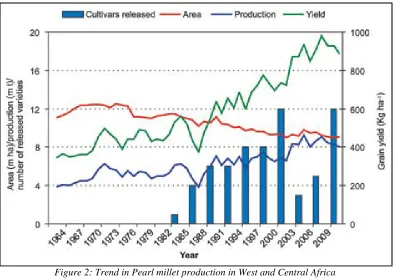
The expected benefits of better productivity through advancing technologies in Kenyan agriculture are being neutralized by poor precipitation and other climate change effects. Many variations that were initially unexpected are now occurring. The rain patterns are changing with some initially high potential lands becoming hotter and drier, (Chonge, et al., 2015). Other regions are receiving heavy rainfall within very short period of time, as opposed to well spread rain throughout the crop growth period. On the other hand, Sorghum and millet production is increasing in the world; this is due to increased realization of the benefits of hardy crops and increased crop cultivation in the dry lands. Increased productivity of millet in Africa has been observed, the trend being attributed to introduction of new varieties (ICRISAT) (Fig. 2). Intensification of Sorghum and Millet farming in Kenya has also been observed (Angwenyi, 2013; Dera et al., 2014)
Figure 2: Trend in Pearl millet production in West and Central Africa Source: ICRISAT http://exploreit.icrisat.org/page/pearl_millet/680/274
Over a period of five years, area under millet production in kenya increased drastically that is from 2008 to 2013. An indicator of increased cultivation of this crop (fig. 3)
10000 12000 14000 16000 18000 20000 22000 1 9 6 1 1 9 6 3 1 9 6 5 1 9 6 7 1 9 6 9 1 9 7 1 1 9 7 3 1 9 7 5 1 9 7 7 1 9 7 9 1 9 8 1 1 9 8 3 1 9 8 5 1 9 8 7 1 9 8 9 1 9 9 1 1 9 9 3 1 9 9 5 1 9 9 7 1 9 9 9 2 0 0 1 2 0 0 3 2 0 0 5 2 0 0 7 2 0 0 9 2 0 1 1 2 0 1 3
H
g
/H
a
The International Journal Of Science & Technoledge (ISSN 2321 – 919X)
www.theijst.com
46
Vol 4 Issue 8 August, 2016
Figure 3: Millet production area in kenya :Source: Faostat
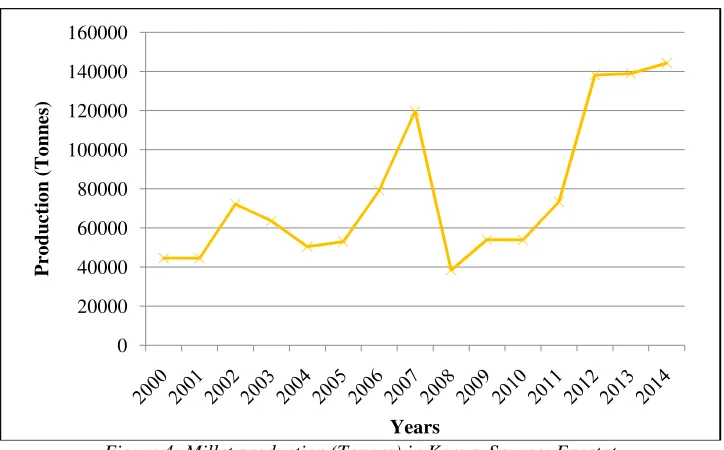
This led to a high improvemnet in kenya’s millet yield, as seen in produced tonnes, (fig. 4)
Figure 4: Millet production (Tonnes) in Kenya. Source: Faostat
Within the same period, an increase in area under sorghum production in was been observed form 2008 to 2011, (fig. 5), this similarily resulted in a drastic increase in sorghum production (fig.6).
0 20000 40000 60000 80000 100000 120000 140000 160000 180000
A
re
a
h
a
rv
es
te
d
(
H
a
)
Years
0 20000 40000 60000 80000 100000 120000 140000 160000
P
ro
d
u
ct
io
n
(
T
o
n
n
es
)
Figure 5
Figure 6:
The fact that Kenya had experienced post- election violence in 2007
undercultivation and prodution of many crops., This seems to blur the advances in both sorghum and millet pro surpassed highly the earlier normal production trends before the unrest.
Sorghum and millet have many uses. They are primary raw materials for alcoholic and non
as part of diet majorly in Africa and Asia. Sorghum grains and straw are used for ethanol production, (Pereira et al., 2011). Finger millet is a source of pro-vitamin A, having large quantities of Micronutrients including, Calcium, Copper and
industrial use and nutritional superiority, these crops are miles ahead in addressing water deficit, high temperatures and salinity issues that are highly affected by precipitation. They already possess unique genes that can foster these good characteristics. This them better at enabling cheaper biotechnological enhancement in comparison to plants showing no tolerance to drought and varying temperatures (Singh, 1984; Ezenekwe et al, 2013).
1.1. Rainfall and Agricultural Productivity
Weather is a significant climatic aspect, playing
rainfall, wind, relative humidity, sunlight intensity which directly affects crops
sectors in the developing world. It is important for crop production influencing soil moisture important for seed germination, plant growth, plant nutrient absorption, decomposition of organic matter and maintaining activity of soil micro
et al., 2012). Water is also necessary for plants physiological processes. Increasingly, water for agriculture is becoming a scarce commodity, (Pereira, 2005). The continued experiences of varying rainfall distribution and rainfall periods, has disrupted th
Figure 5: Sorghum in kenya . Source: Faostat
Sorghum production in Kenya . Source: Faostat
election violence in 2007-2008 electioneering period, is higly blamed to low area undercultivation and prodution of many crops., This seems to blur the advances in both sorghum and millet pro
surpassed highly the earlier normal production trends before the unrest.
Sorghum and millet have many uses. They are primary raw materials for alcoholic and non-alcoholic beverages. They are consumed . Sorghum grains and straw are used for ethanol production, (Pereira et al., 2011). Finger vitamin A, having large quantities of Micronutrients including, Calcium, Copper and
eriority, these crops are miles ahead in addressing water deficit, high temperatures and salinity issues that are highly affected by precipitation. They already possess unique genes that can foster these good characteristics. This
ling cheaper biotechnological enhancement in comparison to plants showing no tolerance to drought and varying Ezenekwe et al, 2013).
Weather is a significant climatic aspect, playing a vital role in agricultural production (Ongoma et al., 2015
rainfall, wind, relative humidity, sunlight intensity which directly affects crops. Rainfall is a primary source of water for agricultural t is important for crop production influencing soil moisture important for seed germination, plant growth, plant nutrient absorption, decomposition of organic matter and maintaining activity of soil micro
lso necessary for plants physiological processes. Increasingly, water for agriculture is becoming a scarce commodity, (Pereira, 2005). The continued experiences of varying rainfall distribution and rainfall periods, has disrupted th
2008 electioneering period, is higly blamed to low area undercultivation and prodution of many crops., This seems to blur the advances in both sorghum and millet production,which
alcoholic beverages. They are consumed . Sorghum grains and straw are used for ethanol production, (Pereira et al., 2011). Finger vitamin A, having large quantities of Micronutrients including, Calcium, Copper and Manganese. Apart from eriority, these crops are miles ahead in addressing water deficit, high temperatures and salinity issues that are highly affected by precipitation. They already possess unique genes that can foster these good characteristics. This makes ling cheaper biotechnological enhancement in comparison to plants showing no tolerance to drought and varying
The International Journal Of Science & Technoledge (ISSN 2321 – 919X)
www.theijst.com
48
Vol 4 Issue 8 August, 2016
crop production especially during water shortage in farms at critical crop development stages. Irregular rainfall in late vegetative crop growth stage has been credited to poor flowering and seed filling for maize resulting to dismal yields (Hastenrath et al., 2010). Heavy rain resulting to excess water coupled with high relative humidity at crop maturity results to heavy post-harvest losses (ref)
Predictions of increased precipitation over East Africa region initially aroused high expectations to Kenya’s agricultural sector. At this time the steady rise in world temperatures was believed to raise evaporation in water bodies, and double up rainfall in most parts of Kenya. On the contrary, this rise in temperatures is contributing to increased evapotranspiration in arable lands, indicating a need for elevated soil moisture. As observed the temperatures are increasing unlike precipitation which is very unstable. Despite expectations of increased rainfall in Kenya, observations over 90 years show no significant increase. There is a worrying trend of decrease from 1961 to 2000 (Fig. 3).
Figure 7: Mean annual rainfalls, (ten years mean) received in Kenya from 1901 to 2000. Source: FAO
Temperature, relative humidity and net precipitation manipulate water distribution and availability for plant growth. Substantial decrease in annual rains has been reported in Rift valley (Wakachala et al 2015), Kerio valley (Kipkori and Kareithi, 2013), Machakos and makindu (Chepng’etich et al., 2014), and Nakuru, (Ogeto et al., 2013). These are some of major cereal production regions of Kenya. Today Kenya faces frequent drought and floods incidences. Classic evidences are depicted in the dry spells in the Eastern region caused by cessation of rain and high levels of evapotranspiration (Kipkorir and Kareithi, 2013; chepng’etich et al., 2014; Wakachala et al., 2015). On average, recorded temperatures for over 70 years indicate a steady rise in the average annual temperature, from 1961 to 2000 (Fig 4). The continued rise in temperatures is likely to affect precipitation and soil moisture.
Figure 8: The average annual temperatures in Kenya from 1901 to 2000.Source; FAO
The recent high temperatures marred with decreased and sometimes poor precipitations (the scenarios of poor rain distribution, variation of time period, intensity, area and amount of rainfall), is resulting in insufficient soil moisture (Maruthi Sankar et al., 2012).
0.00 100.00 200.00 300.00 400.00 500.00 600.00 700.00 800.00
A
v
er
a
g
e
ra
in
fa
ll
(
m
m
)
Years
23.90 24.00 24.10 24.20 24.30 24.40 24.50 24.60 24.70 24.80
A
v
er
a
g
e
te
m
p
er
a
tu
re
(
D
eg
re
e
ce
ls
iu
s)
Variability in rainfall has been recorded in high and medium potential lands comprising of the major cereal (maize, wheat and barley) production areas. In addition, unexpected heavy rain within short periods is being received in many cereal growing areas. One of the interventions is building reservoirs but this has been less beneficial to smallholder cereal farmers lacking irrigation infrastructure (UNEP, 2011). This has resulted to reduced cereal production currently being felt by smallholder farmers who constitute majority of farmers in Kenya 70%, (World Bank, 2013; Oruonye et al., 2016).
Generally, the whole experience has been overwhelming to small holder famers faced with the reality of increased uncertainty to future water availability. Famers are now utilizing sorghum and millet which are short cycle cereals with ability to exploit diminutive rains received for growth to maturity (Ezenekwe et al, 2013; Handschuch and Wollni, 2013). This has increased diversification in small scale farms in Kenya. These measures are directed towards addressing cases of low yield and or total loss (Angwenyi, 2013; Dietz et al, 2013).
1.2. Resilient Features of Sorghum and Millet
Small grain cereals especially sorghum and millet has been credited with novel characteristics of tolerance to drought, (Mwandalu and Mwangi, 2013), soil salinity and ability to withstand flash floods and high temperatures (Okuthe et al., 2013). The two exhibit better productivity in infertile soils in comparison to other cereals. They have a short growth cycle, making use of short duration rains to attain full development (EPZ, 2005; Wortmann et al., 2006). In Kenya they are mainly produced in dry sub-humid areas and medium-high altitudes, which are currently familiar with successive droughts (Mwandalu and Mwangi, 2013). This includes areas of eastern, central, western, north eastern coast and Nyanza regions (Ogeto et al., 2013; Chepng’etich et al., 2014).
Sorghum and millet have special rooting systems. Sorghum has extensive root system which is highly branched accommodating millions of secondary roots. The deposition of considerable amounts of silica in sorghum roots makes it outsmart most crops in drawing water from dry soils (Wortmann et al., 2006). Millet on the other hand is generously deep rooted. These small grained crops have high water use efficiency; they are narrow leafed and roll leaves to reduce water loss. They produce tillers forming an improved canopy. This enhances shading and reduces water loss by evaporation from the rhizosphere (Wortmann et al., 2006; Chepng’etich et al., 2014).
Singh, (1984), illustrated impressive findings in over 39 accessions exhibiting cold tolerance, with accessions from Uganda and Ethiopia highly adapted to the highlands, able to germinate at cold conditions. This adds an advantage of cold tolerance genes that can be extrapolated for enhanced tolerance to cold, a very common scenario in semiarid and arid lands at night (Ezenekwe et al., 2013). Moreover, this characteristic makes this crop to some extend adaptable in cold highlands.
1.3. Nutritional Superiority and Other Uses of Sorghum and Millet
Sorghum grains contain nutritional values of energy1418Kj, dietary fiber 6.30g, and fat 3.30g, carbohydrates 74.63 g protein 11.30 g; all in 100g of sorghum grains (Stefoska-Needham et al, 2015). In east Africa, sorghum is mainly used to make posho, bread, special dishes, brewing of bear and to make highly nutritive foodstuffs such children’s porridge. It has also been used as constituent of animal feeds (forage and silage). In West and South Africa, sorghum grains are made into paste- sorghum syrup (molasses), the stalks are used for fencing, building, weaving, broom making and as firewood. Industrially, it is used for brewing bear, production of vegetable oil, preparation of paper pulp, waxes and dyes and also as a bio-fuel source (Lim, 2013). Millet grains are high in carbohydrate (60%), proteins (7%), fibre (3%), fat (3%) 5. On average millet grains, in about 100g 5 contain about 10.5 g of proteins, 3.8 g of fibre, 2.6 g of minerals, 6.1g of iron and 106.8 of calcium (Sarita and Singh, 2016).
Sorghum and Millet are rich in antioxidants, have high protein content and fiber. They have high levels of unsaturated fats. These grains contain important minerals such as phosphorus, potassium, calcium and iron. The high antioxidant levels help lowering the risk of cancer, diabetes and neurological diseases. Millet contains magnesium that reduces the severity of asthma and migraine attacks, (Adegbola, 2013). They are Natural pre and probiotics treatments especially when fermented, reducing harmful bacteria from the colon while at the same time increasing the good bacteria, in particularly (Sarita and Sigh, 2016) reported this effect from fermented millet products. The slow starch digestibility of these cereals coupled with appetite regulation makes them good for weight management. The slow digestibility is also attributed to attenuation of blood glucose (Stefoska- Needham et al., 2013).
1.4. Breeding and Other Improvement Needs
Sorghum and millet production had for a long time been neglected since the wake of Green Revolution. During this period, rapid introduction of fertilizer and pesticides accompanied by mechanized farming promoted uptake of Maize and Wheat at the expense of traditional crops (Chisi, 2015). This opened up areas for research in the introduced crops but Sorghum and millet were neglected. Due to climate change, there is now projected increase in production of millet and Sorghum. This means increased demand of quality planting materials (Macauley, 2015; Kipkorir and Kareithi, 2013). A lot of research needs to be carried out in order to provide farmers with seeds.
The International Journal Of Science & Technoledge (ISSN 2321 – 919X)
www.theijst.com
50
Vol 4 Issue 8 August, 2016
Many survival mechanisms for survival in drought are used by sorghum this ranges from leaf area dynamics to spatial water use strategies by the stay green sorghum (Borrell et al., 2014). Reduced tilling and increased lower leaves sizes. Efficient silicon accumulation in sorghum root endodermis reported by Lux et al., (2003), contributes to drought tolerance, by improving the osmotic potential of the plant enabling it to absorb water in dry soils. Ahemed et al., (2011), found silicon treated sorghum plants with better water potential. The plat has low transpiration rate in comparison to other cereals. Millet is commonly known as a short growth season, drought resistant crop (Sarita and Singh, 2016).
Reduced water and high rates of evapotranspiration are associated with increased salinity in arable lands. Salinity normally causes reduced plant growth by inhibiting water and nutrients uptake, (Yakubu et al., 2010). Sorghum and millet have better growth in saline conditions. Yakubu et al., 2010 observed Maiwa millet variety tolerant to high levels of sodium salts (above 11 S/dsm) similarly (Kafi et al., 2008) observed a number of millet varieties exhibiting good growth in saline conditions, while Omari and Nhiri, (2015), noted elevated self-protection measures by sorghum against Nacl stress. These features of both sorghum and millet pinpoint to some useful genes that can be used in in talking salinity tolerance issues.
Earlier on small grained cereals production had been founded on informal seed sector with many important landraces being used and conserved by famers themselves this is expected to change, opening opportunities to seed companies and the seed merchants, (Muui et al., 2013a). The increased efforts in crop improvement will enable set up of functional seed systems with markets expected to stock variants of these small grained cereal seeds. Allocation of more funds to research geared towards safeguarding and utilization of diverse sorghum and millet genetic resources(Muui et al., 2013b).
1.5. Value Addition and Product Promotion
Sorghum and millet products are highly in need of promotion at the market to enable increased marketability and profits for the prospective future producers(Kange et al.,2014). Education of individuals would be a key strategy of putting consumers in the know of the benefits of sorghum and millet in their diet; with the two being nutritiously superior to most cereals, they are better placed for attracting high prices with potential of this to increase, (Klopfenstein and Hoseney, 1995; Mosley, 2013). Increased produce value addition and promotion of sorghum and millet is now necessary activities and profitable ventures (GOK, 2013; Aguerre et al., 2015).
2. Conclusion
Generally, there is increasing production of sorghum and millet this is expected to spread to high potential lands that are growing warmer and receiving reduced rain. This future calls for varietal improvement activities, value addition ventures and enhanced industrial utilization and marketing of sorghum and millet products. These measures will ensure adjustment of Kenyan cereal sub sector, allowing wider accommodation of sorghum and millet, and in their preparation for taking lead as the most important cereals in Kenya, Africa and the world.
3. References
i. Adegbola, A. J., Awagu, E. F., Kamaldeen, O. S. & Kashetu R Q.(2013). Sorghum: Most under-utilized grain of the semi-arid Africa. Scholarly Journal of Agricultural Science Vol. 3(4), pp.147-153, April, 2013. Available online at http:// www.scholarly-journals.com/SJAS
ii. Ahmed, M., Hassen, F., Qadeer, U. & Aslam, M. A. (2011). Silicon application and drought tolerance mechanism of sorghum. African Journal of Agricultural Research Vol. 6(3), pp. 594-607, 4 February, 2011.
iii. Aguerre, M., Cajarville, C. & Repetto, J. (2015). Impact of water addition, germination, ensiling and their association on sorghum grain nutritive value. Animal Feed Science and Technology, 205, 75-81. doi:10.1016/j.anifeedsci.2015.04.016 iv. Angwenyi G. The star; Kenya Newspaper 11 September 2013: Siaya farmers drop maize for finger millet.
http://allafrica.com/stories/201309111253.html.Kenya: Siaya Farmers Drop Maize for Finger Millet
v. Borrell, A.K., Mullet, J.E., George-Jaeggli, B., Van Oosterom, E. J., Hammer, G.l., Klein, P.E. & Jordan D.R. (2014). Drought adaptation of stay-green sorghum is associated with canopy development, leaf anatomy, root growth, and water uptake. J. Exp. Bot. (2014) doi: 10.1093/jxb/eru232 First published online: June 13, 2014
vi. Chepng’etich, E., Bett, E. K., Nyamwaro, S. O. & Kizito, K. (2014). Analysis of technical efficiency of sorghum production in lower Eastern Kenya: A Data Envelopment Analysis (DEA) approach. Journal of Economics and Sustainable Development. ISSN 2222-1700 (Paper) ISSN 2222-2855 (Online) Vol.5, No.4, 2014
vii. Chisi, M. (2015). Sorghum and Millet Seed Systems in Southern Africa. Sustainable Agriculture Reviews, 197-211. doi:10.1007/978-3-319-16988-0_9
viii. Chonge, M., Nyongesa, K., Mulati, O., Makokha, L. & Tireito, F. (2015). A time series model of rainfall pattern of Uasin Gishu county. IOSR Journal of Mathematics (IOSR-JM) e-ISSN: 2278-5728, p-ISSN: 2319-765X. Volume 11, Issue 5 Ver. IV (Sep. - Oct. 2015), PP 77-84 www.iosrjournals.org
ix. Dera, J., Mpofu, L.T. & Tavirimirwa, B. (2014). Response of pearl millet varieties to different dates of sowing at Makoholi and Kadoma research stations. Zimbabwe. Academia Journal of Agricultural Research 2(4): 110-113, April 2014 .DOI:http://dx.doi.org/10.15413/ajar.2014.0116 ISSN: 2315-7739 ©2014 Academia Publishing
xi. Export processing zones authority. (2005). Grain production in Kenya,. Nairobi. Export Processing Zones Authority. http://www.epzakenya.com/UserFiles/files/GrainReport.pdf
xii. Ezenekwe, L. N., Ezemonye, M. N. & Emeribe, C.N. (2013) An appraisal of the characteristics of rainfall in Kano. British Journal of Volume 2I SSN 2050
xiii. Government of Kenya. (2013). National climate change action plan 2013 -2017. Government of Kenya, National Climate Change Action Plan
xiv. Handschuch, C. & Wollni, M. (2013). Improved production systems for traditional food crops: The case of finger millet in Western Kenya. Courant Research Centre ‘Poverty, Equity and Growth in Developing and Transition Countries: Statistical Methods and Empirical Analysis Discussion Papers. Wilhelm-Weber-Str. 2 ⋅ 37073 Goettingen 2013
xv. Hastenrath, S., Polzin, D. & Mutai, C. (2010). Circulation Mechanisms of Kenya rainfall anomalies. Journal of Climate. Volume 24. 2010.
xvi. ICRISAT. Pearl Millet | EXPLOREit @ ICRISAT (n.d.). Retrieved from http://exploreit.icrisat.org/page/pearl_millet/680/274
xvii. Kafi, M., Zamani, G.,S. & Ghoraishi, G. (2009). Relative salt tolerance of south Khorasan millets. Desert 14 2009.Pp 63-70 Desert Online at http://jdesert.ut.ac.ir
xviii. Kange, A. M., Cheruiyot, E. K., Ogendo, J. O., Arama, P.F., & Ochola, S. O. (2014). Pre- and post-harvest factors affecting sorghum production (Sorghum bicolor L. Moench) among smallholder farming communities. International Journal of Agronomy and Agricultural Research (IJAAR) ISSN: 2223-7054 (Print) 2225-3610 (Online) http://www.innspub.net Vol. 5, No. 4, p. 40-47, 2014
xix. Kipkorir, D. &Kareithi, J. (2013). Indigenous irrigation and food security in Tot division, Kerio-Valley, Kenya. Journal of Anthropology & Archaeology1 (1); June 2013pp. 12-27
xx. Kisaka, M. O., Muna, M. M., Ngetich, F. K., Mugwe, J. N., Mugendi, D. & Mairura, F. (2015). Rainfall variability, drought characterization, and efficacy of rainfall data reconstruction: Case of Eastern Kenya. Hindawi Publishing Corporation Advances in Meteorology Volume 2015, Article ID 380404, 16 pages http://dx.doi.org/10.1155/2015/380404
xxi. Klopfenstein, C. F. & Hoseney, R. C. (1995). Nutritional properties of sorghum and the millets. In: Dendy, D.A.V. (Ed.), Sorghum and Millets: Chemistry and Technology. American Association of Cereal Chemists 1995, St. Paul, MN, pp. 125– 168
xxii. Kunguni, J. S., Odeny, D. A., Dangasuk, O. G., Matasyoh, L. G. & Oduori, C. O. A. (2015). Response of elite Kenyan finger millet (Eleusine coracana, L. Gaertn) genotypes to Ethrel application. International Letters of Natural Sciences Online: 2015-11-03 ISSN: 2300-9675, Vol. 48, pp 43-52doi:10.18052/www.scipress.com/ILNS.48.43 © 2015 SciPress Ltd., Switzerland
xxiii. Lim, T. K.. (2013). Edible medicinal and non-medicinal plants: Volume 5, Fruits Springer Science & Business Media, 2 Feb 2013
xxiv. Lux, A., Luxová, M., Abe, J., Tanimoto, E., Hattori, T. & Inanaga, S. (2003). The dynamics of silicon deposition in the sorghum root endodermis. New Phytologist (2003) 158: 437–441 www.newphytologist.com
xxv. Macauley, H. (2015). Cereal Crops: Rice, Maize, Millet, Sorghum, Wheat. Proceedings of feeding Africa 21-23 October conference, 2015. An action plan for African agricultural
transformation.http://www.afdb.org/fileadmin/uploads/afdb/Documents/Events/DakAgri2015/Cereal_Crops-_Rice__Maize__Millet__Sorghum__Wheat.pdf
xxvi. Maruthi -Sankar, G. R., Subramanian, V., Sharma, K. L., Mishra, P. K., Jyothimani, S., Bhaskar, K.. & Grace, J. K. (2012). Modeling of Interactive Effects of Rainfall, Evaporation, Soil Temperature, and Soil Fertility for Sustainable Productivity of Sorghum + Cowpea and Cotton + Black Gram Intercrops under Rotation Trials in a Rain-Fed Semi-arid Vertisol. Communications in Soil Science and Plant Analysis, 43(5), 756-787. doi:10.1080/00103624.2012.648355
xxvii. Mosley, M. Five-a-day campaign: A partial success 3. January 2013. http://www.bbc.com/news/health-20858809
xxviii. Mutai, C., Polzin, D., & Hastenrath, S. (2012). Diagnosing Kenya rainfall in boreal Autumn: Further exploration. Journal of Climate. Volume 25 .2012. DOI: 10.1175/JCLI-D-11-00414.1
xxix. Muui, C.W., Muasya, R. M., & Kirubi, D. T. (2013a). Baseline survey on factors affecting sorghum production and use in Eastern Kenya. African Journal of Food, Agriculture, Nutrion and Development.VOL 13. 2013 .N01
xxx. Muui, C. W., Muasya, R. M. & Kirubi, D.T. (2013b). Participatory identification and evaluation of sorghum (Sorghum bicolor (L.) Moench) landraces from lower Eastern Kenya. International Research Journal of Agricultural Science and Soil Science (ISSN: 2251-0044) Vol. 3(8) pp. 283-290, August, 2013.DOI: http:/dx.doi.org/10.14303/irjas.2013.083Available online http://www.interesjournals.org/IRJAS
xxxi. Mwadalu, R. & Mwangi, M. (2013). Potential role of sorghum in enhancing food security in Semi-Arid Eastern Kenya; A riview J. Appl. Biosci. 2013
xxxii. Ogeto, R. M., Cheruiyot, E., Mshenga, P. & Onyari, C. N. (2013). Sorghum production for food security: A socio-economic analysis of sorghum production in Nakuru county, Kenya. African Journal of Agricultural Research. Vol. 8(47), pp. 6055-6067, 5 December, 2013. DOI:10.5897/AJAR12.2123 ISSN 1991-637X ©2013 Academic Journals
The International Journal Of Science & Technoledge (ISSN 2321 – 919X)
www.theijst.com
52
Vol 4 Issue 8 August, 2016
xxxiii. Omari, R. E. L. & Nhiri, M. (2015). Adaptive Response to Salt Stress in Sorghum (Sorghum bicolor). American-Eurasian J. Agric. & Environ. Sci., 15 (7): 1351-1360, 2015 ISSN 1818-6769 © IDOSI Publications, 2015 DOI: 10.5829/idosi.aejaes.2015.15.7.12683
xxxiv. Ongoma, V., Guirong, T., Ogwang, B. A., & Ngarukiyimana, J. P. (2015). Diagnosis of seasonal rainfall variability over East Africa: A case study of 2010-2011 drought over Kenya. Pakistan Journal of Meteorology. Vol. 11, Issue 22: Jan, 2015 xxxv. Onwonga, R.N., Mbuvi, J. P., Kironchi, G. & Githinji, M.(2010). Modeling the potential impact of climate change on
sorghum and cowpea production in Semi-arid Areas of Kenya Using the agricultural production systems simulator. APSIM. Second RUFORUM Biennial Meeting 20 - 24 September 2010, Entebbe, Uganda
xxxvi. Okuthe, I. K., Ngesa, F.U. & Ochola, W. W. (2013). The socio-economic determinants of the adoption of improved sorghum varieties and technologies by smallholder farmers: Evidence from South Western Kenya. International Journal of Humanities and Social Science. Vol. 3 No. 18; October 2013
xxxvii. Oruonye, E. D., Ahmed, Y. M., Gambo, M. N. & Tukura, E. (2016). Effect of rainfall variability on Maize yield in Gassol LGA, Taraba state, Nigeria. J. Agr. Biotechnol 2016. DOI: http://dx.doi.org/10.20936/JAB/160101
xxxviii. Pereira, J. N., Barcelos, C. A., Maeda, R. N. & Betancur, G. J. V. (2011). Ethanol production from sorghum grains [Sorghum bicolor (L.) Moench]: Evaluation of the enzymatic hydrolysis and the hydrolysate fermentability. Brazilian Journal of Chemical Engineering. Vol. 28, No. 04, pp. 597 - 604, October - December, 2011
xxxix. Pereira, L. S. (2005). “Water and agriculture: Facing water scarcity and environmental challenges”. Agricultural engineering international: the CIGR Journal of Scientific Research and Development. Invited Overview Paper. Vol. VII. February 2005 xl. Phiiri, G.K., Egeru, A. & Ekwamu, A. (2016). Climate Change and Agriculture Nexus in Sub-saharan Africa: The
Agonizing Reality for Smallholder Farmers. Int J Cur Res Rev| Vol 8 • Issue 2 • January 2016
xli. Sabadin, P. K., Malosetti, M., Boer, M. P., Tardin, F. D., Santos, F.G, Guimara˜es, C. T., Gomide, R. L, Andrade, C. L. T., Albuquerque, P. E. P., Caniato, F. F., Mollinari, M., Margarido, G. R. A., Oliveira, B. F., Schaffert, R. E., Garcia, A. A. F., Van- Eeuwijk, F. A. & Magalhaes, J. V. (2012). Studying the genetic basis of drought tolerance in sorghum by managed stress trials and adjustments for phenological and plant height differences. Theor Appl Genet. DOI 10.1007/s00122-012-1795-9. Springer-Verlag 2012
xlii. Sarita & Singh, E. (2016). Potential of millets: Nutrients composition and health benefits. Journal of Scientific and Innovative Research 2016; 5(2): 46-50 Available online at: www.jsirjournal.com
xliii. Singh, S. P. (1984). Sources of cold tolerance in grain sorghum. Can. J. Plant Sci. 1984; 652 251-257
xliv. Solange, A.K.A., Konan, G., Fokou, G., Koffi, M. D. & Bonfoh, B. (2014). Review on African Traditional Cereal Beverages. American Journal of Research Communication, 2014, 2(5): 103-153} www.usa-journals.com, ISSN : 2325-4076.
xlv. Stefoska-Needham, A., Beck, E. J., Johnson, S. K. &Tapsell, L.C. (2015). Sorghum: An underutilized cereal whole grain with the potential to assist in the prevention of chronic disease. Food Reviews International. 2015; 31:4, 401-437. DOI: 10.1080/87559129.2015.1022832
xlvi. Sun, Y., Niu, G., Osuna, P., Zhao, L., Ganjegunte, G., Peterson, G., Peralta-Videa, J. R., & Gardea-Torresdey, J. L. (2014). Variability in salt tolerance of sorghum bicolor L. Agricultural Science Volume 2, Issue 1 (2014), 09-21 ISSN 2291-4471 E-ISSN 2291-448X
xlvii. Teferi, T.A. & Wubshet, M. L. (2015). Prevalence and intensity of economically important fungal diseases of sorghum in South Tigray, Ethiopia. Journal of Plant Sciences. Vol. 3, No. 2, 2015, pp. 92-98. Doi: 10.11648/j.jps.20150302.18
xlviii. UNEP. (2011). Gobal environmental alert service (GEAS 2011). Food security in the Horn of Africa: The implications of a drier, hotter and more crowded future.
xlix. Wakachala, F. M., Shilenje, Z.W., Nguyo, J., Shaka, S. & Apondo, W. (2015). Statistical patterns of rainfall variability in the Great Rift Valley of Kenya. Journal of Environmental & Agricultural Sciences. 2015; 5:17-26.
l. World bank. (2013). Kenya economic update (Edition 8). Time to shift gears. Accelerating growth and poverty reduction in the new Kenya. 2013
li. Wortmann, C.S., Mamo, M., Mburu, C., Letayo, E., Abebe, G., Kayuki, K. C, Chisi. M., Mativavarira, M., Xerinda, S. & Ndacyayisenga, T. (2006). Atlas of sorghum (Sorghum bicolor (L.) Moench).The Board of Regents of the University of Nebraska on behalf of the University of Nebraska–Lincoln