151
Construction, Analysis and Behaviour of Stone Column:
A Review
Mohsin Jamal
1, Hiral V Patel
2, Abhilasha Senapati
3Department of Civil Engineering1,2,3,,U.V.Patel College of Engineering, Ganpat University1,2,3, Email: [email protected]1 ,[email protected]2,[email protected]
Abstract-Vibro replacement stone columns are a ground improvement technique to improve the load bearing
capacity and reduce the settlement of the soil. On many occasions, it is noted that the local soil is by nature, unable to bear the proposed structure. Hence the use of ground improvement techniques may be necessitated. Use of stone columns is one such technique. Stone column technique seems to be very suitable and favourable ground improvement technique for deep soft soil improvement.
Stone column technique is a well-known tool and widely spread through the world. It has been used successfully for the improvement of the engineering properties of saturated soft soils. Many events have been reported showing the advantages of this technique. During the last two decades many improvements about this technique regarding the construction equipment’s and materials have been made. This paper discusses the techniques, methods of construction of stone columns, mechanisms of stone column behaviour under load and associated design philosophies.
Keywords: Stone Column, Methods of construction, Design parameters, Settlement valuation.
1. INTRODUCTION
There are a number of methods available to improve ground conditions such as stone columns, jet grouting, compaction grouting, short pile, dynamic compaction, lime stabilization etc. Before using any of these methods, it is required to know the ground improvement in detail. In simple words-ground improvement can be defined as “the process of enhancing the quality of soil.”
Ground improvement mainly refers to the improvement of soil layers but in some cases it also refers to the improvement of rock layers. The ground improvement techniques applied are tools used by the geotechnical engineer for “fixing” the problems of poor ground, when a poor ground exists at the project site (Ghanti&Kashliwal, 2008).
Soft clay deposits are extensively located in many coastal areas and they exhibit poor strength and compressibility. Stone column that consist of granular material compacted in long cylindrical holes is used as a technique for improving the strength and consolidation characteristics of soft clays.
Load carrying capacity of a stone column is attributed to frictional properties of the stone mass, cohesion and frictional properties of soils surrounding the column, flexibility or rigidity characteristics of the foundation transmitting stresses to the improved ground and the magnitude of lateral pressure developed in the surrounding soil mass and
acting on the sides of the stone column due to interaction between various elements in the system. The stone column derives its axial capacity from the passive earth pressure developed due to the bulging effect of the column and increased resistance to lateral deformation under superimposed surcharge load. The theory of load transfer, estimation of ultimate bearing capacity and prediction of settlement of stone columns was first proposed by several researchers (Malarvizhi, 2004).
Guetifet al., 2007, reported based on improvement of a soft soil by stone columns is due to three factors. The first one is inclusion of a stiffer column material (such as crushed stones, gravel, and others) in the soft soil.The second factor is the densification of the surrounding soft soil during the installation of stone column.The third factor is the acting as vertical drains. So, the insertion of stone columns into weak soils is not just a replacement operation and stone column can changes in both the material properties and the state of stresses in the treated soil mass (Ghanti&Kashliwal, 2008).
2. STONE COLUMN INSTALLATION
METHODS
152 inserted into the ground and penetrates to the target
depth under its own weight and compressed air jetting (Taube and Herridge, 2002).
Most widely used methods for installation of stone columns are:
(i) Vibro-Replacement (Wet, Top Feed Method)
(ii) Vibro-Displacement (Dry, Top and Bottom Feed Method )
The construction of stone columns is generally carried out using either a replacement or a
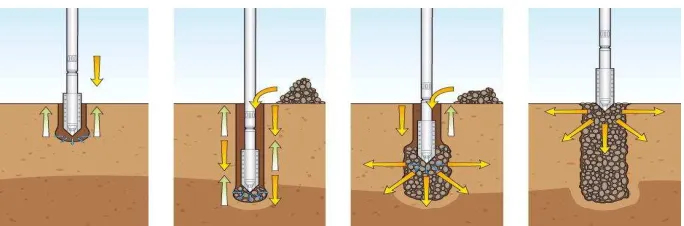
displacement method. In the displacement or dry method, native soil is displaced laterally by a vibratory probe using compressed air. This installation method is appropriate where ground water level is low and in situ soil is firm. This method is shown in the Figure 1 and Figure 2.
In the replacement or wet method, native soil is replaced by stone columns in a regular pattern where the holes are constructed using a vibratory probe accompanied by a water jet. This method is shown in the Fig. 3 (Lee and Pande, 1998).
Figure 1: Dry – top - feed method process schematic( Taube, 2001).
Figure 2: Dry – Bottom - feed method process schematic (Taube, 2001).
153
3. APPLICATION OF STONE COLUMNS
Stone column acts as vertical drains and thus speeding up the process of consolidation, replaces the soft soil by a stronger material and initial compaction of soil during the process of installation thereby increasing the unit weight. Stone columns also mitigate the potential for liquefaction and damage by preventing build up high pore pressure by providing drainage path.
4. ADVANTAGES
Weak soil, which has very low shear strength and high compressibility to support structures require strengthening to be capable of carrying loads from columns have certain limitations. There is increase in the settlement of the bed because of the absence of the lateral restraint. The clay particles get clogged around the stone column thereby reducing radial drainage. To overcome these limitations, and to improve the efficiency of the stone columns with respect to the strength and the compressibility, stone columns are encased (reinforced) using geogrids/geocomposites. Deshpande & Vyas (1996), have brought out conceptual performance of stone columns encased in geosynthetic material. Katti et al (1993) proposed a theory for improvement of soft ground using stone columns with geosynthetic encasing based on the particulate concept.( Malarvizhi, 2004).
6. DESIGN CONSIDERATIONS
In order to assess the applicability of vibro stone columns for a given site and foundation system, it is necessary to evaluate the performance of the unimproved ground and then determine if the stone columns will achieve the desired results in terms of improved bearing capacity, densification, settlement reduction, etc.
In the simplest terms, the preliminary design of stone columns can be accomplished as follows:
1) Estimate the settlement for the proposed loading conditions for the unimproved ground using conventional settlement calculations.
2) Determine the reduction of settlement that is required to meet the design requirements. This reduction factor which is expressed as a ratio of the amount of settlement of the unimprovedsoils to the amount of settlement of the improved soils is referred to as “settlement ratio,” or “improvement factor.” This concept was developed by Priebe.
3) Determine, based on contractor’s experience and published empirical data , if stone columns can provide the required reduction of settlement. Typically, settlement ratios are between 2 and 3.
4) Determine the area replacement ratio. 5) Determine the stone column length, diameter and s pacing. The stone column length is determining d from evaluation of the settlement calculations.
154
Figure 4:Plan of stone column, Triangular pattern (left) and square pattern (right).(Cabe, 2007).
7. FAILURE MODES OF STONE COLUMN
Single stone column can be built upon a firm stratum under a soft soil by end bearing capability or as a floating column with tip of column embedded within the soft soil layer. However end bearing columns are more in practice. To make the most optimum application of stone columns, we must understand the various failure mechanisms it can undergo Three Basic Failure Modes of Stone Columns are:
General shear failure,
Local shear failure,
Bulging failure,
Bulging can be encountered as the main factor to influence the failure in stone column, generally it is believed that if the length of column exceeds 2-3 times of the diameter of column, then bulging happens surely.
The modes of failure of Stone Columns depend upon the following parameters:
Type of Stone Column (End-bearing or Free Floating).
Type of Loading on columns.
Passive resistance of tributary clay.
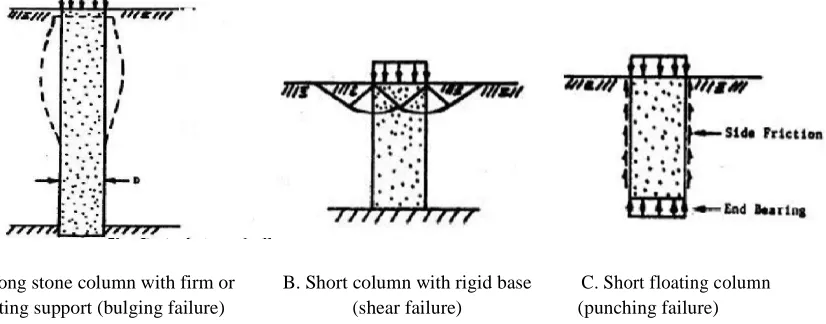
As can be seen in the Fig . 5A the area which has been shown with dash-lines is most probable to have bulging effect within.
Figure 5: Failure mechanism of a single stone column in a homogeneous soft layer. (Ghanti&Kashliwal, 2008).
155 In the case where a rigid short column is assumed(see
Fig 5.B), the main criteria which controls the failure is , bearing capacity type of failures which is denoted by stress and strain bulbs that simply follows the “Meyerhof” and “Terzaghi” type of analysis.Sometimes when a floating stone column embedding in soft soil is considered (see Fig 5.C), especially if it is short one which indicates that length of the column is less than 2-3 times of diameter, before bulging can occur, the column is already unstable due to failure in end bearing but even before bulging can develop. (Ghanti&Kashliwal, 2008)
8. CONCLUSION
The use of stone columns as a technique of soil reinforcement is frequently implemented in soft cohesive soil. Stone columns have been successfully used to support isolated footing, large raft foundations and embankment. Besides, their use in soft clays has been found to provide moderate increases in load carrying capacity accompanied by significant reduction in settlement. Being granular and freely drained material, consolidation settlement is accelerated and post construction settlement is minimized.Stone columns may have particular application in soft soils such as N.C clay, silt and peat, they are generally inserted on volume displacement basis excavating a hole with specified diameter and desired depth.
REFERENCES
[1] Ambily.A.P. (2004): Analysis Of Hydro Test Result For Steel Tank On Stone Column Ground Improvement, Department of Civil Engineering, Indian Institue of Tecnology Madras, Chennai. [2] Bhushan.K& et al. (2004): Ground Improvement
By Stone Columns and Surcharge at a Tank Site, Fifth International Conference in Geotechnical Engineering, New York.
[3] Cabe. Bryan A. (2007): Ground Improvement Using The Vibro-Stone Column Techniqe, Department of Civil Engineering, National University of Ireland, Galway.
[4] Deshpande, P.M and Vyas, A.V., (1996) : Interactive encased stone column foundation, Sixth International Conference and Exhibition on Piling and Deep foundation, DFI’96, ISSMFE, Bombay, pp1-19
[5] Katti, R.K., Katti, A.R and Naik, S.(1993): Monograph to analysis of stone columns with and without geosynthetic encasing, CBRI publication, New Delhi.
[6] Malarvizhi. S.N. (2004): Load versus Settlement of Claybed stabilized with Stone & Reinforced Stone Columns, Division of Soil Mechanics and
Foundation Engineering, Anna University. [7] Niroumand, H., (2011): Soil Improvement by
Reinforced Stone Columns Based on Experimental Work, Department of Geotechnical Engineering, Faculty of Civil Engineering, UniversitiTeknologi Malaysia.
[8] Pivarc. J., (2011): Stone columns –determination of the soil improvement factor, Department of Geotechnics, Faculty of Civil Engineering Slovak University of Technology, Radlinského 11, 813 68 Bratislava, Vol. XIX, No. 3, 17 – 21.
[9] Rudrabir, G &Kashliwal A., (2008): Ground Improvement Techniques – with a Focused Study on Stone Column, Dept. of Civil Engineering, VIT University.
[10] Taube.G& Martin, P.E., P.G.(2002): Stone Columns for Industrial Fills, Nicholson Construction Company, Cuddy, Pennsylvania. [11] Zahmatkesh. A & A.J. Choobbasti, (2010):