A Little Goes a Long Way: Quick Authoring of Semantic Knowledge
Sources for Interpretation
Carolyn Penstein Ros´e
Carnegie Mellon University
[email protected]
Brian S. Hall
University of Pittsburgh
[email protected]
Abstract
In this paper we present an evaluation of Carmel-Tools, a novel behavior oriented ap-proach to authoring and maintaining do-main specific knowledge sources for ro-bust sentence-level language understanding. Carmel-Tools provides a layer of abstraction between the author and the knowledge sources, freeing up the author to focus on the desired language processing behavior that is desired in the target system rather than the linguistic de-tails of the knowledge sources that would make this behavior possible. Furthermore, Carmel-Tools offers greater flexibility in output rep-resentation than the context-free rewrite rules produced by previous semantic authoring tools, allowing authors to design their own predicate language representations.
1
Introduction
One of the major obstacles that currently makes it imprac-tical for language technology applications to make use of sophisticated approaches to natural language understand-ing, such as deep semantic analysis and domain level rea-soning, is the tremendous expense involved in authoring and maintaining domain specific knowledge sources. In this paper we describe an evaluation of Carmel-Tools as a proof of concept for a novel behavior oriented approach to authoring and maintaining domain specific knowledge sources for robust sentence-level language understand-ing. What we mean by behavior oriented is that Carmel-Tools provides a layer of abstraction between the author and the knowledge sources, freeing up the author to fo-cus on the desired language processing behavior that is desired in the target system rather than the linguistic de-tails of the knowledge sources that would make this be-havior possible. Thus, Carmel-Tools is meant to make
the knowledge source engineering process accessible to a broader audience. Carmel-Tools is used to author do-main specific semantic knowledge sources for the Carmel Workbench (Ros´e, 2000; Ros´e et al., 2002) that con-tains broad coverage domain general syntactic and lexical knowledge sources for robust language understanding in English. Our evaluation demonstrates how Carmel-Tools can be used to interpret sentences in the physics domain as part of a content-based approach to automatic essay grading.
Sentence: The man is moving horizontally at a constant
velocity with the pumpkin.
Predicate Language Representation:
((velocity id1 man horizontal constant non-zero) (velocity id2 pumpkin ?dir ?mag-change ?mag-zero) (rel-value id3 id1 id2 equal))
Gloss: The constant, nonzero, horizontal velocity of the
man is equal to the velocity of the pumpkin.
Figure 1: Simple example of how Carmel-Tools builds knowledge sources capable of assigning representations to sentences that are not constrained to mirror the exact wording, structure, or literal surface meaning of the text.
real-ized with a much greater degree of surface syntactic vari-ation. Outside of the information extraction domain, a concept acquisition authoring environment called SGStu-dio (Wang and Acero, 2003) offers similar functionality to JAPE for building language understanding modules for dialogue systems, with similar limitations. Carmel-Tools is more flexible in that it allows a wider range of linguis-tics expression that communicate the same idea to match against the same pattern. It accomplishes this by inducing patterns that match against a deep syntactic parse rather than a stream of words, in order to normalize as much surface syntactic variation as possible, and thus reduc-ing the number of patterns that the learned rules must account for. Furthermore, Carmel-Tools offers greater flexibility in output representation than the context-free rewrite rules produced by previous semantic authoring tools, allowing authors to design their own predicate lan-guage representations that are not constrained to follow the structure of the input text (See Figure 1 for a simple example and Figure 2 for a more complex example.). See Section 3 and (Ros´e, 2000; Ros´e et al., 2002) for more details about CARMEL’s knowledge source representa-tion.
Note that the predicate language representation uti-lized by Carmel-Tools is in the style of Davidsonian event based semantics (Hobbs, 1985). For example, in Figure 1 notice that the first argument of each predicate is an identification token that represents the whole predicate. These identification tokens can then be bound to argu-ments of other predicates, and in that way be used to rep-resent relationships between predicates. For example, the
rel-valuepredicate expresses the idea that the predi-cates indicated byid1andid2are equal in value.
While language understanding systems with this style of analysis are not a new idea, the contribution of this work is a set of authoring tools that simplify the semantic knowledge sources authoring process.
2
Motivation
While the technology presented in this paper is not spe-cific to any particular application area, this work is mo-tivated by a need within a growing community of re-searchers working on educational applications of Natu-ral Language Processing to extract detailed information from student language input to be used for formulating specific feedback directed at the details of what the stu-dent has uttered. Such applications include tutorial dia-logue systems (Zinn et al., 2002; Popescue et al., 2003) and writing coaches that perform detailed assessments of writing content (Ros´e et al., 2003; Wiemer-Hastings et al., 1998; Malatesta et al., 2002) as opposed to just gram-mar (Lonsdale and Strong-Krause, 2003), and provide detailed feedback rather than just letter grades (Burstein et al., 1998; Foltz et al., 1998). Because of the important
role of language in the learning process (Chi et al., 2001), and because of the unique demands educational applica-tions place on the technology, especially where detailed feedback based on student language input is offered to students, educational applications present interesting op-portunities for this community.
The area of automated essay grading has enjoyed a great deal of success at applying shallow language pro-cessing techniques to the problem of assigning general quality measures to student essays (Burstein et al., 1998; Foltz et al., 1998). The problem of providing reliable, de-tailed, content-based feedback to students is a more diffi-cult problem, however, that involves identifying individ-ual pieces of content (Christie, 2003), sometimes called “answer aspects” (Wiemer-Hastings et al., 1998). Previ-ously, tutorial dialogue systems such as AUTO-TUTOR
3
Carmel-Tools Interpretation Framework
Sentence: During the fall of the elevator the man and
the keys have the same constant downward acceleration that the elevator has.
Predicate Language Representation:
((rel-time id0 id1 id2 equal) (body-state id1 elevator freefall) (and id2 id3 id4)
(rel-value id3 id5 id7 equal) (rel-value id4 id6 id6 equal)
(acceleration id5 man down constant non-zero) (acceleration id6 keys down constant non-zero) (acceleration id7 elevator down constant non-zero))
Gloss: The elevator is in a state of freefall at the same
time when there is an equivalence between the elevator’s acceleration and the constant downward nonzero acceleration of both the man and the keys
Figure 2: Example of how deep syntactic analysis facili-tates uncovering complex relationships encoded syntacti-cally within a sentence
One of the goals behind the design of Carmel-Tools is to leverage off of the normalization over surface syntac-tic variation that deep syntacsyntac-tic analysis provides. While our approach is not specific to a particular framework for deep syntactic analysis, we have chosen to build upon the publicly available LCFLEXrobust parser (Ros´e et al., 2002), the CARMEL grammar and semantic interpreta-tion framework (Ros´e, 2000), and the COMLEX lexicon (Grishman et al., 1994). This same broad coverage, do-main general interpretation framework has already been used in a number of educational applications including (Zinn et al., 2002; VanLehn et al., 2002).
Syntactic feature structures produced by the CARMEL grammar normalize those aspects of syntax that modify the surface realization of a sentence but do not change its deep functional analysis. These aspects include tense, negation, mood, modality, and syntactic transformations such as passivization and extraction. Thus, a sentence and it’s otherwise equivalent passive counterpart would be encoded with the same set of functional relationships, but the passive feature would be negative for the active version of the sentence and positive for the passive ver-sion. A verb’s direct object is assigned theobjrole re-gardless of where it appears in relation to the verb. Fur-thermore, constituents that are shared between more than one verb, for example a noun phrase that is the object of a verb as well as the subject of a relative clause modi-fier, will be assigned both roles, in that way “undoing” the relative clause extraction. In order to do this
analy-sis reliably, the component of the grammar that performs the deep syntactic analysis of verb argument functional relationships was generated automatically from a feature representation for each of 91 of COMLEX’s verb subcat-egorization tags (Ros´e et al., 2002). Altogether there are 519 syntactic configurations of a verb in relation to its ar-guments covered by the 91 subcategorization tags, all of which are covered by the CARMEL grammar.
CARMEL provides an interface to allow semantic in-terpretation to operate in parallel with syntactic interpre-tation at parse time in a lexicon driven fashion (Ros´e, 2000). Domain specific semantic knowledge is encoded declaratively within a meaning representation specifica-tion. Semantic constructor functions are compiled au-tomatically from this specification and then linked into lexical entries. Based on syntactic head/argument rela-tionships assigned at parse time, the constructor func-tions enforce semantic selectional restricfunc-tions and assem-ble meaning representation structures by composing the meaning representation associated with the constructor function with the meaning representation of each of its arguments. After the parser produces a semantic feature structure representation of the sentence, predicate map-ping rules then match against that representation in or-der to produce a predicate language representation in the style of Davidsonian event based semantics (Davidson, 1967; Hobbs, 1985), as mentioned above. The predicate mapping stage is the key to the great flexibility in repre-sentation that Carmel-Tools is able to offer. The mapping rules perform two functions. First, they match a feature structure pattern to a predicate language representation. Next, they express where in the feature structure to look for the bindings of the uninstantiated variables that are part of the associated predicate language representation. Because the rules match against feature structure patterns and are thus above the word level, and because the pred-icate language representations associated with them can be arbitrarily complex, the mapping process is decompo-sitional in manner but is not constrained to rigidly follow the structure of the text.
Figure 2 illustrates the power in the pairing between deep functional analyses and the predicate language rep-resentation. The deep syntactic analysis of the sentence makes it possible to uncover the fact that the expression “constant downward acceleration” applies to the acceler-ation of all three entities mentioned in the sentence. The coordination in the subject of the sentence makes it pos-sible to infer that both the acceleration of the man and of the keys are individually in an equative relationship with the acceleration of the elevator. The identification to-ken of theandpredicate allows the whole representation of the matrix clause to be referred to in therel-time
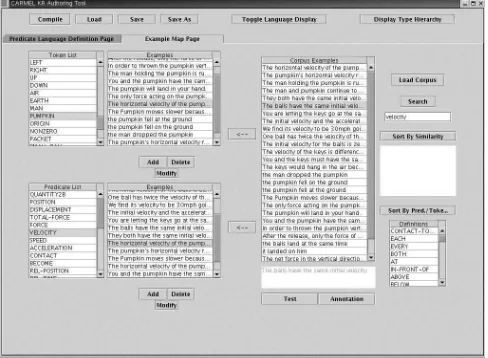
Figure 3: Predicate Language Definition Page
Figure 4: Example Map Page
of freefall. But individual predicates, each representing a part of the meaning of the whole sentence, can also be referred to individually if desired using their own identi-fication tokens.
4
Carmel-Tools Authoring Process
The purpose of Carmel-Tools is to insulate the author from the details of the underlying domain specific knowl-edge sources. If an author were building knowledge sources by hand for this framework, the author would be responsible for building an ontology for the semantic fea-ture strucfea-ture representation produced by the parser, link-ing pointers into this hierarchy into entries in the lexicon, and writing predicate mapping rules. With Carmel-Tools, the author never has to deal directly with these knowledge sources. The Carmel-Tools authoring process involves designing a Predicate Language Definition, augmenting
the base lexical resources by either loading raw human tutoring corpora or entering example texts by hand, and annotating example texts with their corresponding rep-resentation in the defined Predicate Language Defini-tion. From this authored knowledge, CARMEL’s se-mantic knowledge sources can be generated and com-piled. The knowledge source inference algorithm ensures that knowledge coded redundantly across multiple exam-ples is represented only once in the compiled knowledge sources. The authoring interface allows the author or au-thors to test the compiled knowledge sources and then continue the authoring process by updating the Predicate Language Definition, loading additional corpora, tating additional examples, or modifying already anno-tated examples.
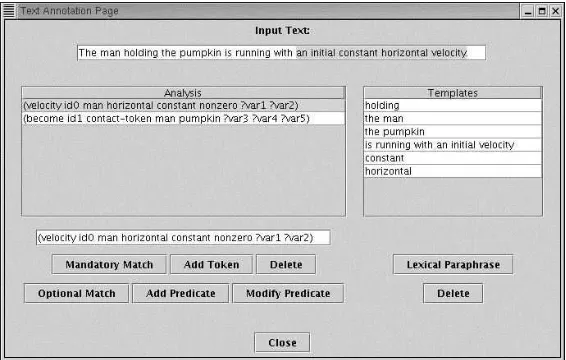
Figure 5: Text Annotation Page Page
process. In particular, its GUI interface guides authors in such a way as to prevent them from introducing inconsis-tencies between knowledge sources, which is particularly crucial when multiple authors work together. For exam-ple, a GUI interface for entering propositional representa-tions for example texts insures that the entered represen-tation is consistent with the author’s Predicate Language Definition. Compiled knowledge sources contain point-ers back to the annotated examples that are responsible for their creation. Thus, it is also able to provide trou-bleshooting facilities to help authors track down potential sources for incorrect analyses generated from compiled knowledge sources. When changes are made to the Pred-icate Language Definition, Carmel-Tools tests whether each proposed change would cause conflicts with any an-notated example texts. An example of such a change would be deleting an argument from a predicate type where some example has as part of its analysis an instan-tiation of a predicate with that type where that argument is bound. If so, it lists these example texts for the author and requires the author to modify the annotated examples first in such a way that the proposed change will not cause a conflict, in this case that would mean uninstantiating the variable that the author desires to remove. In cases where changes would not cause any conflict, such as adding an argument to a predicate type, renaming a predicate, to-ken, or type, or removing an argument that is not bound in any instantiated proposition, these changes are made throughout the database automatically.
4.1 Defining the Predicate Language Definition
The author begins the authoring process by designing the propositional language that will be the output repre-sentation from CARMEL using the authored knowledge sources. This is done on the Predicate Language
Defi-nition page of the Carmel-Tools interface, displayed in Figure 3. The author is free to develop a representation language that is as simple or complex as is required by the type of reasoning, if any, that will be applied to the output representations by the tutoring system as it formulates its response to the student’s natural language input.
The interface includes facilities for defining a list of predicates and Tokens to be used in constructing proposi-tional analyses. Each predicate is associated with a basic predicate type, which is a associated with a list of argu-ments. Each basic predicate type argument is itself asso-ciated with a type that defines the range of atomic values, which may be tokens or identifier tokens referring to in-stantiated predicates, that can be bound to it. Thus, to-kens also have types. Each token has one or more basic token types. Besides basic predicate types and basic to-ken types, we also allow the definition of abstract types that can subsume other types.
4.2 Generating Lexical Resources and Annotating Example Sentences
When the predicate language definition is defined, the next step is to generate the domain specific lexical re-sources and annotate example sentences with their corre-sponding representation within this defined predicate lan-guage. The author begins this process on the Example Map Page, displayed in Figure 4.
en-tries. It also segments the file into a list of student sen-tence strings, which are then loaded into a Corpus Ex-amples list, which appears on the right hand side of the interface. Searching and sorting facilities are provided to make it easy for authors to find sentences that have cer-tain things in common in order to organize the list of sen-tences extracted from the raw corpus file in a convenient way. For example, aSort By Similaritybutton causes Carmel-Tools to sort the list of sentences accord-ing to their respective similarity to a given text straccord-ing ac-cording to an LSA match between the example string and each corpus sentence. The interface also includes the To-ken List and the Predicate List, with all defined toTo-kens and predicates that are part of the defined predicate lan-guage. When the author clicks on a predicate or token, the Examples list beside it will display the list of anno-tated examples that have been annoanno-tated with an analysis containing that token or predicate.
Figure 5 displays how individual texts are annotated. The Analysis box displays the propositional representa-tion of the example text. This analysis is constructed using the Add Token, Delete, Add Predicate, andModify Predicatebuttons, as well as their sub-windows, which are not shown. Once the analysis is en-tered, the author may indicate the compositional break-down of the example text by associating spans of text with parts of the analysis by means of theOptional Match andMandatory Matchbuttons. For exam-ple, the noun phrase “the man” corresponds to theman
token, which is bound in two places. Each time a match takes place, the Carmel-Tools internal data structures cre-ate one or more templcre-ates that show how pieces of syn-tactic analyses corresponding to spans of text are matched up with their corresponding propositional representation. From this match Carmel-Tools infers both that “the man” is a way of expressing the meaning of themantoken in text and that the subject of the verbholdcan be bound to the?body1argument of thebecomepredicate. By de-composing example texts in this way, Carmel-Tools con-structs templates that are general and can be reused in multiple annotated examples. It is these created templates that form the basis for all compiled semantic knowledge sources. Thus, even if mappings are represented redun-dantly in annotated examples, they will not be repre-sented redundantly in the compiled knowledge sournces. The list of templates that indicates the hierarchical break-down of this example text are displayed in the Templates list on the right hand side of Figure 5. Note that while the author matches spans to text to portions of the meaning representation, the tool stores mappings between feature
structures and portions of meaning representation, which
is a more general mapping.
Templates can be generalized by entering paraphrases for portions of template patterns. Internally what this
ac-complishes is that all paraphrases listed can be interpreted by CARMEL as having the same meaning so that they can be treated as interchangeable in the context of this template. A paraphrase can be entered either as a specific string or as a Defined Type, including any type defined in the Predicate Language Definition. What this means is that the selected span of text can be replaced by any span of text that can be interpreted in such a way that its pred-icate representation’s type is subsumed by the indpred-icated type.
4.3 Compiling Knowledge Sources
tag is associated with a set of licensed arguments. Thus, subcat tags are considered consistent if the set of licensed arguments contains at least all mandatory arguments and doesn’t license any arguments that are not either manda-tory or optional. Predicate mapping rules are generated for each template by first converting the corresponding syntactic feature structure into the semantic representa-tion defined by the automatically generated ontology and lexicon with semantic pointers. Predicate mapping rules are then created that map the resulting semantic feature structure into the associated predicate language represen-tation.
5
Evaluation
A preliminary evaluation was run for the physics domain. We used for our evaluation a corpus of essays written by students in response to 5 simple qualitative physics ques-tions such as “If a man is standing in an elevator ing his keys in front of his face, and if the cable hold-ing the elevator snaps and the man then lets go of the keys, what will be the relationship between the position of the keys and that of the man as the elevator falls to the ground? Explain why.” A predicate language definition was designed consisting of 40 predicates, 31 predicate types, 160 tokens, 37 token types, and 15 abstract types. The language was meant to be able to represent phys-ical objects mentioned in our set of physics problems, body states (e.g., freefall, contact, non-contact), quanti-ties that can be measured (e.g., force, velocity, acceler-ation, speed, etc.), features of these quantities (e.g., di-rection, magnitude, etc.), comparisons between quanti-ties (equivalence, non-equivalence, relative size, relative time, relative location), physics laws, and dependency re-lations. An initial set of 250 example sentences was then annotated, including sentences from each of a set of 5 physics problems.
Next a set of 202 novel test sentences, each between 4 and 64 words long, was extracted from the corpus. Since comparisons, such as between the accelerations of objects in freefall together, are important for the reasoning in all of the questions used for corpus collection, we focused the coverage evaluation specifically on sentences pertain-ing to comparisons, such as in Figures 1 and 2. The goal of the evaluation was to test the extent to which knowl-edge generated from annotated examples generalizes to novel examples.
Since obtaining the correct predicate language repre-sentation requires obtaining a correct syntactic parse, we first evaluated CARMEL’s syntactic coverage over the corpus of test sentences to obtain an upper bound for ex-pected performance. We assigned the syntactic interpre-tation of each sentence a score of None, Bad, Partial, or Acceptable. A grade of None indicates that no interpreta-tion was built by the grammar. Bad indicates that parses
were generated, but they contained errorfull functional relationships between constituents. Partial indicates that no parse was generated that covered the entire sentence, ut the portions that were completely correct for at least one interpretation of the sentence. Acceptable indicates that a complete parse was built that contained no incor-rect functional relationships. If any word of the sentence was not covered, it was one that would not change the meaning of the sentence. For example, “he had the same velocity as you had” is the same as “he had the same ve-locity as you”, so if “did” was not part of the final parse but other than that, the parse was fine, it was counted as Acceptable. Overall the coverage of the grammar was very good. 166 sentences were graded Acceptable, which is about 83% of the corpus. 8 received a grade of Partial, 26 Bad, and 1 None.
We then applied the same set of grades to the quality of the predicate language output. Note that that the grade as-signed to an analysis represents the correctness and com-pleteness of the predicate representation the system ob-tained for that sentence. In this case, a grade of Accept-able meant that all aspects of intended meaning were ac-counted for, and no misleading information was encoded. Partial indicated that some non-trivial part of the intended meaning was communicated. Any interpretation contain-ing any misleadcontain-ing information was counted as Bad. If no predicate language representation was returned, the sentence was graded as None. As expected, grades for semantic interpretation were not as high as for syntactic analysis. In particular, 107 were assigned a grade of Ac-ceptable, 45 were assigned a grade of Partial, 36 were assigned a grade of Bad, and 14 received a nil interpre-tation. Our evaluation demonstrates that knowledge gen-erated from annotated examples can be used to interpret novel sentences, however, there are still gaps in the cov-erage of the automatically generated knowledge sources that need to be filled in with new annotated examples. Furthermore, the small but noticeable percentage of bad interpretations indicates that some previously annotated examples need to be modified in order to prevent these bad interpretations from being generated.
6
Current Directions
References
J. Burstein, K. Kukich, S. Wolff, C. Lu, M. Chodorow, L. Braden-Harder, and M. D. Harris. 1998. Au-tomated scoring using a hybrid feature identification technique. In Proceedings of COLING-ACL’98, pages 206–210.
M. T. H. Chi, S. A. Siler, H. Jeong, T. Yamauchi, and R. G. Hausmann. 2001. Learning from human tutor-ing. Cognitive Science, (25):471–533.
J. Christie. 2003. Automated essay marking for content: Does it work? In CAA Conference Proceedings.
H. Cunningham, D. Maynard, and V. Tablan. 2000. Jape: a java annotations patterns engine. Institute for Lan-guage, Speach, and Hearing, University of Sheffield, Tech Report CS-00-10.
H. Cunningham, D. Maynard, K. Bontcheva, and V. Tablan. 2003. Gate: an architecture for develop-ment of robust hlt applications. In Recent Advanced in
Language Processing.
D. Davidson. 1967. The logical form of action sentences. In N. Rescher, editor, The Logic of Decision and
Ac-tion.
P. W. Foltz, W. Kintsch, and T. Landauer. 1998. The measurement of textual coherence with latent semantic analysis. Discourse Processes, 25(2-3):285–307.
R. Grishman, C. Macleod, and A. Meyers. 1994. COM-LEX syntax: Building a computational lexicon. In
Proceedings of the 15th International Conference on Computational Linguistics (COLING-94).
J. R. Hobbs. 1985. Ontological promiscuity. In
Proceed-ings of the 23rd Annual Meeting of the Association for Computational Linguistics.
D. Jay, J. Aberdeen, L. Hirschman, R. Kozierok, P. Robinson, and M. Vilain. 1997. Mixed-initiative development of language processing systems. In Fifth
Conference on Applied Natural Language Processing.
M. Lepper, M. Woolverton, D. Mumme, and J. Gurtner. 1993. Motivational techniques of expert human tutors: Lessons for the design of computer based tutors. In S. P. Lajoie and S. J. Derry, editors, Computers as
Cog-nitive Tools, pages 75–105.
D. Lonsdale and D. Strong-Krause. 2003. Automated rating of esl essays. In Proceedings of the HLT-NAACL
2003 Workshop: Building Educational Applications Using Natural Language Processing.
K. Malatesta, P. Wiemer-Hastings, and J. Robertson. 2002. Beyond the short answer question with research methods tutor. In Proceedings of the Intelligent
Tutor-ing Systems Conference.
D. Maynard, K. Bontcheva, and H. Cunningham. 2002. Towards a semantic extraction of named entities. In
40th Anniversary meeting of the Association for Com-putational Linguistics.
A. McCallum and K. Nigam. 1998. A comparison of event models for naive bayes text classification. In
Proceedings of the AAAI-98 Workshop on Learning for Text Classification.
O. Popescue, V. Aleven, and K. Koedinger. 2003. A kowledge based approach to understanding students’ explanations. In Proceedings of the AI in Education
Workshop on Tutorial Dialogue Systems: With a View Towards the Classroom.
C. P. Ros´e, D. Bhembe, A. Roque, and K. VanLehn. 2002. An efficient incremental architecture for ro-bust interpretation. In Proceedings of the Human
Lan-guages Technology Conference, pages 307–312.
C. P. Ros´e, A. Roque, D. Bhembe, and K VanLehn. 2003. A hybrid text classification approach for analysis of student essays. In Proceedings of the HLT-NAACL
2003 Workshop: Building Educational Applications Using Natural Language Processing.
C. P. Ros´e. 2000. A framework for robust semantic in-terpretation. In Proceedings of the First Meeting of the
North American Chapter of the Association for Com-putational Linguistics, pages 311–318.
K. VanLehn, P. Jordan, C. P. Ros´e, and The Natural Lan-guag e Tutoring Group. 2002. The architecture of why2-atlas: a coach for qualitative physics essay writ-ing. In Proceedings of the Intelligent Tutoring Systems
Conference, pages 159–167.
Y. Wang and A. Acero. 2003. Concept acquisition in example-based grammar authoring. In Proceedings
of the International Conference on Acoustics, Speech, and Signal Processing.
P. Wiemer-Hastings, A. Graesser, D. Harter, and the Tu-toring Res earch Group. 1998. The foundations and architecture of autotutor. In B. Goettl, H. Halff, C. Redfield, and V. Shute, editors, Intelligent
Tutor-ing Systems: 4th International Conference (ITS ’98 ),
pages 334–343. Springer Verlag.
C. Zinn, J. D. Moore, and M. G. Core. 2002. A 3-tier planning architecture for managing tutorial dia-logue. In Proceedings of the Intelligent Tutoring