2666
Evaluation of Unsupervised Compositional Representations
Hanan Aldarmaki
The George Washington University
Mona Diab
The George Washington University
Abstract
We evaluated various compositional models, from bag-of-words representations to compositional RNN-based models, on several extrinsic supervised and unsupervised evaluation benchmarks. Our results confirm that weighted vector averaging can outperform context-sensitive models in most benchmarks, but structural features encoded in RNN models can also be useful in certain classification tasks. We analyzed some of the evaluation datasets to identify the aspects of mean-ing they measure and the characteristics of the various models that explain their performance variance.
1 Introduction
Distributed semantic models for words encode latent features that reflect semantic aspects and corre-lations among words. The goal of compositional semantic models is to induce latent semantic repre-sentations that encode the meaning of phrases, sentences, and paragraphs of variable lengths. Some neural architectures such as convolutional (Kim, 2014) and recursive networks (Socher et al., 2013) han-dle variable-length input by identifying shift-invariant features suitable for the classification problem at hand, which makes it possible to skip composition and work directly with the entire space of individual word embeddings. While such models can achieve excellent performance in supervised classification tasks such as sentiment analysis, we are interested in generic unsupervised fixed-length representations for variable-length text sequences so as to efficiently preserve essential semantic content for later use in various supervised and unsupervised settings.
Binary bag-of-words are simple and effective representations that serve as a strong baseline in several classification benchmarks (Wang and Manning, 2012). However, they do not exploit the distributional re-lationships among different words, which limits their applicability and generalization when training data are scarce. Additive compositional functions, such as word vector sum or average, are more effective in semantic similarity tasks even when compared with tensor-based compositional functions (Milajevs et al., 2014) and can outperform more complex and better tuned models based on recurrent neural ar-chitectures on out-of-domain data (Wieting et al., 2015a). Yet, averaging also has several drawbacks: unlike binary representations, the individual word identities are lost, and some words that do not carry semantic significance may end up being more prominently represented than essential words. Further-more, additive compositional models disregard sentence structure and word order, which can lead to loss of semantic nuance. To alleviate the first issue, the weights of various words can be adjusted using word frequency statistics (Riedel et al., 2017) or by inducing context-sensitive weights using recurrent neural networks (Wieting and Gimpel, 2017), both of which have been shown to outperform vector aver-aging. Context-sensitive feed-forward neural models like the paragraph vector (Le and Mikolov, 2014) potentially incorporate word order, yet the training objective may not be sufficient to model deeper struc-ture. Sequence encoder-decoder models, on the other hand, can be trained with various sentence-level objectives, such as neural machine translation (NMT) (Sutskever et al., 2014), predicting surrounding
sentences (i.e. skip-thought) (Kiros et al., 2015), or reconstruction of the input using denoising auto-encoders (Hill et al., 2016). These sequential models have been evaluated and compared against other models and baselines on several supervised and unsupervised tasks in Hill et al. (2016). The denoising autoencoder model and skip-thought both performed well in supervised tasks, while the NMT model performed worse than the baselines. All three performed poorly in unsupervised settings.
To bridge some of the gaps in evaluation, we evaluated a subset of models with increasing complexity, from binary bag-of-words to RNNs, on various supervised and unupervised settings. Our objective is to evaluate compositional models against strong baselines and identify the elements that lead to perfor-mance gains. We evaluated binary vs. distributed features, weighted vs. unweighted averaging, three different word embedding models, and four context-sensitive models that optimize different objectives: the paragraph vector, the gated recurrent averaging network (Wieting and Gimpel, 2017), skip-thought, and an LSTM encoder trained on labeled natural language inference data (inferSent) (Conneau et al., 2017). We also analyzed the intrinsic structures of the various models by visual inspection and k-means clustering to gain insights into structural differences that may explain the variance in performance.
2 Background: Unsupervised Compositional Models
2.1 Baselines
The simplest way of representing a sentence is a binary bag-of-words representation, where each word is a feature in the vector space. This results in large and sparse representations that only account for the existence of individual words within a sentence, yet they have been shown to be effective in various supervised classification tasks, especially in combination withn-grams and Naive Bayes (NB) features (Wang and Manning, 2012). Let~xi be the binary representation of sentencei, andyi ∈ {0,1}its label. The log-count ratio~ris calculated as
~
r= logp/~ k~pk ~
q/k~qk (1)
Where~p = 1 +P
i:yi=1~xi and~q = 1 +
P
i:yi=0~xi are the smoothed count vectors for each class
(i.e. the number of samples in the class that include each feature). The feature vectors are then modified using the element-wise product~xi◦~r. NB features identify the most discriminative words for each task, so using them results in task-specific rather than general representations. However, given the relative efficiency of this model, we include it as a baseline for comparison.
2.2 Word Embeddings and Composition Functions
Representations of variable-length sentences and paragraphs can be constructed by averaging the em-beddings of all words within a sentence. However, simple averaging may not be the best approach since not all words within a sentence are semantically relevant. The following methods can be used to adjust the weights of words according to their frequency, assuming that frequent words have lower semantic content:
tf-idf-weighted Average The term frequency-inverse document frequency statistic measures the importance of a word to a document. We treat each sentence as a document and calculate the idf weight for termtas follows:
idft=log N
1 +nt
(2)
where N is the total number of sentences and nt the number of sentences in which the term appears. Terms that appear in more documents have loweridfweights.
sif-weighted Average The smooth inverse frequency(Riedel et al., 2017) is an alternative measure for discounting the weights of frequent words as follows:
sift= a
whereais a smoothing parameter andp(t)is the relative frequency of the term in the training corpus. In addition, as proposed in (Riedel et al., 2017), we subtract the projection of the vectors on the first principal component which corresponds to syntactic features associated with common words.
2.2.1 Word Embeddings
Random word projections: we generated a random vector drawn from the standard normal distri-bution for each word in the vocabulary. The vector sum of random word vectors is a low-dimensional projection of binary bag-of-words vectors. .
Continuous Bag of Words: CBOWis an efficient log-linear model for learning word embeddings using a feed-forward neural network classifier that predicts a word given the surrounding words within a fixed context window (Mikolov et al., 2013a). In Schnabel et al. (2015) word embedding evaluation,CBOW outperformed other word embeddings in word relatedness and analogy tasks.
Global Vectors: GloVeis a global log-bilinear regression model (Pennington et al., 2014) that pro-duces word embeddings using weighted matrix factorization of word co-occurrence probabilities.
Subword Information Skip-gram si-skiplearns representations for n-grams of various lengths, and words are represented as sums ofn-gram representations (Bojanowski et al., 2017). The learning architecture is based on the continuous skip-gram model (Mikolov et al., 2013b), which is trained by maximizing the conditional probability of context words within a fixed window with negative sampling. The model exploits the morphological variations within a language to learn more reliable representations, particularly for rare morphological variants.
2.3 Neural Compositional Models
Several models have been proposed to overcome some of the weaknesses of bag-of-words and additive representations, such as lack of structure. We evaluated the following context-sensitive models:
The Paragraph Vector: doc2vecdistributed memory model (Le and Mikolov, 2014) constructs rep-resentations for sentences and paragraphs using a neural feedforward network that maximizes the con-ditional probability of words within a paragraph given a context window and the paragraph embedding, which is shared for all contexts generated from the same paragraph. After learning word and paragraph embeddings for the training corpus, the model learns representations for new paragraphs by fixing the model parameters and updating the paragraph embeddings using backpropagation. This additional train-ing at inference time considerably increases the time complexity of the model compared to all others in this study.
Gated Recurrent Averaging Network: GRAN has been recently introduced to combine the benefits of LSTM networks and averaging, where the weights are computed along with the word and sentence representations (Wieting and Gimpel, 2017). The model is trained using aligned sentences that are as-sumed to be paraphrases to maximize the similarity of their representations against negative examples. The intuition is to make the averaging operation context-sensitive, resulting in a more powerful construc-tion than simple averaging where all words are equally important. The model was shown to outperform averaging and LSTM models in semantic relatedness tasks.
Skip-Thought: Theskip-thmodel is a sequence encoder-decoder trained by projecting sentences into fixed-length vectors, which in turn are used as input to a decoder that is trained to reconstruct sur-rounding sentences (Kiros et al., 2015), where the encoder and decoder are RNNs with GRU activations (Chung et al., 2014). The model is trained with contiguous sentences extracted from a collection of nov-els. After training, the model’s vocabulary is expanded by learning a linear mapping from pre-trained CBOWword embeddings to the vector space of theskip-thword embeddings.
Dataset Pair-wise Similarity Sentiment Analysis Newsgroup TREC
STS SICK MSRP CR MPQA RT-s Subj IMDB REL SPO COM POL
Train 5,749 4,934 4,076 3,775 10,606 10,662 10,000 25k 1,078 1,604 1,694 1,310 5,452
Test 1,379 4,906 1,725 – – – – 25k – – – – 500
pos ratio – – 0.66 0.64 0.31 0.50 0.50 0.50 0.58 0.51 0.51 0.52 –
[image:4.595.77.524.63.130.2]l 12 10 23 21 3 21 24 262 82 82 82 92 10
Table 1: Dataset statistics. Train: number of samples in the training set. Test: number of samples in the test set, if applicable (CV is applied otherwise). pos ratio: ratio of positive samples in the test set (or total for datasets with no splits).l: average length of all samples.
3 Evaluation Datasets
To evaluate the text representations, we used them as features in extrinsic supervised and unsupervised tasks that reflect various semantic aspects, which can be grouped in three categories: pairwise-similarity, sentiment analysis, and categorization. A summary of the dataset statistics is in Table 1.1
3.1 Pairwise Similarity
Semantic Textual Similarity: the STS benchmark dataset (Cer et al., 2017) includes a collection of English sentence pairs and human-annotated similarity scores that range from 0 (unrelated sentences) to 5 (paraphrases). The dataset includes training, development, and test sets. This task can be performed without supervision by calculating the cosine similarity between two sentence vectors. We also evaluated the models in a supervised settings using linear regression, where the input vector is a concatenation of the element-wise produceu.vand absolute difference|u−v|of each pairhu, vi.
Sentences Involving Compositional Knowledge: SICK dataset is a benchmark for evaluating com-positional models (Marelli et al., 2014). We evaluated the models on the relatedness subtask, which is constructed in a similar manner as STS benchmark.
Paraphrase Detection: This is a binary classification task that involves the identification of para-phrases in similar sentence pairs using the Microsoft Research Paraphrase Corpus, MSRP (Dolan et al., 2004). We evaluated the models in two ways: calculating the cosine similarity between the sentence pairs and classifying them as paraphrases if the similarity is larger than a threshold tuned from the training set. The second approach is to learn a logistic regression classifier using a concatenation ofu.vand|u−v|.
3.2 Sentiment Analysis and Text Categorization
Sentiment Analysis: We used the following binary classification tasks:CRcustomer product reviews (Hu and Liu, 2004), MPQA opinion polarity subtask (Wiebe et al., 2005), RT-s short movie reviews (Pang and Lee, 2005),Subjsubjectivity/objectivity classification task (Pang and Lee, 2004), andIMDB
full-length movie review dataset (Maas et al., 2011).
Newsgroups: Following the setup in (Wang and Manning, 2012) we used the 20-Newsgroup dataset
2 to extract several binary topic categorization tasks. We processed the datasets to remove headers,
forwarded text, and signatures, which results in smaller sentences and paragraphs. We used the following newsgroups for binary classification: religion (atheism vs. religion), sports (baseball vs. hockey),
computer (windows vs. graphics), and politics (middle east vs. guns). We also trained multi-class classifiers on the 8 newsgroups.
Question Classification: We used the TREC 10 coarse question categorization task3 which catego-rizes questions into 6 classes: human (HUM), entity (ENTY), location (LOC), number (NUM), descrip-tion (DESC), and abbreviadescrip-tion (ABBR).
1
Evaluation scripts and data can be downloaded from: https://github.com/h-aldarmaki/sentence eval
2
http://qwone.com/∼jason/20Newsgroups/
4 Experimental Setup
4.1 Training Data
We trained the unsupervised word embedding modelsCBOW, GloVe, andsi-skipon a set of ∼7 million sentences extracted from the English Wikipedia and Amazon movie and product reviews (He and McAuley, 2016). We also trained the Paragraph Vector (doc2vec) model on this dataset, and initialized the word embeddings using the si-skip pre-trained word embeddings above. While better results overall could be obtained using pre-trained word embeddings trained with much larger text corpora, we used this medium-size corpus to evaluate the various models consistently and reduce model variability due to data and vocabulary coverage.
We used the publicly available pre-trainedGRAN4andskip-th5models, which require training with special types of datasets: paraphrase collections, and contiguous text from books, respectively. To ensure a fair evaluation, we only compared these models against binary bag-of-words and equivalent word embeddings. The word embeddings within theGRANmodel were initialized withPARAGRAM-SL999 word vectors (Wieting et al., 2015b), so we used them as an evaluation baseline forGRAN. We compared skip-thagainst theCBOW embeddings that were used to expand the vocabulary, which account for most words in the final model’s vocabulary. We used the pre-trainedinferSentmodel6which uses pre-trained GloVe word embeddings7. We also experimented with the post-trained word embeddings for each model with similar results, so we omitted them for brevity.
4.2 Training Settings
We trained the unsupervised word embedding models using the optimal parameters recommended for each model. The hyper-parameters indoc2vecwere set according to the recommendations in (Lau and Baldwin, 2016). For the supervised sentiment classification and text categorization tasks, we trained and tuned linear SVM models using grid search for datasets that include train/dev/test splits, and nested cross-validation otherwise. We also experimented with kernel SVMs but didn’t observe notable differences in the results.
5 Evaluation Results
5.1 Pairwise Similarity Evaluation
0.5
1 2 3 4 5
0 0.2 0.4 0.6 0.8 1
0.65
1 2 3 4 5
0 0.2 0.4 0.6 0.8 1
0.5
1 2 3 4 5
0 0.2 0.4 0.6 0.8 1
0.73
1 2 3 4 5
0 0.2 0.4 0.6 0.8 1
0.74
1 2 3 4 5
0 0.2 0.4 0.6 0.8 1
0.6
0 1 2 3 4 5
0 0.2 0.4 0.6 0.8 1
a:word overlap
0.63
0 1 2 3 4 5
0 0.2 0.4 0.6 0.8 1 b:doc2vec
0.2
0 1 2 3 4 5
0 0.2 0.4 0.6 0.8 1 c:skip-th
0.68
0 1 2 3 4 5
0 0.2 0.4 0.6 0.8 1
d:sif†
0.69
0 1 2 3 4 5
[image:5.595.80.521.482.658.2]0 0.2 0.4 0.6 0.8 1 e:inferSent
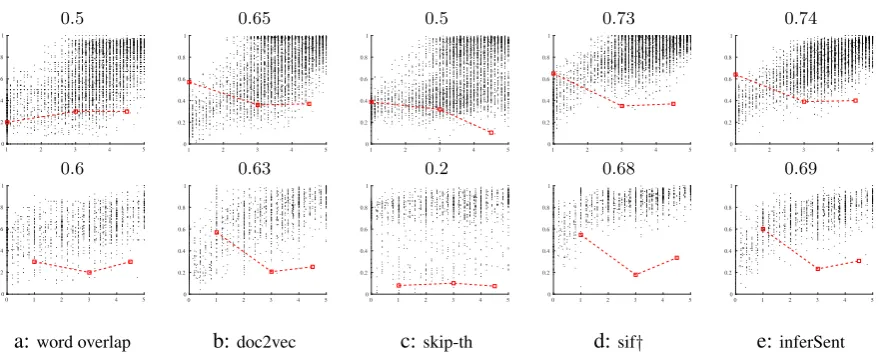
Figure 1: Scatter plots of normalized gold scores in the x axis vs. (a) word overlap (%) and (b - e) cosine similarity using various models. Top: SICK. Bottom: STS Benchmark. Pearsonρplotted in red forscore≤2,score∈(2,4), andscore≥4. Overall Pearsonρshown at the top. †sif-weighted average of pre-trained Glove vectors used in inferSent.
STS Benchmarkρ SICKρ MSRP accuracy/F1 cosine linear reg. cosine linear reg. cosine logistic reg. Binary BOW 0.536 0.606 0.611 0.761 66.9/0.765 72.2/0.811
Paragraph Vector (doc2vec) 0.628 0.673 0.654 0.655 68.6/0.797 70.4/0.803
Random
avg 0.558 0.616 0.602 0.669 70.6/0.780 70.8/0.797 idf 0.668 0.665 0.617 0.659 70.0/0.790 69.1/0.791 sif 0.666 0.665 0.628 0.655 70.1/0.786 69.9/0.699
CBOW
avg 0.630 0.672 0.679 0.728 71.9/0.815 72.0/0.807 idf 0.697 0.695 0.678 0.712 71.8/0.815 72.3/0.809 sif 0.683 0.686 0.690 0.715 72.2/0.814 71.4/0.804
GloVe
avg 0.336 0.574 0.602 0.694 68.9/0.807 71.0/0.810 idf 0.540 0.656 0.624 0.685 71.3/0.818 73.4/0.820 sif 0.685 0.665 0.701 0.695 71.8/0.809 72.1/0.811
si-skip
avg 0.608 0.690 0.684 0.730 72.1/0.817 71.9/0.895 idf 0.683 0.714 0.702 0.715 69.3/0.809 70.3/0.815 sif 0.694 0.721 0.716 0.721 70.6/0.804 70.6/0.802
GRAN 0.747 0.747 0.715 0.756 71.3/0.817 72.3/0.812
Pre-trained PARAGRAM-SL999†
avg 0.564 0.690 0.694 0.746 71.8/0.818 73.2/0.816 idf 0.711 0.733 0.723 0.756 72.1/0.817 73.3/0.817 sif 0.716 0.722 0.733 0.765 73.4/0.822 72.0/0.809 skip-th 0.213 0.729 0.498 0.811 62.3/0.761 73.0/0.812
Pre-trained CBOW†
avg 0.631 0.695 0.727 0.758 70.3/0.813 73.2/0.813 idf 0.674 0.708 0.710 0.731 69.6/0.809 71.3/0.807 sif 0.686 0.707 0.727 0.737 69.8/0.809 70.9/0.803
inferSent 0.692 0.773 0.744 0.865 0.697/0.806 0.746/0.827
Pre-trained GloVe†
[image:6.595.120.484.61.326.2]avg 0.497 0.655 0.687 0.753 0.711/0.818 0.732/0.817 idf 0.606 0.688 0.696 0.736 0.688/0.809 0.711/0.804 sif 0.679 0.699 0.729 0.749 0.709/0.816 0.708/0.804
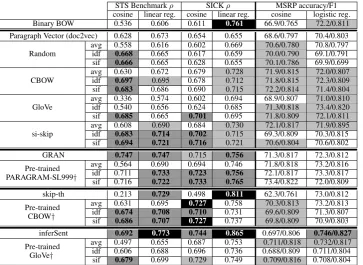
Table 2: Pearsonρfor STS Benchmark and SICK relatedness, and Accuracy%/F1 for MSR Paraphrase detection. Results are shaded according to their statistical significance using the Williams test (Graham and Baldwin, 2014) withα= 0.05. †pre-trained vectors used in the model above.
Table 2 shows the performance of the various models in the pair-wise similarity tasks. We highlight the best performance in each block; differences within the same shade are not statistically significant. Among the word embedding models, the subword skipgram si-skipachieved the best overall performance. For all models exceptsi-skip, simple averaging performed poorly in semantic relatedness tasks, es-pecially in the unsupervised setting, whilesif-weighting generally outperformedidf-weighting (the improvement is most evident forGloVe). A similar trend is observed with random word vectors, which performed on par withdoc2vec.
The binary bag-of-words model performed particularly well in the supervised SICK task. The formance of binary and random vectors can be explained by the high correlation between the per-centage of overlapping words and the similarity scores as seen in Figure 1. We also highlighted the Pearson correlation coefficients for the following subsets of relatedness scores: A = {score ≤ 2},
B = {score ∈ (2,4)}, and C = {score ≥ 4}. The overall Pearson correlation mostly reflects the performance on the most and least similar pairs, which tend to be the pairs with the highest and lowest word overlap, respectively; within the regions we highlighted, all correlations were relatively low. How-ever, distributed models likesifandinferSentimproved the correlation ofAfor SICK, and bothA
andC for STS Benchmark. Table 3 shows some examples of sentence pairs fromAandC; while both sifanddoc2vecvectors consistently identified similar concepts (namely food related and competi-tion concepts) regardless of surface similarity, binary scores only reflected the lexical similarity, which resulted in inconsistent scores.
Sentence 1 Sentence 2 Score Binary si-sif† doc2vec skip-th infer gl-sif† Apersonisfrying some food. Thereisnopersonpeeling a potato. 0.25 0.41 0.49 0.41 0.51 0.67 0.71 A womaniscutting a fish. The mainisslicing potatos. 0.25 0.13 0.46 0.42 0.53 0.65 0.57 Twogroups of peopleareplayingfootball Twoteamarecompeting in afootballmatch. 0.93 0.52 0.74 0.72 0.60 0.79 0.71 Differentteams are playingfootball on the
field
[image:6.595.69.523.669.718.2]Twoteams are playingsoccer 0.70 0.56 0.93 0.89 0.51 0.82 0.91
Sentence 1 Sentence 2 Label
Bashir felt he was being tried by
opin-ionnot on thefacts, Mahendradatta told
Reuters.
Bashiralsofelt he was being tried by
opin-ionrather thanfactsof law, he added.
1
West Nile Virus-whichis spreadthrough
infectedmosquitoes-is potentially fatal.
West Nileis a birdvirusthat isspreadto
peo-ple bymosquitoes.
0
SCO says thepricingterms for a license
willnot be announced for week
Details onpricing willbe announced within a
few weeks , McBride said
1
Russ Brittisthe Los AngelesBureau Chief
forCBS.MarketWatch.com.
Emily Church is London bureau chief of
CBS.MarketWatch.com.
0
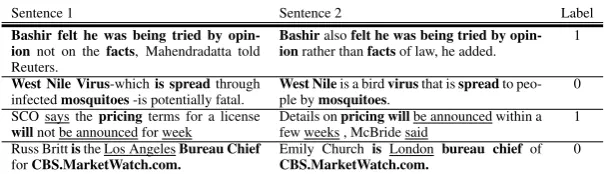
Table 4: Examples of sentence pairs in MSRP and their labels. Shared words are shown in bold and related words underlined.
< 0.4 < 0.5 < 0.6 < 0.7 < 0.8 < 0.9 <=1
[image:7.595.73.376.82.169.2]Word Overlap 0 100 200 300 400 500 Count y=1 y=0
Figure 2: Ratio of para-phrases with increasing word overlap in MSRP.
GRAN outperformed simple averaging in both the STS and SICK tasks, which confirms the results in (Wieting and Gimpel, 2017), but compared with idf and sif averaging, there is no apparent improvement; it only outperformed weighted averaging in the unsupervised STS benchmark.skip-th vectors performed poorly in the unsupervised similarity tasks, but outperformed the pre-trained vectors in the supervised similarity tasks, particularly in SICK.
The low variance of the performance in the paraphrase detection task also reflects the overall corre-lation between word overlap and the likelihood of being a paraphrase as seen in Figure 2; for difficult cases, as in the examples in Table 4, the overall similarity is not a good indication of being a paraphrase. Significant improvements in this task may require more nuanced features as in (Ji and Eisenstein, 2013).
5.2 Evaluation on Sentiment Analysis and Categorization
Sentiment Analysis Text Categorization
CR mpqa RT-s subj imdb rel spo com pol mult TREC Binary BOW 77.0/0.821 85.9/0.756 74.8 89.5 84.1 66.2/0.710 85.7 78.2 81.6 72.2 89.8
Unigram NBSVM 80.5 85.3 78.1 92.4 88.3 73.2 93.5 86.7 91.9 93.4 89.8
Paragraph Vector (doc2vec) 76.6/0.831 82.4/0.688 78.6 89.9 87.8 68.9/0.751 89.6 82.3 90.6 76.1 59.6
si-skip
avg 81.3/0.857 87.2/0.778 78.8 91.6 88.0 67.1/0.759 87.8 80.3 87.2 74.4 79.6 idf 80.2/0.849 86.2/0.765 78.5 91.0 87.0 69.1/0.755 88.3 81.9 89.7 75.0 70.4 sif 80.6/0.852 86.7/0.774 78.6 91.0 88.2 69.1/0.765 88.8 81.0 89.4 74.7 71.8
CBOW
avg 81.6/0.859 86.1/0.759 78.1 91.0 87.2 63.6/0.745 74.9 78.2 84.7 66.6 82.8
idf 81.2/0.856 86.0/0.761 77.7 90.5 87.3 65.8/0.745 78.6 79.8 85.6 68.2 77.4 sif 80.8/0.852 85.7/0.756 77.8 90.2 87.4 65.6/0.742 80.0 79.5 85. 68.3 76.2
GloVe
avg 80.7/0.851 85.4/0.745 77.6 91.0 87.3 67.1/0.748 82.1 78.8 86.5 69.3 79.8 idf 80.7/0.851 85.8/0.756 77.8 90.8 87.5 65.5/0.725 85.2 77.7 87.6 70.9 72.4 sif 80.6/0.850 85.4/0.751 77.6 90.7 87.4 66.8/0.736 85.8 78.5 87.5 70.9 72.0
Random
avg 70.7/0.779 74.2/0.413 61.9 77.3 74.0 55.8/0.634 71.4 72.8 69.4 47. 70.2 idf 68.6/0.763 74.1/0.423 61.1 72.7 74.2 58.9/0.654 74.4 72.7 72.9 47.2 57.0 sif 69.2/0.770 72.7/0.369 61.5 69.6 74.5 59.4/0.655 73.0 72.1 72.6 47.4 54.8 GRAN 78.4/0.838 86.6/0.769 75.1 88.5 83.1 66.0/0.753 90.6 80.8 88.5 73.2 60.4 pre-trained
PARAGRAM-SL999†
avg 79.8/0.845 87.8/0.794 75.9 89.6 84.5 65.3/0.721 89.8 78.9 87.5 72.5 83.2
idf 79.1/0.840 87.4/0.791 75.8 89.3 84.1 68.2/0.737 90.3 79.8 89.0 74.1 74.6 sif 78.4/0.838 86.6/0.769 75.1 88.5 83.1 66.0/0.753 90.6 80.8 88.5 73.2 60.4
skip-th 80.4/0.851 87.0/0.78 76.4 93.4 81.8 65.5/0.736 70.4 69.4 81.5 60.1 88.2
Pre-trained CBOW†
avg 79.9/0.847 88.2/0.800 77.5 90.5 85.6 64.8/0.751 86.6 79.5 85.9 70.7 80.0 idf 79.6/0.844 87.9/0.797 77.2 90.0 85.6 68.4/0.766 87.5 80.5 85.8 72.6 72.2 sif 79.2/0.842 87.7/0.794 77.0 89.7 85.8 67.7/0.761 87.8 81.3 86.9 72.9 74.2
inferSent 83.0/0.867 88.5/0.811 77.1 91.0 86.4 68.5/0.731 88.6 80.9 85.2 74.4 88.6
Pre-trained GloVe†
[image:7.595.74.527.405.722.2]avg 80.6/0.851 87.9/0.793 77.1 90.9 85.7 69.5/0.759 90.7 83.8 88.3 75.8 82.2 idf 79.8/0.844 87.4/0.788 77.2 90.1 85.5 69.7/0.757 89.8 83.0 88.8 76.9 75.4 sif 79.6/0.842 87.2/0.785 77.5 90.0 85.5 67.8/0.742 89.7 83.3 88.7 76.7 77.0
a: Random b: Binary c: avg† d: sif†
[image:8.595.117.455.66.229.2]e: doc2vec f: GRAN g: skip-th h: inferSent
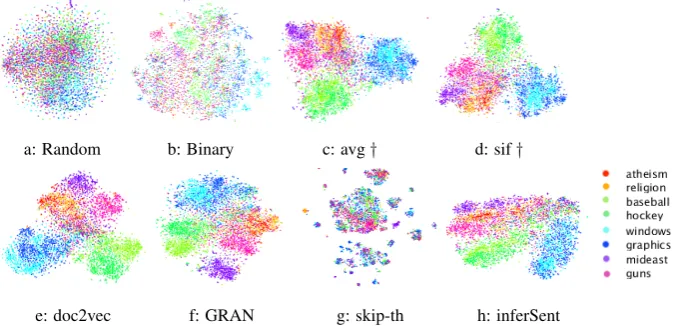
Figure 3: t-SNE visualizations of vectors on the 20-Newsgroup datasets.†avgandsifusingsi-skip.
Table 5 shows the performance in sentiment analysis and categorization tasks. Unlike in pair-wise similarity, random vectors underperformed the NBSVM and distributed models by a large margin. This underscores the importance of global and distributed features in these tasks. si-skipoutperformed other word embedding models, but we observe no advantage for weighted vs. unweighted averaging. In TREC question classification and the subjectivity benchmarks, avg performed significantly better than both idf and sif weighted averaging. skip-th vectors also significantly outperformed the pre-trained vectors in these two tasks, and underperformed in all others. We surmise that the syntactic features conveyed in frequent function words and the overall structure encoded by the LSTM network in skip-thmay provide useful clues for these two classification tasks. inferSent achieved the highest accuracy in CR sentiment task, and on par withskip-thand NBSVM in TREC, and it slightly underperformed the averaging models in Newsgroup categorization. In the next section, we analyze the Newsgroup and TREC datasets to shed light on intrinsic characteristics that may explain some of the performance variance.
6 Qualitative Analysis
Figure 3 shows t-SNE visualizations of the Newsgroup datasets using the various compositional models, including random and binary vectors. While random and binary vectors could identify shallow similari-ties between sentences as in STS tasks, they failed to do so in a globally cohesive manner. The random vectors also introduced noise in the representations, which resulted in a rather uniform vector space. All other models, exceptskip-th, clearly separated at least three regions that correspond to the categories
sport,computer, andreligion/politics. Smaller clusters with consistent labeling can also be identified with minimal separation between the clusters.
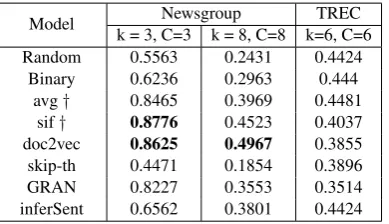
Table 6 shows examples of nearest neighbors using some of the models.skip-thvectors seem to be clustered more by structure than semantic content, unlike thedoc2vecandsifmodels. To quantify these differences, we applied k-means clustering usingk = 3andk = 8, and calculated the clustering purity for each model as follows:
P(C, L) = 1 N
X
k
max
|ck∩`j| (4)
sif†
And they work especially well when theFedshavecut off your utilities.
The Dividians did not have that option after theFBI cut off their
electric-ity.
Not when thepower has been cut offfor weeks on end.
Whatdoes thisbilldo?
AndBillJames is not? Do you own ” the Bill James players
rating book”?
Whohas to consider it ? The being that does the action? I am
still not sure I know what you are trying to say.
doc2vec
And they work especially well when theFedshavecut off your utilities.
The Dividians did not have that option after theFBI cut off their
electric-ity.
Can theFedsget him on tax evasion ? I do not remember hearing about him
running to the Post Office last night.
I did notclaimthat our system wasobjective.
Did Iclaimthat there was an absolute morality , or just an
ob-jectiveone?
I have just spent two solid monthsarguingthat no such thing
as anobjectivemoral system exists.
skip-th
Whatdoes this bill do ?
Wheredo I get hold of these widgets ?
Whatgives the United States the right to keep Washington D.C.?
Whatmakes you think Buck will still be in New York at year ’s end with
George back?
I have just spenttwo solid months arguing that no such thing as an objective moral system exists.
The amount of energy being spent on one lousy syllogism says volumes for the true position of reason in this group.
[image:9.595.73.511.62.192.2]I just heardthis week that he has started on compuserve flying models forum now.
Table 6: Examples of nearest neighbors in the 20-Newsgroup dataset.†sifusingsi-skip.
Model Newsgroup TREC
k = 3, C=3 k = 8, C=8 k=6, C=6
Random 0.5563 0.2431 0.4424
Binary 0.6236 0.2963 0.444
avg† 0.8465 0.3969 0.4481
sif† 0.8776 0.4523 0.4037
doc2vec 0.8625 0.4967 0.3855
skip-th 0.4471 0.1854 0.3896
GRAN 0.8227 0.3553 0.3514
[image:9.595.204.399.226.338.2]inferSent 0.6562 0.3801 0.4424
Table 7: Clustering purity measure with coarse categories (sports, computers, religion/politics) and the original 8 categories for the Newsgroup dataset, and 6 categories for TREC.†avgandsifusingsi-skip.
Figure 4 shows t-SNE visualizations of the questions in TREC training set. While all models identified some of the categories, like HUM and LOC, the skip-th and binary vectors appears to be more cohesively clustered by type than the other models. The question types are scattered in multiple smaller clusters, however, which explains why k-means clustering resulted in lower purity scores thandoc2vec and averaging with k = 6. In Figure 5, purity results with various k are plotted. While purity is expected to increase with larger k, the rate of increase is much higher forskip-ththan all other models, including binary features. This is consistent with the t-SNE visualization which shows several consistent clusters withskip-ththat are larger than the binary clusters. inferSent’s performance was on par withavg, which is slightly lower than binary andskip-th, although the performance in the supervised setting was equivalent.
Table 8 shows nearest neighbors to the question “What country do the Galapagos Islands belong to?” using the various models. The averaging model clustered questions about islands; we observed similar behavior using weighted averaging,doc2vecandGRAN. On the other hand,skip-thclustered ques-tions that start with “what country”, which happens to be more suitable for identifying theLOCquestion type. Using binary vectors, questions that include the words “What” and “country” were clustered to-gether, which do not necessarily correspond to the same question type.inferSentvectors seem to be clustered by a combination of semantic and syntactic features.
6.1 Discussion and Conclusions
a: Binary b: avg† c: sif† d: GRAN
[image:10.595.135.469.64.255.2]e: skip-th f: doc2vec g: inferSent
Figure 4: t-SNE visualizations of vectors on the TREC dataset.†avgandsifusingsi-skip.
avg†
What currents affect the area of the Shetland Islands and Orkney Islands in the North Sea?
What two Caribbean countries share the island of Hispan-iola?
Binary What is a First World country? What is the best college in the country?
skip-th
What country is the worlds leading supplier of cannabis? What country did the Nile River originate in?
What country boasts the most dams?
inferSent
What country did the ancient Romans refer to as Hibernia? How many islands does Fiji have?
[image:10.595.346.538.297.411.2]What country does Ileana Cotrubas come from ?
Table 8: Nearest neighbors to “What country do the Gala-pagos Islands belong to? ” in TREC.†avgusingsi-skip
10 20 30 40 50
k
0.35 0.4 0.45 0.5 0.55 0.6
Purity - 6 classes
doc2vec avg sif skip-th binary infer
Figure 5: Clustering purity with increas-ing k on TREC.[avgandsifforsi-skip]
inferSent. All models achieved higher correlation scores in the supervised STS evaluation, including skip-th, which performed poorly in the unsupervised setting. This suggests that at least some of the features in the vector space encode the semantic content and the remaining features are superfluous or encode structural information.
doc2vecandGRANrepresentations were qualitatively similar toidf andsifvectors where sen-tences/paragraphs were clustered by topic and semantic similarity.skip-thvectors, on the other hand, seemed to prominently represent structural rather than semantic features, which makes them more suit-able for supervised tasks that rely on sentence structure rather than unsupervised similarity or topic categorization. inferSentvectors performed consistently well in all evaluation benchmarks, and a qualitative analysis of the vector space suggests that the vectors encode a balance of semantic and syn-tactic features. This makesinferSentsuitable as a general-purpose model for sentence representation, particularly in supervised classification. For topic categorization, none of the compositional models out-performed the NBSVM baseline, which achieved significantly higher accuracies in all supervised topic categorization tasks. However, the distributional models, particularly weighted averaging, are more suit-able in unsupervised or low-resource settings since sentences tend to be clustered cohesively by topic similarity and semantic relatedness.
References
Samuel R Bowman, Gabor Angeli, Christopher Potts, and Christopher D Manning. 2015. A large annotated corpus for learning natural language inference. Proceedings of the 2015 Conference on Empirical Methods in
Natural Language Processing.
Daniel Cer, Mona Diab, Eneko Agirre, Inigo Lopez-Gazpio, and Lucia Specia. 2017. Semeval-2017 task 1: Semantic textual similarity-multilingual and cross-lingual focused evaluation. Proceedings of the 10th
Interna-tional Workshop on Semantic Evaluation (SemEval 2017).
Junyoung Chung, Caglar Gulcehre, KyungHyun Cho, and Yoshua Bengio. 2014. Empirical evaluation of gated recurrent neural networks on sequence modeling. arXiv preprint arXiv:1412.3555.
Alexis Conneau, Douwe Kiela, Holger Schwenk, Lo¨ıc Barrault, and Antoine Bordes. 2017. Supervised learning of universal sentence representations from natural language inference data. InProceedings of the 2017 Conference
on Empirical Methods in Natural Language Processing.
Bill Dolan, Chris Quirk, and Chris Brockett. 2004. Unsupervised construction of large paraphrase corpora: Ex-ploiting massively parallel news sources. InProceedings of the 20th international conference on Computational Linguistics.
Yvette Graham and Timothy Baldwin. 2014. Testing for significance of increased correlation with human judg-ment. InProceedings of the 2014 Conference on Empirical Methods in Natural Language Processing (EMNLP), pages 172–176.
Ruining He and Julian McAuley. 2016. Ups and downs: Modeling the visual evolution of fashion trends with one-class collaborative filtering. Inproceedings of the 25th international conference on World Wide Web.
Felix Hill, Kyunghyun Cho, and Anna Korhonen. 2016. Learning distributed representations of sentences from unlabelled data. pages 1367–1377.
Minqing Hu and Bing Liu. 2004. Mining and summarizing customer reviews. InProceedings of the tenth ACM
SIGKDD international conference on Knowledge discovery and data mining.
Yangfeng Ji and Jacob Eisenstein. 2013. Discriminative improvements to distributional sentence similarity. In
Proceedings of the 2013 Conference on Empirical Methods in Natural Language Processing, pages 891–896.
Yoon Kim. 2014. Convolutional neural networks for sentence classification. Proceedings of the 2014 Conference
on Empirical Methods in Natural Language Processing (EMNLP).
Ryan Kiros, Yukun Zhu, Ruslan R Salakhutdinov, Richard Zemel, Raquel Urtasun, Antonio Torralba, and Sanja Fidler. 2015. Skip-thought vectors. InAdvances in neural information processing systems, pages 3294–3302.
Jey Han Lau and Timothy Baldwin. 2016. An empirical evaluation of doc2vec with practical insights into docu-ment embedding generation.arXiv preprint arXiv:1607.05368.
Quoc Le and Tomas Mikolov. 2014. Distributed representations of sentences and documents. InInternational
Conference on Machine Learning, pages 1188–1196.
Andrew L Maas, Raymond E Daly, Peter T Pham, Dan Huang, Andrew Y Ng, and Christopher Potts. 2011. Learning word vectors for sentiment analysis. InProceedings of the 49th annual meeting of the association for computational linguistics: Human language technologies.
Marco Marelli, Stefano Menini, Marco Baroni, Luisa Bentivogli, Raffaella Bernardi, Roberto Zamparelli, et al. 2014. A sick cure for the evaluation of compositional distributional semantic models. In LREC, pages 216– 223.
Tomas Mikolov, Kai Chen, Greg Corrado, and Jeffrey Dean. 2013a. Efficient estimation of word representations in vector space. ICLR.
Tomas Mikolov, Ilya Sutskever, Kai Chen, Greg S Corrado, and Jeff Dean. 2013b. Distributed representations of words and phrases and their compositionality. InAdvances in neural information processing systems, pages 3111–3119.
Dmitrijs Milajevs, Dimitri Kartsaklis, Mehrnoosh Sadrzadeh, and Matthew Purver. 2014. Evaluating neural word representations in tensor-based compositional settings. Proceedings of the Conference on Empirical Methods
Bo Pang and Lillian Lee. 2004. A sentimental education: Sentiment analysis using subjectivity summarization based on minimum cuts. InProceedings of the 42nd annual meeting on Association for Computational Linguis-tics, page 271.
Bo Pang and Lillian Lee. 2005. Seeing stars: Exploiting class relationships for sentiment categorization with respect to rating scales. InProceedings of the 43rd annual meeting on association for computational linguistics, pages 115–124.
Jeffrey Pennington, Richard Socher, and Christopher Manning. 2014. Glove: Global vectors for word represen-tation. InProceedings of the 2014 conference on empirical methods in natural language processing (EMNLP), pages 1532–1543.
Benjamin Riedel, Isabelle Augenstein, Georgios P Spithourakis, and Sebastian Riedel. 2017. A simple but tough-to-beat baseline for the fake news challenge stance detection task.arXiv preprint arXiv:1707.03264.
Tobias Schnabel, Igor Labutov, David Mimno, and Thorsten Joachims. 2015. Evaluation methods for unsuper-vised word embeddings. InProceedings of the 2015 Conference on Empirical Methods in Natural Language Processing, pages 298–307.
Richard Socher, Alex Perelygin, Jean Wu, Jason Chuang, Christopher D Manning, Andrew Ng, and Christopher Potts. 2013. Recursive deep models for semantic compositionality over a sentiment treebank. InProceedings of the 2013 conference on empirical methods in natural language processing.
Ilya Sutskever, Oriol Vinyals, and Quoc V Le. 2014. Sequence to sequence learning with neural networks. In
Advances in neural information processing systems, pages 3104–3112.
Sida Wang and Christopher D Manning. 2012. Baselines and bigrams: Simple, good sentiment and topic classifi-cation. InProceedings of the 50th Annual Meeting of the Association for Computational Linguistics.
Janyce Wiebe, Theresa Wilson, and Claire Cardie. 2005. Annotating expressions of opinions and emotions in language.Language resources and evaluation, 39(2-3):165–210.
John Wieting and Kevin Gimpel. 2017. Revisiting recurrent networks for paraphrastic sentence embeddings.
John Wieting, Mohit Bansal, Kevin Gimpel, and Karen Livescu. 2015a. Towards universal paraphrastic sentence embeddings. ICLR.