Keyword-based Document Clustering
Seung-Shik Kang
School of Computer Science, Kookmin University & AITrc
Chungnung-dong, Songbuk-gu, Seoul 136-702, Korea
[email protected]
Abstract
1
Document clustering is an aggregation of related documents to a cluster based on the similarity evaluation task between documents and the representatives of clusters. Terms and their discriminating features of terms are the clue to the clustering and the discriminating features are based on the term and document frequencies. Feature selection method on the basis of frequency statistics has a limitation to the enhancement of the clustering algorithm because it does not consider the contents of the cluster objects. In this paper, we adopt a content-based analytic approach to refine the similarity computation and propose a keyword-based clustering algorithm. Experimental results show that content-based keyword weighting outperforms frequency-based weighting method.
Keywords: Document Clustering, Weighting
Scheme, Feature Selection
1 Introduction
Document clustering is an aggregation of documents by discriminating the relevant documents from the irrelevant documents. The relevance determination criteria of any two documents is a similarity measure and the representatives of the documents [1,2,3,4]. There are some similarity measures such as Dice coefficient, Jaccard’s coefficient, and cosine measure. These similarity measures require that the documents are represented in document vectors and the similarity of two documents is calculated from the operation of document vectors.
In general, the representatives of a document or a cluster are document vectors that consist of <term, weight> pairs and the document similarities are determined by the terms and their weighting values that are extracted from the document [7,9]. In the previous studies on the document clustering, we focused on the clustering algorithm, but the document
This work was supported by the Korea Science and Engineering Foundation(KOSEF) through the Advanced Information Technology Research Center(AITrc).
representation methodology was not the important issue. Document vectors are simply constructed from the term frequency (TF) and the inverted document frequency (IDF). This representation of term weighting method starts from the precondition that terms or keywords representing the document are calculated by TF-IDF. Term weighting method by TF-IDF is generally used to construct a document vector, but we cannot say that it is the best way of representing a document. So, we suppose that there is a limitation to improve the accuracy of the clustering system only by improving the clustering algorithm without changing the document/cluster representation method.
Also, document clustering requires a large amount of memory spaces to keep the representatives of documents/clusters and the similarity measures [6, 8, 10]. Given N documents to be clustered, N × N similarity matrix is needed to store document similarity measures. Also, the recursive iteration of similarity calculation and reconstructing the representative of the clusters need a huge number of computations.
In this paper, we propose a new clustering method that is based on the keyword weighting approach. The clustering algorithm starts from the seed documents and the cluster is expanded by the keyword relationship. The evolution of the cluster stops when no more documents are added to the cluster and irrelevant documents are removed from the cluster candidates.
2
Keyword-based Weighting Scheme
In general, the construction of a document vector depends on the term frequency and document frequency. If keywords are determined by frequency information of the document, we are apt to generate an error that nouns are often used regardless of substance of the document and the words of a high frequency are extracted. The clustering method, which is focused on similarity calculation considers the whole words except stopwords as the representative of the document, and constitutes a document vector that is calculated by the weight value from the term frequency and document frequency.
their weight values, the weight value of a term means a ranking score just as an importance factor to the document. So, the term weighting can be seen as an evaluation of the term as a keyword or a stopword to the document. The weighting function w(t) from a term to its weight is described in expression (1).
w: term Æ weight (1)
w(t) = 0, if t is a stopword 1, if t is a keyword a, otherwise 0 ≤a≤ 1
For the weighting scheme of terms, there are two points of views as the representation of a document:
(1) a discriminative value that distinguishes or characterizes the document from others; (2) an importance measure as a keyword or a
stopword.
Frequency-based term weighting (FBW) is a statistical measure of terms in an inter-document relationship. This weighting scheme is a very efficient method for distinguishing and characterizing a document from others, and it performs well for the applications of document classification or clustering in the information retrieval system. The only evaluation measure to characterize a document in frequency-based weighting scheme is a frequency statistics, but term frequencies are not the best measures to characterize the document by terms.
Another weighting scheme is a keyword-based term weighting (KBW) method that is based on the keyword importance factors in a document. It is an analytic approach that analyses the contents of a document to get a keyword list from the document. The weight value of a word is calculated by the importance factors as a keyword in a document. The weight value of a word is a combination value of keyword-weighting factors and the terms are ordered by the keyword ranking score. The ranking scores in this weighting scheme are calculated from the analysis results of the document. Keyword-based term weighting will be a good solution to overcome the limitation of the frequency-based weighting scheme.
Keywords in a text are the terms that represent a document and the candidate keywords are extracted from the analysis results of the document. Keyword ranking method depends on several factors of a term such as the type of a document, the location and the role of words in a sentence or a paragraph [5].
Thematic words of a document are representative terms for the document. Thematic words are extracted from a text by analysing the contents of the text, but keyword extraction depends on the type of text. Keywords are easily found in the title or an abstract in a research paper that consists of a title, abstract, body, experiment, and conclusion. Also, newspaper article contains a keyword in the title or the first part of the
text. There are some clues of determining a keyword and we may classify them as word level, sentence level, paragraph level, and text level features. Word-level features are the type of part-of-speech and case-role information. The part-of-speech of Korean noun is divided into common noun, compound noun, proper noun, and numeral.
Syntactic or sentence-level features are the type of a phrase or a clause, sentence location, and sentence type. From the rhetoric word in a sentence, the importance of the sentence is computed and the terms in a sentence are affected by the type of a sentence. Also, the weighting scheme of a term in the subjective clause is not the equal to the same term that appeared in an auxiliary clause or in a modifying clause. Basic term weight is assigned by the type of a term and recomputed by the features that it accompanies in the text. That is, the weight value of a term is also determined by the characteristics of word, sentence, phrase, and clause where the term is extracted.
3
Keyword-based Document Clustering
Keyword-based document clustering creates a cluster by the keywords of each document. Suppose that C is a set of clusters that is finally created by the clustering algorithm. If n is the number of clusters in C, then C is a set of clusters
C
1,C
2, ,C
n.C = {
C
1,C
2, ,C
n}Each cluster is initialised by document d that is not assigned to the existing clusters, and d is a seed document of . When a new cluster is created, expansion and reduction steps are repeated until it reaches a stable state from the start state. In each evolution steps for cluster , is the j-th state of
The characteristic vector of a cluster is a set of <keyword, weight value> pairs that represents the cluster. If is a keyword set of a document and
i is a keyword set of cluster , then i
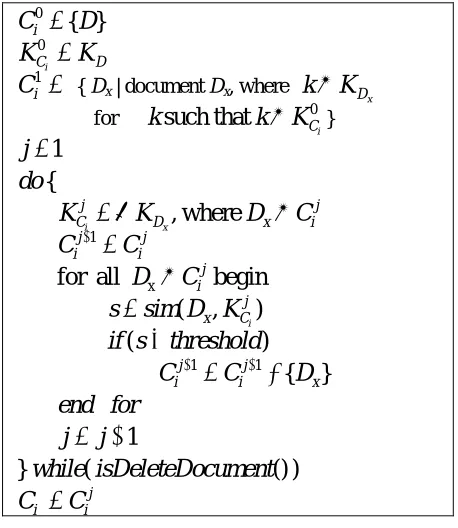
is the j-th state of cluster . Figure 1 shows a keyword-based clustering algorithm for the cluster . Given the keyword sets for each document, cluster is created by the self-expanding algorithm.
D
3.1 Cluster Initialisation
The first step of the clustering algorithm is a creation and initialisation of a new cluster. A document is selected that does not belong to any other cluster, and it is assigned to a new cluster that is an initial state
D
0 i
of cluster
C
i.At this time, a document that is the first document in the new cluster is called a seed document (or an initialisation document). The seed document is randomly selected among the documents that do not belong to the clusters ~ . Keyword set
kn that are extracted from document . The initial
state of keyword set is initialised by .
}
while
isDeleteDo
cument
j i
i
C
C
=
Figure 1. Keyword-based clustering algorithm
3.2 Expanding the Cluster
In the initialisation step of the cluster, a new cluster , an initial state of cluster
C
, is established as the seed document, and the keyword setiis initialised by the key word set of the seed
document. In the expanding step of the cluster, the cluster is expanded by adding more related documents to the cluster, that include the keywords of the seed document as the related documents of the seed document. That is, adding the total documents that
appear each keyword of
i(the keyword extracted
from the seed document) to the cluster
C
that is the next state of clusterC
expands the cluster.i
The cluster expansion is performed by the iteration of keyword expansion and cluster expansion. More documents are added to a cluster by the similarity evaluation between the keyword set and the document. If a new document is added to a cluster, then the keywords in the added document are also added to the keyword set of the cluster. The first expansion is performed by the keyword set extracted from the seed document. The second expansion is performed by new keywords that are added to a cluster as a result of the first expansion. And the i-th expansion is performed by the (i-1)-th state of the keyword set.
The number of iterations is decided through the experiment. When a cluster is expanded from to
, the keyword set
i is also expanded to a new
keyword set
i that appears in the total documents
of the cluster . The keyword set
i of is a
The keyword set
i of the cluster is used to
calculate the characteristic vector of each cluster. The characteristic vector is constituted the weight value calculated by term frequency (TF) and inverted document frequency (IDF) of the keywords and this is used to calculate the similarity measure between a document and the cluster.
3.3 Cluster Reduction and Completion
This step is to produce a complete cluster by removing the documents that are not related to the cluster. For the cluster
C
, documents of a low similarity to the cluster are removed, that are not related to a clusterC
through the similarity computation with the cluster . The result of cluster reduction is a filtering of documents that are not related to the cluster, and the cluster is generated as a next step of the clusterC
. Ultimately, the cluster is completed that consists of the related documents after filtering the non-related documents. If a clusterFigure 2. Overall architecture of keyword-based clustering
4
Design and Implementation
The structure of a keyword-based clustering system is shown in Figure 2. At first, keywords are extracted from each input document and the weight values of them are computed. Keywords and their scores are stored in an inverted-file structure. Inverted-file structure is a good for the expansion of the cluster and adding the documents that includes a keyword to the initial cluster. Figure 3 shows an example of the operation of the document clustering system: initialization, expansion, reduction, and completion of clusters.
A new cluster is created and it includes a seed document D. An initial set of keywords for the initial state of a cluster is a keyword set KD of document D.
KD = { T1,D, T2,D, …, Ti,D …, Tn,D}
For the terms in KD, documents that contain the same
term are added as a candidate document in the cluster. Let the candidate documents be D1a, D1b, … , D2a, D2b,
…, Dna, Dnb, …. then Dxy, is a document that is
expanded by term Tx. Keyword set of the cluster is
reconstructed by new set of documents.
In each step of the cluster expansion, the number of keywords that are used for the expansion, and the threshold of the weight value are decided through experiments considering the maximum number of document candidates in a cluster. Also, <keyword, weight> pairs as an intermediate representative of the cluster are much important factor of the cluster expansion.
a a
a D nD
D T T
T1, , 2, L, ,
b b
b D nD
D T T
T1, ,2, ,L, ,
z z
z D nD
D T T
T1, ,2, ,L, ,
Input Document
Keyword Extraction
create inverted-file create cluster
Create Inverted-File
Init. Cluster Keyword set
T1,D,
T2,D,
Tn,D,
D Create a Cluster
Expand Cluster
expand cluster
Reduce/Complete Cluster
D1a, D1b,
D2a, D2b,
, , Dna, Dnb,
,
Clusters
complete cluster
result D1A, D1B,
D2A, D2B,
, , DnA, DnB,
Figure 3. Example of keyword-based clustering
Now, a new keyword set that is limited to the cluster candidates is constructed to get cluster documents. Through the similarity calculation between the document and the candidate centroid of the cluster, relevant documents are selected to be a member of the cluster. Through the iterations on keyword selection and the reconstruction of the related documents, a new cluster is completed that reaches in a stable status with a strong relationship between keyword set and document set.
5 The
Experiments
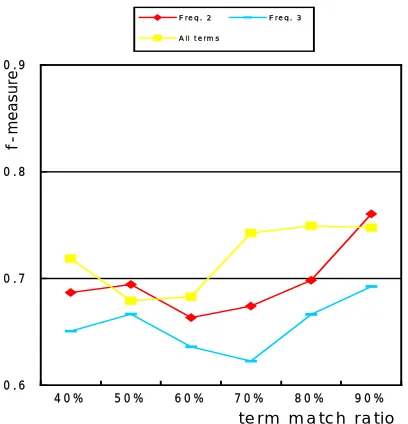
- all terms are used to the clustering - terms with more than frequency 2 - terms with more than frequency 3
In each experiment, we varied the similarity decision ratio by the percentage of term matches. Figure 4 shows that term selection by frequency 2 or 3 is not good for the representation of a document.
t e r m m a t c h r a t io
Figure 4. Frequency-based keyword selection
term match ratio
Figure 5. Percentage-based keyword selection
In the experiment of percentage-based keyword selection, terms of high weight values are selected for the similarity calculation of the document. All the curves in Figure 5 are a similar shape, except for 10 % selection. In case of 10% selection, we guess that less than 10% of keywords are not sufficient for the
similarity decision and auxiliary keywords are also needed for the accuracy. Another point in this experiment is that 30%~60% keyword selection resulted better than the selection of all terms.
We compared the F1-measure for the selection of
maximum keywords. All the experiments in Figure 6 resulted better than the experiment of using all the terms in the document. Also, 30~70 keywords with 60%~70% match ratio resulted a good performance for the comparison of document similarity.
term match ratio
Figure 6. Keyword selection by maximum
6 Conclusion
It is common that clustering algorithm is based on the similarity computation by frequency-based statistics to aggregate the related documents. This metric is an important factor for term weighting. We proposed a term weighting method that is based on the keyword features and we tried to complement the drawback of frequency-based metric. Based on the keyword weighting scheme, documents of the same keywords are grouped into a cluster candidate and a new cluster is created by removing irrelevant documents. We performed an experiment for the clustering of similar documents and the results showed that keyword-based weighting scheme is better than the frequency-based method.
References
[1] Anderberg, M. R., “Cluster Analysis for Applications”, New York: Academic, 1973.
[2] Can, F., and E. A. Ozkarahan, “Dynamic Cluster Maintenance”, Information Processing & Management, Vol. 25, pp.275-291, 1989.
[3] Dubes, R., and A. K. Jain, “Clustering Methodologies in Exploratory Data Analysis”, Advances in Computers, Vol. 19, pp.113-227, 1980.
[4] Frakes, W. B. and R. Baeza-Yates, Information Retrieval, Prentice Hall, 1992.
[5] Kang, S. S., H. G. Lee, S. H. Son, G. C. Hong, and B. J. Moon, “Term Weighting Method by Postposition and Compound Noun Recognition”, Proceedings of 13th Conference on Korean Language Computing, pp.196-198, 2001.
[6] Murtagh, F., “Complexities of Hierarchic Clustering Algorithms: State of the Art”, Computational Statistics Quarterly, Vol. 1, pp.101-113, 1984.
[7] Perry, S. A., and P. Willett, “A Review of the Use of Inverted Files for Best Match Searching in Information Retrieval Systems”, Journal of Information Science, Vol. 6, pp.59-66, 1983.
[8] Sibson, R. “SLINK: an Optimally Efficient Algorithm for the Single-Link Cluster Method”, Computer Journal, Vol. 16, pp.328-342, 1973.
[9] Willett, P., “Document Clustering Using an Inverted File Approach”, Journal of Information Science, Vol. 2, pp.223-231, 1980.