A Method for Forming Mutual Beliefs for Communication through
Human-robot Multi-modal Interaction
Naoto Iwahashi Sony Computer Science Labs.
Tokyo, Japan
Abstract
This paper describes a method of multi-modal language processing that reflects experiences shared by people and robots. Through incremental online optimization in the process of interaction, the user and the robot form mutual beliefs represented by a stochastic model. Based on these mu-tual beliefs, the robot can interpret even fragmental and ambiguous utterances, and can act and generate utterances appropri-ate for a given situation.
1 Introduction
The process of human communication is based on certain beliefs shared by those who are communi-cating. Language is one such mutual belief, and it is used to convey meaning based on its relevance to other mutual beliefs (Sperber and Wilson, 1995). These mutual beliefs are formed through interac-tion with the environment and other people, and the meaning of utterances is embedded in such shared experiences.
If those communicating want to logically con-vince each other that propositionpis a mutual belief, they must prove that the infinitely nested proposition “They have information that they have information that. . .that they have information thatp” also holds. However, in reality, all we can do is assume, based on a few clues, that our beliefs are identical to those of other people we are talking to. That is, it can never be guaranteed that our beliefs are identical to those of other people.
The processes of utterance generation and un-derstanding rely on a system of mutual beliefs as-sumed by each person, and this system changes au-tonomously and recursively through these processes. The listener interprets utterances based on their rel-evance to their system of assumed mutual beliefs. The listener also receives information for updating their system of assumed mutual beliefs through this process. In addition, the speaker can receive simi-lar information through the response of the listener. Through utterances, people simultaneously send and receive information about one another’s system of assumed mutual beliefs. In this sense, we can say that a mutual belief system assumed by one per-son couples with mutual belief systems assumed by other people they are communicating with.
To enable humans and robots to communicate with one another in a physical environment the way people do, spoken-language processing meth-ods must emphasize mutual understanding, and they must have a mechanism that would enable the mu-tual belief systems couple with one another. More-over, language, perception, and behavior have to be processed integratively in order for humans and robots to physically share their environment as the basis for the formation of common experiences and in order for linguistic and nonlinguistic beliefs to combine in the process of human-robot interaction. Previous language processing methods, which are characterized by fixed language knowledge, do not satisfy these requirements because they cannot dy-namically reflect experiences in the communication process in a real environment.
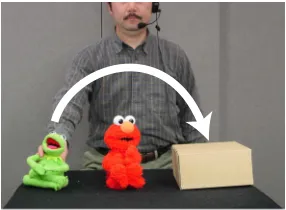
ex-Figure 1: Interaction between a user and a robot
periences between people and robots (for further de-tail, see (Iwahashi, 2001; Iwahashi, 2003)). This pa-per describes a method that enables robots to learn a system of mutual beliefs including nonlinguistic ones through multi-modal language interaction with people. The learning is based on incremental on-line optimization, and it uses information from raw speech and visual observations as well as behavioral reinforcement, which is integrated in a probabilistic framework.
Theoretical research (Clark, 1996) and its com-putational modelling (Traum, 1994) focused on the formation of mutual beliefs that is a direct target of communication, and aimed at representing the for-mation of mutual beliefs as a procedure- and rule-driven process. In contrast, this study focuses on a system of mutual beliefs that is used in the process of utterance generation and understanding in a physical environment, and aims at representing the formation of this system by a mathematical model of coupling systems.
2 Task for Forming Mutual Beliefs
The task for forming mutual beliefs was set up as follows. A robot was sat at a table so that the robot and the user sitting at the table could see and move the objects on the table (Fig. 1) The user and the robot initially shared certain basic linguistic beliefs, including a lexicon with a small number of items and a simple grammar, and the robot could understand some utterances1. The user asked the robot to move an object by making an utterance and a gesture, and the robot acted in response. If the robot responded incorrectly, the user slapped the robot’s hand. The
1
No function words were included in the lexicon.
Figure 2: A scene during which utterances were made and understood
robot also asked the user to move an object, and the user acted in response. Mutual beliefs were formed incrementally, online, through such interaction.
Figure 2 shows an example of utterance genera-tion and understanding using mutual beliefs. In the scene shown in Fig. 2, the object on the left, Kermit, has just been put on the table.
If the user in the figure wants to ask the robot to move Kermit onto the box, he may say “Kermit box move-onto”. In this situation, if the user assumes that the robot shares the belief that the object moved in the previous action is likely to be the next target for movement and the belief that the box is likely to be something for the object to be moved onto, he might just say “move-onto”. To understand this fragmental utterance, the robot has to have similar beliefs. Inversely, when the robot wants to ask the user to do something, mutual beliefs are used in the same way.
3 Algorithm for Learning a System of Mutual Beliefs
3.1 Setting
3.2 Representation of a system of mutual beliefs
In the algorithm I developed, the system of mutual beliefs consists of two parts: 1) a decision func-tion, composed of a set of beliefs with values rep-resenting the degree of confidence that each belief is shared by the robot and the user, and 2) a global confidence function, which represents the degree of confidence for the decision function. The beliefs I used are those concerning lexicon, grammar, behav-ioral context, and motion-object relationship. The degree of confidence for each belief is represented by a scalar value. The beliefs are represented by stochastic models as follows:
LexiconL
The lexicon is represented by a set of pairs, each with probability density function (pdf) p(s|ci) of featuresof a spoken word and a pdf for representing the image concept of lexical itemci,i= 1, . . . , N. Two types of image concepts are used. One is a con-cept for the static observation of an object. Con-ditional pdf p(o|c) of feature o of an object given lexical itemcis represented by a Gaussian pdf. The other is a concept for the movement of an object. The concept is viewed as the process of change in the relationship between the trajector and the land-mark. Here, given lexical item c, position ot,p of trajector objectt, and position ol,p of landmark ob-jectl, conditional pdfp(u|ot,p, ol,p, c)of trajectoryu is represented by a hidden Markov Model (HMM). Pdfp(s|c) of the features of a spoken word is also represented by an HMM.
GrammarG
I assume that an utterance can be understood based on its conceptual structure z, which has three at-tributes: landmark, trajector, and motion, each of which contains certain elements of the utterance. Grammar G is represented by a set of occurrence probabilities for the orders of these attributes in an utterance and a statistical bigram model of the lexi-cal items for each of the three attributes.
Effect of behavioral contextB1(i, q;H)
Effect of behavioral context represents the belief that the current utterance refers to objecti, given behav-ioral context q. q includes information on whether
objectiwas a trajector or a landmark in the previ-ous action and whether the user’s current gesture is referring to objecti. This belief is represented by a parameter setH = {hc, hg, hp}, and it takeshc as its value if objectiwas involved in the previous ac-tion,hg if the object is being held, hp if it is being pointed to, and0in all other cases.
Motion-object relationshipB2(ot,f, ol,f, WM;R) Motion-object relationship represents the belief that in the motion corresponing to lexical itemWM, fea-ture ot,f of object tand feature ol,f of objectl are typical for a trajector and a landmark, respectively. This belief is represented by a conditional multivari-ate Gaussian pdf, p(ot,f, ol,f|WM;R), whereR is its parameter set.
3.3 Decision function
The beliefs described above are organized and as-signed confidence values to obtain the decision func-tion used in the process of utterance generafunc-tion and understanding. This decision function is written as
Ψ(s, a, O, q, L, G, R, H,Γ) = max
l,z
γ1logp(s|z; L, G) [Speech]
+γ2logp(u|ot,p, ol,p, WM; L) [Motion]
+γ2logp(ot,f|WT; L) + logp(ol,f|WL; L)
[Object]
+γ3logp(ot,f, ol,f,|WM; R)
[Motion-Object Relationship]
+γ4B1(t, q; H) +B1(l, q; H)
[Behavioral Context]
to be the meaning of utterance s is determined by maximizing the decision function as
˜
a = arg max
a Ψ(s, a, O, q, L, G, R, H,Γ).
3.4 Global confidence function
Global confidence functionf outputs an estimate of the probability that the robot’s utterance s will be correctly understood by the user, and it is written as
f(x) = 1
whereλ1andλ2are the parameters of this function. A margin in the value of the output of the decision function in the process of generating an utterance is used for inputxof this function. Margindobtained in the process of generating utterance sthat means action a in scene O under behavioral context q is defined as
We can easily see that a large margin increases the probability of the robot being understood correctly by the user. If there is a high probability of the robot’s utterances being understood correctly even when the margin is small, we can say that the robot’s beliefs are consistent with those of the user. When the robot asks for actionain sceneOunder behav-ioral context q, the robot generates utterance ˜s so as to make the value of the output off as close as possible to value of parameter ξ, which represents the taget probability of the robot’s utterance being understood correctly. This utterance can be repre-sented as
The robot can increase the chance of being under-stood correctly by using more words. On the other hand, if the robot can predict correct understanding with a sufficiently high probability, the robot can manage with a fragmental utterance using a small number of words.
3.5 Learning
The decision function and the global confidence function are learned separately in the utterance un-derstanding and utterance generation processes, re-spectively.
The decision function is learned incrementally, online, through a sequence of episodes each of which consists of the following steps. 1) Through an utterance and a gesture, the user asks the robot to move an object. 2) The robot acts on its understand-ing of the utterance. 3) If the robot acts correctly, the process is terminated. Otherwise, the user slaps the robot’s hand. 4) The robot acts in a different way. 5) If the robot acts incorrectly, the user slaps the robot’s hand.
When the robot acts correctly in the first or sec-ond trial in an episode, the robot associates utterance s, action a, scene O, and behavioral contextq with each other, and makes these associations a learning sample. Then the robot adapts the values of parame-ter setRfor the belief about the motion-object rela-tionship, parameter setHfor the belief about the ef-fect of the behavioral context, and a set of weighting parameters,Γ. R is learned by using the Bayesian learning method. HandΓare learned based on the minimum error criterion (Juang and Katagiri, 1992). LexiconLand grammarGare given beforehand and are fixed. When theith sample(si, ai, Oi, qi)is ob-tained based on this process of association,Hi and
Γi are adapted to minimize the probability of mis-understanding based on the minimum error criterion as K andwi−j represent the number of latest samples used in the learning process and the weights for each sample, respectively.
In each episode, the robot generates an utterance that makes the value of the output of global confi-dence functionfas close toξas possible. After each episode, the value of margindin the utterance gen-eration process is associated with information about whether the utterance was understood correctly or not, and this sample of associations is used for learn-ing. The learning is done so as to approximate the probability that an utterance will be understood cor-rectly by minimizing the weighted sum of squared errors in the latest episodes. After theith episode, parametersλ1andλ2are adapted as
[λ1,i, λ2,i]←(1−δ)[λ1,i−1, λ2,i−1] +δ[˜λ1,i,˜λ2,i], where
(˜λ1,i,˜λ2,i)
= arg min
λ1,λ2
i
j=i−K
wi−j(f(dj; λ1, λ2)−ej)2,
where ei is 1 if the user’s understanding is correct and0 if it is not, andδ is the value that determines the learning speed.
4 Experiments
4.1 Conditions
The lexicon used in the experiments included eleven items for the static image and six items to describe the motions. Eleven stuffed toys and four boxes were used as objects in the interaction between a user and a robot. In the learning process, the inter-action was simulated by using software.
4.2 Learning of decision function
Sequence X of quadruplets(si, ai, Oi, qi)consisting of the user’s utterancesi, sceneOi, behavioral con-textqi, and actionaithat the user wanted to ask the robot to perform (i = 1, . . ., nd), was used for the interaction. At the beginning of the sequence, the sentences were relatively complete (e.g., “green ker-mit red box move-onto”). Then the length of the sen-tences was gradually reduced (e.g., “move-onto”).
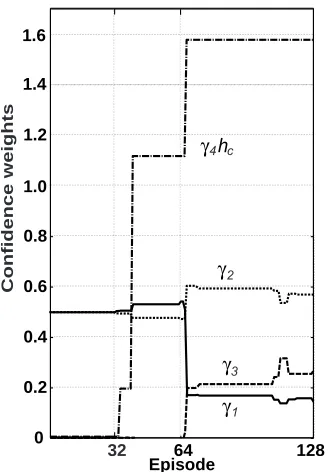
R could be estimated with high accuracy during the episodes in which relatively complete utterances were understood correctly. HandΓcould be effec-tively estimated based on the estimation ofRwhen fragmental utterances were given. Figure 3 shows
32 64 128
0 0.2 0.4 0.6 0.8
Episode γ1 γ2
γ3
Confidence weights
1.0 1.2 1.4 1.6
γ 4 c h
Figure 3: Changes in the confidence values
32 64 128
0 20 40 60 80
Episode
Err
or rate[%]
w/o learning
with learning
Figure 4: The change in decision error rate
changes in the values ofγ1, γ2, γ3, andγ4hc. We can see that each value was adapted according to the ambiguity of a given sentence. Figure 4 shows the decision error (misunderstanding) rates obtained during the course of the interaction, along with the error rates obtained in the same data,X, by keeping the values of the parameters of the decision function fixed to their initial values.
(a)
" Move-onto "
previous
correct
incorrect
Speech Motion BehavioralContext Motion-Object Relationship
1st (Correct)
2nd (Incorrect)
(b)
" Grover Small Kermit Jump-over "
correct
previous
incorrect
Speech Motion Behavioral
context Motion-objectrelationship Object
1st (Correct)
3rd (Incorrect)
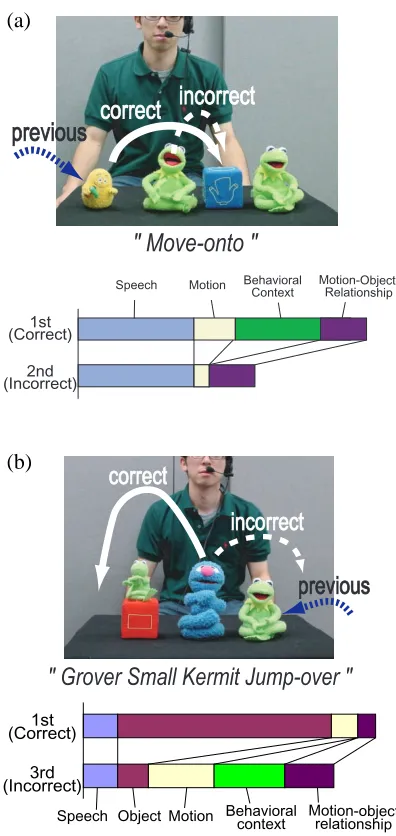
Figure 5: Examples of fragmental utterances under-stood correctly by the robot
about the behavioral context were more effective in Fig. 5 (a), while in Fig. 5 (b), beliefs about the object concepts were more effective than other nonlinguis-tic beliefs in leading to the correct understanding. This learning process is described in greater detail in (Miyata et al., 2001)
4.3 Learning of the global confidence function
In the experiments with the learning of the global confidence function, The robot’s utterances were ex-pressed through text on a display instead of oral speech, and they included one word describing the motion and either no words or one to several words
describing the trajector and landmark objects or just the trajector object.
A sequence of triplets (a, O, q) consisting of sceneO, behavioral contextq, and actionathat the robot needed to ask the user to perform, was used for the interaction. In each episode, the robot generated an utterance to bring the global confidence function as close to0.75as possible.
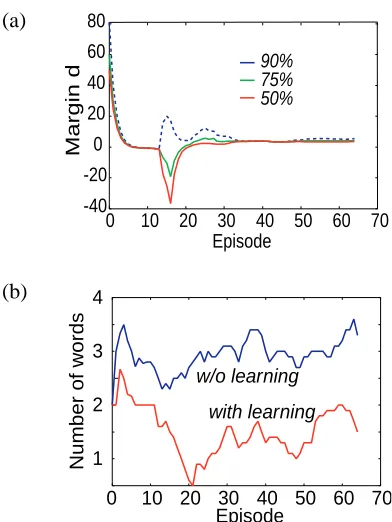
The changes in f(d) are shown in Fig. 5 (a), where three lines are drawn for d0.5 = f−1(0.5), d0.75 = f−1(0.75), and d0.9 = f−1(0.9)in order
to make the shape off(d)easily recognizable. The changes in the number of words used to describe the objects in each utterance are shown in Fig. 5 (b), along with the changes obtained in the case when f(d) was not learned, which are shown for com-parison. The initial values were set atd0.9 = 161,
d0.75 = 120, and d0.5 = 100, which means that a large margin was necessary for an utterance to be understood correctly. Note that when all the values are close to0, the slope in the middle off is steep, and the robot makes a decision that a small margin is enough for its utterances to be understood cor-rectly. After the learning began, these values rapidly approached0, and the number of words decreased. The slope became temporarily smooth at around the 15th episode. Then, the number of words became too small, which sometimes lead to misunderstand-ing. Finally, the slope became steep again at around the35th episode.
5 Discussion
de-(a)
-40 -20 0 20 40 60 80
0 10 20 30 40 50 60 70 Episode
Margin d
90% 75% 50%
(b)
1 2 3 4
0 10 20 30 40 50 60 70 Episode
Number of w
ords
w/o learning
with learning
Figure 6: Changes in the global confidence function (a) and the number of words needed to describe the objects in each utterance (b)
tail in this paper). These results show that occa-sional errors enhance the formation of mutual be-liefs in both the utterance generation and utterance understanding processes. This implies that in or-der to obtain information about mutual beliefs, both the robot and the user must face the risk of not be-ing understood correctly. The importance of error and repair to learning in general has been seen as an exploration-exploitation trade-off in the area of re-inforcement learning by machines (e.g. (Dayan and Sejnowski, 1996)).
The experimental results showed that the robot could learn its system of the beliefs the robot as-sumed the user had. Because the user came to un-derstand the robot’s fragmental and ambiguous ut-terances, the user and the robot must have shared similar beliefs, and must have been aware of that. It would be interesting to investigate by experiment the dynamics of sharing beliefs between a user and a robot.
6 Related Works
(Winograd, 1972) and (Shapiro et al., 2000) ex-plored the grounding of the meanings of utterances in conversation onto the physical world by using logic, but the researchers did not investigate the pro-cessing of information from the real physical world. (Matsui et al., 2000) focused on enabling robots to work in the real world, and integrated language with information from robot’s sensors by using pattern recognition. (Inamura et al., 2000) investigated an autonomous mobile robot that controlled its actions and conversations with a user based on a Bayesian network. The use of Bayesian networks in the terpretation and generation of dialogue was also in-vestigated by (Lemon et al., 2002). In (Singh et al., 2000), the learning of dialogue strategies us-ing reinforcement learnus-ing was investigated. Some of these works looked at beliefs ”held by” the ma-chines themselves, but none focused on the for-mation of mutual beliefs between humans and ma-chines through interaction, based on common expe-riences.
7 Conclusion
The presented method enables the formation of mu-tual beliefs between people and robots through in-teraction in physical environments, and it facilitates the process of human-machine communication. In the future, I want to focus on the generalization of learning of mutual beliefs and the learning of dia-logue control.
References
H. Clark. 1996. Using Language. Cambridge University Press.
P. Dayan and T. J. Sejnowski. 1996. Exploration
Bonuses and Dual Control. Machine Learning, 25:5– 22.
T. Inamura, M. Inaba and H. Inoue. 2000. Integration Model of Learning Mechanism and Dialogue Strategy based on Stochastic Experience Representation us-ing Bayesian Network. Proceedus-ings of International
Workshop on Robot and Human Interactive Communi-cation, 27–29.
N. Iwahashi. 2001. Language Acquisition by Robots.
N. Iwahashi. 2003. Language Acquisition by Robots: Towards New Paradigm of Language Processing.
Journal of Japanese Society for Artificial Intelligence,
18(1):49-58.
B.-H. Juang and S. Katagiri. 1992. Discriminative
Learning for Minimum Error Classification. IEEE
Transactions on Signal Processing, 40(12):3043–
3054.
O. Lemon, P. Parikh and S. Peters. 2002. Probabilistic Dialogue Management. Proceedings of Third SIGdial
Workshop on Discourse and Dialogue, 125–128.
T. Matsui, H. Asoh, J. Fry, Y. Motomura, F. Asano, T Kurita and N. Otsu. 1999. Integrated Natural Spo-ken Dialogue System of Jijo-2 Mobile Robot for Office Services. Proceedings of 15th National Conference on
Artificial Intelligence.
A. Miyata, N. Iwahashi and A. Kurematsu. 2001. Mutual belief forming by robots based on the process of utter-ance comprehension. Technical Report of The
Insti-tute of Electronics, Information, and Communication Engineers, SP2001-98.
C. S. Shapiro, H. O. Ismail, and J. F. Santore. 2000. Our Dinner with Cassie. Working Notes for AAAI 2000
Spring Symposium on Natural Dialogues with Prac-tical Robotic Devices, 57-61.
S. Singh, M. Kearns, D. J. Litman and M. A. Malker. 2000. Empirical Evaluation of a Reinforce Learning Spoken Dialogue System. Proc. 16th National
Con-ference on Artificial Intelligence, 645–651.
D. Sperber and D. Wilson. 1995. Relevance (2nd
Edi-tion). Blackwell.
D. R. Traum. 1994. A computational theory of grounding
in natural language conversation. Unpublished
doc-toral dissertation, University of Rochester.