Language-Specific Mappings from Semantics to Syntax
J u d y D e l i n
D e p a r t m e n t o f E n g l i s h S t u d i e s U n i v e r s i t y o f S t i r l i n g S t i r l i n g F K 9 4 L A U . K .
j I d l ~ s t ir.
a c .u k
D o n i a R. S c o t t
ITRI
University of Brighton
Mithras Annexe
Lewes Road
Brighton BN2 4AT, U.K.
drs2@itri, bton. a c . ukA n t h o n y H a r t l e y
ITRI
University of Brighton
Mithras Annexe
Lewes Road
Brighton BN2 4AT, U.K.
afh~it ri. bton. a c . ukA b s t r a c t
We. present a study of the mappings from semantic content to syntactic ex- pression with the aim of isolating the precise locus and role of pragmatic infor- mation in the generation process, l~om a corpus of English, French, and Por- tuguese instructions for consumer prod- ucts, we demonstrate the range of ex- pressions of two semantic relations, G E N - EI~ATION and E N A B L E M E N T (Goldman, 1970) in each language, and show how the available choices are constrained syn- tactically, semantically, and pragmati- cally. T h e study reveals how multilin- gum NLG can be informed by language- specific principles for syntactic choice.
1
I n t r o d u c t i o n
We report here on work which addresses the message-to-syntax mapping in the context of au-
tomatic generation of instructional texts the
kinds of texts found in the procedural parts of manuMs or information leaflets, pharmaceuticM products. Instructional texts do not simply con- sist of lists of imperatives: instructions may also describe, eulogise, inform and explain. Generating good-quality draft instructions requires a detailed specification of how to map from semantic repre- sentations of the task actions onto a wide range of linguistic expressions.
Our corpus is composed of naturally-occurring instructions in the three languages of study. Our overall approach is to obtain different-language drafts that are congruenl with the technical con- tent embodied in the task to be performed (and with other relevant information about the task). A satisfactory level of congruence requires the use of syntactic and pragmatic rules appropriate to
each target language, mat)ping fi'om the seman-
tics to appropriate expression in a way that is frec from influence from any source language 1. We 1See (Hartley and Paris, 1995) for discussion of the
begin the generation process with a plan-based model of the underlying t a s k }
In our study, we have looked at two specific procedurM relations that can hold between pairs of actions in a task, identified by the philoso- pher Alvin Goldman as the relations of GENEP~- ATION and ENABLEMENT (Goldman, 1970) re- lations which have the advantage of being tbr- mally specified (see e.g.(Pollack, 1986; Balkanski, 1993)), and need to be expressed regularly within instructional texts. In section 2, we give a brief definition of generation and enablement, before going on in section 3 to describe how the two re- lations are realised in the corpus of Portuguese, English, and French instructions.
2
T h e S e m a n t i c R e l a t i o n s
Generation and enablement are relations that can hold between pairs of states, events, processes, or actions. A simple test of generation holding be- tween action pairs is whether it can be said that by performing one of the actions (a) under appro- priate conditions, the other (/9) will automaticMly occur (Pollack, 1986). If so, it can be said that c, generates/). The two actions must be performed, or perceived to be performed, by the same h u m a n agent, and the two actions must be asymmetric (i.e. if a generates fl, then fl cannot generate a). Simple examples of generation are ~ follows: 3 (1) Heat gently to soften the coating.
(2) Dial the numbers of the Mercury authorisa- tion code by pressing the appropriate num- bers on the keypad.
In example 1, the action of heating gently ha~s the effect of softening the coating. In example 2, advantages of this approach over the inherent limi- tations of a translation-based approach to producing multilinguM instructions.
pressing the correct keypad numbers has the auto- marie effect of dialing the numbers of the Mercury authorisation code. In each case, by performing the ¢t action (or set of actions), the user has au- tomatically performed the fl action. Note that the two actions can bc presented in either order: g e n e r a t i N G first, or generatED first.
q'he t e r m cnablemeut is commonly used to re- fer to the procedural relation between precondi- tions and actions. It obtains between two actions where the execution of the first brings about a set of conditions that are necessary, but not necessar- ily suJJicienl for the subsequent performance of the second (Pollack, 1986). This is different from the generation ('rose, since enablement requires the further intervention of an agent - and it need not be the s a m e agent - to bring about the fl even- tuality.
(3) (?lose cover and test a.s recornmended in 'Op- eration' section.
(4) l)br prolonged viewing, ttle slide m a y be pushed downwards and then backwards un- til it locks under the ledges at each end of the slot.
E x a m p l e 3, taken from the instructions for a household smoke alarm, shows the enabliNG ac- tion appearil, g tirst: closing the cover enables test- ing to take place, but does not automatically re- sult in a test. E x a m p l e 4, front the instructions for a h o m e photographic slide viewer, presents the e n a b l E D action ~ prolonged viewing - first, and describes to tile user what must be done to facili- tate it.
These two relations have been formalised by Pollack (1986) and Balkanski (1993) for the pur- poses of plan recognition, and can be represented in a plan formalism t h a t is a simple extension of STRll)S-styled operators developed by Fikes (1971) and expanded in the NOAII system (Sacer- doti, 1977). [Iere, we summarise the two relations in the form of the following planning statements:
,, (~ generates fl iff c~ is the body of a plan e whose goal is ft.
,, oe enables fl if ce is a precondition of a plan e and/3 is the goal of plan e, or iffl is the body of e and t~ is a preconditkm of/3.
In order to generate instructions clearly, it must be obvious which, if either of the two relations is intended at any given point: eonflmion of one with the other will lead to inadequte, incomplete, or even dangerous execution of the t ~ k described.
3
F r o m S e m a n t i c s t o S y n t a x
Ilow, then, are generation and enablement re- alised in the three languages of study? In what follows, we look at the syntactic resources t h a t are used in each language to convey the two parts of the two relations, and look at tile constraints
on tile ordering of tile two parts; then, at what discourse markers play a role in further ensuring the clarity of the relation intended, and finally show how different rhetorical interpretations re- sult from these choices. Together, these factors explain a significant a m o u n t of the cross-linguistic wtriation t h a t occurs within the instructions sub- language, in what follows, however, it is not our intention to suggest an ordering tbr the set of de~ cisions that need to be m a d e for generation: so far, our research suggests a complex interaction of factors is involved in choice of expression, and t i m ther research is required to establish their relative priorities in the decision-making process.
Our corpora for the study consisted of 65 exam- pies of generation, and 65 examples of enablement for each of the three languages of study. 4
3.1 Syntacti(. R e s o u r c e s
T h e distribution of expressions a m o n g the two components tED and ING) of the g e n e r a t i o n re- lation for Portuguese is shown in figure 1 '~.
hdinitive ~ ~ I --27 V 501 - 3 - I - - ' 9 ~ - ~ 47.8 hnperative | 0 I 0 I 0 [ 26 I 19 I 45 I 34.6
p,.<v,~ / ~1 ° l 21 31 '21 '~/~.4
Subjunctive/
4 I i I 5 I ° l o [ o / a . 8N o m i n a l K 1 k _ 4 [ _ 4 5 '51 0 ~ 0 ( ~ 0 )] :.~ 3 8 Figure l: Expressions of(~eneral, ion: Portuguese
Three strong patterns emerge in the data. First, two syntactic forms, infinitives and imperatives, dominate; together they account for over 80% of the action expressions in tile d a t a set. Second, tile overlap in expressions between ED and I N G ele- ments is relatively small; it is confined to only two of the five types of expressions: infinitives and pas- sives. Finally, these d a t a suggest that the order of occurrence of the ED and ING components in a sentence does not interact with decisions of choice of expression: in general, once a syntactic form is made available lbr expressing El) or I N G compo- nents, it can be used irrespective of the order of occurrence of t h a t component in the sentence.
French (see figure 2) shows a strong prefer- ence for the use of the two forms of imperative (imperative- simple and imperative-infinitive), the infinitive anti tile gerundive. Overall, however, there is a more even spread between choices than 4 In order to satisfy ourselves that the linguistic ex-- amples in the corpus were indeed representative reali- sations of the two semantic relations described, we also perfornmd an experiment requiring naive informa.ts to identify linguistic cxamples as cases of one or other relation. There was a high degree of agreement (m what constituted all example of each.
[image:2.596.293.505.331.400.2]that appearing in Portuguese.
Syntax ] GeneratED GeneratiNG %
L~
t 2nd Total 1st 2nd Total hnp've-Infin. I 15 0 15 13 5 18 25.4,nfinitive
]i
0 1 9 . 2Gerundive 0 O 2 25 19.2
Imp've-Simple O 7 10 5 15 16.9
Finite 6 9 0 1 1 7.7
Nominal 0 . 2 3 3 6 6.2
Figure 2: Expressions of Generation: French
French, unlike Portuguese and English, has two forms of imperative. One is identical in form to the infinitive of the verb and is usually associated with a generic addressee: a 'public' form of ad- dress. The imperative-simple, on the other hand, is identical in form to the second-person plural 6 indicative of the verb and its use is associated with identifiable addressees. The fact that this form accounts for 40% of imperatives in the cor- pus may be seen as evidence for the increasingly user-oriented style of instructions for household appliances.
Unlike in Portuguese, ordering does play a role in French. Both imperative-infinitive and impera- tive simple expressing generatED occur first, while a gerundive expressing generatiNG occurs second. In addition, Portuguese showed a strong differenti- ation between ED-specific and ING-specific forms, and therefore little overlap, but in French, overlap is much greater: only one form, the gerundive, is constrained to one part of the semantic relation (generatiNG).
English appears the most permissive in terms of both overlap between ED and ING-bearing ex- pressions, and lack of influence of ordering - a combination of the characteristics of the other two languages. While there is a strong preference for infinitive and imperative forms, the influence of the part of the semantic relation only extends, as in French, to a single form: the appearance of the infinitive as an expression of generatED rather than generatiNG. The influence of order- ing appears to be at the level of weak preferences, in line with Portuguese, rather than the stronger role seen in French generation. The distribution of expressions in English generation is shown in figure 3.
1 G e . 0 r ~ G ~ . e r a t I N G
[ l s t [ 2 n a I T o t a l t 1st 2ha I Tota~ 1
1251 7 I 32] 0 O 0124.4 I
[ 8J 1 I 9 I 10 29 I 39 136.71
I 41 3 ] 7 I 1 0 11 6.11
i 1 1 l I 2 I .3 20 23]19.0 I
i 81 4 I 12 I 3 o I 3111.5 I
Syntax
Infinitive imperative Passive Nominal Other Finite Other
Figure 3: Expressions of Generation: English Portuguese uses a very small subset of of the available syntactic resources of the language to ex- press e n a b l e m e n t : only infinitives, imperatives (together, over 85% of the data set) and nominals
6We ignore here the singular, familiar imperative.
express enablement 7. While there was no ordering preference in Portuguese generation, there is an ordering constraint on enablement: imperatives expressing ED do not appear first. The distribu- tion of syntactic forms (figure 4) shows that, while there is a high degree of overlap in terms of ex- pression of 1NG or ED, a system of preferences operates: the infinitive is three times as likely to be used for the ED than ING component, while the imperative is twice as likely to be used for ING than for ED.
Syntax
Infinitive hnperative Nomina!
EnablED ~ EnabliNG
- 1st 2n~ Tot-al 1st 2nd Total I ]
Infinitive 17 ~5 3 8
0 29 29 3 19 49
3 2 5 3 2
Figure 4: Expressions of Enablement: Portuguese
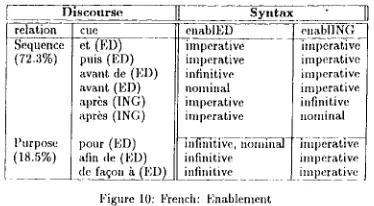
French has a relatively broad range of expres- sions available for enablement (see figure 5)-much wider than Portuguese. As was the case for gen- eration, French enablement shows a strong order- ing preference: when an imperative is used as en- ablED, it must be placed second (if expressing generatED, it must be placed first). The gerun- dive is strongly marked for generation, and in the rare cases it is used in enablement is restricted to a single semantic role: expressing enabliNG, rather than enablED-the only French expression so re- stricted. Euablement is most regularly expressed by the imperative-infinitive.
ySy,"a~ I EnablEO ~ E,,ab.NG
/ D s t l 2ha I T o t a l / 1st 2 n d ~ t ~ ] _ [
/ 6 23 29/~71 61 3314HI
] Imp've-Infin.InfinitiVeGerundive | ~ l 1~1 l ~ l ~l ~ l : I 1.~:~l
Imp're-Simple/ O I 7 / 7 / 10 ] 4 I 14 I 16.'_2 ]
NoInillal ~ _ ~ ~
Figure 5: Expre~ions of Enablement: French
In English (figure 6), although the imperative is the most popular expression of enablement, (over 60% of tokens), when it expresses the enablED part of the relation, it must appear second: to place it first would be misleading, as it would imply that this action should be performed first. There is also a constraint arising from the part of the semantic relation being expressed: infinitives do not express the enabliNG action. Infinitives are only capable of conveying a goal, and the en- abliNG element is not the goal.
Syntax
Infinitive Imperative Pa.ssiw~ Nominal Other Finite CI. Other
[image:3.596.87.305.90.187.2] [image:3.596.324.531.221.270.2] [image:3.596.319.541.447.523.2] [image:3.596.321.546.667.740.2]4 0 0 6.1
| 0 1 t l 11 31 31 61 5.41
1 9 1 91 lSl 3 I ol 3lt6.2 I
/ 3 1 31 61 41 31 7110.0 I
± _ £ L ° L ~ °_I__°A___ °~L_°'sS
potactic conjunctions. D i s c o u r s e ~ n
S ~ (72.3%)
Purpose 08.5%) [ _ _ _ _
Syntax
et (ED) nnperative | ,mperatlv(
puis (ED) imperative | imperative
avant de (El)) infinitive ~ imperatiw:
avast tED) nominal [ imperative
apr/~s ([NG) imperative [ infinitive
apr6s (ING) imperative | nominal
/
pour (ED) inner{lye, i~o~]qn~er-dtlw~
afin de tED) i n f i n i t i v e [iml)erative
[image:4.596.78.265.97.200.2]de fa(;oI~l']D~ inlinitive Limperative
Figure 10: French: Enablement
T h e relationship with actual t e m p o r a l ordering of events plays no role in determining ordering in the case of
avant de
andapr~s
followed by an infinitive: the two possible orderings are eqnally likely. In the case ofavast
andapr&
followed by a nominal, there is a strong preference for placing the prepositional phrase containing the nominal first. Clearly, this yields an iconic ordering in the cause ofapt&
and a non-iconic ordering in the case ofavant.
Apr~s ddpoussidrage, a p p l i q u e r d e u x couches de peinture vinylique.
After dusting, apply two coats of
vinyl paint.
(6)
Avant l'emploi, faites tremper le boyau dans de l'eau ti6de.B e f o r e use, soak the tube in warm
water.
As in Portuguese, though, both rhetorical rela- tions are clearly marked, and there is a similar, Mthough less marked, tendency to view the se- mantic content of the enablement relation as being one of t e m p o r a l sequence.
3 . 2 . 3 E n g l i s h
English h~s the greatest tolerance of m m m r k e d discourse relations a m o n g the languages studied: only 37 of the 130 clauses examined appeared with a marker of any kind. The m a j o r i t y of markers were instances of
by
appearing with a nominali- sation to convey the generatiNG part of the rela- tion, showing a preference for communicating this semantic content in terms of the rhetorical rela- tion of MF, ANS in English 9 18 of these 19 instances ofby
appeared when the generatED element was presented first:by
is used to signal the MEANS re- lation when conflmion might otherwise result from a user a t t e m p t i n g to perform the generated action,9As stated at the outset, however, we cannot yet state the ordering of the relevant semantic, syntactic, and rhetoricM decisions.
presented first, rather than the generating action.
[[ Di;~oT,;g& - - [ ~iilati~ cue I [ ' , t r p o s ~
j (50.8%) simply ([NG)
generatED infinitive infinitive
Syntax
I so that (H)) [inite clause
I for tED) nominal
i
I Means by (]NG) ] m ~ r ~ f f [ { e . - ~ -
(29,2)%
Itesult if/when (ING) ~ e
(la.S%) by (IN(:) and tED)
O subject complement
Condition if (EI)) fiit~te..
[image:4.596.298.508.103.245.2][ i~ 2%) _ _
Figure It: English: Generation
generatiNG
imperative imperatiw! imperative
- h o ~ n ~ I
nominal imperative nominal
~ n p c ~ e - - - --
The markers
simply
andjust
appear only withgeneratiNG imperatives.
For
appears only withNP, and marks only generatED elements. So
that,
which appears rarely, marks only generatE1) elc- ments. The less commonand, if
andwhen
couhl appear with either ING or 1'3).Even though English does not m a r k the two parts of the generation relation explicitly by means of discourse markers, the combination of ordering, syntax, and rhetorical relation results in all but one c ~ e in an unambiguous interpretation. PUIU'OSF,, is the only relation t h a t is expressible in both ED-first and ING-first order: in fact, it is only infinitives and
for
with a nominal t h a t can appear either before or after their main chmse.t° The range of rhetorical relations available for the expression of generation is, however, the greatest of the three languages, consisting of a superset of the relations adopted in French and Portuguese.Enablement in English is expressed most fl'e- quently by SEQUENCI.;, which, with a p p r o p r i a t e temporal markers, can appear in both iconic and non-iconic order: the few non-iconic cases (5) are n,arked with
before, follow ling] by [ed],
andfol-
lowed by.
PURPOSE is also a frequent interpreta- tion. For enablement, some discourse markers areexclusive, and some ambiguous.
If
appears ex-clusively with the E1)-first presentation, and
and,
then, followed by, follow X by,
andnow
only ap-- pear with the ING-first ordering, ~ do commas. 7'0,for
andbefore
are ambiguous. Finally,just
and simply
are markers t h a t only a p p e a r with the ING clement, but there is always another marker that appears in the ED element in conjunction with them.As was the case with generation in English, there is a high degree of overlap between all other expressions of the two parts of the relation. 3.2 D i s c o u r s e M a r k e r s a n d R h e t o r i c a l
R e l a t i o n s
Very strong correlations appear between particu- lar choices of semantic relation and syntactic form on the one hand, and the appearance of discourse markers a n d / o r a strong bias towards a particular rhetorical interpretation on the other. Our anal- ysis shows t h a t selection of syntactic expression and local discourse relation strongly interact, and provides a rather clearer picture of the influences t h a t bear on the m a p p i n g front semantics to syn- tax.
A particularly i m p o r t a n t element to emerge is the language-specific nature of the choice of rhetorical relation, a notion which we express for the m o m e n t in terms of l~ST-style rhetorical rela- tions, of. (Mann and T h o m p s o n , 1988). The anal- ysis represents a careful but intuitive interpreta- tion of what rhetorical relation would be retrieved, by a native speaker of the language, front the par- ticular combination of syntax, discourse marker, and content. W h a t triggers these interpretations is constrained both by semantic content and by the conventions and syntactic resources available within the languages of study.
3.2.1 P o r t u g u e s e
Portuguese appears to have obligatory signalling of discourse relation by a discourse marker, or at the very least by punctuation s . Three dis- course relations are available for generation (PUR-
POSE, CONDITION, RESULT) and two for enable-
ment (PURPOSE, SEQUENCE). For generation, the d o m i n a n t relation is PURPOSE (80%); for enable- ment it is SEQUENCE (72%). T h e overlap in the syntax of generation vs enablement sentences is confined to expressions of PURPOSE. Figures 7 and 8 show the relationships between semantic relation and syntax with an overlay of discourse: rhetorical relations and discourse markers.
[ Discourse Syntax
generatED generatl NG
(80.1%)
Condition (9.3%)
Result (1..5%)
cne
caso ED
se El)
e + aulomat- icamente ED
~-nfinitive
infinitive nominal
infinitive p;msive
f'u[ure (agent = artifact)
~imperative,passive, infinitive} basta + infinitive {imperative, infinitive}
imperative} infinitive/imperative
~npera6C, Z
Figure 7: Portuguese: Generation
T h e figures show a strong and unambiguous re- SThis can be compared with the finding presented by (Moser and Moore, 1995) in their ACL-95 presen-. tation, that discourse cues are significantly more likely to occur when the 'contributor' component of the re- lation PRECEDES the 'core' in English dialogues.
lationship between rhetorical relation, discourse marker, and syntax. There is a strong tendency to present generation in terms of the rhetorical relation of I'URPOSE, which is marked almost in- variably by para or para que (so that), both of which can only take a nominal or infinitival ex- pression. SEQUENCE, on the other hand, is sig- nalled by temporal connectives such as antes de (before), depois de
(after)
or apes (afte,9, by the connective e (and) or implicitly by the use of a c o m m a between the elements of a string of imper- atives. For Portuguese enablement, two relations are preferred: PURPOSE and SEQUENCE, with a strong preference for the latter. Again, the m a r k - ers of each rhetorical relation are distinct.Discourse Syntax
relation cue
['urpose para ( E D ) - -
(18.5%)
Sequence antes de tED)
(72.3%) depois de (ING)
ap6s (ING) o tED)
-~]mblED enabliNG
( n ~ i , infinitive} ]imperative
infinitive I ba.sta + infinitive
L _
imperative I infinitive
imperative I ! ... inal, infinitive}
imperative I !mperative
imperative [imperative
Portuguese: Enablement 3.2.2 h.encl~ig.re s:
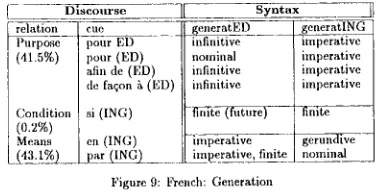
In French, discourse markers do not a c c o m p a n y all expressions of generation. However, where they do occur, the markers unambiguously assign the expressions to one or other of the plan elements: body (si, en and par) or goal (pour, afin de, and
de fafon it). While Portuguese generation is over- whelmingly expressed through the rhetorical re- lation of PURPOSE, in French it is more evenly distributed between PURPOSE and MEANS, with a small showing for CONDITmN. Although not shown in the figure, there is only one case in French generation where the choice of ordering of the elements and the choice of marker-plus- expression are not mutually constraining: this is when the preposition pour is followed by an infini- tive. In this case, the two orderings of the relation (ING first or ED first) are more or less equally probable.
[7)nrp-po.~ -- ] p .... ED
(41.5%) pour (ED)
afin de (ED) de faqon ~. (ED)
Condition si (ING) (0.2%)
[ Means ien (ING)
L ( ' 1 3 . t % l _ L p a ~ . . . .
Syntax
ge,,e~atED ~ n n e ~
infinitive tmperat!ve I
nominal imperat!vc I
mlperat!vc I
infinitive imperatlve~
infinitive
imperative, finite nominM
Figure 9: l~ench: Generation
The expression of enablement in French instruc- tions (figure 10) is limited to two rhetorical rela-
tions: SEQUENCE and PURPOSE. Situations where
[image:5.596.318.537.249.349.2] [image:5.596.330.521.555.652.2]?elation Sequence (68%)
_ Syntax
cue enablED e n a b l i N G - -
{~nd, t-h-~,
now (ED)} imperative imperative
finite finite
{~, ,} imperative imperative
{when, after (ING)} imperative nominal
follow (ING) by (ED) nominal nominal
followed by (ED) nominal imperative
before (ED) nominal {imperative, finite}
finite finite
(21.4%) for (ED) nominal {finite,imperative}
for (ED) nominal imperative
in order to (ED) infinitive finite
Condition when (ING)
(7.6%) if(ED) imperative ] finite
Result once (ING)
[image:6.596.65.269.59.280.2](3.0%) which (ED)
Figure 12: English: Enablement
4
Conclusions and Implications
In this paper, we have gone some way towards isolating the specific point in the generation pro- cedure at which pragmatic information such as rhetorical relation must be brought into play. Since our notion of semantic content is based on a formal model of the task plan to be con- veyed to the instruction user, the significance of the approach is clear for developing natural lan- guage generation applications within this limited domain. In particular, for rhetorical planning of the communication of particular content, we can use the preferences observed for selection of the preferred rhetorical relation in the language in question. Second, we can use our knowledge of how that relation is constituted and expressed in terms of syntax for marking the relation appropri- ately.
The approach also reveals some interesting facts about the individual languages. In particular, we found d i f f e r e n t levels o f t o l e r a n c e o f resid- ual a m b i g u i t y : Portuguese has little ambigu- ity in the mapping from semantic content to syn- tactic realisation (the least ambiguous markers of rhetorical relation, fewest available syntactic re- alisations, least overlap in the roles of these real- isations for conveying one or the other semantic relation, most restricted set of favoured rhetori- cal relations). English, on the other hand, had the opposite characteristics. We also found dif- fering p r e f e r e n c e s f o r r h e t o r i c a l r e l a t i o n s in expressing semantic content: for example, while Portuguese expresses generation in over 80% of cases with the relation of PURPOSE, French gener- ation divides this relation almost equally between PURPOSE and MEANS. The English corpus, on the other hand, while it has a strong showing for PURPOSE (around 50%), reveals a relatively strong showing (around 14%) for the relation of RESULT, a relation found in only 1.5% of the Portuguese relations and not at all in French.
No natural language has an unambiguous map- ping from semantics to surface syntax, which
makes the information encoded by syntax, both semantic and pragmatic, very difficult to con- sciously 'unpack' from surface form in the per- formance of the translation task. We suggest that uncovering the decisions necessary for producing pragmatically-appropriate sets of parallel instruc- tions is a task best performed as an empirical study along the lines suggested here. In this way, we can encode language-specific pragmatic princi- ples into tools that support the process of multi- lingual document production.
R e f e r e n c e s
Cecile T. Balkanski. 1993. Actions, Beliefs and Intentions in Multi-Action Utterances. Ph.D. thesis, Harvard University, May.
R. E. Fikes and Ntis Nilsson. 1971. STRIPS:
a new approach to the application of theorem proving to problem solving. Artificial Intelli- gence, 2:189-208.
Alvin I. Goldman. 1970. A Theory of Human
Action. Prentice Hall, Englewood Cliffs, NJ. Anthony F. Hartley and C6cile L. Paris. 1995.
Supporting Multilingual Document Production: Machine Translation or Multilingual Genera- tion? In working notes of the IJCAI-95 Work- shop on Multilingual Text Generation, August
20-21, Montr6al, Canada. Also available as
ITRI report ITRI-95-13.
William C. Mann and Sandra A. Thompson. 1988. Rhetorical structure theory: Toward a functional theory of text organization. Text: An Interdisciplinary Journal for the Study of
Text, 8(2):243-281.
M. Moser and J. Moore. 1995. Investigating Cue Selection and Placement in Tutorial Discourse. In Proceedings of the 33rd Annual Meeting of the ACL, pages 130-150, Boston, Mass.
C~cile Paris, Keith Vander Linden, Markus Fischer, Anthony Hartley, Lyn Pemberton, Richard Power, and Donia Scott. 1995. A sup- port tool for writing mnltilingual instructions. In Proceedings of the Fourteenth International Joint Conference on Artificial Intelligence, Au- gust 20-25, Montrdal, Canada, pages 1398-1404. Also available as ITRI report ITRI-95-11.
Martha E. Pollack. 1986. Inferring Domain Plans
in Question-Answering. SRI Technical Report SRIN-403.
Earl D. Sacerdoti. 1977. A Structure for Plans and Behavior. Elsevier, New York.
Keith Vander Linden. 1993. Speaking of Ac-
tions: Choosing Rhetorical Status and Gram- matical Form in Instructional Text Generation.