R e a c t i v e C o n t e n t S e l e c t i o n
i n t h e G e n e r a t i o n o f R e a l - t i m e S o c c e r C o m m e n t a r y
Kumiko TANAKA-Ishii and KSiti HASIDA and Itsuki N O D A
Electrotechnical Laboratory
1-1-4 Umezono, Tsukuba, Ibaraki 305, Japan.
A b s t r a c t
MIKE is an automatic commentary system that gen- erates a c o m m e n t a r y of a simulated soccer game in English, French, or Japanese.
One of the major technical challenges involved in live sports c o m m e n t a r y is the reactive selection of content to describe complex, rapidly unfolding situ- ation. To address this challenge, MIKE employs im- portance scores that intuitively capture the amount of information communicated to the audience. We describe how a principle of maximizing the total gain of importance scores during a game can be used to incorporate content selection into the surface gen- eration module, thus accounting for issues such as interruption and abbreviation.
Sample commentaries produced by M I K E are pre- sented and used to evaluate different methods for content selection and generation in terms of effi- ciency of communication.
1 I n t r o d u c t i o n
Timeliness, or reactivity, plays an important role in actual language use. An expression should not only be appropriately planned to communicate relevant content, but should also be uttered at the right mo- ment to describe the action and further to carry on the discourse smoothly. Content selection and its generation are inseparable here. For example, peo- ple often start talking before knowing all that they want to say. It is also relatively common to fill gaps in c o m m e n t a r y by describing what was t r u e in the
past. An extreme instance is when an utterance
needs to be interrupted to describe a more impor- tant event that suddenly occurs.
It might be expected that dialogue systems should have addressed such real-time issues, but in fact these studies appear to have been much more fo- cused on content planning. The reason for this lies in the nature of dialogue. Although many human- human conversations involve a lot of time pressure, slower conversations can also be successful provided
the planning is sufficiently incorporated. For exam- ple, even if one conversation participant spends time before taking a turn, the conversation partner can just wait until hearing a contribution.
In contrast, reactivity is inevitable in live com- m e n t a r y generation, because the complexity and the rapid flow of the situation severely restrict what to be said, and when. If too much time is spent think- ing, the situation will unfold quickly into another phase and important events will not be mentioned at the right time.
MIKE is an automatic narration system that gen- erates spoken live c o m m e n t a r y of a simulated soccer game in English, French, or Japanese. We chose the game of soccer firstly because it is a multi-agent game in which various events happen simultaneously in the field. Thus, it is a suitable domain to study real-time content selection among many heteroge- neous facts. A second reason for choosing soccer is that detailed, high-quality logs of simulated soccer games are available on a real-time basis from Soc- cer Server(Noda and Matsubara, 1996), the official soccer simulation system for the RoboCup (Robotic Soccer World Cup) initiative.
The rest of the paper proceeds as follows. First, we describe our principle for real time content se-
lection and explain its background. Then, after
briefly explaining MIKE'S overall design, §4 explains how our principles are realized within our imple- mentation. §6 discusses some related works, and §5 presents some actual o u t p u t by MIKE and evaluates it in terms of efficiency of communication.
2 P r i n c i p l e s o f C o n t e n t S e l e c t i o n i n t h e R e a l T i m e D i s c o u r s e
2.1 M a x i m i z a t i o n o f T o t a l I n f o r m a t i o n
A discourse is most effective when the amount of information transmitted to the listener is maximal.
the given time.
In the case of making discourse on a dynamic sub- ject, however, content selection suddenly becomes very complex. Above all, the importance of the con- tents changes according to the dynamic discourse topic, and also according to the dynamic situation
of the subject. Additionally, past events become
less i m p o r t a n t with time. Under this condition, the basic function of content selection is to choose the most important content at any given time. This con- trol, however, is not enough, because any content will take time to be uttered and during that time, the situation of the subject might change rapidly. Therefore, it should always be possible to change or rearrange the content being uttered.
Examples of such rearrangements are:
• i n t e r r u p t i o n . When the situation of the sub- ject changes suddenly to a new one, more in- formation can be given by rejecting the current utterance and switching to new one.
• a b b r e v i a t i o n . When many important facts
arise, the total information can be augmented by referring to each facts quickly by abbreviat- ing each one.
• r e p e t i t i o n . When nothing new comes up in the subject, the important facts already uttered can be repeated to reinforce the information given to the listener.
As a consequence, creating a system which in- volves real time discourse concerns 1.assessing the dynamic importance of contents, 2.controlling the content selection with this importance so that the total information becomes maximal using the rear- rangement functions.
In §4, we discuss how we implemented these prin- ciples in MIKE to produce a real time narration.
2.2
What, How
a n dWhen-to-Say
T h e previous section pointed out that contents should be uttered at the right time; that is, real time discourse systems should effectively address the
problem of
when-to-say
any piece of information.However, in MIKE we have only an implicit model of
when-to-say.
Rather, a collection of game analysis modules and inference rules first suggest the possiblecomments that can be made
(what-to-say).
Then, anNL-generation module decides which of these com-
ments to say (again
what-to-say),
and also how itshould be realised
(how-to-say).
Thishow-to-say
process takes into account issues such as the rear- rangements described in the previous section.
In traditional language generation research, the
relationship between the
what-to-say
aspect (plan-ning) and the
how-to-say
aspect (surface generation)• E x p l a n a t i o n o f c o m p l e x e v e n t s c o n c e r n f o r m c h a n g e s , p o s i t i o n c h a n g e , a n d a d v a n c e d plays. • E v a l u a t i o n o f t e a m p l a y s concern average forms,
f o r m s at a c e r t a i n m o m e n t , players' location, indi- c a t i o n of t h e active or p r o b l e m a t i c players, w i n n i n g p a s s w o r k p a t t e r n s , w a s t e f u l m o v e m e n t s .
• S u g g e s t i o n s f o r i m p r o v i n g p l a y c o n c e r n loose de- fense areas, a n d b e t t e r l o c a t i o n s for inactive players. • P r e d i c t i o n s c o n c e r n p a s s , g a m e result, a n d s h o t s at
goal.
• S e t p i e c e s c o n c e r n goal kicks, t h r o w ins, kick offs, c o r n e r kicks, ~nd free kicks.
• P a s s w o r k s t r a c k basic ball-by-ball plays. Figure 1: MIKE's repertoire of statements
has been widely discussed (Appelt, 1982) (Hovy, 1988). One viewpoint is that, for designing natural
language systems, it is better to realize
what-to-say
and
how-to-say
as separate modules. However, in M:IKE we found that the time pressure in the domainmakes it difficult to separate
what-to-say
andhow-to-
say
in this way. Our NL generator decides both onwhat-to-say
andhow-to-say
because the rearrange- ments made when deciding how to realize a piece of information directly affect the importance of the remaining unuttered comments. To separate these processes cause significant time delays that would not be tolerable in our time-critical domain.3 B r i e f D e s c r i p t i o n o f M I K E ' s D e s i g n A detailed description, of MIKE, especially its soccer game analysis capabilities can be found in (Tanaka-
Ishii et al., 1998). Here we simply give a brief
overview.
3,,1 M I K E ' s S t r u c t u r e
MIKE, 'Multi-agent Interactions Knowledgeably Explained', is designed to produce simultaneous commentary for the Soccer Server, originally pro- posed as a standard evaluation method for multi-
agent systems(Noda and Matsubara, 1996). The
Soccer Server provides a real-time game log 1 of a w~ry high quality, sending information on the po- sitions of the players and the ball to a monitoring program every 100msec. Specifically, this informa- tion consists of:
• p l a y e r location and orientation, • b a l l location,
• g a m e score and play modes (such as throw ins,
goal kicks,
ere ).
From this low-level input, the current implementa- tion of MIKE can generate the range of comments shown in Figure 1.
[image:2.612.320.535.73.213.2]• L o g i c a l c o n s e q u e n c e s :
( P a s s S u c c e s s R a t e
player percentage)
( P a s s P a t t e r nplayer
G o a l )- ~ ( a c t i v e
player)
• L o g i c a l s u b s u m p t i o n :(Pass
playerl player2)(Kick player1)
~* (Delete ¢2)
• S t a t e c h a n g e :
(Form
team forml)(Form team form2)
--~ ( D e l e t e e a r l i e r - p r o p ) • S e c o n d o r d e r r e l a t i o n :
(PassSuccessRate
player percentage)
(PlayerOnYoronoiLine
playr)
(Reason @1 ~2)
Figure 3: Categories and examples of inference rules
I SoccerServer 1
Figure 2: MIKE'S structure
Table 1:
fragments of commentary
Local E v e n t Kick
P a s s
Dribble ShootPredict
S t a t e Mark
PlayerPassSucces sRate
ProblematicPlayer PlayerActive
Examples of
Propositions,
the internalGlobal ChangeForm
SideChange
T e a m P a s s S u c c e s s R a t e A v e r a g e P a s s D i s t a n c e
Score Time
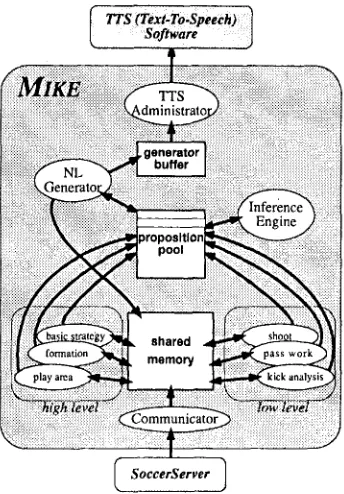
MIKE'S architecture - - a role-sharing multi-agent system 2 __ is shown in Figure 2. Here, the ovals rep- resent concurrently running modules and the rectan- gles represent data.
All communication among modules is mediated by the internal symbolic representation of commentary
2In n a t u r a l l a n g u a g e p r o c e s s i n g , t h e m u l t i - a g e n t a p p r o a c h d a t e s b a c k to H e a r s a y - I I ( E r m a n et al., 1980), w h i c h w a s t h e first to u s e t h e b l a c k b o a r d a r c h i t e c t u r e . T h e core o r g a n i z a t i o n of MIKE, however, is m o r e a k i n to a s u b s u m p t i o n a r c h i t e c t u r e ( B r o o k s , 1991), b e c a u s e t h e a g e n t s are r e g a r d e d as b e h a v i o r m o d u l e s w h i c h are b o t h d i r e c t l y c o n n e c t e d to t h e e x t e r n a l e n v i r o n m e n t ( t h r o u g h s e n s o r r e a d i n g s f r o m t h e s h a r e d m e m - ory) a n d c a n directly p r o d u c e s y s t e m b e h a v i o r ( b y s u g g e s t - i n g c o m m e n t a r y ) . However, MIKE d o e s n o t e x a c t l y fit t h e s u b s u m p t i o n a r c h i t e c t u r e m o d e l b e c a u s e t h e a g e n t s c a n also c o m m u n i c a t e w i t h e a c h other: t h e r e are s o m e p o r t i o n s o f t h e s h a r e d m e m o r y t h a t are global a n d s o m e t h a t are e x p o r t e d to o n l y a l i m i t e d n u m b e r of a g e n t s . T h i s division of s h a r e d m e m - ory l e a d s to m o r e possibilities for i n t e r - a g e n t c o m m u n i c a t i o n .
fragments, which we call
propositions.
A proposi-tion is represented with a tag and some attributes. For example, a kick by player No.5 is represented as (Kick 5), where Kick is the tag and 5 is the at- tribute. So far, MIKE has around 80 sorts of tags, categorized in two ways: as being local or global and as being state-based or event-based. Table 1 shows some examples of categorized proposition tags.
Some of the important modules in MIKE's archi- tecture can be summarized as follows.
There are six S o c c e r A n a l y z e r s that try to inter- pret the game. Three of these analyze events (shown in the figure as the 'kick analysis', 'pass work', and 'shoot' modules). The other three carry out state- based analysis (shown as the 'basic strategy', 'for- mation', and 'play area' modules). The modules an- alyze the data from the Soccer Server, communicate with each other via the shared memory, and then post the results as propositions into the Pool.
The R e a l T i m e I n f e r e n c e E n g i n e processes the propositions. Prpositions deposited in the Pool are bare facts and are often too detailed to be used as comments. MIKE therefore uses forward chaining rules of the form
precedents--* antecedents
to draw further inferences. The types of rules used for this process are shown in Figure 3. Currently, MIKE has about 110 such rules.
[image:3.612.315.547.65.245.2] [image:3.612.101.273.67.314.2] [image:3.612.72.302.389.482.2]importance
j~iaLvalue <
Global Propositions: ~i always the default value i! Local Propositions:
i different values according i to the bali's location
~ ~ decreased by
post infer delete time or utter
Figure 4: An example transformation of importance of a proposition
put can be is in English, French or Japanese. To produce speech, MIKE uses off the shelf
text-to-speech software. English is produced by
Dectalk(DEC, 1994), French by Proverbe Speech
Engine Unit(Elan, 1997), Japanese by Fujitsu
Japanese Synthesizer(Fujitsu, 1995).
4 I m p l e m e n t a t i o n o f C o n t e n t S e l e c t i o n
4.1 I m p o r t a n c e o f a
Proposition
The Soccer Analyzers attach an importance score to a proposition, which intuitively captures the amount of information that the proposition would transmit to an audience.
The importance score of a proposition is planned to change over time as follows (Figure 4). After be- ing posted to the Pool, the score decreases over time while it remains in the Pool waiting to be uttered. When the importance score of a proposition reaches zero, it is deleted. This decrease in importance mod- els the way that an event's relevance decreases as the game progresses.
T h e rate at which importance scores decrease can be modeled by any monotonic function. For sim- plicity, MIKE'S function is currently linear. Since it seems sensible that local propositions should lose their score more quickly than global ones, several functions with different slopes are used, depending on the degree to which a proposition can be consid- ered local or global. When a proposition is used for utterance or inference, the score is reduced in order to avoid the redundant use of the same proposition, but not set to zero, thus leaving a small chance for other inferences.
There is also an initialization process for tile im- portance scores as follows. First, to reflect the situa- tion of the game, the local propositions are modified by a multiplicative factor depending on the state
of the game. This factor is designed so that local propositions are more important when the ball is near the goal. Global propositions ~re always ini- tialized with the default value.
Secondly, to reflect the topic of the discourse, MIKE has a feedback control which enables each Soc- cer Analyzer module to take into account MIKE's
past and present utterances. The NL generator
broadcasts the current subject to the agents and they assign greater initial importance scores to
propositions with related subjects. For example,
when MIKE is talking about player No.5, the An- alyzers assign a higher importance to propositions relating to this player No.5.
4.2 M a x i m i z a t i o n o f t h e I m p o r t a n c e S c o r e As the importance score is designed to intuitively reflect the information transmitted to the audience, the natural application of our content selection prin- ciples described in §2 is simply to a t t e m p t to max- imize the total importance of all the propositions that are selected for utterance.
MIKE has the very basic function of uttering the most important content at any given time. T h a t
is, MIKE repeatedly selects the proposition with the
largest importance score in the Pool.
T h e NL Generator translates the selected propo- sition into a natural language expression and sends it to the T T S - a d m i n i s t r a t o r module. Then tile NL Generator has to wait until the Text-to-Speech soft- ware finishes the utterance before sending out tile next expression. During this time lag, however, the game situation might rapidly unfold and numerous further propositions may be posted to the Pool. It is
to cope with this time lag that MIKE implements a
alternative function, that allows a more flexible se- lection of propositions by modeling the processes of interruption, abbreviation, and repetition,
Interruption
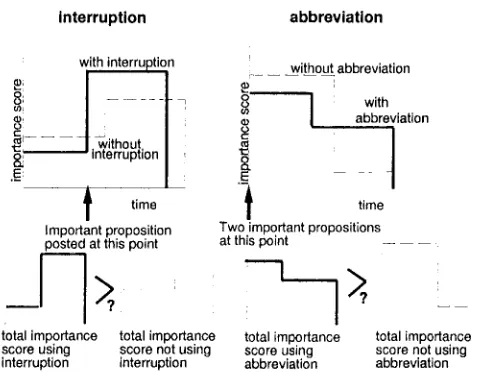
If a proposition with a much larger importance score than the one currently being uttered is inserted into the Pool, the total importance score may become larger by immediately interrupting the current ut- terance and switching to the new one. For example, the left of Figure 5 shows (solid line) the change of the importance score with time when an inter- ruption takes place (the dotted line represents the
importance score without interruption). T h e left
[image:4.612.79.283.76.204.2]Interruption a b b r e v i a t i o n
:
with interruption~ . . . . ~ " ~ ' - - - - ~ interruption / : ]without |
time Important proposition posted at this point
total importance score using interruption
,.- _ without abbreviation
]
] ~ ' - - ' ~ : with abbreviation
~
timeTwo important propositions at this point
total importance total importance total importance score not using score using score not using interruption abbreviation abbreviation
Figure 5: Change of importance score on interrup- tion and abbreviation
to be selected.
Thus, the sum of the importance of the uttered propositions can no longer be used to access the sys- tem's performance. Instead, the area between the lines and the horizontal axis indicates the total im- portance score over time. W h e t h e r or not to make interruption should be decided by comparing two ar- eas made by the solid and dotted, and the larger area size is the total importance score gain. Further, this selection decides what to be said and how at the same time.
Note that interruptions raise the importance score gain by reacting sharply to the sudden increase of the importance score.
Abbreviation
If the two most important propositions in the Pool are of similar importance, it is possible that the amount of communicated information could be max- imized by quickly uttering the most important proposition and then moving on to the second be- fore loses importance due to some development of the game situation. In the Figure 5, we have illus- trated this in the same way we did for the case of interruption. T h e left hand side of the solid line is lower than that of the dotted because an abbrevi- ated utterance (which might not be grammatically correct, or whose context might not be fully given) transmits less information than a more complete ut- terance. As the second proposition can be uttered before losing its importance score, however, the right hand part of the solid line is higher than that of the dotted. As before, the benefits or otherwise of this modification should be decided by comparing with
Red3 collects the ball from Red~, Red3, Red-Team, wonderful goal/ 2 to 2/ Red3's great center shot] Equal] The Red-Team's formation is now breaking through enemy line from center, The Red-Team's counter attack (Red4 near at the center line made a long pass towards Red3 near the goal and he made
a shot very swiftly.), Red3's goal/ Kick off, Yellow-
Team, Red1 is very active because, Red1 always takes good positions, Second half of RoboCup'97 quater- final(Some background is described while the ball
is in the mid field.) Left is Ohta Team, Japan,
Right is Humboldt, Germany, Red1 takes the ball, bad pass, (Yellow team's play after kick off was in-
terrupted by Read team) Interception by the Yellow-
Team, Wonderful dribble, Yellow2, Yellow2 (Yellow6
approaches Yellow2 for guard), Yellow6's pass, A
pass through the opponents' defense, Red6 can take the ball, because, Yellow6 is being marked by Red6, .... The Red-Team's counter attack, The Red-Team's formation is (system's interruption), Yellow5, Back pass of YellowlO, Wonderful pass,
Figure 6: Example of MIKE's c o m m e n t a r y of a quater-final from RoboCup'97
the two areas made by the solid and the dotted line with the horizontal axis. Again, this selection de-
cides how and what-to-say at the same point.
In this case we would hope that abbreviations raise the importance score by smoothing sudden de- creases of the importance scores posted to the Pool.
Repetition
Whenever a proposition is selected to be uttered, its importance value is decreased. It is also marked as having been uttered, to prevent its re-use. However, sometimes it can happen that the remaining un- uttered propositions in the Pool have much smaller values than any of those that have already been se- lected. In this case, we investigate the effects of allowing previously uttered propositions to be re- peated.
5 E v a l u a t i o n
5.1 O u t p u t E x a m p l e
[image:5.612.77.316.70.256.2]~ 4 ~:e)'7°Iz - , , ~ , 4 ~ ~ , ~ , 3 ~ :, ~ 3 ~ / , ,~, w,,h~e.¢~..g~--- :
~z--7~'1~9(7")~/~-- b ! ~],,~,, [ ~ 3:~7)¢:J*--}1/, ~ f f ' - - ~ I [ / Still talking on Ii
I [ / Goal after the ]
A , ~ : * : ~ [ - ~ " " ~ , ~ _ ~ ' f ' - - . L , 0~:~:I:~'7°~ - , I:/~" [ 1 ;' kickoff
~ ; ~ , ,JV,,¢I 7 5" ~,')1-' b , b" 4' '7,J~, 1 ~75~I[7.a%@ ~ , "-= Goal" .~ ,1 Goal \
+t.5"~'L z -)h ~, :: : ;
Figure 7: Japanese o u t p u t o
Rouge4, Rouged, Balle du Rouged au Rouge3, Rouge3, 2e but. Score de 2h 2. Tit du centre par Rouge3 ! Egalite ! Rouge3, but t Attaque rap[de de l'dquipe rouge, JaunelO, La formation de l'dquipe jaune est bas6e sur l'attaque par le centre. L 'dquipe japonaise a gagnd dans le Groupe C du deuxi~me Tour, tandis que l'dquipe allemande a 9agnd dans le Groupe D. Rouge1 prend la balle, mauvaise passe C'est l'gquipe jaune qui relance le jeu, Magnifique dribble du Jaune2, Passe pour Jaune5. Est-ce que Jaune6 passe it Jaune5?
Figure 8: French o u t p u t
covers a roughly 20 second period of a quater-final from RoboCup'97.
For comparison, we have included MIKE'S French and Japanese descriptions of the same game period in Figure 8 and Figure 7. In general, the generated c o m m e n t a r y differs because of the timing issues re- sulting from two factors: agent concurrency and the length of the NL-templates. One NL template is randomly chosen from several candidates at transla- tion time and it is the length of this template that decides the timing of the next content selection.
5.2 Effect o f R e a r r a n g e m e n t s
I m p o r t a n c e S c o r e I n c r e a s e
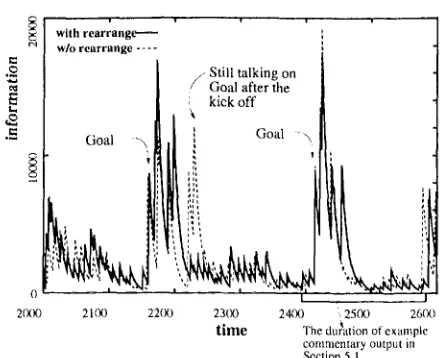
Figure 9 plots the importance score of the propositions in MIKE's commentary for the some RoboCup'97 quater-final we used i n the previous section. T h e horizontal axis indicates time unit of 100msec and the vertical axis the importance score of the comment being uttered (taking into account reductions due to interruption, abbreviation, or re- peated use of a proposition). T h e solid line describes the importance score change with interruption, ab- breviation and repetition, whereas the dotted shows that without such rearrangements. As we described in §4, the area between the plotted lines and the
2fXlO 2100 2200 23(D 2400 ' 2500 26(X)
time The dura mn of example commentary output in Section 5.1
Figure 9: Importance score change during a
RoboCup'97 quater-final game
horizontal axis indicates the total intportance score. Two observations:
• The graph peaks generally occur earlier for the solid line than for the dotted. This indicates that the commentary with rearrangements is more timely than the commentary that repeat- edly selects the most important proposition. For instance, the peaks caused by a goal around time 2200 spread out for the dotted line, which is not the case for the solid line. Also, the peaks are higher for the solid line than dotted. • The area covered by the solid line is larger than
that by the dotted, meaning that the total im- portance score is greater with rearrangements. During this whole game, the total importance score with rearrangements amounted 9.90% more than that without.
D e c r e a s e o f D e l a y e d U t t e r a n c e s
As a further experiments, we manually annotated each statement in the Japanese o u t p u t for the RoboCup'97 quater-final with it optimal time for utterance. We then calculated the average delay in
the appearance of these statements in MIKE'S com-
m e n t a r y both with and without rearrangements. We
found that adding the rearrangements decreased this delay from 2.51sec to 2.16see , a improvement at about 14%.
6 R e l a t e d W o r k s
[image:6.612.317.537.79.258.2]participants. Their model of context handling is an adaptation of a subsumption architecture. One im- portant common aspect between their system and MIKE is that the system itself creates topics.
The SOCCER system described in (Andr~ et al., 1994), combines a vision system with an intelligent multimedia generation system to provide commen- tary on 'short sections of video recordings of real
soccer games'. The system is built on VITRA,
which uses generalized simultaneous scene descrip- tion to produce concurrent image sequence evalua- tion and natural language processing. The vision system translates TV images into information and the intelligent multimedia generation module then takes this information and presents it by combining media such as text, graphics and video.
7 C o n c l u s i o n s a n d F u t u r e W o r k
We have described how MIKE, a live commentary generation system for the game of soccer, deals with the issues of real time content selection and realiza- tion.
MIKE uses heterogeneous modules to recognize
various low-level and high-level features from basic input information on the positions of the ball and the players. An NL generator then selects contents from a large number of propositions describing these features.
The selection of contents is controlled by impor- tance scores that intuitively capture the amount of information communicated to the audience. Under our principle of maximizing the total importance scores communicated to the audience, the decision on how a content should be realized considering re- arrangements such as interruption, abbreviation, is decided at the same time as the selection of a con- tent. Thus, one of our discoveries was that severe
when-to-say
restriction works to tightly incorporatewhat-to-say
(content selection) module and ahow-
to-say
(language realization) module.We presented sample commentaries produced by MIKE in English, French and Japanese. The effect of using the rearrangements was shown compared and found to increase the total importance scores by 10%, to decrease delay of the commentary by 14%.
An important goal for future work is parameter learning to allow systematic improvement of MIKE'S performance. Although the parameters used in the system should ideally be extracted from the game log corpus, this opportunity is currently very lim- ited; only the game logs of RoboCup'97 (56 games) and JapanOpen-98 (26 games) is open to public. Additionally, no model commentary text corpus is available. One way to surmount the lack of appro-
priate corpora is to utilize feedback from an actual audience. Evaluations and requests raised by the audience could be automatically reflected in param- eters such as the initial values for importance scores, rates of decay of these scores, the coefficients in the formulae used for controlling inferences.
Another important research topic is the incorpo- ration of more sophisticated natural language gen- eration technologies in MIKE to produce a more
lively, diverse output. At the phrase generation
level, this includes the generation of temporal ex- pressions, anaphoric references to preceding parts of the commentary, embedded clauses. At the more surface level, these are many research issues related to text-to-speech technology, especially prosody con- trol.
R e f e r e n c e s
E. Andre, G. Herzog, and T. Rist. 1994. Mul- timedia presentation of interpreted visual data.
In P. McKevitt, editor,
Proceedings of AAAI-94,
Workshop on Integration o/Natural Language and
Vision Processing,
pages 74-82, Seattle, WA. D.E. Appelt. 1982. Planning natural-language refer-ring expressions. In
Proceedings o/ Annual Meet-
ing o/the Association/or Computational Linguis-
tics,
pages 108-112.R.A. Brooks. 1991. A new approach to robotics.
Science,
pages 1227-1232.DEC. 1994. Dectalk express text-to-speech synthe- sizer user guide.
Elan. 1997. Speech proverbe engine unit manual. L. D. Erman, F. Hayes-Roth, V. R. Lesser, and D. R.
Reddy. 1980. The Hearsay-II speech understand- ing system: Integrating knowledge to resolve un-
certainty.
ACM Computing Surveys,
12(2):213-253.
Fujitsu. 1995. FSUNvoicel.0 Japanese speech syn- thesizer document.
E.H. Hovy. 1988.
Generating Natural Language un-
der Pragmatic Constraints.
Lawrence Erlbaum Associates.I. Noda and H. Matsubara. 1996. Soccer Server and researches on multi-agent systems. In Hiroaki Ki-
tano, editor,
Proceedings of IROS-96 Workshop
on RoboCup,
pages 1-7, Nov.N. Suzuki, S. Inoguchi, K. Ishii, and M. Okada. 1997. Chatting with interactive agent. In Eu-
rospeech'97,
volume 3, pages 2243-2247.K. Tanaka-Ishii, I. Noda, I. Frank, H. Nakashima, K. Hasida, and H. Matsubara. 1998. Mike: An
automatic commentary system for soccer. In
Pro-