Generic Querying of Relational Databases using Natural Language
Generation Techniques
Catalina Hallett
Center for Research in Computing The Open University Walton Hall, Milton Keynes
United Kingdom
Abstract
This paper presents a method of querying databases by means of a natural language-like interface which offers the advantage of minimal configuration necessary for porting the system. The method allows us to first automatically infer the set of possible queries that can apply to a given database, automatically generate a lexicon and grammar rules for expressing these queries, and then provide users with an interface that allows them to pose these queries in natural language without the well-known limitations of most natural language interfaces to databases. The way the queries are inferred and constructed means that semantic translation is per-formed with perfect reliability.
1 Introduction
Natural Language interfaces to databases
(here-after NLIDBs ) have long held an appeal to both
the databases and NLP communities. However, difficulties associated with text processing, seman-tic encoding, translation to database querying lan-guages and, above all, portability, have meant that,
despite recent advances in the field, NLIDBs are
still more a research topic than a commercial solu-tion.
Broadly, research in NLIDBs has focused
on addressing the following fundamental,
inter-dependent issues1:
• domain knowledge aquisition (Frank et al.,
2005);
1The extent of
NLIDBresearch is such that it is beyond the scope of this paper to reference a comprehensive list of projects in this area. For reviews on various NLIDBs , the reader is referred to (Androutsopoulos et al., 1995).
• interpretation of the input query, including
parsing and semantic disambiguation, se-mantic interpretation and transformation of the query to an intermediary logical form (Hendrix et al., 1978; Zhang et al., 1999; Tang and Mooney, 2001; Popescu et al., 2003; Kate et al., 2005);
• translation to a database query language
(Lowden et al., 1991; Androutsopoulos,
1992);
• portability (Templeton and Burger, 1983;
Ka-plan, 1984; Hafner and Godden, 1985; An-droutsopoulos et al., 1993; Popescu et al., 2003)
In order to recover from errors in any either of
these steps, most advanced NLIDB systems will
also incorporate some sort of cooperative user feedback module that will inform the user of the inability of the system to construct their query and ask for clarification.
We report here on a generic method we have developed to automatically infer the set of possi-ble queries that can apply to a given database, and an interface that allows users to pose these ques-tions in natural language but without the
previ-ously mentioned drawbacks of mostNLIDBs . Our
work is substantially different from previous re-search in that it does not require the user to input free text queries, but it assists the user in com-posing query through a natural language-like in-terface. Consequently, the necessity for syntactic parsing and semantic interpretation is eliminated. Also, since users are in control of the meaning of the query they compose, ambiguity is not an issue. Our work builds primarily on two directions of research: conceptual authoring of queries via
WYSIWYM interfaces, as described in section 2, andNLIDBportability research. From the perspec-tive of the query composing technique, our sys-tem resembles early menu-based techniques, such as Mueckstein (1985), NL-Menu (Tennant et al., 1983) and its more recent re-development Lingo-Logic (Thompson et al., 2005). This resemblance is however only superficial. Our query editing in-terface employs natural language generation tech-niques for rendering queries in fluent language; it also allows the editing of the semantic content of a query rather than its surface form, which allows
seamless translation toSQL.
As in (Zhang et al., 1999), our system makes use of a semantic graph as a mean of representing the database model. However, whilst Zhang et al (1999) use the Semantic Graph as a resource for providing and interpreting keywords in the input query, we use this information as the main means of automatically generating query frames.
2 WYSIWYM interfaces for database
querying
Conceptual authoring through WYSIWYM editing
alleviates the need for expensive syntactic and se-mantic processing of the queries by providing the users with an interface for editing the conceptual meaning of a query instead of the surface text (Power and Scott, 1998).
The WYSIWYM interface presents the contents
of a knowledge base to the user in the form of a natural language feedback text. In the case of query editing, the content of the knowledge base is a yet to be completed formal representation of the users query. The interface presents the user with a natural language text that corresponds to the in-complete query and guides them towards editing a semantically consistent and complete query. In this way, the users are able to control the interpre-tation that the system gives to their queries. The user starts by editing a basic query frame, where concepts to be instantiated (anchors) are clickable spans of text with associated pop-up menus con-taining options for expanding the query.
Previously, WYSIWYM interfaces have proved
valid solutions to querying databases of legal doc-uments and medical records (Piwek et al., 2000), (Piwek, 2002), (Hallett et al., 2005).
As a query-formulation method, WYSIWYM
provides most of the advantages of NLIDBs , but
overcomes the problems associated with natural
language interpretation and of users attempting to pose questions that are beyond the capability of the system or, conversely, refraining from asking useful questions that are in fact within the sys-tem’s capability. However, one of the
disadvan-tages of theWYSIWYMmethod is the fact that
do-main knowledge has to be manually encoded. In order to construct a querying interface for a new database, one has to analyse the database and man-ually model the queries that can be posed, then implement grammar rules for the construction of these queries. Also, the process of transforming
WYSIWYM queries into SQL or another database
querying language has previously been database-specific. These issues have made it expensive to port the interface to new databases and new do-mains.
The research reported here addresses both these shortcomings by providing a way of automatically inferring the type of possible queries from a graph representation of the database model and by devel-oping a generic way of translating internal
repre-sentations of WYSIWYM constructed queries into
SQL.
3 Current approach
In the rest of the paper, we will use the following terms: a query frame refers to a system-generated query that has not been yet edited by the user,
therefore containing only unfilled WYSIWYM
an-chors. An anchor is part of the WYSIWYM
ter-minology and means a span of text in a partially formulated query, that can be edited by the user to expand a concept. Anchors are displayed in square brackets (see examples in section 3.3).
To exemplify the system behaviour, we will use as a case study the MEDIGAP database, which is a freely downloadable repository of informa-tion concerning medical insurance companies in the United States. We have chosen this particu-lar database because it contains a relatively wide range of entity and relation types and can yield a large number of types of queries. In practice we have often noticed that large databases tend to be far less complex.
3.1 System architecture
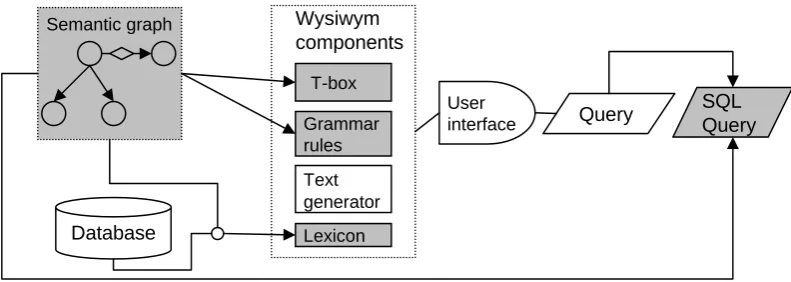
Figure 1 shows the architecture of the
query-ing system. It receives as input a model of
compo-Semantic graph
User interface
Wysiwym components
T-box
Grammar rules
Text generator
Query SQL Query
Lexicon
Database
Figure 1: System architecture
nents and resources (highlighted in grey) that in
previous WYSIWYM querying systems were
con-structed manually. Finally, it implements a mod-ule that translates the user-composed query into
SQL.
The components highlighted in grey are those that are constructed by the current system.
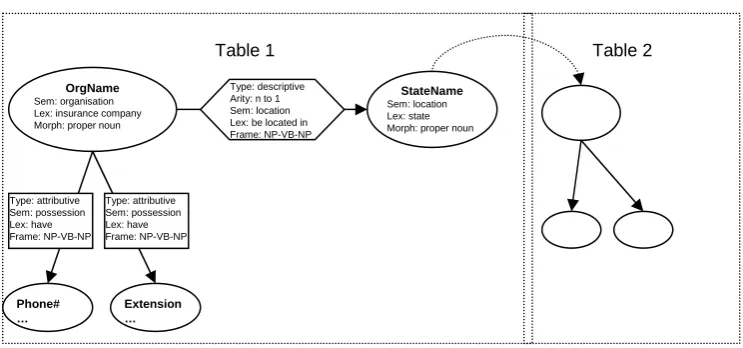
The T-box describes the high-level components of the queries. It is represented in Profit notation (Erbach, 1995) and describes the composition of the query frames (the elements that contribute to a query and their type) . A fragment of the semantic graph displayed in 2 will generate the following fragment of t-box:
query > [about_company, about_state, about_phone, about_ext].
about_company > [company_state, company_phone, company_ext].
company_state intro [company:company_desc].
company_desc intro [comp:comp_desc, phone:phone_desc, ext:ext_desc].
state_desc > external(’dbo_vwOrgsByState_StateName’). comp_desc > external(’dbo_vwOrgsByState_org_name’). phone_desc > external(’dbo_vwOrgsByState_org_phone’). ext_desc > external(’dbo_vwOrgsByState_org_ext’).
The grammar rules are also expressed in Profit, and they describe the query formulation procedure. For example, the following rule will be generated automatically to represent the construc-tion procedure for the query in Example (1.1):
rule(english, company_state, meaning!(<description &
predicate!company_state &
properties![attribute!comp & value!Comp]) & layout!level!question &
cset![meaning!in &
syntax!category!prep & layout!level!word,
meaning!which & syntax!category!int & layout!level!word,
meaning!state & syntax!category!np & layout!level!word,
meaning!be &
syntax!(category!vb & form!pres), layout!level!word,
meaning!Comp & syntax!category!np & layout!level!phrase,
meaning!locate &
syntax!(category!vb & form!part), layout!level!word]).
In addition to the grammar rules automatically
generated by the system, the WYSIWYM
pack-age also contains a set of English grammar rules (for example, rules for the construction of defi-nite noun phrases or attachment of prepositional phrases). These rules are domain independent, and therefore a constant resource for the system.
The lexicon consists of a list of concepts to-gether with their lexical form and syntactic cate-gory. For example, the lexicon entry for insurance
company will look like:
word(english, meaning!company & syntax!(category!noun & form!name) & cset!’insurance company’)).
3.2 Semantic graph
The semantics of a relational database is specified as a directed graph where the nodes represent el-ements and the edges represent relations between elements. Each table in the database can be seen as a subgraph, with edges between subgraphs rep-resenting a special type of join relation.
Each node has to be described in terms of its se-mantics and, at least for the present, in terms of its linguistic realisation. The semantic type of a node is restricted by the data type of the correspond-ing entity in the database. A database entity of type String can belong to one of the following se-mantic categories: person, organization, location
(town, country), address (street or complete ad-dress), telephone number, other name, other ob-ject. Similarly, numerical entities can have the
OrgName
Sem: organisation Lex: insurance company Morph: proper noun
Phone# …
Extension …
StateName
Sem: location Lex: state Morph: proper noun Type: descriptive
Arity: n to 1 Sem: location Lex: be located in Frame: NP-VB-NP Table 1
Type: attributive Sem: possession Lex: have Frame: NP-VB-NP
Type: attributive Sem: possession Lex: have Frame: NP-VB-NP
Table 2
Figure 2: Example of a semantic graph
weight, value, height. The data type date has only
one possible semantic type, which is date. These semantic types have proved sufficient in our exper-iments, however this list can be expanded if nec-essary.
Apart from the semantic type, each node must specify the linguistic form used to express that node in a query. For example, in our case study, the field StateName will be realised as state, with the semantic category location. Additionally, each node will contain the name of the table it belongs to and the name of the column it describes.
Relations in the semantic graph are also de-scribed in terms of their semantic type. Since re-lations are always realised as verbs, their seman-tic type also defines the subcategorisation frame associated with that verb. For the moment, sub-categorisation frames are imported from a locally compiled dictionary of 50 frequent verbs. The user only needs to specify the semantic type of the verb and, optionally, the verb to use. The system au-tomatically retrieves from the dictionary the ap-propriate subcategorisation frame. The dictionary has the disadvantage of being rather restricted in coverage, however it alleviates the need for the user to enter subcategorisation frames manually, a task which may prove tedious for a user with-out the necessary linguistic knowledge. However, we allow users to enter new frames in the dictio-nary, should their verb or category of choice not be present. A relation must also specify its arity.
This model of the database semantics is par-tially constructed automatically by extracting database metadata information such as data types and value ranges and foreign keys. The manual
effort involved in creating the semantic graph is reduced to the input of semantic and linguistic in-formation.
3.3 Constructing queries
We focus our attention in this paper to the con-struction of the most difficult type of queries: complex wh-queries over multiple database tables and containing logical operators. The only restric-tion on the range of wh-queries we currently con-struct is that we omit queries that require infer-ences over numerical and date types.
Each node in the semantic graph can be used to generate a number of query frames equal to the number of nodes it is connected to in the graph. Each query frame is constructed by pairing the current node with each other of the nodes it is linked to. By generation of query frames we desig-nate the process of automatically generating Profit code for the grammar rule or set of rules used by
WYSIWYM , together with the T-box entries
re-quired by that particular rule.
If we consider the graph presented in Fig.2, and focus on the node orgName, the system will construct the query frames:
Example (1):
1. In which state is [some insurance
company] located?
2. What phone number does [some
insurance company] have?
3. What extension does [some insurance
company] have?
the company by selecting the [some insurance
company] anchor and choosing one of the options
available (which themselves are automatically generated from the database in question). This information may come from one or more tables. For example, one table in our database contains information about the insurance companies con-tact details, whilst another describes the services provided by the insurance companies. Therefore, the user can choose between three options:
contact details, services and all. Each selection
triggers a text regeneration process, where the feedback text is transformed to reflect the user selection, as in the example below:
Example (2):
1. In which state is [some insurance
company] that has [some phone number]
and [some extension] located?
2. In which state is [some insurance
company] that offers [some medical
insurance plan] and [is available] to
people over 65 located?
3. In which state is the insurance
company with the following features
located:
• It has [some phone number] and [some extension]
and
• It offers [some medical insurance plan] and [is available] to people over
65
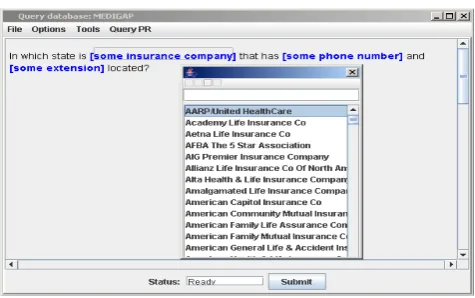
Figure 3 shows a snapshot of the query editing interface where query (2.1) is being composed.
Each query frame is syntactically realised by
using specially designed grammar rules. The
generation of high level queries such as those in Example (1.1) relies on basic query syntax rules. The semantic type of each linked element determines the type of wh-question that will be constructed. For example, if the element has the semantic type location, we will construct where questions, whilst a node with the semantic type
PERSON will give rise to a who-question. In order to avoid ambiguities, we impose further restrictions on the realisation of the query frames. If there is more than one location-type element linked to a node, the system will not generate two
where query frames, which would be ambiguous,
but more specific which queries. For example,
our database contains two nodes of semantic type
location linked to the node OrgName. The first
describes the state where an insurance company is located, the second its address. The query frames generated will be:
Example (3):
1. In which states is some insurance
company located?
2. At what addresses is some insurance
company located?
The basic grammar rule pattern for queries based on one table only states that elements linked to a particular node will be realised in relative clauses modifying that node. For example, in Ex-ample (2.1), the nodes phones and ext are accessi-ble from the node orgName, therefore will be re-alised in a relative clause that modifies insurance
company.
In the case where the information comes from more than one table, it is necessary to introduce more complex layout features in order to make the query readable. For each table that provides in-formation about the focused element we generate bulleted lines as in Example (2.3).
Each question frame consists of a bound
ele-ment2, i.e., the user cannot edit any values for that
particular element. This corresponds to the infor-mation that represents the answer to the questions. In example (2), the bound element is state. All other nodes will be realised in the feedback text as anchors, that are editable by users. One ex-ception is represented by nodes that correspond to database elements of boolean type. In this case, the anchor will not be associated to a node, but to a relation, as in Example (2.3) (the availability of an insurance plan is a boolean value). This is to allow the verb to take negative form - in our ex-ample, one can have is available to people over 65 or is not available to people over 65.
Since not all anchors have to be filled in, one query frame can in fact represent more than one real-life question. In example (4), one can edit the query to compose any of the following corresponding natural language questions:
Example (4):
1. In which state is the insurance
company with the phone number 8008474836
located?
2. In which state is the insurance
2
Figure 3: Query editing interface snapshot
company Thrivent Financial for Lutherans
with the phone number 8008474836
located?
3. In which state is the insurance
company Thrivent Financial for Lutherans
with the phone number 8008474836 and
extension 8469 located?
The actual values of anchors are extracted from the database and transformed into correct lexicon entries on a per-need basis. The strings associated with a value (e.g. Thrivent Financial for
Luther-ans) are retrieved from the database table and
col-umn indicated in the description of the node that was used for generating the anchor (e.g. orgName) and the syntactic role (e.g. proper noun) is given by the syntactic information associated with the node.
3.4 Query translation module
Once a query has been constructed, it is rep-resented internally as a directed acyclic graph. Moreover, each node in the graph can be mapped into a node in the semantic graph of the database. The translation module transforms a contructed
query to an SQL statement by parsing the query
graph and combining it with the corresponding el-ements in the semantic graph.
The SELECT portion of the statement contains the focused element. The WHERE portion con-tains those nodes in the question graph that cor-respond to edited anchors. For constructing the FROM portion of the statement, we extract, from the semantic graph, for each SELECTED element information about their corresponding database ta-ble.
For example, if we assume that in Example (2.1)
the user has specified the name of the company
and its phone number, the SQL statement
gener-ated will be:
SELECT dbo_vwOrgsByState.StateName FROM dbo_vwOrgsByState
WHERE org_name="Thrivent Financial for Lutherans"
And org_phone="8008474836";
4 Evaluation
4.1 Usability
A recent study of the usability of aWYSIWYMtype
of interface for querying databases (Hallett et al., 2006) has shown that users can learn how to use the interface after a very brief training and suc-ceed in composing queries of quite a high level of complexity. They achieve near-perfect query con-struction after the first query they compose. The study also showed that the queries as they appear
in the WYSIWYM feedback text are unambiguous
— not only to the back-end system — but also to the user, i.e., users are not misled into constructing queries that may have a different meaning than the one intended. Additionally, it appears that expert
users of SQL , with expert knowledge of the
un-derlying database, find the query interface easier
to use than querying the database directly inSQL
4.2 Coverage
We have assessed the coverage of the system us-ing as our test set a set of English questions posed over a database of geographical information GEOBASE, as in (Tang and Mooney, 2001) and (Popescu et al., 2003). Our first step was to convert the original Prolog database (containing about 800 facts) into a relational database. Then we tested how many of the 250 human produced questions in the test set can be constructed using our system. There are several issues in using this particu-lar dataset for testing. Since we do not provide a pure natural language interface, the queries our system can construct are not necessarily expressed in the same way or using the same words as the questions in the test set. For example, the ques-tion ”How high is Mount McKinley?” in the test set is equivalent to ”What is the height of Mount
McKinley?” produced by our system. Similarly,
”Name all the rivers in Colorado.” is equivalent to ”Which rivers flow through Colorado?”. Also, since the above test set was designed for testing and evaluating natural language interfaces, many of the questions have equivalent semantic content. For example, ”How many people live in
Califor-nia?” is semantically equivalent to ”What is the population of California?”. Similarly, there is no
difference in composing and analysing ”What is
the population of Utah?” and ”What is the popu-lation of New York City?”.
Out of 250 test questions, 100 had duplicate se-mantic content and the remaining 150 had original content. On the whole test set of 250 questions, our system was able to generate query frames that allow the construction of 145 questions, therefore 58%. The remaining 42% of questions belong to a single type of questions that our current imple-mentation cannot handle, which is questions that require inferences over numerical types, such as
Which is the highest point in Alaska? or What is the combined area of all 50 states?.
Similar results are achieved when testing the system on the 150 relevant questions only: 60% of the questions can be formulated, while the re-maining 40% cannot.
4.3 Correctness
The correctness of theSQL generated queries was
assessed on the subset of queries that our system can formulate out of the total number of queries
in the test set. We found that the correct SQLwas
produced for all the generated WYSIWYM queries
produced.
5 Conclusions & Further work
Our method presents three main advantages over other natural language interfaces to databases: 1. It is easily customizable for new domains and databases.
2. It eliminates errors in parsing and query-to-SQL
translation.
3. It makes clear to the user the full range of possible queries that can be posed to any given database.
From a user’s point of view, one could argue that our method is less natural to use than one that allows unconstrained (or less constrained) natural language input. It could also be said that while syntactically correct, the queries as presented to the user may not be as fluent as human-authored questions. These possible disadvantages are, in our opinion, outweighed by the clarity of the query composition process, since the user is fully in con-trol of the semantic content of the query she com-poses; they are unambiguous to both the user and the back-end system.
We are currently extending this work to cover more complex queries that require inferences and ones that contain elements linked through tempo-ral relations. We will also refine the query layout procedures to allow complex queries to be pre-sented in a more intuitive way. Additionally, we are about to begin work on automating the the con-struction of the semantic graph. We expect that some of the semantic and syntactic information that, at the moment, has to be manually entered in the description of the semantic graph can be in-ferred automatically from the database content.
Acknowledgement
The work described in this paper is part of the Clinical E-Science Framework (CLEF) project, funded by the Medical Research Council grant
G0100852 under the E-Science Initiative. We
References
I. Androutsopoulos, G.Ritchie, and P.Thanitsch. 1993. An effcient and portable natural language query in-terface for relational databases. In Proceedings of
the 6th International Conference on Industrial En-gineering Applications of Artificial Intelligence and Expert Systems Edinburgh, pages 327–330.
I. Androutsopoulos, G.D. Ritchie, and P.Thanisch. 1995. Natural language interfaces to databases -an introduction. Natural Language Engineering,
2(1):29–81.
I. Androutsopoulos. 1992. Interfacing a natural lan-guage front end to a relational database. Master’s thesis, Department of Artificial Intelligence Univer-sity of Edinburgh.
Gregor Erbach. 1995. ProFIT – prolog with features, inheritance, and templates. In Proceedings of the
7th Conference of the European Chapter of the Ass-cociation for Computational Linguistics, EACL-95,
Dublin, Ireland.
A. Frank, Hans-Ulrich Krieger, Feiyu Xu, Hans Uszko-reit, Berthold Crysmann, Brigitte Jorg, and Ulrich Schafer. 2005. Querying structured knowledge sources. In AAAI-05 Workshop on Question
Answer-ing in Restricted Domains, Pittsburgh,
Pennsylva-nia.
Carole D. Hafner and Kurt Godden. 1985. Portability of syntax and semantics in datalog. ACM Trans. Inf.
Syst., 3(2):141–164.
C. Hallett, D. Scott, and R.Power. 2005. Intuitive querying of ehealth data repositories. In
Proceed-ings of the UK E-Science All-Hands Meeting,
Not-tingham, UK.
C. Hallett, D. Scott, and R.Power. 2006. Evaluation of the clef query interface. Technical Report 2006/01, Department of Computing, The Open University.
Gary G. Hendrix, Earl D. Sacerdoti, Daniel Sagalow-icz, and Jonathan Slocum. 1978. Developing a natu-ral language interface to complex data. ACM Trans.
Database Syst., 3(2):105–147.
S. Jerrold Kaplan. 1984. Designing a portable nat-ural language database query system. ACM Trans.
Database Syst., 9(1):1–19.
R.J. Kate, Y.W. Wong, and R.J. Mooney. 2005. Learn-ing to transform natural to formal languages. In
Pro-ceedings of the Twentieth National Conference on Artificial Intelligence (AAAI-05), pages 1062–1068,
Pittsburgh, PA.
B.G.T. Lowden, B.R. Walls, A. De Roeck, C.J. Fox, and R. Turner. 1991. A formal approach to translat-ing english into sql. In Jackson and Robinson, edi-tors, Proceedings of the 9th British National
Confer-ence on Databases.
Eva-Martin Mueckstein. 1985. Controlled natural language interfaces (extended abstract): the best of three worlds. In CSC ’85: Proceedings of the 1985
ACM thirteenth annual conference on Computer Sci-ence, pages 176–178, New York, NY, USA. ACM
Press.
P. Piwek, R. Evans, L. Cahill, and N. Tipper. 2000. Natural language generation in the mile system. In
Proceedings of the IMPACTS in NLG Workshop,
Schloss Dagstuhl, Germany.
P. Piwek. 2002. Requirements definition, validation, verification and evaluation of the clime interface and language processing technology. Technical Report ITRI-02-03, ITRI, University of Brighton.
Ana-Maria Popescu, Oren Etzioni, and Henry Kautz. 2003. Towards a theory of natural language in-terfaces to databases. In IUI ’03: Proceedings of
the 8th international conference on Intelligent user interfaces, pages 149–157, New York, NY, USA.
ACM Press.
Richard Power and Donia Scott. 1998. Multilin-gual authoring using feedback texts. In Proceedings
of 17th International Conference on Computational Linguistics and 36th Annual Meeting of the Associ-ation for ComputAssoci-ational Linguistics (COLING-ACL 98), pages 1053–1059, Montreal, Canada.
Lappoon R. Tang and Raymond J. Mooney. 2001. Us-ing multiple clause constructors in inductive logic programming for semantic parsing. In EMCL ’01:
Proceedings of the 12th European Conference on Machine Learning, pages 466–477, London, UK.
Springer-Verlag.
Marjorie Templeton and John Burger. 1983. Problems in natural-language interface to dbms with examples from eufid. In Proceedings of the first conference
on Applied natural language processing, pages 3–
16, Morristown, NJ, USA. Association for Compu-tational Linguistics.
Harry R. Tennant, Kenneth M. Ross, and Craig W. Thompson. 1983. Usable natural language inter-faces through menu-based natural language under-standing. In CHI ’83: Proceedings of the SIGCHI
conference on Human Factors in Computing Sys-tems, pages 154–160, New York, NY, USA. ACM
Press.
C. Thompson, P. Pazandak, and H. Tennant. 2005. Talk to your semantic web. IEEE Internet
Comput-ing, 9:75–78.
Guogen Zhang, Wesley W. Chu, Frank Meng, and Gladys Kong. 1999. Query formulation from high-level concepts for relational databases. In UIDIS
’99: Proceedings of the 1999 User Interfaces to Data Intensive Systems, page 64, Washington, DC,