How Many Bits Are Needed To Store Probabilities
for Phrase-Based Translation?
Marcello Federico and Nicola Bertoldi
ITC-irst - Centro per la Ricerca Scientifica e Tecnologica 38050 Povo - Trento, Italy
{federico,bertoldi}@itc.it
Abstract
State of the art in statistical machine trans-lation is currently represented by phrase-based models, which typically incorpo-rate a large number of probabilities of phrase-pairs and word n-grams. In this
work, we investigate data compression methods for efficiently encoding n-gram
and phrase-pair probabilities, that are usu-ally encoded in 32-bit floating point num-bers. We measured the impact of com-pression on translation quality through a phrase-based decoder trained on two dis-tinct tasks: the translation of European Parliament speeches from Spanish to En-glish, and the translation of news agencies from Chinese to English. We show that with a very simple quantization scheme all probabilities can be encoded in just 4 bits with a relative loss in BLEU score on the two tasks by 1.0% and 1.6%, respectively.
1 Introduction
In several natural language processing tasks, such as automatic speech recognition and machine transla-tion, state-of-the-art systems rely on the statistical approach.
Statistical machine translation (SMT) is based on parametric models incorporating a large num-ber of observations and probabilities estimated from monolingual and parallel texts. The current state of the art is represented by the so-called phrase-based translation approach (Och and Ney, 2004; Koehn et
al., 2003). Its core components are a translation model that contains probabilities of phrase-pairs, and a language model that incorporates probabilities of word n-grams.
Due to the intrinsic data-sparseness of language corpora, the set of observations increases almost lin-early with the size of the training data. Hence, to efficiently store observations and probabilities in a computer memory the following approaches can be tackled: designing compact data-structures, pruning rare or unreliable observations, and applying data compression.
In this paper we only focus on the last approach. We investigate two different quantization methods to encode probabilities and analyze their impact on translation performance. In particular, we address the following questions:
• How does probability quantization impact on the components of the translation system, namely the language model and the translation model?
• Which is the optimal trade-off between data compression and translation performance?
• How do quantized models perform under dif-ferent data-sparseness conditions?
• Is the impact of quantization consistent across different translation tasks?
English, and the translation of news agencies from Chinese to English, according to the set up defined by the 2005 NIST MT Evaluation Workshop.
The paper is organized as follows. Section 2 re-views previous work addressing efficiency in speech recognition and information retrieval. Section 3 in-troduces the two quantization methods considered in this paper, namely the Lloyd’s algorithm and the Binning method. Section 4 briefly describes our phrase-based SMT system. Sections 5 reports and discusses experimental results addressing the ques-tions in the introduction. Finally, Section 6 draws some conclusions.
2 Previous work
Most related work can be found in the area of speech recognition, where n-gram language models have been used for a while.
Efforts targeting efficiency have been mainly fo-cused on pruning techniques (Seymore and Rosen-feld, 1996; Gao and Zhang, 2002), which permit to significantly reduce the amount of n-grams to be stored at a negligible cost in performance. More-over, very compact data-structures for storing back-off n-gram models have been recently proposed by Raj and Whittaker (2003).
Whittaker and Raj (2001) discuss probability en-coding as a means to reduce memory requirements of an n-gram language model. Quantization of a 3-gram back-off model was performed by applying the k-means Lloyd-Max algorithm at each n-gram level. Experiments were performed on several large-vocabulary speech recognition tasks by considering different levels of compression. By encoded proba-bilities in 4 bits, the increase in word-error-rate was only around 2% relative with respect to a baseline using 32-bit floating point probabilities.
Similar work was carried out in the field of formation retrieval, where memory efficiency is in-stead related to the indexing data structure, which contains information about frequencies of terms in all the individual documents. Franz and McCarley (2002) investigated quantization of term frequencies by applying a binning method. The impact on re-trieval performance was analyzed against different quantization levels. Results showed that 2 bits are sufficient to encode term frequencies at the cost of a
negligible loss in performance.
In our work, we investigate both data compres-sion methods, namely the Lloyd’s algorithm and the binning method, in a SMT framework.
3 Quantization
Quantization provides an effective way of reducing the number of bits needed to store floating point variables. The quantization process consists in par-titioning the real space into a finite set ofk quantiza-tion levelsand identifying a centercifor each level,
i= 1, . . . , k. A functionq(x)maps any real-valued
pointx onto its unique centerci. Cost of quantiza-tion is the approximaquantiza-tion error betweenxandci.
Ifk = 2h,
hbits are enough to represent a floating
point variable; as a floating point is usually encoded in 32 bits (4 byte), the compression ratio is equal to32/h1 . Hence, the compression ratio also gives
an upper bound for the relative reduction of mem-ory use, because it assumes an optimal implemen-tation of data structures without any memory waste. Notice that memory consumption for storing thek
-entry codebook is negligible (k∗32bits).
As we will apply quantization on probabilistic distribution, we can restrict the range of real val-ues between 0 and 1. Most quantization algorithms require a fixed (although huge) amount of points in order to define the quantization levels and their centers. Probabilistic models used in SMT satisfy this requirement because the set of parameters larger than 0 is always limited.
Quantization algorithms differ in the way parti-tion of data points is computed and centers are iden-tified. In this paper we investigate two different quantization algorithms.
Lloyd’s Algorithm
Quantization of a finite set of real-valued data points can be seen as a clustering problem. A large fam-ily of clustering algorithms, called k-means algo-rithms (Kanungo et al., 2002), look for optimal cen-ters ci which minimize the mean squared distance from each data point to its nearest center. The map between points and centers is trivially derived.
1In the computation of the compression ratio we take into
As no efficient exact solution to this problem is known, either polynomial-time approximation or heuristic algorithms have been proposed to tackle the problem. In particular, Lloyd’s algorithm starts from a feasible set of centers and iteratively moves them until some convergence criterion is satisfied. Finally, the algorithm finds a local optimal solution. In this work we applied the version of the algorithm available in the K-MEANS package2.
Binning Method
The binning method partitions data points into uni-formly populated intervals or bins. The center of each bin corresponds to the mean value of all points falling into it. IfNi is the number of points of the
i-th bin, andxi the smallest point in thei-th bin, a partition [xi, xi+1] results such that Ni is constant for eachi= 0, . . . , k−1, wherexk = 1by default. The following map is thus defined:
q(x) =ciifxi<=x < xi+1.
Our implementation uses the following greedy
strategy: bins are build by uniformly partition all different points of the data set.
4 Phrase-based Translation System
Given a string f in the source language, our SMT
system (Federico and Bertoldi, 2005; Cettolo et al., 2005), looks for the target stringemaximizing the
posterior probability Pr(e,a | f) over all possible
word alignments a. The conditional distribution is
computed with the log-linear model:
pλ(e,a|f) ∝ exp
( R X
r=1
λrhr(e,f,a)
)
,
wherehr(e,f,a), r= 1. . . Rare real valued feature functions.
The log-linear model is used to score translation hypotheses(e,a)built in terms of strings of phrases,
which are simple sequences of words. The transla-tion process works as follows. At each step, a target phrase is added to the translation whose correspond-ing source phrase withinfis identified through three
random quantities: thefertilitywhich establishes its length; thepermutationwhich sets its first position;
2www.cs.umd.edu/
∼mount/Projects/KMeans.
thetabletwhich tells its word string. Notice that tar-get phrases might have fertility equal to zero, hence they do not translate any source word. Moreover, untranslated words in f are also modeled through
some random variables.
The choice of permutation and tablets can be constrained in order to limit the search space un-til performing a monotone phrase-based translation. In any case, local word reordering is permitted by phrases.
The above process is performed by a beam-search decoder and is modeled with twelve feature func-tions (Cettolo et al., 2005) which are either esti-mated from data, e.g. the target n-gram language models and the phrase-based translation model, or empirically fixed, e.g. the permutation models. While feature functions exploit statistics extracted from monolingual or word-aligned texts from the training data, the scaling factors λof the log-linear
model are empirically estimated on development data.
The two most memory consuming feature func-tions are the phrase-based Translation Model (TM) and the n-gram Language Model (LM).
Translation Model
The TM contains phrase-pairs statistics computed on a parallel corpus provided with word-alignments in both directions. Phrase-pairs up to length 8 are extracted and singleton observations are pruned off. For each extracted phrase-pair ( ˜f ,e˜), four
transla-tion probabilities are estimated: – a smoothed frequency off˜given˜e
– a smoothed frequency of˜egivenf˜
– an IBM model 1 based probability ofe˜givenf˜
– an IBM model 1 based probability off˜givene˜
Hence, the number of parameters of the transla-tion models corresponds to 4 times the number of extracted phrase-pairs. From the point of view of quantization, the four types of probabilities are con-sidered separately and a specific codebook is gener-ated for each type.
Language Model
num-task parallel resources mono resources LM TM src trg words 1-gram 2-gram 3-gram 4-gram phrase pairs
NIST 82,168 88,159 463,855 1,408 20,475 29,182 46,326 10,410
EPPS 34,460 32,951 3,2951 110 2,252 2,191 2,677 3,877
EPPS-800 23,611 22,520 22,520 90 1,778 1,586 1,834 2,499
EPPS-400 11,816 11,181 11,181 65 1,143 859 897 1,326
EPPS-200 5,954 5,639 5,639 47 738 464 439 712
[image:4.612.313.511.203.248.2]EPPS-100 2,994 2,845 2,845 35 469 246 213 387
Table 1: Figures (in thousand) regarding the training data of each translation task.
ber of parameters, each n-gram, with n < 4, has
two probabilities associated with: the probability of then-gram itself, and the back-off probability of the
corresponding n+ 1-gram extensions. Finally,
4-grams have only one probability associated with. For the sake of quantization, two separate code-books are generated for each of the first three lev-els, and one codebook is generated for the last level. Hence, a total of 7 codebooks are generated. In all discussed quantized LMs, unigram probabilities are always encoded with 8 bits. The reason is that uni-gram probabilities have indeed the largest variability and do not contribute significantly to the total num-ber of parameters.
5 Experiments
Data and Experimental Framework
We performed experiments on two large vocabulary translation tasks: the translation of European Parlia-mentary Plenary Sessions (EPPS) (Vilar et al., 2005) from Spanish to English, and the translation of doc-uments from Chinese to English as proposed by the NIST MT Evaluation Workshops3.
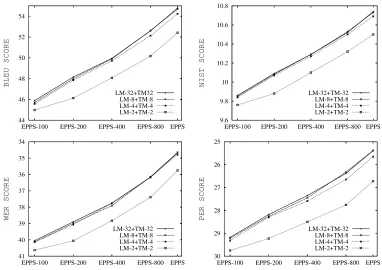
Translation of EPPS is performed on the so-called final text editions, which are prepared by the trans-lation office of the European Parliament. Both the training and testing data were collected by the TC-STAR4 project and were made freely available to participants in the 2006 TC-STAR Evaluation Cam-paign. In order to perform experiments under differ-ent data sparseness conditions, four subsamples of the training data with different sizes were generated, too.
Training and test data used for the NIST task are 3www.nist.gov/speech/tests/mt/.
4www.tc-star.org
task sentences src words ref words
EPPS 840 22725 23066
NIST 919 25586 29155
Table 2: Statistics of test data for each task.
available through the Linguistic Data Consortium5. Employed training data meet the requirements set for the Chinese-English large-data track of the 2005 NIST MT Evaluation Workshop. For testing we used instead the NIST 2003 test set.
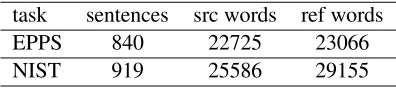
Table 1 reports statistics about the training data of each task and the models estimated on them. That is, the number of running words of source and target languages, the number of n-grams in the language
model and the number phrase-pairs in the transla-tion model. Table 2 reports instead statistics about the test sets, namely, the number of source sentences and running words in the source part and in the gold reference translations.
Translation performance was measured in terms of BLEU score, NIST score, word-error rate (WER), and position independent error rate (PER). Score computation relied on two and four reference trans-lations per sentence, respectively, for the EPPS and NIST tasks. Scores were computed in case-insensitive modality with punctuation. In general, none of the above measures is alone sufficiently in-formative about translation quality, however, in the community there seems to be a preference toward reporting results with BLEU. Here, to be on the safe side and to better support our findings we will report results with all measures, but will limit discussion on performance to the BLEU score.
LM-h
32 8 6 5 4 3 2
32 54.78 54.75 54.73 54.65 54.49 54.24 53.82 8 54.78 54.69 54.69 54.79 54.55 54.18 53.65 6 54.57 54.49 54.76 54.57 54.63 54.26 53.60 TM-h 5 54.68 54.68 54.56 54.61 54.60 54.10 53.39 4 54.37 54.36 54.47 54.44 54.23 54.06 53.26 3 54.28 54.03 54.22 53.96 53.75 53.69 53.03 2 53.58 53.51 53.47 53.35 53.39 53.41 52.41
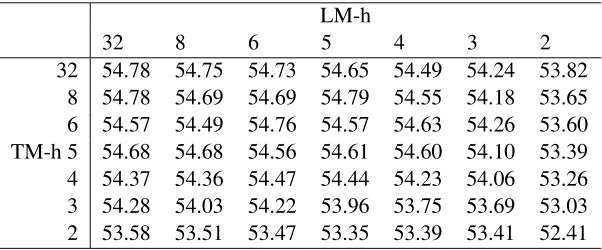
Table 3: BLEU scores in the EPPS task with different quantization levels of the LM and TM.
tion, all reported experiments were performed with a plain configuration of the ITC-irst SMT system. That is, we used a single decoding step, no phrase re-ordering, and task-dependent weights of the log-linear model.
Henceforth, LMs and TM quantized with h bits
are denoted with LM-h and TM-h, respectively. Non quantized models are indicated with LM-32 andTM-32.
Impact of Quantization on LM and TM
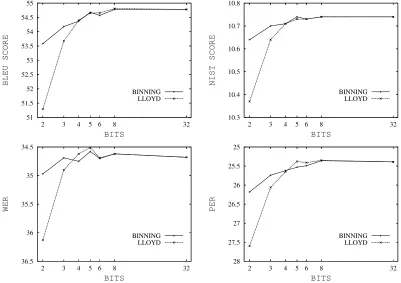
A first set of experiments was performed on the EPPS task by applying probability quantization ei-ther on the LM or on the TMs. Figures 1 and 2 compare the two proposed quantization algorithms (LLOYD and BINNING) against different levels of quantization, namely 2, 3, 4, 5, 6, and 8 bits. The scores achieved by the non quantized models (LM-32andTM-32) are reported as reference.
The following considerations can be drawn from these results. The Binning method works slightly, but not significantly, better than the Lloyd’s algo-rithm, especially with the highest compression ra-tios.
In general, the LM seems less affected by data compression than the TM. By comparing tion with the binning method against no quantiza-tion, the BLEU score with LM-4 is only 0.42% rel-ative worse (54.78 vs 54.55). Degradation of BLEU score by TM-4 is 0.77% (54.78 vs 54.36). For all the models, encoding with 8 bits does not affect transla-tion quality at all.
In following experiments, binning quantization was applied to both LM and TM. Figure 3 plots all scores against different levels of quantization. As references, the curves corresponding to only
LM-h TM-h BLEU NIST WER PER 32 32 28.82 8.769 62.41 42.30
8 8 28.87 8.772 62.39 42.19
4 4 28.36 8.742 62.94 42.45
[image:5.612.156.457.52.177.2]2 2 25.95 8.491 65.87 44.04
Table 4: Translation scores on the NIST task with different quantization levels of the LM and TM.
LM quantization (LM-h) and only TM quantization (TM-h) are shown. Independent levels of quantiza-tion of the LM and TM were also considered. BLEU scores related to several combinations are reported in Table 3.
Results show that the joint impact of LM and TM quantization is almost additive. Degradation with 4 bits quantization is only about 1% relative (from 54.78 to 54.23). Quantization with 2 bits is sur-prisingly robust: the BLEU score just decreases by 4.33% relative (from 54.78 to 52.41).
Quantization vs. Data Sparseness
Consistency Across Different Tasks
A subset of quantization settings tested with the EPPS tasks was also evaluated on the NIST task. Results are reported in Table 4.
Quantization with 8 bits does not affect perfor-mance, and gives even slightly better scores. Also quantization with 4 bits produces scores very close to those of non quantized models, with a loss in BLEU score of only 1.60% relative. However, push-ing quantization to 2 bits significantly deteriorates performance, with a drop in BLEU score of 9.96% relative.
In comparison to the EPPS task, performance degradation due to quantization seems to be twice as large. In conclusion, consistent behavior is observed among different degrees of compression. Absolute loss in performance, though quite different from the EPPS task, remains nevertheless very reasonable.
Performance vs. Compression
From the results of single versus combined com-pression, we can reasonably assume that perfor-mance degradation due to quantization of LM and TM probabilities is additive. Hence, as memory sav-ings on the two models are also independent we can look at the optimal trade-off between performance and compression separately. Experiments on the NIST and EPPS tasks seem to show that encoding of LM and TM probabilities with 4 bits provides the best trade-off, that is a compression ratio of 8 with a relative loss in BLEU score of 1% and 1.6%. It can be seen that score degradation below 4 bits grows generally faster than the corresponding memory sav-ings.
6 Conclusion
In this paper we investigated the application of data compression methods to the probabilities stored by a phrase-based translation model. In particular, probability quantization was applied on the n-gram language model and on the phrase-pair translation model. Experimental results confirm previous find-ings in speech recognition: language model proba-bilities can be encoded in just 4 bits at the cost of a very little loss in performance. The same resolu-tion level seems to be a good compromise even for the translation model. Remarkably, the impact of
quantization on the language model and translation model seems to be additive with respect to perfor-mance. Finally, quantization does not seems to be affected by data sparseness and behaves similarly on different translation tasks.
References
M Cettolo, M. Federico, N. Bertoldi, R. Cattoni, and B. Chen. 2005. A Look Inside the ITC-irst SMT Sys-tem. InProc. of MT Summit X, pp. 451–457, Pukhet, Thailand.
S. F. Chen and J. Goodman. 1998. An Empirical Study of Smoothing Techniques for Language Mod-eling. Technical Report TR-10-98, Computer Science Group, Harvard University, Cambridge, MA, USA. M. Federico and N. Bertoldi. 2005. A Word-to-Phrase
Statistical Translation Model. ACM Transaction on
Speech Language Processing, 2(2):1–24.
M. Franz and J. S. McCarley. 2002. How Many Bits are Needed to Store Term Frequencies. InProc. of ACM
SIGIR, pp. 377–378, Tampere, Finland.
J. Gao and M. Zhang. 2002. Improving Language Model Size Reduction using Better Pruning Criteria. InProc. of ACL, pp. 176–182, Philadelphia, PA.
T. Kanungo, D. M. Mount, N. Netanyahu, C. Piatko, R. Silverman, , and A. Y. Wu. 2002. An Efficient K-Means Clustering Algorithm: Analysis and Imple-mentation.IEEE Transaction on Pattern Analysis and
Machine Intelligence, 24(7):881–892.
P. Koehn, F. J. Och, and D. Marcu. 2003. Statistical Phrase-Based Translation. In Proc. of HLT/NAACL 2003, pp. 127–133, Edmonton, Canada.
F. J. Och and H. Ney. 2004. The Alignment Template Approach to Statistical Machine Translation. Compu-tational Linguistics, 30(4):417–449.
B. Raj and E. W. D. Whittaker. 2003. Lossless Compres-sion of Language Model Structure and Word Identi-fiers. InProc. of ICASSP, pp. 388–391, Honk Kong. K. Seymore and R. Rosenfeld. 1996. Scalable Backoff
Language Models. InProc. of ICSLP, vol. 1, pp. 232– 235, Philadelphia, PA.
D. Vilar, E. Matusov, S. Hasan, R . Zens, , and H. Ney. 2005. Statistical Machine Translation of European Parliamentary Speeches. In Proc. of MT Summit X, pp. 259–266, Pukhet, Thailand.
51 51.5 52 52.5 53 53.5 54 54.5 55
32 8
6 5 4 3 2
BLEU SCORE
BITS
BINNING LLOYD
10.3 10.4 10.5 10.6 10.7 10.8
32 8
6 5 4 3 2
NIST SCORE
BITS
BINNING LLOYD
34.5
35
35.5
36
36.5
32 8
6 5 4 3 2
WER
BITS
BINNING LLOYD
25
25.5
26
26.5
27
27.5
28
32 8
6 5 4 3 2
PER
BITS
[image:7.612.103.501.59.348.2]BINNING LLOYD
Figure 1: EPPS task: translation scores vs. quantization level of LM. TM is not quantized.
51 51.5 52 52.5 53 53.5 54 54.5 55
32 8
6 5 4 3 2
BLEU SCORE
BITS
BINNING LLOYD
10.3 10.4 10.5 10.6 10.7 10.8
32 8
6 5 4 3 2
NIST SCORE
BITS
BINNING LLOYD
34.5
35
35.5
36
36.5
32 8
6 5 4 3 2
WER
BITS
BINNING LLOYD
25
25.5
26
26.5
27
27.5
28
32 8
6 5 4 3 2
PER
BITS
BINNING LLOYD
[image:7.612.102.503.390.673.2]52 52.5 53 53.5 54 54.5 55
32 8
6 5 4 3 2
BLEU SCORE
BITS
LM-h+TM-h LM-h TM-h
10.4 10.45 10.5 10.55 10.6 10.65 10.7 10.75 10.8
32 8
6 5 4 3 2
NIST SCORE
BITS
LM-h+TM-h LM-h TM-h
34.6 34.8 35 35.2 35.4 35.6 35.8 36
32 8
6 5 4 3 2
WER
BITS
LM-h+TM-h LM-h TM-h
25
25.5
26
26.5
27
32 8
6 5 4 3 2
PER
BITS
[image:8.612.104.501.56.343.2]LM-h+TM-h LM-h TM-h
Figure 3: EPPS task: translation scores vs. quantization level of LM and TM. Quantization was performed with the Binning algorithm.
44 46 48 50 52 54
EPPS EPPS-800 EPPS-400
EPPS-200 EPPS-100
BLEU SCORE
LM-32+TM32 LM-8+TM-8 LM-4+TM-4 LM-2+TM-2
9.6 9.8 10 10.2 10.4 10.6 10.8
EPPS EPPS-800 EPPS-400
EPPS-200 EPPS-100
NIST SCORE
LM-32+TM-32 LM-8+TM-8 LM-4+TM-4 LM-2+TM-2
34
35
36
37
38
39
40
41
EPPS EPPS-800 EPPS-400
EPPS-200 EPPS-100
WER SCORE
LM-32+TM-32 LM-8+TM-8 LM-4+TM-4 LM-2+TM-2
25
26
27
28
29
30
EPPS EPPS-800 EPPS-400
EPPS-200 EPPS-100
PER SCORE
LM-32+TM-32 LM-8+TM-8 LM-4+TM-4 LM-2+TM-2
[image:8.612.112.494.392.662.2]