A Data Driven Approach to Relevancy Recognition for
Contextual Question Answering
Fan Yang∗
OGI School of Science & Engineering Oregon Health & Science University
Junlan Feng and Giuseppe Di Fabbrizio AT&T Labs - Research
180 Park Avenue, Florham Park, NJ, 07932 - USA
[email protected], [email protected]
Abstract
Contextual question answering (QA), in which users’ information needs are satis-fied through an interactive QA dialogue, has recently attracted more research atten-tion. One challenge of engaging dialogue into QA systems is to determine whether a question is relevant to the previous inter-action context. We refer to this task as rel-evancy recognition. In this paper we pro-pose a data driven approach for the task of relevancy recognition and evaluate it on two data sets: the TREC data and the HandQA data. The results show that we achieve better performance than a previ-ous rule-based algorithm. A detailed eval-uation analysis is presented.
1 Introduction
Question Answering (QA) is an interactive human-machine process that aims to respond to users’ natural language questions with exact answers rather than a list of documents. In the last few years, QA has attracted broader research attention from both the information retrieval (Voorhees, 2004) and the computational linguistic fields (http://www.clt.mq.edu.au/Events/ Conferences/acl04qa/). Publicly ac-cessible web-based QA systems, such as AskJeeves (http://www.ask.com/) and START (http://start.csail.mit.edu/), have scaled up
∗
The work was done when the first author was visiting AT&T Labs - Research.
this technology to open-domain solutions. More task-oriented QA systems are deployed as virtual customer care agents addressing questions about specific domains. For instance, the AT&T Ask Allier agent (http://www.allie.att.com/) is
able to answer questions about the AT&T plans and services; and the Ikea “Just Ask Anna!” agent (http://www.ikea.com/ms/en US/) targets ques-tions pertaining the company’s catalog. Most of these QA systems, however, are limited to answer questions in isolation. The reality is that users often ask questions naturally as part of contextualized interaction. For instance, a question “How do I subscribe to the AT&T CallVantager service?” is
likely to be followed by other related questions like “How much will the basic plan cost?” and so on. Furthermore, many questions that users frequently want answers for cannot be satisfied with a simple answer. Some of them are too complicated, broad, narrow, or vague resulting that there isn’t a simple good answer or there are many good answer candidates, which entails a clarification procedure to constrain or relax the search. In all these cases, a question answering system that is able to answer contextual questions is more favored.
Contextual question answering as a research chal-lenge has been fostered by TREC (Text Retrieval Conference) since 2001. The TREC 2001 QA track made the first attempt to evaluate QA systems’ abil-ity of tracking context through a series of questions. The TREC 2004 re-introduced this task and orga-nized all questions into 64 series, with each series focusing on a specific topic. The earlier questions in a series provide context for the on-going ques-tion. However, in reality, QA systems will not be
informed about the boundaries between series in ad-vance.
One challenge of engaging dialogue into QA sys-tems is to determine the boundaries between topics. For each question, the system would need to deter-mine whether the question begins a new topic or it is a follow-up question related to the current exist-ing topic. We refer to this procedure as relevancy
recognition. If a question is recognized as a
follow-up question, the next step is to make use of context information to interpret it and retrieve the answer. We refer to this procedure as context information
fu-sion. Relevancy recognition is similar to text
seg-mentation (Hearst, 1994), but relevancy recognition focuses on the current question with the previous text while text segmentation has the full text avail-able and is allowed to look ahead.
De Boni and Manandhar (2005) developed a rule-based algorithm for relevancy recognition. Their rules were manually deduced by carefully analyzing the TREC 2001 QA data. For example, if a question has no verbs, it is a follow-up question. This rule-based algorithm achieves 81% in accuracy when rec-ognizing the question relevance in the TREC 2001 QA data set. The disadvantage of this approach is that it involves a good deal of human effort to re-search on a specific data set and summarize the rules. For a new corpus from a different domain, it is very likely that one would have to go over the data set and modify the rules, which is time and human-effort consuming. An alternative is to pursue a data driven approach to automatically learn the rules from a data set. In this paper, we describe our experiments of using supervised learning classification techniques for the task of relevancy recognition. Experiments show that machine learning approach achieves better recognition accuracy and can also be easily applied to a new domain.
The organization of this paper is as follows. In Section 2, we summarize De Boni and Manandhar’s rule-based algorithm. We present our learning ap-proach in Section 3. We ran our experiments on two data sets, namely, the TREC QA data and the HandQA data, and give the results in Section 4. In section 5, we report our preliminary study on con-text information fusion. We conclude this paper in Section 6.
2 Rule-Based Approach
De Boni and Manandhar (2005) observed the fol-lowing cues to recognize follow-up questions:
• Pronouns and possessive adjectives. For
exam-ple, if a question has a pronoun that does not re-fer to an entity in the same sentence, this ques-tion could be a follow-up quesques-tion.
• Cue words, such as “precisely” and “exactly”.
• Ellipsis. For example, if a question is not
syn-tactically complete, this question could be a follow-up question.
• Semantic Similarity. For example, if a
ques-tion bears certain semantic similarity to previ-ous questions, this question might be a follow-up question.
De Boni and Manandhar (2005) proposed an algorithm of calculating the semantic similar-ity between the current questionQ and a pre-vious questionQ0. Supposed Q consists of a list of words (w1, w2, ..., wn) andQ0 consists
of (w0
1, w02, ..., w0m):
SentenceSimilarity(Q, Q0) (1)
= X
1≤j≤n
( max
1≤i≤mW ordSimilarity(wj, w
0
i))
The value of W ordSimilarity(w, w0) is the similarity between two words, calculated from WordNet (Fellbaum, 1998). It returns a value between 0 (w and w0 have no semantic rela-tions) and 1 (wandw0 are the same).
Given the current questionQiand a sequence of history ques-tionsQi−n, ...,Qi−1:
1. IfQi has a pronoun or possessive adjective which has no references in the current question,Qiis a follow-up question.
2. IfQihas cue words such as “precisely” or “exactly”,Qi
is a follow-up question.
3. IfQidoes not contain any verbs,Qiis a follow-up ques-tion.
4. Otherwise, calculate the semantic similarity measure of
Qias
SimilarityM easure(Qi) = max
1≤j≤nf(j)·SentenceSimilarity(Qi, Qi−j)
Here f(j) is a decay function. If the similarity measure is higher than a certain threshold,Qiis a follow-up ques-tion.
5. Otherwise, if answer is available, calculate the semantic distance betweenQi and the immediately previous an-swer Ai−1: SentenceSimilarity(Qi, Ai−1). If it is
higher than a certain threshold,Qiis a follow-up ques-tion that is related to the previous answer.
6. Otherwise,Qibegins a new topic.
Figure 1: Rule-based Algorithm
3 Data Driven Approach
3.1 Decision Tree Learning
As a move away from heuristic rules, in this paper, we make an attempt towards the task of relevancy recognition using machine learning techniques. We formulate it as a binary classification problem: a question either begins a new topic or follows the current existing topic. This classification task can be approached with a number of learning algorithms such as support vector machines, Adaboost and arti-ficial neural networks. In this paper, we present our experiments using Decision Tree. A decision tree is a tree in which each internal node represents a choice between a number of alternatives, and each leaf node represents a decision. Learning a decision tree is fairly straightforward. It begins from the root node which consists of all the training data, growing the tree top-down by recursively splitting each node based on maximum information gain until certain criteria is met. Although the idea is simple, decision tree learning is often able to yield good results.
3.2 Feature Extraction
Inspired by De Boni and Manandhar’s (2005) work, we selected two categories of features: syntactic fea-tures and semantic feafea-tures. Syntactic feafea-tures cap-ture whether a question has certain syntactic compo-nents, such as verbs or pronouns. Semantic features characterize the semantic similarity between the cur-rent question and previous questions.
3.2.1 Syntactic Features
As the first step, we tagged each question with part-of-speech tags using GATE (Cunningham et al., 2002), a software tool set for text engineering. We then extracted the following binary syntactic fea-tures:
PRONOUN: whether the question has a pronoun
or not. A more useful feature would be to la-bel whether a pronoun refers to an entity in the previous questions or in the current question. However, the performances of currently avail-able tools for anaphora resolution are quite lim-ited for our task. The tools we tried, includ-ing GATE (Cunninclud-ingham et al., 2002), Linclud-ing- Ling-Pipe (http://www.alias-i.com/lingpipe/) and JavaRAP (Qiu et al., 2004), tend to use the nearest noun phrase as the referents for pro-nouns. While in the TREC questions, pronouns tend to refer to the topic words (focus). As a result, unsupervised anaphora resolution intro-duced more noise than useful information.
ProperNoun: whether the question has a proper
noun or not.
NOUN: whether the question has a noun or not. VERB: whether the question has a verb or not. DefiniteNoun: if a question has a definite noun
phrase that refers to an entity in previous ques-tions, the question is very likely to be a follow-up question. However, considering the diffi-culty in automatically identifying definite noun phrases and their referents, we ended up not us-ing this feature in our trainus-ing because it in fact introduced misleading information.
3.3 Semantic Features
SentenceSimilarity(Q, Q0) (2)
= 1
n X
1≤j≤n
( max
1≤i≤mW ordSimilarity(wj, w
0
i))
This normalization has pros and cons. It removes the bias towards long sentences by eliminating the accumulating effect; but on the other hand, it might cause the system to miss a related question, for ex-ample, when two related sentences have only one key word in common.1
Formula (2) shows that sentence level similarity depends on word-word similarity. Researchers have proposed a variety of ways in measuring the seman-tic similarity or relatedness between two words (to be exact, word senses) based on WordNet. For ex-ample, the Path (path) measure is the inverse of the shortest path length between two word senses in WordNet; the Wu and Palmer’s (wup) measure (Wu and Palmer, 1994) is to find the most spe-cific concept that two word senses share as ances-tor (least common subsumer), and then scale the path length of this concept to the root note (sup-posed that there is a virtual root note in WordNet) by the sum of the path lengths of the individual word sense to the root node; the Lin’s (lin)
mea-sure (Lin, 1998) is based on information content,
which is a corpus based measure of the specificity of a word; the Vector (vector) measure associates each word with a gloss vector and calculates the similar-ity of two words as the cosine between their gloss vectors (Patwardhan, 2003). It was unclear which measure(s) would contribute the best information to the task of relevancy recognition, so we just exper-imented on all four measures, path, wup, lin, and vector, in our decision tree training. We used Peder-sen et al.’s (2004) tool WordNet::Similarity to com-pute these four measures. WordNet::Similarity im-plements nine different measures of word similar-ity. We here only used the four described above be-cause they return a value between 0 and 1, which is suitable for using formula (2) to calculate sen-tence similarity, and we leave others as future work. Notice that the WordNet::Similarity implementation
1
Another idea is to feed the decision tree training both the normalized and non-normalized semantic similarity informa-tion and see what would come out. We tried it on the TREC data and found out that the normalized features actually have higher information gain (i.e. appear at the top levels of the learned tree.
can only measure path, wup, and lin between two nouns or between two verbs, while it uses all the content words for the vector measure. We thus have the following semantic features:
path noun: sentence similarity is based on the
nouns2similarity using the path measure.
path verb: sentence similarity is based on the
non-trivial verbs similarity using the path measure. Trivial verbs include “does, been, has, have, had, was, were, am, will, do, did, would, might, could, is, are, can, should, shall, being”.
wup noun: sentence similarity is based on the
nouns similarity using the Wu and Palmer’s measure.
wup verb: sentence similarity is based on the
non-trivial verbs similarity using the Wu and
Palmer’s measure.
lin noun: sentence similarity is based on the nouns
similarity using the Lin’s measure.
lin verb: sentence similarity is based on the
non-trivial verbs similarity using the Lin’s measure.
vector: sentence similarity is based on all content
words (nouns, verbs, and adjectives) similarity using the vector measure.
4 Results
We ran the experiments on two sets of data: the TREC QA data and the HandQA data.
4.1 Results on the TREC data
TREC has contextual questions in 2001 context track and 2004 (Voorhees, 2001; Voorhees, 2004). Questions about a specific topic are organized into a session. In reality, the boundaries between sessions are not given. The QA system would have to rec-ognize the start of a new session as the first step of question answering. We used the TREC 2004 data as training and the TREC 2001 context track data as testing. The training data contain 286 factoid and list questions in 65 sessions3; the testing data contain 42 questions in 10 sessions. Averagely each session has about 4-5 questions. Figure 2 shows some example questions (the first three sessions) from the TREC 2001 context track data.
2This is to filter out all other words but nouns from a
sen-tence for measuring semantic similarity.
3
CTX1a Which museum in Florence was damaged by a major bomb explosion in 1993?
CTX1b On what day did this happen? CTX1c Which galleries were involved? CTX1d How many people were killed? CTX1e Where were these people located? CTX1f How much explosive was used?
CTX2a Which industrial sector supplies the most jobs in Toulouse?
CTX2b How many foreign companies were based there in 1994?
CTX2c Name a company that flies there.
CTX3a What grape variety is used in Chateau Petrus Bordeaus?
CTX3b How much did the future cost for the 1989 Vintage?
CTX3c Where did the winery’s owner go to college? CTX3d What California winery does he own?
Figure 2: Example TREC questions
4.1.1 Confusion Matrix
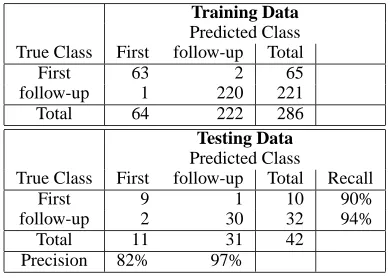
Table 1 shows the confusion matrix of the deci-sion tree learning results. On the testing data, the learned model performs with 90% in recall and 82% in precision for recognizing first questions; for rec-ognizing follow-up questions, the recall is 94% and precision is 97%. In contrast, De Boni and Man-andhar’s rule-based algorithm has 90% in recall and 56% in precision for recognizing first questions; for follow-up questions, the recall is 78% and precision is 96%. The recall and precision of our learned model to recognize first questions and follow-up questions are all better than or at least the same as the rule-based algorithm. The accuracy of our learned model is 93%, about 12% absolute improve-ment from the rule-based algorithm, which is 81% in accuracy. Although the size of the data is too small to draw a more general conclusion, we do see that the data driven approach has better performance.
Training Data Predicted Class True Class First follow-up Total
First 63 2 65
follow-up 1 220 221
Total 64 222 286
Testing Data Predicted Class
True Class First follow-up Total Recall
First 9 1 10 90%
follow-up 2 30 32 94%
Total 11 31 42
Precision 82% 97%
Table 1: Confusion Matrix for TREC Data
4.1.2 Trained Tree
Figure 3 shows the first top two levels of the tree learned from the training data. Not surprisingly,
PRONOUN turns out to be the most important
fea-ture which has the highest information gain. In the TREC data, when there is a pronoun in a question, the question is very likely to be a follow-up ques-tion. In fact, in the TREC 2004 data, the referent of pronouns very often is the topic phrase. The fea-ture path noun, on the second level of the trained tree, turns out to contribute most information in this recognition task among the four different semantic similarity measures. The similarity measures using
wup, wup noun and wup verb, and the vector
mea-sure do not appear in any node of the trained tree.
Figure 3: Trained Tree on TREC Data
The following are rules generated from the train-ing data whose confidence is higher than 90%. Con-fidence is defined as out of the training records for which the left hand side of the rule is true, the per-centage of records for which the right hand side is also true. This measures the accuracy of the rule.
- If PRONOUN=1 then follow-up question - If path noun≥0.31 then follow-up question - If lin noun≥0.43 then follow-up question
- If path noun<0.15 and PRONOUN=0 then first question
optimized combination of features which captures most cases, and avoids redundant rules.
4.1.3 Error Analysis
The trained decision tree has 3 errors in the test-ing data. Two of the errors are mis-recognition of follow-up questions to be first questions, and one is the vice versa.
The first error is failure to recognize the ques-tion “which galleries were involved?” (CTX1c) as a follow-up question (see Figure 2 for context). It is a syntactically complete sentence, and there is no pronoun or definite noun in the sentence. Seman-tic features are the most useful information to rec-ognize it as a follow-up question. However, the se-mantic relatedness in WordNet between the words “gallery” in the current question and “museum” in the first question of this session (CTX1a in Figure 2) is not strong enough for the trained decision tree to relate the two questions together.
The second error is failure to recognize the ques-tion “Where did the winery’s owner go to college?” (CTX3c) as a follow-up question. Similarly, part of the reason for this failure is due to the insuffi-cient semantic relatedness between the words “win-ery” and “grape” (in CTX3a) to connect the ques-tions together. However, this question has a definite noun phrase “the winery” which refers to “Chateau Petrus Bordeaux” in the first question in this session. We did not make use of the feature DefiniteNoun in our training, because it is not easy to automatically identify the referents of a definite noun phrase, or even whether it has a referent or not. A lot of def-inite noun phrases, such as “the sun”, “the trees in China”, “the first movie”, and “the space shuttles”, do not refer to any entity in the text. This does not mean that the feature DefiniteNoun is not important, but instead that we just leave it as our future work to better incorporate this feature.
The third error, is failure to recognize the question “What does transgenic mean?” as the first question that opens a session. This error is due to the over-fitting of decision tree training.
4.1.4 Boosting
We tried another machine learning approach, Ad-aboost (Schapire and Singer, 2000), which is resis-tant (but not always) to over-fitting. It calls a given
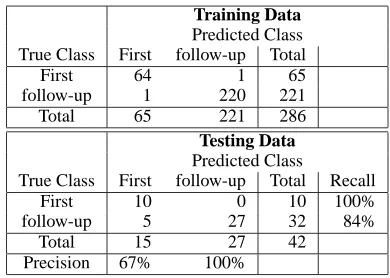
weak learning algorithm repeatedly in a series of rounds t = 1, ..., T. Each time the weak learning algorithm generates a rough “rule of thumb”, and after many rounds Adaboost combines these weak rules into a single prediction rule that, hopefully, will be more accurate than any one of the weak rules. Figure 2 shows the confusion matrix of Ad-aboost learning results. It shows that AdAd-aboost is able to correctly recognize “What does transgenic mean?” as beginning a new topic. However, Ad-aboost has more errors in recognizing follow-up questions, which results in an overall accuracy of 88%, slightly lower than decision tree learning.
Training Data Predicted Class True Class First follow-up Total
First 64 1 65
follow-up 1 220 221
Total 65 221 286
Testing Data Predicted Class
True Class First follow-up Total Recall
First 10 0 10 100%
follow-up 5 27 32 84%
Total 15 27 42
Precision 67% 100%
Table 2: Confusion Matrix Using Adaboosting
4.2 Results on the HandQA data
We also conducted an experiment using real-world customer-care related questions. We selected our test data from the chat logs of a deployed online QA system. We refer to this system as HandQA. HandQA is built using a telecommunication ontol-ogy database and 1600 pre-determined FAQ-answer pairs. For every submitted customer question, HandQA chooses one of these 1600 answers as the response. Each chat session contains about 3 ques-tions. We assume the questions in a session are context-related.
the user’s question, the user would repeat or rephrase the same question, until they gave up or the system luckily found the answer. As an example, Figure 4 shows two chat sessions. Again, we did not use the system’s answer in our relevancy recognition.
How to make number non published? Non published numbers
How to make number non listed?
Is my number switched to Call Vantage yet? When will my number be switched? When is number transferred?
Figure 4: Example questions in HandQA
A subset of the HandQA data, 5908 questions in 2184 sessions are used for training and testing the decision tree. The data were randomly divided into two sets: 90% for training and 10% for testing.
4.2.1 Confusion Matrix
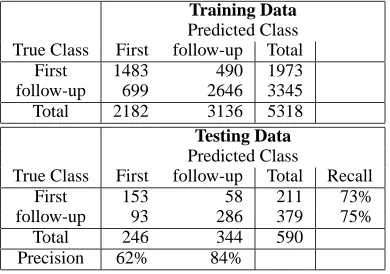
Table 3 shows the confusion matrix of the deci-sion tree learning results. For recognizing first ques-tions, the learned model has 73% in recall and 62% in precision; for recognizing follow-up questions, the recall is 75% and precision is 84%. The accuracy is 74%. A base line model is to have all questions except the first one as following up questions, which results in the accuracy of 64% (380/590). Thus the learned decision tree yields an absolute improve-ment of 10%. However, the results on this data set are not as good as those on the TREC data.
Training Data Predicted Class True Class First follow-up Total
First 1483 490 1973
follow-up 699 2646 3345
Total 2182 3136 5318
Testing Data Predicted Class
True Class First follow-up Total Recall
First 153 58 211 73%
follow-up 93 286 379 75%
Total 246 344 590
Precision 62% 84%
Table 3: Confusion Matrix for HandQA Data
4.2.2 Trained Tree
Table 5 shows the top two levels of the tree learned from the training data, both of which are on the semantic measure path. This again confirms
that path best fits the task of relevancy recognition among the four semantic measures.
No syntactical features appear in any node of the learned tree. This is not surprising because syntac-tic information is noisy in this data set. Typos, bad grammars, and mis-capitalization affect automatic POS tagging. Keywords input also results in incom-plete sentences, which makes it unreliable to recog-nize follow-up questions based on whether a ques-tion is a complete sentence or not. Furthermore, because questions in a session rarely refer to each other, but just repeat or rephrase each other, the fea-ture PRONOUN does not help either. All these make syntactic features not useful. Semantic features turn out to be more important for this data set.
Figure 5: Trained Tree on HandQA Data
4.2.3 Error Analysis
There are two reasons for the decreased perfor-mance in this data set. The first reason, as we ana-lyzed above, is that syntactical features do not con-tribute to the recognition task. The second reason is that consecutive chat sessions might ask for the same information. In the handQA data set, questions are basically all about telecommunication service, and questions in two consecutive chat sessions, although by different users, could be on very similar topics or even have same words. Thus, questions, although in two separate chat sessions, could have high semantic similarity measure. This would introduce confusing information to the decision tree learning.
5 Making Use of Context Information
and retrieve the answers. To explore how context in-formation helps answer retrieval, we conducted pre-liminary experiments with the TREC 2004 QA data. We indexed the TREC documents using the Lucene search engine (Hatcher and Gospodnetic, 2004) for document retrieval. The Lucene search engine takes as input a query (a list of keywords), and returns a ranked list of relevant documents, of which the first 50 were taken and analyzed in our experiments. We tried different strategies for query formulation. Sim-ply using the questions as the query, only 20% of the follow-up questions find their answers in the first 50 returned documents. This percentage went up to 85% when we used the topic words, provided in TREC data for each section, as the query. Because topic words are usually not available in real world applications, to be more practical, we tried using the noun phrases in the first question as the query. In this case, 81% of the questions are able to find the answers in the returned documents. When we com-bined the (follow-up) question with the noun phrases in the first question as the query, the retrieved rate increases to 84%. Typically, document retrieval is a crucial step for QA systems. These results suggest that context information fusion has a big potential to improve the performance of answer retrieval. How-ever, we leave the topic of how to fuse context infor-mation into the follow-up questions as future work.
6 Conclusion
In this paper, we present a data driven approach, de-cision tree learning, for the task of relevancy recog-nition in contextual question answering. Experi-ments show that this approach achieves 93% accu-racy on the TREC data, about 12% improvement from the rule-based algorithm reported by De Boni and Mananhar (2005). Moreover, this data driven approach requires much less human effort on inves-tigating a specific data set and less human exper-tise to summarize rules from the observation. All the features we used in the training can be automat-ically extracted. This makes it straightforward to train a model in a new domain, such as the HandQA. Furthermore, decision tree learning is a white-box model and the trained tree is human interpretable. It shows that the path measure has the best information gain among the other semantic similarity measures.
We also report our preliminary experiment results on context information fusion for question answering.
7 Acknowledgement
The authors thank Srinivas Bangalore and Mazin E. Gilbert for helpful discussion.
References
Hamish Cunningham, Diana Maynard, Kalina Bontcheva, and Valentin Tablan. 2002. GATE: A framework and graphical development environment for robust nlp tools and applications. In Proceedings
of the 40th ACL.
Marco De Boni and Suresh Manandhar. 2005. Imple-menting clarification dialogues in open domain ques-tion answering. Natural Language Engineering. Ac-cepted.
Christiane Fellbaum. 1998. WordNet:An Electronic
Lex-ical Database. MIT Press, Cambridge, MA.
Erik Hatcher and Otis Gospodnetic. 2004. Lucene in
Action. Manning.
Marti A. Hearst. 1994. Multi-paragraph segmentation of expository text. In Proceedings of 32nd ACL, pages 9–16.
Dekang Lin. 1998. An information-theoretic definition of similarity. In Proceedings of the International
Con-ference on Machine Learning.
Siddharth Patwardhan. 2003. Incorporating dictionary and corpus information into a context vector measure of semantic relatedness. master’s thesis, University of Minnesota, Duluth.
Ted Pederson, Siddharth Patwardhan, and Jason Miche-lizzi. 2004. WordNet::Similarity - measuring the re-latedness of concepts. In Proceedings of the 9th AAAI. Intelligent Systems Demonstration.
Long Qiu, Min-Yen Kan, and Tat-Seng Chua. 2004. A public reference implementation of the rap anaphora resolution algorithm. In Proceedings of LREC, pages 291–294.
Robert E. Schapire and Yoram Singer. 2000. BoosTex-ter: A boosting-based system for text categorization.
Machine Learning, 39:135–168.