How and Where do People Fail with Time: Temporal Reference Mapping
Annotation by Chinese and English Bilinguals
Yang Ye§, Steven Abney†§
†Department of Linguistics
§Department of Electrical Engineering and Computer Science
University of Michigan
Abstract
This work reports on three human tense annotation experiments for Chinese verbs in Chinese-to-English translation scenar-ios. The results show that inter-annotator agreement increases as the context of the verb under the annotation becomes in-creasingly specified, i.e. as the context moves from the situation in which the tar-get English sentence is unknown to the situation in which the target lexicon and target syntactic structure are fully speci-fied. The annotation scheme with a fully specified syntax and lexicon in the tar-get English sentence yields a satisfactorily high agreement rate. The annotation re-sults were then analyzed via an ANOVA analysis, a logistic regression model and a log-linear model. The analyses reveal that while both the overt and the latent linguis-tic factors seem to significantly affect an-notation agreement under different scenar-ios, the latent features are the real driving factors of tense annotation disagreement among multiple annotators. The analy-ses also find the verb telicity feature, as-pect marker presence and syntactic em-bedding structure to be strongly associated with tense, suggesting their utility in the automatic tense classification task.
1 Introduction
In recent years, the research community has seen a fast-growing volume of work in temporal infor-mation processing. Consequently, the investiga-tion and practice of temporal informainvestiga-tion anno-tation by human experts have emerged from the corpus annotation research. To evaluate automatic temporal relation classification systems, annotated corpora must be created and validated, which
mo-tivates experiments and research in temporal infor-mation annotation.
One important temporal relation distinction that human beings make is the temporal reference dis-tinction based on relative positioning between the following three time parameters, as proposed by (Reichenbach, 1947): speech time (S), event time (E) and reference time (R). Temporal reference distinction is linguistically realized as tenses. Lan-guages have various granularities of tense repre-sentations; some have finer-grained tenses or as-pects than others. This poses a great challenge to automatic cross-lingual tense mapping. The same challenge holds for cross-lingual tense annotation, especially for language pairs that have dramati-cally different tense strategies. A decent solution for cross-lingual tense mapping will benefit a va-riety of NLP tasks such as Machine Translation, Cross-lingual Question Answering (CLQA), and Multi-lingual Information Summarization. While automatic cross-lingual tense mapping has re-cently started to receive research attention, such as in (Olsen,et al., 2001) and (Ye, et al., 2005), to the best of our knowledge, human performance on tense and aspect annotation for machine trans-lation between English and Chinese has not re-ceived any systematic investigation to date. Cross-linguistic NLP tasks, especially those requiring a more accurate tense and aspect resolution, await a more focused study of human tense and aspect annotation performance.
Chinese and English are a language pair in which tense and aspect are represented at differ-ent levels of units: one being realized at the word level and the other at the morpheme level.
This paper reports on a series of cross-linguistic tense annotation experiments between Chinese and English, and provides statistical inference for different linguistic factors via a series of statisti-cal modeling. Since tense and aspect are mor-phologically merged in English, tense annotation
discussed in this paper also includes elements of aspect. We only deal with tense annotation in Chinese-to-English scenario in the scope of this paper.
The remaining part of the paper is organized as follows: Section 2 summarizes the significant related works in temporal information annotation and points out how this study relates to yet differs from them. Section 3 reports the details of three tense annotation experiments under three scenar-ios. Section 4 discusses the inter-judge agree-ment by presenting two measures of agreeagree-ment: the Kappa Statistic and accuracy-based measure-ment. Section 5 investigates and reports on the significance of different linguistic factors in tense annotation via an ANOVA analysis, a logistic re-gression analysis and a log-linear model analysis. Finally, section 6 concludes the paper and points out directions for future research.
2 Related Work
There are two basic types of temporal location re-lationships. The first one is the ternary classifica-tion of past, present and future. The second one is the binary classification of “BEFORE” versus “AFTER”. These two types of temporal relation-ships are intrinsically related but each stands as a separate issue and is dealt with in different works. While the “BEFORE” versus “AFTER” relation-ship can easily be transferred across a language pair, the ternary tense taxonomy is often very hard to transfer from one language to another.
(Wilson, et al., 1997) describes a multilin-gual approach to annotating temporal information, which involves flagging a temporal expression in the document and identifying the time value that the expression designates. Their work reports an inter-annotator reliability F-measure of 0.79 and 0.86 respectively for English corpora.
(Katz, et al., 2001) describes a simple and gen-eral technique for the annotation of temporal rela-tion informarela-tion based on binary interval relarela-tion types: precedence and inclusion. Their annotation scheme could benefit a range of NLP applications and is easy to carry out.
(Pustejovsky et al., 2004) reports an annotation scheme, the TimeML metadata, for the markup of events and their anchoring in documents. The an-notation schema of TimeML is very fine-grained with a wide coverage of different event types, de-pendencies between events and times, as well as
“LINK” tags which encode the various relations existing between the temporal elements of a doc-ument. The challenge of human labeling of links among eventualities was discussed at great length in their paper. Automatic “time-stamping” was attempted on a small sample of text in an earlier work of (Mani, 2003). The result was not partic-ularly promising. It showed the need for a larger quantity of training data as well as more predictive features, especially on the discourse level. At the word level, the semantic representation of tenses could be approached in various ways depending on different applications. So far, their work has gone the furthest towards establishing a broad and open standard metadata mark-up language for nat-ural language texts.
(Setzer, et al., 2004) presents a method of eval-uating temporal order relation annotations and an approach to facilitate the creation of a gold stan-dard by introducing the notion of temporal clo-sure, which can be deduced from any annotations through using a set of inference rules.
From the above works, it can be seen that the effort in temporal information annotation has thus far been dominated by annotating temporal rela-tions that hold entities such as events or times explicitly mentioned in the text. Cross-linguistic tense and aspect annotation has so far gone un-studied.
3 Chinese Tense Annotation
Experiments1
In current section, we present three tense annota-tion experiments with the following scenarios:
1. Null-control situation by native Chinese speakers where the annotators were provided with the source Chinese sentences but not the English translations;
2. High-control situation by native English speakers where the annotators were provided with the Chinese sentences as well as English translations with specified syntax and lexi-cons;
3. Semi-control situation by native English speakers where the annotators were allowed to choose the syntax and lexicons for the En-glish sentence with appropriate tenses;
1All experiments in the paper are approved by
3.1 Experiment One
Experiment One presents the first scenario of tense annotation for Chinese verbs in Chinese-to-English cross-lingual situation. In the first sce-nario, the annotation experiment was carried out on 25 news articles from LDC Xinhua News re-lease with category number LDC2001T11. The ar-ticles were divided into 5 groups with 5 arar-ticles in each group. There are a total number of 985 verbs. For each group, three native Chinese speakers who were bilingual in Chinese and English annotated the tense of the verbs in the articles independently. Prior to annotating the data, the annotators under-went brief training during which they were asked to read an example of a Chinese sentence for each tense and make sure they understand the exam-ples. During the annotation, the annotators were asked to read the whole articles first and then se-lect a tense tag based on the context of each verb. The tense taxonomy provided to the annotators in-clude the twelve tenses that are different combi-nations of the simple tenses (present, past and fu-ture), the prograssive aspect and the perfect aspect. In cases where the judges were unable to decide the tense of a verb, they were instructed to tag it as “unknown”. In this experiment, the annotators were asked to tag the tense for all Chinese words that were tagged as verbs in the Penn Treebank corpora. Conceivably, the task under the current scenario is meta-linguistic in nature for the reason that tense is an elusive notion for Chinese speak-ers. Nevertheless, the experiment provides a base-line situation for human tense annotation agree-ment. The following is an example of the anno-tation where the annotators were to choose an ap-propriate tense tag from the provided tense tags:
((IP (NP-TPC (NP-PN (NR Ё))(NP (NN ᓎㄥ)(NNᏖഎ)))(LCP-TMP (NP (NT 䖥 ᑈ))(LCᴹ)) (NP-SBJ (NP (PP (P ᇍ)(NP (NN )))(NP (NN ᓔᬒ)))(NP (NN ℹ Ӥ)))(VP (ADVP (AD 䖯ϔℹ)) (VP (VVࡴᖿ)))(PUDŽ)) )
1. simple present tense 2. simple past tense 3. simple future tense 4. present perfect tense 5. past perfect tense 6. future perfect tense 7. present progressive tense 8. past progressive tense 9. future progressive 10. present perfect progressive 11. past perfect progressive
3.2 Experiment Two
Experiment Two was carried out using 25 news articles from the parallel Chinese and English news articles available from LDC Multiple Trans-lation Chinese corpora (MTC catalog number
LDC2002T01). In the previous experiment, the annotators tagged all verbs. In the current experi-mental set-up, we preprocessed the materials and removed those verbs that lose their verbal status in translation from Chinese to English due to nom-inalization. After this preprocessing, there was a total of 288 verbs annotated by the annotators. Three native speakers, who were bilingually fluent in English and Chinese, were recruited to annotate the tense for the English verbs that were translated from Chinese. As in the previous scenario, the an-notators were encouraged to pay attention to the context of the target verb when tagging its tense. The annotators were provided with the full taxon-omy illustrated by examples of English verbs and they worked independently. The following is an example of the annotation where the annotators were to choose an appropriate tense tag from the provided tense tags:
㒳䅵ˈ䖭ѯජᏖএᑈᅠ៤ݙ⫳ѻᘏؐϔⱒбकғܗˈ↨ᓔᬒࠡⱘϔббϔᑈ 䭓б៤DŽ
According to statistics, the cities (achieve) a combined gross domestic product of RMB19 billion last year, an increase of more than 90% over 1991 before their opening. A. achieves
B. achieved C. will achieve D. are achieving E. were achieving F. will be achieving G. have achieved H. had achieved I. will have achieved J. have been achieving K. had been achieving L. will have been achieving M. would achieve
3.3 Experiment Three
that were not translated as verbs into English, we assigned a “Not Available” tag. There are 1505 verbs in total including the ones that lost their ver-bal status across the language.
4 Inter-Judge Agreement
Researchers use consistency checking to validate human annotation experiments. There are vari-ous ways of performing consistency checking de-scribed in the literature, depending on the scale of the measurements. Each has its advantages and disadvantages. Since our tense taxonomy is nomi-nal without any ordinomi-nal information, Kappa statis-tics measurement is the most appropriate choice to measure inter-judge agreement.
4.1 Kappa Statistic
Kappa scores were calculated for the three human judges’ annotation results. The Kappa score is the de facto standard for evaluating inter-judge agree-ment on tagging tasks. It reports the agreeagree-ment rate among multiple annotators while correcting for the agreement brought about by pure chance. It is defined by the following formula, where P(A) is the observed agreement among the judges and P(E) is the expected agreement:
k= P(A)−P(E)
1−P(E) (1)
Depending on how one identifies the expected agreement brought about by pure chance, there are two ways to calculate the Kappa score. One is the “Seigel-Castellian” Kappa discussed in (Eugenio, 2004), which assumes that there is one hypotheti-cal distribution of labels for all judges. In contrast, the “Cohen” Kappa discussed in (Cohen, 1960), assumes that each annotator has an individual dis-tribution of labels. This discrepancy slightly af-fects the calculation of P(E). There is no consen-sus regarding which Kappa is the ”right” one and researchers use both. In our experiments, we use the “Seigel-Castellian” Kappa.
The Kappa statistic for the annotation results of Experiment One are 0.277 on the full taxonomy and 0.37 if we collapse the tenses into three big classes: present, past and future. The observed agreement rate,that is, P(A), is 0.42.
The Kappa score for tense resolution from the ten human translation teams for the 52 Xinhua news articles is 0.585 on the full taxonomy; we expect the Kappa score to be higher if we exclude
the verbs that are nominalized. Interestingly, the Kappa score calculated by collapsing the 13 tenses into 3 tenses (present, past and future) is only slightly higher: 0.595. The observed agreement rate is 0.72.
Human tense annotation in the Chinese-to-English restricted translation scenario achieved a Kappa score of 0.723 on the full taxonomy with an observed agreement of 0.798. If we collapse sim-ple past and present perfect, the Kappa score goes up to 0.792 with an observed agreement of 0.893. The Kappa score is 0.81 on the reduced taxonomy.
4.2 Accuracy
The Kappa score is a relatively conservative mea-surement of the inter-judge agreement rate. Con-ceptually, we could also obtain an alternative mea-surement of reliability by taking one annotator as the gold standard at one time and averaging over the accuracies of the different annotators across different gold standards. While it is true that nu-merically, this would yield a higher score than the Kappa score and seems to be inflating the agree-ment rate, we argue that the difference between the Kappa score and the accuracy-based measure-ment is not limited to one being more aggressive than the other. The policies of these two mea-surements are different. The Kappa score is con-cerned purely with agreement without any consid-eration of truthfulness or falsehood, while the pro-cedure we described above gives equal weights to each annotator being the gold standard. Therefore, it considers both the agreement and the truthful-ness of the annotation. Additionally, the accuracy-based measurement is the same measurement that is typically used to evaluate machine performance; therefore it gives a genuine ceiling for machine performance.
The accuracy under such a scheme for the three annotators in Experiment One is 43% on the full tense taxonomy.
The accuracy under such a scheme for tense generation agreement from three annotators in Ex-periment Two is 80% on the full tense taxonomy.
The accuracy under such a scheme for the ten translation teams in Experiment Three is 70.8% on the full tense taxonomy.
Table 1 summarizes the inter-judge agreement for the three experiments.
Agreement Exp 1 Exp 2 Exp 3 Kappa Statistic 0.277 0.723 0.585 Kappa Statistic
0.37 0.81 0.595 (Reduced Taxonomy)
Accuracy 43% 80% 70.8%
Table 1: Inter-Annotator Agreement for the Three Tense Annotation Experiments
first two factors can be controlled for by a clearly pre-defined annotation guideline, the last two fac-tors are intrinsically rooted in natural languages and therefore hard to deal with:
1. Different compliance with Sequence of Tense (SOT) principle among annotators;
2. “Headline Effect”;
3. Ambiguous POS of the “verb”: sometimes it is not clear whether a verb is adjective or past participle. e.g. The Fenglingdu Economic
Development Zone is the only one in China that is/was built on the basis of a small town.
4. Ambiguous aspectual property of the verb: the annotator’s view with respect to whether or not the verb is an atelic verb or a telic verb.
e.g. “statistics showed/show...”
Put abstractly, ambiguity is an intrinsic property of natural languages. A taxonomy allows us to investigate the research problem, yet any clearly defined discrete taxonomy will inevitably fail on boundary cases between different classes.
5 Significance of Linguistic Factors in
Annotation
In the NLP community, researchers carry out an-notation experiments mainly to acquire a gold standard data set for evaluation. Little effort has been made beyond the scope of agreement rate calculations. We propose that not only does fea-ture analysis for annotation experiments fall un-der the concern of psycholinguists, it also merits investigation within the enterprise of natural lan-guage processing. There are at least two ways that the analysis of annotation results can help the NLP task besides just providing a gold stan-dard: identifying certain features that are respon-sible for the inter-judge disagreement and model-ing the situation of associations among the differ-ent features. The former attempts to answer the
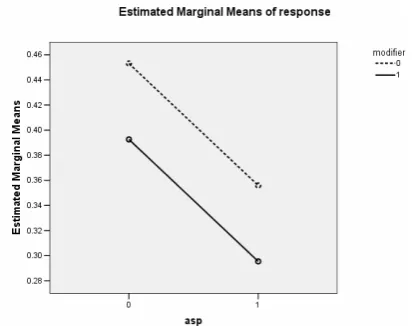
Figure 1: Interaction between Aspect Marker and Temporal Modifier
question of where the challenge for human classi-fication comes from, and thereby provides an ex-ternal reference for an automatic NLP system, al-though not necessarily in a direct way. The latter sheds light on the structures hidden among groups of features, the identification of which could pro-vide insights for feature selection as well as of-fer convergent evidence for the significance of cer-tain features confirmed from classification practice based on machine learning.
In this section, we discuss at some length a fea-ture analysis for the results of each of the anno-tation experiments discussed in the previous sec-tions and summarize the findings.
5.1 ANOVA analysis of Agreement and Linguistic Factors in Free Translation Tense Annotation
inconsistency rate is measured by the ratio of the number of distinct tenses over the number of tense tokens from the ten translation teams.
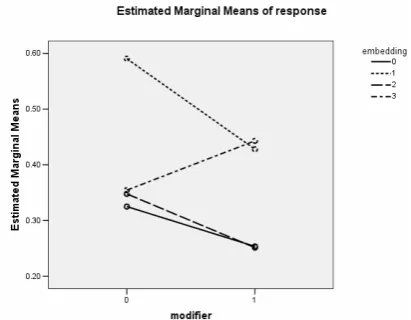
Our ANOVA analysis shows that all of the three main effects, i.e. the embedding structures of the verb (p 0.001), the presence of aspect markers (p 0.01), and the presence of temporal mod-ifiers (p < 0.05) significantly affect the rate of disagreement in tense generation among the dif-ferent translation teams. The following graphs show the trend: tense generation disagreement rates are consistently lower when the Chinese as-pect marker is present, whether there is a temporal modifier present or not (Figure 1). The model also suggested that the presence of temporal modifiers is associated with a lower rate of disagreement for three embedding structures except for verbs in sentential complements (Figure 2, 0: the verb is not in any embedding structures; 1: the verb is embedded in a relative clause; 2: the verb is bedded in an appositive clause; 3: the verb is em-bedded in sentential complement). Our explana-tion for this is that the annotators receive varying degrees of prescriptive writing training, so when there is a temporal modifier in the sentence as a confounder, there will be a larger number, a higher incidence of SOT violations than when there is no temporal modifier present in the sentence. On top of this, the rate of disagreement in tense tag-ging between the case where a temporal modifier is present in the sentence and the case where it is not depends on different types of embedding struc-tures (Figure 2,pvalue<0.05).
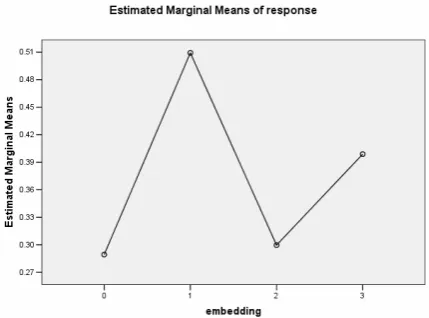
We also note that the relative clause embed-ding structure is associated with a much higher disagreement rate than any other embedding struc-tures (Figure 3).
5.2 Logistic Regression Analysis of Agreement and Linguistic Factors in Restricted Tense Annotation
The ANOVA analysis in the previous section is concerned with the confounding power of the overt linguistic features. The current section ex-amines the significance of the more latent fea-tures on tense annotation agreement when the SOT effect is removed by providing the annotators a clear guideline about the SOT principle. Specif-ically, we are interested in the effect of verb telic-ity and punctualtelic-ity features on tense annotation agreement. The telicity and punctuality features
Figure 2: Interaction between the Temporal Mod-ifier and the Syntactic Embedding Structure
were obtained through manual annotation based on the situation in the context. The data are from Experiment Two. Since there are only three an-notators, the inconsistency rate we discussed in 5.1 would have insufficient variance in the current scenario, making logistic regression a more appro-priate analysis. The response is now binary being either agreement or disagreement (including par-tial agreement and pure disagreement). To avoid a multi-colinearity problem, we model Chinese fea-tures and English feafea-tures separately. In order to truly investigate the effects of the latent fea-tures, we keep the overt linguistic features in the model as well. The overt features include: type of syntactic embedding, presence of aspect marker, presence of temporal expression in the sentence, whether the verb is in a headline or not, and the presence of certain signal adverbs including “yi-jing”(already), “zhengzai” (Chinese pre-verb pro-gressive marker), “jiang”(Chinese pre-verbal ad-verb indicating future tense). We used backward elimination to obtain the final model.
sus-Figure 3: Effect of Syntactic Embedding Structure on Tense Annotation Disagreement
pect this is partly due to the correlation between the punctuality feature and the telicity feature. Ad-ditionally, none of the overt linguistic features is significant in the presence of the latent features, which implies that the latent features drive dis-agreement among multiple annotators.
5.3 Log-linear Model Analysis of
Associations between Linguistic Factors in Free Translation Tense Annotation
This section discusses the association patterns be-tween tense and the relevant linguistic factors via a log-linear model. A log-linear model is a special case of generalized linear models (GLMs) and has been widely applied in many fields of social sci-ence research for multivariate analysis of categor-ical data. The model reveals the interaction be-tween categorical variables. The log-linear model is different from other GLMs in that it does not distinguish between “response” and “explanatory variables”. All variables are treated alike as “re-sponse variables”, whose mutual associations are explored. Under the log-linear model, the ex-pected cell frequencies are functions of all vari-ables in the model. The most parsimonious model that produces the smallest discrepancy between the expected cell and the observed cell frequen-cies is chosen as the final model. This provides the best explanation of the observed relationships among variables.
We use the data from Experiment Two for the current analysis. The results show that three lin-guistic features under investigation are signifi-cantly associated with tense. First, there is a strong association between aspect marker presence and
tense, independent of punctuality, telicity feature and embedding structure. Second, there is a strong association between telicity and tense, indepen-dent of punctuality, aspect marker presence and punctuality feature. Thirdly, there is a strong as-sociation between embedding structure and tense, independent of telicity, punctuality feature and as-pect marker presence. This result is consistent with (Olsen, 2001), in that the lexical telicity fea-ture, when used heuristically as the single knowl-edge source, can achieve a good prediction of verb tense in Chinese to English Machine Translation. For example, the odds of the verb being atelic in the past tense is 2.5 times the odds of the verb being atelic in the future tense, with a 95% con-fidence interval of (0.9, 7.2). And the odds of a verb in the future tense having an aspect marker approaches zero when compared to the odds of a verb in the past tense having an aspect marker.
Putting together the pieces from the logistic analysis and the current analysis, we see that an-notators fail to agree on tense selection mostly with apunctual verbs, while the agreed-upon tense is jointly decided by the telicity feature, aspect marker feature and the syntactic embedding struc-ture that are associated with the verb.
6 Conclusions and Future Work
the telicity feature exhibit the strongest association with tense, potentially indicating their high utility in tense classification task.
The current analysis, while suggesting certain interesting patterns in tense annotation, could be more significant if the findings could be replicated by experiments of different scales on different data sets. Furthermore, the statistical analysis could be more finely geared to capture the more subtle dis-tinctions encoded in the features.
Acknowledgement All of the annotation
exper-iments in this paper are funded by Rackham Grad-uate School’s Discretionary Funds at the Univer-sity of Michigan.
References
Hans Reichenbach,1947. Elements of Symbolic Logic, Macmillan, New York, N.Y.
Mari Olson, David Traum, Carol Van Ess-Dykema, and Amy Weinberg, 2001. Implicit Cues for Explicit Generation: Using Telicity as a Cue for Tense Struc-ture in a Chinese to English MT System, Proceed-ings Machine Translation Summit VIII, Santiago de Compostela, Spain.
Yang Ye, Zhu Zhang, 2005. Tense Tagging for Verbs in Cross-Lingual Context: A Case Study. Proceed-ings of 2nd International Joint Conference in Natural Language Processing (IJCNLP), 885-895.
George Wilson, Inderjeet Mani, Beth Sundheim, and Lisa Ferro, 2001. A Multilingual Approach to An-notating and Extracting Temporal Information, Pro-ceedings of the ACL 2001 Workshop on Temporal And Spatial Information Processing, 39th Annual Meeting of ACL, Toulouse, 81-87.
Graham Katz and Fabrizio Arosio, 2001. The Annota-tion of Temporal InformaAnnota-tion in Natural Language Sentences, Proceedings of the ACL 2001 Workshop on Temporal And Spatial Information Processing, 39th Annual Meeting of ACL, Toulouse, 104-111.
James Pustejovsky, Robert Ingria, Roser Sauri, Jose Castano, Jessica Littman, Rob Gaizauskas, Andrea Setzer, Graham Katz, and Inderjeet Mani. 2004. The Specification Language TimeML. The Language of Time: A Reader. Oxford, 185-96.
Barbara Di Eugenio and Michael Glass. 2004. The kappa statistic: A second look. Computational Lin-guistics, 30(1): 95-101.
Inderjeet Mani, 2003. Recent Developments in Tem-poral Information Extraction. In Nicolov, N. and Mitkov, R., editors, Proceedings of RANLP’03. John Benjamins.
Andrea Setzer, Robert Gaizauskas, and Mark Hep-ple, 2003. Using Semantic Inferences for Tem-poral Annotation Comparison, Proceedings of the Fourth International Workshop on Inference in Computational Semantics (ICOS-4), INRIA, Lor-raine, Nancy, France, September 25-26, 185-96.