Quantifier Scope in German: An MCTAG Analysis
Laura Kallmeyer University of Tübingen Collaborative Research Center 441
Maribel Romero University of Pennsylvania
Department of Linguistics
Abstract
Relative quantifier scope in German de-pends, in contrast to English, very much on word order. The scope possibilities of a quantifier are determined by its surface po-sition, its base position and the type of the quantifier. In this paper we propose a mul-ticomponent analysis for German quanti-fiers computing the scope of the quantifier, in particular its minimal nuclear scope, de-pending on the syntactic configuration it occurs in.
1 Introduction: The data
(1) A man loves every woman.
∃>∀,∀>∃
In English, in sentences with several quantifica-tional NPs, in principle all scope orders are pos-sible independent from word order. (1) for exam-ple has two readings, the ∃ > ∀reading and the inverse scope ∀ > ∃ reading. This is different in German where word order is crucial for scope pos-sibilities.
(2) a. Viele Männer haben mindestens eine many mennomhave at least one
Frau hofiert.
womanaccflattered.
‘Many men have flattered at least one woman.’
viele > eine,∗eine > viele
b. Mindestens eine Frau haben viele at least one womanacchave many
Männer hofiert. mennomflattered.
‘Many men have flattered at least one woman.’
viele > eine,eine > viele
In German, for quantifiers in base order, the sur-face order determines scope.1 (2a) has only the scope order viele > eine corresponding to sur-face order, that is, the inverse ordereine > viele
is not available. In contrast to this, if the word order differs from the base order, ambiguities are possible. (2b) for example displays both scope or-ders,viele > eineandeine > viele.
In the literature, the following generalizations have been noticed for German: For two quantifiers
Q1,Q2withQ1precedingQ2in the surface order
of a sentence, the scope orderQ1 > Q2is always
possible. Furthermore, the inverse reading Q2 >
Q1is possible if
(Q1) Q1 has been moved so thatQ2 c-commands
the trace ofQ1 ((Frey, 1993)), and
(Q2) Q1 is a weak quantifier (e.g., irgendein
‘some’, viele ‘many’, cardinals) ((Lechner, 1998)).
Evidence for (Q2) –and further evidence for (Q1)– are the examples in (3)–(4). In (3), the (a)-example is in base order and thus has only surface scope, but moving the weak quantifier over the da-tive quantifier in the (b)-version results in scope ambiguity. This contrasts with (4). In (4), the (a)-version with base order has only surface scope, as before. But now we move the strong quantifier over the dative quantifier, and this does not yield ambiguity. That is, even though the dative quan-tifier c-commands the trace of the moved quanti-fier both in (3b) and in (4b), only when the moved
1Throughout the paper we assume an unmarked intona-tion. With a different intonation, other scope orders become available because of the change in information structure. But this lies outside the scope of this paper.
The base order depends on the verb; in most cases it is Sub-ject - (Indirect ObSub-ject) - Direct ObSub-ject.
element is a weak quantifier do we obtain scope ambiguity.
(3) a. . . .dass er [fast jedem Verlag] . . .that he almost every publisher
[mindestens ein Gedicht]anbot.
at least one poem proposed_to.
‘. . .that he proposed some poem to almost every publisher.’
jedem > ein,∗ein > jedem
b. . . .dass er [mindestens ein Gedicht]1
. . .that he some poem
[fast jedem Verlag] t1anbot.
almost every publisher proposed_to.
jedem > ein,ein > jedem
(4) a. . . .dass er [mindestens einem Verleger] . . .that he at least one publisher
[fast jedes Gedicht]anbot.
almost every poem proposed_to
‘. . .that he proposed almost every poem to at least one publisher.’
jedes > einem,∗einem > jedes
b. . . .dass er [fast jedes Gedicht]1
. . .that he almost every poem
[mindestens einem Verleger]t1
at least one publisher anbot.
proposed_to.
jedes > einem,∗einem > jedes
(Kiss, 2000) claims that if two quantifiers have been moved such that among themselves they re-main in base order, inverse scope is not possible between them. Because of this, he argues for a non-movement-based theory of German quantifier scope. However, Kiss’ claim is not true as can be seen with the example (5) from (Frey, 1993):
(5) a. weil der freundliche Museumsdirektor because the friendly curatornom
[mindestens einer Frau]1
at least one womandat
[fast jedes Gemälde]2 gezeigt hat
almost every paintingacchas shown ‘because the friendly curator has shown almost ev-ery painting to at least one woman’
Q1 > Q2,∗Q2 > Q1
b. weil [mindestens einer Frau]1 [fast jedes
Gemälde]2 der freundliche
Museumsdi-rektort1 t2gezeigt hat
Q1 > Q2,Q2 > Q1
In both cases, (5a) and (5b), the two quanti-fiers are in base order. According to Kiss there should be, contrary to fact, no ambiguity in (5b). The difference between the two is that in (5a) the quantifiers are in base position while in (5b) both of them have been scrambled with the result that
Q2c-commands the trace ofQ1. We assume with
(Frey, 1993) that this is why the inverse scope or-der becomes available.
We therefore stick to the above-mentioned gen-eralizations (Q1) and (Q2) and try to capture them in our LTAG analysis. This means that, in order to capture (Q1), we need a syntactic analysis of Ger-man NPs that takes into account movement and base positions.
2 English quantifier scope in LTAG
We use the LTAG semantics framework from (Kallmeyer and Romero, 2004; Kallmeyer and Romero, 2005). Semantic computation is done on the derivation tree. Each elementary tree is linked to a semantic representation (a set of Ty2 formu-las and scope constraints). Ty2 formuformu-las (Gallin, 1975) are typedλ-terms with individuals and situ-ations as basic types. The scope constraints of the form x ≥ y specify subordination relations be-tween Ty2 expressions. In other words, x ≥ y
indicates thatyis a component ofx.
maximal scope of attaching quantifiers.
Features can be global (feature GLOBAL, here abbreviated withGL) or they can be linked to spe-cific node positions (featuresS,VP, . . . ). The latter
are divided into top (T) and bottom (B) features. The equations of top and bottom features linked to specific node positions in the elementary trees are parallel to the syntactic unifications in FTAG (Vijay-Shanker and Joshi, 1988). The global fea-tures that are not linked to specific nodes can be passed from mothers to daughters and vice versa in the derivation tree.
(6) Everybody laughs.
As a sample derivation let us sketch the anal-ysis of quantificational NPs in English from (Kallmeyer, 2005). Fig. 1 shows the LTAG anal-ysis of (6). More precisely, it shows the deriva-tion tree with the semantic representaderiva-tions and fea-ture strucfea-ture descriptions of laughs and
every-body as node labels. The feature identifications
are depicted by dotted lines. The semantic repre-sentation of the NP everybody contains the gen-eralized quantifiereverythat binds the variablex
and that has a restrictive scope 4 and a nuclear
scope 5. Furthermore, it contains the
proposi-tionperson(x)that must be part of the restrictive scope (constraint 4 ≥l3). Concerning functional
application, the NP provides the individual vari-able x in the global feature I as a possible argu-ment for the verb predicatelaugh.
l1:laugh(1), 2 ≥ 3
GL
MINS l1
MAXS 2
S
h
B P 3
i
VP
"
T P 3
B P l1
#
NP
h
GL I 1
i
np
l2:every(x,4,5), l3:person(x),
4 ≥l3, 6 ≥ 5, 5 ≥ 7
GLI x
NP
"
GL
MINS 7
MAXS 6
#
Figure 1: LTAG analysis of (6) everybody laughs
Quantificational NPs in English can in princi-ple scope freely; an analysis of quantifier scope must guarantee only two things: 1. the proposition corresponding to the predicate to which a quanti-fier attaches must be in its nuclear scope, and 2. a quantifier cannot scope higher than the first finite
clause. (Kallmeyer and Romero, 2005) model this by defining a scope window delimited by some maximal scope (global feature MAXS and some minimal scope (global featureMINS) for a
quanti-fier. In Fig. 1, the nuclear scope 5 of the quantifier
is delimited by the maximal and minimal scope boundaries provided by the verb the quantifier at-taches to (constraints 6 ≥ 5,5 ≥ 7). The feature
identifications in Fig. 1 lead then to the constraints
2 ≥ 5,5 ≥l1.
Applying the assignments following from the feature identifications and building the union of the semantic representations leads to the under-specified representation (7):
(7)
l1 :laugh(x),
l2 :every(x,4,5),l3:person(x) 2 ≥l1,
4 ≥l3,2 ≥ 5,5 ≥l1
As the only possible disambiguation, we obtain
2 → l2, 4 →l3,5 →l1which yields the
seman-ticsevery(x,person(x),laugh(x)).
3 Syntax of German quantificational NPs
Recall that, according to criterion (Q1), not only the position of an NP but also -if the NP was moved- the position of its trace are crucial for the scope properties. In order to capture this, our anal-ysis needs to take into account movements (scram-bling, topicalization, etc.) of NPs including traces at base positions. We therefore cannot adopt the analyses proposed by (Rambow, 1994) in V-TAG where the slot for the NP is generated at the sur-face position and there is only one initial tree for NPs, whether moved or not.2
(8) a. . . . dass jeder/irgendeiner
. . .that everybody/someone irgendein Buch/jedes Buch liest
some book/every book reads
‘. . . that everybody/someone reads some book/every book’
SUBJ>DOBJ
b. . . . dass[jedes Buch]1 irgendeinert1liest
. . . that every book someone reads DOBJ>SUBJ
c. . . . dass[irgendein Buch]1 jedert1 liest
. . . that some book everybody reads SUBJ>DOBJ, DOBJ>SUBJ
To illustrate our analysis, in this and the follow-ing section, we restrict ourselves to the sentences in (8). For the syntax, we adopt a multicompo-nent analysis for NPs that have been moved con-sisting of an auxiliary tree for the moved mate-rial and an initial tree for the trace. Our analysis can be adopted using V-TAG (Rambow, 1994) or something in the style of SN-MCTAG (Kallmeyer, 2005). Note that, in order to account for scram-bling, we need some type of MCTAG anyway, in-dependent from quantifier scope.
VP
NP VP
NP V
liest for each NP, e.g., irgendein Buch:
α1
NP irgendein Buch
β VP
NP VP∗
irgendein Buch
α2 NP ǫ
Figure 2: Elementary trees for (8)
The elementary trees for (8) are in Fig. 2. α1
is used for NPs in base position, while the set
{α2, β} is used for moved NPs. We assume that,
if possible,α1is used. I.e., starting from the verb,
trees of type α1 are substituted to its left as long
as possible. {α2, β}sets are used whenα1 could
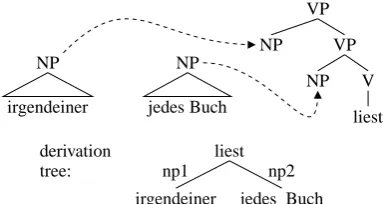
not possibly yield the desired surface word order. Fig. 3 shows a derivation of a sentence of type (8a) (with no movement). Fig. 4 shows the derivation of (8b). ((8c) is similar to (8b).)
NP irgendeiner
NP jedes Buch
VP
NP VP
NP V
liest
derivation liest
tree: np1 np2
irgendeiner jedes_Buch
Figure 3: Derivation for (8a)
VP
NP VP
NP V
liest NP
irgendeiner
VP
NP VP∗
jedes Buch NP
ǫ
derivation liest
tree: np1 np2 vp1
irgendeiner tjedes_Buch jedes_Buch
Figure 4: Derivation for (8b)
Note that, in the derivation trees, each node rep-resents a single elementary tree, not a set of el-ementary trees from the grammar. An MCTAG derivation tree as defined in (Weir, 1988) with each node representing a set is available only for tree-local or set-tree-local MCTAG, not for the MCTAG variants we need (SN-MCTAG or V-TAG). There-fore we take the undelying TAG derivation tree as the derivation structure semantics will be com-puted on.
4 Semantics of German quantificational NPs
Because of the generalizations above, the fol-lowing must be guaranteed: i) Strong quantifiers scope over the next element in surface order (take scope where they attach).3 ii) The minimal nu-clear scope of a weak quantifier is the closest “un-moved” element following its base position. Con-sequently, we need different lexical entries for weak and strong quantifiers.
We characterize the scope possibilities of a quantifier in terms of its minimal scope. Consider first the verb tree for liest ’read’ in Fig. 5. In con-trast to English,MINSis not a global feature since, depending on the position where the quantifier at-taches, its minimal scope is different. In the liest-tree, MINS appears in the feature structure of dif-ferent nodes, with each MINSvalue determined in the following way: the value of MINSat the NP2
address is the label l1 of the verb; the value of MINS at the NP1 address depends on what is
at-tached at NP2 (see variables 4 and 0, which in
this case will be identified with each other); and the value of MINSat the top VP address depends on what is attached at NP1(5).
VP
Figure 5: Semantics for liest
NP
Figure 6: Quantifiers in base position
The idea is that, when an NP (part) is attached at a given address, the label of that NP is the new
MINSto be passed up the verb tree; when a trace (part) is attached instead, theMINSof the verb ad-dress is passed up unmodified. This feature pass-ing is technically achieved by articulatpass-ing the VP spine with the feature MINS (much like the use
of the P feature in English for adverbial scope in
Kallmeyer and Romero, 2005), and by adding the featureNEXTfor passing between NP substitution nodes (since substitution nodes do not haveTand Bfeatures that allow feature percolations between mothers and daughters).
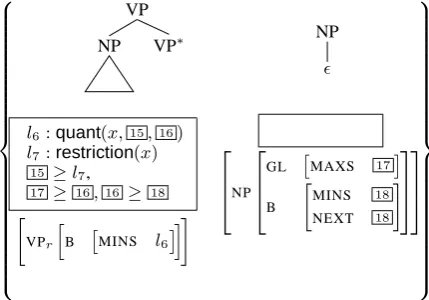
The lexical entries for the three types of quanti-fiers we must distinguish (non-moved quantiquanti-fiers, weak moved quantifiers and strong moved quanti-fiers) are shown in Fig. 6–8. Quantificational NPs that have not been moved (Fig. 6) receive their
MINSboundary (variable 9) simply from their
at-tachment position. Weak and strong quantifiers that have been moved differ in how their own
MINSis determined: Strong quantifiers (see Fig. 7) get their MINS from the VP node they attach to, i.e., from their surface position (see variable 13).
In contrast to this, weak quantifiers (see Fig. 8) get theirMINSfrom the base order position, i.e., from
their trace position (see variable 18).
MINS 14
NEXT 14
Figure 7: Strong quantifiers that have been moved
As sample analyses consider Fig. 9 and Fig. 10 showing the analyses of (8b) and (8c) where the accusative object quantifier has been moved. (The features of the internal VP node are omitted since they are not relevant here.) In the first case, it is a strong quantifier, in the second case a weak quanti-fier. For Fig. 9, we obtain the identifications 12 =
l1 = 4 = 8,5 = l2 = 11 (depicted with dotted
lines). Consequently, the only scope order is wide scope of jedes Buch: l4 > 10 ≥ l2 > 7 ≥ l1.
In Fig. 10, we obtain 11 = l1 = 4 = 8,5 = l2
which leads to the scope constraintsl2 > 7 ≥ l1
and l4 > 10 ≥ l1. Consequently, we have
an underspecified representation allowing for both scope orders.
The analysis proposed in this section has demonstrated that some features –in this case
MINS– are global in some languages (e.g. English) while being local in other languages (e.g. Ger-man). We take this as further evidence that the distinction between the two kinds of features, ad-vocated in (Kallmeyer and Romero, 2005) is
em-
MINS 18
NEXT 18
l1:read(1,2)
VP
h
B MINS 5
i
NP1
"
T
MINS 4
NEXT 5
#
NP2
"
T
MINS l1
NEXT 4
#
vp np1 np2
l4:every(x,9,10) l5:book(x)
9 ≥l5,10 ≥ 11
l2:some(x,6,7) l3:person(x)
6 ≥l3,7 ≥ 8
VPr
h
B MINS l4
i
VPf
h
B MINS 11
i
"
NP
"
B
MINS 8
NEXT l2
## "
NP
"
B
MINS 12
NEXT 12
##
Figure 9: Analysis of dass[jedes Buch]1irgendeinert1liest
l1:read(1,2)
VP
h
B MINS 5
i
NP1
"
T
MINS 4
NEXT 5
#
NP2
"
T
MINS l1
NEXT 4
#
vp np1 np2
l4:some(x,9,10) l5:book(x)
9 ≥l5,10 ≥ 11
l2:every(x,6,7) l3:person(x)
6 ≥l3,7 ≥ 8
VPr
h
B MINS l4
i "
NP
"
B
MINS 8
NEXT l2
## "
NP
"
B
MINS 11
NEXT 11
##
Figure 10: Semantic analysis of dass[irgendein Buch]1jedert1liest
pirically justified.
5 Long-distance scrambling and quantifier scope
So far we have examined cases where local scram-bling affects quantifier scope order. In this section, we will demonstrate how our analysis carries over to long-distance scrambling.
(9) . . . dass[irgendein Lied]1 Maria
. . . that some songacc Marianom
[fast jedem]2 [t1zu singen]
almost everybodydatto sing
versprochen hat promised has
‘that Maria has promised almost everybody to sing some song’
Q1> Q2,Q2 > Q1
In (9) both scope orders are possible.
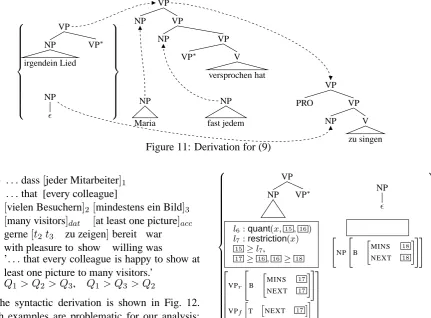
Fig. 11 shows the syntactic analysis for (9). Ac-cording to the treatment of weak quantifiers pro-posed above, the minimal nuclear scope of
irgen-dein Lied is determined by the position of the
trace; it is therefore the proposition of singen. As for fast jedem, its minimal nuclear scope is re-quired to include the proposition of versprochen
hat. Nothing else is required, and consequently irgendein can scope over or under fast jedem.
A problematic configuration that can occur with scrambling concerns cases where two weak quan-tifiers Q2 and Q3 have been moved with a third
quantifierQ1preceding them whereQ1is either a
strong quantifier or a weak quantifier in base posi-tion. ThenQ1 has scope overQ2 and Q3 but the
scope order betweenQ2andQ3is unspecified. An
irgendein Lied
NP
versprochen hat
NP Maria
NP fast jedem
VP
PRO VP
NP V
zu singen
Figure 11: Derivation for (9)
(10) . . .dass[jeder Mitarbeiter]1
. . .that [every colleague]
[vielen Besuchern]2[mindestens ein Bild]3
[many visitors]dat [at least one picture]acc
gerne[t2t3 zu zeigen]bereit war
with pleasure to show willing was
’. . .that every colleague is happy to show at least one picture to many visitors.’
Q1> Q2> Q3, Q1 > Q3 > Q2
The syntactic derivation is shown in Fig. 12. Such examples are problematic for our analysis: our approach predicts that Q2 and Q3 have the
same minimal scope, namely the zeigen proposi-tion, and that the minimal scope ofQ1is the
quan-tifier it precedes, namely Q2. But nothing in the
analysis preventsQ3 from having scope over Q1,
contrary to fact.
This example indicates that the generalization (i) in section 4 -that the minimal scope of a strong quantifier is the proposition of the next quantifier in surface order- needs to be refined. More accu-rately, the minimal scope of a strong quantifier is the highest proposition following in surface order. We propose to model this using the feature NEXT
also in VP nodes. HereNEXT stands for the max-imal scope of all quantifiers following in surface order. An attaching weak quantifier has to do two things: 1. equate the current NEXT feature with the newMINSthat provides the minimal scope for higher strong quantifiers, and 2. state that NEXT
is its own maximal scope. The corresponding re-vised lexical entry for moved weak quantifiers is shown in Fig. 13.
Fig. 14 shows the way the minimal scope for the unmoved quantifier in (10) is computed from combining the auxiliary trees of the moved weak quantifiers with bereit. (The adverb is left aside.) In the tree of a verb and also in the auxiliary trees of moved strong quantifiers, an additional feature
MINS 18
NEXT 18
##
MINS 17
NEXT 17
#
Figure 13: Moved weak quantifiers (revised)
NEXTis added, linked to the bottom of VP nodes. The value of this feature is required to be higher than the value of the bottomMINSat that position. Whenever a moved strong quantifier adjoins, noth-ing happens with thisNEXTfeature. Moved weak quantifiers take theNEXTfeature as their maximal scope and pass it as the new MINS. This is how in Fig. 14, the final MINS at the top of the root of the leftmost moved weak quantifier contains all moved quantifiers and is passed to the NP node as new MINSlimit. A (weak or strong) quantifier substituting into the NP slot takes this new MINS
as its minimal scope. Consequently, it scopes over both moved weak quantifiers.
6 Conclusion
It has been shown that, although quantifier scope is usually read off surface word order in German, ambiguities can arise from movement of weak quantifiers. We have developed an MCTAG anal-ysis using traces. In our approach, the scope pos-sibilities of a quantifier are characterized in terms of its minimal scope. In contrast to English,MINS
po-NP jeder Mitarbeiter
VP gerne VP∗
VP
NP VP
VP∗ V
bereit war
VP
PRO VP
NP VP
NP V
zu zeigen
VP
NP VP∗
mindestens ein Bild
NP
ǫ
VP
NP VP∗
vielen Besuchern
NP
ǫ
Figure 12: Derivation for (10)
l1:willing(1,2) 4 ≥ 3, 7 ≥ 6
VPr
"
B
MINS 3
NEXT 4
#
NP1 "
T
MINS 5
NEXT 3
#
VP
T MINS 5
B
MINS 6
NEXT 7
VPfT . . .
vp
l2:q3(x,9,10) l3:picture(x)
9 ≥l3,
12 ≥ 10,10 ≥ 11
VPr
"
B
MINS 12
NEXT 12
#
VPf
h
T NEXT 12
i
vpr
l4:q2(y,13,14) l5:visitor(y)
13 ≥l5,
16 ≥ 14,14 ≥ 15
VPr
"
B
MINS 16
NEXT 16
#
VPf
h
T NEXT 16
i
q2=many,q3=at_least_one
Figure 14: Attaching the moved weak quantifiers in (10)
sition of the quantifier. The minimal scope of weak and strong quantifiers is determined differ-ently: The minimal scope of a moved weak quan-tifier depends on its trace; the minimal scope of a moved strong quantifier depends on the position of the moved material.
Acknowledgments
For fruitful discussions of the work presented in this paper, we want to thank Timm Lichte and Wolfgang Maier. Furthermore, we are grateful to three anonymous reviewers for helpful comments.
References
Tilman Becker, Aravind K. Joshi, and Owen Rambow. 1991. Long-distance scrambling and tree adjoining grammars. In Proceedings of ACL-Europe.
Werner Frey. 1993. Syntaktische Bedingungen für die semantische Interpretation: Über Bindung, im-plizite Argumente und Skopus. studia grammatica.
Akademie Verlag, Berlin.
Daniel Gallin. 1975. Intensional and Higher-Order
Modal Logic with Applications to Montague Seman-tics. North Holland mathematics studies 19.
North-Holland Publ. Co., Amsterdam.
Laura Kallmeyer and Maribel Romero. 2004. LTAG Semantics with Semantic Unification. In
Proceed-ings of TAG+7, pages 155–162, Vancouver.
Laura Kallmeyer and Maribel Romero. 2005. Scope and Situation Binding in LTAG using Semantic Uni-fication. Submitted to Research on Language and
Computation. 57 pages., December.
Laura Kallmeyer. 2005. Tree-local multicomponent tree adjoining grammars with shared nodes.
Com-putational Linguistics, 31(2):187–225.
Tibor Kiss. 2000. Configurational and Relational Scope Determination in German. In Tibor Kiss and Detmar Meurers, editors, Constraint-Based
Approaches to Germanic Syntax, pages 141–176.
CSLI.
Winfried Lechner. 1998. Two Kinds of Reconstruc-tion. Studia Linguistica, 52(3):276–310.
Owen Rambow. 1994. Formal and Computational
Aspects of Natural Language Syntax. Ph.D. thesis,
University of Pennsylvania.
K. Vijay-Shanker and Aravind K. Joshi. 1988. Feature structures based tree adjoining grammar. In
Pro-ceedings of COLING, pages 714–719, Budapest.
David J. Weir. 1988. Characterizing mildly
context-sensitive grammar formalisms. Ph.D. thesis,
![Figure 9: Analysis of dass [ jedes Buch] 1 irgendeiner t 1 liest�� �](https://thumb-us.123doks.com/thumbv2/123dok_us/740132.1084138/6.595.78.490.52.475/figure-analysis-of-buch-irgendeiner-t.webp)