A Corpus of Drug Usage Guidelines Annotated with Type of Advice
Sarah Masud Preum, Md. Rizwan Parvez, Kai-Wei Chang, John A. Stankovic
University of Virginia; University of California, Los AngelesCharlottesville VA 22903; Los Angeles CA 90095
[email protected], [email protected], [email protected], [email protected]
Abstract
Adherence to drug usage guidelines for prescription and over-the-counter drugs is critical for drug safety and effectiveness of treatment. Drug usage guideline documents contain advice on potential drug-drug interaction, drug-food interaction, and drug administration process. Current research on drug safety and public health indicates patients are often either unaware of such critical advice or overlook them. Categorizing advice statements from these documents according to their topics can enable the patients to find safety critical information. However, automatically categorizing drug usage guidelines based on their topic is an open challenge and there is no annotated dataset on drug usage guidelines. To address the latter issue, this paper presents (i) an annotation scheme for annotating safety critical advice from drug usage guidelines, (ii) an annotation tool for such data, and (iii) an annotated dataset containing drug usage guidelines from 90 drugs. This work is expected to accelerate further release of annotated drug usage guideline datasets and research on automatically filtering safety critical information from these textual documents.
Keywords:Drug Usage Guidelines, Annotation Tool, Medical Corpora, Health Informatics
1.
Introduction
Drug safety is crucial for ensuring overall health safety of patients and effectiveness of treatment (Yi et al., 2015). In order to ensure drug safety, with each of their prescribed drugs, patients are often provided with drug usage guide-lines (DUG) documents1. These documents contain
essen-tial information regarding drug usage, including, but not limited to, dosage, drug administration, adverse reactions or symptoms, drug storage and disposal, contraindications, drug-drug interactions, and drug-food interactions (MDS, 2017) as illustrated in Table 1. Doctors and pharmacists are expected to educate patients about drug usage guidelines to ensure drug safety (Patel and Dowse, 2015). Such as, educating a patient who is prescribedCoumadin to avoid certain herbal products likeSt John’s Wortand foods high in Vitamin K due to potential drug-food interaction. But pa-tients are often unaware of such critical information / advice related to their prescription drugs due to several reasons, in-cluding, (i) lack of communication with their doctors and/or pharmacists (Liddy et al., 2014), (Patel and Dowse, 2015) (ii) low health literacy (Wolf et al., 2006), and (iii) volume of received information (Savas and Evcik, 2000).
Textual analysis of drug usage guidelines and automatically filtering critical personalized advice can aid a patient to ad-here to the drug usage guidelines. Such research can benefit from annotated datasets where the information is annotated according to its topic, e.g., whether a piece of advice from a DUG document is related tointeraction with food or bev-erageorinteraction with other drugs. For example, the an-notated advice from DUG documents can be forwarded to a medication reminder app to present advice that indicates potential interaction with (i) daily activities, (ii) exercise, (iii) diet, and (iv) other drugs. Examples of such advice are presented in Table 1. Presenting advice based on their top-ics can aid users to receive critical advice effectively and
1Also known as consumer medical information (CMI) and
pa-tient handouts.
increase drug adherence (Tang et al., 2014), (Jimmy and Jose, 2011). Also, often advice are subjected to physio-logical and/or temporal conditions. Annotated advice can be used to filter out irrelevant information and personal-ize DUG documents for a patient. For example, removing pregnancy related advice for a male patient. This will re-duce the information burden for the patients, which is of-ten identified as a primary barrier to self-management of chronic diseases (Woolley, 2015).
. . .
HOW TO USE:Read the Medication Guide ...
Take this medication by mouth with or without food as di-rected by your doctor or other health care professional, usu-ally once a day. It is very important to take it exactly as di-rected. . . .
It is important to eat a balanced, consistent diet while taking Warfarin. . . . Avoid sudden large increases or decreases in your intake of foods high in vitamin K (such as Broccoli, Cauliflower, Cabbage, Brussels sprouts, Kale, Spinach, and other green leafy vegetables, liver, green tea, certain vitamin supplements). If you are trying to lose weight, check with your doctor before you go on a diet. . . .
Since this drug can be absorbed through the skin and lungs and may harm an unborn baby, women who are pregnant or who may become pregnant should not handle this medication or breathe the dust from the tablets.. . .
Text Box 1: An excerpt from the drug usage guideline (DUG) document ofWarfarinfrom MedScape (MDS, 2017). Different colors are used to underline advice related to different topics. Text underlined in blue, green, and red indicate advice related todrug administration,food interaction, andpregnancy, respec-tively. Such DUG documents are also available from FDA drug database(FDA, 2017) and WebMD(WMD, 2017).
ad-vice statements from DUG documents according to their topics. This annotation tool is used to annotate a corpus of 90 online DUG documents and 9,831 sentences. The multi-label annotation results in the first annotated corpus of DUG documents containing 1,611 annotated safety criti-cal drug usage guidelines. We make the annotation tool and the annotated corpus available to the community (Preum et al., 2018). These resources can aid the release of more an-notated datasets of DUG documents and accelerate NLP re-search on automatic extraction of safety critical information from these textual documents.
2.
Background
In this section we briefly introduce the drug usage guideline (DUG) data and the relevant existing research.
The DUG documents contain a variety of information span-ning different topics, which can be broadly categorized in following classes. (i) basic drug information (e.g., alter-nate names, diseases that are commonly treated with the drug, ingredients, dosage information), (ii) drug adminis-tration related advice (i.e., how and when the drug should be administered), (iii) side effects of the drug, (iv) informa-tion regarding how the drug can interact with other drugs, foods and activities, and (v) drug storage and disposal re-lated information. This information is the input for the data annotation tool.
The DUG documents are semi-structured documents where the text contents are organized under different section head-ers. As shown in the text excerpt in Section 1., under the tileHow To Use, information related to drug administration and potential drug-food interaction are included. The top-ics described above are not always structurally organized in the textual documents. Often critical information related to drug-food interaction or drug-activity interaction are scat-tered through the document and patients face difficulties in finding them. Also, the structure and organization of infor-mation varies from one source to another.
Such irregular organization and structural variety across sources pose a challenge to automatically extract critical information from the DUG documents. Therefore, there is a need for an annotated corpus for DUG documents. Cur-rently, there are several annotated medical corpora (Saeed et al., 2011), (Aronson and Lang, 2010), (Uzuner et al., 2007), (Pardelli et al., 2012), (Bongelli et al., 2012) that contain clinical notes, bio-medical textual contents, and electronic health records. There are some existing anno-tation tools and techniques than focus on annotating elec-tronic health records (Roberts and Demner-Fushman, 2016) and clinical practice guidelines (Read et al., 2016) and ex-tracting relations from bio-medical text (Ellendorff et al., 2014). But to the best of our knowledge, there is no exist-ing work that focuses on annotatexist-ing and analyzexist-ing the tex-tual content of such documents. So, we introduce a DUG data annotation scheme, an annotation tool, and an anno-tated corpus as presented in the following sections.
3.
Data Annotation Scheme
While a DUG document contains an array of informa-tion, not all information is critical to patients (Yi et al.,
2015). We develop the following multi-label data anno-tation scheme to annotate the critical advice statements of DUG documents in 8 categories.
1. Activity or lifestyle related advice: to indicate po-tential interaction between the corresponding drug and any activity of daily living (e.g., driving). For instance, from Table 1, driving or performing other activities that require alertness might cause fatal accident if the person took Ambien within a day.
2. Disease or symptoms related advice: to indicate po-tential interaction between the corresponding drug and any diseases / symptoms. Such advice statements are crucial for patients suffering from multiple diseases, as multiple diseases can often be conflicting (Kienhues et al., 2011), (Caughey et al., 2013).
3. Drug administration related advice: to annotate im-portant advice related to drug administration process, e.g., how the drug should be taken. This type of ad-vice are essential for medication adherence and effec-tive treatment. For example, Topomax should not be taken within 6 hours of drinking alcohol (Table 1).
4. Exercise related advice: to indicate potential interac-tion between the corresponding drug and any exercise (e.g., running outdoors in a hot weather). As exer-cise is often suggested to patients taking prescription drugs, annotating the special circumstances when (i) exercise should be limited or avoided in certain con-text or (iii) performed with certain preparation (e.g., checking blood sugar before exercising) is necessary to avoid adverse conditions.
5. Food or beverage related advice: to indicate poten-tial interaction between the corresponding drug and any food / beverage. This is critical to health safety. For example, in the text excerpt from DUG document of drug Warfarin presented in Section 1., patients are suggested to avoid dark green vegetables as they can interact with the drug. But these vegetables are widely known as healthy food and often suggested to people for weight loss. High weight is a significant factor of deep vein thrombosis, a disease for which Warfarin is suggested. So, this particular food related advice is critical for the patients who are prescribed Warfarin.
6. Other drug related advice: to indicate the ad-vice suggest avoiding / limiting consumption of other drugs. As shown in Table 1, when taking Abilify, cer-tain prescription and over-the-counter drugs (e.g., al-lergy or cough relief products) should be taken with caution, as they can increase the effect of drowsiness.
Drug Name Advice Text Annotation
Ambien
Do notdrive, use machinery, or do any activitiesthat require clear thinking after you take this medication and the next day. You may feel
alert, but this medication may continue to affect your thinking, making such activities unsafe.
Activity or lifestyle related
Zoloft Older adults may also be more likely to develop a type ofsalt imbalance (hyponatremia), especially if they are taking ”water pills” (diuretics).
Disease or symptom related Other drug related
Fentanyl Avoid activities that might cause your body temperature to rise.
Such as doingstrenuous work/exercisein hot weather. Exercise related
Topamax
not drinkalcoholic beverages for 6 hours before or 6 hours after taking Topamaxextended release capsules, since alcohol may affect
this medication works.
Temporal Food or beverage related Drug administration related
Abilify Ask your pharmacist about usingallergyorcough-and-cold products
because they may contain ingredients that cause drowsiness. Other drug related
Ativan This medication is not recommended for use duringpregnancy.
It may harm an unborn baby. Pregnancy related
Table 1: Different types of advice extracted from the online DUG data. The first, second, and third columns contain the name of the drug, an advice statement from the DUG document of that drug, and the annotation of that advice statement, respectively. An advice statement can have multiple tags based on its topics.
8. Temporal advice: to indicate the advice suggests an action with temporal condition(s), e.g., when to take a drug, for how long to wait before eating/drink after taking the drug. It suggests duration or frequency of drug usage, and interval between consecutive dosage. Also, it denotes temporal dependency between taking a drug and one of the following events: (i) having a meal, (ii) doing an activity, and (iii) exercising. Such as, as shown in Table 1, when taking Topomax, alco-hol should not be consumed with in 6 hours.
Although a DUG document contains a few other categories of advice (e.g., drug dosage, route of drug administration, drug storage, drug disposal), those categories are not con-sidered here. Because, existing studies find patients are ed-ucated by their primary health care providers on these types of advice (Yi et al., 2015) when applicable. So, this infor-mation can be either filtered out or presented with lower priority. This will reduce the document length and the cog-nitive overload of the patients (Savas and Evcik, 2000), (Shrank and Avorn, 2007).
4.
Data Annotation Tool
Our goal is to develop a drug usage guideline (DUG) docu-ment annotation tool that isinteractiveandgeneralizable to DUG data from different sources. Based on empirical ev-idence found in the DUG documents from different sources, the tool should address following issues:
(i) The tool should parse through the DUG document sen-tence by sensen-tence, as critical information can be found in different parts of the document. (ii) It should provide the option to annotate advice that spans across multiple sen-tences. (iii) It should be flexible so that an annotator can add multiple tags to an advice. (iv) It should be interactive so that an annotator can change previous annotations based on his new observation as he/she goes through the docu-ment. (v) As the DUG documents often contain redundant headers or text fragments, the tool should allow the annota-tor to select part of text as advice.
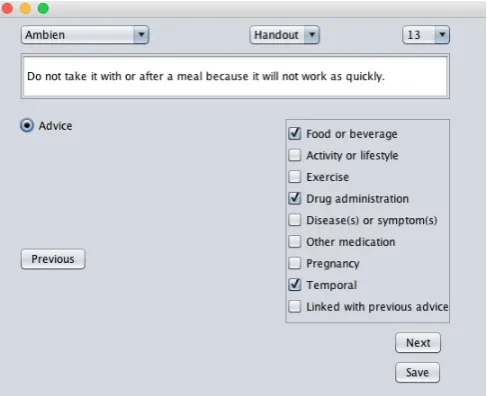
Figure 1: The Data Annotation Tool for annotating advice statements in DUG according to their topics. Here, an an-notator tagged the 13-th sentence of the DUG document of the drug named Ambien as advice. He also annotated three topics for the current sentence, namely, food or beverage, drug administration, and temporal.
We have developed a desktop application for annotating DUG documents based on the annotation scheme described in Section 3. that addresses the above mentioned issues. This tool is developed using Java Swing library. A screen shot of this tool is shown in Figure 1. The input of this tool is the textual content of the DUG documents. The output is the annotation of each sentence of the DUG document. The main features of this tool are described below.
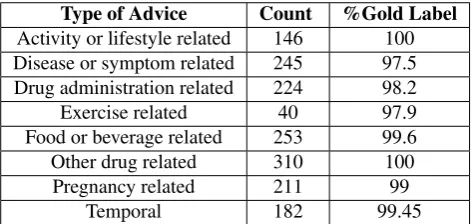
Type of Advice Count %Gold Label Activity or lifestyle related 146 100 Disease or symptom related 245 97.5 Drug administration related 224 98.2
Exercise related 40 97.9
Food or beverage related 253 99.6
Other drug related 310 100
Pregnancy related 211 99
Temporal 182 99.45
Table 2: Annotation of Drug usage guideline dataset. Eight types of advice are annotated in the data as shown in col-umn 1. The second colcol-umn denotes the count of advice for each type of advice. The third column contains the % of advice statements of that received gold label in annotation.
be selected from the drop down menu namedHandout in Figure 1. The annotator can go to a specific line of the cur-rent DUG document. An annotator can tag a sentence as an advice and specify the categories of the advice statements. Also, a sentence can be annotated as an advice without specifying the exact category of the advice. When an ad-vice statement consists of multiple consecutive sentences, it can be annotated using the linked with previousoption. An annotator can browse forward and backward through a document and update the annotation of each sentence. Also, the DUG documents often contain section headers, titles, and formatted text in between sentences that adds redundant text fragments in advice sentence(s). This an-notation tool allows the annotators to select portion of text as advice and ignore the rest of the text. As it is unlikely for an annotator to annotate the whole corpus at a time, the tool supports session memory, i.e., once the application is relaunched it loads the data from the most recent position of the corpus.
This tool can be easily adapted to annotate more categories of advice. It can also be generalized to annotate DUG doc-uments from different sources and other descriptive health / clinical textual documents (e.g., health articles, websites).
5.
Annotated Corpus
The data collection is motivated by self management of pa-tients suffering from multiple chronic diseases. We sam-pled 34 anonymized prescriptions from MTSamples. This dataset contains anonymized prescriptions of real patients. Each of the sampled prescriptions represents an anonymous patient who is suffering from two or more chronic dis-eases. The chronic diseases covered in the sampled pre-scriptions include the most common chronic diseases, e.g., diabetes, hypothyroidism, bipolar affective disorder, alco-hol withdrawal, anxiety, depression, lethargy, alcoalco-hol de-pendence, substance abuse, obesity, chronic pain, chronic kidney disease, and coronary vascular disease. Each pre-scription contains a list of suggested drugs and their corre-sponding dosages.
From the 34 prescriptions, a total of 166 drugs are found. For each of these drugs, we crawled online drug usage guidelines (DUG) documents from MedScape. We chose MedScape as it is one of the most widely used
applica-tions by the physicians. It contains more comprehensive DUG documents when compared to FDA drug database or WebMD DUG documents. Among the 166 drugs, the on-line drug usage guideon-line document is available for only 90 drugs in MedScape. We crawled and annotated these 90 online DUG documents.
The collected DUG document corpus contains 9,831 sen-tences and 170,646 words. It is annotated by three human annotators using the data annotation tool presented in Sec-tion 4. For each advice, they also tag the potential cate-gories of the advice based on the annotation scheme pre-sented in Section 3. Each of the annotators have at least a masters degree in computer science. Majority voting is ap-plied to decide the ground truth of annotation. The result of this annotation is presented in Table 2. There are 1,637 advice statements in eight categories. Here, majority of the advice received gold label, i.e., all three annotators agree on the annotation of the advice.
Among the eight categories of our proposed scheme,other drug relatedadvice is the most common category (n=336). Advice fromfood and beverage relatedcategories are also common (n=253), as most of the drugs in our constructed corpus interact negatively with alcoholic beverages. As our corpus contains drugs that are used for treating chronic dis-eases, a major portion of the annotated advice (n=245) de-scribes how a drug can interact withother diseasesorcause physiological / psychological syndromes. Exercise related adviceare relatively rare (n=40), as exercise is often rec-ommended for most of the chronic diseases. However, it is found from the annotation that exercise in certain contexts (e.g., in a hot or humid weather, within certain time range of drug administration) can negatively affect well-being. Some of the categories show strong correlation, e.g.,drug administration relatedadvice statements are often tempo-ral, and related tofood/beverage, activity (e.g., sleeping, driving), andexercise.
This dataset or the extension of such dataset can be used to automatically extract personalized advice from patient handout or DUG documents to raise patient’s awareness and hereby increase medication adherence and effective-ness of treatment. Some potential applications to utilize such datasets are presented below.
Firstly, a medication reminder app can present personal-ized safety critical drug related advice while reminding the patient to take a medication. Such as, reminding safety-critical pregnancy related advice from a DUG document to only women of child bearing age. As often DUG docu-ments contain numerous advice, filtering them in a person-alized manner and prioritizing them according to severity can increase patient’s adherence.
Secondly, another application is detecting conflicts between advice from the DUG documents with other health related advice (Preum et al., 2017a; Preum et al., 2017b). Such as, Aspirin is suggested to take with food or milk to avoid stomach upset. On the other hand, an individual with lac-tose intolerance is also suggested to avoid milk. In this case, there is a conflict between these two advice state-ments. Such datasets can accelerate automatic conflict de-tection from drug related advice.
context-aware manner can increase effectiveness of treat-ment. Often drugs are suggested to take within a certain in-terval of other activities (e.g., one hour after meal, 2 hours before sleep). Individuals suffering from multiple condi-tions may not be aware of all such temporal, drug admin-istration related advice, as they are often prescribed several drugs. In such cases, presenting relevant drug related ad-vice by inferring the context of their daily lives can be ben-eficial. Such as, for a drug that should be taken two hours before sleep, an activity tracking app can suggest it’s user to take the drug two hours before her frequent bed time.
6.
Conclusion
A plethora of textual documents containing crucial infor-mation on drug usage guidelines (DUG) are available on-line. Although analyzing such textual document can aid patient education and promote safe usage of drugs, these resources are underutilized. To bridge this knowledge gap, we introduce a multi-label annotation scheme to annotate advice from the DUG documents in eight categories based on their topics. We develop an interactive data annotation tool for this data that can also be generalized to annotated advice from various other descriptive textual information sources (e.g., DUG documents from other sources, health article). Finally, we share the first annotated corpus on DUG data containing annotated drug usage guidelines of 90 drugs that are used to treat over 30 chronic diseases. The corpus contains 9,831 sentences and 1,611 advice state-ments on eight safety critical categories. The corpus yields several important insights on instructions regarding safe us-age of drugs. The annotation tool and the annotated corpus can aid future research to automatically annotate / classify critical information from DUG documents as well as other textual health documents.
7.
Acknowledgements
This work was supported, in part, by NSF grant CPS-1646470.
8.
Bibliographical References
Aronson, A. R. and Lang, F.-M. (2010). An overview of metamap: historical perspective and recent advances. Journal of the American Medical Informatics Associa-tion, 17(3):229–236.
Bongelli, R., Canestrari, C., Riccioni, I., Zuczkowski, A., Buldorini, C., Pietrobon, R., Lavelli, A., and Magnini, B. (2012). A corpus of scientific biomedical texts span-ning over 168 years annotated for uncertainty. InLREC, pages 2009–2014.
Caughey, G., Gilbert, A., Roughead, L., McDermott, R., Ryan, P., Esterman, A., et al. (2013). Multiple chronic health conditions in older people. Implications for health policy planning, practitioners and patients.
Ellendorff, T., Rinaldi, F., and Clematide, S. (2014). Using large biomedical databases as gold annotations for auto-matic relation extraction. InLREC, pages 3736–3741. (2017). Medication guides: Us food and drug
ad-ministration. https://www.fda.gov/Drugs/
DrugSafety/ucm085729.htm. Accessed:
2017-04-15.
Jimmy, B. and Jose, J. (2011). Patient medication adher-ence: measures in daily practice.Oman medical journal, 26(3):155.
Kienhues, D., Stadtler, M., and Bromme, R. (2011). Deal-ing with conflictDeal-ing or consistent medical information on the web: When expert information breeds layper-sons’ doubts about experts. Learning and Instruction, 21(2):193–204.
Liddy, C., Blazkho, V., and Mill, K. (2014). Challenges of self-management when living with multiple chronic conditions. Canadian Family Physician, 60(12):1123– 1133.
(2017). Medscape: Search drugs, otcs & herbals.
http://reference.medscape.com/drugs.
Accessed: 2017-04-15.
Pardelli, G., Sassi, M., Goggi, S., and Biagioni, S. (2012). From medical language processing to bionlp domain. In LREC, pages 2049–2055.
Patel, S. and Dowse, R. (2015). Understanding the medicines information-seeking behaviour and informa-tion needs of south african long-term patients with lim-ited literacy skills. Health Expectations, 18(5):1494– 1507.
Preum, S. M., Mondol, A. S., Ma, M., Wang, H., and Stankovic, J. A. (2017a). Preclude: Conflict detection in textual health advice. InPervasive Computing and Com-munications (PerCom), 2017 IEEE International Confer-ence on, pages 286–296. IEEE.
Preum, S. M., Mondol, A. S., Ma, M., Wang, H., and Stankovic, J. A. (2017b). Preclude2: Personalized con-flict detection in heterogeneous health applications. Per-vasive and Mobile Computing.
Preum, S. M., Parvez, M. R., Chang, K.-W., and Stankovic, J. A. (2018). A Corpus of Online Drug Us-age Guideline Documents Annotated with Type of Ad-vice. Available at https://doi.org/10.5281/
zenodo.1173345.
Read, J., Velldal, E., Cavazza, M., and Georg, G. (2016). A corpus of clinical practice guidelines annotated with the importance of recommendations.
Roberts, K. and Demner-Fushman, D. (2016). Annotating logical forms for ehr questions. In International Con-ference on Language Resources and Evaluation, volume 2016, page 3772. NIH Public Access.
Saeed, M., Villarroel, M., Reisner, A. T., Clifford, G., Lehman, L.-W., Moody, G., Heldt, T., Kyaw, T. H., Moody, B., and Mark, R. G. (2011). Multiparameter intelligent monitoring in intensive care ii (mimic-ii): a public-access intensive care unit database. Critical care medicine, 39(5):952.
Savas, S. and Evcik, D. (2000). Do undereducated pa-tients read and understand written education materials? a pilot study in isparta, turkey. Scandinavian journal of rheumatology, 30(2):99–102.
Shrank, W. H. and Avorn, J. (2007). Educating patients about their medications: the potential and limitations of written drug information. Health Affairs, 26(3):731– 740.
B. (2014). The effects of medication education and be-havioral intervention on chinese patients with epilepsy. Epilepsy & Behavior, 37:157–164.
Uzuner, ¨O., Luo, Y., and Szolovits, P. (2007). Evaluating the state-of-the-art in automatic de-identification. Jour-nal of the American Medical Informatics Association, 14(5):550–563.
(2017). Webmd: Drugs medications a-z. http://www.
webmd.com/drugs/2/index. Accessed:
2017-04-15.
Wolf, M. S., Davis, T. C., Tilson, H. H., Bass III, P. F., and Parker, R. M. (2006). Misunderstanding of prescription drug warning labels among patients with low literacy. American Journal of Health-System Pharmacy, 63(11). Woolley, K. R. (2015). Enhancing education of medication
side effects to improve patient outcomes.