A Semi-autonomous System for Creating a Human-Machine Interaction
Corpus in Virtual Reality:
Application to the ACORFORMed System for
Training Doctors to Break Bad News
M. Ochs
1, P. Blache
2, G. Montcheuil
2,3,4, J.-M. Pergandi
3, J. Saubesty
2, D. Francon
5, and D. Mestre
3Aix Marseille Universit´e CNRS ENSAM, Universit´e de Toulon,1LSIS UMR 7296,
2LPL UMR 7309,3ISM UMR7287 ;4Bor´eal Innovation,5Institut Paoli-Calmettes (IPC), Marseille, France
Abstract
In this paper, we introduce a two-step corpora-based methodology, starting from a corpus of human-human interactions to construct a semi-autonomous system in order to collect a new corpus of human-machine interaction, a step before the development of a fully autonomous system constructed based on the analysis of the collected corpora. The presented methodology is illustrated in the context of a virtual reality training platform for doctors breaking bad news.
Keywords:Virtual patient, Virtual reality, Corpus, Health domain, Training
1.
Introduction
This paper presents a corpus-based methodology elab-orated to design a virtual reality environment aiming at training doctors to break bad news to a virtual patient. Many works have shown that doctors should be trained not only to perform medical or surgical acts but also to develop skills in communication with patients (Baile et al., 2000; Monden et al., 2016; Rosenbaum et al., 2004). Among all possible bad new, doctors can be faced to the complex situation of announcing a damage associated to a care, and that can engage their responsibility: unforeseeable medical situation, dysfunction, medical error, etc. The waydoctors deliver bad news related to damage associated with care
has a significant impact on the therapeutic process: disease evolution, adherence with treatment recommendations, litigation possibilities (Andrade et al., 2010). However, both experienced clinicians and medical students consider this task as difficult, daunting, and stressful.
Training health care professional to break bad news is now recommended by several national agencies (e.g. the French National Authority for Health, HAS)1. Such trainings are organized as workshops during which doctors disclose bad news to actors playing the role of patients. This solution is complex to implement: it requires several persons, it is costly, and time consuming (each 30 mn. session requires one hour of preparation). Our project2 aims at developinga virtual reality training systemwith an embod-ied conversational agent playing the role of a virtual patient.
The approaches classically used to develop an interactive system including an embodied conversational agent consist in analyzing automatically or manuallyoneannotated cor-pus of human-human interactions (Cassell, 2000). Then, a fully autonomous prototype is developed and evaluated
1
The French National Authority for Health is an independent public scientific authority with an overall mission of contribut-ing to the regulation of the healthcare system by improvcontribut-ing health quality and efficiency.
2ACORFORMed, (Ochs et al., 2017),
http://www.lpl-aix.fr/˜acorformed/.
through perceptive studies. In the approach presented here, the methodology is based on several steps, making it possi-ble to acquire specific data and information about the re-quired modules and functionalities. More precisely, the procedure starts classically with the collection of natural data (recordings of human-human interactions), but we troduce a new step based to acquire human-machine in-teractional data. The idea consists in developing a con-versational agent implementing both automatic and manual modules, making it possible to simulate a fully automatized human-machine interaction, without needing to develop the entire system (in particular the comprehension module).
This methodology presents several advantages. First, both human-human and human-machine interaction corpora cor-respond to the same context. Their study leads to spec-ify the verbal or non-verbal behavioral characteristics that the trainee may use when faced with a virtual human com-pared to interpersonal interactions. As a consequence, the prototype completely fits with the observed users behav-ior during human-machine interaction. Moreover, using a semi-autonomous system enables one to abstract from crit-ical modules, difficult to develop and crucial for a success-ful interaction, for example the speech recognition system, that may strongly deteriorate the interaction in case of fail-ure. Such modules are integrated in a third step without any impact on the evaluation of the first prototype. In the remaining of this paper, we illustrate an application of this methodology with the development of a prototype for train-ing doctors to break bad news to patients.
2.
The Corpus-based Methodology
The methodology used for developing the virtual training platform consists of several steps, each based on the cre-ation and the analysis of a corpus (human or human-machine interaction) in the context of breaking bad news situations. These steps can be specified as follows (see Fig-ure 1):
1. Analysis of a human-human interaction corpus: speci-fication of the discourse organization, definition of the different behavioral modules, development of a proto-type (a semi-autonomous agent).
2. The prototype is used to collect a new corpus of human-machine interaction.
3. The new human-machine corpus is analyzed to specify the missing modules and improve the different func-tionalities in order to develop the autonomous version of the system.
4. Evaluation of the system, classically with perceptive experiments.
The initial corpus of doctor-patient interaction (recorded during training sessions) has been annotated manually (see section 3). The results of the analysis have been used to develop a first version of the virtual reality training plat-form. This platform, as described in Section 4, is semi-autonomous: some modules of the architecture are simu-lated by an experimenter. This semi-autonomous platform has been used to collect a new corpus of human-machine in-teraction, considering different devices of interaction (PC, virtual reality headset, and virtual reality cave). The col-lected corpora constitute the basis of the missing modules and improve the initial prototype in the perspective of a fully autonomous virtual training platform.
3.
Multimodal Human-Human Corpus
Analysis to Model Virtual Agent’s
Behavior
The modeling of the virtual patient is based on an audio-visual corpus of interactions between doctors and actors playing the role of patients (called “Standardized patients”) during real training sessions in French medical institutions (it is not possible, for ethical reasons, to record real breaking bad news situations). The use of “Standardized Patients” in medical training is a common practice. The actors are carefully trained (in our project, actors are also nurses) and follow pre-determined scenarios defined by experts to play the most frequently observed patients reactions. The recommendations of the experts, doctors specialized in breaking bad news situations, are global and related to the attitude of the patient ; the verbal and non-verbal behavior of the actor remains spontaneous. Note that the videos of the corpus have been selected by the experts as representative of real breaking bad news situations.
On average, a simulated consultation lasts 9 minutes. The collected corpus is composed of 13 videos of patient-doctor interaction (each video involves a different doctor and/or a
different actor-patient pair), with different scenarios3. The size of the corpus remains small. However, our objective is not to learn a model (in a machine learning point of view) but to extract automatically and manually information to model the virtual patient’s behavior (Porhet et al., 2017) that, then, will be validated through perceptive studies.
The initial corpus has been semi-manually annotated, leading to a total duration of 119 minutes. Different tools have been used in order to annotate the corpus. First, the corpus has been automatically segmented using SPPAS (Bigi, 2012) and manually transcribed using Praat (Boersma and Weenik, 1996). The doctors’ and patients non-verbal behaviors have been manually annotated using ELAN (Sloetjes and Wittenburg, 2008). Different gestures of both doctors and patients have been annotated: head movements, posture changes, gaze direction, eyebrow expressions, hand gestures, and smiles. Three experts annotated one third of the corpus each. In order to validate the annotation, 5% of the corpus has been annotated by one more annotator. The inter-annotator agreement, using Cohen’s Kappa, was satisfying (k=0.63). The corpus and the annotations are described in more detail in (Porhet et al., 2017).
The annotated corpus has been analyzed for two different purposes:
• to build thedialog model of the virtual patient: the dialog model of the virtual patient is based on the notion of “common ground” (Garrod and Pickering, 2004; Stalnaker, 2002), i.e. a situation model rep-resented through different variables that is updated depending on the information exchange between the interlocutors. The variables describing the situation model (e.g. the cause of the damage), specific to breaking bad news situations, have been defined based on the manual analysis of the transcribed corpus and in light of the pedagogical objective in terms of dia-log. We used for the implementation the dialog sys-tem OpenDial (Lison and Kennington, 2016). In this approach, the model selects automatically the verbal patient’s reaction depending on the recognized verbal utterance of the doctor (matched to flexible patterns defined through regular expressions) as well as the his-tory of the dialog (the information already delivered by the doctor being encoded in thecommon ground). The dialog model is described in more detail in (Ochs et al., 2017) ;
• to designnon-verbal behaviors of the virtual patient: the corpus has been used to enrich the non-verbal be-havior library of the virtual patient with gestures spe-cific to breaking bad news situations. The recurrent gestures identified in the corpus are those used to indi-cate pain. In total, we have enriched the virtual charac-ter’s non-verbal behavior library with 16 new gestures specific to this context.
3
Figure 1: Methodology
The dialog model as well as the non-verbal behavior library of the virtual patient have been used to implement a first prototype of a virtual reality training platform, as described in the next section.
4.
Semi-Autonomous Virtual Reality
Training Platform
In order to evaluate the general architecture of the train-ing platform and to collect a corpus of human-machine interaction specific to our project, we have developed a semi-autonomous platform, which architecture is described in Figure 2.
The platform issemi-autonomous because some modules of the system are automatic (for example the dialogue generation) where some others are manual. In particular, the speech recognition and the comprehension modules are simulated by a human: the doctor verbal production is interpreted in real time by the operator which selects the adequate input signal to be transmitted to the dialogue system. Indeed, these modules may be particularly critical in case of failure and then damage strongly the interaction. They represent moreover the most difficult part of the sys-tem to be developed. Replacing the module by the operator comes to a perfect speech recognition and comprehension. This makes it possible to completely control the corre-sponding parameters and concentrate on the evaluation of the others modules, such as the dialog supervision and the non-verbal behavior of the virtual patient. Moreover, it renders possible the evaluation of the overall interaction (e.g. presence, satisfaction, believability).
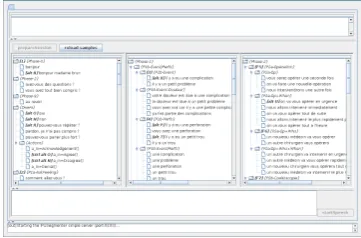
A specific interface has been designed for this purpose to enable the experimenter to select the sentences as close as possible to that has been said by the doctors (Figure 3).
Figure 3: Screen-shot of the interface of the experimenter to select the corresponding doctor’s recognized sentences
recogni-Figure 2: Overall architecture of the virtual reality training platform
tion module is replaced by the experimenter.
The dialogue system then generates a sequence of instruc-tions, to be sent to a non-verbal behavior animation system called VIB (Pelachaud, 2009). This system computes the animation parameters (Facial Animation Parameters
- FAP - andBehavioral Animation Parameters - BAP) to animate the face and the body of the virtual patient. The result is encoded in XML and describes the communicative intention to perform (encoded in FML, Function Markup Language) as well as the non-verbal signals to express (encoded in BML, Behavior Markup Language). More-over, the VIB system contains a text-to-speech synthesis (Aylett and Pidcock, 2007) for generating the speech, in synchronization with the non-verbal behavior (including lips animation).
In order to experiment as broadly as possible the validity of the approach, we have implemented the virtual patient on different platforms: PC, virtual reality headset, and virtual reality cave. The virtual reality cave is constituted of a 3m deep, 3m wide, and 4m high cubic space with three vertical screens and a horizontal screen (floor). A cluster of graphics machine makes it possible to deliver stereoscopic, wide-field, real-time rendering of 3D environments, including spatial sound. This offers an optimal sensorial immersion of the user. The environment has been designed to simulate a real recovery room where the breaking bad news are generally performed. The virtual agent based on the VIB platform has been integrated in by means of the
Unityplayer.
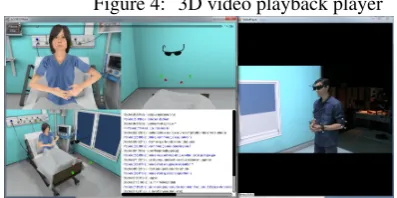
In order to collect the interaction and create the corpus of human-machine interaction in the context of breaking bad news, we have implemented a specific methodology. First, the doctor is filmed using a camera. His gestures and head movements are digitally recorded from the track-ing data: his head (stereo glasses), elbows and wrists are equipped with tracked targets. A high-end microphone syn-chronously records the participant’s verbal expression. As for the virtual agent, its gesture and verbal expressions are recorded from the Unity Player. The visualization of the interaction, is done through a 3D video playback player
we have developed (Figure 4). This player replays syn-chronously the animation and verbal expression of the vir-tual agent as well as the movements and video of the par-ticipant.
Figure 4: 3D video playback player
This environment facilitates the collection of corpora of doctor-virtual patient interaction in order to analyze the ver-bal and non-verver-bal behavior in different immersive environ-ments. The collected corpus is the basis of the development of a fully autonomous virtual reality training platform.
5.
From Human-Machine Corpus to a Fully
Autonomous Training Platform
Using the semi-autonomous system described in the previ-ous section, we have collected 108 interactions of partic-ipants with the virtual patient. In total, 36 persons have participated to the experimentation. Ten of them are real doctors that already have an experience in breaking bad news to real patients. The others are student from the Uni-versity. Each participant has interacted with the systems 3 times with three different devices: PC, virtual reality head-set, and virtual reality room. The task of the participants was to announce a digestive perforation after a gastroen-terologic endoscopy in immediate post operative period4. Before the interaction, written instructions were presented to the participants: the role they have to play is a doctor that had just operated the virtual patient to remove a polyp in the bowel. A digestive perforation occurred during the surgery.
4The scenario has been carefully chosen with the medical
These written instructions explains precisely the causes of the problem, the effects (pain), and the proposed remedia-tion (a new surgery, urgently). Participants are asked to read the instructions several times as well as before each inter-action. The understanding is verified by means of a ques-tionnaire. Each participant has the instruction to announce this medical situation to the virtual patient three times with three different devices: PC, virtual reality headset, and vir-tual reality room. The order of the conditions were coun-terbalanced.
The collected corpus is composed of 108 videos (36 per device). The total duration of the corpus is 5h34 (among which two hours with real doctors). In average, an inter-action lasts 3mn16 (an example of interinter-action is presented on the ACORFORMed site). Note that thanks to the tools described in the previous section, some of the non-verbal participant behavior can be automatically annotated. In order to validate this first prototype, we asked the par-ticipants to fill different questionnaires on their subjec-tive experience to measure their feeling of presence (with theIgroup Presence Questionnaire, IPQ (Schubert, 2003)), feeling of co-presence (Bailenson et al., 2005), and percep-tion of the believability of the virtual patient (quespercep-tions ex-tracted from (Gerhard et al., 2001)). These subjective eval-uations enabled us totagthe video of the corpus with the results of these tests and then to correlate objective mea-sures (e.g. verbal and non-verbal behavior of the partici-pants) to subjective measures (e.g. feeling of presence and perception of the virtual patient’s believability).
We are currently analyzing the corpus before entering into the development of the fully autonomous training plat-form (in particular the comprehension and generation mod-ule). We already have used the corpus to train and test the speech recognition system, in order to ensure that the speech recognition system can accurately recognize the participants. We also verify that the recognized words and sentences activate correctly the expected rules in the dialog model. These comprehension rules are adapted in conse-quence. Moreover, the corpus is also used in order to com-pare the non-verbal behaviors through the different devices. We formulate the hypothesis that participants use less ges-tures in the virtual reality headset condition since they do not see their body. Depending on the results, the automatic gestures recognition could be adapted.
6.
Conclusion
The development of embodied conversational agent with specific conversational skills is a challenge for human-machine communication, not only concerning the dialogue capacities of the agent, but also the adequacy of the envi-ronment to the task. The creation of rich and large cor-pora is a pre-requisite towards this goal. We have presented in this paper a semi-automatic platform answering these needs: offering the possibilities of an ecological human-machine interaction within a virtual reality environment following the final architecture of the system by implement-ing or simulatimplement-ing the functionalities of all the modules.
7.
Acknowledgements
This work has been funded by the French National Research Agency project ACORFORMED (ANR-14-CE24-0034-02) and supported by grants ANR-16-CONV-0002 (ILCB), LABX-0036 (BLRI) and ANR-11-IDEX-0001-02 (A*MIDEX).
8.
Bibliographical References
Andrade, A., Bagri, A., Zaw, K., Roos, B., and Ruiz, J. (2010). Avatar-mediated training in the delivery of bad news in a virtual world. Journal of palliative medicine, 13(12):1415–1419.
Aylett, M. P. and Pidcock, C. J. (2007). The cerevoice char-acterful speech synthesiser sdk. InIVA, pages 413–414. Baile, W., Buckman, R., Lenzi, R., Glober, G., Beale, E.,
and Kudelka, A. (2000). Spikes-a six-step protocol for delivering bad news: application to the patient with can-cer. Oncologist, 5(4):302–311.
Bailenson, J. N., Swinth, K., Hoyt, C., Persky, S., Di-mov, A., and Blascovich, J. (2005). The indepen-dent and interactive effects of embodied-agent appear-ance and behavior on self-report, cognitive, and behav-ioral markers of copresence in immersive virtual envi-ronments. Presence: Teleoperators and Virtual Environ-ments, 14(4):379–393.
Bigi, B. (2012). Sppas: a tool for the phonetic segmenta-tions of speech. InThe eighth international conference on Language Resources and Evaluation, pages 1748– 1755.
Boersma, P. and Weenik, D. (1996). Praat: a system for doing phonetics by computer. report of the institute of phonetic sciences of the university of amsterdam. Ams-terdam: University of Amsterdam.
Cassell, J. (2000). Embodied conversational agents. MIT press.
Garrod, S. and Pickering, M. J. (2004). Why is conversa-tion so easy? Trends in cognitive sciences, 8(1):8–11. Gerhard, M., Moore, D. J., and Hobbs, D. J. (2001).
Con-tinuous presence in collaborative virtual environments: Towards a hybrid avatar-agent model for user represen-tation. InInternational Workshop on Intelligent Virtual Agents, pages 137–155. Springer.
Lison, P. and Kennington, C. (2016). OpenDial: A Toolkit for Developing Spoken Dialogue Systems with Proba-bilistic Rules. InProceedings of the 54th Annual Meet-ing of the Association for Computational LMeet-inguistics (Demonstrations), pages 67–72, Berlin, Germany. Asso-ciation for Computational Linguistics.
Monden, K., Gentry, L., and Cox, T. (2016). Delivering bad news to patients. Proceedings (Baylor University. Medical Center), 29(1).
Ochs, M., Montcheuil, G., Pergandi, J.-M., Saubesty, J., Donval, B., Pelachaud, C., Mestre, D., and Blache, P. (2017). An architecture of virtual patient simulation platform to train doctor to break bad news. In Interna-tional Conference on Computer Animation and Social Agents (CASA).
Porhet, C., Ochs, M., Saubesty, J., Montcheuil, G., and Bertrand, R. (2017). Mining a multimodal corpus of doctor’s training for virtual patient’s feedbacks. In Pro-ceedings of 19th ACM International Conference on Mul-timodal Interaction (ICMI), Glasgow, UK.
Rosenbaum, M., Ferguson, K., and Lobas, J. (2004). Teaching medical students and residents skills for deliv-ering bad news: A review of strategies. Acad Med, 79. Schubert, T. W. (2003). The sense of presence in virtual
environments: A three-component scale measuring spa-tial presence, involvement, and realness. Zeitschrift f¨ur Medienpsychologie, 15(2):69–71.
Sloetjes, H. and Wittenburg, P. (2008). Annotation by cat-egory: Elan and iso dcr. InLREC.