The Morpho-syntactic Annotation of Animacy for a Dependency Parser
Mohammed Attia, Vitaly Nikolaev, Ali Elkahky
Google Inc.New York, USA
{attia,vitalyn,alielkahky}@google.com
Abstract
In this paper we present the annotation scheme and parser results of the animacy feature in Russian and Arabic, two morphologically-rich languages, in the spirit of the universal dependency framework (McDonald et al., 2013; de Marneffe et al., 2014). We explain the animacy hierarchies in both languages and make the case for the existence of five animacy types. We train a morphologi-cal analyzer on the annotated data and the results show a prediction f-measure for animacy of 95.39% for Russian and 92.71% for Arabic. We also use animacy along with other morphological tags as features to train a dependency parser, and the results show a slight improvement gained from animacy. We compare the impact of animacy on improving the dependency parser to other features found in nouns, namely, ‘gender’, ‘number’, and ‘case’. To our knowledge this is the first contrastive study of the impact of morphological features on the accuracy of a transition parser. A portion of our data (1,000 sentences for Arabic and Russian each, along with other languages) annotated according to the scheme described in this paper is made publicly available (https://lindat.mff.cuni.cz/repository/xmlui/handle/11234/1-1983) as part of the CoNLL 2017 Shared Task on Multilingual Parsing (Zeman et al., 2017).
Keywords:animacy, Arabic, Russian, Dependency Parsing
1.
Introduction
The explicit encoding and identification of the animacy of entities in data has been reported to improve NLP tasks such as syntactic function disambiguation (Øvrelid, 2004; Lamers, 2007), anaphora resolution (Orasan and Evans, 2007a; Liang and Wu, 2004; Singh et al., 2014), syntac-tic parsing (Marton et al., 2011; Ambati et al., 2010; Nivre et al., 2008; Bharati et al., 2008), and disambiguation ac-curacy in boosting fluency in text generation (Bloem and Bouma, 2013).
In human cognition research, animacy is considered as one of the first characterizations made by human beings in their infancy and the last distinction lost in adults with Alzheimer’s disease (Szewczyk and Schriefers, 2010). This is probably why computational representation of languages (particularly where animacy plays a morpho-syntactic func-tion, e.g. Russian, Arabic, and Hindi) needs to provide ad-equate description and annotation of this feature. Contrary to previously prevalent perception that animacy is merely a semantic feature, recent years have seen increasing research showing animacy as permeating all levels of linguistic rep-resentations: morphology, syntax, semantics, and discourse (Folli and Harley, 2008; Ramchand, 2008; Ritter, 2014; Szewczyk and Schriefers, 2010). Moreover, animacy anno-tation for some languages is important for both downstream tasks as well as generation.
Animacy is a linguistic property that impacts and relates to a number of other linguistic phenomena, such as case marking, agreement, topicality, argument realization, and structural preferences. It has received formal linguistic in-vestigation in the works of various researchers, most no-tably (Silverstein, 1976; Dik, 1997; Aissen, 2003; Martin et al., 2005; Dahl, 2008; Bloem and Bouma, 2013; Eck-hoff, 2015; Karsdorp et al., 2015).
Various projects have targeted animacy annotation, most remarkably was the benchmark initiative of (Zaenen et
al., 2004) where animacy annotation was included in two projects: the Paraphrase project and Possessive Alternation. The GNOME project (Poesio, 2004) aimed to create a cor-pus to study aspects of discourse and included an animacy taxonomy. The Dutch Cornetto lexical-semantic database (Martin et al., 2005) includes animacy annotation using hi-erarchical division of categories and subcategories. Orasan and Evans (2007a) described animacy annotation meant for anaphora resolution in English. Thuilier and Danlos (2012) annotated a French corpus for animacy and verb seman-tic classes. Jena et al. (2013) reported on work to enrich an already available treebank for Hindi with animacy in-formation. Alkuhlani and Habash (2011), Elghamry et al. (2008), and Diab et al. (2014) reported on annotating Ara-bic data for gender, number and rationality (a hyponym of animacy).
1.1.
Animacy Hierarchies
Different hierarchies and annotation schemes have been de-veloped for animacy with different levels of granularity, but the common denominator in these hierarchies is the three level taxonomy first proposed by (Silverstein, 1976): human > animate > inanimate
More fine-grained details are added to this core hierarchy by classifying ‘human’ according to person (1st, 2nd, and 3rd person) (Dik, 1997), breaking down ‘inanimate’ into ‘concrete’ and ‘abstract’ (Martin et al., 2005), classifying animates into ‘organizations’, ‘animals’, ‘intelligent ma-chines’ and ‘vehicles’ (Zaenen et al., 2004) and making a special class for ‘inanimate forces’ (Dik, 1997) or ‘natural forces’ (DeLancey, 1981). This classification is assumed to emanate from the speakers’ view of objects in the universe where humans are considered as more interesting and valu-able than animals, and animals more so than things (Ran-som, 1977).
morpho-syntactic paradigm, the exact meaning of animacy is also a source of variation from one language to the other. This is clearly exemplified by the comparison between animacy in Arabic and Russian. Russian makes distinction based on the lower scale of Silverstein’s animacy hierarchy (animate vs. inanimate), while Arabic, makes the distinction on the higher scale, rational vs. irrational, which is the equivalent of human vs. non-human. In effect, the binary opposition in the animacy space in the two languages is carved out dif-ferently. The paradigms of animacy in Russian and Arabic are illustrated in Figure 1 where animacy in Russian is rep-resented by the solid lines and in Arabic by the dotted ones.
Figure 1: Comparing the notions of Animacy in Russian and Arabic
It is to be noted that animacy as a morpho-syntactic feature does not have to align with biological or ontological ani-macy. In biology, animacy is used to refer to living things, or anything that has a form of life, including animals and plants. Animals by contrast have the power of locomotion, which separates them from plants. Linguistic animacy is also not equivalent to the notion of ‘living things’, but is similar to the biological class of ‘animal’, yet modified by augmenting two additional features: sentience and volition (Jena et al., 2013), that are entities with intrinsic feeling and free will. This allows linguistic animacy to optionally exclude germs, viruses, and lower animates that are seen as collective entities, like cattle and insects. Moreover, what separates humans from non-humans is the feature of ‘ratio-nality’. This allows languages to optionally treat entities from outside homo sapiens, like devils and angels, as hu-man.
We also note that animacy as a morpho-syntactic feature, does not have a universal definition, as there are exceptions and a certain element of arbitrariness in the assignment of this feature in different languages. In a survey of animacy in Penobscot, Quinn (2001) points out some unusual exam-ples of nouns treated as animates, including nouns denoting fluid containers: kettle, pot and cup.
1.2.
Animacy Types
There is a considerable amount of controversy regarding whether animacy is inside or outside of the “narrow syntax” (Folli and Harley, 2008; Ramchand, 2008; Ritter, 2014; Szewczyk and Schriefers, 2010), or in other terms whether animacy is a semantic/ontological category or a morpho-syntactic feature. We assume that the resolution to this question is to distinguish between the various types of ani-macy depending on how it is manifested across languages. (Wiltschko and Ritter, 2014) argued for the existence of two types of animacy: morphological animacy and high (se-mantic) animacy. We take this distinction further by hy-pothesizing three more types of animacy: anaphoric ani-macy, syntactic animacy and discourse aniani-macy, adding up to a total of five types of animacy as explained below. These
types are not dichotomous, and the existence of animacy at one level, usually has relevance to animacy in the other lev-els.
Morphological animacyis a property of lexical entries and can additionally be featured in the inflection or derivation of words where lexemes at a certain animacy cutoff limit receive specific inflectional or derivational paradigms. In some languages animacy is a determinant of inflectional paradigms, like plural suffixes in Blackfoot, where animate nouns take the plural suffix -iksi while inanimates take the suffix -stsi (Wiltschko and Ritter, 2014), the plural suffix in the Sistani dialect of Persian (Shariphia et al., 2014) where -h¯a is used for non-human and ¯an for human nouns, and Arabic sound (regular) masculine plural suffix -uwna which is used exclusively with rational (human) entities. The derivational paradigm is exemplified by the Arabic col-lective nouns for lower animates (
X@Qk.
(jarAd) –‘locusts’,H.AK.
X
(*ubAb) –‘flies’,ÉÖ
ß
(namol) –‘ant’) and lower inan-imates (ÈA
®KQK.
(burotuqAl) –‘oranges’,hA
®K
(tuf AH) –‘ap-ple’, and
I
.
J«
(Einab) –‘grapes’) where, contrary to other derivational tenancies, the singular is derived from the plu-ral form.Syntactic animacy can show in the grammar of a lan-guages as strict rules and constraints or merely preferences. As a set of constraints, animacy is featured in the differ-ential case assignment or gender-number agreement which is delineated by animacy, as detailed further in Section 2.. Languages which show inherent or explicit morphological animacy are expected to have syntactic animacy employed in one form or the other. Swart et al. (2008) points out that nouns that lie in the borderline between animate and inanimate may behave syntactically in both ways, reflecting the different aspects of their semantics (Jena et al., 2013). This is clearly exemplified by collective human nouns de-noting organizations (such as tribe, team, police) which can be treated syntactically with alternate animacy agreement depending on whether the usage is literal or metonymical. Ambiguous words, like ‘monster’, and figurative language, like ‘star’ can also be considered on the borderline of the animacy divides, allowing them to optionally attach to dif-ferent animacy classes.
As a set of preferences, animacy is assumed to affect the choice of the genitive type in English, where animate nouns tend to attract thes-genitive and inanimate nouns the of-genitive (Hinrichs and Szmrecsanyi, 2007; Altenberg, 1982).
Anaphoric (or pronominal) animacyis manifested in the animacy-based opposition in the pronoun system (Orasan and Evans, 2007b). English is a good example of this type of animacy. In English the pronouns ‘he’, ‘she’, ‘it’, ‘who’, and ‘which’ are demarcated along animacy (and gender) borderlines, and hence animacy is a property of referents, not of the morphology of the lexical items themselves. This feature lies on the border between felicity and grammatical-ity, depending on whether you see a phrase like ‘The book and his reader’ as ungrammatical or just unacceptable.
1996). While the first three types of animacy are language-specific, semantic animacy is universal across all lan-guages. It is the encyclopedic knowledge which deter-mines, for instance, that the subject of the verb ‘read’ must be a human at a certain age. This feature determines sen-tence felicity, rather than grammaticality.
Discourse animacyis related to the effect of animacy (as an accessibility scale) on topicality and the salience of en-tities in texts. It is suggested that animacy plays an impor-tant role in determining entity prominence and how likely they are to be pronominalized (Poesio, 2004; McGill, 2009; Prat-Sala and Branigan, 2002).
The five types of animacy illustrate just how profoundly animacy permeates human language. This lends support to Dahl (2000)’s claim that animacy is “so pervasive in the grammars of human languages that it tends to be taken for granted and become invisible,” and to Øvrelid (2004) ’s statement that there is a “strong correlation between the animacy dimension and other linguistic dimensions.” Nonetheless, the encoding of animacy in morphology and syntax is directly expressed in much fewer languages than the other features.
Our focus in this paper is on animacy as a purely morpho-syntactic phenomenon (i.e. the first two types above) where animacy applies to a certain, predefined cutoff limit. For example in Arabic and Russian, animacy has an immediate and tangible effect on the morphology and syntax of the two languages.
2.
Animacy in Russian and Arabic
Grammar
Despite the apparent differences in linguistic perception and dividing lines of animacy in Russian and Arabic (an-imate vs. inan(an-imate and rational vs. irrational respectively) and despite the differences in the way animacy is featured in the syntax of both languages (differential object marking and differential gender-number agreement), we find that the two languages converge along many routes in the morpho-logical and syntactic representation of animacy.
In morphology, the two languages meet along several de-marcating lines when deciding the cutoff limits in animacy hierarchy. For example, groups of people are treated as inanimate in both languages(ru:армия(armiya) – ar:
k.
(jayo$) –‘army’; ru: народ(narod) – ar:
I
. ª
($aEob) – ‘nation’). Groups of animals (ru:стадо(stado) – ar:©J¢
¯
(qaTiyE) –‘herd’) and insects (ru: муравьи(muravyi) – ar:ÉÖ
ß
(namol) –‘ants’) are inanimate in Russian, and theyreceive inanimate morphology in Arabic by taking collec-tive noun marking).
In syntax, both languages impose structural constraints based on animacy distinctions. In Arabic when a noun is both plural and irrational, it receives agreement equivalent to feminine gender and singular number, as shown by the following example.
àñJ.ªÊK XBð
B@
(Al->awoladu yaloEabuwna.) ‘The boys play.pl.masc’I
. ªÊ
K ¡¢®Ë@
(Al-qiTaTu taloEabu.) ‘The cats play.sg.fem’In Russian animate nouns have identical inflection marking in genitive and accusative forms, while inanimates have identical inflection marking in nominative and accusative forms, as shown by the following example.
Я увидел мальчика.(Ya uvidel mal’chika.) ‘I saw the boy.gen1.’
Я читаю журнал.(Ya chitayu jurnal.) ‘I am reading a journal.nom.’
3.
Data Description
Over the past 25 years, the Linguistic Data Consortium (LDC) has been the main provider of annotated data and an-notation standards. However, there are two main concerns with the LDC data (Marcus et al., 1995; Maamouri et al., 2003; Lander, 2005) that poses somes questions about its reliability and relevance to contemporary language. Firstly, most of the collected data is over two decades old now, which makes it less up-to-date. Interestingly, the last two decades have particularly witnessed many socio-political changes, information revolution, and many technological innovations leading to the coinage of many new terms and concepts. Secondly the LDC data is mainly focused on news edited texts, significantly limiting the robustness and scalability of parsing systems. The emergence of the so-cial media and user-generated data have remarkably con-tributed to the surfacing of new or previously-ignored lin-guistic phenomena such as code-switching, informal texts and dialects, substandard spelling and grammatical con-structions and the use of hashtags, repeated characters for emphasis, electronic addresses and emoticons.
As our annotation is eventually meant for aiding Informa-tion Retrieval, we focus on three document genres, namely, news, Wikipedia, and web documents. For the time be-ing we do not include social media posts (e.g. from Face-book, Twitter or Google+) and we do not mine data from other genres, such as literature, religion, tourism, educa-tional materials, technical manuals, spoken dialog, etc. We annotated freshly collected data with roughly one-third from news articles (covering politics, sports, entertainment, business, health, sci-tech, arts), one-third from Wikipedia articles and one-third from web articles (including blogs, forums, reviews). We also try as much as possible to main-tain the balance between sub-domains. This is to ensure that the data we collect is fresh, heterogeneous, application-oriented and representative.
Given the limited bandwidth of annotation time and cost, we also wanted to achieve the largest possible coverage with the smallest possible amount of sentences. Therefore we apply random sampling only for the initial 30% of the data. For the subsequent 70% we apply a ‘word frequency-based sampling’ approach which favors sentences with lex-ical items not seen in the initial set.
In this current work we annotate 10,466 sentences (189,029) for Russian and 9,717 sentences (399,774
to-1
kens) for Arabic, with the average sentence length of 18.06 for Russian and 41.14 for Arabic. In the extracted data, we observed that only 0.39% of Russian sentence exceeded the 70 token limit while in Arabic (which exhibits the phe-nomenon of run-on sentences) we have 27.44% of the data going above that limit. Heuristically we decided to exclude all sentences exceeding 70 tokens.
4.
Animacy Annotation Guidelines
Despite of the similarities between Russian and Arabic in the general perspective of animacy and its manifestation on linguistic representation, the two languages still have paradigmatic differences related to the cutoff limit within this feature (animate and inanimate vs. rational and irra-tional). This is why the annotation guidelines are developed independently to reflect the nature and idiosyncratic needs of each language.4.1.
Animacy in Russian Treebank Annotation
The Russian annotation scheme postulates that the cate-gory of animacy refers to the grammatical representation of nouns; it is a grammatical class and does not always align with the biological classification of living and nonliv-ing entities. It affects the accusative case marknonliv-ing in snonliv-ingu- singu-lar forms of masculine and neuter nouns and the accusative case marking in plural forms of all nouns. It is also anno-tated on adjectival modifiers of these nouns.Animate nouns of all three genders (feminine, masculine, neuter) have the same marking in the genitive and the ac-cusative cases of the plural form. Likewise, all inanimate nouns regardless of gender have the same marking in the nominative and the accusative cases of the plural form. Un-like feminine nouns, masculine and neuter nouns show the same syncretic pattern across animacy also in the singular paradigm: animate nouns share inflections in the genitive and the accusative case and inanimate nouns share inflec-tions in the nominative and the accusative cases. Animacy for feminine nouns and plural-only nouns are defined based on this pattern:
• Nominative_Singular:лампа“lamp”
• Nominative_Plural:лампы“lamps”
• Genitive_Plural:ламп“lamps”
• Accusative_Plural: лампы “lamps”= Nomina-tive_Plural (inanimate)
• Nominative_Singular:мышь“mouse”
• Nominative_Plural:мыши“mice”
• Genitive_Plural:мышей“mice”
• Accusative_Plural:мышей“mice” = Genitive_Plural (animate)
The majority of neuter nouns is inanimate in Russian. There are several classes of exceptions, such as nouns referring to living creatures with the augmentative suffix
-ище(-ische) likeкотище(kotische) –‘big cat’,чудовище
(chudovische) –‘monster’,страшилище(strashilische) – ‘ogre’, etc. For non-masculine nouns, we identify the pat-tern of syncretism in plural paradigms to determine the an-imacy. If the accusative plural is identical to the genitive plural, we annotate the nouns as animate even in singular
forms where this morpho-syntactic distinction is not ob-served; likewise, if the accusative plural is identical to the nominative plural, we annotate inanimate.
4.2.
Animacy in Arabic Treebank Annotation
The general principle of animacy annotation in Arabic is that all nouns (NNs) and proper nouns (NNPs) need to be tagged as either “rat” (rational), “irrat” (irrational) or “unps_a” (unspecified). Rationality mostly correlated with the state of humanness of the entity the noun denotes. The tag unsps_a is reserved for quantifiers (when used nomi-nally), as they do not have intrinsic rationality and can be used variably to refer to rational or irrational objects, e.g.ªJ.Ë@
Al-baEoD “some”,Q»
B@
Al->akovar “most”. Two of the problem areas when annotating animacy in Ara-bic are pluralia tantum and metaphors and homonyms, and they are detailed below.a) Pluralia Tantum
The pluralia tantum are special case plurals which break away from the productive methods of forming plurals from singular nouns. They refer to groups of people, animals or objects, and sometimes they are treated as units which can themselves be assigned plural inflection. They are of two main categories:
Group nouns. Plurals that can receive plural inflection, such as:
é«AÔg.
jamAEap “group”,KQ
¯
fariyq “team”(ra-tionality: irrat).
Fixed plurals. These are plurals not derived from the sin-gular forms, e.g.
ZA
nisA’ “women”,
A K
nAs “people”(rationality: rat).
Mass nouns. These plurals that do not have singular forms, e.g.
ÉÓP
ramol “sand”,H.@Q
K
turAb “dust”,H.AJ.
DabAb“cloud” (rationality: irrat).
Collective nouns. In this class, the lemma has a plural meaning, and the singular is derived from the plural by adding a morpheme (taa marboutah) in the end, such as:
Q
®K.
baqar “cows”,H.AK.
X
*ubAb “flies”,hA
®K
tuf AH “ap-ples” (rationality: irrat).b) Similes and Metaphors
Similes denote likeness between rational and irrational en-tities, while metaphors use an irrational entity to denote a rational one. In the former case, the human entity should be tagged as rational and the non-human entity as irrational. In the latter case, metaphors are treated as rational entities, as in the following example.
Ðñj.
JË@ áÓ YKYªË@ É ®mÌ'@ Qå k
HaDara Al-Hafola Al-Eadiydu mina Al-nujuwmi NN/rat‘Many stars NN/rat attended the party.’
5.
Inter-Annotator Agreement Results
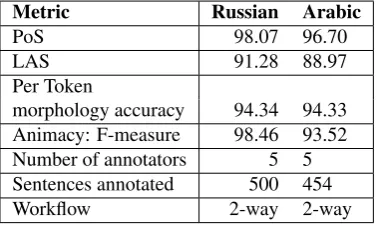
Note that PoS is part-of-speech tagging accuracy, and LAS is Labeled Attachment Score (Buchholz and Marsi, 2006). The table shows that LAS scores are in the low 90s while PoS scores are in the high 90s. While aimacy IAA scores are above 90% for both Russian and Arabic, Russian scores are 5% higher, which indicate more error analysis is needed for Arabic.
Metric Russian Arabic
PoS 98.07 96.70
LAS 91.28 88.97
Per Token
morphology accuracy 94.34 94.33 Animacy: F-measure 98.46 93.52
Number of annotators 5 5
Sentences annotated 500 454
Workflow 2-way 2-way
Table 1: IAA scores for Russian and Arabic
Russian Arabic
Total Sentences 3,985 3,745
total tokens 79,730 145,725
avg tokens per sentence 20.01 38.91 tokens with anim/rat 41,337 45,378 tokens with anim/rat % 51.85% 31.14%
Table 2: Percentage of tokens with animacy annotations
We also extract interesting statistics from the annotated data (full corpus). Table 2 shows the prevalence of the animacy feature in the annotated data. We also observe that the ra-tio of tokens annotated with animacy is different between Arabic (31.14%) and Russian (51.85%). This is due to the fact that the Arabic corpus has animacy annotations only for common and proper nouns, whereas the Russian cor-pus has animacy annotation on common and proper nouns, adjectives, participles, determiners, numerals, and several types of pronouns.
NN-ru NN-ar NNP-ru NNP-ar
anim/rat 13.82 9.93 44.27 45.55
inanim/irrat 86.18 90.07 55.73 53.59
Table 3: Animacy in NN and NNP
Table 3 demonstrates correlation between animate/rational and inanimate/irrational values in common (NN) and proper (NNP) nouns. Animacy in NNs and NNPs have a very similar distribution across Arabic and Russian where inanimate/irrational values are assigned to the majority of NNs, while we see a more balanced distribution of animacy in NNPs.
In regards to the correlation between gender and animacy, all genders across both languages show (Table 4) a gen-eral tendency towards a higher ratio of inanimate/irrational values associated with fem. This is contrasted by a more
Russian % Arabic %
fem anim/rat 7.57 5.81
fem inan/irrat 92.43 94.19
masc anim/rat 27.25 20.27
masc inan/irrat 72.75 79.73
neut anim 0.29
-neut inan 99.71
-Table 4: Gender to animacy correlation
balanced distribution in masculine nouns: Arabic 20.27% rational vs. 79.73% irrational; Russian 27.25% animate vs. 72.75% inanimate. Almost all Russian nouns with the neuter gender are inanimate.
In Table 5 we observe correlations between dependency function and animacy values in Russian and Arabic. For ex-ample, there is a general tendency for the animate/rational entities to occupy the subject position, and for the inanani-mate/irrational to occupy the position of an object of prepo-sition. In Russian, 16.50% of animate nouns occupy the nsbuj position, compared to 7.09% of inanimate nouns. Similarly in Arabic, 18.77% of rational nouns are nsubj, compared to 9.16% of irrational nouns. Genitive modifiers (gmod) in both languages appear in the top three positions regardless of the animacy value.
6.
Dependency Grammar
The dependency syntactic representation is a simple de-scription of the grammatical relationships in a sentence. It represents a sentence as a set of binary asymmetrical dependency relations between each pair of tokens or con-stituents within the sentence. The dependencies merely ex-press dominance relations between a governor (also known the head) and a dependent (also known as the child). Dependency Grammar is usually viewed in contrast to Con-stituency Grammar (Chomsky, 1964) which represents sen-tences as phrase structure trees with a root node branching into non-terminal, terminal, and leaf nodes. It also uses empty nodes and traces for dropped elements. The advan-tage of Dependency Grammar is that it simplifies the rep-resentation by having one node for each token (or syntactic unit) and the arc is labelled with syntactic functions rather than phrase types. It does not employ the concept of empty nodes, making sure that the number of nodes corresponds to the number of tokens.
ru inan % ru anim % ar irrat % ar rat %
23.23 amod 16.50 nsubj 36.19 pobj 22.52 nn
22.80 pobj 12.75 gmod 27.52 gmod 18.77 nsubj
14.25 gmod 11.83 amod 9.16 nsubj 16.32 gmod
7.09 nsubj 11.13 nn 8.21 conj 13.43 pobj
6.12 conj 9.19 conj 6.89 dobj 12.83 appos
5.10 dobj 8.85 appos 1.91 ROOT 7.03 conj
4.39 appos 8.01 pobj 1.41 appos 3.08 dobj
2.68 ROOT 4.40 ROOT 1.09 nn 1.13 attr
2.17 tmod 3.20 iobj 0.99 nsubjpass 0.89 ROOT
Table 5: Animacy and syntactic dependency
such as the Stanford parser (Chen and Manning, 2014), the inductive dependency parser (Nivre et al., 2004) and the MaltParser (Nivre et al., 2007).
Within Dependency Grammar, the dependency relations can be represented both in relational format and in graph format. In the relational format, the representation is a triple which shows a relation between a pair of words. The head of the dependency relation is given as the first argu-ment and the dependent as the second. We represent this relation as follows:
relation(head, dependent)
For example, the sentence “he slept” can be represented as:
nsubj(slept, he)
which means “the nominal subject of ‘slept’ is ‘he”’, and the verb is the head of the pronoun.
Similarly, in the graph representation the dependency arc point from the head category to the dependent category, and the relation (or grammatical function) is represented as a label on the arc as shown in Figure 2.
• head-dependent relations (directed arcs)
• functional categories (arc labels)
Figure 2: Sample Dependency Graphs
7.
Experimental Setup and Evaluation
Results
For the prediction of animcy, in addition to the other mor-phological features, we train a linear-SVM classifier using features based on a window of the current word and word clusters of three words to the left and to the right, suffix for length 1, 2 and 3 for the current word, its left and right words, prefixes of lengths 1, 2 and 3 for the current word and the set of all known morphological attributes for the
current word paired with the observed POS tags in the train-ing data.
In our experiments we use an arc-eager transition based de-pendency parser (Nivre, 2003) with a model trained using a linear SVM architecture similar to the one in Yamada and Matsumoto (2003). When experimenting with morpholog-ical features, we add the morphologmorpholog-ical attributes for both stack top and buffer top tokens.
7.1.
Morphological Analysis
Apart from the morphological feature of animacy, our data is annotated for number, gender, case, aspect, mood, per-son, tense and voice, in addition to the Arabic-specific feature of definiteness and the Russian-specific features of number-antecedent and gender-antecedent.
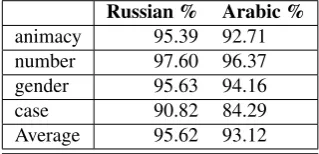
The prediction results for animacy (as shown in Table 6) is 95.39% for Russian and 92.71% for Arabic which is slightly below the average (95.62% for Russian and 93.12% for Arabic).
Russian % Arabic %
animacy 95.39 92.71
number 97.60 96.37
gender 95.63 94.16
case 90.82 84.29
Average 95.62 93.12
Table 6: Evaluation results of morphological analysis
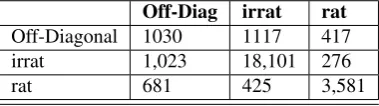
Tables 7 and 8 show the confusion matrices for ‘animate’ and ‘inanimate’ in Russian and ‘rational’ and ‘irrational’ for Arabic.
Off-Diag anim inan
Off-Diagonal 197 268 589
anim 445 2,642 418
inan 396 226 14,906
Table 7: Confusion matrix for animacy in Russian
Off-Diag irrat rat
Off-Diagonal 1030 1117 417
irrat 1,023 18,101 276
rat 681 425 3,581
Table 8: Confusion matrix for animacy in Arabic
high error rates for these classes (14.42% and 15.98% re-spectively). This shows that one possibility to improve the results is to treat the imbalance in the data, probably using active learning.
Feature Sample Sample Error Total Ratio Rate
ru/anim 3,087 16.79% 14.42%
ru/inan 15,302 83.21% 2.59%
ar/rat 4,262 18.22% 15.98%
ar/irrat 19,124 81.78% 5.35%
Table 9: Animacy Sample Space and Error Rate
Setup Ru % Loss Ar % Loss %
All features 81.76 - 80.05
-No animacy 81.01 0.75 79.95 0.10
No case 79.78 1.98 79.71 0.34
No gender 81.82 -0.06 79.91 0.14
No number 81.66 0.10 80.08 -0.03
No anim/case 79.79 1.97 79.78 0.27 No anim/gend 81.42 0.34 79.91 0.14 No anim/num 81.20 0.56 79.96 0.09 No anim/case 79.14 2.62 79.74 0.31 num/gend
Table 10: Evaluation results of dependency parsing
7.2.
Dependency Parsing
We conducted a number of experiment using different mor-phological tags as features for the transition parser to eval-uate the effectiveness of animacy in improving the parser, and to compare animacy to other features found in nouns, independently and as a group or pairs.
Table 10 compares the parsing results using all morpholog-ical features to the situation where only one, a couple or a group of morphological features are removed. The results show that ‘animacy’ has a moderately positive impact on Russian and a slightly positive impact on Arabic. Com-pared to the other morphological features, ‘animacy’ is the second strongest morphological feature in Russian, while it ranks third among the four morphological features in Ara-bic.,
Table 10 also shows that morphological tags are helpful as features to the dependency parser, although the impact is much higher in Russian than in Arabic. Moreover, it is to be noted that the predicted tags (not the gold ones) are used
as features in the transition parser, and improving the mor-phological prediction accuracy would likely improve the dependency accuracy.
8.
Conclusion
In this paper we have described the motivation for the an-notation of animacy in a syntactic dependency treebank. We explained our annotation scheme for Russian and Ara-bic, two morphologically-rich, remotely related languages which have different views to the animacy scale. We have presented the results and statistics of the annotation of the animacy feature in our dependency treebanks for Russian and Arabic.
The annotated data is used to train a morphological ana-lyzer and the results show a prediction f-measure of 95.39% and 92.71% for animacy in Russian and Arabic respec-tively. We also show that animacy along with other mor-phological tags can boost the performance of a dependency parser, and we assume that work on improving the morpho-logical accuracy prediction can lead to further improvement on the parser.
9.
Bibliographical References
Aissen, J. (2003). Differential object marking: Iconicity vs. economy. InNatural Language & Linguistic Theory, 21(3), pages 435–483.
Alkuhlani, S. and Habash, N. (2011). A corpus for model-ing morpho-syntactic agreement in arabic: Gender, num-ber and rationality. InProceedings of the 49th Annual Meeting of the Association for Computational Linguis-tics: short papers, pages 357–362, Portland, Oregon. Altenberg, B. (1982).The Genitive v. the Of-Construction.
A Study of Syntactic Variation in 17th Century English. CWK Gleerup.
Ambati, B. R., Husain, S., Nivre, J., and Sangal, R. (2010). On the role of morphosyntactic features in hindi de-pendency parsing. In In Proceedings of the NAACL HLT 2010 First Workshop on Statistical Parsing of Morphologically-Rich Languages, pages 94–102. Asso-ciation for Computational Linguistics.
Bharati, A., Husain, S., Ambati, B., Jain, S., Sharma, D., and Sangal, R. (2008). Two semantic features make all the difference in parsing accuracy. InProc. of ICON 8. Bloem, J. and Bouma, G. (2013). Automatic animacy
clas-sification for dutch. InComputational Linguistics in the Netherlands Journal 3, pages 82–10.
Chen, D. and Manning, C. (2014). A fast and accurate de-pendency parser using neural networks. InProceedings of the 2014 conference on empirical methods in natural language processing (EMNLP), pages 740–750. Chomsky, N. (1964). Aspects of the theory of syntax.
Technical report, Massachusetts Institute of Technology. Dahl, Ö. and Fraurud, K. (1996). Animacy in grammar and discourse. Pragmatics and Beyond New Series, pages 47–64.
Dahl, Ö. (2008). Animacy and egophoricity: Grammar, ontology and phylogeny.Lingua, 118:141–150.
De Marneffe, M.-C. and Manning, C. D. (2008). The stanford typed dependencies representation. InCOLING 2008: Proceedings of the Workshop on Cross-framework and Cross-domain Parser Evaluation, pages 1–8. Asso-ciation for Computational Linguistics.
de Marneffe, M.-C., Dozat, T., Silveira, N., Haverinen, K., Ginter, F., Nivre, J., and Manning, C. (2014). Universal stanford dependencies: A cross-linguistic typology. In Proceedings of LREC-14.
DeLancey, S. (1981). An interpretation of split ergativity and related patterns. pages 626–657. JSTOR.
Diab, M., Al-Badrashiny, M., Aminian, M., Attia, M., El-fardy, H., Habash, N., and Hawwari, A. (2014). Tharwa: A large scale dialectal arabic - standard arabic - english lexicon. InThe 9th edition of the Language Resources and Evaluation (LREC) Conference, Reykjavik, Iceland. Dik, S. C. (1997). The theory of functional grammar. In Ed. Kees Hengeveld. Berlin and New York: Mouton de Gruyter.
Eckhoff, H. M. (2015). Animacy and differential object marking in old church slavonic. Russian Linguist, 39. Elghamry, K., Al-Sabbagh, R., and El-Zeiny, N. (2008).
Cue-based bootstrapping of arabic semantic features. In JADT 2008: 9es Journées internationales d’Analyse statistique des Données Textuelles.
Folli, R. and Harley, H. (2008). Teleology and animacy in external arguments.
Hajiˇc, J., Vidová-Hladká, B., and Pajas, P. (2001). The prague dependency treebank: Annotation structure and support. InProceedings of the IRCS Workshop on Lin-guistic Databases, pages 105–114.
Hays, D. G. (1964). Dependency theory: A formalism and some observations. Language, 40(4):511–525.
Hinrichs, L. and Szmrecsanyi, B. (2007). Recent changes in the function and frequency of standard english genitive constructions: A multivariate analysis of tagged corpora. English Language & Linguistics, 11(3):437–474. Jena, I., Bhat, R. A., Jain, S., and Sharma, D. M. (2013).
Animacy annotation in the hindi treebank. In Proceed-ings of the 7th Linguistic Annotation Workshop & Inter-operability with Discourse, pages 159–167, Sofia, Bul-garia.
Karsdorp, F., Meulen, van der; Meder, M., Bosch, T., and van den, A. (2015). Animacy detection in stories. InIn Finlayson, M., Miller, B., Lieto, A. (ed.), Proceedings of the 6th Workshop on Computational Models of Narrative (CMN-2015), pages 82–97.
Lamers, M. J. (2007). Verb type, animacy and definiteness in grammatical function disambiguation. Linguistics in the Netherlands, 24:125–137.
Lander, T. (2005). Cslu: 22 languages corpus. In LDC2005S26, Philadelphia. Linguistic Data Consor-tium.
Liang, T. and Wu, D.-S. (2004). Automatic pronominal anaphora resolution in english texts. In Computational Linguistics and Chinese Language, pages 21–40. Maamouri, M., Bies, A., Jin, H., and Buckwalter, T.
(2003). Part 1 v 2.0. InLDC2003T06, Philadelphia. Lin-guistic Data Consortium.
Marcus, M., Santorini, B., and Marcinkiewicz, M. A. (1995). Treebank-2. In LDC95T7, Philadelphia. Lin-guistic Data Consortium.
Martin, W., Maks, I., Bopp, S., and Groot, M. (2005). Rbn-documentatie. InReport, TST Centrale.
Marton, Y., Habash, N., and Rambow, O. (2011). Im-proving arabic dependency parsing with form-based and functional morphological features. InProceedings of the 49th Annual Meeting of the Association for Computa-tional Linguistics, pages 1586–1596, Portland, Oregon. McDonald, R. T., Nivre, J., Quirmbach-Brundage, Y.,
Goldberg, Y., Das, D., Ganchev, K., Hall, K. B., Petrov, S., Zhang, H., Täckström, O., et al. (2013). Universal dependency annotation for multilingual parsing. InThe Annual Meeting of the Association for Computational Linguistics (ACL 2013), pages 92–97, Sofia, Bulgaria. McGill, S. (2009). Gender and person agreement in cicipu
discourse. InPhD thesis, School of Oriental and African Studies.
Mel’ˇcuk, I. A. (1988). Dependency syntax: theory and practice. SUNY press.
Nivre, J., Hall, J., and Nilsson, J. (2004). Memory-based dependency parsing. InProceedings of the Eighth Con-ference on Computational Natural Language Learning (CoNLL-2004) at HLT-NAACL 2004.
Nivre, J., Hall, J., Nilsson, J., Chanev, A., Eryigit, G., Kübler, S., Marinov, S., and Marsi, E. (2007). Malt-parser: A language-independent system for data-driven dependency parsing. Natural Language Engineering, 13(2):95–135.
Nivre, J., Boguslavsky, I. M., and Iomdin, L. L. (2008). Parsing the syntagrus treebank of russian. In Proceed-ings of the 22nd International Conference on Compu-tational Linguistics. Association for Computational Lin-guistics.
Nivre, J., de Marneffe, M.-C., Ginter, F., Goldberg, Y., Ha-jic, J., Manning, C. D., McDonald, R. T., Petrov, S., Pyysalo, S., Silveira, N., et al. (2016). Universal depen-dencies v1: A multilingual treebank collection. In Inter-national Conference on Language Resources and Evalu-ation (LREC 2016), pages 1659–1666, Portorož, Slove-nia.
Nivre, J. (2003). An efficient algorithm for projective de-pendency parsing. In Proceedings of the 8th Interna-tional Workshop on Parsing Technologies (IWPT). Orasan, C. and Evans, R. J. (2007a). Np animacy
identifi-cation for anaphora resolution. InJournal for Artificial Intelligence Research, volume 29, pages 79–103. Orasan, C. and Evans, R. J. (2007b). Np animacy
iden-tification for anaphora resolution. Journal of Artificial Intelligence Research, 29:79–103.
Osborne, T., Maxwell, D., and Center, U. C. (2015). A historical overview of the status of function words in de-pendency grammar. InDepLing, pages 241–250. Øvrelid, L. (2004). Disambiguation of syntactic functions
Proceedings of the 20th Scandinavian Conference of Lin-guistics, Helsinki: University of Helsinki.
Poesio, M. (2004). Discourse annotation and semantic an-notation in the gnome corpus. InThe ACL 2004 Work-shop on Discourse Annotation, pages 72–79, Barcelona, Spain.
Prat-Sala, M. and Branigan, H. P. (2002). Discourse con-straints on syntactic processing in language production: A cross-linguistic study in english and spanish. Journal of Memory and Language, 42:168–182.
Quinn, C. (2001). A preliminary survey of animacy cate-gories in penobscot. InPapers of the 32nd. Algonquian Conference, pages 395–426.
Ramchand, G. (2008). InVerb Meaning and the Lexicon: A First Phase Syntax. Cambridge University Press. Ransom, E. N. (1977). Definiteness, animacy, and np
or-dering. InProceedings of the 3rd Annual Meeting of the Berkeley Linguistics Society, pages 418–429.
Ritter, E. (2014). Featuring animacy. In Nordlyd 41.1:, special issue on Features edited by Martin Krämer, Sandra-Iulia. Ronai and Peter Svenonius. University of Tromsø, pages 103–124. The Arctic University of Nor-way.
Robinson, J. J. (1970). Dependency structures and trans-formational rules. Language, pages 259–285.
Shariphia, S., Mirib, M., and Heidarypur, M. (2014). In-vestigation of relation of animacy and number in sis-tani dialect. International Journal of Education and Re-search, 2.
Silverstein, M. (1976). Hierarchy of features and ergativ-ity. InDixon, R.M.W. (Ed.), Grammatical Categories in Australian Languages, pages 112–171, Australian Insti-tute of Aboriginal Studies, Canberra.
Singh, S., Lakhmani, P., Mathur, P., and Morwal, S. (2014). Analysis of anaphora resolution system for english lan-guage. International Journal on Information Theory (IJIT), 3.
Swart, P. D., Lamers, M., and Lestrade, S. (2008). Ani-macy, argument structure, and argument encoding. Lin-gua, 118:131–140.
Szewczyk, J. M. and Schriefers, H. (2010). Is animacy special? erp correlates of semantic violations and ani-macy violations in sentence processing. Brain Research, 1368:208–221.
Thuilier, J. and Danlos, L. (2012). Semantic annotation of french corpora: animacy and verb semantic classes. In LREC 2012, pages 1533–1537. European Language Resources Association (ELRA).
Wiltschko, M. and Ritter, E. (2014). Animating the narrow syntax. InTalk given at GLOW 37.
Yamada, H. and Matsumoto, Y. (2003). Statistical depen-dency analysis with support vector machines. In Pro-ceedings of the 8th International Workshop on Parsing Technologies, pages 195–206, Nancy, France.
Zaenen, A., Carletta, J., Garretson, G., Bresnan, J., Koontz-Garboden, A., Nikitina, T., Catherine O’Connor, M., and Wasow, T. (2004). Animacy encoding in english: Why and how. InProceedings of the Workshop on Discourse Annotation.