An Empirical Investigation of the Relation Between Discourse Structure and
Co-Reference
Dan Cristea
Department of Computer Science
University “A.I. Cuza”
Ias¸i, Romˆania
[email protected]
Nancy Ide
Department of Computer Science
Vassar College
Poughkeepsie, NY, USA
[email protected]
Daniel Marcu
Information Sciences Institute and
Department of Computer Science
University of Southern California
Los Angeles, CA, USA
[email protected]
Valentin Tablan
Department of Computer Science
University of Sheffield
United Kingdom
[email protected]
Abstract
We compare the potential of two classes of linear and hi-erarchical models of discourse to determine co-reference links and resolve anaphors. The comparison uses a cor-pus of thirty texts, which were manually annotated for co-reference and discourse structure.
1
Introduction
Most current anaphora resolution systems implement a pipeline architecture with three modules (Lappin and Le-ass, 1994; Mitkov, 1997; Kameyama, 1997).
1. A COLLECT module determines a list of potential antecedents (LPA) for each anaphor (pronoun, defi-nite noun, proper name, etc.) that have the potential to resolve it.
2. A FILTERmodule eliminates referees incompatible with the anaphor from the LPA.
3. A PREFERENCEmodule determines the most likely antecedent on the basis of an ordering policy.
In most cases, the COLLECTmodule determines an LPA by enumerating all antecedents in a window of text that precedes the anaphor under scrutiny (Hobbs, 1978; Lap-pin and Leass, 1994; Mitkov, 1997; Kameyama, 1997; Ge et al., 1998). This window can be as small as two or three sentences or as large as the entire preceding text. The FILTERmodule usually imposes semantic
con-straints by requiring that the anaphor and potential an-tecedents have the same number and gender, that selec-tional restrictions are obeyed, etc. The PREFERENCE
module imposes preferences on potential antecedents on the basis of their grammatical roles, parallelism, frequency, proximity, etc. In some cases, anaphora resolution systems implement these modules explic-itly (Hobbs, 1978; Lappin and Leass, 1994; Mitkov,
On leave from the Faculty of Computer Science, University “Al. I. Cuza” of Iasi.
1997; Kameyama, 1997). In other cases, these modules are integrated by means of statistical (Ge et al., 1998) or uncertainty reasoning techniques (Mitkov, 1997).
The fact that current anaphora resolution systems rely exclusively on the linear nature of texts in order to de-termine the LPA of an anaphor seems odd, given that several studies have claimed that there is a strong rela-tion between discourse structure and reference (Sidner, 1981; Grosz and Sidner, 1986; Grosz et al., 1995; Fox, 1987; Vonk et al., 1992; Azzam et al., 1998; Hitzeman and Poesio, 1998). These studies claim, on the one hand, that the use of referents in naturally occurring texts im-poses constraints on the interpretation of discourse; and, on the other, that the structure of discourse constrains the LPAs to which anaphors can be resolved. The oddness of the situation can be explained by the fact that both groups seem prima facie to be right. Empirical exper-iments studies that employ linear techniques for deter-mining the LPAs of anaphors report recall and precision anaphora resolution results in the range of 80% (Lappin and Leass, 1994; Ge et al., 1998). Empirical experiments that investigated the relation between discourse structure and reference also claim that by exploiting the structure of discourse one has the potential of determining correct co-referential links for more than 80% of the referential expressions (Fox, 1987; Cristea et al., 1998) although to date, no discourse-based anaphora resolution system has been implemented. Since no direct comparison of these two classes of approaches has been made, it is difficult to determine which group is right, and what method is the best.
-LECTlists of potential antecedents. Specifically, we fo-cus on determining whether discourse theories can help an anaphora resolution system determine LPAs that are ”better” than the LPAs that can be computed from a lin-ear interpretation of texts. Section 2 outlines the theoreti-cal assumptions of our empiritheoreti-cal investigation. Section 3 describes our experiment. We conclude with a discussion of the results.
2
Background
2.1 Assumptions
Our approach is based on the following assumptions:
1. For each anaphor in a text, an anaphora resolution system must produce an LPA that contains a refer-ent to which the anaphor can be resolved. The size of this LPA varies from system to system, depend-ing on the theory a system implements.
2. The smaller the LPA (while retaining a correct an-tecedent), the less likely that errors in the FILTER
and PREFERENCEmodules will affect the ability of a system to select the appropriate referent.
3. Theory A is better than theory B for the task of ref-erence resolution if theory A produces LPAs that contain more antecedents to which anaphors can be correctly resolved than theory B, and if the LPAs produced by theory A are smaller than those pro-duced by theory B. For example, if for a given anaphor, theory A produces an LPA that contains a referee to which the anaphor can be resolved, while theory B produces an LPA that does not contain such a referee, theory A is better than theory B. Moreover, if for a given anaphor, theory A produces an LPA with two referees and theory B produces an LPA with seven referees (each LPA containing a ref-eree to which the anaphor can be resolved), theory A is considered better than theory B because it has a higher probability of solving that anaphor correctly.
We consider two classes of models for determining the LPAs of anaphors in a text:
Linear-k models. This is a class of linear models in which the LPAs include all the references found in the discourse unit under scrutiny and the k discourse units that immediately precede it. Linear-0 models an ap-proach that assumes that all anaphors can be resolved intra-unit; Linear-1 models an approach that corresponds roughly to centering (Grosz et al., 1995). Linear-k is con-sistent with the assumptions that underlie most current anaphora resolution systems, which look backkunits in
order to resolve an anaphor.
Discourse-VT-k models. In this class of models, LPAs include all the referential expressions found in the dis-course unit under scrutiny and thekdiscourse units that
hierarchically precede it. The units that hierarchically
precede a given unit are determined according to Veins
Theory (VT) (Cristea et al., 1998), which is described briefly below.
2.2 Veins Theory
VT extends and formalizes the relation between dis-course structure and reference proposed by Fox (1987). It identifies ”veins”, i.e., chains of elementary discourse units, over discourse structure trees that are built accord-ing to the requirements put forth in Rhetorical Structure Theory (RST) (Mann and Thompson, 1988).
One of the conjectures of VT is that the vein expres-sion of an elementary discourse unit provides a coher-ent ”abstract” of the discourse fragmcoher-ent that contains that unit. As an internally coherent discourse fragment, most of the anaphors and referential expressions (REs) in a unit must be resolved to referees that occur in the text subsumed by the units in the vein. This conjec-ture is consistent with Fox’s view (1987) that the units that contain referees to which anaphors can be resolved are determined by the nuclearity of the discourse units that precede the anaphors and the overall structure of dis-course. According to VT, REs of both satellites and clei can access referees of hierarchically preceding nu-cleus nodes. REs of nuclei can mainly access referees of preceding nuclei nodes and of directly subordinated, pre-ceding satellite nodes. And the interposition of a nucleus after a satellite blocks the accessibility of the satellite for all nodes that are lower in the corresponding discourse structure (see (Cristea et al., 1998) for a full definition).
Hence, the fundamental intuition underlying VT is that the RST-specific distinction between nuclei and satellites constrains the range of referents to which anaphors can be resolved; in other words, the nucleus-satellite distinction induces for each anaphor (and each referential expression) a Domain of Referential Acces-sibility (DRA). For each anaphora in a discourse unit
u, VT hypothesizes thatacan be resolved by
examin-ing referential expressions that were used in a subset of the discourse units that precedeu; this subset is called
the DRA ofu. For any elementary unituin a text, the
corresponding DRA is computed automatically from the rhetorical representation of that text in two steps:
1. Heads for each node are computed bottom-up over the rhetorical representation tree. Heads of elemen-tary discourse units are the units themselves. Heads of internal nodes, i.e., discourse spans, are com-puted by taking the union of the heads of the im-mediate child nodes that are nuclei. For example, for the text in Figure 1, whose rhetorical structure is shown in Figure 2, the head of span [5,7] is unit 5 because the head of the immediate nucleus, the ele-mentary unit 5, is 5. However, the head of span [6,7] is the listh6,7ibecause both immediate children are
nuclei of a multinuclear relation.
Figure 1: An example of text and its elementary units. The referential expressions surrounded by boxes and el-lipses correspond to two distinct co-referential equiv-alence classes. Referential expressions surrounded by boxes refer to Mr. Casey; those surrounded by ellipses refer to Genetic Therapy Inc.
are computed recursively according to the rules de-scribed by Cristea et al.(1998). The DRA of a unitu
is given by the units that precedeuin the vein.
For example, for the text and RST tree in Figures 1 and 2, the vein expression of unit 3, which contains units 1 and 3, suggests that anaphors from unit 3 should be resolved only to referential expressions in units 1 and 3. Because unit 2 is a satellite to unit 1, it is considered to be ”blocked” to referen-tial links from unit 3. In contrast, the DRA of unit 9, consisting of units 1, 8, and 9, reflects the intu-ition that anaphors from unit 9 can be resolved only to referential expressions from unit 1, which is the most important unit in span [1,7], and to unit 8, a satellite that immediately precedes unit 9. Figure 2 shows the heads and veins of all internal nodes in the rhetorical representation.
2.3 Comparing models
The premise underlying our experiment is that there are potentially significant differences in the size of the search
space required to resolve referential expressions when using Linear models vs. Discourse-VT models. For ex-ample, for text and the RST tree in Figures 1 and 2, the Discourse-VT model narrows the search space required to resolve the anaphor the smaller company in unit 9. According to VT, we look for potential antecedents for
the smaller company in the DRA of unit 9, which lists
units 1, 8, and 9. The antecedent Genetic Therapy, Inc. appears in unit 1; therefore, using VT we search back 2 units (units 8 and 1) to find a correct antecedent. In con-trast, to resolve the same reference using a linear model, four units (units 8, 7, 6, and 5) must be examined be-fore Genetic Therapy is found. Assuming that referen-tial links are established as the text is processed, Genetic
Therapy would be linked back to pronoun its in unit 2,
which would in turn be linked to the first occurrence of the antecedent,Genetic Therapy, Inc., in unit 1, the an-tecedent determined directly by using VT.
In general, when hierarchical adjacency is considered, an anaphor may be resolved to a referent that is not the closest in a linear interpretation of a text. Similarly, a ref-erential expression can be linked to a referee that is not the closest in a linear interpretation of a text. However, this does not create problems because we are focusing here only on co-referential relations of identity (see sec-tion 3). Since these relasec-tions induce equivalence classes over the set of referential expressions in a text, it is suffi-cient that an anaphor or referential expression is resolved to any of the members of the relevant equivalence class. For example, according to VT, the referential expression
Mr. Casey in unit 5 in Figure 1 can be linked directly
only to the referee Mr Casey in unit 1, because the DRA of unit 5 isf1,5g. By considering the co-referential links
of the REs in the other units, the full equivalence class can be determined. This is consistent with the distinction between ”direct” and ”indirect” references discussed by Cristea, et al.(1998).
3
The Experiment
3.1 Materials
We used thirty newspaper texts whose lengths varied widely; the meanis 408 words and the standard
de-viationis 376. The texts were annotated manually for
Figure 2: The RST analysis of the text in figure 1. The tree is represented using the conventions proposed by Mann and Thompson (1988).
3.2 Comparing potential to establish co-referential links
3.2.1 Method
The annotations for co-reference relations and rhetorical structure trees for the thirty texts were fused, yielding representations that reflect not only the discourse struc-ture, but also the co-reference equivalence classes spe-cific to each text. Based on this information, we eval-uated the potential of each of the two classes of mod-els discussed in section 2 (Linear-k and Discourse-VT-k) to correctly establish co-referential links as follows: For each model, eachk, and each marked referential
expres-siona, we determined whether or not the corresponding
LPA (defined overkelementary units) contained a
ref-eree from the same equivalence class. For example, for the Linear-2 model and referential expression the smaller
company in unit 9, we estimated whether a co-referential
link could be established between the smaller company and another referential expression in units 7, 8, or 9. For the Discourse-VT-2 model and the same referential expression, we estimated whether a co-referential link could be established between the smaller company and another referential expression in units 1, 8, or 9, which correspond to the DRA of unit 9.
To enable a fair comparison of the two models, whenk
is larger than the size of the DRA of a given unit, we ex-tend that DRA using the closest units that precede the unit under scrutiny and are not already in the DRA. Hence, for the Linear-3 model and the referential expression the
smaller company in unit 9, we estimate whether a
co-referential link can be established between the smaller
company and another referential expression in units 9, 8,
7, or 6. For the Discourse-VT-3 model and the same ref-erential expression, we estimate whether a co-refref-erential link can be established between the smaller company and another referential expression in units 9, 8, 1, or 7, which correspond to the DRA of unit 9 (units 9, 8, and 1) and to unit 7, the closest unit preceding unit 9 that is not in its
DRA.
For the Discourse-VT-k models, we assume that the Extended DRA (EDRA) of sizekof a unitu(EDRA
k (u))
is given by the first l k units of a sequence that
lists, in reverse order, the units of the DRA ofu plus
thek ,l units that precede ubut are not in its DRA.
For example, for the text in Figure 1, the follow-ing relations hold: EDRA0
(9) = 9; EDRA 1
(9) = 9;8; EDRA
2
(9) = 9;8;1; EDRA 3
(9) = 9;8;1;7;
EDRA4
(9) = 9;8;1;7;6. For Linear-k models, the
EDRAk
(u) is given byuand thek units that
immedi-ately precedeu.
The potentialp(M;a;EDRA k
)of a modelM to
de-termine correct co-referential links with respect to a ref-erential expression a in unitu, given a corresponding
EDRA of sizek(EDRA k
(u)), is assigned the value 1 if
the EDRA contains a co-referent from the same equiva-lence class asa. Otherwise,p(M;a;EDRA
k
)is assigned
the value 0. The potentialp(M;C ;k ) of a model M
to determine correct co-referential links for all referen-tial expressions in a corpus of texts C, using EDRAs
of size k, is computed as the sum of the potentials
p(M;a;EDRA k
) of all referential expressions a in C.
expressions in the corpus that have an antecedent. By examining the potential of each model to correctly determine co-referential expressions for eachk, it is
pos-sible to determine the degree to which an implementa-tion of a given approach can contribute to the overall efficiency of anaphora resolution systems. That is, if a given model has the potential to correctly determine a significant percentage of co-referential expressions with small DRAs, an anaphora resolution system implement-ing that model will have to consider fewer options over-all. Hence, the probability of error is reduced.
3.2.2 Results
The graph in Figure 3 shows the potentials of the Linear-k and Discourse-VT-Linear-k models to correctly determine co-referential links for eachkfrom 1 to 20. The graph in
Figure 4 represents the same potentials but focuses only onks in the interval [2,9]. As these two graphs show, the
potentials increase monotonically withk, the VT-k
mod-els always doing better than the Linear-k modmod-els. Even-tually, for largeks, the potential performance of the two
models converges to 100%.
The graphs in Figures 3 and 4 also suggest resolution strategies for implemented systems. For example, the graphs suggests that by choosing to work with EDRAs of size 7, a discourse-based system has the potential of resolving more than 90% of the co-referential links in a text correctly. To achieve the same potential, a linear-based system needs to look back 8 units. If a system does not look back at all and attempts to resolve co-referential links only within the unit under scrutiny(k =0), it has
the potential to correctly resolve about 40% of the co-referential links.
To provide a clearer idea of how the two models differ, Figure 5 shows, for eachk, the value of the
Discourse-VT-k potentials divided by the value of the Linear-k po-tentials. Fork = 0, the potentials of both models are
equal because both use only the unit in focus in order to determine co-referential links. Fork=1, the
Discourse-VT-1 model is about 7% better than the Linear-1 model. As the value of k increases, the value
Discourse-VT-k/Linear-k converges to 1.
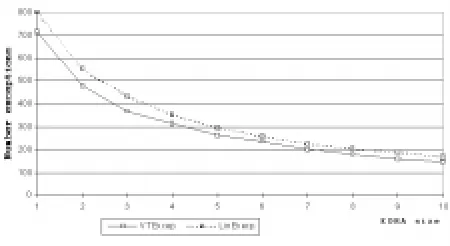
In Figures 6 and 7, we display the number of excep-tions, i.e., co-referential links that Discourse-VT-k and Linear-k models cannot determine correctly. As one can see, over the whole corpus, for each k 3, the
Discourse-VT-k models have the potential to determine correctly about 100 more co-referential links than the Linear-k models. Askincreases, the performance of the
two models converges.
3.2.3 Statistical significance
In order to assess the statistical significance of the differ-ence between the potentials of the two models to estab-lish correct co-referential links, we carried out a Paired-Samples T Test for eachk. In general, a Paired-Samples
T Test checks whether the mean of casewise differences between two variables differs from 0. For each text in
Figure 3: The potential of Linear-k and Discourse-VT-k models to determine correct co-referential linDiscourse-VT-ks(0
k20).
Figure 4: The potential of Linear-k and Discourse-VT-k models to determine correct co-referential linDiscourse-VT-ks(2
k9).
the corpus and eachk, we determined the potentials of
both VT-k and Linear-k models to establish correct co-referential links in that text. Forks smaller than 4, the
difference in potentials was statistically significant. For example, fork=3,t=3:345;df=29;P =0:002. For
values ofklarger than or equal to 4, the difference was no
longer significant. These results are consistent with the graphs shown in Figure 3 to 7, which all show that the potentials of Discourse-VT-k and Linear-k models con-verges to the same value as the value ofkincreases.
3.3 Comparing the effort required to establish co-referential links
3.3.1 Method
Figure 5: A direct comparison of Discourse-VT-k and Linear-VT-k potentials to correctly determine co-referential links(0k20).
Figure 6: The number of co-referential links that cannot be correctly determined by Discourse-VT-k and Linear-k models(0k20).
presumably, from a psycholinguistic perspective as well) it also makes sense to compare the effort required by the two classes of models to establish correct co-referential links. We estimate this effort using a very simple metric that assumes that the closer an antecedent is to a cor-responding referential expression in the EDRA, the bet-ter. Hence, in estimating the effort to establish a co-referential link, we treat EDRAs as ordered lists. For ex-ample, using the Linear-9 model, to determine the correct antecedent of the referential expression the smaller
com-pany in unit 9 of Figure 1, it is necessary to search back
through 4 units (to unit 5, which contains the referent
Ge-netic Therapy). Had unit 5 been Mr. Cassey succeeds M. James Barrett, 50, we would have had to go back 8 units
(to unit 1) in order to correctly resolve the RE the smaller
company. In contrast, in the Discourse-VT-9 model, we
go back only 2 units because unit 1 is two units away from unit 9 (EDRA9
(9)=9;8;1;7;6;5;4;3;2).
We consider that the effort e(M;a;EDRA k
) of a
modelM to determine correct co-referential links with
respect to one referentialain unitu, given a
correspond-ing EDRA of sizek(EDRA k
(u))is given by the number
Figure 7: The number of co-referential links that cannot be correctly determined by Discourse-VT-k and Linear-k models(1k10).
of units betweenuand the first unit in EDRA k
(u) that
contains a co-referential expression ofa.
The efforte(M;C ;k )of a modelM to determine
cor-rect co-referential links for all referential expressions in a corpus of textsCusing EDRAs of sizekwas computed
as the sum of the effortse(M;a;EDRA k
)of all
referen-tial expressionsainC.
3.3.2 Results
Figure 8 shows the Discourse-VT-k and Linear-k efforts computed over all referential expressions in the corpus and allks. It is possible, for a given referent aand a
givenk, that no co-referential link exists in the units of
the corresponding EDRAk. In this case, we consider that
the effort is equal tok. As a consequence, for smallks
the effort required to establish co-referential links is sim-ilar for both theories, because both can establish only a limited number of links. However, as kincreases, the
effort computed over the entire corpus diverges dramat-ically: using the Discourse-VT model, the search space for co-referential links is reduced by about 800 units for a corpus containing roughly 1200 referential expressions.
3.3.3 Statistical significance
A Paired-Samples T Test was performed for eachk. For
each text in the corpus and each k, we determined the
effort of both VT-k and Linear-k models to establish cor-rect co-referential links in that text. For allks the
dif-ference in effort was statistically significant. For exam-ple, fork = 7, we obtained the valuest = 3:51;df =
29;P = 0:001. These results are intuitive: because
EDRAs are treated as ordered lists and not as sets, the
effect of the discourse structure on establishing correct co-referential links is not diminished askincreases.
4
Conclusion
Figure 8: The effort required by Linear-k and Discourse-VT-k models to determine correct co-referential links
(0k100).
of natural language systems to correctly determine co-referential links, which is a requirement for correctly re-solving anaphors. If one treats all discourse units in the preceding discourse equally, the increase is statistically significant only when a discourse-based coreference sys-tem looks back at most four discourse units in order to establish co-referential links. However, if one assumes that proximity plays an important role in establishing co-referential links and that co-referential expressions are more likely to be linked to referees that were used recently in discourse, the increase is statistically significant no mat-ter how many units a discourse-based co-reference sys-tem looks back in order to establish co-referential links.
Acknowledgements. We are grateful to Lynette Hirschman and Nancy Chinchor for making available their corpora of co-reference annotations. We are also grateful to Graeme Hirst for comments and feedback on a previous draft of this paper.
References
Saliha Azzam, Kevin Humphreys, and Robert Gaizauskas. 1998. Evaluating a focus-based ap-proach to anaphora resolution. In Proceedings of
the 36th Annual Meeting of the Association for Computational Linguistics and of the 17th Inter-national Conference on Computational Linguistics (COLING/ACL’98), pages 74–78, Montreal, Canada,
August 10–14.
Dan Cristea, Nancy Ide, and Laurent Romary. 1998. Veins theory: A model of global discourse cohesion and coherence. In Proceedings of the 36th Annual
Meeting of the Association for Computational Lin-guistics and of the 17th International Conference on Computational Linguistics (COLING/ACL’98), pages
281–285, Montreal, Canada, August.
Barbara Fox. 1987. Discourse Structure and Anaphora. Cambridge Studies in Linguistics; 48. Cambridge Uni-versity Press.
Niyu Ge, John Hale, and Eugene Charniak. 1998. A sta-tistical approach to anaphora resolution. In
Proceed-ings of the Sixth Workshop on Very Large Corpora,
pages 161–170, Montreal, Canada, August 15-16. Barbara J. Grosz and Candace L. Sidner. 1986.
At-tention, intentions, and the structure of discourse.
Computational Linguistics, 12(3):175–204, July–
September.
Barbara J. Grosz, Aravind K. Joshi, and Scott Weinstein. 1995. Centering: A framework for modeling the lo-cal coherence of discourse. Computational
Linguis-tics, 21(2):203–226, June.
Lynette Hirschman and Nancy Chinchor, 1997. MUC-7
Coreference Task Definition, July 13.
Janet Hitzeman and Massimo Poesio. 1998. Long dis-tance pronominalization and global focus. In
Pro-ceedings of the 36th Annual Meeting of the Associ-ation for ComputAssoci-ational Linguistics and of the 17th International Conference on Computational Linguis-tics (COLING/ACL’98), pages 550–556, Montreal,
Canada, August.
Jerry H. Hobbs. 1978. Resolving pronoun references.
Lingua, 44:311–338.
Megumi Kameyama. 1997. Recognizing referential links: An information extraction perspective. In
Pro-ceedings of the ACL/EACL’97 Workshop on Opera-tional Factors in Practical, Robust Anaphora Resolu-tion, pages 46–53.
Shalom Lappin and Herbert J. Leass. 1994. An algo-rithm for pronominal anaphora resolution.
Computa-tional Linguistics, 20(4):535–561.
William C. Mann and Sandra A. Thompson. 1988. Rhetorical structure theory: Toward a functional the-ory of text organization. Text, 8(3):243–281.
Daniel Marcu, Estibaliz Amorrortu, and Magdalena Romera. 1999. Experiments in constructing a cor-pus of discourse trees. In Proceedings of the ACL’99
Workshop on Standards and Tools for Discourse Tag-ging, pages 48–57, University of Maryland, June 22.
Ruslan Mitkov. 1997. Factors in anaphora resolution: They are not the only things that matter. a case study based on two different approaches. In Proceedings of
the ACL/EACL’97 Workshop on Operational Factors in Practical, Robust Anaphora Resolution, pages 14–
21.
Candace L. Sidner. 1981. Focusing for interpretation of pronouns. Computational Linguistics, 7(4):217–231, October–December.
Wietske Vonk, Lettica G.M.M. Hustinx, and Wim H.G. Simons. 1992. The use of referential expressions in structuring discourse. Language and Cognitive


![Figure 4 represents the same potentials but focuses onlyks in the interval [2,9]. As these two graphs show, thepotentials increase monotonically with, the VT-k mod-](https://thumb-us.123doks.com/thumbv2/123dok_us/788801.1091950/5.612.317.540.75.235/figure-represents-potentials-focuses-interval-thepotentials-increase-monotonically.webp)