Aggregating Machine Learning and Rule Based Heuristics for Named
Entity Recognition
Karthik Gali, Harshit Surana, Ashwini Vaidya, Praneeth Shishtla and
Dipti Misra Sharma
Language Technologies Research Centre,
International Institute of Information Technology,
Hyderabad, India.
[email protected], [email protected],
[email protected], [email protected], [email protected]
Abstract
This paper, submitted as an entry for the NERSSEAL-2008 shared task, describes a system build for Named Entity Recognition for South and South East Asian Languages. Our paper combines machine learning techniques with language specific heuris-tics to model the problem of NER for In-dian languages. The system has been tested on five languages: Telugu, Hindi, Bengali, Urdu and Oriya. It uses CRF (Conditional Random Fields) based machine learning, followed by post processing which in-volves using some heuristics or rules. The system is specifically tuned for Hindi and Telugu, we also report the results for the other four languages.
1
Introduction
Named Entity Recognition (NER) is a task that seeks to locate and classify entities (‘atomic ele-ments’) in a text into predefined categories such as the names of persons, organizations, locations, ex-pressions of times, quantities, etc. It can be viewed as a two stage process:
1. Identification of entity boundaries 2. Classification into the correct category
For example, if “Mahatma Gandhi” is a named entity in the corpus, it is necessary to identify the beginning and the end of this entity in the sentence. Following this step, the entity must be classified
into the predefined category, which is NEP (Named Entity Person) in this case.
This task is the precursor for many natural lan-guage processing applications. It has been used in Question Answering (Toral et al, 2005) as well as Machine Translation (Babych et al, 2004).
The NERSSEAL contest has used 12 categories of named entities to define a tagset. The data has been manually tagged for training and testing pur-poses for the contestants.
The task of building a named entity recognizer for South and South East Asian languages presents several problems related to their linguistic charac-teristics. We will first discuss some of these lin-guistic issues, followed by a description of the method used. Further, we show some of the heuris-tics used for post-processing and finally an analy-sis of the results obtained.
2
Previous Work
The linguistic methods generally use rules manually written by linguists. There are several rule based NER systems, containing mainly lexi-calized grammar, gazetteer lists, and list of trigger words, which are capable of providing upto 92% f-measure accuracy for English (McDonald, 1996; Wakao et al., 1996).
Linguistic approach uses hand-crafted rules which need skilled linguistics. The chief disadvan-tage of these rule-based techniques is that they re-quire huge experience and grammatical knowledge of the particular language or domain and these sys-tems are not transferable to other languages or do-mains. However, given the closer nature of many Indian languages, the cost of adaptation of a
source from one language to another could be quite less (Singh and Surana, 2007).
Various machine learning techniques have also been successfully used for the NER task. Generally hidden markov model (Bikel et al.,1997), maxi-mum entropy (Borthwick, 1999), conditional ran-dom field (Li and Mccallum, 2004) are more popu-lar machine learning techniques used for the pur-pose of NER.
Hybrid systems have been generally more effec-tive at the task of NER. Given lesser data and more complex NE classes which were present in NERSSEAL shared task, hybrid systems make more sense. Srihari et al. (2000) combines MaxEnt, hidden markov model (HMM) and handcrafted rules to build an NER system.
Though not much work has been done for other South Asian languages, some previous work fo-cuses on NER for Hindi. It has been previously attempted by Cucerzan and Yarowsky in their lan-guage independent NER work which used morpho-logical and contextual evidences (Cucerzan and Yarowsky, 1999). They ran their experiment with 5 different languages. Among these the accuracy for Hindi was the worst. For Hindi the system achieved 42% f-value with a recall of 28% and about 85% precision. A result which highlights lack of good training data, and other various issues involved with linguistic handling of Indian lan-guages.
Later approaches have resulted in better results for Hindi. Hindi NER system developed by Wei Li and Andrew Mccallum (2004) using conditional random fields (CRFs) with feature induction have achieved f-value of 71%. (Kumar and Bhat-tacharyya, 2006) used maximum entropy markov model to achieve f-value of upto 80%.
3
Some Linguistic Issues
3.1 Agglutinative Nature
Some of the SSEA languages have agglutinative properties. For example, a Dravidian language like Telugu has a number of postpositions attached to a stem to form a single word. An example is:
guruvAraMwo = guruvAraM + wo up to Wednesday = Wednesday + up to
Most of the NERs are suffixed with several dif-ferent postpositions, which increase the number of
distinct words in the corpus. This in turn affects the machine learning process.
3.2 No Capitalization
All the five languages have scripts without graphi-cal cues like capitalization, which could act as an important indicator for NER. For a language like English, the NER system can exploit this feature to its advantage.
3.3 Ambiguity
One of the properties of the named entities in these languages is the high overlap between common names and proper names. For instance Kamal (in Hindi) can mean ‘lotus’, which is not a named en-tity, but it can also be a person’s name, in which case, it is a named entity.
Among the named entities themselves, there is ambiguity between a location name Bangalore ek badzA shaher heI (Bangalore is a big city) or a per-son’s surname ‘M. Bangalore shikshak heI’ (M. Bangalore is a teacher).
3.4 Low POS Tagging Accuracy for Nouns
For English, the available tools like POS (Part of Speech) tagger can be used to provide features for machine learning. This is not very helpful for SSEA languages because the accuracy for noun and proper noun tags is quite low (PVS and G., 2006) Hence, features based on POS tags cannot be used for NER for these languages.
To illustrate this difficulty, we conducted the following experiment. A POS tagger (described in PVS & G.,2006) was run on the Hindi test data. The data had 544 tokens with NEL, NEP, NEO tags. The POS tagger should have given the NNP (proper noun) tag for all those named entities. However the tagger was able to tag only 80 tokens accurately. This meant that only 14.7% of the named entities were correctly recognized.
3.5 Spelling Variation
One other important language related issue is the variation in the spellings of proper names. For in-stance the same name Shri Ram Dixit can be writ-ten as Sri. Ram Dixit, Shree Ram Dixit, Sh. R. Dixit
2.6 Pattern of suffixes We have converted this format into the BIO
format as described in Ramshaw et. al. For exam-ple, the above format will now be shown as: Named entities of Location (NEL) or Person
(NEP) will share certain common suffixes, which can be exploited by the learning algorthm. For in-stance, in Hindi, -pur (Rampur, Manipur) or -giri
(Devgiri) are suffixes that will appear in the named entities for Location. Similarly, there are suffixes like -swamy (Ramaswamy, Krishnaswamy) or -deva (Vasudeva, Mahadeva) which can be
com-monly found in named entities for person. These suffixes are cues for some of the named entities in the SSEA languages.
Rabindranath B-NEP
Tagore I-NEP
ne O
kahaa O
The training data set contains (approximately) 400,000 Hindi, 50,000 Telugu, 35,000 Urdu, 93,000 Oriya and 120,000 Bengali words respec-tively.
A NER system can be rule-based, statistical or hybrid. A rule-based NER system uses hand-written rules to tag a corpus with named entities. A statistical NER system learns the probabilities of named entities using training data, whereas hybrid systems use both.
5
Conditional Random Fields
Conditional Random Fields (CRFs) are undirected graphical models used to calculate the conditional probability of values on designated output nodes given values assigned to other designated input nodes.
Developing rule-based taggers for NER can be cumbersome as it is a language specific process. Statistical taggers require large amount of anno-tated data (the more the merrier) to train. Our sys-tem is a hybrid NER tagger which first uses Condi-tional Random Fields (CRF) as a machine learning technique followed by some rule based post-processing.
In the special case in which the output nodes of the graphical model are linked by edges in a linear chain, CRFs make a first-order Markov independ-ence assumption, and thus can be understood as conditionally-trained finite state machines (FSMs). Let o = (o,,o
We treat the named entity recognition problem as a sequential token-based tagging problem.
According to Lafferty et. al. CRF outperforms other Machine Learning algorithms viz., Hidden Markov Models (HMM), Maximum Entropy Markov Model (MEMM) for sequence labeling tasks.
4
Training data
The training data given by the organizers was in SSF format1. For example in SSF format, the
named entity ‘Rabindranath Tagore’ will be shown in the following way:
0 (( SSF
1 (( NP <ne=NEP> 1.1 Rabindranath
1.2 Tagore
)) 2 ne 3 kahaa ))
1http://shiva.iiit.ac.in/SPSAL2007/ssf-analysis-representation.pdf
2,o3 ,o4 ,... oT ) be some observed
in-put data sequence, such as a sequence of words in text in a document,(the values on n input nodes of the graphical model). Let S be a set of FSM states, each of which is associated with a label, l Є £.
Let s = (s ,s ,s ,s ,... s1 2 3 4 T ) be some sequence of
states, (the values on T output nodes). By the Hammersley-Clifford theorem, CRFs define the conditional probability of a state sequence given an input sequence to be:
where Zo is a normalization factor over all state
sequences is an arbitrary feature function over its arguments, and λk is a learned weight for each
where l(s) is the sequence of labels correspond-ing to the labels of the states in sequence s.
Note that the normalization factor, Zo, (also
known in statistical physics as the partition func-tion) is the sum of the scores of all possible states.
And that the number of state sequences is expo-nential in the input sequence length, T. In arbitrar-ily-structured CRFs, calculating the partition func-tion in closed form is intractable, and approxima-tion methods such as Gibbs sampling or loopy be-lief propagation must be used. In linear-chain structured CRFs (in use here for sequence model-ing), the partition function can be calculated effi-ciently by dynamic programming.
6
CRF Based Machine Learning
We used the CRF model to perform the initial tag-ging followed by post-processing.
6.1 Statistical Tagging
In the first phase, we have used language inde-pendent features to build the model using CRF.
Orthographic features (like capitalization, decimals), affixes (suffixes and prefixes), context (previous words and following words), gazetteer features, POS and morphological features etc. are generally used for NER. In English and some other languages, capitali-zation features play an important role as NEs are
generally capitalized for these languages. Unfortu-nately as explained above this feature is not applica-ble for the Indian languages.
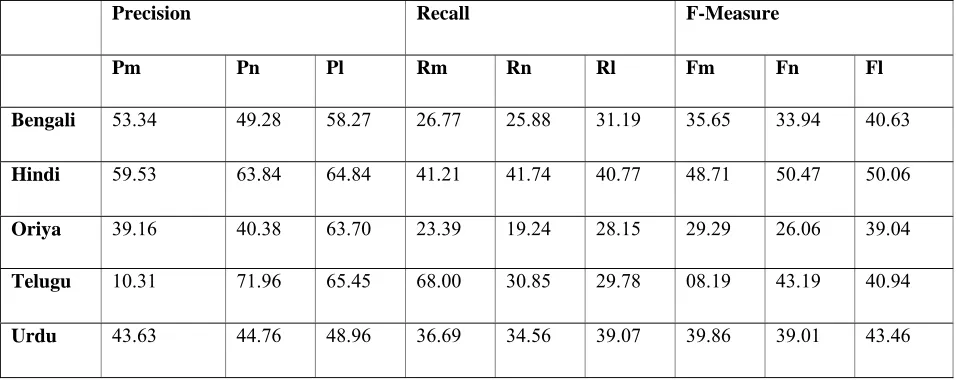
Precision Recall F-Measure
Pm Pn Pl Rm Rn Rl Fm Fn Fl
Bengali 53.34 49.28 58.27 26.77 25.88 31.19 35.65 33.94 40.63
Hindi 59.53 63.84 64.84 41.21 41.74 40.77 48.71 50.47 50.06
Oriya 39.16 40.38 63.70 23.39 19.24 28.15 29.29 26.06 39.04
Telugu 10.31 71.96 65.45 68.00 30.85 29.78 08.19 43.19 40.94
Urdu 43.63 44.76 48.96 36.69 34.56 39.07 39.86 39.01 43.46
Table 1: Evaluation of the NER System for Five Languages
The exact set of features used are described be-low.
6.2 Window of the Words
Words preceding or following the target word may be useful for determining its category. Following a few trials we found that a suitable window size is five.
6.3 Suffixes
Statistical suffixes of length 1 to 4 have been con-sidered. These can capture information for named entities having the NEL tag like Hyderabad,
Secunderabad, Ahmedabad etc., all of which end in -bad. We have collected lists of such suffixes for NEP (Named Entity Person) and NEL (Named En-tity Location) for Hindi. In the machine learning model, this resource can be used as a binary fea-ture. A sample of these lists is as follows:
Type of NE Example suffixes (Hindi)
NE- Location -desa, -vana, -nagara, -garh, -rashtra, -giri NE – Person -raja, -natha, -lal,
7
Heuristics Based Post Processing
6.4 PrefixesStatistical prefixes of length 1 to 4 have been con-sidered. These can take care of the problems asso-ciated with a large number of distinct tokens. As mentioned earlier, agglutinative languages can have a number of postpositions. The use of pre-fixes will increase the probability of Hyderabad
and Hyderabadlo (Telugu for ‘in Hyderabad’) be-ing treated as the same token.
Complex named entities like fifty five kilograms
contain a Named Entity Number within a Named Entity Measure. We observed that these were not identified accurately enough in the machine learn-ing based system. Hence, instead of applylearn-ing ma-chine learning to handle nested entities we make use of rule-based post processing.
7.1 Second Best Tag
Table 3: F-Measure (Lexical) for NE Tags
Bengali Hindi Oriya Telugu Urdu
It was observed that the recall of the CRF model is low. In order to improve recall, we have used the following rule: if the best tag given by the CRF model is O (not a named entity) and the confidence of the second best tag is greater than 0.15, then the second best tag is considered as the correct tag.
NEP 35.22 54.05 52.22 01.93 31.22
NED NA 42.47 01.97 NA 21.27
NEO 11.59 45.63 14.50 NA 19.13 NEA NA 61.53 NA NA NA
We observed an increase of 7% in recall and 3% decrease in precision. This resulted in a 4% crease in the F-measure, which is a significant in-crease in performance. The dein-crease in precision is expected as we are taking the second tag.
NEB NA NA NA NA NA
NETP 42.30 NA NA NA NA
NETO 33.33 13.77 NA 01.66 NA NEL 45.27 62.66 48.72 01.49 57.85
7.2 Nested Entities NETI 55.85 79.09 40.91 71.35 63.47
NEN 62.67 80.69 24.94 83.17 13.75 One of the important tasks in the contest was to identify nested named entities. For example if we consider eka kilo (Hindi: one kilo) as NEM (Named Entity Measure), it contains a NEN (Named Entity Number) within it.
NEM 60.51 43.75 19.00 26.66 84.10 NETE 19.17 31.52 NA 08.91 NA
The CRF model tags eka kilo as NEM and in or-der to tag eka as NEN we have made use of other resources like a gazetteer for the list of numbers. We used such lists for four languages.
6.5 Start of a sentence
There is a possibility of confusing the NEN (Named Entity Number) in a sentence with the number that appears in a numbered list. The num-bered list will always have numbers at the begin-ning of a sentence and hence a feature that checks for this property will resolve the ambiguity with an actual NEN.
7.3 Gazetteers
For Hindi, we made use of three different kinds of gazetteers. These consisted of lists for measures (entities like kilogram, millimetre, lakh), numerals and quantifiers (one, first, second) and time ex-pressions (January, minutes, hours) etc. Similar lists were used for all the other languages except Urdu. These gazetteers were effective in identify-ing this relatively closed class of named entities and showed good results for these languages.
6.6 Presence of digits
Usually, the presence of digits indicates that the token is a named entity. For example, the tokens
92, 10.1 will be identified as Named Entity Num-ber based on the binary feature ‘contains digits’.
6.7 Presence of four digits
8
Evaluation
If the token is a four digit number, it is likelier to be a NETI (Named Entity Time). For example, 1857, 2007 etc. are most probably years.
1. Maximal Matches: The largest possible
named entities are matched with the refer-ence data.
The amount of annotated corpus available for Hindi was substantially more. This should have ideally resulted in better results for Hindi with the machine learning approach. But, the results were only marginally better than other languages. A ma-jor reason for this was that a very high percentage (44%) of tags in Hindi were NETE. The tagset gives examples like ‘Horticulture’, ‘Conditional Random Fields’ for the tag NETE. It has also been mentioned that even manual annotation is harder for NETE as it is domain specific. This affected the overall results for Hindi because the performance for NETE was low (Table 3).
2. Nested Matches: The largest possible as
well as nested named entities are matched. 3. Lexical Item Matches: The lexical items
inside largest possible named entities are matched.
9
Results
The results of evaluation as explained in the previ-ous section are shown in the Table-1. The F-measures for nested lexical match are also shown individually for each named entity tag separately in Table-3
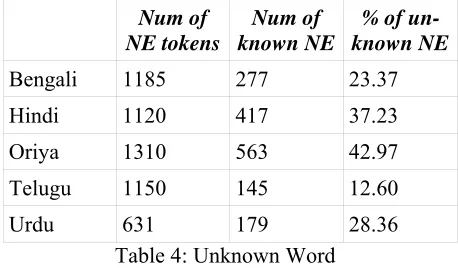
Num of
NE tokens
Num of known NE
% of un-known NE
Bengali 1185 277 23.37
10
Unknown Words
Hindi 1120 417 37.23Table 4 shows the number of unknown words pre-sent in the test data when compared with the train-ing data.
Oriya 1310 563 42.97
Telugu 1150 145 12.60
First column shows the number of unique Named entity tags present in the test data for each language. Second column shows the number of unique known named entities present in the test data. Third column shows the percentage of unique unknown words present in the test data of different languages when compared to training data.
Urdu 631 179 28.36 Table 4: Unknown Word
Also, the F-measures of NEN, NETI, and NEM could have been higher because they are relatively closed classes. However, certain NEN can be am-biguous (Example: eka is a NEN for ‘one’ in Hindi, but in a different context it can be a non-number. For instance eka-doosra is Hindi for ‘each other’).
11
Error Analysis
We can observe from the results that the maximal F-measure for Telugu is very low when compared to lexical F-measure and nested F-measure. The reason is that the test data of Telugu contains a large number of long named entities (around 6 words), which in turn contain around 4 - 5 nested named entities. Our system was able to tag nested named entities correctly unlike maximal named entity.
In a language like Telugu, NENs will appear as inflected words. For example 2001lo, guru-vaaramto.
10 Conclusion and Further Work
In this paper we have presented the results of using a two stage hybrid approach for the task of named entity recognition for South and South East Asian Languages. We have achieved decent Lexical F-measures of 40.63, 50.06, 39.04, 40.94, and 43.46 for Bengali, Hindi, Oriya, Telugu and Urdu respec-tively without using many language specific re-sources.
We can also observe that the maximal F-measure for Telugu is very low when compared to other languages. This is because Telugu test data has very few known words.
Urdu results are comparatively low chiefly be-cause gazetteers for numbers and measures were
2008) and use transliteration techniques to produce Indian language gazetteers (Surana and Singh, 2008). Use of character models for increasing the lower recalls (Shishtla et. al, 2008) is also under-way. We also plan to enrich the Indian dependency tree bank (Begum et. al, 2008) by use of our NER system.
11 Acknowledgments
We would like to thank the organizer Mr. Anil Kumar Singh deeply for his continuous support during the shared task.
References
B. Babych, and A. Hartley, Improving Machine transla-tion Quality with Automatic Named Entity Recognitransla-tion. www.mt-archive.info/EAMT-2003- Babych.pdf
Rafiya Begum, Samar Husain, Arun Dhwaj, Dipti Misra Sharma, Lakshmi Bai, and Rajeev Sangal. 2008. De-pendency annotation scheme for Indian languages. In
Proceedings of IJCNLP-2008, Hyderabad, India. M. Bikel Daniel, Miller Scott, Schwartz Richard and
Weischedel Ralph. 1997. Nymble: A High Perfor mance Learning Name-finder. In Proceedings of the Fifth Conference on Applied Natural Language Processing.
S. Cucerzan, and D. Yarowsky, 1999. Language inde-pendent named entity recognition combining mor-phological and contextual evidence. Proceedings of the Joint SIGDAT Conference on EMNLP and VLC.
N. Kumar and Pushpak Bhattacharyya. 2006. Named Entity Recognition in Hindi using MEMM. In Tech-nical Report, IIT Bombay, India.
John Lafferty, Andrew McCallum and Fernando Pereira. 2001. Conditional Random Fields: Probabil-istic Models for Segmenting and Labeling Sequence Data. Proc. 18th International Conf. on Machine Learning.
D. McDonald 1996. Internal and external evidence in the identification and semantic categorization of proper names. In B. Boguraev and J. Pustejovsky, editors, Corpus Processing for Lexical Acquisition.
Avinesh PVS and Karthik G. Part-Of-Speech Tagging and Chunking Using Conditional Random Fields and Transformation Based Learning. Proceedings of the SPSAL workshop during IJCAI’07.
Lance Ramshaw and Mitch Marcus. Text Chunking Using Transformation-Based Learning. Proceedings of the Third Workshop on Very Large Corpora.
S.K. Saha , S. Chatterji , S. Dandapat , S. Sarkar and P. Mitra 2008. A Hybrid Approach for Named Entity Recognition in Indian Languages. In Proceedings of IJCNLP Workshop on NER for South and South East Asian Languages.
Fei Sha and Fernando Pereira. 2003. Shallow Parsing with Conditional Random Fields. In the Proceedings of HLT-NAACL.
P. Shishtla, P. Pingali , V. Varma 2008. A Character n-gram Based Approach for Improved Recall in Indian Language NER. In Proceedings of IJCNLP Work-shop on NER for South and South East Asian Lan-guages.
Cucerzan Silviu and Yarowsky David. 1999. Language Independent Named Entity Recognition Combining Morphological and Contextual Evidence. In Proceed-ings of the Joint SIGDAT Conference on EMNLP and VLC.
A. K. Singh and H. Surana Can Corpus Based Meas-ures be Used for Comparative Study of Languages?
In Proceedings of Ninth Meeting of the ACL Special Interest Group in Computational Morphology and Phonology. ACL. 2007.
R. Srihari, C. Niu and W. Li 2000. A Hybrid Approach for Named Entity and Sub-Type Tagging. In Pro-ceedings of the sixth conference on Applied natural language processing.
H. Surana and A. K. Singh 2008. A More Discerning and Adaptable Multilingual Transliteration Mecha-nism for Indian Languages. In Proceedings of the Third International Joint Conference on Natural Language Processing.
Charles Sutton, An Introduction to Conditional Random Fields for Relational Learning.
T. Wakao , R. Gaizauskas and Y. Wilks 1996. Evalua-tion of an algorithm for the recogniEvalua-tion and classifi-cation of proper names. In Proceedings of COLING.
Li Wei and McCallum Andrew. 2004. Rapid Develop-ment of Hindi Named Entity Recognition using Con-ditional Random Fields and Feature Induction. In ACM Transactions on Computational Logic.