Detecting Segmentation Errors in Chinese Annotated Corpus
Chengjie Sun Chang-Ning Huang Xiaolong Wang Mu Li
Harbin Institute of Microsoft Research, Harbin Institute of Microsoft Research, Technology, Harbin, Asia, Beijing, Technology, Harbin, Asia, Beijing,
150001, China 100080, China 150001, China 100080, China {cjsun, wangxl}@insun.hit.edu.cn [email protected]
Abstract
This paper proposes a semi-automatic method to detect segmentation errors in a manually annotated Chinese corpus in order to improve its quality further. A particular Chinese character string occurring more than once in a corpus may be assigned different segmentations during a segmentation process. Based on these differences our approach outputs the segmentation error candidates found in a segmented corpus and then on which the segmentation errors are identified manually. Segmentation error rate of a gold standard corpus can be given using our method. In Peking University (PK) and Academic Sinica (AS) test corpora of Special Interest Group for Chinese Language Processing (SIGHAN) Bakeoff1, 1.29% and 2.26% segmentation error rates are detected by our method. These errors decrease the F-measure of SIGHAN Bakeoff1 baseline test by 1.36% in PK test data and 1.93% in AS test data respectively.
This work was done while Chengjie Sun was visiting
Microsoft Research Asia.
1 Introduction
SIGHAN Bakeoff11 proposed an automatic method to evaluate the performance of different Chinese word segmentation systems on four distinct data sets. This method makes the performance of different Chinese word segmentation systems comparable and greatly promotes the technology of Chinese Word Segmentation. However, the quality of the reference corpora in the evaluation should be paid more attention because they provide training material for participants and they serve as a gold standard for evaluating the performance of participant systems.
This paper presents a semi-automatic method to detect segmentation errors in a manually annotated Chinese corpus in order to improve its quality further. Especially a segmentation error rate of a gold standard corpus could be obtained with our approach. As we know a particular Chinese character string occurring more than once in a corpus may be assigned different segmentations. Those differences are considered as segmentation inconsistencies by some researchers (Wu, 2003; Chen, 2003). Segmentation consistency is also considered as one of the quality criteria of an annotated Chinese corpus (Sun, 1999). But in order to provide a more clearer description of those segmentation differences we define a new
1
term, segmentation variation, to replace the original one, segmentation inconsistency.
Our approach of spotting segmentation errors within an annotated corpus consists of two steps: (1) automatically listing the segmentation error candidates with segmentation variations found in an annotated corpus, (2) spotting segmentation errors within those candidates manually. The target of this approach is to count the number of error tokens in the corpus and give the segmentation error rate of the corpus, which is not given for any gold standard corpus in Bakeoff1.
The remainder of this paper is structured as follows. In section 2, we discriminate the kinds of segmentation inconsistencies in test sets of SIGHAN Bakeoff1. In section 3, segmentation variation is defined and our approach to detect segmentation errors in a manually annotated corpus is proposed. In section 4 we conduct baseline experiments of PK and AS corpora with revised test sets in order to show exactly the impact of segmentation errors in the test sets of Bakeoff1. Section 5 is a brief conclusion.
2 Segmentation inconsistency
In the close test of Bakeoff1, participants could only use training material from the training data for the particular corpus being testing on. No other material was allowed (Sproat and Emerson, 2003). As we know that the test data should be consistent with the training data based on a general definition of Chinese words. That is if we collect all words seen in the training data and store them into a lexicon, then each word in a test set is either a lexicon word or an OOV (out of vocabulary) word (Gao et al., 2003). In another word, if a character string has been treated as one word, i.e. a lexicon word, in the training data, the same occurrence should be taken in the
corresponding test data unless it is a CAS (combination ambiguity string) and vice versa.
As we all know that a CAS like "ᠡ㛑 [cai2-neng2]" may be segmented into one word or two words depending on different contexts. Thus segmentation inconsistency like "ᠡ㛑" (talent) and "ᠡ㛑" (only can) could both be correct segmentations in a text. Therefore “segmentation inconsistency” should not be regarded as incorrect segmentations in general and should be clarified further. If one wants to discuss the segmentation errors based on segmentation inconsistencies, then from which those CAS instances should be excluded.
If we exclude CAS words in our investigation temporary then for a non-CAS character string, there are four kinds of situations violating the general definition of Chinese word, also called lexicon driven principle in automatic word segmentation technology:
S1. A character string is segmented inconsistently within a training data;
S2. A character string is segmented
inconsistently within a test data;
S3. A character string is segmented inconsistently between a test data and its training
data. This situation could be divided into the following two cases further:
S3.1 A word identified in a training data has
been segmented into multiple words in corresponding test data;
S3.2 A word identified in a test data has been
segmented into multiple words in corresponding training data.
But those CAS words have not been excluded in his description. Ignoring the content of inconsistencies the influence about the number of segmentation inconsistencies of a particular corpus will be exaggerated greatly. In addition, Chen didn’t consider the case of S3.2 which could also affect the evaluation significantly according to the lexicon driven principle. 53 word types found in case 3.2 (refer to Appendix part 2) were totally treated as OOV words in Bakeoff1 which impacts the identification of those authentic new words in the task. So the issue of segmentation inconsistency in reference corpora needs further investigation.
As mentioned before, in common knowledge "segmentation inconsistency" is a derogatory term. But our investigation shows that most of segmentation inconsistencies found in an annotated corpus turned out to be correct segmentations of CASs. Therefore it is not an appropriate technique term to assess the quality of an annotated corpus. Besides, with the concept of "segmentation inconsistency" it is hard to distinguish the different inconsistent components within an annotated corpus and finally count up the number of segmentation errors exactly. In the next section we propose a new term "segmentation variation" to replace the original one, "segmentation inconsistency".
3 Segmentation variation
3.1 Definition
Definition 1: In annotated corpora C, a set
of f(W, C) is defined as: f(W, C) = {all
possible segmentations that word W has in
corporaC}.
Definition 2: W is a segmentation
variation type (segmentation variation in short, hereafter) with respect to C iff
|f(W,C)|>1.
Definition 3: An instance of element in f(W, C) is called a variation instance. Thus a
segmentation variation (type) consists of more than one variation instances in corpora C. And a variation instance may
include one or more than one tokens. Definition 4: If a variation instance is an
incorrect segmentation, it is called an error instance (EI).
The definitions of segmentation variation, variation instance and error instance (EI) clearly distinguish those inconsistent components, so we can count the number of segmentation errors (in tokens) exactly.
The term variation is also used to express other annotation inconsistency in a corpus by other researchers. For example, Dickinson and Meurers (2003) used variation to describe POS (Part-of-Speech) inconsistency in an annotated corpus. Example 1: Segmentation variations (Bakeoff1 PK corpus):
Word "ㄝৠ[deng3-tong2]" is segmented as "ㄝৠ" (equal) and "ㄝৠ" (et al. with). Word "咘䞥਼[huang2-jin1-zhou1]" is segmented as "咘䞥਼" (golden week) and "
咘䞥਼" (gold week).
Word "ބ⏙⥝⋕[bing1-qing1-yu4-jie2]" is segmented as "ބ⏙⥝⋕" (pure and noble) and "ބ⏙⥝⋕" (ice clear jade clean).
In example 1, Words like “ㄝৠ”, “咘䞥 ” and “ބ ⏙ ⥝ ⋕” are segmentation variation types. Segmentations “ㄝৠ” and “ㄝ ৠ” are two variation instances of segmentation variation “ㄝৠ”. Besides, the variation instance “ㄝৠ” consists of two tokens “ㄝ” and “ৠ”. While the variation instance "ބ ⏙ ⥝ ⋕" consists of four tokens "ބ", "⏙", "⥝" and "⋕".
The existence of segmentation variations in corpora lies in two reasons: 1) ambiguity: variation type W has multiple possible
error:W has been wrongly segmented which
could be judged by a given lexicon. Example 2: A segmentation variation caused by ambiguity (Bakeoff1 PK corpus): Segmentation variation: "䛑[guo2-du1]" Variation instances: "䛑" (capital) and "
[guo2] 䛑[dou1]" (countries all). They are both correct segmentations in following sentences:
৯ഺϕ៤Ўᢰऴᒁ䛑DŽ
(Constantinople became the capital of Byzantium.)
ϸ䛑Џᓴ䗮䖛ᇍ䆱 䇜߸ᴹ㾷އߚ℻DŽ
(Both countries all advocate solving disagreements by conversation and negotiation.)
Example 3: Segmentation variations caused by error (Bakeoff1 PK corpus):
Segmentation variation: "ሑㅵབℸ
[jin4-guan3-ru2-ci4]"
Variation instances: "ሑㅵབℸ" (still) and "
ሑㅵབℸ" (despite so).
Segmentation variation: “ބ⏙⥝⋕” Variation instances: “ބ⏙⥝⋕” and “ބ
⏙⥝⋕ā
In the rest of the paper, a segmentation variation caused by ambiguity is called a CAS variation and a segmentation variation caused by error is called a non-CAS variation. Each kind of segmentation variations may include error instances (EIs).
[image:4.595.100.496.353.452.2]*:The number in the bracket is the amount caused by CAS.
Table 1 segmentation variations types, instances and EIs in PK test data
3.2 Finding error instances (EIs)
How to find the segmentation variations in corpora? Following is the algorithm of finding segmentation variations. According to our definition, the algorithm is quite straightforward. It takes two segmented Chinese corpora (reference corpus and corpus to be checked) and outputs a list of segmentation variation instances between the two corpora2.
Algorithm steps:
2
These two corpora could be also regarded as one
unique corpus: the corpus to be checked. A large scale
reference corpus is always helpful in spotting more
variations in the corpus to be checked.
1. Extract all the multi-character words in reference corpus and store their positions in reference corpus respectively;
2. Find the words that be segmented into N parts (N is from 2 to the length of current word) in the corpus to be checked. Store the positions of those segmentations found in the corpus to be checked;
3. Output a list of variation instances with their contexts between two corpora.
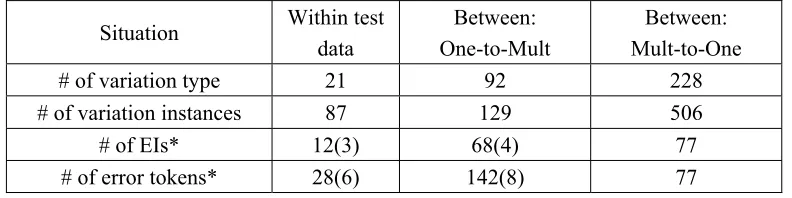
We use “AutoCheck” to stand for the processing using the algorithm above. In order to find the segmentation variations within one corpus, we can also make the reference corpus and the corpus to be checked be the same corpus. Data in Table 1 are obtained through “AutoCheck + manual Situation Within test
data
Between: One-to-Mult
Between: Mult-to-One
# of variation type 21 92 228
# of variation instances 87 129 506
# of EIs* 12(3) 68(4) 77
checking”. That is firstly running “AutoCheck” 3 times as shown in Table 2 to get the list of variation types and instances in each situation respectively, and then EIs are found through manual checking.
In Table 1, situations “within test data”, “Between: One-to-Mult” and “Between: Mult-to-One” correspond to the Situations S2, S3.1 and S3.2 described in Section 2. Here we still include CAS segmentations in order to take a close look at the distribution of EIs in each kind of segmentation variation. We can see that in situation “Between: One-to-Mult”, there are only 4 EIs caused by CAS among 68 EIs. It is a very small fraction, so most of CAS variation instances are correct segmentations in a manually checked corpus.
Situation Reference corpus
Corpus to be checked
Within test
data
PK test data PK test data
Between: One-to-Mult
PK training data
PK test data
Between:
Mult-to-One
PK test data PK training
[image:5.595.85.292.368.498.2]data
Table 2 Inputs of different AutoCheck runs
Except “咘䞥 ਼” (gold week) most of the EIs in S2: “within test data” are also found in S3.1: “Between Rne-to-Pult”3. This is because in S3.1 the size of the reference corpus (training set) is much greater than the corpus to be checked (test set) so variations found in this case almost cover all of those found in S2 (test set only). EIs in S3.2: “between:Pult-to-Rne” are such strings that they are never considered as one word in PK training data while always identified as one
3 Ā咘䞥 ਼ā
is considered as a segmentation
error according to its variation instance Ā咘䞥਼ā
(golden week).
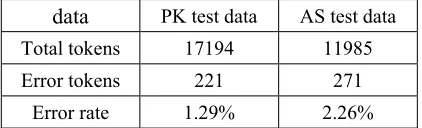
[image:5.595.301.512.509.573.2]word in PK test data. For example, the segmentation variation (type) " Ϟ [shang4-tu2]" occurs four times as one word “Ϟ” (above picture) in test data, but three of its variation instances "Ϟ " (upper picture) have been found in the training set. Thus, variation type "Ϟ " should be identified as a segmentation error rather than an OOV word as in Bakeoff1. From Table 1, we can find 221 error tokens in all error instances (EIs) after removing the 26 redundant ones in PK test data (17194 tokens). So, the error rate of PK test data is 1.29%.
Using the same method, we also find out the 139 error instances (271 error tokens) in AS test data. The error rate of AS test data is 2.26% as shown in table 3.
Table 3 shows the error rate of AS test set is 2.26% and it is higher than PK test data which is 1.29%. So we believe that the reason why the evaluation result on AS corpus are higher than those on PK corpus of Bakeoff1 is not due to the segmentation quality of AS test data but because RI the OOV rate (0.022) in AS test data ZKLFK is much lower than PK test data (0.069).
data PK test data AS test data Total tokens 17194 11985
Error tokens 221 271
Error rate 1.29% 2.26%
Table 3 Segmentation errors in PK and AS test data
means that “AutoCheck+manual checking”4 can not spot all segmentation errors in a corpus. Despite of these disadvantages of “AutoCheck”, it is still a necessary assistant to find out almost all of the segmentation errors in an annotated corpus for its effective in finding segmentation error candidates. Example 4: Segmentation errors which are not instances of any segmentation variation (Bakeoff1 PK corpus):
ᠻᬓᅬ䏃ᯧঢ়g偀ᠢ偀䞠 䇎gᠢ䇎㩖ˍ˒᮹ϞजВ㸠Ҿᓣ
(Archon Marino Zanotti held a ceremony on the morning of 16th)
Ꮖথሩ៤ЎϪ⬠Ϟ㾘᳔ ⱘҷ⧚㋏㒳
(̖has become the largest scale agency system in the world)
AutoCheck has been applied in preparing the MSRA (Microsoft Research Asia) annotated corpora of Chinese word segmentation (MS corpora, hereafter) that were submitted to SIGHAN Bakeoff2 as one of the data sets. "AutoCheck+manual checking" is applied as the principal way of quality control on MS corpora. Even only taking a manual check on those variations output by the AutoCheck could provide an approximate assessment about the quality of the annotated corpus. The lower the number of error instances (EIs) found in the output list the lower the segmentation error rate the annotated corpus reaches. For example, there are 37 variation instances output by AutoCheck in an annotated document #25 with 26K tokens in MS Corpora, in which no EIs has been found manually. Then the whole document was reviewed thoroughly by a person in which only two segmentation errors (shown in Example 5) have been found. Our practice shows that with the
4 ̌
manual checking” is restricted on the output list
only. Therefore it is a very effective way to assess
approximately the quality of an annotated corpus.
quality control method above the segmentation error rate of MS corpora reaches 0.1% in average at the worst cases. Example 5: Segmentation errors in #25
Error 1: Ꮖ ᳝ ϝⱒ݁कৡ ݯᏜ 㘠
乚ᇐᑆ䚼 ⏅ܹ 䚼䯳 䰶᷵ DŽ
(There are more than 360 leaders of corps and division working in grass roots of army and college.)
The string "ݯᏜ[jun1-shi1]" (military counselor) should be corrected as "ݯ Ꮬ" (corps and division).
Error 2: ᅗ Ԑ ϔ䴶 ݁ ễ䬰 ˈᡬᇘ ߎ
ᯊҷ ⱘ 亢䉠 ˈ
(It is like a prism reflecting the style and features of the age)
The string "ϔ䴶[yi1-mian4] (at the same time) should be corrected as "ϔ 䴶" (a).
4 The impact to the evaluation caused by segmentation errors in corpora of Bakeoff1
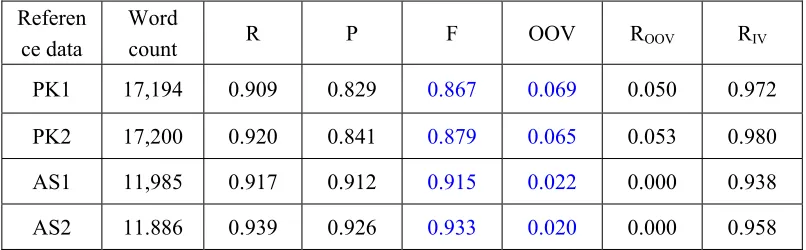
In order to show the impact to the evaluation result caused by EIs existing in test data of Bakeoff1, we conduct the baseline close test with PK and AS corpora, i.e. we compile lexicons only containing words in their training data and then use the lexicons with a forward maximum matching algorithm to segment their test data respectively (Sproat and Emerson, 2003). Original and modified test data are used as gold standard in our baseline test.
In table 4, reference data PK1 and AS1 are the original PK test data and AS test data. Reference data PK2 and AS2 are obtained after correcting all segmentation errors found in their original data (Table 3).
can see the F measure increase to 0.879 (0.933) from 0.867 (0.915) and the OOV ratio is decrease to 0.065 (0.020) from 0.069
[image:7.595.96.499.135.260.2](0.022) when all EIs are corrected in PK (AS) test data.
Table 4 Baseline test results with original and revised PK and AS test data
5 Conclusion
A semi-automatic method to detect segmentation errors in a manually annotated Chinese corpus is presented in this paper. The main contributions of this research are:
¾ Offer an effective way to spot the segmentation errors in a manually annotated corpus and give the segmentation error rate of the corpus.
¾ Point out that segmentation inconsistency is not an appropriate technique term to assess the segmentation quality of an annotated corpus and define the concept of segmentation variation instead to get the segmentation error rate of a gold standard corpus.
¾ Show the influence to the evaluation result caused by the segmentation errors in a gold standard corpus. 1.29% error rate of PK test data and 2.26% error rate of AS test data decrease the F-measure of the SIGHAN Bakeoff1 baseline test by 1.36% and 1.93% respectively.
Acknowledgements
We would like to thank the members of the Natural Language Computing Group at Microsoft Research Asia, especially to acknowledge Jianfeng Gao, John Chen, and the two anonymous reviewers for their insightful comments and suggestions.
References
Aitao Chen. 2003. Chinese word segmentation using minimal linguistic knowledge. In
Proceedings of the Second SIGHAN Workshop on Chinese Language Processing, July 11-12, 2003, Sapporo, Japan.
Andi Wu. 2003. Chinese word segmentation in MSR-NLP. In Proceedings of the Second SIGHAN Workshop on Chinese Language
Processing, July 11-12, 2003, Sapporo, Japan.
Jianfeng Gao, Mu Li and Chang-Ning Huang. 2003. Improved source-channel models for
Chinese word segmentation. In Proceedings of ACL-2003. July 7-12, 2003. Sapporo, Japan.
Markus Dickinson, W. Detmar Meurers. 2003. Detecting errors in Part-of-Speech annotation. In Proceedings of the 11th Conference of the
European Chapter of the Association for
Referen ce data
Word
count R P F OOV ROOV RIV
PK1 17,194 0.909 0.829 0.867 0.069 0.050 0.972
PK2 17,200 0.920 0.841 0.879 0.065 0.053 0.980
AS1 11,985 0.917 0.912 0.915 0.022 0.000 0.938
Computational Linguistics (EACL-03), 2003, Budapest, Hungary
Richard Sproat, Thomas Emerson. 2003. The first international Chinese word Segmentation Bakeoff. In Proceedings of the Second
SIGHAN Workshop on Chinese Language Processing, July 11-12, 2003, Sapporo, Japan.
Sun Maosong. 1999. On the consistency of
word-segmented Chinese corpus. (In Chinese) Applied Linguistics, (2):88-91, 1999.
Appendix: Modified EIs in PK test data
1) EI found in CAS variations:
Original: ᴢ䭓ǃ㔫ᑆㄝৠ佪䛑
⬠Ҏ
Modified: ᴢ䭓ǃ㔫ᑆㄝৠ佪
䛑⬠Ҏ
2) Some EIs in S3.2 which are considered as new words in Bakeoff1:
བᵰ䇈 Ѹ䗮䚼䮼 䯂ᯢ Ϫ⬠ ⳟⴔ ܼ ජ ऎݙ ᤶϞ ᑚ㡖 ≵ᛇࠄ 䏣Ϟ ᭛ ࣪ᴥ 㗕ৠᖫ 䖢㢅Ꮦ ᅜቯ ୰䖕 ܼ䖛 ܼ ঠⴐ ঠ㝓 ᮣҎ Ϟ ݅ଚ 䍄 ܹ 乚ࠄ ҷЎ ϔᮍ ᑈੇ ቕቕ ⥛݉ 䗕 ᕔ ࠡफ 㡖㡖催 䆒 偊䖛 Ꮉଚ䚼䮼 䏇䖯 䕗 㗏ⳟ ਚ 䰶ಶ 䌘䞥 ϟ ބϞ ಲ㗕ᆊ 㾕ࠄ ওᏖऎ ᵕッߚᄤ ᏺಲ 䖭ᷟ ࡲॖ ᇣࣙ ⬭
3) Some EIs in S3.1 in which their variation types should be lexicon words
Original Modified
⾥ᬭ ݈ ⾥ᬭ݈
☿ ᷥ 䫊 㢅 ϡ
☿ᷥ䫊㢅ϡ
䜦ᑫ 䜦ᑫ
䲚ಶ ݀ৌ 䲚ಶ݀ৌ
⬭ᄺ Ҏਬ ⬭ᄺҎਬ
ሑㅵ བℸ ሑㅵབℸ
ބ ⏙ ⥝ ⋕ ބ⏙⥝⋕
㖑↯ ⧗䯳 㖑↯⧗䯳
催ㄝ ᄺ᷵ 催ㄝᄺ᷵
Ⳉ ᣛ Ⳉᣛ
㖴 㖴