R. Dale et al. (Eds.): IJCNLP 2005, LNAI 3651, pp. 731 – 741, 2005. © Springer-Verlag Berlin Heidelberg 2005
Shrinkage and Discourse Stack
Kyungsun Kim1, Youngjoong Ko2
, and Jungyun Seo3 1 Information Retrieval Division, Diquest.Inc, Seocho-dong,
Seocho-gu, Seoul, 137-070, Korea
2 Dept. of Computer Engineering, Dong-A University, 840,
Hadan 2-dong, Saha-gu, Busan, 604-714, Korea
3 Dept. of Computer Science and Interdisciplinary Program of Integrated Biotechnology,
Sogang University, Seoul, 121-742, Korea
Abstract. A speech act is a linguistic action intended by a speaker. It is impor-tant to analyze the speech act for the dialogue understanding system because the speech act of an utterance is closely tied with the user’s intention in the utter-ance. This paper proposes to use a speech acts hierarchy and a discourse stack for improving the accuracy of classifiers in speech acts analysis. We first adopt a hierarchical statistical technique called shrinkage to solve the data sparseness problem. In addition, we use a discourse stack in order to easily apply discourse structure information to the speech acts analysis. From the results of experi-ments, we observed that the proposed model made a significant improvement for Korean speech acts analysis. Moreover, we found that it can be more useful when training data is insufficient.
1 Introduction
To understand a natural language dialogue, a dialogue system must be able to make out the speaker’s intentions indicated by utterances. Since the speech act of an utter-ance is very important in understanding a speaker’s intentions, it is an essential part of a dialogue system. However, it is difficult to infer the speech act from a surface utter-ance because the utterutter-ance may represent more than one speech act according to the context [5][7].
Various machine learning models have been used to efficiently classify speech acts such as MEM (Maximum Entropy Model) [1], HMM (Hidden Markov Model) with Decision Tree [8][11], Neural Network Model [5]. And there are also studies on methods of automatically selecting efficient features with useful information for speech acts analysis [5][10]. Since the machine learning models can efficiently ana-lyze a large quantity of data and consider many different feature interactions, they can provide a means of associating features of utterances with particular speech acts.
frequency of some speech acts has commonly occurred in the previous research [8]. Due to the problem, the accuracy of each speech act in previous research tends to be proportional to the frequency of each speech act in the training data. Therefore, we first focus on how to scale up statistical learning methods to solve the sparseness problem of training data in speech acts analysis. Then we propose to construct the commonly-available hierarchies of speech acts and apply a well-understood technique from Statistics called shrinkage to our speech acts analysis system. It provides im-proved estimates of parameters that would otherwise be uncertain due to limited amounts of training data [3]. The technique uses a hierarchy to shrink parameter esti-mates in data sparse children toward the estiesti-mates of the data-rich ancestors in ways that are probably optimal under the appropriate conditions [9]. We employ a simple form of shrinkage that creates new parameter estimates for a child by a linear interpo-lation of all hierarchy nodes from the child to the root.
In addition, discourse structure information can be used to identify the speech acts of utterances [1]. But most previous research has used only speech acts of previous utterances without considering discourse structure information to determine the speech act of current utterance. Therefore, in order to use discourse structure information for analyzing speech acts, we design a simple discourse stack. By using the discourse stack, the discourse structure information is easily applied to speech acts analysis.
In this paper, we propose a new speech acts analysis model to improve the per-formance by using shrinkage and discourse structure information. From the results of experiments, the proposed system showed significant improvement in comparison with previous research.
The rest of this paper is organized as follows. Section 2 explains the proposed speech acts analysis system in detail. In section 3, we discuss the empirical results in our experiments. The final section presents conclusions.
2 The Proposed Speech Acts Analysis System
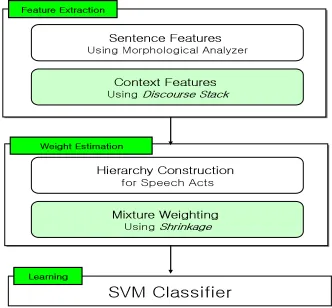
The proposed system consists of two modules as shown in Fig. 1: one module to extract features from training data and the other module to build up a hierarchy of
mGl
[image:2.430.132.298.429.583.2]zGm |GtGh ¡
z}tGj
s ~Gl
jGm |GkGz
o Gj GzGh
tG~ |Gz
speech acts and estimate weights of each feature on the hierarchy by shrinkage. Each process of Fig. 1 is explained in the following sections.
2.1 Feature Extraction
2.1.1 Sentence Features Extraction
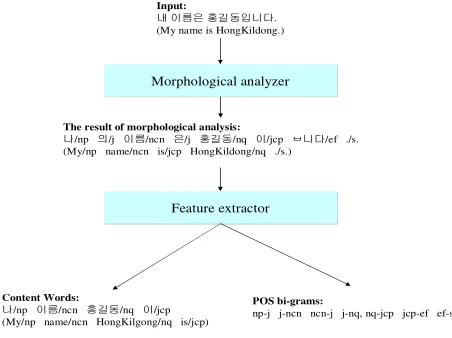
We assume that clue words and a sequence of POS tags in an utterance provide very effective information for analyzing the speech act of the current utterance. We extract informative features for speech acts analysis using a Morphological analyzer; they are called the sentence features. The sentence features consist of content words annotated with POS tags and POS bi-grams of all words in an utterance. Fig. 2 shows an exam-ple of sentence feature extraction.
Input:
⇨ 㢨⪸㡴 䞁Ὤ┍㢹⏼␘.
(My name is HongKildong.)
Morphological analyzer
Morphological analyzer
The result of morphological analysis:
⇌/np 㢌/j 㢨⪸/ncn 㡴/j 䞁Ὤ┍/nq 㢨/jcp ෬⏼␘/ef ./s. (My/np name/ncn is/jcp HongKildong/nq ./s.)
Feature extractor
Feature extractor
Content Words:
⇌/np 㢨⪸/ncn 䞁Ὤ┍/nq 㢨/jcp
(My/np name/ncn HongKilgong/nq is/jcp)
POS bi-grams:
[image:3.430.101.327.212.381.2]np-j j-ncn ncn-j j-nq, nq-jcp jcp-ef ef-s.
Fig. 2 An example of sentence feature extraction
2.1.2 Context Features Extraction
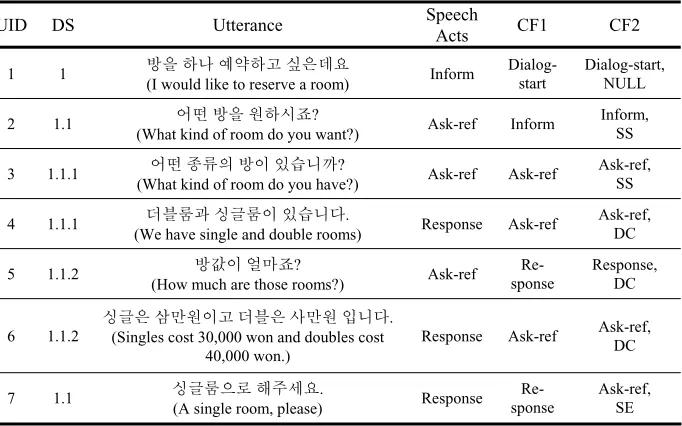
Most previous research uses the speech act of previous utterance as context feature (CF1 in Table 1) [5][8]. Since discourse structure information represents the relation-ship between two consecutive utterances, it is efficient to use discourse structure
For each utterance
Begin
if(Move a sub-dialogue?)
Use speech acts of previous utterance and Sub-dialogue Start (SS) Push speech acts of current utterance.
else if(Return from a sub-dialogue?)
Use speech acts that pop in discourse stack and Sub-dialogue End (SE) else
information for speech acts analysis [1]. Especially, the speech act of seventh utter-ance in Table 1 (UID: 7) is tied with that of second utterutter-ance (UID: 2). In our system, we first design a discourse stack to easily detect discourse structure information and extract the discourse structure information from the discourse stack for context fea-tures. Context features of our system consist of speech acts of previous utterance and markers of discourse structure information (CF2 in Table 1). An algorithm for dis-course stack is described as the following:
Table 1. An example of Context Feature
* UID: ID of utterances, DS: Discourse Structure, CF1: Using speech acts of previous utterances as features (Context Feature Type1), CF2: Using Discourse Structure Information by Discourse Stack as features (Context Feature Type2), Speech acts and discourse structure information were annotated by human.
2.2 The Feature Weight Calculation by Shrinkage in a Hierarchy of Speech Acts
Data sparseness is a common problem in mechanical learning fields. For speech acts analysis, the problem becomes more serious because it is a time-consuming and diffi-cult task to collect dialogue examples and construct dialogue training data tagged with a lot of information for various application areas. Therefore, we apply the shrinkage technique to solve this data sparseness problem in speech acts analysis. The shrinkage technique was verified in its efficiency for text classification tasks learned with insuf-ficient training data. Therefore, we first build up a hierarchy of speech acts to estimate the weight of features for each speech act by the shrinkage technique.
2.2.1 The Hierarchy Construction for Speech Acts
To model a dialogue system, the dialogue grammar has commonly used and it has observed that dialogues consist of adjacency pairs of the types of utterances such as
UID DS Utterance Speech
Acts CF1 CF2
1 1 㦚 䞮⋮ 㡞㟓䞮ἶ 㕌㦖◆㣪
(I would like to reserve a room) Inform
Dialog-start
Dialog-start, NULL
2 1.1 㠊⟺ 㦚 㤦䞮㔲㬶?
(What kind of room do you want?) Ask-ref Inform
Inform, SS
3 1.1.1 㠊⟺ 㫛⮮㦮 㧊 㧞㔋┞₢?
(What kind of room do you have?) Ask-ref Ask-ref
Ask-ref, SS
4 1.1.1 ▪な⭎ὒ 㕇⁖⭎㧊 㧞㔋┞┺.
(We have single and double rooms) Response Ask-ref
Ask-ref, DC
5 1.1.2 Ṩ㧊 㠒Ⱎ㬶?
(How much are those rooms?) Ask-ref
Re-sponse
Response, DC
6 1.1.2
㕇⁖㦖 ㌒Ⱒ㤦㧊ἶ ▪な㦖 ㌂Ⱒ㤦 㧛┞┺. (Singles cost 30,000 won and doubles cost
40,000 won.)
Response Ask-ref Ask-ref,
DC
7 1.1 㕇⁖⭎㦒⪲ 䟊㭒㎎㣪.
(A single room, please) Response
Re-sponse
Table 2. The Hierarchy of Speech Acts
Parent Child
Ask-if Ask-ref Ask-confirm
Offer Suggest Type1: Utterances of
request type
Request Accept Response
Reject Type2: Utterances of
response type
Acknowledge Expressive
Promise Type3: Utterances with a
speaker emotion
Closing Opening Introducing-oneself
Correct Root
Type4: Utterances of usually life
Inform
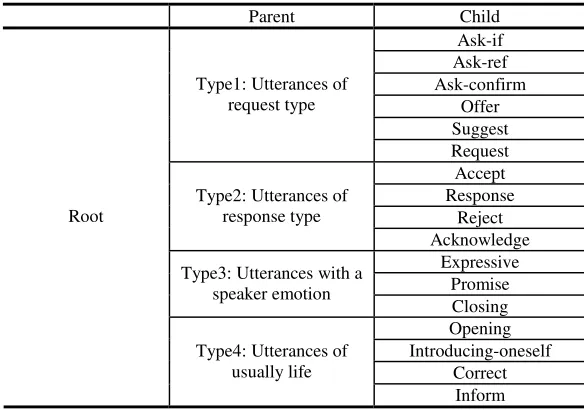
request-type and response-type [2][8]. Therefore, our speech acts hierarchy is built up according to this grammar. Table 2 shows the structure of our speech acts hierarchy. 2.2.2 Mixture Weighting Model by Shrinkage in a Hierarchy of Speech Acts The shrinkage technique estimates the probability of a word as the weighted sum of the maximum-likelihood estimates from leaf to root in a hierarchy [9]. This estimate process can give us a possibility to resolve the data sparseness problem in some speech acts with insufficient examples. Fig.3 shows that the shrinkage-based estimate of the probability of a feature (“⋮/np”) given a speech act class (“Accept”) is calcu-lated from a weighted sum of the maximum-likelihood estimates from leaf to root.
ROOT wtslO“⇌V”£GP
TYPE1 wtslO“⇌V”£G XP
TYPE2 wtslO“⇌V”£G YP
ACCEPT
wtslO“⇌V”£GP
…
…
…
ɅX XU
ɅY XU
ɅZ XU
wzopypurhnlO“⇌V”£GPGdGɅ1type1.acceptwtslO“⇌V”£GPGRG
Ʌ2
type1.acceptwtslOˈ⇌Vˉ £G XPGR
Ʌ3
type1.acceptwtslOˈ⇌Vˉ £GP
[image:5.430.101.330.426.584.2]Let {θˆ1j,θˆ2j,...,θˆjk} be k such estimates, where θ =ˆkj θj is the estimate at the leaf, and k-1 is the depth of speech acts stin a hierarchy of Speech Acts. The interpolation
weights among the ancestors of speech acts stare written { 1, 2,..., } k
j j
j λ λ
λ , where
1
1 =
¦
= ij ki λ . We write θj
for the new estimate of the speech act-conditioned feature probabilities based on shrinkage. The new estimate for the probability of feature
t
f given speech act sjis as follows:
1 1 2 1 1 ˆ ... ˆ ˆ ) ;
( j j jt j jt kj jt
j t
jt P f s θ λθ λθ λθ
θ = = + + + . (1)
We derive empirically optimal weights using the following iterative procedure:
2.3 The SVM Classifier
Support Vector Machines (SVM) is one of the state-of-the-art classifiers for classifi-cation tasks [6][12]. Since SVM has shown the high performance in various research areas, we also employ it in our method. In our method, we use the linear models of-fered by SVMlight [4] and θjt, which are calculated by formula (1), are used as the feature weights of speech acts for the SVM classifier.
Initialize:
Set the λj’s to some initial values, say
k i j 1 = λ Iterate:
1. Calculate the degree to which each estimate predicts the features ft in the held-out feature set, Hj, from speech acts sj :
¦ ¦
¦
∈ ∈ = = j t jt w H m
m jt m j i jt i j H w t i j i
j P f
θ λ θ λ θ
β (ˆ wasused togenerate ) ˆ ˆ (2)
2. Compensate the degree for loss that is caused by large variation of each degree :
m m m j j i j
i = +
¦
β β
β (3)
3. Derive new weights by normalizing theβ's:
¦
= m m j i j i j β βλ (4)
Table 3. The part of mixture weights learned by shrinkage-based estimation
Speech Acts Mixture Weights # training
documents Root Parent Child Root Parent Child Ask-ref 0.289 0.32 0.39 Type1
Suggest 0.257 0.275 0.467 Type2 Expressive 0.263 0.335 0.4
Type3 Reject 0.259 0.269 0.47
250 Root
Type4 Inform 0.297 0.336 0.366 Ask-ref 0.282 0.295 0.422 Type1
Suggest 0.217 0.22 0.562 Type2 Expressive 0.229 0.279 0.49 Type3 Reject 0.212 0.215 0.571 8349 Root
Type4 Inform 0.26 0.332 0.406
3 Empirical Evaluation
3.1 Experimental Data
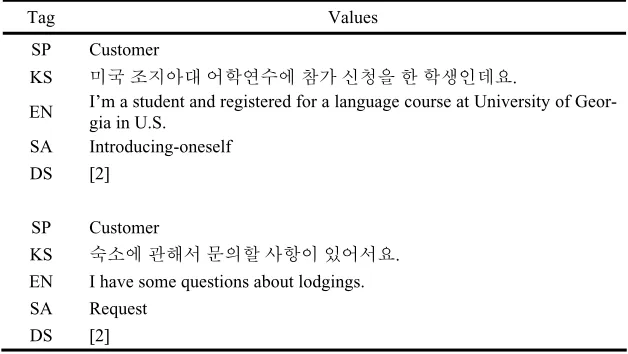
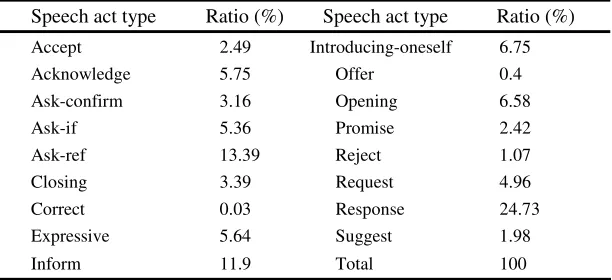
We used the Korean dialogue corpus which has used in previous research [1][5][8]. This corpus was transcribed from recordings in real fields such as hotel reservation, airline reservation and tour reservation and consists of 528 dialogues, 10,285 utter-ances (19.48 utterutter-ances per dialogue). Each utterance in dialogues is manually anno-tated with a speaker (SP), a speech act (SA) and a discourse structure (DS). This an-notated dialogue corpus has 17 types of speech acts. Table 4 shows a part of the anno-tated dialog corpus and Table 5 shows the distribution of speech acts in the annoanno-tated dialogue corpus.
Table 4. A part of the annotated dialogue corpus
Tag Values SP Customer
KS ⹎ῃ 㫆㰖㞚╖ 㠊䞯㡆㑮㠦 㺎Ṗ 㔶㼃㦚 䞲 䞯㌳㧎◆㣪.
EN I’m a student and registered for a language course at University of Geor-gia in U.S.
SA Introducing-oneself DS [2]
SP Customer
KS 㑯㏢㠦 ὖ䟊㍲ ⶎ㦮䞶 ㌂䟃㧊 㧞㠊㍲㣪.
EN I have some questions about lodgings.
[image:7.430.59.373.428.605.2]Table 5. The distribution of speech acts in corpus
Speech act type Ratio (%) Speech act type Ratio (%)
Accept 2.49 Introducing-oneself 6.75
Acknowledge 5.75 Offer 0.4
Ask-confirm 3.16 Opening 6.58
Ask-if 5.36 Promise 2.42
Ask-ref 13.39 Reject 1.07
Closing 3.39 Request 4.96
Correct 0.03 Response 24.73
Expressive 5.64 Suggest 1.98
Inform 11.9 Total 100
We divided the annotated dialogue corpus into the training data with 428 dia-logues, 8,349 utterances (19.51 utterances per dialogue), and the testing data with 100 dialogues, 1,936 utterances (19.36 utterances per dialogue).
3.2 Primary Experimental Results
3.2.1 The Performances of Speech Acts Analysis Model Using Shrinkage and Discourse Stack
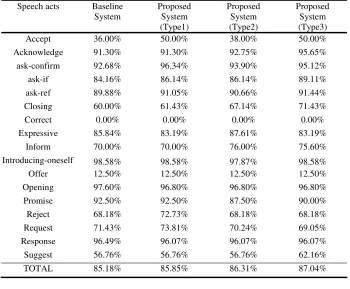
In order to verify the proposed method, we made four kinds of speech acts analysis systems which use different kind of features. The Baseline System used default fea-tures such as sentence feafea-tures and context feafea-tures [5]. The Second system (Type 1) was built up to verify the shrinkage technique. Its features were the same as those of the first system but they were weighted by the shrinkage technique. The third System (Type 2) used the discourse structure information from the proposed discourse stack without shrinkage. Finally, the fourth system (Type 3) combined the discourse struc-ture information and the shrinkage technique.
Table 6 shows the results of four speech acts analysis systems. As shown in Table 6, the performances of the proposed systems (Type 1,2,3) are better than the baseline system. The proposed system of Type 3 reported the best performance.
3.2.2 The Improvement of the Proposed System Using the Shrinkage Technique in Sparse Data
Table 6. The results of four speech acts analysis systems (precision %)
Speech acts Baseline System
Proposed System (Type1)
Proposed System (Type2)
Proposed System (Type3)
Accept 36.00% 50.00% 38.00% 50.00%
Acknowledge 91.30% 91.30% 92.75% 95.65%
ask-confirm 92.68% 96.34% 93.90% 95.12%
ask-if 84.16% 86.14% 86.14% 89.11% ask-ref 89.88% 91.05% 90.66% 91.44% Closing 60.00% 61.43% 67.14% 71.43% Correct 0.00% 0.00% 0.00% 0.00%
Expressive 85.84% 83.19% 87.61% 83.19%
Inform 70.00% 70.00% 76.00% 75.60%
Introducing-oneself 98.58% 98.58% 97.87% 98.58%
Offer 12.50% 12.50% 12.50% 12.50%
Opening 97.60% 96.80% 96.80% 96.80% Promise 92.50% 92.50% 87.50% 90.00% Reject 68.18% 72.73% 68.18% 68.18% Request 71.43% 73.81% 70.24% 69.05%
Response 96.49% 96.07% 96.07% 96.07% Suggest 56.76% 56.76% 56.76% 62.16% TOTAL 85.18% 85.85% 86.31% 87.04%
ͦ͟͡ ͦͦ͟͡ ͧ͟͡ ͧͦ͟͡ ͨ͟͡ ͨͦ͟͡ ͩ͟͡ ͩͦ͟͡ ͪ͟͡
ͣͦ͡ ͦ͡͡ ͢͡͡͡ ͣ͡͡͡ ͥ͡͡͡ ͩͥͤͪ
ΤΙΣΚΟΜΒΘΖ͙͑΅ΪΡΖ͚ͤ ΟΠ͑ΤΙΣΚΟΜΒΘΖ͙͑΅ΪΡΖ͚͑ͣ
Fig. 4. The performance according to different number of training data
[image:9.430.41.391.80.369.2]͡ ͟͢͡ ͣ͟͡ ͤ͟͡ ͥ͟͡ ͦ͟͡ ͧ͟͡ ͨ͟͡ ͩ͟͡ ͪ͟͡ ͢
ΣΖΤΡ ΠΟΤΖ
ΒΤΜ͞ ΣΖΗ
ΚΟΗΠΣ Ξ
ΚΟΥΣΠ ΕΦΔΚΟ
Θ͞ΠΟ ΖΤΖΝΗ
ΠΡΖΟ ΚΟΘ
ΖΩΡΣ ΖΤΤΚΧ
Ζ ΒΤΜ͞
ΚΗ ΣΖΦ
ΖΤΥ ΒΤΜ͞
ΔΠΟΗ ΚΣΞ
ΔΝΠΤΚΟ Θ
ΒΔΜΟ ΠΨΝΖ
ΕΘΖ ΒΔΔΖ
ΡΥ ΡΣΠΞ
ΚΤΖ ΤΦΘΘ
ΖΤΥ ΣΖΛΖΔ
Υ ΠΗΗΖ
Σ ΔΠΣΣΖ
ΔΥ
ΤΙΚΟΜΒΘΖ͙͑ΥΪΡΖ͚͑ͤ ΟΠ͑ΤΙΣΚΟΜΒΘΖ͙͑ΥΪΡΖ͚͑ͣ ΕΚΤΥΣΚΓΦΥΚΠΟ͑ΠΗ͑ΤΡΖΖΔΙ͑ΒΔΥ
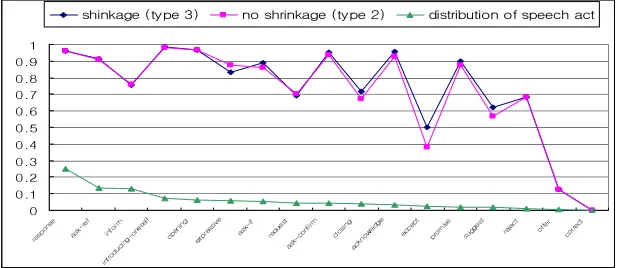
Fig. 5.The comparison of the performances for the shrinkage technique according to the distri-bution of speech acts
[image:10.430.61.370.57.191.2]3.2.3 The Comparison of Performance with Speech Acts Analysis Models Table 7 shows results from the proposed model and previous speech acts analysis models: the maximum entropy model (MEM) [1], the decision tree model (DTM) [8], and the neural network model (NNM) [5]. We report the performance of each system when using the same test data set as that of this paper. As a result, the proposed model achieved the highest performance.
Table 7. The experimental results of the proposed model and other previous models
Model Precision (%)
MEM 83.4% DTM 81.7%
NNM 85.2%
The propose model 87.0%
In the experiment, it is difficult to compare the proposed model directly with the other models because input features are different respectively. Even though direct comparisons are impossible, we think that the proposed model is more robust and efficient than MEM and DTM. In MEM and DTM, they used many kinds of high level linguistic knowledge than ours such as sentence type, tense, modality and so on. Nevertheless, the performances of them are lower than that of the proposed model. Moreover, the proposed model is more effective than NNM because the performance of the proposed model is better than that of NNM in spite of using same features.
4 Conclusions
In this paper, we proposed the new speech analysis model to improve speech acts analysis by using the shrinkage technique and the discourse stack. We first made a
[image:10.430.64.365.350.422.2]hierarchy of speech acts by dialogue grammar for shrinkage and then estimate the probability of each feature on the hierarchy by the shrinkage technique. In experimen-tal results, the proposed model is more effective for classifying speech acts. Espe-cially, the shrinkage technique achieved more improvement when training data is sparse. Therefore, the shrinkage technique can be applied to the real applications that suffer from the data sparseness problem. We also proposed to use the discourse stack for easily extracting discourse structure information. As a result, the proposed model with shrinkage and the discourse stack showed the better performance than other speech acts analysis models.
Acknowledgement
This research was supported as a Brain Neuroinformatics Research Program spon-sored by the Ministry of Commerce, Industry and Energy of Korea.
References
1. Choi, W., Cho, J. and Seo, J.: Analysis System of speech acts and Discourse Structures Using Maximum Entropy Model, In Proceedings of COLING-ACL99, (1999), 230-237 2. Grosz, B.: Discourse and Dialogue, In Survey of the State of the Art in Human Language
Technology, Center for Spoken Language Understanding, (1995), 227-254
3. James, W. and Stein, C.: Estimation with Quadratic Loss, In Proceedings of the Fourth Berkeley Symposium on Mathematical Statistics and Probability 1, University of Califor-nia Press, 361-379
4. Joachims, T.: Text Categorization with Support Vector Machines: Learning with Many Relevant Features. In European conference on machine learning (ECML), (1998), 137-142 5. Kim, K., Kim, H. and Seo, J.: A Neural Network Model with Feature Selection for Korean Speech Act Classification, International Journal of Neural System, VOL. 14 NO. 6, (2004), 407-414
6. Ko, Y., Park, J, Seo, J.: Improving Text Categorization Using the Importance of Sen-tences, Information Processing & Management, Vol. 40, No. 1, (2004), 65-79
7. Lee, J., Kim, G., and Seo, J.: A Dialogue Analysis Model with Statistical Speech Act Proc-essing for Dialogue Machine Translation, In Proceedings of ACL Workshop on Spoken Language Translation, (1997), 10-15
8. Lee, S. and Seo, J.: A Korean Speech Act Analysis System Using Hidden Markov Model with Decision Trees, International Journal of Computer Processing of Oriental Languages. VOL. 15, NO. 3, (2002), 231-243
9. MacCallum, A., Rosenfeld, R., Mitchell, T. and Ng, A.Y.: Improving Text Classification by Shrinkge in a Hierarchy of Classes, In Proceedings of the International Conference on Machine Learning. (1998)
10. Samuel, K., Caberry, S., and Vijay-Shanker, K.: Automatically Selecting Useful Phrases for Dialogue Act Tagging, In Proceedings of the Fourth Conference of the Pacific Associa-tion for ComputaAssocia-tional Linguistics, (1999)
11. Tanaka, H. and Yokoo, A.: An Efficient Statistical Speech Act Type Tagging System for Speech Translation Systems, In Proceedings of COLING-ACL99, (1999), 381-388 12. Vapnik, V.: The Nature of Statistical Learning Theory, Springer Verlag, New York,