The Utility of Discourse Structure in Identifying
Resolved Threads in Technical User Forums
Li Wang
1,2Su N am Kim
3T imothy Baldwin
1,2 (1) Dept. of Computing and Information Systems, The University of Melbourne(2) NICTA Victoria Research Laboratory (3) Faculty of Information Technology, Monash University
[email protected], [email protected], [email protected]
A
BSTRACTOnline discussion forums are a valuable means for users to resolve specific information needs, both interactively for the participants and statically for users who search/browse over historical thread data. However, the complex structure of forum threads can make it difficult for users to extract relevant information. Automatically identifying whether the problem in a thread has been solved or not can help direct users to threads where the original problem has been solved, hence enhancing their prospects of solving their particular problem. In this paper, we investigate the task ofSolvednessclassification by exploiting the discourse structure of forum threads. Experimental results show that simple features derived from thread discourse structure can greatly boost the accuracy ofSolvednessclassification, which has been shown to be very difficult in previous research.
1 Introduction
Web user forums (or simply “forums”) are online platforms for people to discuss information and obtain information via a text-based threaded discourse, generally in a pre-determined domain (e.g. IT support or DSLR cameras). With the advent of Web 2.0, there has been an explosion of web authorship in this area, and forums are now widely used in various areas such as customer support, community development, interactive reporting and online eduction. In addition to providing the means to interactively participate in discussions or obtain/provide answers to questions, the vast volumes of data contained in forums make them a valuable resource for “support sharing”, i.e. looking over records of past user interactions to potentially find an immediately applicable solution to a current problem. On the one hand, more and more answers to questions over a wide range of domains are becoming available on forums; on the other hand, it is becoming harder and harder to extract and access relevant information due to the sheer scale and diversity of the data.
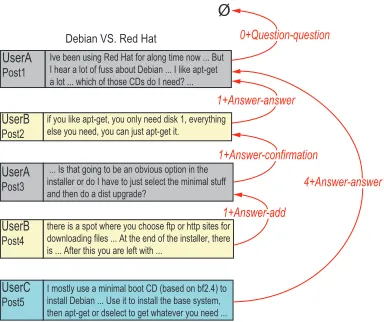
In the domain of troubleshooting-oriented forums, one potential way to enhance information access and support sharing is to automatically identify threads where the original information need has been resolved. By filtering out threads which do not contain a valid answer, we can focus the attention of users on threads which have a greater chance of containing the required solution. Baldwin et al. (2007) explore this task ofSolvednessclassification, and find that it is an extremely difficult problem. Figure 1 shows an example thread, made up of 5 posts from 3 distinct participants, from theILIAD(Improved Linux Information Access by Data Mining) dataset of Baldwin et al. (2007). In this thread, Post1 and Post3 are both from the thread’s initiator UserA. Post1 asks a question, and Post3 asks for more information about an answer provided by UserB in Post2. In response to Post3, UserB adds more information to his/her original answer, and Post5 provides another independent answer. In threads like this, it is important to identify whether the problem is solved or not, and also where solution(s) are likely to be found.
This research proposes to use information derived from thread discourse structure (Kim et al., 2010b; Wang et al., 2011) to help predictSolvednessof threads, without validating the answers provided in the threads. The discourse structure of the thread is modelled as a rooted Directed Acyclic Graph (DAG), and each post in the thread is represented as a node in this DAG. The reply-to relations between posts are then denoted as direct edges (Links) between nodes in the DAG, and the type of a reply-to relation is defined as Dialogue Act (DA). TheLinkbetween two connected posts (i.e. having a reply-to relation) is represented as the distance between the two posts in their chronological ordering. In the annotated version of the exampleILIAD
thread, as is shown in Figure 1, UserA initiates the thread with a question (Dialogue Act=
Question-question: (Kim et al., 2010b)) in the first post, by asking a question. In response,
UserB provides an answer (Dialogue Act=Answer-answer). Then, UserA confirms more details about the answer provided (Dialogue Act=Answer-confirmation). UserB responds to UserA to add more information about his/her previous answer (Dialogue Act=Answer-add). Finally, UserC proposes an independent answer again to the original question (Dialogue Act=
Answer-answer).
UserB
Post2
UserA
Post3
UserC
Post5
Ive been using Red Hat for along time now ... But I hear a lot of fuss about Debian ... I like apt-get a lot ... which of those CDs do I need? ...
UserA
Post1
if you like apt-get, you only need disk 1, everything else you need, you can just apt-get it.
... Is that going to be an obvious option in the installer or do I have to just select the minimal stuff and then do a dist upgrade?
UserB
Post4
there is a spot where you choose ftp or http sites for downloading files ... At the end of the installer, there is ... After this you are left with ...
I mostly use a minimal boot CD (based on bf2.4) to install Debian ... Use it to install the base system, then apt-get or dselect to get whatever you need ...
Debian VS. Red Hat 0+Question-question
Ø
1+Answer-answer
1+Answer-confirmation
1+Answer-add
[image:3.420.125.317.74.235.2]4+Answer-answer
Figure 1: A snippetedILIADthread with annotated discourse structure.
achieving state-of-the-art results over the task. We also investigate the correlation between thread discourse structure prediction F-score and threadSolvednessclassification accuracy, and demonstrate a positive correlation. Finally, we show that focusing on improving the F-score over certain dialogue acts is able to boostSolvednessclassification.
2 Related Work
As far as we are aware, there is very little NLP work that is specifically targeted at the thread-level analysis of web user forum data. The most closely-related work is that performed by Baldwin et al. (2007), on which this work is directly based. Baldwin et al. (2007) focused on three specific characteristics detected from forum threads, namelyTask orientation(i.e. whether a thread focuses on solving a problem),Completeness(i.e. whether the initial post provides enough information of the problem) andSolvedness(i.e. whether the problem is solved). Three classification tasks were identified base on these three characteristics, and experiments were carried out using a range of classification and regression methods. Baldwin et al. (2007) explored not only bag-of-words features, but also another 18 lexical and contextual features from distinct partitions of the thread, namelyinitial posts,first response post,all responses postsandfinal post from the initiator. 250 threads with various topics from a Linux-related forum and mailing list were annotated for use in the experiments in the paper. While the experimental results illustrated the difficulties in performing the three tasks automatically, the experiments also implied that their approach could be employed to rank threads based on their characteristics.
and extended by Kim et al. (2010b) to describe possible types of posts in troubleshooting-oriented online forums. Specifically, Kim et al. (2010b) devised a post-level dialogue act set and annotated a set of threads taken fromCNET.1In this work, they proposed a set of novel features,
which they applied to the separate tasks of post link classification and dialogue act classification. They later applied the same basic methodology to dialogue act classification over one-on-one live chat data with provided message dependencies (Kim et al., 2010a), demonstrating the generalisability of the original method. In both cases, however, they tackled only a single task, either link classification (optionally given dialogue act tags) or dialogue act classification, but never the two together.
Wang et al. (2011) delved into the task of thread discourse structure parsing further. They used the same features as Kim et al. (2010b), but different parsing approaches. Specifically, Wang et al. (2011) approached thread discourse structure parsing as a joint link and dialogue act classification task, by usingCRFSGD(Bottou, 2011) andMaltParser(Nivre et al., 2007). They also demonstrated that the methods they use for thread discourse structure parsing are able to perform equally well over partial threads as complete threads, by experimenting with “in situ” classification of evolving threads.
There is also research focusing on particular types of dialogue acts, such asquestion–answer
pairs in emails (Shrestha and McKeown, 2004) and forum threads (Cong et al., 2008),question–
context–answerin forum threads (Cong et al., 2008; Ding et al., 2008; Cao et al., 2009),
initiation–response pairs (e.g.question–answer,assessment–agreement, andblame–denial) in forum threads (Wang and Rosé, 2010), as well asrequestandcommitmentin emails (Lampert et al., 2007, 2008a,b, 2010).
Thread discourse structure can be used to facilitate different tasks in web user forums. For example, threading information has been shown to enhance retrieval effectiveness for post-level retrieval (Xi et al., 2004; Seo et al., 2009), thread-level retrieval (Seo et al., 2009; Elsas and Carbonell, 2009), sentence-level shallow information extraction (Sondhi et al., 2010), and near-duplicate thread detection (Muthmann et al., 2009). Moreover Wang and Rosé (2010) demonstrated that initiation–response pairs (e.g.question–answer,assessment–agreement,
andblame–denial) from online forums have the potential to enhance thread summarisation and
automatically generate knowledge bases for Community Question Answering (cQA) services such as Yahoo! Answers. Furthermore, Kim et al. (2006) showed that dialogue acts can be used to classify student online discussions in web-enhanced courses. Specifically, they use dialogue acts to identify discussion threads that may have unanswered questions and need the attention of an instructor.
These previous research efforts suggest that the thread structural representation used in Wang et al. (2011), which includes both linking structure and the dialogue act associated with each link, could potentially provide even greater leverage in these tasks. We specifically target the thread-level task ofSolvednessclassification as it is conceptually the most difficult of the three classification tasks proposed by Baldwin et al. (2007), and intuitively, it is the task which stands to gain the most from discourse parsing.
3 Data Description
We useILIAD(Improved Linux Information Access by Data Mining) data set created by Baldwin et al. (2007), which contains threads crawled fromLinuxquestions2andDebian mailing lists.3
TheILIADdataset is made up of 250 threads, which are annotated with three Boolean
thread-level labels, namelyTask Orientation,CompletenessandSolvedness. This paper only explores the classification task ofSolvedness, which addresses the question of “is there a documented solution to the original problem described by the thread initiator in the thread (including the possibility of URLs pointing off to solutions elsewhere on that same forum or generally on the web)?” A detailed description of the other tasks and the dataset is presented in Baldwin et al. (2007).
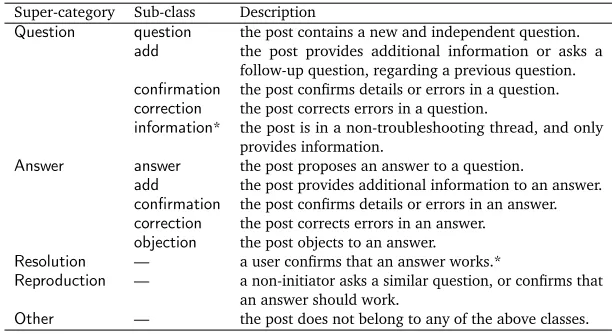
To explore the task of using discourse structure to predict theSolvednessof a thread, we annotated theILIADthreads for discourse structure based on the dialogue act set proposed by Kim et al. (2010b). The dialogue act set is made up of 5 super-categories:Question,Answer,
Resolution,ReproductionandOther. TheQuestioncategory contains 4 sub-classes:question,
add,confirmationandcorrection. Similarly, theAnswercategory contains 5 sub-classes:answer,
add,confirmation,correctionandobjection. For example, the labelQuestion-addsignifies the
Questionsuperclass andaddsubclass, i.e. addition of extra information to a question. For full
details of the original dialogue act tagset, see Kim et al. (2010b).
The original dialogue act set was developed primarily over troubleshooting-oriented threads (i.e. theCNETdataset described in Section 2), however there are non-troubleshooting threads present in theILIADdataset (hence theTask Orientationthread classification task is addressed in Baldwin et al. (2007)). After manual analysis of the ILIAD data, we identified that the dialogue act tagset was largely transferable in its original state, but needed the addition of the
informationsub-class to theQuestionsuper-category (i.e.Question-information).
Question-informationis used on posts in threads which are not troubleshooting-oriented and only provide
information (e.g. on developer mailing lists to report on a bug fix). We also relaxed the definition ofResolutionslightly to accommodate non-troubleshooting threads. For example, in one thread the initiator requests an update to a wiki page, and this update is confirmed later by a non-initiator. In this case, this non-initiator’s post is labelled asResolution. In the original definition,Resolutioncan only be used on posts from the initiator of the thread.
The modified dialogue acts (DAs) used to annotate theILIADdataset for discourse structure are described in Table 1. The annotation was performed by two annotators. The main annotator annotated all 250 threads (containing 1158 posts), and the secondary annotator independently annotated 26 randomly-selected threads (containing 113 posts) for quality assurance purposes. During annotation, annotators first annotate theLinks between posts in a thread, and then identify the type of each link (DA). Theκvalues for agreement between the two annotators are 0.64 for combinedLinkandDAtagging, 0.79 for just theLinks and 0.68 for just theDAs. While both theILIADandCNETdatasets are mainly troubleshooting-oriented and technical, they come from different domains. Therefore, we expect theDAandLinkdistributions of them to be different. However, to our surprise, the distributions of bothDAs andLinks in the two datasets are remarkably similar, supporting the suggestion that theDAlabel set has cross-domain applicability.
2http://www.linuxquestions.org
Super-category Sub-class Description
Question question the post contains a new and independent question.
add the post provides additional information or asks a follow-up question, regarding a previous question.
confirmation the post confirms details or errors in a question.
correction the post corrects errors in a question.
information* the post is in a non-troubleshooting thread, and only
provides information.
Answer answer the post proposes an answer to a question.
add the post provides additional information to an answer.
confirmation the post confirms details or errors in an answer.
correction the post corrects errors in an answer.
objection the post objects to an answer.
Resolution — a user confirms that an answer works.*
Reproduction — a non-initiator asks a similar question, or confirms that
an answer should work.
[image:6.420.49.355.70.237.2]Other — the post does not belong to any of the above classes.
Table 1: The Dialogue Act (DA) set used for annotatingILIADdataset. (“*” signifies a difference over the originalDAproposed by Kim et al. (2010b))
Regarding theSolvednesslabel forILIADdataset, the original thread-level annotations were done by three annotators are on a five-point scale, with 1 indicating high confidence in
Solvednessfor a given thread and 5 indicating low confidence (Baldwin et al., 2007). These
annotations were aggregated by taking the simple mean across the three annotators and discretising into binary classes, with 2.5 as the breakpoint. Out of the 250 threads in theILIAD
dataset, 28 threads had a score of 2.5 and were discarded in the original paper. In the interests of comparability with the original research, we experiment over this reduced dataset (denoted
ILIAD222), but question the theoretical soundness of removing these threads from the dataset,
so additionally experiment with the full dataset (denotedILIAD).
4 Discourse Structure Parsing for Thread
Solvedness
Classification
Baldwin et al. (2007) showed that the task of automatic Solvedness classification onILIAD222
is extremely hard. This is because the annotation was often based on expert knowledge of Linux, and a great deal of information not explicitly mentioned in the thread. Take the thread in Figure 1 for example: although two independent answers are provided in Post2 and Post5, it is almost impossible to identify whether there is a correct solution unless the whole thread is understood at a technical level.
Although predictingSolvednessis challenging, we believe that the use of thread discourse structure should assist in the task. As a first step, we need to do thread discourse structure parsing, which includes predicting both the linkings (Links) between posts and the type (DA) of each link.
Discourse structure parsing, as discussed in Wang et al. (2011), can be addressed in several ways. If a structured classification approach, such as Conditional Random Fields (CRFs: Lafferty et al. (2001)), is used, we can either classify theLinkandDAseparately and compose them afterwards (denoted asComposition), or we can classify the combinedLinkandDA(e.g. treat
Feature Category Feature Name Description
DA-only LastPostDA TheDAof the last post in the thread.
LastNonInitDA TheDAof the last post from a non-initiator in the thread.
HasResolution Whether the thread contains aResolutionpost.
LinkDA-based LastPairDA The DApair for the deepest post pair in the
thread tree. In the case of ties, the pair contain-ing the latest post is chosen.
[image:7.420.61.374.70.176.2]LastSubthreadDA The sequence ofDAs in the longest subthread in the thread tree. In case of ties, the sequence containing the latest post is chosen.
Table 2: Thread discourse structure features used forSolvednessclassification.
to treat discourse structure parsing as a dependency parsing problem. Dependency parsing (Kübler et al., 2009) is the task of automatically predicting the dependency structure of a token sequence, in the form of binary asymmetric dependency relations with dependency types. The joint classification task ofLinkandDAis a natural fit for dependency parsing, in that the task is intrinsically one of inferring labelled dependencies between posts.
For discourse structure parsing, all experiments were carried out based on 10-fold cross-validation, stratifying at the thread level to ensure that all posts from a given thread occur in a single fold. The results are evaluated using post-level micro-averaged F-score (β=1). All three discourse structure parsing methods were tested in our experiments, by usingCRFSGD
(Bottou, 2011) andMaltParser(Nivre et al., 2007). As for features, we experimented with all the features proposed by Wang et al. (2011), includingInitiator,Position,TitSim,PostSim,
PunctandUserProf, as well as many of our own features. We found that usingCRFSGDwith
a simpleInitiator(i.e. whether a post’s author is the initiator of the thread) feature and the
Combineapproach achieves the highestLinkandDAjoint (LinkDA) classification F-score of
0.626. This is significantly better4than a strong heuristic baseline which classifies all first posts
as0+Question-questionand all subsequent posts as1+Answer-answer, which achieves a joint
classification F-score of 0.420.
We also explored the possibility of domain adaptation, by using threads from theCNETdataset of Kim et al. (2010b) to augment theILIADthread discourse structure parsing. However, we were unable to achieve any significant improvements.
When using the thread discourse structure (i.e.LinkandDA) forSolvednessprediction, one natural question is “could we simply useResolutionto identify solved thread?” WhileResolution
is a clear identifier of solved threads with 100% precision, only 8% of the threads contain
Resolutionposts, and yet 80.4% of the threads are labelled as solved. Therefore, by only using
Resolution, a classifier could not do better than a majority class baseline. Instead, we propose
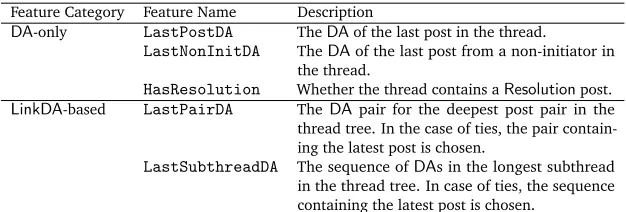
to use a combination of discourse structure features to address theSolvednessclassification problem. Table 2 displays all the discourse structure features5used in this paper, which can be
grouped into two categories: (1) those based on only theDAs (DA-only); and (2) those based
4All statistical significance results in the paper are based on randomised estimation (Yeh, 2000), at a significance
level ofp<0.05.
5We have experimented with many “discourse structure” features and non-“discourse structure” features, and these
Post1
Ø
Post2
Post3
Post5
Post4
Post1
Ø
Post2
Post3
Post5
Post4
[image:8.420.120.278.71.195.2]An example pair An example subthread
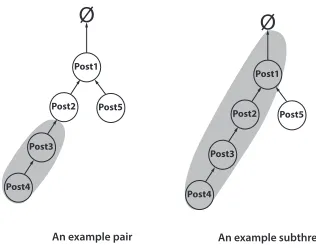
Figure 2: Examples of a pair and a subthread in a thread.
onLinkandDA(LinkDA-based). When using theLinkinformation, we rely on the notions of
“pairing” and “subthreading”. A pair is defined to be the combination of a post with the parent post it links to (noting that a given post can participate as child in multiple “pairs” as it can link to multiple posts), and a subthread contains all posts in a given path from a leaf node to the root node following the link structure. Figure 2 shows an example of each, based on the sample thread from Figure 1. As theLastPostDAisAnswer-answerfrom Post5 (the final post), theLastNonInitDAfor the thread isAnswer-answer,HasResolutionis 0 (as there are noResolutionposts),LastPairDAisAnswer-add/Answer-confirmationfrom the pairing of Post4 and Post3, andLastSubthreadDAis
Answer-add/Answer-confirmation/Answer-answer/Question-questionfrom the subthread Post4/Post3/Post2/Post1.
5
Solvedness
Classification
Baldwin et al. (2007) experimented with various learners from three machine learning software packages, namelyLIBSVM(Chang and Lin, 2011),TiMBL(Daelemans et al., 2010) andWeka
(Hall et al., 2009), and found thatLIBSVMperforms superiorly on theSolvednessclassification task. Therefore,LIBSVMis used forSolvednessclassification in this research.
In our initial experiments, we experimented with different kernel functions for LIBSVM, including linear, polynomial, radial basis function (RBF) and sigmoid kernels, and found the linear kernel to outperform other kernels. Therefore, LIBSVMwith linear kernel is used throughout our experiments. We approach theSolvednessclassification task by firstly following the procedure of Baldwin et al. (2007), whereILIAD222is used. Subsequently, we carry out
experiments over the full 250-threadILIADdataset. In both cases, various combinations of the features introduced in Section 4 are used. To generate these features, both the gold-standard
LinkDAs and the automatically predicted ones are used.
Feature Category System/feature(s) ACCgold ACCauto
Baseline ZeroR .779
ADCS .788
DA-only LastPostDA .833∗ .775
LastNonInitDA .766 .792
HasResolution .779 .779
LastPostDA+LastNonInitDA .834∗ .779
LastPostDA+HasResolution .883∗ .775
LastNonInitDA+HasResolution .874∗ .792
AllDAFeat .883∗ .779
LinkDA-based LastPairDA .851∗ .792
LastSubthreadDA .833∗ .779
AllLinkDAFeat .833∗ .792
AllDAFeat+AllLinkDAFeat .865∗ .792
Table 3: Results overILIAD222, using discourse structure features from the gold-standard and
also the discourse parsing model (“∗” signifies a significantly better result than both baselines; the best result in each column is indicated inboldface).
5.1 Experiments over
ILIAD
222Table 3 presents the results from experiments over ILIAD222, using the thread discourse
structure features generated from both the gold-standard (ACCgold)LinkDAs, and automatically
predicted ones (ACCauto). The automatically predicted discourse structure of the wholeILIAD222
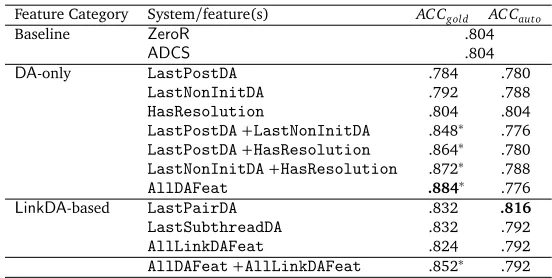
dataset is obtained by aggregating the discourse structure predictions from each fold of the 10-fold cross-validation experiments described in Section 4. The combination of allDA-only features (i.e.LastPostDA,LastNonInitDAandHasResolution) is denotedAllDAFeat, and the combination of allLinkDA-based features (i.e.LastPairDAandLastSubthreadDA) is denotedAllLinkDAFeat. Results which are significantly better than both baseline results are signified by “∗”, and the best result(s) in each column are presented inboldface. Looking first at theACCgoldresults in Table 3 we can see that, not surprisingly,HasResolution
by itself does not have any effect on the prediction (see our comments in Section 4). Moreover, whileLastPostDAleads to a significant improvement,LastNonInitDAdoes not have a significant effect. More interestingly, the combination ofLastPostDAorLastNonInitDA
withHasResolutionleads to further improvements. This is because the classifiers trained
onLastPostDAorLastNonInitDAare aggressive and misclassify many solved threads as unsolved, whichHasResolutioncan correct.
TheACCgoldcolumn also shows both the potential and shortcomings ofLinkDA-based features
— i.e. while bothLastPairDAandLastSubthreadDAlead to significantly better results in isolation, combining them does not lead to further improvements. Moreover, combining all the features (i.e.AllDAFeat+AllLinkDAFeat) leads to a drop in results compared to just
usingAllDAFeat. We hypothesise that there are a number of reasons for this. Firstly, the
Feature Category System/feature(s) ACCgold ACCauto
Baseline ZeroR .804
ADCS .804
DA-only LastPostDA .784 .780
LastNonInitDA .792 .788
HasResolution .804 .804
LastPostDA+LastNonInitDA .848∗ .776
LastPostDA+HasResolution .864∗ .780
LastNonInitDA+HasResolution .872∗ .788
AllDAFeat .884∗ .776
LinkDA-based LastPairDA .832 .816
LastSubthreadDA .832 .792
AllLinkDAFeat .824 .792
[image:10.420.64.340.69.208.2]AllDAFeat+AllLinkDAFeat .852∗ .792
Table 4: Results overILIAD, using discourse structure features from the gold-standard and also the discourse parsing model (“∗” signifies a significantly better result than both baselines; the best result in each column is indicated inboldface).
LastSubthreadDAhave 72 and 135 distinct values, respectively), much moreso than the
DA-based features. When combined with the other features, however, some of these features are found to have utility.
Looking next to theACCautoresults in Table 3, we can see that we surpass the two baselines,
delivering on the promise of discourse parsing aiding inSolvednessclassification. The results drop appreciably relative to those achieved with the gold-standard labels, and in fact the improvements over the baselines aren’t statistically significant. This is perhaps not surprising, however, given than the F-score for discourse parsing was a modest 0.626, meaning that errors will propagate through to the thread-level classification.
While these results are certainly encouraging, and were worthwhile in terms of establishing the superiority of our method when discourse parsing features are used, we always had reservations about theILIAD222dataset, due to the most contentious instances having been removed from
the dataset. In introducing these instances back into the dataset and labelling them as solved, the task becomes both more realistic and more challenging, including theZeroRbaseline rising up further. In the next section, we reapply our methods to theILIADdataset.
5.2 Experiments over
ILIAD
We carry out the same experiments done in Section 5.1 over the wholeILIADdataset, and present the results in Table 4. Again, the results which are significantly better than both baseline results are signified by “∗”, and the best result in each column is presented inboldface. From Table 4 we can see a similar trend to that in Section 5.1, with our method improving over both baselines when we use either gold-standard or automatically-predicted features. However, there are some notable differences. Looking first at theACCgold column, firstly,
none ofLastPostDA,LastNonInitDAandHasResolutionled to any improvement in isolation. However, the combination of these three features led to results that are significantly better than the baselines, withAllDAFeatachieving the best result of 0.883. Secondly, neither
DA LastPostDA LastNonInitDA HasResolution AllDAFeat
Question-add 0.999 0.811 — 0.999
Question-confirmation 0.881 0.991 — 0.961
Question-information 0.918 — — 0.918
Answer-answer 0.500 0.513 — 0.498
Answer-add 0.461 0.550 — 0.489
Answer-confirmation 0.918 — — 0.918
Answer-objection 0.918 1.000 — 0.954
Reproduction 1.000 1.000 — 1.000
Resolution 0.332 0.918 0.229 0.237
[image:11.420.63.384.69.178.2]Other 0.971 0.934 — 0.952
Table 5: Entropy of eachDAagainst theSolvednessclass distribution for everyDA-only feature andAllDAFeatfeatures.
(i.e.AllLinkDAFeat) also does not outperform the baselines significantly. Looking next to
ACCauto, we achieve the best results withLastPairDAonce again, surpassing the baselines
but not at a level of statistical significance. Overall, while it is clear that theSolvedness
classification task becomes harder when we experiment with the fullILIADdataset, we were able to reproduce the overall results from Section 5.1.
6 Results Analysis and Simulation
Examining the differences between the results forACCgoldandACCautoin Section 5.1 and
Section 5.2 leads us to suspect that if the F-score of the thread discourse parsing could be boosted, we would be able to achieve betterSolvednessclassification accuracy. Furthermore, because the most effective discourse structure features, i.e.LastPostDA,LastNonInitDA
andHasResolution, only make use of a subset of theDAs, we anticipate that if we can improve the F-score over certainDAs, we will be able to significantly boost ourSolvedness
classification accuracy.
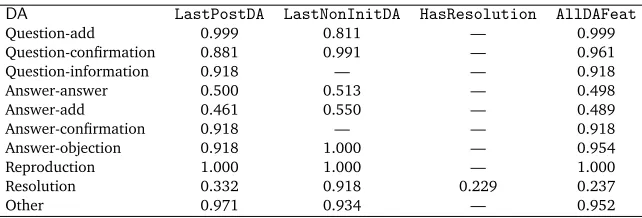
To test these hypotheses, firstly, we examine the entropy (presented in Table 5) of every
DAagainst theSolvednessclass distribution for eachDA-only feature (i.e.LastPostDA,
LastNonInitDAandHasResolution) and the combination of allDA-only features (i.e.
AllDAFeat). From Table 5, we can see thatAnswer-answer,Answer-addandResolutionhave relatively low entropy compared to the rest of theDAs. Therefore, it seems that these three
DAs can contribute more inSolvednessclassification.6
Secondly, we conducted simulation experiments to examine the potential relation betweenDA
classification andSolvednessclassification. The simulation starts with a seedDAclassification result (SeedResults), based onCRFSGDand theInitiatorfeature. This seedDAclassification achieves a F-score of 0.651, significantly better than a strong heuristic baseline (i.e. 0.515) which classifies all first posts asQuestion-questionand all subsequent posts asAnswer-answer. Then, an arbitrary higher goal (e.g. 0.8) is set and an artificial classification result (ArtificialResults) is created by randomly correcting errors in the output of the discourse parsing model. The corrections are made evenly across allDAlabels, relative to the original error rates for eachDA. Next, a simulator is used to predict the labels of each instance, by randomly selecting from the
6Note that this entropy analysis can only capture the association between a singleDAand theSolvednessclass,
0.6 0.65 0.7 0.75 0.8 0.85 0.9 0.95 1 0.75
0.8 0.85 0.9
DA F−score
DA vs Solveness
[image:12.420.54.361.77.214.2]Solvedness Accuracy
Figure 3: Simulation over allDAs (AllDA).
0.6 0.65 0.7 0.75 0.8 0.85 0.9 0.95 1 0.75
0.8 0.85 0.9
DA F−score
DA Groups Comparison
Solvedness Accuracy
AllDA PositiveDA (auto) OtherDA (auto)
Figure 4: Simulation over automatically-generatedDAgroups (PositiveDAautoand
OtherDAauto).
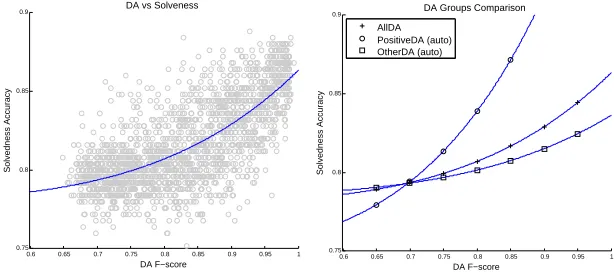
labels returned bySeedResultsandArtificialResultswith equal chance. In order to generate enough simulated results, we pick 20 goal F-score figures between 0.651 and 1.0, and run the simulator 100 times for each of these figures. Finally, we use these 2000 simulated discourse structure predictions to classifySolvednessusingAllDAFeatfeatures, and plot each pair of discourse structure F-score andSolvednessaccuracy in a scatter plot. We also try to fit a series of simple polynomial models of the formy=axn+b(n∈ {1, 2, 3, 4, 5})7to the plot. We find
that the model fory=ax5+bprovides the best fit with the data, although the differences in
the rangen∈ {2, 3, 4, 5}are negligible. Figure 3 shows the graph, along with the curve of best fit for the functiony=ax5+b.
From Figure 3 we can see that there is a clear correlation between the F-score ofDAclassification and the accuracy ofSolvednessclassification, and that the impact ofDAclassification on
Solvednessclassification is, in fact, accentuated for higher F-scores. Theoretically, therefore,
by improving theDAclassification F-score, theSolvednessclassification accuracy will increase accordingly.
The entropy analysis showed that not allDAs have the same utility for the task ofSolvedness
classification — i.e. someDAs are more important (lower entropy) than others. We select the threeDAs (i.e.Answer-answer,Answer-addandResolution) with lowest entropy values from Table 5, because theseDAs seem to be the most effective across the three feature types (i.e.LastPostDA,LastNonInitDAandHasResolution). Then, we carry out an analogous simulation over this set of automatically-selectedDAs (PositiveDAauto). Additionally, we
conducted a simulation over the 8 non-selectedDAs (OtherDAauto).8Once again, a line of best
fit fory=ax5+bis generated for the resulting simulations. The curves of best fit are shown
in Figure 4, along with the original curve of best fit for allDAs (AllDA) from Figure 3.
7Choosingn>5 does not result in better fit with the data.
8Question-correctionandAnswer-correctionare never used in annotating the discourse structure ofILIAD
DAGroup DA F-score
PositiveDAauto Answer-answer 0.782
Answer-add 0.641
Resolution 0.514
OtherDAauto Question-question 0.992
Question-add 0.678
Question-confirmation 0
Question-information 0
Answer-confirmation 0
Answer-objection 0
Reproduction 0
[image:13.420.128.305.69.187.2]Other 0
Table 6: Micro-averagedDAclassification F-scores perDAoverILIAD
0.6 0.65 0.7 0.75 0.8 0.85 0.9 0.95 1 0.75
0.8 0.85 0.9
DA F−score
DA Groups Comparison
Solvedness Accuracy
AllDA PositiveDA (manual) OtherDA (manual)
Figure 5: Simulation over manually-createdDAgroups (PositiveDAmanualandOtherDAmanual).
From Figure 4 we can see that, as suspected, thePositiveDAautogroup is much more important
than theOtherDAautogroup forSolvednessclassification. Therefore, to improveSolvedness
classification, we should focus our attention on improving theDAclassification F-score for
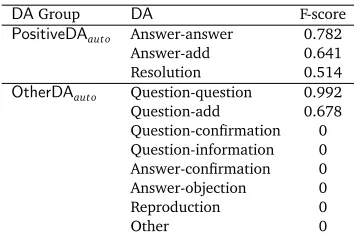
DAs such asAnswer-answer,Answer-addandResolution. Table 6 shows the micro-averaged F-scores ofDAclassification, calculated perDA. When we do a breakdown of the results for the discourse parsing model, we can see that there is definitely room for improvement with
Answer-answer,Answer-addandResolution. Moreover,Answer-answerandAnswer-addare
the most-frequent and third most-frequentDAs in theILIADdataset, respectively, appearing 354 and 147 times. Therefore, there appears to be considerable scope for improvement. While the identification of the more importantDAs can be done automatically as shown above, we also attempted to select them in a more ad hoc way, based on our understanding and analysis of the data set. Intuitively, if a thread’s last post or the last post from a non-initiator
isQuestion-confirmation,Question-information,Answer-confirmationorAnswer-objection,
[image:13.420.141.289.211.348.2]micro-average F-scores for all theseDAs are 0, that is the model never predicts a post to be one of theseDAtypes correctly. To explore the utility of these additionalDAs, we conducted an additional simulation experiment includingQuestion-confirmation,Question-information,
Answer-confirmation,Answer-objectionandResolutioninPositiveDAmanual, and relegating
the other 6DAs toOtherDAmanual. The results for these manually-created groupings are shown
in Figure 5.
From Figure 5 we can see that the improvements in discourse parsing over the manually-chosen
PositiveDAmanual will lead to even greater improvements overSolvednessprediction than
before, if only we can get the models to make predictions using them. Perhaps even more surprising is that our simulations predict that improvements overOtherDAmanual stand to degradeSolvednessclassification. These findings set the direction for future work on improving the F-score of the discourse parser.
7 Conclusions and Future Work
In this research, we explore the task ofSolvednessclassification, that is the automatic prediction of whether the information need on the part of the initiator of a thread has been resolved or not, by parsing thread discourse structure in the form of a rooted directed acyclic graph over posts, with edges labelled with dialogue acts. WhileSolvednessclassification has been shown to be very difficult in previous research (Baldwin et al., 2007), we achieve significantly better results using gold-standard discourse structure. We are also able to attain improvements in
Solvednessclassification accuracy using automatically-predicted thread discourse structure,
although not at a level of statistical significance. However, simulations suggest that as we improve the F-score of thread discourse structure parsing, theSolvednessclassification accuracy will increase disproportionately. Additionally, we showed that a particular subset ofDAs is crucial toSolvednessclassification accuracy, and that if we can improve the F-score of our discourse structure predictions over theseDAs, we stand to make large gains inSolvedness
classification accuracy.
In future work, we plan to firstly investigate ways to improve the discourse parser F-score over thePositiveDAautoandPositiveDAmanualsets ofDAs. Moreover, we plan to delve further
into feature engineering, looking at other means of capturing thread discourse structure. Additionally, although our preliminary experiments on usingCNETannotated threads to help
ILIADdiscourse structure parsing were not positive, it would be interesting to investigate the
effect of usingCNETthreads in predicting specificDAs for theILIADdataset.
Acknowledgements
NICTA is funded by the Australian government as represented by Department of Broadband, Communication and Digital Economy, and the Australian Research Council through the ICT Centre of Excellence programme.
References
Baldwin, T., Martinez, D., and Penman, R. B. (2007). Automatic thread classification for Linux user forum information access. InProceedings of the 12th Australasian Document Computing Symposium (ADCS 2007), pages 72–79, Melbourne, Australia.
Cao, X., Cong, G., Cui, B., Jensen, C. S., and Zhang, C. (2009). The use of categorization information in language models for question retrieval. InProceedings of the 18th ACM Conference on Information and Knowledge Management (CIKM 2009), pages 265–274, Hong Kong, China.
Chang, C.-C. and Lin, C.-J. (2011). LIBSVM: A library for support vector machines. ACM Transactions on Intelligent Systems and Technology, 2(3):27:1–27:27. Software available at
http://www.csie.ntu.edu.tw/~cjlin/libsvm.
Cong, G., Wang, L., Lin, C.-Y., Song, Y.-I., and Sun, Y. (2008). Finding question-answer pairs from online forums. InProceedings of 31st International ACM-SIGIR Conference on Research and Development in Information Retrieval (SIGIR’08), pages 467–474, Singapore.
Daelemans, W., Zavrel, J., Van der Sloot, K., and Van den Bosch, A. (2010). TiMBL: Tilburg memory based learner, version 6.3, API guide. ILK Research Group Technical Report Series, 03(10). Software available athttp://ilk.uvt.nl/timbl/.
Ding, S., Cong, G., Lin, C.-Y., and Zhu, X. (2008). Using conditional random fields to extract context and answers of questions from online forums. InProceedings of the 46th Annual Meeting of the ACL: HLT (ACL 2008), pages 710–718, Columbus, USA.
Elsas, J. L. and Carbonell, J. G. (2009). It pays to be picky: An evaluation of thread retrieval in online forums. InProceedings of 32nd International ACM-SIGIR Conference on Research and Development in Information Retrieval (SIGIR’09), pages 714–715, Boston, USA.
Fortuna, B., Rodrigues, E. M., and Milic-Frayling, N. (2007). Improving the classification of newsgroup messages through social network analysis. InProceedings of the 16th ACM Conference on Information and Knowledge Management (CIKM 2007), pages 877–880, Lisbon, Portugal.
Hall, M., Frank, E., Holmes, G., Pfahringer, B., Reutemann, P., and Witten, I. H. (2009). The WEKA data mining software: An update.ACM SIGKDD Explorations Newsletter, 11(1):10–18.
Kim, J., Chern, G., Feng, D., Shaw, E., and Hovy, E. (2006). Mining and assessing discussions on the web through speech act analysis. InProceedings of the ISWC’06 Workshop on Web Content Mining with Human Language Technologies, Athens, USA.
Kim, S. N., Cavedon, L., and Baldwin, T. (2010a). Classifying dialogue acts in one-on-one live chats. InProceedings of the 2010 Conference on Empirical Methods in Natural Language Processing (EMNLP 2010), pages 862–871, Boston, USA.
Kim, S. N., Wang, L., and Baldwin, T. (2010b). Tagging and linking web forum posts. In Proceedings of the 14th Conference on Computational Natural Language Learning (CoNLL-2010), pages 192–202, Uppsala, Sweden.
Kübler, S., McDonald, R., and Nivre, J. (2009). Dependency parsing.Synthesis Lectures on Human Language Technologies, 2(1):1–127.
Lampert, A., Dale, R., and Paris, C. (2008a). The nature of requests and commitments in email messages. InProceedings of the AAAI 2008 Workshop on Enhanced Messaging, pages 42–47, Chicago, USA.
Lampert, A., Dale, R., and Paris, C. (2008b). Requests and commitments in email are more complex than you think: Eight reasons to be cautious. InProceedings of the Australasian Language Technology Association Workshop 2008 (ALTA 2008), pages 64–72, Hobart, Australia.
Lampert, A., Dale, R., and Paris, C. (2010). Detecting emails containing requests for action. In Human Language Technologies: The 2010 Annual Conference of the North American Chapter of the Association for Computational Linguistics (NAACL HLT 2010), pages 984–992, Los Angeles, California.
Lampert, A., Paris, C., and Dale, R. (2007). Can requests-for-action and commitments-to-act be reliably identified in email messages? InProceedings of the Twelfth Australasian Document Computing Symposium (ADCS 2007), pages 48–55, Melbourne, Australia.
Muthmann, K., Barczy´nski, W. M., Brauer, F., and Löser, A. (2009). Near-duplicate detection for web-forums. InProceedings of the 2009 International Database Engineering & Applications Symposium (IDEAS 2009), pages 142–151, Cetraro, Italy.
Nivre, J., Hall, J., Nilsson, J., Chanev, A., Eryigit, G., Kübler, S., Marinov, S., and Marsi, E. (2007). MaltParser: A language-independent system for data-driven dependency parsing. Natural Language Engineering, 13(02):95–135.
Seo, J., Croft, W. B., and Smith, D. A. (2009). Online community search using thread structure. InProceedings of the 18th ACM Conference on Information and Knowledge Management (CIKM 2009), pages 1907–1910, Hong Kong, China.
Shrestha, L. and McKeown, K. (2004). Detection of question-answer pairs in email conversa-tions. InProceedings of the 20th International Conference on Computational Linguistics (COLING 2004), pages 889–895, Geneva, Switzerland.
Sondhi, P., Gupta, M., Zhai, C., and Hockenmaier, J. (2010). Shallow information extraction from medical forum data. InProceedings of the 23rd International Conference on Computational Linguistics (COLING 2010), Posters Volume, pages 1158–1166, Beijing, China.
Wang, L., Lui, M., Kim, S. N., Nivre, J., and Baldwin, T. (2011). Predicting thread discourse structure over technical web forums. InProceedings of the 2011 Conference on Empirical Methods in Natural Language Processing, pages 13–25, Edinburgh, UK.
Wang, Y.-C. and Rosé, C. P. (2010). Making conversational structure explicit: identification of initiation-response pairs within online discussions. InHuman Language Technologies: The 2010 Annual Conference of the North American Chapter of the Association for Computational Linguistics (NAACL HLT 2010), pages 673–676.