Build Chinese Emotion Lexicons
Using A Graph-based Algorithm and Multiple Resources
Ge Xu, Xinfan Meng, Houfeng Wang
Key Laboratory of Computational Linguistics (Peking University), Ministry of Education Institute of Computational Linguistics, Peking University
{xuge, mxf, wanghf}@pku.edu.cn
Abstract
For sentiment analysis, lexicons play an important role in many related tasks. In this paper, aiming to build Chinese emo-tion lexicons for public use, we adopted a graph-based algorithm which ranks words according to a few seed emotion words. The ranking algorithm exploits the simi-larity between words, and uses multiple similarity metrics which can be derived from dictionaries, unlabeled corpora or heuristic rules. To evaluate the adopted algorithm and resources, two independent judges were asked to label the top words of ranking list.
It is observed that noise is almost un-avoidable due to imprecise similarity met-rics between words. So, to guarantee the quality of emotion lexicons, we use an iterative feedback to combine man-ual labeling and the automatic ranking al-gorithm above. We also compared our newly constructed Chinese emotion lexi-cons (happiness, anger, sadness, fear and surprise) with existing counterparts, and related analysis is offered.
1 Introduction
Emotion lexicons have a great impact on the re-sults of related tasks. With high-quality emo-tion lexicons, systems using simple methods can achieve competitive performance. However, to manually build an emotion lexicon is time-consuming. Many research works in building lex-icons use automatic methods to assist the building
procedure. Such works commonly rank words by the similarities to a set of seed words, then those words with high ranking scores are more likely to be added to the final lexicons or used as additional seed words.
For Chinese, emotion lexicons are scarce re-sources. We can get a small set of emotion words from semantic dictionary (such as CCD, HowNet, synonym dictionaries) or directly from related pa-pers (Xu and Tao, 2003) (Chen et al. , 2009), but it is often not sufficient for practical systems. Xu et al. (2008) constructed a large-scale emotion on-tology dictionary, but it is not publicly available yet.
In this paper, we adopted a graph-based algo-rithm to automatically rank words according to a few seed words. Similarity between words can be utilized and multiple resources are used to boost performance. Combining manual labeling with automatic ranking through an iterative feedback framework, we can produce high-quality emotion lexicons. Our experiments focused on Chinese, but the method is applicable to any other language as long as suitable resources exist.
2 Related work
Riloff and Shepherd (1997) presented a corpus-based method that can be used to build seman-tic lexicons for specific categories. The input to the system is a small set of seed words for a cat-egory and a representative text corpus. The out-put is a ranked list of words that are associated with the category. An approach proposed by (Tur-ney, 2002) for the construction of polarity started with a few positive and negative seeds, then used a similarity method (pointwise mutual informa-tion) to grow this seed list from web corpus. Our experiments are similar with these works, but we use a different ranking method and incorpo-rate multiple resources. To perform rating infer-ence on reviews, Goldberg and Zhu (2006) cated a graph on both labeled and unlabeled re-views, and then solved an optimization problem to obtain a smooth rating function over the whole graph. Rao and Ravichandran (2009) used three semi-supervised methods in polarity lexicon in-duction based on WordNet, and compared them with corpus-based methods. Encouraging results show methods using similarity between words can improve the performance. Wan and Xiao (2009) presented a method to use two types of similarity between sentences for document summarization, namely similarity within a document and simi-larity between documents. The ranking method in our paper is similar to the ones used in above three papers, which fully exploit the relationship between any pair of sample points (both labeled and unlabeled). When only limited labeled data are available, such method achieves significantly better predictive accuracy over other methods that ignore the unlabeled examples during training.
Xu et al. (2008) at first formed a taxonomy for emotions, under which an affective lexicon ontol-ogy exploiting various resources was constructed. The framework of ontology is filled by the com-bination of manual classification and automatic
methods.To our best knowledge, this affective
lexicon ontology is the largest Chinese emotion-oriented dictionary.
3 Our method
3.1 A graph-based algorithm
For our experiments, we chose the graph-based al-gorithm in (Zhou et al. , 2004) which is transduc-tive learning and formulated as follows:
Given a point setχ={x1, ..., xl, xl+1, ..., xn},
the firstlpointsxi(i ≤l)are labeled and the
re-maining pointsxu(l+ 1≤u≤n)unlabeled. The
goal is to rank the unlabeled points.
LetF denotes an n-dimensional vector whose
elements correspond to ranking scores on the data
setχ. Define another n-dimensional vectorY with
Yi = 1ifxi is labeled andYi = 0otherwise. Y
denotes the initial label assignment.
The iterative algorithm is shown in the follow-ing:
Algorithm 1A graph-based algorithm
1. Construct the weight matrixW and setWiito
zero to avoid self-reinforcement. W is
domain-dependent.
2. Construct the similarity matrix S =
D1/2W D1/2 using symmetric normalization. D
is a diagonal matrix withDii= ΣjWij.
3. IterateF(t+ 1) = αSF(t) + (1−α)Y until
convergence, whereαis a parameter in (0, 1), and
F(0) = Y. We clamp labeled points to 1 after
each iteration.
4. Let F∗ denote F(t) when the iteration
con-verges.
In our experiments, labeled points are seed
emotion words,Sijdenotes the similarity between
ith word andjth word. In an iteration, each word
absorbs label information from other words. More similar two words are, more influence they have on each other. The label information (initially
from seed emotion words) will propagate alongS.
The final outputF∗contains ranking scores for all
words, and a score indicates how similar the cor-responding word is to the seed emotion words.
The implementation of the iterative algorithm is theoretically simple, which only involves
ba-sic matrix operation. Compared with
in (Rao and Ravichandran, 2009),(Goldberg and Zhu, 2006),(Tong et al. , 2005),(Wan and Xiao, 2009),(Zhu and Ghahramani, 2002) etc. When la-beled data are scarce, such graph-based transduc-tive learning methods are especially useful.
3.2 Incorporate multiple resources
For building the emotion lexicons, we are faced with lots of resources, such as semantic dictio-naries, labeled or unlabeled corpora, and some linguistic experiences which can be presented as heuristic rules. Naturally we want to use these resources together, thus boosting the final perfor-mance. In graph-base setting, such resources can be used to construct the emotion-oriented similar-ity between words, and similarities will be repre-sented by matrices.
The schemes to fuse similarity matrices are pre-sented in (Sindhwani et al. , 2005), (Zhou and Burges, 2007), (Wan and Xiao, 2009) and (Tong et al. , 2005) etc. In our paper, not aiming at compar-ing different fusion schemes, we used a linear fu-sion scheme to fuse different similarities matrices from different resources. The scheme is actually a convex combination of matrices, with weights specified empirically.
The fusion of different similarity matrices falls in the domain of multi-view learning. A well-known multi-view learning method is Co-Training, which uses two views (two resources) to train two interactive classifiers (Blum and Mitchell, 1998). Since we focus on building emo-tion lexicons using multiple resources (multiple views), those who want to see the advantages of multi-view learning over learning with one view can refer to (Blum and Mitchell, 1998), (Sind-hwani et al. , 2005), (Zhou and Burges, 2007), (Wan and Xiao, 2009) and (Tong et al. , 2005) etc.
4 Experiments
We use the method in section 3 to rank for each emotion with a few seed emotion words. Once we implement the ranking algorithm 1, the main work resides in constructing similarity matrices, which are highly domain-dependent.
4.1 Construct similarity matrices
Here, we introduce how to construct four sim-ilarity matrices used in building emotion lexi-cons. Three of them are based on cooccurrence of words; the fourth matrix is from a heuristic rule.
We use ictclas3.01 to perform word
segmenta-tion and POS tagging.
In our experiments, the number of words
in-volved in ranking is 935062, so theoretically, the
matrices are 93506×93506. If the similarity
be-tween any pair of words is considered, the compu-tation becomes impractical in both time and space cost. So we require that each word has at most 500 nearest neighbors.
Four matrices are constructed as follows:
4.1.1 Similarity based on a unlabeled corpus
The unlabeled corpus used is People’s
Daily3(人 民 日 报1997∼2004). After word
segmentation and POS tagging, we chose three
POS’s (i,a,l)4. The nouns were not included
to limit the scale of word space. We set the cooccurrence window to a sentence, and removed the duplicate occurrences of words. Any pair of words in a sentence will contribute a unit weight to the edge which connects the pair of words.
4.1.2 Similarity based on a synonym dictionary
We used the Chinese synonym dictionary (哈
工大同义词词林扩展版5) for this matrix. In
this dictionary, the words in a synonym set are presented in one line and separated by spaces, so there is no need to perform word segmentation and POS tagging. Any pair of words in one line will contribute a unit weight to the edge which connects the pair of words.
4.1.3 Similarity based on a semantic dictionary
We used The Contemporary Chinese
Dictio-nary (现代汉语词典) to construct the third
simi-1downloaded from http://www.ictclas.org/
2Words are selected after word segmentation and POS
tagging, see section 4.1.1∼4.1.3 for selection of words in de-tails.
3http://icl.pku.edu.cn/
larity matrix. Since word segmentation may seg-ment the entries of the dictionary, we extracted all the entries in the dictionary and store them in a file whose words ictclas3.0 was required not to seg-ment. Furthermore, for an entry in the dictionary, the example sentences or phrases appearing in its gloss may contain many irrelevant words in terms of emotions, so they were removed from the gloss.
After word segmentation and POS tagging6, we
set the cooccurrence window to one line (an en-try and its gloss without example sentences or phrases), and removed the duplicate occurrences of words. An entry and any word in the modi-fied gloss will contribute a unit weight to the edge which connects the pair of words. This construct-ing was a bit different, since we did not consider the similarity between words in modified gloss.
4.1.4 similarity based on a heuristic rule
In Chinese, a word is composed of one or sev-eral Chinese characters. A Chinese character is normally by itself an independent semantic unit, so the similarity between two words can be in-ferred from the character(s) that they share. For
example, the Chinese word 欣 (happy) appears
in the word 欣然 (readily). Since 欣然 and 欣
share one Chinese character, they are regarded as similar. Naturally, the larger the proportion that two words share, the more similar they are. In this way, the fourth weighted matrix was formed. To avoid incurring noises, we exclude the cases where one Chinese character is shared, with the exception that the Chinese character itself is one of the two Chinese words.
4.1.5 Fusion of four similarity matrices
After processing all the lines (or sentences), the weighted matrices are normalized as in algorithm 1, then four similarity matrices are linearly fused with equal weights (1/4 for each matrix).
4.2 Select seed emotion words
In our experiments, we chose emotions of
happi-ness, sadhappi-ness, anger, fear and surprisewhich are
widely accepted as basic emotions7. Empirically,
6since we do not segment entries in this dictionary, all
POS’s are possible
7Guidelines for identifying emotions is in section 5,
be-fore that, we understand emotions through common sense.
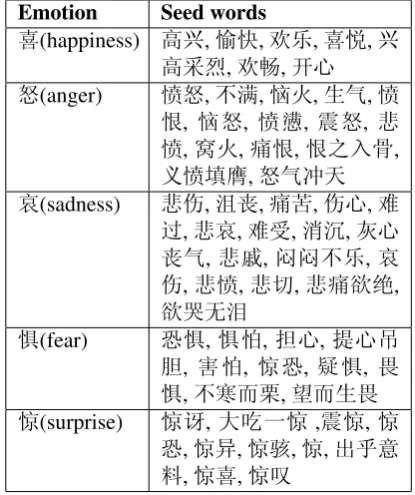
we assigned each emotion with seed words given in Table 1.
Emotion Seed words
喜(happiness) 高兴,愉快,欢乐,喜悦,兴
高采烈,欢畅,开心
怒(anger) 愤怒,不满,恼火,生气,愤
恨, 恼怒, 愤懑, 震怒, 悲 愤,窝火,痛恨,恨之入骨,
义愤填膺,怒气冲天
哀(sadness) 悲伤,沮丧,痛苦,伤心,难
过,悲哀,难受,消沉,灰心 丧气, 悲戚,闷闷不乐,哀 伤,悲愤,悲切,悲痛欲绝,
欲哭无泪
惧(fear) 恐惧,惧怕,担心,提心吊
胆, 害怕, 惊恐, 疑惧, 畏 惧,不寒而栗,望而生畏
惊(surprise) 惊讶,大吃一惊,震惊,惊
恐,惊异,惊骇,惊,出乎意 料,惊喜,惊叹
Table 1: Seed emotion words
4.3 Evaluation of our method
We obtained five ranking lists of words using the method in section 3. Following the work of (Riloff and Shepherd, 1997), we adopted the following evaluation setting.
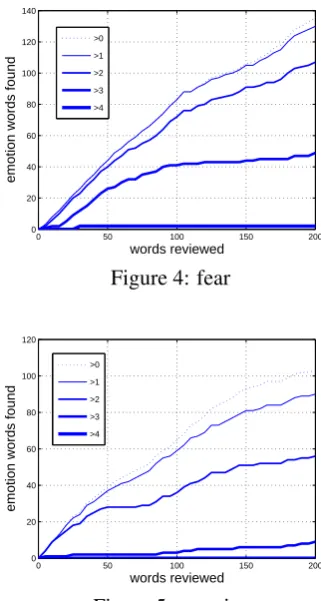
To evaluate the quality of emotion ranking lists, each list was manually rated by two persons inde-pendently. For each emotion, we selected the top 200 words of each ranking list and presented them to judges. We presented the words in random or-der so that the judges had no idea how our system had ranked the words. The judges were asked to rate each word on a scale from 1 to 5 indicating how strongly it was associated with an emotion, 0 indicating no association. We allowed the judges to assign -1 to a word if they did not know what it meant. For the words rated as -1, we manually assigned ratings that we thought were appropriate. The results of judges are shown in figures 1-5. In these figures, horizontal axes are the number of reviewed words in ranking lists and vertical axes are number of emotion words found (with 5
dif-ferent strength). The curve labeled as> xmeans
0 50 100 150 200
greater thanxby either judge.
Curves (>0, > 1, >2) display positive slopes
even at the end of the 200 words, which implies that more emotion words would occur if more than 200 words are reviewed. By comparison,
curves (> 3, > 4) tend to be flat when they are
close to the right side, which means the cost of identifying high-quality emotion words will in-crease greatly as one checks along the ranking list in descendent order.
It is observed that words which both judges
as-sign 5 are few. Insurpriseemotion, the number
is even 0. Such results may reflect that emotion is harder to identify compared with topical cate-gories in (Riloff and Shepherd, 1997).
0 50 100 150 200
From the semantic dictionary, our method found many low-frequency emotion words such as
忭(pleasant, glad),蘧然(surprise and happy),忉
怛(sad), or those used in Chinese dialects such as
毛咕(fear), 挂气(angry). Such emotion words
are necessary for comprehensive emotion lexi-cons.
Because more POS’s than adjectives and verbs are included in our experiments, some emotion
words such as the noun 冷门 (unexpected
win-ner),and the adverb 竟然 (to one’s surprise) are
also spotted, which to some extent implies the generality of our method.
5 Construct emotion lexicons
5.1 An iterative feedback to denoise
In our experiments, we observed that noises in-curred by similarity matrices are almost
unavoid-able. For example, in the unlabeled corpus, 国
事访问 (state visits) always co-occurred with高
兴(happy) or愉快(happy), so in happiness
emo-tion,国事访问 acquired a high ranking position
(174th); in terms of the heuristic rule, 意料
(ex-pected) shares two Chinese characters with出乎
意料(unexpected, surprised), however they have
opposite meaning because出乎(exceed, beyond)
is a negative word.意料unfavorably ranked high
(88th) in surprise emotion; from the semantic
dic-tionary, the gloss of年画(Chinese Spring Festival
pictures) contains欢乐(happy), thus in happiness
emotion,年画ranked high (158th).
So after each ranking of an emotion, in the de-scendent order of ranking scores, we manually re-vised some scores in about top 500. Several crite-ria (see 5.2 and 5.3) were given to guide if a word has a specified emotion. For those words surely bearing the specified emotion, we assigned 1 to them ,and left others unchanged. Seeing the words newly revised to be 1 as new seed emotion words, we run the ranking algorithm again. After such
feedback was repeated 2∼3 times, we collected
all the words labeled with 1 to form the final emo-tion lexicons. In (Zhou et al. , 2004), the author
also suggested such iterative feedback to extend
the query (seed) set and improve the ranking out-put. Commonly, the size of an emotion lexicon is small, so we do not have to check too many words. The human revising procedure is sensitive to annotators’ background. To improve the quality of the emotion lexicons, experts with linguistic or psychology background will help.
Furthermore, the ranking algorithm used in our paper is clearly sensitive to the initial seed words, but since we adopt an iterative feedback frame-work, the words not appearing in the initial set of seed words will show up in next iteration with high ranking scores. We also performed experi-ments which selected emotion seed words based on the Chinese synonym dictionary and the emo-tion words in (Chen et al. , 2009), similar results were found.
5.2 Guidelines for identifying emotions
The same as (Chen et al. , 2009), we used the def-inition that emotion is the felt awareness of bod-ily reactions to something perceived or thought. Also, we were highly influenced by the structure of the affective lexicon presented by (Ortony et al. , 1987), and used the Affective states and Affective-Behavioral conditions in the structure to
identify emotion words in our paper8.
With such guidelines,胆小(cowardice, relates
more to external evaluation) is not an emotional word of fear. We also intentionally distinguish be-tween emotions and expression of emotions. For
example,大笑(laugh),哈哈(haw-haw) are seen
as expression of happiness and颤抖(tremble) as
of fear, but not as emotion words. In addition, we try to distinguish between an emotion and the cause of an emotion, see 5.3 for an example.
For each emotion, brief description is given as
below9:
1. Happiness:the emotional reaction to
some-thing that is satisfying.
2. Anger:do not satisfy the current situation and have a desire to fight or change the situa-tion. Often there exists a target for this emo-tion.
3. Sadness:an emotion characterized by
feel-ings of disadvantage, loss, and helplessness. Sadness often leads to cry.
4. Fear:the emotional response to a perceived
threat. Fear almost always relates to future events, such as worsening of a situation, or continuation of a situation that is unaccept-able.
5. Surprise:the emotional reaction to
some-thing unexpected.
5.3 Linguistic consideration for identifying emotion words
If a word has multiple senses, we only consider its
emotional one(s). For example,生气(as a verb, it
meansbe angry, but meansvitality or spiritsas a
noun) will appear in the emotion lexicon of anger.
8According to (Ortony et al. , 1987),surpriseshould not
be seen as a basic emotion for it relates more to cognition. However, our paper focuses on the building of emotion lexi-cons, not the disputable issue of basic emotions
If one sense of a word is the combination of emo-tions, the word will appear in all related emotions. We mainly consider four POS’s, namely nouns,
verbs, adjectives and adverb10. If a word has
mul-tiple POS’s, we normally consider its POS with strongest emotion (Empirically, we think the emo-tion strength ranks in decedent order as following: adjectives, verbs, adverbs, nouns.). So we
con-sider the verb of恐惧(fear) when it can be used
as a noun and a verb in Chinese. The生气
exam-ple above also applies here.
For each of four POS’s, instruction for emotion identification is given as below:
Nouns: For example,怒火(rage, anger),喜气
(joy or jubilation), 冷门(an unexpected winner)
are selected as emotion words. We distinguish be-tween an emotion and the cause of an emotion. For example, calamity often leads to sadness, but does not directly contain the emotion of sadness.
冷门appears in the surprise lexicon because we
believe it contains surprise by itself.
Adverbs: The adverbs selected into emotion lexicons contain the emotions by themselves. For
example,竟然(unexpectedly),欣欣然(cheerily),
气哼哼 (angrily), 蓦地 (unexpectedly), 伤心地
(sadly) etc.
Verbs: As in (Ortony et al. , 1987), Chi-nese emotion verbs also fall into at least two dis-tinct classes, causatives and noncausatives. Both classes are included in our emotion lexicons. For
example, 动 肝 火 (be angry), 担 心 (fear) are
noncausative verbs, while 激 怒 (enrage), 震 惊
(to make someone surprised) are causative ones.
Probably due to the abundant usage of 令人/让
人/使人(to make someone) etc., causative
emo-tion verbs are few compared to noncausative ones in Chinese.
Adjective:Quite a lot of emotion words fall in
this POS, since adjectives are the natural
expres-sion of internal states of humans. For example,高
兴(happy),惊讶(surprised),愤怒(angry) etc.
For any word that it is hard to identify at first
sight, we used a search tool11to retrieve sentences
10For Chinese idioms, we only considered those used as
these four POS’s, omitted those used as a statement, such as哀兵必胜(an army burning with righteous indignation is bound to win)
11provided by Center for Chinese Linguistics of Peking
University, http://ccl.pku.edu.cn
which contain the word, and then identify if the word is emotional or not by its usage in the sen-tences.
5.4 Comparison with existing Chinese emotion resources
Table 2: The emotion lexicon of surprise
Under the guidelines for manually identifying emotion words, we finally constructed five Chi-nese emotion lexicons using the iterative feed-back. The newly constructed emotion lexicons were also reported as resources together with our
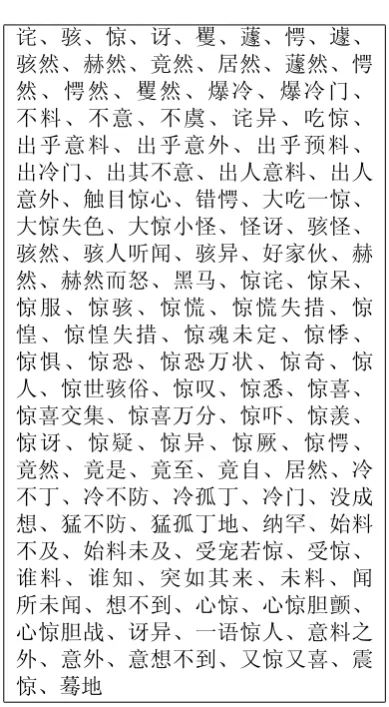
paper. The emotion lexicon ofsurpriseis shown
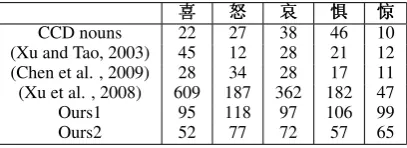
in Table 2. In this part, we compare our lexicons with the following counterparts, see Table 3.
Ours1 in the table is the final emotion lexicons, and Ours2 is the abridged version that excludes the words of single Chinese character and Chinese idioms.
喜
Table 3: Compare various emotion lexicons We only considered the noun network which is richly developed in CCD, as in other semantic dic-tionaries. For each emotion, we chose its synset as well as the synsets of its hypernym and hy-ponym(s). In fact, most of words in the emotion nouns extracted can be used as verbs or adjectives in Chinese. However, since CCD is not designed for emotion analysis, words which are expression
of emotions such as哭泣(cry) or evaluation such
as胆小(cowardice) were included.
Selecting nouns and verbs, Xu and Tao (2003) offered an emotion taxonomy of 390 emotion words. The taxonomy contains 24 classes of emo-tions and excludes Chinese idioms. By our in-spection to the offered emotion words in this tax-onomy, the authors tried to exclude expression of emotions, evaluation and cause of emotions from
emotions, which is similar with our processing12.
Ours2 is intentionally created to compare with this emotion taxonomy.
Based on (Xu and Tao, 2003), Chen et al. (2009) removed the words of single Chinese char-acter; let two persons to judge if a word is an emotional one and only those agreed by the two persons were seen as emotion words. It is worth
noting that Chen et al. (2009) merges怒(anger)
and烦(fidget) in (Xu and Tao, 2003) to form the
怒(anger) lexicon, thus讨厌(dislike) appears in
anger lexicon. However, we believe讨厌(dislike)
is different with怒(anger), and should be put into
another emotion. Also, we distinguish between恨
(hate) and怒(anger).
Xu et al. (2008) constructed a large-scale affec-tive lexicon ontology. Given the example words in their paper, we found that the authors did not intentionally exclude the expression of emotions
such as面红耳赤(literally, red face and ear),笑
眯眯(literally, be smiling). Such criteria of
iden-12Xu and Tao (2003) included words such as情愿/愿意
(be willing to),留神(be careful) in their happiness lexicon, which we think should not be classified into happiness.
tifying emotion words may partially account for the large size of their emotion resources.
6 Conclusion and future work
In this paper, aiming to build Chinese emotion lex-icons, we adopt a graph-based algorithm and in-corporate multiple resources to improve the qual-ity of lexicons and save human labor. This is an initial attempt to build Chinese emotion lexicons, the quality of constructed emotion lexicons is far from perfect and is supposed to be improved step by step.
The method in this paper can be further ex-tended to subjectivity/polarity classification and other non-sentimental tasks such as word similar-ity computing, and can be also adapted to other languages. The more resources we use, the more human cost can be saved and the higher the qual-ity of built emotion lexicons is.
In the future work, we want to construct other
emotion lexicons such as好(like, love), 恶
(dis-like),欲(desire) etc. using the same method.
AcknowledgementThis research is supported by National Natural Science Foundation of China (No.60973053, No.90920011)
References
A. Blum and T. Mitchell. 1998. Combining labeled and unlabeled data with co-training。 In Proceed-ings of the 11th Annual Conference on Computa-tional Learning Theory, 92-100.
Ying Chen, Sophia Y. M. Lee, and Churen Huang. 2009. A Cognitive-based Annotation System for Emotion Computing. Proceedings of the Third Lin-guistic Annotation Workshop (LAW III).
Andrew B. Goldberg, Xiaojin Zhu. 2006. Seeing stars when there aren’t many stars: graph-based semi-supervised learning for sentiment categoriza-tion. Proceedings of TextGraphs: the First Work-shop on Graph Based Methods for Natural Lan-guage Processing on the First Workshop on Graph Based Methods for Natural Language Processing.
Y. Liu and et al. 2003. The CCD Construction Model and Its Auxiliary Tool VACOL. Applied Linguis-tics, 45(1):83-88.
Delip Rao and D. Ravichandran. 2009. Semisuper-vised polarity lexicon induction.Proceedings of the 12th Conference of the European Chapter of the As-sociation for Computational Linguistics, 675-682.
Ellen Riloff and Jessica Shepherd. 1997. A Corpus-Based Approach for Building Semantic Lexicons.
In Proceedings of the Second Conference on Em-pirical Methods in Natural Language Processing, pages 117-124.
V. Sindhwani, P. Niyogi, and M. Belkin. 2005. A co-regularization approach to semisupervised learn-ing with multiple views. Proc. ICML Workshop on Learning with Multiple views.
H. Tong, J. He, M. Li, C. Zhang, and W. Ma. 2005. Graph based multi-modality learning. In Proceed-ings of the 13th Annual ACM international Con-ference on Multimedia. MULTIMEDIA ’05. ACM, New York, NY, 862-871.
Peter D. Turney. 2002. Thumbs up or thumbs down? Semantic orientation applied to unsupervised classi-fication of reviews. ACL 2002, 417-424.
Xiaojun Wan and Jianguo Xiao. 2009. Graph-Based Multi-Modality Learning for Topic-Focused Mul-tiDocument Summarization. IJCAI 2009, 1586-1591.
Linhong Xu, Hongfei Lin, Yu Pan, Hui Ren and Jian-mei Chen. 2008. Constructing the Afective Lexicon Ontology. JOURNAL OF THE CHINA SOCIETY F0R SCIENTIFIC AND TECHNICAL INFORMA-TION Vo1.27 No.2, 180-185.
X. Y. Xu, and J. H. Tao. 2003. The study of affective categorization in Chinese. The 1st Chinese Confer-ence on Affective Computing and Intelligent Inter-action. Beijing, China.
Hongbo Xu, Tianfang Yao, and Xuanjing Huang. 2009. The second Chinese Opinion Analysis Eval-uation(in Chinese).COAE 2009.
D. Zhou, O. Bousquet, T. Lal, J. Weston, and B. Scholkopf. 2004. Learning with local and global consistency. Advances in Neural Information Pro-cessing Systems 16. MIT Press, Cambridge, MA..
D. Zhou and C. J. C. Burges. 2007. Spectral cluster-ing and transductive learncluster-ing with multiple views.
Proceedings of the 24th international conference on Machine learning.
X. Zhu and Z. Ghahramani. 2002. Learning from labeled and unlabeled data with label propagation.