Self-Annotation for Fine-Grained Geospatial Relation Extraction
Andre Blessing Hinrich Sch¨utze
Institute for Natural Language Processing Universit¨at Stuttgart
Abstract
A great deal of information on the Web is represented in both textual and structured form. The structured form is machine-readable and can be used to augment the textual data. We call this augmentation – the annotation of texts with relations that are included in the structured data –
self-annotation. In this paper, we intro-duce self-annotation as a new supervised learning approach for developing and im-plementing a system that extracts fine-grained relations between entities. The main benefit of self-annotation is that it does not require manual labeling. The in-put of the learned model is a represen-tation of the free text, its output struc-tured relations. Thus, the model, once learned, can be applied to any arbitrary free text. We describe the challenges for the self-annotation process and give re-sults for a sample relation extraction sys-tem. To deal with the challenge of fine-grained relations, we implement and eval-uate both shallow and deep linguistic anal-ysis, focusing on German.
1 Introduction
In the last years, information extraction has be-come more important in domains like context-aware systems (e.g. Nexus (D¨urr et al., 2004)) that need a rich knowledge base to make the right de-cisions in different user contexts. Geospatial data are one of the key features in such systems and need to be represented on different levels of de-tail. Data providers do not cover all these
lev-els completely. To overcome this problem, fine-grainedinformation extraction (IE) methods can be used to acquire the missing knowledge. We define fine-grained IE as methods that recognize entities at a finer grain than standard categories like person, location, and organization. Further-more, the quality of the data in context-aware sys-tems plays an important role and updates by an in-formation extraction component can increase the overall user acceptance.
For both issues an information extraction sys-tem is required that can handlefine-grained rela-tions, e.g., “X is a suburb of Y” or “the river X is a tributary of Y” – as opposed to simple con-tainment. The World Wide Web offers a wealth of information about geospatial data and can be used as source for the extraction task. The extraction component can be seen as a kind of sensor that we calltext senor(Blessing et al., 2006).
addi-tion to unstructured text, structured data. We use structured data sources to automatically annotate unstructured texts. In this paper, we use German Wikipedia data because it is a good source for the information required for our context-aware sys-tem and show that a syssys-tem created without man-ual labeling has good performance.
Our trained model only uses text, not the struc-tured data (or any other markup) of the input doc-uments. This means that we can train an informa-tion extractor on Wikipedia and then apply it to any text, regardless of whether this text also con-tains structured information.
In the first part of this paper, we discuss the challenges of self-annotation including some heuristics which can easily be adapted to different relation types. We then describe the architecture of the extraction system. The components we de-velop are based on the UIMA (Unstructured In-formation Management Architecture) framework (Hahn et al., 2008) and include two linguistic en-gines (OpenNLP1, FSPar). The extraction task is
performed by a supervised classifier; this classi-fier is also implemented as a UIMA component and uses the ClearTK framework. We evaluate our approach on two types of fine-grained relations.
2 Related work
Jiang (2009) also addresses the issue of super-vised relation extraction when no large manually labeled data set is available. They use only a few seed instances of the target relation type to train a supervised relation extraction system. However, they use multi-task transfer learning including a large amount of labeled instances of other relation types for training their system. In contrast, our work eliminates manual labeling by using struc-tured data to annotate the relations.
Wu and Weld (2007) extract facts from in-foboxes and link them with their corresponding representation in the text. They discuss several is-sues that occur when using infoboxes as a knowl-edge base, in particular, (i) the fact that infoboxes are incomplete; and (ii) schema drift. Schema drift occurs when authors over time use differ-ent attribute names to model facts or the same
1http://opennlp.sourceforge.net/
attributes are used to model different facts. So the semantics of the infoboxes changes slightly and introduces noise into the structured informa-tion. Their work differs from self-annotation in that they are not interested in the creation of self-annotated corpora that can be used as training data for other tasks. Their goal is to develop methods that make infoboxes more consistent.
Zhang and Iria (2009) use a novel entity extrac-tion method to automatically generate gazetteers from seed lists using Wikipedia as knowledge source. In contrast to our work they need struc-tured data for the extraction while our system fo-cuses on the extraction of information from un-structured text. Methods that are applicable to any unstructured text (not just the text in the Wikipedia) are needed to increase coverage be-yond the limited number of instances covered in Wikipedia.
Nothman et al. (2009) also annotate Wikipedia’s unstructured text using struc-tured data. The type of strucstruc-tured data they use is hyperlinking (as opposed to infoboxes) and they use it to derive a labeled named entity corpus. They show that the quality of the annotation is comparable to other manually labeled named entity recognition gold standards. We interpret their results as evidence that self-annotation can be used to create high quality gold standards.
3 Task definition
In this section, we describe the annotation task; give a definition of the relation types covered in this paper; and introduce the extraction model.
We focus on binary relations between two re-lation arguments occurring in the same sentence. To simplify the self-annotation process we restrict the first argument of the relation to the main en-tity of the Wikipedia article. As we are building text sensors for a context aware system, relations between geospatial entities are of interest. Thus we consider only relations that use a geospatial named entity as second argument.
sentences in the text and annotate the relations (see section 4). All other not yet marked binary relations between the main entity and geospatial entities are annotated as negative samples. The result of this step is a self-annotated training set.
In the second step of our task, the self-annotated training set is used to train the extrac-tion model. The model only takes textual features as input and can be applied to any free text.
3.1 Classification task and relations used
Our relation extraction task is modeled as a classi-fication task which considers a pair of named en-tities and decides whether they occur in the re-quested relation or not. The classifier uses ex-tracted features for this decision. Features be-long to three different classes. The first class con-tainstoken-based features and their linguistic la-bels like part-of-speech, lemma, stem. In the sec-ond class, we have chunks that aggregate one or more tokens into complex units. Dependency re-lationsbetween the tokens are represented in the third class.
Our classifier is applicable to a wide spectrum of geospatial relation types. For the purposes of a focused evaluation, we selected two relations. The first type contains rivers and the bodies of water into which they flow. We call it river-bodyOfWater relation. Our second type is com-posed of relations between towns and the corre-sponding suburb. We call this town-suburb rela-tion.
3.2 Wikipedia as resource
Wikipedia satisfies all corpus requirements for our task. It contains a lot of knowledge about geospa-tial data with unstructured (textual) and structured information. We consider only German Wikipedia articles because our target application is a German context aware system. In relation extraction for German, we arguably face more challenges – e.g., more complex morphology and freer word order – than we would in English.
For this work we consider only a subset of the German Wikipedia. We use all articles that belong to the following categories: Rivers by country, Mountains by country, Valleys by country, Islands by country, Mountain passes by country, Forests
by country and Settlements by country.
For the annotation task we use the structural content of Wikipedia articles. Most articles be-longing to the same categories use similar tem-plates to represent structured information. One type of template is the infobox, which con-tains pairs of attributes and their values. These attribute-value pairs specify a wide range of geospatial relation types including fine-grained relations. In this work we consider only the in-fobox data and the article names from the struc-tured data.
For context-aware systems fine-grained relation types are particularly relevant. Such relations are not represented in resources like DBPedia (Auer et al., 2007) or Yago (Suchanek et al., 2007) al-though they also consist of infobox data. Hence, we have to build our own extraction component (see section 5.2) when using infoboxes.
4 Self-Annotation
Self-annotation is a two-fold task. First, the struc-tured data, in our case the infoboxes of Wikipedia articles, must be analyzed to get all relevant attribute-value pairs. Then all relevant geospatial entities are marked and extracted. In a second step these entities must be matched with the unstruc-tured data.
In most cases, the extraction of the named en-tities that correspond to the required relations is trivial because the values in the infoboxes con-sist only of one single entity or one single link. But in some cases the values contain mixed con-tent which can include links, entities and even free text. In order to find an accurate extraction method for those values we have developed sev-eral heuristics. See section 5.2 for discussion.
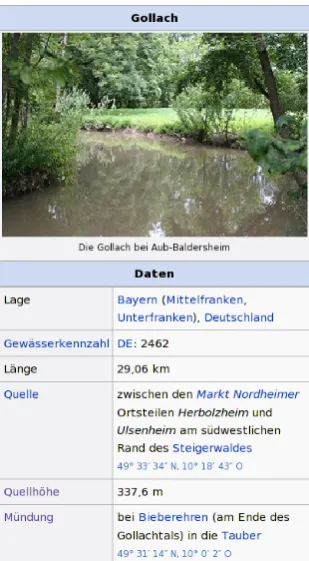
Figure 1: Infobox of the German Wikipedia article aboutGollach.
similar toYork vs.New York). We have to use a longest match strategy to avoid such overlapping annotations.
The main goal of the self-annotation task is to reach the highest possible annotation quality. Thus, only complete extracted relations are used for the annotation process while incomplete data are excluded from the training set. This procedure reduces the noise in the labeled data.
4.1 Example
We use the river-bodyOfWater relation between the two riversGollachandTauberto describe the self-annotation steps.
Figure 1 depicts a part of the infobox for the German Wikipedia article about the riverGollach. For this relation the attribute M¨undung ‘mouth’ is relevant. The value contains unstructured infor-mation (i.e., text, e.g. bei ‘at’ Bieberehren) and structured information (the link fromBieberehren
to its Wikipedia page). The relation we want to extract is that the riverGollachflows into the river
Tauber.
Bieberehren sie
sie
Tauber Gollach
Gollach Tauber
Sie
Gollach
[image:4.595.103.258.69.350.2]Tauber
Figure 2: Textual content of the German Wikipedia article aboutGollach. All named enti-ties which are relevant for the river-bodyOfWater relation are highlighted. This article contains two instances for the relation between Gollach and
Tauber.
Figure 2 shows the textual content of the Gol-lach article. We have highlighted all relevant named entities for the self-annotation process. This includes the name of the article and instances of the pronoun sie referring to Gollach. Our matching algorithm identifies two sentences as positive samples for the relation betweenGollach
andTauber:
• (i) DieGollachist ein rechter Nebenfluss der
Tauber in Mittel- und Unterfranken. (The
Gollach is a right tributary of theTauberin Middle and Lower Franconia.)
• (ii) Schließlich m¨undet sie in Bieberehren
auf 244 m in die Tauber. (Finally, it dis-charges in Bieberehren at 244 m above MSL into theTauber.)
5 Processing
pipeline. Second we present the components of the UIMA pipeline which are used for the relation extraction task.
5.1 Wikipedia interaction
We use the JWPL API (Zesch et al., 2008) to pre-process the Wikipedia data. This interface provides functions to extract structured and un-structured information from Wikipedia. How-ever, many Wikipedia articles do not adhere to valid Wikipedia syntax (missing closing brack-ets etc.). The API also does not correctly handle all Wikipedia syntax constructions. We therefore have enhanced the API for our extraction task to get high quality data for German Wikipedia arti-cles.
5.2 Infobox extraction
As discussed in section 4 infoboxes are the key resource for the self-annotation step. However the processing of infoboxes that include attribute-value pairs with mixed content is not trivial.
For each new relation type an initial manual ef-fort is required. However, in comparison to the complete annotation of a training corpus, this ef-fort is small. First the attributes used in the in-foboxes of the Wikipedia articles relevant for a specific relation have to be analyzed. The results of this analysis simplify the choice of the cor-rect attributes. Next, the used values of these at-tributes must be investigated. If they contain only single entries (links or named entities) the extrac-tion is trivial. However, if they consist of mixed content (see section 4.1) then specific extraction methods have to be applied. We investigated dif-ferent heuristics for the self-annotation process to get a method that can easily be adapted to new re-lation types.
Our first heuristic includes a set of rules spec-ifying the extraction of the values from the in-foboxes. This heuristic gives an insufficient basis for the self-annotation task because the rich mor-phology and free word order in German can not be modeled with simple rules. Moreover, hand-crafted rules are arguably not as robust and main-tainable as a statistical classifier trained on self-annotated training material.
Our second heuristic is a three step process. In
step one we collect all links in the mixed con-tent and replace them by a placeholder. In the second step we tag the remaining content with the OpenNLP tokenizer to get all named entities. Both collected lists are then looked up in a lexicon that contains named entities and the correspond-ing geospatial classes. This process requires a nor-malization procedure that includes the application of morphological methods. The second method can be easily adapted to new relation types.
5.3 UIMA
The self-annotated corpora are processed by sev-eral components of the UIMA (M¨uller et al., 2008) pipeline. The advantage of exchangeable collection readers is that they seamlessly handle structured and unstructured data. Another advan-tage of using UIMA is the possibility to share components with other research groups. We can easily exchange different components, like the us-age of the commonly known OpenNLP process-ing tools or the FSPar NLP engine (Schiehlen, 2003) (which includes the TreeTagger (Schmid, 1995)). This allows us to experiment with dif-ferent approaches, e.g., shallow vs. deep analy-sis. The components we use provide linguistic analysis on different levels: tokens, morphology, part of speech (POS), chunking and partial depen-dency analysis. Figure 4 shows the results after the linguistic processing of our sample sentence. For this work only a few annotations are wrapped as UIMA types: token (incl. lemma, POS), multi-word, sentence, NP, PP and dependency relations (labeled edges between tokens). We will intro-duce our machine learning component in section 5.5. Finally, the CAS consumers allow us to store extracted facts in a context model.
Figure 3 shows the article aboutGollach after linguistic processing. In the legend all annotated categories are listed. We highlighted all marked relations, all references to the article name (re-ferred to as subject in the figure) and links. After selection of theTauberrelation, all annotations for this token are listed in the right panel.
5.4 Coreference resolution
ar-Figure 3: Screenshot of the UIMA Annotation-Viewer.
ticles. Coreference resolution is therefore neces-sary for our annotation task. A shallow linguis-tic analysis showed that the writing style is simi-lar throughout Wikipedia articles. Based on this observation, we empirically investigated some geospatial articles and came to the conclusion that a simple heuristic is sufficient for our coreference resolution problem. In almost all articles, pro-nouns refer to the main entity of the article. In addition we include some additional rules to be able to establish coreference of markables such as
der Fluss‘the river’ order Bach‘the creek’ with the main entity.
5.5 Supervised relation extraction
We use the ClearTK (Ogren et al., 2008) toolkit, which is also an UIMA component, for the rela-tion extracrela-tion task. It contains wrappers for dif-ferent machine learning suites. Our initial exper-iments showed that the MaximumEntropy clas-sifier achieved the best results for our classifi-cation task. The toolkit provides additional ex-tensible feature methods. Because we view self-annotation and fine-grained named entity recogni-tion as our main contriburecogni-tions, not feature selec-tion, we only give a brief overview of the features we use.
F1 is a window based bag-of-words feature (window size = 3). It considers lemma and part-of-speech tag of the tokens. F2 is a phrase based extractor that uses the parent phrase of both enti-ties (max 2 levels). F3 is a representation of all
sie she Schließlich Finally
auf on
Meter meter
244 in in
Bieberehren
in
Tauber
die the
1
2
3
4
1 3 1 2 3 4
1 2 2
TOP münden
[image:6.595.334.491.68.175.2]flow SUBJ ADV
Figure 4: Dependency parser output of the FSPar framework.
linguistic effort description
F1 pos-tagging window size 3, LEMMA F2 chunk-parse parent chunks
F3 dependency-parse dependency paths betw. NEs
Table 1: List of feature types
possible dependency paths between the article’s main entity and a target entity, where each path is represented as a feature vector. In most cases, more than one path is returned by the partial de-pendency parser (which makes no disambiguation decisions) and included in the feature representa-tion. Figure 4 depicts the dependency parser out-put of our sample sentence. Each pair of square and circle with the same number corresponds to one dependency. These different possible depen-dency combinations give rise to 8 possible paths between the relation entitiesTauberandsie ‘she’
although our example sentence is a very simple sentence.
6 Evaluation
[image:6.595.75.288.71.225.2]6.1 Metric used
Our gold standard includes all relations of each article. Our metric works on the level of type and is independent of how often the same relation occurs in the article. The metric counts a rela-tion as true positive (TP) if the system extracted it at least once. If the relation was not found by the system a false negative (FN) is counted. A false positive (FP) is given if the system extracts a relation between two entities that is not part of the (infobox-derived) gold standard for the article. All three measures are used to calculate precision (P = T PT P+F P), recall (R = T PT P+F N), and F1
-score (F1= 2PP+∗RR).
6.2 Town-suburb extraction
The town-suburb extractor uses one attribute of the infobox to identify the town-suburb relation. There is no schema drift in the infobox data and the values contain only links. Therefore the self-annotation works almost perfectly. The only ex-ceptions are articles without an infobox which cannot be used for training. However, this is not a real issue because the amount of remaining data is sufficient: 9000 articles can be used for this task. The results in table 2 show that the classifier that uses F1, F2 and F3 (that is, including the depen-dency features) performs best.
engine features F1 recall precision
FSPar F1 64.9 79.0% 55.7%
[image:7.595.303.516.241.307.2]FSPar F1, F2 89.6 90.2% 89.5% FSPar F1, F2, F3 98.3 98.8% 97.8%
Table 2: Results of different feature combinations on the test set for town-suburb relation
6.3 River-bodyOfWater extraction
For the extraction of the river-bodyOfWater re-lation the infobox processing is more difficult. We have to handle more attributes because there is schema drift between the different users. It is hence necessary to merge information coming from different attribute values. The other diffi-culty is the usage of mixed contents in the values. Another main difference to the town-suburb rela-tion is that the river-bodyOfWater relarela-tion is often not mentioned in the first sentence (which usually gives a short definition about the the main entity).
Thus, the self-annotation method has to deal with the more complex sentences that are common later in the article. This also contributes to a more chal-lenging extraction task.
Our river-bodyOfWater relation corpus consists of 3000 self-annotated articles.
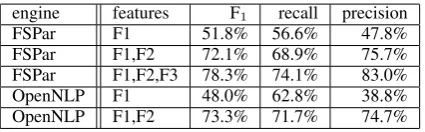
Table 3 shows the performance of the extrac-tor using two different linguistic components as described in section 5.3. As in the case of town-suburb extraction the classifier that uses all fea-tures, including dependency feafea-tures, performs best.
engine features F1 recall precision
FSPar F1 51.8% 56.6% 47.8%
FSPar F1,F2 72.1% 68.9% 75.7%
FSPar F1,F2,F3 78.3% 74.1% 83.0%
OpenNLP F1 48.0% 62.8% 38.8%
OpenNLP F1,F2 73.3% 71.7% 74.7%
Table 3: Results of different feature combinations on the test set for river-bodyOfWater extraction
6.4 Evaluation of self-annotation
To evaluate the quality of self-annotation, we ran-domly selected one set of 100 self-annotated ar-ticles from each data set and labeled these sets manually. These annotations are used to calcu-late the inter-annotator agreement between the hu-man annotated and machine annotated instances. We use Cohen’sκas measure and get a result of 1.00 for the town-suburb relation. For the river-bodyOfWater relation we got aκ-value of 0.79, which also indicates good agreement.
We also use a gazetteer to evaluate the qual-ity of all town-suburb relations that were extracted for our self-annotated training set. The accuracy is nearly perfect (only one single error), which is good evidence for the high quality of Wikipedia.
Required size of self-annotated training set.
The performance of a supervised system depends on the size of the training data. In the self-annotation step a minimum of instances has to be annotated, but it is not necessary to self-annotate all available articles.
[image:7.595.75.267.468.512.2]by 2.0% for town-suburb and by 2.4% for river-bodyOfWater; a reduction to 100 reduces F1 by 8.5% for town-suburb and by 9.3% for river-bodyOfWater (compared to the 9000/3000 base-line).
7 Discussion
Wu and Weld (2007) observed schema drift in their work: Wikipedia authors do not not use in-fobox attributes in a consistent manner. However, we did not find schema drift to be a large prob-lem in our experiments. The variation we found can easily be handled with a small number of rules. This can be due to the fact that the qual-ity of Wikipedia articles improved a lot in the last years through the introduction of automatic main-tenance tools like bots2. Nevertheless, the
devel-opment of self-annotation for a new relation type requires some manual work. The developer has to check the quality of the extraction relations in the infoboxes. This can lead to some additional adap-tation work for the used attributes such as merging or creating rules. However, a perfect coverage is not required because the extraction system is only used for training purposes; we only need to find a sufficiently large number of positive training in-stances and do not require exhaustive labeling of all articles.
It is important to note that considering par-tially found relations as negative samples has to be avoided. Wrong negative samples have a gen-erally unwanted impact on the performance of the learned extraction model. A developer has to be aware of this fact. In one experiment, the learned classifiers were applied to the training data and returned a number of false positive results – 40 in case of the river-bodyOfWater relation. 31 of these errors were not actual errors because the self-annotation missed some true instances. Nev-ertheless, the trained model recognizes these sam-ples as correct; this could perhaps be used to fur-ther improve the quality of self-annotation.
Manually labeled data also includes noise and the benefit of self-annotation is substantial when
2See en.wikipedia.org/wiki/Wikipedia:Bots. The edit
his-tory of many articles shows that there is a lot of automatic maintenance by bots to avoid schema drift.
the aim is to build a fine-grained relation extrac-tion system in a fast and cheap way.
The difference of the results between OpenNLP and FSPar engines are smaller than expected. Although sentence splitting is poorly done by OpenNLP the effect on the extraction result is rather low. Another crucial point is that the lexicon-based named entity recognizer of the FS-Par engine that was optimized for named entities used in Wikipedia has no significant impact on the overall performance. Thus, a basic set of NLP components with moderate error rates may be suf-ficient for effective self-annotation.
8 Conclusion
This paper described a new approach to develop-ing and implementdevelop-ing a complete system to ex-tract fine-grained geospatial relations by using a supervised machine learning approach without ex-pensive manual labeling. Using self-annotation, systems can be rapidly developed and adapted for new relations without expensive manual annota-tion. Only some manual work has to be done to find the right attributes in the infoboxes. The matching process between infoboxes and text is not in all cases trivial and for some attributes ad-ditional rules have to be modeled.
9 Acknowledgment
This project was funded by DFG as part of Nexus (Collaborative Research Centre, SFB 627).
References
Auer, S¨oren, Christian Bizer, Georgi Kobilarov, Jens Lehmann, and Zachary Ives. 2007. Dbpedia: A nucleus for a web of open data. InIn 6th Intl Se-mantic Web Conference, Busan, Korea, pages 11– 15. Springer.
Blessing, Andre, Stefan Klatt, Daniela Nicklas, Stef-fen Volz, and Hinrich Sch¨utze. 2006. Language-derived information and context models. In Pro-ceedings of 3rd IEEE PerCom Workshop on Context Modeling and Reasoning (CoMoRea) (at 4th IEEE International Conference on Pervasive Computing and Communication (PerCom’06)).
editor, 1. Fachgespr¨ach Ortsbezogene Anwendun-gen und Dienste der GI-Fachgruppe KuVS, pages 15–18, Hagen, Juni. Informatik-Bericht der Fer-nUniversit¨at Hagen.
Hahn, Udo, Ekaterina Buyko, Rico Landefeld, Matthias M¨uhlhausen, Michael Poprat, Katrin Tomanek, and Joachim Wermter. 2008. An overview of JCoRe, the JULIE lab UIMA compo-nent repository. In Proceedings of the LREC’08 Workshop ‘Towards Enhanced Interoperability for Large HLT Systems: UIMA for NLP‘, Marrakech, Morocco, May.
Jiang, Jing. 2009. Multi-task transfer learning for weakly-supervised relation extraction. In ACL-IJCNLP ’09: Proceedings of the Joint Conference of the 47th Annual Meeting of the ACL and the 4th In-ternational Joint Conference on Natural Language Processing of the AFNLP: Volume 2, pages 1012– 1020, Morristown, NJ, USA. Association for Com-putational Linguistics.
M¨uller, Christof, Torsten Zesch, Mark-Christoph M¨uller, Delphine Bernhard, Kateryna Ignatova, Iryna Gurevych, and Max M¨uhlh¨auser. 2008. Flex-ible uima components for information retrieval re-search. In Proceedings of the LREC 2008 Work-shop ’Towards Enhanced Interoperability for Large HLT Systems: UIMA for NLP’, Marrakech, Mo-rocco, May 31, 2008. 24–27.
Nothman, Joel, Tara Murphy, and James R. Curran. 2009. Analysing wikipedia and gold-standard cor-pora for ner training. In EACL ’09: Proceedings of the 12th Conference of the European Chapter of the Association for Computational Linguistics, pages 612–620, Morristown, NJ, USA. Association for Computational Linguistics.
Ogren, Philip V., Philipp G. Wetzler, and Steven Bethard. 2008. Cleartk: A uima toolkit for sta-tistical natural language processing. In UIMA for NLP workshop at Language Resources and Evalua-tion Conference (LREC).
Schiehlen, Michael. 2003. Combining deep and shal-low approaches in parsing german. In ACL ’03: Proceedings of the 41st Annual Meeting on Asso-ciation for Computational Linguistics, pages 112– 119, Morristown, NJ, USA. Association for Com-putational Linguistics.
Schmid, Helmut. 1995. Improvements in part-of-speech tagging with an application to german. InIn Proceedings of the ACL SIGDAT-Workshop, pages 47–50.
Suchanek, Fabian M., Gjergji Kasneci, and Gerhard Weikum. 2007. Yago: A Core of Semantic Knowl-edge. In 16th international World Wide Web
con-ference (WWW 2007), New York, NY, USA. ACM Press.
Wu, Fei and Daniel S. Weld. 2007. Autonomously semantifying wikipedia. InProceedings of the Six-teenth ACM Conference on Information and Knowl-edge Management, CIKM 2007, Lisbon, Portugal, November 6-10, 2007, pages 41–50.
Zesch, Torsten, Christof M¨uller, and Iryna Gurevych. 2008. Extracting Lexical Semantic Knowledge from Wikipedia and Wiktionary. InProceedings of the Conference on Language Resources and Evalu-ation (LREC).