FEEDBACK COMMUNICATION USING ORTHOGONAL SIGNALS
Thesis by
Stephen Stuart Lavenberg
In Partial Fulfillment of the Requirements
For the Degree of Doctor of Philosophy
California Institute of Technology Pasadena, California
1968
ii ACKNCWLEDGMENT
I greatly benefited from the guidance and advice of my research advisor, Dr. T. L. Grettenberg, and from several useful discussions with Mr. S. Farber, a fellow student. My studies were conducted under a National Science Foundation Graduate Fellowship and a National
Science Foundation Graduate Traineeship, and I am grateful for the financial assistance they have provided. I wish to thank my wife, whose constant encouragement and good cheer provided great impetus for
i i i ABSTRACT
This research is concerned with block coding for a feedback communication system in which the forward and feedback channels are independently disturbed by additive white Gaussian noise and average power constrained. Two coding schemes are proposed in which the messages to be coded for transmission over the forward channel are realized as a set of orthogonal waveforms. A finite number of forward and feedback transmissions (iterations) per message is made. Infor-mation received over the feedback channel is used to modify the
wave-form transmitted on successive forward iterations in such a way that the expected value of forward signal energy is zero on all iterations after the first. Similarly, information is sent over the feedback
Chapter I. II. III. IV.
v.
TABLE OF CONTENTS
INTRODUCTION ...••. · ..••••.•.•..•.•....•...•. FEEDBACK CODING SCHEME 1 . . . . 2 .1.
2.2. 2 .3.
Preliminaries ..•... Description of Scheme 1 . . . ... . . . Analysis of Scheme 1 . . . . FEEDBACK CODING SCHEME 2
3.1.
3
.2.
3.3.'
3
.4.
Preliminaries ...•...•... Description of Scheme 2 ••••••••••••••••• Analysis of Scheme 2 . . . ... . . . . Peak Power ...•... PERFORMANCE OF THE CODI:r.G SCHEMES ... .
4.1.
The Channel Reliability Function .•...4.2.
Comparison of Coding Schemes ...•...•.CONCLUSIONS APPENDICES
A. Weak Converse for a Feedback Communication
l 5 5 6
8
20 20 20 2132
36 36 3643
System . . . • . . . . • . . . • . . . • . . 45 B. A Lower Bound to the Probability of Error
l
I. INTRODUCTION
This research is concerned with block coding for a communication
system consisting of a forward and a feedback channel. A block coding
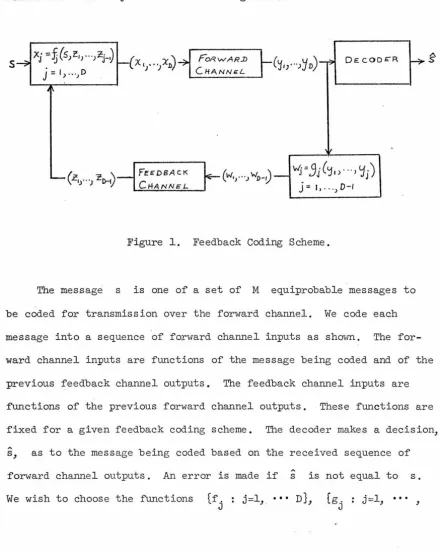
scheme for such a system is shovm in Figure l.
s
Xj ::t(s>~,,...
>~j-~
j=l,
...
)D
FoR.vvAR.D C HANNt<L
De:cooE"R
Vlj=,9j(<ju···1<jj)
[image:5.554.55.497.156.711.2]j
=
1,. .. ,D-IFigure l. Feedback Coding Scheme.
The message s is one of a set of M equiprobable messages to
be coded for transmission over the forward channel. We code each
message into a sequence of forward channel inputs as shovm. The
for-ward channel inputs are functions of the message being coded and of the
previous feedback channel outputs. The feedback channel inputs are
fUnctions of the previous forward channel outputs, These functions are
fixed for a given feedback coding scheme. The decoder makes a decision,
"
s, as to the message being coded based on the received sequence of
"
forward channel outputs. An error is made if s is not equal to s.
D-l}, and the decoder so as to achieve reliable transmission of
infor-mation over the forward channel.
Feedback coding schemes have been analyzed under a variety of
assumptions regarding the forward and feedback channels [l-6]. These
schemes achieve a lower probability of error than that attainable
with-out feedback. The presence of the feedback channel does not, however,
increase the capacity of the forward channel. This result holds for a
wide class of feedback communication systems (see Appendix A).
In the remainder of this paper, we consider a feedback
communica-tion system in which the forward and feedback channels are independently
disturbed by additive white Gaussian noise and average power constrained.
While feedback coding does not increase the maximum rate at which
reliable information may be sent over the forward channel of this
system, it can improve error performance. If the feedback channel is
noiseless, Schalkwijk [2, 3], Kailath [2], Omura [4], and Butman [5]
have devised schemes in which the probability of error in transmitting
information over the forward channel is lower than the minimum
proba-bility of error attainable without feedback. This result holds at all
rates up to the forward channel capacity. These schemes use scalar
signals, that is each message is realized as a point on the real line.
The forward channel inputs are linear combinations of the scalar message
point being coded and the previous feedback channel outputs. The feed
-back channel inputs are linear combinations of the previous forward
channel outputs. Decoding is accomplished by taking an appropriate
linear combination of the forward channel outputs. Then, denoting this
3
representing the message being coded. In particular, the maximum
likelihood decoder may be implemented in this way. (Reference 5
con-tains the complete formulation of this linear coding scheme.)
Note that
a
is of the formwhere n is a Gaussian random variable with mean zero and variance
2
a , and 8 is the message point being coded. If the message points
n
are equispaced about the origin, the probability of error, p '
e for
this linear coding scheme is
p
e
where T is the time to transmit a message,
information rate of the forward channel, and
R _
lnM
-
T
is they is the output signal
to noise ratio.
0
e
2
(y
=
- -2 ' wherecre
is the variance of the set ofa
n
equiprobable message points.) Clearly, as T becomes large, it is
necessary that y increase exponentially with time in order to
attain a vanishingly small probability of error for any non-zero rate R.
The above expression for the probability of error for a linear
coding scheme is also valid in the presence of feedback channel noise.
In this case y may be upper bounded by the sum ·or the ratio of
for-ward signal energy to forfor-ward channel noise and the ratio of feedback
result obtained by Elias
[
8
].
An alternate derivation of this bound,which makes use of Butman's matrix formulation of the linear coding
scheme
[5],
is due to Farber[9].)
Thus, with the average powercon-strained in both the forward and feedback channels, y can increase
no faster than linearly with time, and reliable transmission cannot be
maintained over the forward channel at non-zero rates. Equivalently,
for a finite amount of power in the forward direction, an infinite
amount of feedback power is required to maintain any non-zero rate, R,
and achieve a zero probability of error. This is a severe limitation
of linear coding schemes.
Kramer
[6]
has recently analyzed a feedback coding scheme in whicheach message is realized as one of a set of orthogonal waveforms.
Information received over the feedback channel is used to modify the
waveform transmitted on successive forward iterations in such a way
that the expected value of forward signal energy is zero on all
itera-tions after the first. His scheme also achieves a lower probability
of error than the best one-way coding scheme at all rates up to the
forward channel capacity. However, even in the presence of feedback
noise, only a finite amount of feedback power is required to achieve
this improved performance. Thus, this scheme is of particular interest.
In
Chapters +I and III of this paper, feedback coding schemes areintroduced which further reduce the amount of feedback power required.
This is accomplished by sending information over the feedback channel
in such a way· that the expected value of feedback- signal energy is also
zero on all iterations after the first. Chapter IV contains a dis-' ""'
5
II. FEEDBACK CODIJ>G SCHEME 1.
2.1. Preliminaries.
The forward and feedback channels are the vector channel equiva
-lents of the time continuous additive white Gaussian noise channel .
(Chapter
4
of Referencell contains a discussion of the equivalence ofthe vector and time continuous channel models.) Both channels are
assumed to have no bandwidth constraints, and the forward and feedback
noises are assumed to be statistically independent. Every T seconds
we wish to code and transmit over the forward channel one of M
equiprobable messages from the message set
' M}
Let
e
=
te.
1 i=l, • • • , M}be a set of orthogonal M dimensional vectors representing M
orthogonal waveforms over a time interval 'f with \\eill2
=
E. Leti--1 J • • • , M}
be a similar set with \\¢i\\2 = E'. We associate each message s. 1
,J'
with a vector e. ine
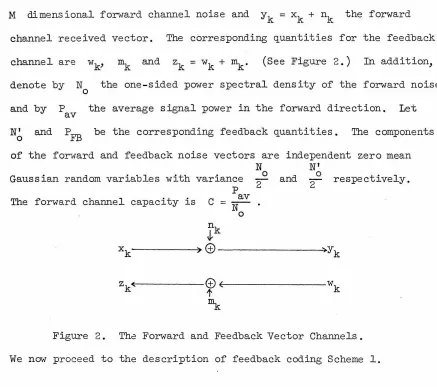
1 Let xk denote the M dimensional
in
M dimensional forward channel noise and yk
=
xk + ~ the forwardchannel received vector. The corresponding quantities for the feedback
channel are wk' and (See Figure 2.) In addition,
denote by N
0 the one-sided power spectral density of the forward noise
and by p
av the average signal power in the forward direction. Let
N~ and PFB be the corresponding feedback quantities. The components
of the forward and feedback noise vectors are independent zero mean
N
N'
0 0
~ and ~ respectively. Gaussian random variables with variance
p
The forward channel capacity is
xk
zk
C -~ - N 0 nk
J-©
©
t ~ yk wkFigure 2. The Forward and Feedback Vector Channels.
We now proceed to the description of feedback coding Scheme 1.
2.2. Description of Scheme 1.
Assume s £ ~ is the message to be coded for forward transmission
and
e
£ 8 is the M dimensional vector associated with s. We makeN forward transmissions and N-1 feedback transmissions, each of time
duration 1, as follows:
nl J,
xl
e
©
1
=e
+ nlzl
¢1
+ ml @ wl =¢1
1'
[image:10.549.50.487.60.447.2]7
n2
*
l
*
x2
=
e
-
e
l
~@ Y2e
-
e
l
+ n2,...
zk
=
¢k - ¢k-l +~"c--@----wk
=
¢k - ¢k-lI
~
¢
k
*
where and
ek
are determined as follows:Let
k
A.k = Y1 +
l:
(yj +e.
i)
J-j=2
over
and if ek = et then ¢k = ¢t•
Let
e.
Ee
J
(¢*
=
0) 0¢
*kThen is that member of which maximizes
*
and if ¢ k = ¢ t then Finally, if 9N
=
over
-lC·
ek = et.
¢.
E pJ
et the receiver decides st was the message
coded. An error is made if eN
f
e. Note that the total time T to transmit s isT
=
NT2.3. Analysis of Scheme l.
We wish to determine the probability of error, PN(e), the
average forward power and the average feedback power for this scheme.
In particular we wish to determine the behavior of these quantities as
we let 'f .... 00 while the rate of transmission, R =
:4,
and N areheld constant. Bounds on these quantities wil l be obtained in terms
9
Let
f(x) 1
-2
y
JM
-
1
2
dy dcxWe define
Pefb
=
~
;J
where S'E
T'
and
f(~)
wheres
= E -TThe properties of f(x) are well known and the reader unfamiliar with them should consult Chapter
5
of Reference ll. In particular, f(x) is monotone decreasing in x.In the previous section we defined vector quantities A.k and 13k
*
which were used in determining ek and ¢k. If s is the message
being coded, then
*
and if e. e.J J
k
Ak = k9 +
L
for j 1,
...
k
A.k k9 +
l:
n. J j=lIn this case the probability that
*
(e. - e.)
J J
'
k-1 it follows thatSimilarly,
*
"
and if ¢k-l
=
¢k-l then*
"
In this case the probability that ¢k
f
¢k is simply Pefb" Hence,is the probability that ek
f
e given that••• , k-l and Pefb is the probability that
*
e.
=
e. forJ J
*
"
ek
f
ek given*
ek-l = 9k-l" In what follows let £ ( ) be an operator denoting
statistical expectation and P( ) denote the probability of the
event in parentheses.
I.et
Then
where
=
P(ekf
e./s. J.. J.. is being coded)11
An upper bound to Pk(e) may be derived as follows:
*
,...
Pk(e/s. )= Pk(e/s. ,e. = 8.
l. l. J J
*
,...
for j=l,•••,k-1) P(8. = e. J J for
*
,...
j=l,···,k-l/s
1. ) + Pk(e/sl. .,eJ .
f
e. J for some j). k-1
*
,...
for some j/s.) = P k(l-P fb) + Pk(e/s.,e. -f e. for
l. e e l . J J
k-1
some j)(l-(1-Pefb) ) (2.1)
since
k-1
*
IT
*
,...
*
P(e. = e. j=l,···,k-1/s.) = P(e.
=
e./s., e~J J l. . 1 J J l. 'V
J=
Noting that
it follows from (2.1) that
k-1
=IT
P(e~
=
. 1 J
J=
(1-P )k-1 efb
*
e./s., e. 1 J l.
J-e
t-1 • • • J. -1)t - ' '
e.
J-1)
It also follows directly from (2.1) that
We now obtain bounds on P where
. av
N
Pav =
~,.
L
dllxk\12)
k=l=
~T
(E
+~
e(\\xk\\
2
))
For k ~ 2,
*
*
AIf ek-l
f
ei then either ek-lf
ek-l orek 1
!
e./s.)- l. l.
Therefore,
where
(2 .3)
(2
.4)
13
* ...
and by induction, noting that P(e1
f
e1)=
Pefb' we have(2.6)
It follows from (2.2), (2.4), (2.5) and (2.6) that
Hence,
(2. 7)
We now bound PFB where
N-l
PFB =
~'f
L
dllwkli2)k=l
(
N-l )
=
~'
E' +~2'
<hll2)
(2.8),.
Now if ek
I
ek-l then either ekI
ei or ek-lI
ei. Itfollows from this that
,.
P(ek
I
ek_1/si) s P(ekI
ei/si) + P(8k-lI
ei/si)Therefore,
It follows from
(2.2), (2.8)
and(2.9)
thatE'
- s
PFB
NT (
N-l
,;;
~~
i + 2~
2
( Pek + (k-i)Finally, noting that Pek s Pek-l we obtain
SI SI ( 2
N
sPFB
sN
l
+2(N-2)
Pefb +(2.9)
(k-2)
pefb))
(2.10)
We now wish to determine the asymptotic behavior of this scheme
for large 'T. It follows from the properties of the function f(x)
that
for
for
k > l
S' S
1
5
and
p -+ 0
el as T -+ "" for 0
lnM
s
~ -- <
-T N
0
Therefore, for
S'
s
and 0 ~ R lnM
s
- ~NT <
-N' N NN 0
0 0
we have
p -+ -
s
as T -+ ""av N (2.ll )
PFB -+ -S' as T -+ ""
N
(
2
.1
2)
To observe the asymptotic behavior of the probability of error we examine the behavior of the channel reliability function, E (R), where
From Eq.(2.2) we have that
Let us now consider the following two cases:
A) S
NT
'0
s
r'N
0
In this case
Therefore,
and
p
er
PN(e) $ N P
er
and
E(R) ~ lim
T-+C:O
(-
~
NT tn P ) er +r
(
-
1per)
=N
l,.
__
im -rT tnlim T-+c:o
Making use of the asymptotic expression for
E(R) ~ r N
s
tnM
2N - rT
0
(
-
;T
tnN)P we have
er
We now require that
R
<~ NN . Then using (2.ll) and (2.12) the0 above result may be rewritten as:
If
then
p
av
r
-N 0
l7
0 ~ R . av av
(
rP P )
~min ~, No
E(R) ~
(2.l4)
. av
( rP
:rrun ~'
B) r ;?:: N (r need not be an integer)
In this case
so that
and
E(R) ;?:: ( -
~
-Ln p ) +NT eN
lim
T-+CO
=
lim T-4D(-
~
NT{,
n
P eN )s
R 0 ~ Rs
2N - ~ 4N
0 0
=
(~
-JRr
s
s
4N
~ R < -NIn additio~ from (2.3) we have that
Therefore,
E(R) s lim (-
~
tn P)+
lim ( N l - ~-~ tn(l- -P ) )NT eN NT efb
'!"->CO 1"->eo
lim
(-
l peNl
::: - t n
T_,co NT
provided that Pefb _, 0 as T _, ""'· This will be true as long as
lnM Si
-,.-
<NT
.
0
Finally, if we require that R < NN
s
, then using (2.ll) and (2.l2) 0the above results may be rewritten as:
If
then
E(R) ==
NP av
W- -
R0
r ;;:: N
0 s R s mm . (NP~, av Pav) N
0 0
(NP p
l
. av av
min
rm- ,
W-
s R 0 -o Ip
<~ N
0
(2.l5)
19
The upper bound to E(R) obtained here from (2.3) also applies
to the case 1 ~ r < N. However, in that case the upper and lower
bounds no longer coincide. A more exact analysis is required to
obtain the true value of E(R) in that case. In the following
chapter a feedback coding scheme is introduced for which an exact
expression for the channel reliability function is obtained.
A discussion of the performance of these schemes is postponed
III. FEEDBACK CODING SCHEME 2
3.l. Preliminaries.
Section 2.l of Chapter II applies verbatim to Scheme 2. In
addition, quantities defined in Chapter II are not redefined in this
Chapter unless their meanings have changed. The feedback coding
scheme introduced here permits an exact analysis of the channel relia
-bility function. In addition, a simple modification of this scheme is
considered and its effect on peak power is discussed.
We now proceed to the description of feedback coding Scheme 2.
3.2. Description of Scheme 2.
Assume s c: ~ is the message to be coded for forward trans-mission and 9 c: 8 is the M dimensional vector associated with s. We make N forward transmissions and only one feedback transmission,
21
In this scheme we let
N
f..N = Y1 +
L
(yk + e1) • k=2*
*
eN is then determined as in Scheme 1. e
1,
¢
1,¢
1 and e1 are thesame as in Scheme 1.
3.3.
Analysis of Scheme 2.We first obtain exact expressions for P and P
av FB' N
Pav -
;T
L
E(llxkll
2)k=l
For k ~ 2,
*
2EP(e1
r
e./s.)where
Pefb' To do this we write
Therefore,
and
1
23
Also
Therefore,
(3.2)
We now consider PN(e), the probability of error, for this
scheme. Note that when s is the message being coded,
The probability of error therefore depends on the values of
e
1 and
*
e
1. The following is a table of the possible events associated withthese values.
Event
A
B
c
D
It is assumed that s. is the message being coded.
1
e.
J
e
.
J
e.
1e
.
1 jfi jfie.
Je
1.
j,h
e.
J
e.i
ifi, jk=l N
L
nk + (2N-l)91 .-(N-l)8J .k=l N
2=
~+k=l N
2=
~ +E
e.
j.fiJ
e.
l.These events are disjoint and we may write
A
2=
k=ln. + e. + (N-l)e.
.K l. J
PN(e/si) = P(eN.tei/si,A)P(A/si) + P(8N
t
ei/si,B)P(B/si)A A
+ P(eN
t
ei/si,C)P(C/si) + P(eNt
8i/si,D)P(D/si)A
+ P(eN _J_ e./s.,E)P(E/s.)
F i i l.
We wish to consider the terms which make up this sum.
~ P((A.._, . ".N 8.) J ~ (A.N'
e.
l. )/s .,D) l.(3 .3)
We now substitute the value of A.N corresponding to event D in the above expression. When we do this we can condition the probability
o~y on the relationship
implied by event D. Therefore,
=
p
(
t
k=lN
(nk, ej) + (N-1) E
~
L
(nk' ei) k=l25
k=2
N
where
L
(nk, e j) andk=2
are independent identically
dis-tributed Gaussian random variables.
It therefore follows that
(3.4)
A similar argument shows that
The conditional probabilities of events D and E are
and
P(E/s.)
J.
Now
P(eN-!= e./s.,B) J. i
=
1 - P((A.N,e.) J. > (A.N,e) r~
l -P
(
~
1
(nk,e1)
+ (2N-l) E >~
(3.7)
for all r-/= i/s.,B)
. J.
N
(nk, ej )- (N-1) E,
L
(nk, er)£or all r
f
i,j/(n~ei)
+E
>(n
1
,er)
£or
all
r
f
i)
::;; l - for all r
f
i/(n1,ei)+ E >
(n
1,er) for all r
f
i)
"
=
P(eN -f e./s.,A) 1. 1.and
If
then
The conditional probabilities of events
A
andB
arelnM
s'
Q : : ; ; <
-T N'
0
p -+ 0
27
and for large T
In this case
"
0 ~ P(eN
f
ei/si,B) P(B/si) ~ P(eNf
ei/si,A) P(A/si) (3. 8)Finally,
(3. 9)
It follows from
(
3
.
3)
-
(3.9)
that(3.lO)
where we have assumed T is large and 0 ~ -tnM < -S' to obtain the
T N'
0
upper bound.
Suppose now that
8 I S
N1
=
r N""" for r ~ l (r need not be an integer)This implies
If, in addition, we require that
then
and from (3.l)
0
~
R
<~
NNO
p --+ 0 el
p --+ 0 efb
s
p --+-av N
as
as
as
Equation (3.lO) is valid with
reliability function
E(R) = lim
[-T-+eo
where
T --+ co
pefb = p er
~ln
NT PN(e))
(3.ll)
29
El(R) = l:i.m [-
~
ln p ),._,co
NT eNand
Now, using (3.2), (3.ll) and the asymptotic expressions for Pel'
Per and PeN' the above results may be written as:
If
then
where
NP
av
~-R
0
r :e: l
0 ~ R ~ . av ~
(
NP P )
min
W--,
N0 0
. av av
(
NP p )
~in~' No ~ R
p <~
N 0
(3.l2)
(3 . l3a)
and
(r+l)P
_ _ _ a_v - 2R
2N 0
p
0 s R s av
4N
0
(r+2 )P av 2N
0
~
av s . av
P (rP
4N
Rsmmw-,::v)
(r+l)P av N
0
0
2~
(l+/;) + 2R0
0 0
( rP
. av
min~,
p
< av N
0
(3 .l3c)
These eQuations completely describe the behavior of E(R) for this
scheme. If N s r or N ~ r + l they can be simplified as follows:
Clearly
so that
as in Scheme l.
rP av
~-R
0
. av av
(
rP P )
0 s R s min ~ , N
0
. av (
rP
min ~'
for N s r
p
< ~
N
0
Therefore,
(r+l)P
_____ a_v __ R
2N
0
31
. av av
(
(r+l)P P )
0 :-s:: R :-s:: min 4No ' No
. av av
(
(r+l)P P )
min 4No ' No :-s:: R
for N ~ r + l
p
<
2:.!
N
0
Note that E
2(R) is independent of N. Hence, E(R) cannot be
in-creased by further increasing N, for N ~ r + l.
Before concluding this section it is of interest to consider the
p p
performance of this coding scheme when
N"E('
< N av We show that in0 0
this case reliable transmission of information over the forward
channel is not possible at all rates up to the forward channel
capacity.
To see this, note that if
then
lnM S'
~ ~
N'
so that Pefb ~ 1 as ~ ~ ~It then follows from (3.1) that
Pav -
~
(2N-l)
as T - ooand from (3.10) that
for all rates R such that
av
p )
p
<~
N
0
Reliable transmission cannot be maintained for this range of rates.
3
.4.
Peak Power.We define peak power for the feedback coding scheme as the
maximum average -power over any transmission interval T. let PPK
denote the peak power in the forward direction and PPK denote the
peak power in the feedback direction. The peak -power in the forward
direction is the maximum value of
llxkl!2
k
1,
• • • ' N TIf
e1
*
f:.
e
thenllxkll2
28 k 2, • • • ' N
= =
33
Therefore,
The peak power in the feedback direction is
Hence, from (3.2)
N
For the remainder of this section we assume that
and
Then from (3.ll)
S'
N'
0
s
rN
0
0
~R <~
NNOPPK
- - -+ 2N
p av
as
r ~ l
(3.14)
Thus the ratio of peak power to average power increases with N,
transmissions is limited.
Suppose now we modif'y feedback coding Scheme 2 by letting
k
=
2, • • • , Nwhere g is a fixed positive gain constant. For this scheme we let
N
A.N = Y1 +
L
(yk + gel)k=2
to determine 9N. Note that
p av
s
+
-N as T
-+ co
independent of the choice of g. Now, however,
Since,
PPK 2 .
p---
=
max(2g N,N)av
we assume that only the constraint on the forward peak to average
(3 .15)
power ratio is critical. We wish to determine tlJ.e channel reliability
If then where p av 2N 0
E1(R) =
v~:v
PFB rP av
N'
=
-w---0 0
( (N-l)g+l) N
( (N-l)g+l) 2 N
2 - R
-JR
r
35
r ~ l
<R<min(
2
Pav
J
( (N-l)g+l) p0 av
N
4N
JNo
j
0. ( ( (N-l)g+l)2 p av p ) p
_ £ sR< _ £
min N
4N
J NN
0 0 0
and E
2(R) is again given by (3.l3c) and is independent of N and g. E
1(R) can be increased by increasing either Nor g. However, if we fix the forward peak to average power ratio (see (3.15)), it can be shown that
E1(R)
increases with decreasing g (for g ~ J2/2).Therefore, it is reasonable to choose g
=
l as in feedback codingScheme 2, and increase ance. E1 (R) is
g
=
[2/2
andN
in fact PPK
= p
av
N in order to obtain maximized, for fixed
improved error
perform-p PK
IV. PERFORMAl'fCE OF THE CODING SCHEMES
4.1.
The Channel Reliability Function.In Chapters II and III of this paper we analyzed two block coding schemes for a feedback communication system in which the forward and
feedback channels are disturbed by independent additive white
Gaussian noise and average power constrained. In particular, we focused our attention on the behavior of the channel reliability
function, E(R), for these schemes. (See Equations (2.13)-(2.16),
(3.12) and (3.13).) This function is of particular interest since for large coding delay (time to transmit a message) T, the probability
of error is given by
PN(e) ""'exp(-E(R)T)
and E(R) can be used to compare the performance of different coding schemes.
4.2. Comparison of Coding Schemes.
The channel reliability functions for the feedback coding schemes can be compared with the optimum reliability function attainable if
the feedback channel were not available. Denoting this optimum
p
av 2N - R
0
37
EI (R)
(4.l)
p p
av ~ R < av
'l:j:N N
0 0
It is well known that signals orthogonal over the time interval T
attain this performance. Note that for both feedback coding schemes, E(R) >EI (R) at all rates R up to the forward channel capacity,
p
C - _!!:".'!_
- N '
0
provided only that the feedback channel capacity be greater than· the
T,
forward channel
p
and R <
..E-N 0 'capacity. Hence, for the same values of the probability of error, for the feedback schemes is less than the probability of error, P'(e) ::::.. exp(-E' (R)T), for the best one-way scheme.
p av'
As T becomes arbitrarily large for these schemes, so does the number of dimensions per second used in coding, or equivalently, so does the bandwidth used [ll]. In many practical systems we may be restricted to a given large but finite time-bandwidth product, or equivalently, to a given large but finite number of dimensions. It is interesting to compare the one-way and feedback schemes for the same
p values of Pav' N
0, R
<
N av , and the same large but finite number0
of dimensions D. Letting M' denote the number of messages and T' the coding delay for the one-way orthogonal scheme, we have
and
D = M'
Using (4.1), it then follows that
p ~
4;v
0
P'(e) ""'exp(-E'(R)T') =
(4.2)
p p
av ~ R < ~
4N
N0 0
Letting M denote the number of messages, T the coding delay, and
N the munber of forward transmissions for the feedback coding schemes,
we have
and
D
=MN •
39
f
exp
{
_(NP
av _ l) ln~1
p \
N:VJ
\ 2N R N
PN(e) ""' exp(-E(R)T)
=l
o(4.
3)
\2 NP p
ex{(Jif-
l)
ln~)min(~, N:v)~
R
p <~
N
Using (4.2) and
same p
av'
(4.3)
it can be shown that PN(e) < P'(e) for thep
R < av and number of dimensions D which is
N 0 '
assumed to be large.
0
We now discuss the relation of Schemes 1 and 2 to existing
feed-back coding schemes. In Chapter I we mentioned several existing
coding schemes for the particular feedback communication system we
have considered. It is worth repeating that in the presence of feed
-back noise the schemes of Schalkwijk [2,3], Kailath [2], Omura
[4],
and Butman [5] require an infinite amount of feedback power to maintain
any non-zero rate and achieve a zero probability of error. Hence, the
presence of feedback noise poses a severe limitation on the performance
of these schemes. The scheme considered by Kramer
[6
]
does not havethis limitation, however. Even in the presence of feedback noise, his
scheme requires only a finite amount of feedback power to achieve
im-·proved asymptotic performance over the best one-way scheme at all
rates up to the forward channel capacity. His is the first feedback
coding scheme.with this property. Kramer's sche~e uses ,N forward
transmissions and N-1 feedback transmissions and is similar to
If
then
E(R)
=
NP
av
~-R 0
r :?: N(N-1)
. av av
(
NP p )
0 ~ R ~ min ~ , No
. av av
(
NP p )
mm~, No ~ R
p <
....!E:!..
N
0
(4.4)
(4.5)
To obtain the same performance as in
(4.5)
for the same number, N,of forward transmissions, Schemes 1 and 2 require only that
p
av r - -N
0
r:?: N
(See Equations (2.15), (2.16), (3.12), and (3.13).) Of course the
condition
(4.4)
on the amount of feedback power required is only asufficient condition. As Kramer points out, it may in fact be
possible to obtain the s&me E(R) for a smaller value of the feedback
power.
With this in mind, a lower bound to the probability of error for
Kramer's scheme is obtained in Appendix B. (S~e _Equations (B.8) and
•
4l
where r is an integer greater than 1 and that N
=
r + 1, LetEK(R) denote the channel reliability function for Kramer's scheme.
It follows from (B.9) that
(r+l)P av
- (r+l) R
p
0 s; R s; av
4N
0
=
(4.6)
(J
(r+l)P)
2
No av - j(r+l)R
p p
av s; R < ..E_
4N
N0 0
The channel reliability function, E(R), for Scheme 2 with N r + l
is given by (3.13c), which is repeated here for convenience.
(r+l)P p
av
- 2R 0 s; R s; av
2N
4N
0 0
(r+2 )P
15
P
(r
P
::v)
E(R) 2N av 2 __:::...
4N
av s; R s; min .4N"" ,
av (3 .13c) N0 0 0 0
(r+l)P
~
(rP
P
)
P
av . av av < av
N 2 N (l+Jr)+ 2Rmrn~, N s: R N
It follows from the above that E(R) > EK(R) for R > O. In particular, it can be shown that
E(R) ~ EK(R) + (r-l)R
and for r ~ 4
p
E(R) ~ EK(R) +
4
:v (r-l)0
p av
O~R~Ij:N
0
p p
av~ R < ~
4N
N0 0
Kramer uses equal amounts of energy on each feedback transmission rather than using all the available energy on the first transmission as in the forward channel. By sending information over the feedback channel in such a way that the expected value of feedback signal
energy is zero on all transmissions after the first, Schemes 1 and 2
achieve a reduction in the amount of feedback power required.
Finally, it should be mentioned that for N
=
2, Schemes l and 243
V. CONCLUSIONS
A feedback communication system in which the forward and feedback
channels are independently disturbed by additive white Gaussian noise
and average power constrained was considered. Feedback coding schemes
were presented which make efficient use of the feedback power available
to obtain improved error performance over existing coding schemes. The
behavior of the probability of error is particularly dramatic at rates
arbitrarily close to the forward channel capacity, since channel
reliability functions were obtained which remain positive at capacity.
The messages to be coded were realized with a set of signals (in
this case orthogonal signals) which allow reliable one-way transmission
of information over both the forward and feedback channels. The
ex-pected value of signal energy in both the forward and feedback channels
could then be made negligible on all iterations after the first. In
this way all the available signal energy per message could be used on
the first iteration, and the probability of error was decreased. This
approach can be applied under other assumptions regarding the forward
and feedback channels provided that signal sets exist which allow
reliable one-way transmission of information over these channels. If
the average power were the critical factor in determining the error
probability for the forward channel, improved error performance should
be obtainable in this way.
It should be pointed out that the coding schemes presented here,
while effective, are not optimum. Several modifications are possible.
Signal gain constants could be used. However, it was shown that peak
iterations per message as a means of improving error performance
rather than using gain constants. The decoder considered is optimum
only if the feedback channel is noiseless, and it could be modified.
It is, however, desirable that the decoder still be easy to implement
and analyze. The decision rule used on the feedback channel could
APPENDIX A
WEAK CONVERSE FOR A FEEDBACK COMMUNICATION SYSTEM
Consider the feedback coding scheme of Figure 1. If the forward
channel is discrete and memoryless and the feedback channel is
noiseless, Shannon
[
7
]
has shown that such a scheme cannot increasethe capacity of the forward channel. This result is now extended to
a system in which the forward and feedback channels are independent,
time discrete, amplitude continuous, and memoryless. In what follows
we assume that all random variables have bounded density functions and
finite variances so that all integrals exist.
Let p(y/x) be the conditional probability density describing
the forward channel, where the channel inputs x and outputs y are
points on the real line. Let / denote the set of M messages to be
coded for transmission over the forward channel and V denote the
space of forward channel output sequences (V is Euclidean D-space).
We assume the forward channel inputs are constrained so that
1
n
e:(h(xJ .)) ~ Kwhere E( ) is an operator denoting statistical expectation, h is
a real-valued fUnction, and K is a constant. I.et
I(./;v)
=
L
f
P(s) p(v/s) lnP~(t))
dvJv
.
Let
CD CD
r(x;Y) ==
J
J
p(x)p(y/x) inP~ci))
dy dx _co -CDbe the forward channel mutual information, and
C == Max CD I(X;Y)
p(x) :
J
p(x)h(x)dx~
Kbe the forward channel capacity.
We now prove the following
Lemma.
r(J;v)
~nc
Proof: Since the channels are independent and memoryless, the
channel output yj depends only on the channel input xj. Therefore,
Making use of this, Gallager has shown (see Appendix A of
Reference
4)
D
I(../;V)
~
L
Ij (X;Y) j==lThe mutual information, Ij(X;Y), is computed using the density,
pj(x), on the jth channel input for the given feedback coding scheme.
D
p'(x) =IT
L
pj(x) j=lLet I'(X;Y) be the mutual information computed using this density
:function. Letting
co co
pj(y)
~
pj(x)p(y/x)dx and p'(y) =f
p'(x)p(y/x)dx_co -CO
we have
co co co
I' (X;Y) =
J
p' (y)ln p' (y) dy -J f
p' (x)p(y/x) lnp(~/x)
dy dx-CO _co _co
D co D co co
= IT
L
f
P/Y)ln p'CY)
dy - ITL
f
J
p/x)p(y/x) lnp(~/x)
dy dxj=l -CO j=l -co -CO
D ( co
;:: IT
L
f
pj(y)ln p.ty). l J
J= -co
D
=
IT
L
Ij (X;Y) j=lHence
co co
dy -
J
J
pj (x)p(y/x)ln p(ylx)r(..!;v) ~DI' (X;Y)
D oo
~
L
J
pj (x) h(x) dx~
K j=l -<XlTherefore, p'(x) satisfies
CXl
J
p'(x) h(x) dx~
Kand
I ' (X;Y) ~ C
The proof is complete.
Assuming the messages are equiprobable, we now have the
following.
Theorem (Weak Converse). If R =
D
lnM >c,
the probability of error, P(e), for the feedback coding scheme is bounded away from zero.Proof: The proof is standard (see Chapter
8
of Reference 10). LetThen
H(..//v)
=L
J
P(s/v)p(v) ln P(;/v) dv..!
v
' ( J 1 1
H( ..
.//v)
~ P(e)lnP(e)
+ (1-P(e))ln l-P(e) + P(e)ln(M-1)messages,
I(J';V) 1nM - H
(..//v)
Application of the lerruna now yields the weak converse.
Hence, feedback coding cannot increase the capacity,
c,
of the forward channel. In particular, the above results apply to theAPPENDIX B
A LCMER BOUND TO THE PROBABILITY OF ERROR FOR
KRAMER'S SCHEME
The symbols to be used here have been previously defined in
Chapter II. The description of feedback coding Scheme l (see Section
2.2) applies to Kramer's coding scheme
[6]
with the following changes.We transmit
k = l, • • • , N - l
over the feedback channel and let
k = l, • • • , N-l
*
*
~to determine ¢k. Note that the probability that ¢k
f
¢k is simplypefb' independent of the values of
¢:
~It can be shovm for this scheme that
p
av
(N-l)S I
N
(See Chapter III of Reference
6.)
and t=l, ••• ' k-l.
(B.l)
(B. 2)
5l
We now obtain a lower bolilld to the prooability of error for this scheme. To do this we consider. the following table of events
(similar to that in Section
3.3)
associated with the possible values*
of eN-l and 9N-l" It is assumed that s. l. is the message being
coded.
Event 9
N-°1 9
*
N-l "-N = "-N-1 + YN + 9N-lAN-l e. l. e. l. "-N-l + ~ + 9l. .
B ei ej j;fi A.N-1 + ~+ 29.
-
9.N-l· l. J
CN-l e. J j;fi eJ . "-N-l + ~ + ei
DN-l e. J j;fi e .{, .if i, j A.N-l + ~+ e. l.
-
e .i + ejEN-l e. J jfi e. l. A.N-l + ~+ eJ .
The method of analysis is similar to that of Section
3.3.
The events are disjoint so thatA A
PN(e/si) P(9Nf ei/si'~-l) P(~_
1
/si) + P(eNf
9i/si,BN_1 )P(BN-l/si) A+ P(eN
f
ei/si,cN-l) P(CN-1/si) + P(eNf
ei/si,DN-l)P(DN-l/si) A+ P(eN
f
ei/si,EN-l) P(EN-l/si) (B.4)P(eN
f
ei/si,DN_1 )=
P((AN,er) ~ (AN,ei) for some rf
i/si,DN_1 )<~-1'
ei >);;:.: P( (nN'
e
j>
~<,,
e
i>
)
l=2
Similarly, it can be shown that
The conditional probabilities of events DN-l and EN-l are
and
Lower bounding the second term in (B.4) by zero, it follows from
tne above that
.... ....
PN(e/si) ~ P(9N
f
ei/si,~-l)P(AN-l/si) + P(9Nf
ei/si,CN-l)P(CN-l/si)53
It is difficult to obtain an exact expression for the first two terms in (B.5). However, a simple lower bound to these terms follows from
noting that
= p (1-P )N-1
eN efb
Therefore,
for k = 1, ••• , N-1/s.)
1
P (e) P
PN(e)
~
p (1-P )N-1 + N-1 efb (B.6)eN efb 2
A similar lower bound to PN_1(e) may be obtained. Substituting this
lower bound in (B.6), lower bounding PN_
2(e), and continuing in this way, the following lower bound to PN(e) is obtained.
(B .7)
Suppose now that
Then
O:SR<~
NN0
Pek < Pel -> 0 as T -> oo for k > l
= p
r
e N-l
,and if N :S r + l then
It then follows fro~ (B.l) and (B.3) that
s
P .-. - asav
N
Using (B.2) and (B.7), it follows from the above that If
r ;;::: l and N :S r + l
then
55
N (
PeN~ll
k-l (
p eN2~liN-k
PN( e)
~
L
P ek l-k=l
(B. 9)
REFERENCES
[l] E. R. Berlekamp, "Block Coding with Noiseless Feedback", Ph.D.
Dissertation, M.I.T., Department of Electrical Engineering,
September 1964.
[2] J. P. M. Schalkwijk and T. Kailath, "A Coding Scheme for Additive
Noise Channels with Feedback - Part I: No Bandwidth Constraint",
I.E.E.E. Transactions on Information Theory, IT-12, 172-182, April 1966.
[3] J. P. M. Schalkwijk, "A Coding Scheme for Additive Noise Channels
. with Feedback - Part II: Band-Limited Signals", I.E.E.E.
Trans-actions on Information Theory, IT-12, 183-189, Apri l 1966.
[4] J. K. Omura, "Signal Optimization for Channels with Feedback",
Report SEL-66-068, Stanford Electronics Labs., Stanford University,
August 1966.
[5] S. Butman, "Optimum Linear Coding for Additive Noise Systems Using
Information Feedback", Technical Report No. l, Communications Theory Lab., California Institute of Technology, May 1967.
[6] A. J. Kramer, "Analysis of Communication Schemes Using an
Intermittent Feedback Link", Report SEL-67-014, Stanford Electronics Labs., Stanford University, March 1967.
[7] C. E. Shannon, "The Zero-Error Capacity of a Noisy Channel",
I.R.E. Transactions on Information Theory, IT-2, 8-19, September
1956,
[8] P. Elias, "Networks of Gaussian Channels with Applications to
Feedback Systems", I.E .E .E. Transactions on Information Theory,
IT-13, 493-501, July 1967.
[9] S. M. Farber, Private Communication, 1968 (to be published).
[10] R. B. Ash, Information Theory, John Wiley and Sons, Inc., New York,
1965.