Bootstrapping Phrase-based Statistical Machine Translation via WSD
Integration
Hien Vu Huy†,] , Phuong-Thai Nguyen†,] , Tung-Lam Nguyen†,] and M.L Nguyen†,‡ †
University of Engineering and Technology, VNU Hanoi {hienvuhuy, thainp, lamnt 52}@vnu.edu.vn ‡
Japan Advanced Institute of Science and Technology (JAIST) [email protected]
Abstract
Beside the word order problem, word choice is another major obstacle for ma-chine translation. Though phrase-based statistical machine translation (SMT) has an advantage of word choice based on lo-cal context, exploiting larger context is an interesting research topic. Recently, there have been a number of studies on inte-grating word sense disambiguation (WSD) into phrase-based SMT. The WSD score has been used as a feature of translation. In this paper, we will show that by bootstrap-ping WSD models using unlabeled data, we can bootstrap an SMT system. Our ex-periments on English-Vietnamese transla-tion showed that BLEU scores have been improved significantly.
1 Introduction
Conventional phrase-based systems use local context information from phrase table and lan-guage model. Though phrase based SMT achieves a jump in translation quality in comparison with word based SMT, there are still cases in which local context cannot capture correctly the mean-ings of source words. WSD can use features from much larger contexts and those features can over-lap each other. The idea of integrating WSD into SMT rises naturally from this perspective. Previ-ously, Varea et al. (2001) directly used context sen-sitive lexical models, applying these models for re-ranking n-best for their word-based maximum entropy model (MEM) SMT and achieving slight improvements in translation quality.
Chan et al. (2007) made use of WSD for hi-erarchical phrase-based translation for Chinese-English by utilizing two new WSD features for SMT and proposing an algorithm for scoring syn-chronous rules. Phrases which do not exceed a
length of two were computed WSD models. Their experiments showed that WSD can improve SMT significantly.
Simultaneously with Chan et al. (2007), Carpuat and Wu (2007) used a similar approach to the problem. The main difference was that they focused on conventional phrase-based SMT in Koehn et al. (2003) and used only one WSD fea-ture for SMT. The limit of phrase length was the same as the value used by their SMT system. Their experiments led to the same conclusion: WSD can improve SMT.
However, approaches based on statistic fre-quently against deficiencies of parallel and spe-cific domain corpora. Only a few popular lan-guages are derived continuous financial support and interest of researchers. Therefore, it becomes an immense obstacle to apply these approaches for the remaining languages.
Recently, there are several approaches to ad-dress this impediment. Ambati et al. (2011) ap-plied multi-strategy methods in active learning for machine translation by combining several tech-niques in sentence selection process. They at-tained significantly results while parallel training data was scarce.
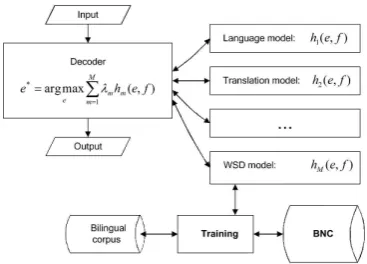
In this paper, we present our study on this topic. First, by integrating WSD as a model of SMT sys-tem as shown in the Figure 1, we present how we use WSD for SMT. Then we demonstrate a method to bootstrap WSD models by using unla-belled data. Finally, we show our experimental re-sults. We analyse various settings of WSD-SMT integration. Our results give a thorough view into the problem.
2 WSD for SMT
2.1 WSD Task
In order to use WSD for SMT, the precondi-tion is that training data must be large enough.
Figure 1: Integrating WSD into phrase-based SMT system
Manually-created data sets such as SENSEVAL and SemCor, which are often used in WSD stud-ies, are too small for applications like machine translation. We overcome this difficulty by us-ing an approach based on Carpuat and Wu (2007) and Chan et al. (2007) to extract training data from bilingual data. Word alignment information serves as a map between source words and target words. Target words are seen as senses. Since word alignment usually performs incorrectly, the resulting WSD training data is noisy. When carry-ing out this research, we consider WSD for word and phrase levels.
2.2 WSD Training Data Generation
A procedure for WSD-training-data extraction: Input: a bilingual corpus, a POS-tagged version of the source text and word alignment information. Output: WSD training sets for source phrases. • Step 1: Collect phrase pair instances
as-sociated with position in the bilingual cor-pus. Group phrase pairs according to source phrase.
• Step 2: For each group, generate a training set for its corresponding source phrase. Phrase pairs (s,t) which are consistent with the word alignment will be generated. The criteria of consistence with word alignment in Koehn et al. (2003) are as follows: First, there exists links from words of s to words of t. Second, for every word outside s, there is no link to any word of t. Third, for every word outside t, there is no link to any word of s.
When extracting WSD training data from a bilingual corpus, the number of training sets re-sulting from the extractive procedure is often much larger than vocabulary size of the source
text. Additionally, raw data extracted from a bilin-gual corpus is a miscellany of semantic, lexical, morphological, an syntactic ingredients. It is very different from conventional WSD data style. This data can be refined in several ways such as lemma-tization.
2.3 WSD Features
In our work, we use six kinds of knowledge and represent them as subsets of features, as follows:
• bag-of-words, F1(l, r) = {w−l, . . . , w+r}: We investigate three sets of this knowl-edge including F1a = F1(−5,+5), F1b =
F1(−10,+10),F1c =F1(−100,+100), cor-responding to small, medium and large size respectively.
• collocation of words, F2 = {w−l. . . w+r}: As a result of the work in Le and Shimazu (2004) we choose such collocations that their lengths (including the target words) are less than or equal to4, it means(l+r+ 1)≤4. • ordered words,F3 = {wi|i = −l, . . . ,+r}:
We choosel=r= 3
• collocation of POSs, F4 = {p−l. . . p+r}: Like collocation of words, we choose their lengths including the target words are less than or equal to4.
• ordered POSs: F5 = {pi|i = −l, . . . ,+r}: We choosel=r= 3
In cases that we are working with a training set of a source phrase, features will be extracted from surrounding context of that phrase.
2.4 Integration
After having been trained, WSD models can be used as a feature for SMT as shown in the Figure 1. Since we use a log linear translation model, the use of a new feature is easy. Feature’s weight is tuned using minimum error rate training (MERT) in Och (2003). In decoding phase, when translation op-tions are generated, their WSD score is computed and then can be used in searching process. Among other features, this new feature is sensitive to large contexts.
reduce computational time. Suppose that we are considering a phrase pair (s, t) in which s is a source phrase, tis a target phrase. If this phrase pair can be split into a sequence (si, ti) ofnsub phrase pairs which are consistent with the word alignment of(s, t), then the probability oftgiven sand its context can be computed using (1) here
Pwsd(t|s)≈ tioning onsi and its surrounding context. If there are more than one possible split, we use a greedy method. This method gives preferences to sub phrases according to their length and score.
3 Using Unlabelled Data
3.1 Basic Algorithm
Suppose that we have two data sets, one la-belled (eg., the data extracted from a bilingual cor-pus) and the other unlabelled. First, a classifier is trained using the labelled data set, then it can be used to classify the unlabelled data set. Among newly labelled examples, the ones with high score will be chosen to enlarge the training data. These steps are repeated until a stopping condition is matched. Stopping condition can be a maximum number of iterations, or a minimum increase in classification accuracy, etc.
Input: L = a labelled data set. U = an unlabelled data set. Output:Lnew, a new labelled data set. 1. Train a classifier C using L.
2. For each u∈U: a. use C to classify u.
b. find the label assigned with highest score. c. if the score is above a threshold, choose u. 3.Lnew= LS{u∈U : u has been labelled}.
andUnew={u∈U : u unlabelled}.
4. If the stopping condition is not matched, repeat from step 1, else stop.
3.2 A New Algorithm with Sense Distribution Control
A problem with the basic algorithm is that af-ter extension, the resulting labelled data set can be highly imbalanced in sense distribution with dominating senses, due to which the classification accuracy decreases. To handle the problem, the change of sense distribution during extending pro-cess should be controlled. We propose to use the
relative entropy or Kullback-Leibler distance in Cover and Thomas (2006) to measure the change in sense distribution and control the amount of new examples. After extending using the previous algorithm, we will remove examples one by one until the KL distance is smaller than a threshold. The threshold need not to be a fixed number.
Algorithm: Input: a labelled data set Linitial and its expanded setLnew.
Output: a labelled data set Lextending whose sense distribution is controlled
1. p = (p1,p2, . . . ,pn) and q = (q1,q2,. . . ,qn) are sense distributions overLinitialandLnew. 2. Compute the Kullback Leibler distance
be-tween p and q:∆= KL(p,q) =
• find um minimizing KL(t, p), then um is the element that when remov-ing it, the KL distance decreases a maximum amount.
b. RemoveumfromLnew c. Compute KL(p,q)
4. The iteration stop when KL(p,q)<∆
2
5. Lextending=Lnew. 6. ReturnLextending.
4 Evaluation
4.1 Corpora and Tools
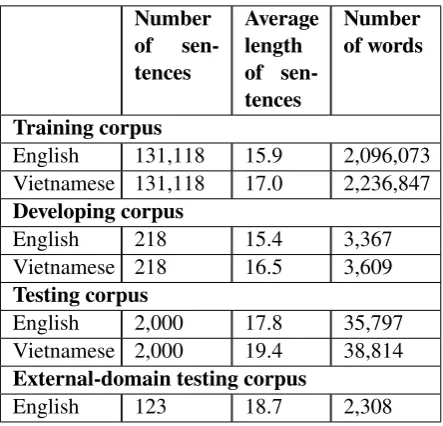
The corpus in our experiments is English-Vietnamese bilingual corpus from several differ-ent fields which includes approximately 135,000 sentence pairs. It is divided into three parts: train-ing, developing and testing in Table 1. We used the developing set in the evaluation of MERT of SMT system in all experiments. In addition to the testing set extracted from the bilingual corpus, we used an additional corpus consisting of ambiguous words that are labelled by evaluators to test the ex-ternal domain. The rate of Out-of-Vocabulary in testing sets is roughly 2%.
morpho-logical analyser in Pham et al. (2003) and Nat-ural Language Toolkit in (Bird et al., 2009) for segmenting Vietnamese sentences, learning phrase translations, creating word alignment, learning language models, analysing morphology and ex-ploiting BNC respectively.
English 131,118 15.9 2,096,073 Vietnamese 131,118 17.0 2,236,847 Developing corpus
English 218 15.4 3,367
Vietnamese 218 16.5 3,609
Testing corpus
English 2,000 17.8 35,797
Vietnamese 2,000 19.4 38,814 External-domain testing corpus
English 123 18.7 2,308
Table 1: Statistics for training, testing and devel-oping corpora
4.2 Experiments and results
Without
BLEU 34.93 35.43 36.47
NIST 7.4491 7.4937 7.7971
Table 2: BLEU scores of SMT based on phrase-based with WSD and BNC-extended WSD
As indicated from the Table 2, that SMT sys-tem utilizes WSD with expanded information of BNC corpus leads to the high translation quality with growths by 1.04 and 1.54 in BLUE score and 0.3034 and 0.3488 in NIST score in comparison with non-extended WSD integrated SMT system and baseline SMT system. Let consider the exam-ple:
Input:hard water is water that has high mineral content (in contrast with soft water).
SMT: chăm_chỉ/(hard) nước/(water) là/(is) nước/(water) cao/(hight) nội_dung/(content) khoáng_sản/(mineral) trái/(in contrast) với/(with) nước/(water) mềm/(soft) .
SMT + WSD: khó/(hard) nước/(water) là/(is) nước/(water) có/(has) hàm_lượng/(content) khoáng_sản/(mineral) cao/(hight) mềm/(soft) (ngược_lại)/(in contrast) với/(with) nước/(water).
SMT + WSD + BNC: nước/(water) rất cứng/(hard) là/(is) nước/(water) cao/(hight) hàm_lượng/(content) khoáng_sản/(mineral) trái/(in contrast) với/(with) mềm/(soft) ra nước/(water).
Clearly, ambiguous words in above example were translated precisely in the target language when utilizing WSD and BNC. In the first exam-ple, the wordhard in hard wateris translated to
cứng(a type of water) which is more accurate than
chăm chỉ(a personality) andkhó(a difficulty).
4.3 The impact of context on WSD and WSD on SMT system
In many cases, the evaluation result of WSD is incorrect, resulting in the effect on the transla-tion outcome of SMT. Below are two main rea-sons for this phenomenon: First, after the BNC expansion, the context could not embrace all pos-sible cases due to limitation of contexts of BNC. Second, in several situations, information contexts of surrounding sentences should be used to deter-mine labels of ambiguous words, whereas the sys-tem only uses the information in one sentence.
Besides, in the integration of WSD system into SMT system, WSD system occupies only a certain weight thus translation results are depend majorly on other models such as language model, transla-tion model even though WSD gave precise results.
5 Conclusions
In this paper, we indicated a considerable effect of WSD which is bootstrapped on SMT system. The analyses and results on experiments point out that the approach of enhancing quality of WSD model contributes to the improvement of trans-lation quality. The explanation for the increase of BLEU point is the impact of sparse data on the training set in WSD model. The expansion of training data from BNC whereby not only in-creases the degree of accurateness of WSD sys-tem but also improves the quality of translation. In the future, we would like to continue to ex-periment with the expansion of the training set on other sources to enhance the quality of translation.
Acknowledgments
References
Vamshi Ambati, Stephan Vogen and Jaime Carbonell.
2011. Multi-Strategy Approaches to Active
Learn-ing for Statistical Machine Translation. Proc of the 13th Machine Translation Summit.
Marine Carpuat and Dekai Wu. 2007. Improving
Sta-tistical Machine Translation Using Word Sense Dis-ambiguation. Proceedings of EMNLP-CoNLL.
Y. S. Chan, H. T. Ng, and D. Chiang. 2007. Word
Sense Disambiguation Improves Statistical Machine Translation. Proceedings of ACL.
Jeremy H. Clear 1993. The British National Corpus
MIT Press, Cambridge, MA, USA, pages 163–187.
Philipp Koehn, Franz Josef Och, Daniel Marcu. 2003.
Statistical Phrase-based Translation. In Proceed-ings of HLT-NAACL.
Philipp Koehn et al. June, 2007. Moses: Open Source
Toolkit for Statistical Machine Translation.In ACL, demonstration session, Prague, Czech Republic.
C.A. Le and A. Shimazu. 2004. High Word Sense
Disambiguation Using Naive Bayesian Classifier with Rich Features. The 18th Pacific Asian Con-ference on Linguistic Information and Computation (PACLIC18), pages 105–113.
Nguyen, T. P., Nguyen V. V. and Le A. C. 2003.
Viet-namese Word Segmentation Using Hidden Markov Model. In Proceedings of International Work-shop for Computer, Information, and Communica-tion Technologies in Korea and Vietnam.
Franz Josef Och and Hermann Ney. 2000. Improved
Statistical Alignment Models. In Proceedings of ACL.
Pham, N. H., Nguyen L. M., Le A. C., Nguyen P.
T., and Nguyen V. V. 2003. LVT: An
English-Vietnamese Machine Translation System. In Pro-ceedings of FAIR.
Stolcke, A. September, 2002. SRILM - An
Extensi-ble Language Modeling Toolkit. In Proc. Intl. Conf. Spoken Language Processing, Denver, Colorado.
Varea, I. G., F. J. Och, H. Ney, and F. Casacuberta.
2001. Refined Lexicon Models for Statistical
Ma-chine Translation using a Maximum Entropy Ap-proach. Proceedings of ACL, pages 204–211.
Bird, Steven, Ewan Klein and Edward Loper. 2006.
Natural Language Processing with Python. Se-bastopol, CA: O’Reilly Media, 2009
Thomas M. Cover and Joy A. Thomas: Elements of
Information Theory. New Jersey, John Wiley & Son.
Och F.J. 2003 Minimum Error Rate Training in