Natural Language Informs the Interpretation of Iconic Gestures:
A Computational Approach
Ting Han and Julian Hough and David Schlangen
Dialogue Systems Group // CITEC // Faculty of Linguistics and Literary Studies Bielefeld University
Abstract
When giving descriptions, speakers often signify object shape or size with hand ges-tures. Such so-called ‘iconic’ gestures rep-resent their meaning through their rele-vance to referents in the verbal content, rather than having a conventional form. The gesture form on its own is often am-biguous, and the aspect of the referent that it highlights is constrained by what the lan-guage makes salient. We show how the verbal content guides gesture interpreta-tion through a computainterpreta-tional model that frames the task as a multi-label classifi-cation task that maps multimodal utter-ances to semantic categories, using anno-tated human-human data.
1 Introduction
Besides natural language, human communication often involves other modalities such as hand ges-tures. As shown in Figure 1, when describing
two lanterns, one can describe “two lanterns”
ver-bally, while showing the relative position with two hands facing each other. Interestingly, when the same gesture is accompanied by the utterance “a ball”, the same gesture may indicate shape. These gestures (referred to as ‘iconic gestures’ in gesture studies (McNeill,1992)) are characterised as conveying meanings through similarity to ref-erents in verbal content, rather than conventional forms of shape/trajectory. Hence, the interpreta-tion of iconic gestures largely depends on verbal content.
Although this theory has been proposed and confirmed in various gesture studies (Feyereisen and De Lannoy, 1991; McNeill, 1992; Kita and ¨Ozy¨urek, 2003;Kita et al.,2007; ¨Ozy¨urek et al.,
2008; Bergmann et al., 2014, 2013b), it has not
Figure 1: Speech / gesture description of a vir-tual scene: “. . . sind halt zwei Laternen” (“[there] are two lanterns”). Gestures indicate theamount (two) andrelative placementof the two lanterns, while speech indicates the entity name and
amount. From (L¨ucking et al.,2010).
attracted much attention from works on human-computer interfaces (HCIs), which usually assume that gestures have predefined meanings either through conventional agreements (e.g., “thumb up” for “great”), or defined by the system (e.g., “circling” for “circle”) (Stiefelhagen et al.,2004;
Burger et al., 2012; Lucignano et al., 2013;
Rodomagoulakis et al.,2016). Hence, the systems can only interpret a limited number of gestures by classifying gestures based on the shape/trajectory of hands, then combining the information with language. We propose that, in order to incor-porate iconic gestures in HCIs, natural language should be taken as an important resource to inter-pret iconic gestures.
The relation between speech and iconic gestures has certainly been investigated in previous work. Empirical studies such as (Kita and ¨Ozy¨urek,
2003;Kita et al.,2007) analysed speech and ges-ture semantics with statistical methods and show that the semantics of speech and gestures coor-dinate with each other. However, it remains un-clear how to computationally derive the semantics of iconic gestures and build corresponding mul-timodal semantics together with the accompany-ing verbal content. In this paper, we address this “how” question and present a computational
Verbal utteranceU “two, lanterns”
GestureG two hands facing each other Speech semantics [entity, amount]
Gesture semantics [relative position, amount] Multi-modal
semantics [entity,amount] relative position,
Figure 2: Example of a multimodal utterance, and semantic categories.
proach that predicts speech and gesture seman-tic categories using speech and gesture input as features. Speech and gesture information within the same semantic category can then be fused to form a complete multimodal meaning, where previous methods on representing multimodal se-mantic (Bergmann and Kopp, 2008; Bergmann et al., 2013a; Lascarides and Stone, 2009; Gior-golo, 2010) can be applied. Consequently, this enables HCIs to construct and represent multi-modal semantics of natural communications in-volving iconic gestures.
We investigated whether language informs the interpretation of iconic gestures with the data from the SAGA corpus (L¨ucking et al., 2010). From the SAGA corpus, we take gesture-speech ensem-bles as well as semantic category annotations of speech and gestures according to the information they convey. Using words and annotations of ges-tures to represent verbal content and gesture in-formation, we conducted experiments to map lan-guage and gesture inputs to semantic categories. The results show that language is more informa-tive than gestures in terms of predicting iconic ges-ture semantics and multimodal semantics.
2 Task formulation
We now describe the task formally. Suppose a ver-bal utterance U is accompanied by a gesture G
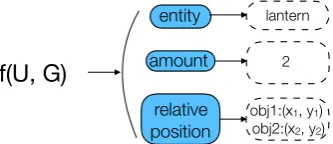
(as shown in Figure 2), we represent the speech-gesture ensemble as(U, G). The ultimate goal is to map the input information of(U, G)to a set of semantic categories according to the information they convey (as shown in Figure3), then compose the multi-modal semantics of the ensemble with information in the same category across speech and gestures.
We define a mapping function f that takes a speech-gesture ensemble(U, G)as input, and out-puts semantic categories ci, computed by the set
of features of U and G. Additionally, we
as-f(U, G)
entity
amount
relative position
lantern
2
obj1:(x1, y1) obj2:(x2, y2)
Figure 3: Mapping a speech-gesture ensemble to semantic categories in blue rectangles (U and G dicate speech and gesture). Dashed rectangles in-dicate the value of each semantic category, which are not included in our current work.
sume each modality has its own meaning function
fu(U) andfg(G). In this paper, we make the
as-sumption thatmulti-modal meaning outputted by
f(U, G)is in fact the union offu(U)andfg(G):
fu(U) ={c1, c2} fg(G) ={c2, c3} f(U, G) ={c1, c2, c3}
(1)
Figure3shows an example of mapping the ver-bal utterance “two lanterns” to semantic categories
{amount, entity}, while mapping the gesture to
categories: {amount, relative position}. The se-mantics of the ensemble(U, G)is composed of the semantic categories and their values (in the dashed boxes). In this work we focus on predicting the se-mantic category rather than their value, which we leave for future work.
We derive input features for the mapping task from speech and gestures respectively:
a)Language features: The word tokens of each verbal utterance are taken as a bag-of-words to represent linguistic information. b)Gesture fea-tures: Hand movements and forms, including hand shape, palm direction, path of palm direction, palm movement direction, wrist distance, wrist position, path of wrist, wrist movement direction, back of hand direction and back of hand direc-tion movement, are derived as gesture features (as there was no hand motion data, these features were manually annotated, see below for details).
Modelling the learning task We frame the
ver-bal utterance/gesture multimodal semantic cate-gory mapping problem as a multi-label classifi-cation task (Tsoumakas and Katakis,2006) where several labels are predicted for an input.
which the length is variable. The prediction task can be further framed as multiple binary classifica-tion tasks. Technically, we trained a linear support vector classifier (SVC)1for each semantic labelc
i
(6 label classifiers in total). Given an input feature X, we apply all semantic label classifiers to the feature vector. If a semantic label classifier gives positive prediction for inputX, we assign the se-mantic label to the input. For example, given fea-ture vector of the input utterance “two lanterns”, only the amount and entiry label classifiers give positive predictions, thus we assign amount and
entityto the input utterance.
The word/gesture utterances are encoded as several-hot feature vectors as input of the classi-fiers, which will be explained now.
3 The SAGA corpus
We conducted the experiments with the SAGA corpus (L¨ucking et al.,2010), which provides fine-grained annotations for speech and gestures.
The data The corpus consists of 25 dialogues
of route and sight descriptions of a virtual town. In each dialogue, a route giver gave descriptions (e.g., route directions, shape, size and location of buildings) of the virtual town to a naive route fol-lower with speech (in German) and gestures. The dialogues were recorded with three synchronised cameras from different perspectives.
In total, 280 minutes of video and audio data were recorded. The audio was manually tran-scribed and aligned with videos; the gestures were manually annotated and segmented according to video and audio recordings. We selected 939 speech-gesture ensembles out of 973 annotations (Bergmann et al.,2011), omitting 34 without full annotations of speech/gesture semantic categories and gesture features. The semantic categories were annotated according to the semantic infor-mation that speech and gestures contained. In our data set, each item is a tuple of 4 elements:(words, gesture features, speech semantic categories,
ges-ture semantic categories).
There are 5 gesture semantic category labels:
shape, size, direction, relative position, amount;
the speech semantic labels consist of these and an extra label ofentity(6 labels in total). Since there was only one gesture labeled asdirection, we treat 1penalty: `2, penalty parameter C=1.0, maxi-mum iteration 1000, using an implementation in http://scikit-learn.org.
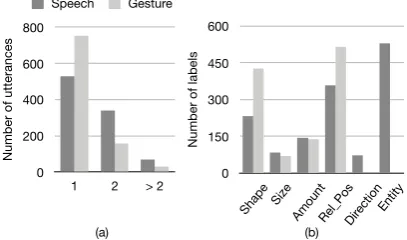
Figure 4: (a) Histogram of semantic labels per ut-terance/gesture. (b) Histogram of semantic labels. (Rel Pos indicates relative position.)
it as a rare instance, and removed it from the eval-uation experiments. From these the multi-modal category labels are derived as the union of those two sets for each ensemble.
Data statistics Bergmann et al.(2011) provides
detailed data statistics regarding the relation of speech and gestures of the corpus. As we focus on speech and gesture semantics only here, we report statistics only for the 939 speech-gesture ensem-bles. On average, each verbal utterance is com-posed of 3.15 words. 386 gestures (41%) provide a semantic category on top of the verbal utterance (e.g., speech:{amount,shape}, gesture: {relative
position}), 312 (33%) gestures convey the same
amount of semantic information as the verbal ut-terance (e.g., speech: {amount, shape}, gesture:
{amount,shape}), and 241 (26%) conveys part of
the semantics of the verbal utterance (e.g., speech:
{amount,shape}, gesture:{amount}).
As shown in Table 4 (a), 56%of verbal utter-ances and80%of gestures are annotated with only a single label. On average, each gesture was an-notated with 1.23 semantic labels and each utter-ance with 1.51 semantic labels. As shown in Fig-ure4(b), there are many more utterances labeled
with shape, relative position and entity than the
other labels, making the data unbalanced. More-over, there are considerably more gestures anno-tated with labels ofshapeandrelative position.
Gesture features Since there is no tracked hand
palm direction, back of hand direction, wrist po-sition. (See (L¨ucking et al.,2010) for the details of the annotation scheme). Other features such as path of palm direction which are not related to this static gesture were set as 0.
We treated these annotated tokens as “words” that describe gestures. Annotations with more than 1 token were split into a sequence of tokens (e.g., BAB/BUP to BAB, BUP). Therefore, ges-ture feages-ture sequences have variable lengths, in the same sense as utterances have variable amount of word tokens.
4 Experiments
We randomly selected70%of the gesture-speech ensembles as a training set, using the rest as a test set. We designed 3 experiments to investi-gate whether and to what degree language and ges-tures inform mono-modal and multimodal seman-tics. Each experiment was conducted under 3 dif-ferent setups, namely, using: a) only gesture tures; b) only language features; c) gesture fea-tures and language feafea-tures, as shown in Table1.
Metrics We calculatedF1-score,precisionand
recall for each label, and find their average,
weighted by the number of true instances for each label, so that imbalanced labels are taken into ac-count.
4.1 Results
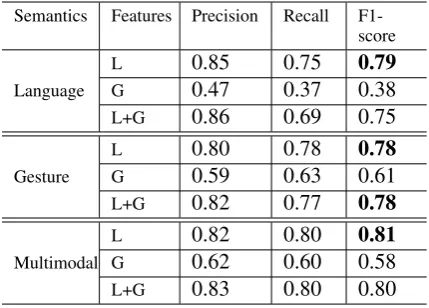
Language semantics As shown in Table1, the
most informative features of language semantic categories are words on their own. It achieves an F1-score of 0.79 for each label, well above a chance level baseline accuracy 0.17. While as expected, gesture features are not very infor-mative for language semantics, the gesture-only still classifier outperforms the chance level base-line with 0.38. The combination of features in the joint classifier results in slightly worse perfor-mance than language features alone, suggesting some of the gestural semantics may be comple-mentary to, rather than identical to, the language semantics.
Gesture semantics While language features
help predict the semantics of their own modal-ity, the same is not true of gesture features. The language-only classifier achieves an F1-score of 0.78 when predicting gesture semantics, while the gesture features-only setting only achieves 0.61.
Semantics Features Precision Recall F1-score
Language
L 0.85 0.75 0.79
G 0.47 0.37 0.38
L+G 0.86 0.69 0.75
Gesture
L 0.80 0.78 0.78
G 0.59 0.63 0.61
L+G 0.82 0.77 0.78
Multimodal
L 0.82 0.80 0.81
G 0.62 0.60 0.58
L+G 0.83 0.80 0.80
Table 1: Evaluation results. (L and G indicates language and gesture.)
Combining language and gesture features does not improve performance, but results in a slightly higher precision score (+0.02). This is consistent with previous observations in gesture studies ( Fey-ereisen and De Lannoy,1991) that iconic gestures are difficult to interpret without speech. Even hu-mans perform poorly on such a task without verbal content.
In our setup, the abstract gesture features might be one of the reasons for poor performance. Only 10 manually annotated categories were used to represent gestures, so these features might not be optimal for a computational model. It is possible that with more accurate gesture features (e.g. mo-tion features), gestures can be better represented and more informative for interpreting gesture se-mantics.
Multimodal semantics As gestures can add
accor-0 2 4 6 8 Relative position classifier: language features 0
2 4
Feature weight rechts links zwei mitte recht wasserfläche da unter link an
0 2 4 6 8
Size classifier: language features
0 2 4
Feature weight
klein groß
kurz breit
riesenplatz zweigeschossig hoch meter dreigeschossig eingeschossig
0 2 4 6 8
Relative position classifier: hand features 0
2 4
Feature weight b_bent_loose_spread5_loose o_loose_tapered s_1 pab c_loose_large y_loose d_bent g_bent loose
0 2 4 6 8
Size classifier: hand features
0 2 4
Feature weight btb b_angled pup g_loose_bent b_loose ml medium md btr arc
Figure 5: Featuring ranking according to coefficient values (weights assigned to the features, see (L¨ucking et al.,2010) for the details of the annotation scheme).
dance with the finding that the majority of gestures are inherently underspecified semantically by their physical form alone (Rieser,2015).
Regarding individual semantic categories, we find gesture features are more informative for
shapeandrelative positions; language is more
in-formative for size, direction and amount in our dataset. Figure 5 shows the gesture and lan-guage feature ranking results for classifiers of
en-tity and relative position accordingly. For
rel-ative position label prediction, the most
infor-mative language features are the words “rechts” (right) and “links” (left), while hand shape, such as b bent loose spread (an open palm, thumb ap-plied sideways, but not clearly folded and with a weak hand tension) and 5 loose (an open palm with a weak hand tension) are the two most in-formative gesture features. For sizelabel predic-tion, the most informative language features are words that specify size such as “klein” (small) and “groß” (big); the most informative gesture feature is back of hand palm direction (btb, back of hand palm facing towards body).
5 Conclusion
Language and co-verbal gestures are widely ac-cepted as an integral process of natural commu-nication. In this paper, we have shown that natural language is informative for the interpretation of a particular kind of gesture, iconic gestures. With the task of mapping speech and gesture informa-tion to semantic categories, we show that language
is more informative than gesture for interpreting not only gesture meaning, but also the overall mul-timodal meaning of speech and gesture. This work is a step towards HCIs which take language as an important resource for interpreting iconic gestures in more natural multimodal communication. In fu-ture work, we will predict speech/gesfu-ture seman-tics using raw hand motion features and investi-gate prediction performance in an online, contuous fashion. This forms part of our ongoing in-vestigation into the interplay of speech and gesture semantics.
Acknowledgements
We are grateful to Kirsten Bergmann and Stefan Kopp for sharing the SAGA corpus. The first au-thor is supported by the China Scholarship Coun-cil (CSC). This work was also supported by the Cluster of Excellence Cognitive Interaction Tech-nology CITEC (EXC 277) at Bielefeld Univer-sity, funded by the German Research Foundation (DFG).
References
Kirsten Bergmann, Volkan Aksu, and Stefan Kopp. 2011. The relation of speech and gestures: temporal synchrony follows semantic synchrony. In Proceed-ings of the 2nd Workshop on Gesture and Speech in Interaction (GeSpIn 2011).
motion: Theory and simulation. InProceedings of the Tilburg Gesture Research Meeting (TiGeR 2013). Kirsten Bergmann, Sebastian Kahl, and Stefan Kopp. 2013b. Modeling the semantic coordination of speech and gesture under cognitive and linguistic constraints. In International Workshop on Intelli-gent Virtual AIntelli-gents, pages 203–216. Springer. Kirsten Bergmann, Sebastian Kahl, and Stefan Kopp.
2014. How is information distributed across speech and gesture? a cognitive modeling approach. Cogni-tive Processing, Special Issue: Proceedings of Kog-Wis, pages S84–S87.
Kirsten Bergmann and Stefan Kopp. 2008. Multimodal content representation for speech and gesture pro-duction. In Proceedings of the 2nd Workshop on Multimodal Output Generation, pages 61–68. B. Burger, I. Ferran´e, F. Lerasle, and G. Infantes. 2012.
Two-handed gesture recognition and fusion with speech to command a robot. Autonomous Robots, 32(2):129–147.
Pierre Feyereisen and Jacques-Dominique De Lannoy. 1991. Gestures and speech: Psychological investi-gations. Cambridge University Press.
Gianluca Giorgolo. 2010. Space and Time in Our Hands. Ph.D. thesis, Netherlands Graduate School of Linguistics.
Sotaro Kita and Asli ¨Ozy¨urek. 2003. What does cross-linguistic variation in semantic coordination of speech and gesture reveal?: Evidence for an inter-face representation of spatial thinking and speaking. Journal of Memory and language, 48(1):16–32. Sotaro Kita, Asli ¨Ozy¨urek, Shanley Allen, Amanda
Brown, Reyhan Furman, and Tomoko Ishizuka. 2007. Relations between syntactic encoding and co-speech gestures: Implications for a model of co-speech and gesture production. Language and cognitive processes, 22(8):1212–1236.
Alex Lascarides and Matthew Stone. 2009. A formal semantic analysis of gesture. Journal of Semantics, 26(4):393–449.
Lorenzo Lucignano, Francesco Cutugno, Silvia Rossi, and Alberto Finzi. 2013. A dialogue system for mul-timodal human-robot interaction. InProceedings of the 15th ACM on International conference on multi-modal interaction, pages 197–204. ACM.
Andy L¨ucking, Kirsten Bergmann, Florian Hahn, Ste-fan Kopp, and Hannes Rieser. 2010. The biele-feld speech and gesture alignment corpus (saga). In LREC 2010 workshop: Multimodal corpora– advances in capturing, coding and analyzing mul-timodality.
David McNeill. 1992. Hand and Mind: What Gestures Reveal About Thought.
Asli ¨Ozy¨urek, Sotaro Kita, Shanley Allen, Amanda Brown, Reyhan Furman, and Tomoko Ishizuka. 2008. Development of cross-linguistic variation in speech and gesture: Motion events in english and turkish. Developmental psychology, 44(4):1040. Hannes Rieser. 2015. When hands talk to mouth.
ges-ture and speech as autonomous communicating pro-cesses. SEMDIAL 2015 goDIAL, page 122. Isidoros Rodomagoulakis, Nikolaos Kardaris,
Vas-silis Pitsikalis, E Mavroudi, Athanasios Katsamanis, Antigoni Tsiami, and Petros Maragos. 2016. Multi-modal human action recognition in assistive human-robot interaction. In Acoustics, Speech and Sig-nal Processing (ICASSP), 2016 IEEE InternatioSig-nal Conference on, pages 2702–2706. IEEE.
R. Stiefelhagen, C. Fugen, R. Gieselmann, H. Holzapfel, K. Nickel, and A. Waibel. 2004. Natural human-robot interaction using speech, head pose and gestures. In2004 IEEE/RSJ International Conference on Intelligent Robots and Systems (IROS) (IEEE Cat. No.04CH37566), volume 3, pages 2422–2427.
![Figure 1: Speech / gesture description of a vir-tual scene: “...sind halt zwei Laternen” (“[there]are two lanterns”)](https://thumb-us.123doks.com/thumbv2/123dok_us/800036.1094137/1.595.343.490.221.277/figure-speech-gesture-description-tual-scene-laternen-lanterns.webp)