Alignment-based Annotation of Proofreading Texts toward
Professional Writing Assistance
Ngan L.T. Nguyen
University of Information Technology Hochiminh, Vietnam
Yusuke Miyao
National Institute of Informatics Tokyo, Japan
Abstract
This work aims at constructing a corpus to satisfy such requirements to support re-search towards professional writing assis-tance. Our corpus is a collection of sci-entific work written by non-native speak-ers that has been proofread by native En-glish experts. A new annotation scheme, which is based on word-alignments, is then proposed that is used to capture all types of inarticulations and their correc-tions including both spelling/grammatical error corrections and paraphrases made by proofreaders. The resulting corpus con-tains 3,485 pairs of original and revised sentences, of which, 2,516 pairs contain at least one articulation.
1 Introduction
Detection and correction of misspellings and grammatical errors have been recognized as key techniques for writing assistance, and have exten-sively been studied in natural language process-ing (NLP) (Whitelaw et al., 2009; Gamon, 2010; Tetreault et al., 2010; Park and Levy, 2011). How-ever, correcting misspellings and grammatical er-rors, which can be performed by normal English native speakers, does not satisfy all the require-ments of professional writing (Futagi, 2010). The core of the proofreading process, in reality, is para-phrasing inarticulations, which can only be done by expert proofreaders. Considering the two para-phrased sentences (1a) and (1b) below, we can see that sentence (1b) is likely to be considered better by most people (Williams and Colomb, 2010), al-though neither of them contains any misspellings or grammatical errors.
(1a)The outsourcing of high-tech work to Asia by cor-porations means the loss of jobs for many middle-class American workers.
SWA corpus Data Collection
Preprocessing
Corpus Annotation Annotation Scheme Annotation Scheme
Design Scientific
written work
[image:1.595.353.477.205.352.2]Proofreading
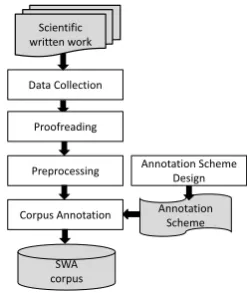
Figure 1:Methodology for corpus annotation
(1b) Many middle-class American workers are losing their jobs, because corporations are outsourcing their high-tech work to Asia.
(Williams and Colomb, 2010)
Most of the existing corpora are designed to cap-ture errors in spelling and grammar, but they have not paid enough attention to paraphrasing.
We constructed a corpus that we called sci-entific writing assistance corpus (SWA), to sup-port research on assistance with scientific-writing that captures all types of inarticulations, including those in both mispellings/grammar and
paraphras-ing. We have used the term inarticulation and
inarticulation correction instead oferrorand
er-ror correctionin this paper, to include in our task
the paraphrasing, which is actually not errors. Figure 1 overviews the methodology we
pro-posed to construct the corpus. Scientific work
written by non-native researchers or graduate stu-dents are collected (i.e., data collection, see Sec-tion 3), and this was then proofread by English native experts (i.e., proofreading). After that, we preprocessed the documents to convert them into a predefined format (i.e., preprocessing, see Section 3). Annotators with linguistic backgrounds were asked to strictly follow our annotation scheme, which had been designed to capture all types of
inarticulations (i.e., annotation scheme design, see Section 2).
Our corpus construction had several substantial advantages in comparison to the existing corpora such as the NUCLE (Dahlmeier and Ng, 2011), NICT JLE (Izumi et al., 2004) and KJ corpora (Nagata et al., 2011). First, the proofreading pro-cess is separated from the annotation propro-cess. By doing this, both the writer and the proofreader were unaware of the construction of the corpus, so it could capture real articulations and correc-tions to these. Second, the alignment-based an-notation scheme was employed in anan-notations to capture all types of articulation correction. This allowed us to annotate discontinuous paraphasing patterns, which were not neatly handled in other corpora. Third, paraphrases were captured, and were proved to be an important type of articula-tion correcarticula-tion for advanced learners.
The main contributions of this work are in the annotation of paraphrasing and its annotation method, in context of professional proofreading. Statistics for the SWA corpus was given in Sec-tion 4). We compared the grammatical errors an-notated in the obtained corpus with those in the KJ corpus and NUCLE corpus, two popular corpora often used for research on grammatical error cor-rection (Section 5), and performed an analysis of the paraphrases annotated (Section 6). Our analy-ses also show the potential of NLP research toward professional text revision.
2 Annotation scheme design
We extended the alignment-based paraphrase an-notation scheme of Cohn et al. (2008) by catego-rizing the alignments into more fine-grained types (see Figure 2) to capture all types of inarticula-tion correcinarticula-tions. Figure 3 outlines example anno-tations to illustrate our annotation scheme. The alignments at the top level, are divided up into four broad types: Preserved, Metadata, Inarticulation Bi-alignment and Inarticulation Mono-alignment. The Preserved type of alignments is the most trivial type that connects words with the same
surface and function, e.g., the, efficiency,
vari-ous,methodologiesin Figure 3(A). Still, there are
many cases where two words have the same sur-face form, but do not have the same functions in the original and the proofread sentences. For
in-stance, the wordof in the above example appears
in both the sentences, but the two occurrences are
Alignment
Inarticulation Mono-alignment
Inarticulation Bi-alignment
Spelling Grammar
Verb tense Paraphrase Preposition Determiner
Word form Others: noun
number, …
Grammar Unaligned
Preposition Determiner Agreement Duplicate
Typo Metadata
Alignment
[image:2.595.310.521.60.216.2]Uncertain Problematic Preserved
Figure 2: Proposed tagset. Categories in gray are used for
classification but not for tagging.
Figure 3: Annotations using our annotation scheme. Top
has original texts, and bottom has the proofread text.
not aligned, because they modify different words,
i.e.,approachandmethodologiesin this case.
Inarticulation alignments including
mono-alignments and bi-mono-alignments are for capturing inarticulations and their corrections. The Gram-mar subtype of inarticulation alignments is not used for all types of grammatical errors as in the other annotation scheme, but is limited to some well-defined types of grammatical errors, which will be explained later in Section 2.1. The other subtypes are Duplicate, Spelling, Typo, and Unaligned, which will be explained in the following.
• Duplicate: A duplicate alignment connects words that appear once in the original sen-tence, but more than once in the proofread sentence, or vice versa. This tag captures the correction for articulations like the word
learningin the example in Figure 3(B).
• Spelling: A spelling alignment is used for
misspellings, e.g.,occured→occurred1. This
also includes the use of hyphens, e.g.,state of
[image:2.595.312.520.260.378.2]the art→state-of-the-art.
• Typo: The expression typo is a short form
of typographical error, which refers to er-rors caused by typing mistakes. If annotators judge that the error is likely to be caused by a typing mistake, they should mark the errors as typo. Typo may be considered to be less important in writing assistance.
• Unaligned: An unaligned mono-alignment is used for words in the original sentence that have no correspondences in the proof-read sentence, or vice versa.
Reordering of words are naturally captured by cross alignments, so we do not create a type for this. Punctuation marks are not annotated.
Besides, alignments have additional features to capture information that is specific to proofread-ing by humans. The current features are: Uncer-tain and Problematic. An alignment is marked as
uncertainwhen the proofreader is not confident in
the correction. This type is specific to the proof-reading process. When the native proofreader is doubtful about his/her understanding of the origi-nal sentence, he/she will comment on it by stating
“I do not understand this,”or“This correction is a
guess”. An alignment is classified asProblematic
when the annotators discover that the proofreader has made an erroneous correction. This happens when the proofreader misunderstands the author’s intention. Although such situations can be rare, this tag is designed to offer a mechanism for anno-tators to provide feedback.
2.1 Grammar
Grammar-typed alignments connect a grammati-cal error in the original sentence with its correc-tion in the proofread sentence. Grammatical rors in our annotation scheme are comprised of er-rors with determiners, prepositions, verb tenses,
word forms, agreement, and others. They are
tagged with the corresponding tags called Deter-miner, Preposition, Verb tense, Word form, Agree-ment, and Others. The Others type merges several specific subtypes of grammatical errors, includ-ing noun number, verb number, wh-word choice, or conjunction choice. Note that we do not use Others as a catch-all type. Except for Agreement, most of the subtypes of the Grammar type can be aligned well with the error types in the error tax-onomies used by the existing corpora. The Agree-ment type is used to capture the number
agree-ments of articles and nouns, genitives and nouns, or nouns and verbs, when a change in the number of one word forces us to change the number and form of another word.
2.2 Paraphrase
Any type of correspondence that cannot be classi-fied into these types above is marked Paraphrase. In other words, Paraphrase is used as a catch-all type. Those errors that require complex correc-tions, i.e., corrections to phrase structures or sen-tence structures, which are not classified into the Grammar type, are captured with Paraphrase. We have followed the definition of paraphrases in the guidelines for paraphrase annotation by
Callison-Burch et al. (2006): “paraphrases convey the
same meaning but are worded differently”. We
have two rules of thumb for the boundary of para-phrases: (1) shorter paraphrases are preferable (similar to (Callison-Burch et al., 2006)), and (2) a paraphrase alignment should not contain an align-ment of other types in it.
3 Data collection and preprocessing
We collected scientific works that were written by seven authors with two language backgrounds Japanese and Vietnamese. The collected docu-ments included different types of scientific publi-cations such as short papers, full papers, and book
chapters. We will use the terminologydocumentto
refer to a written work of any type. The collected documents belonged to two domains or fields of studies, which were computer vision (11 ments) and natural language processing (7 docu-ments); and all were proofread by native English experts.
4 Corpus annotation and results
We made use of Yawat, a web-based word-alignment annotation tool (Germann, 2008) to an-notate the corpus. Yawat accepts text files contain-ing pairs of aligned sentences as input. We applied a simple string-matching algorithm to produce de-fault Preserved and Unaligned alignments for the corpus to save annotation time and effort.
The corpus was annotated by two annotators with linguistics background. The agreement be-tween them was measured using the F1-score
for-mula similarly to that by Cohn et al. (2008).
Atom-alignments, or one-to-one alignments, were
generated from the bi- and mono-alignments. An
M ×N multiple alignment would result inM ×
N atom alignments. We removed the preserved
atom-alignments that were annotated by both an-notators, because they occupied the majority of atom alignments but were not a meaningful in-dicator of inter-annotator agreement. Consider-ing annotations by one annotator as gold anno-tations, we then calculated recall, precision, and F1-score over all the annotated alignments in the
two versions of the SWA corpus. The overall
F-scores with and without considering alignment types were 0.637 and 0.716 respectively. It can be seen that our inter-annotator agreement mea-sure without considering alignment classification is comparable to those reported by Cohn et al. (2008) (0.71, 0.74, and 0.76, for the three datasets of MTC, Leagues, and News, respectively). This is reasonable because when alignment classifica-tion is taken into account, the annotaclassifica-tion task is more difficult, so the inter-annotator agreement is lower.
A total of 4,686 Inarticulation alignments were annotated for 2,516 pairs of sentences in 18 doc-uments. 69,738 (91.8%) of the total of 75,968 words in the corpus were annotated with Preserved alignments. Table 1 lists the ratios (%) of broad types of alignments. We can see that the Grammar errors, both in bi- and mono-alignments, occupy 58.1% of the total errors, which is not a surprise. Paraphrase alignments occupy a significant part, i.e., 29.3% of the total. These figures indicates that paraphrasing is an essential type for scientific writing; therefore, research on writing assistance should pay more attention to error correction by using paraphrasing.
The ratios of the subtypes of Grammar
align-ments are listed in the column named SWA (the
Alignment Type Count Ratio (% )
Paraphrase 1,372 29.3
Bi-Grammar 1,511 32.2
Typo 68 1.5
Spelling 308 6.6
Duplicate 13 0.3
Preserved 2 0.0
Mono-Grammar 1,212 25.9
Unaligned 200 4.3
[image:4.595.325.508.60.204.2]TOTAL 4,686 100.0
Table 1: Statistics for all alignments (except for the
Pre-served type) annotated in the corpus
name of our corpus) in Table 2. Out of all gram-matical errors, determiners caused a lot of troubles for non-native writers from the Japanese and Viet-namese language backgrounds, even though the authors of the collected documents all had an ad-vanced level of proficiency in English. This may be because of the difference between the charac-teristics of their background languages and the En-glish language.
5 Cross-corpora comparison for grammatical errors
This section compares the grammatical-error an-notations (Grammar alignments) in our corpus with those annotated in the KJ and NUCLE cor-pora. The Grammar types of errors in our scheme are restricted to well-defined types of grammatical errors. It would be interesting to analyze the dif-ferences in grammatical errors made by writers of the three corpora. The writers for our SWA cor-pus were graduate students and researchers in the field of computer vision and natural language pro-cessing, who could be considered to be advanced learners. The writers for the KJ and NUCLE were Japanese and Singaporean students, respectively.
Type KJ Count (×α) KJ (%) NUCLE Count (×β) NUCLE (%) SWA Count SWA (%)
Determiner 543 (726) 18.7 6,004 (641) 12.9 1,176 25.1
Preposition 377 (504) 13.0 7,312 (781) 15.7 547 11.7
Others 404 (540) 13.9 5,486 (543) 10.9 427 9.1
Verb tense 249 (333) 8.6 3,288 (351) 7.1 369 7.9
Word form 317 (423) 10.9 2,241 (239) 4.8 151 3.2
Agreement 146 (195) 5.0 1,578 (168) 3.4 53 1.1
TOTAL of Grammar 2,036 (2,723) 70.0 25,509 (2,723) 54.7 2,723 58.1
[image:5.595.83.521.63.164.2]Total of all types 2,907 100.0 46,597 100.0 4,686 100.0
Table 2:Statistics for Grammar alignments in SWA in comparison with KJ corpus and NUCLE corpus withα= TOTALSWA/
TOTALKJ,β= TOTALSWA/ TOTALNUCLE
KJ NUCLE SWA
at ArtOrDet Determiner
prp Wcip Preposition
n num, rel Nn, Vform Others
v tns Vt Verb tense
aj, v lxc Wform Word form
v agr SVA Agreement
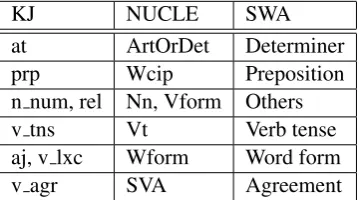
Table 3: Tagset mapping of KJ, NUCLE, and SWA for comparison. Note that only corresponding tags are mapped.
noun inflection, noun case,noun countabilityand
complement of nounof the NICT JLE annotation
scheme, are merged into one type, the noun
lex-ical. The KJ tagset contains 19 tags, fewer than
the total number of 45 error tags in the NICT JLE tagset (Izumi et al., 2004). The NUCLE tagset has more fine-grained tags than the KJ tag set (27 tags).
The four types Determiner, Preposition, Verb tense, and Agreement in our tagset have
coun-terparts in the KJ tagset, which are at (article),
prp (preposition), v tns (verb tense), and v agr
(verb agreement) tags, and in the NUCLE tagset,
which areArtOrDet(article or determiner), Wcip
(wrong collocation/idiom/preposition), Vt (verb
tense), and SVA (subject-verb agreement). Note
that subject-verb agreement is only part of the Agreement type in our annotation scheme (see Section 2). The counts for the Others type were
sums of the n num (noun number) and rel
(rela-tive) types for the KJ corpus, and of theNn(noun
number) andVform(verb form) types for the
NU-CLE corpus. The Word-form figure of the KJ
cor-pus was a sum of theaj(adjective), andv lxc(verb
lexical) types. As NUCLE has the exactly
corre-sponding type called Wform(word form), so we
used the count of this type in our comparison. The comparison statistics are summarized in
Ta-ble 2. We can see in this taTa-ble that the ratios (%) of the totals of basic grammatical types over the totals of all annotated inarticulations, are signifi-cantly different for the three corpora, which cor-respond to 70.0%, 54.7%, and 58.1% for KJ, NU-CLE, and SWA. The differences probably reflect the actual proficiency levels of the writers. Texts in KJ and NUCLE are written by college students, but they are not the same. This can be explained by the fact that NUCLE’s college students are study-ing in Sstudy-ingapore, where English is used as an of-ficial language, while KJ’s students are living in Japan, where English is not usually heard in daily
life. The SWA’s writers are also not living in
an English-speaking environment, but they made fewer basic grammatical errors than KJ’s students, which is reasonable because they have a higher proficiency level.
We normalized the count of each error type by
using α andβ listed in Table 2 to directly
com-pare the three corpora in more detail. The nor-malized counts are in parentheses, next to the ac-tual counts. To our surprise, the SWA’s writers, who were scientific writers, make numerous deter-miner errors: 1,176 errors, compared to 726 (KJ) and 641 (NUCLE). KJ’s students made fewer er-rors of this type than SWA’s writers. This is pos-sibly due to the difference in the complexity of the sentence structures used by the three groups of writers. KJ’s students wrote very short sentences, while advanced learners tended to write those that were longer and more complex. Additional anal-yses of the sentence lengths and structures would clarify this further.
6 Analysis for paraphrase alignments
[image:5.595.92.272.212.312.2]anal-Type Examples of annotation Count % 1.Short-form
↔Long-form
PCA→principle com-ponent analysis
2 0.6
2.Verb ↔
Prepositional phrase
to collect→of collect-ing
13 3.6
3.Relative
clause ↔
Participle
needed→that need 5 1.4
4.Active ↔
Passive
has not ... studied →
has not ... been ... stud-ied
13 3.6
5.Anaphoric pronoun ↔
Referent
this→the result 22 6.1
6.Selection have→provide on the contrary → on the other hand
131 36.4
7.Mis-use/ Ad-dition
frontal→the front of 55 15.3 8.Unknown/
Simplification
good point → advan-tage
32 8.9 9.Complex It is better if ... are used
→Using ... is better
87 24.2
[image:6.595.72.291.59.305.2]TOTAL 360 100.0
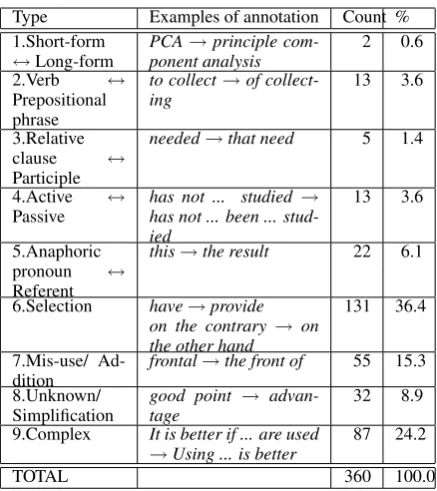
Table 4: Subtypes of Paraphrase alignments representing
different confusing patterns of writers.
ysis, we randomly picked 20 Paraphrase align-ments from each annotated document, and manu-ally categorized them into nine subtypes that ap-proximately represented different confusing pat-terns of writers.
The first five subtypes in the table are rather well-defined types. They were used for such trans-formations as between short- and long-form of acronyms, or relative clauses and their reduced forms, and so on. These well-defined paraphrases occupy 20.8 percent of all the total samples. The transformation between active and passive forms, and between anaphoric pronouns and their con-crete forms could be challenging, because it re-quires correct interpretation of the event or en-tity being mentioned. For not-well-defined para-phrases, we classified them based on the number and the part-of-speech of the inclusive words.
The Selection subtype is for the replacement of a word with another word of the same part-of-speech, or an idiom with another idiom. There were several causes of this type of inarticulation. One cause was that the writers used less-formal or ambiguous words, which were inappropriate for scientific writing style. Another cause was that they selected a word which did not precisely de-scribe the intended meaning, due to the interfer-ence by the writer’s background-language or other reasons. The latter reason would be more chal-lenging for automatic proofreading applications.
Selection-typed paraphrasing is very important for writing assistance, not only because of its fre-quency but also it is a representative example of the increasing fluency of texts.
The Mis-use/Addition subtype is applied when a word in the original text is replaced with a se-quence of several words in the proofread text. This often happens when the original words do not pro-vide enough details, or mis-describe what the writ-ers mean. Unknown/Simplification is the revwrit-erse subtype of Mis-use/Addition. This subtype indi-cated that non-native writers sometimes used long descriptions instead of compact words, such as
good pointinstead ofadvantage. These two
sub-types reveal the demand for techniques to simplify, or to provide more information to the text.
The Complex subtype is for many-to-many alignments. While the changes made by the other subtypes above are rather local, this subtype of-ten required global changes at high levels of a
sen-tence structure, such as those in the exampleit is
better if ... are used→using ... is better. Previous studies on text revision have suggested that such changes are necessary for the coherence of a big-ger discourse such as a paragraph or whole docu-ment (Williams and Colomb, 2010). How to make use of discourse information in automatic proof-reading is an interesting issue of NLP studies us-ing our corpus.
7 Conclusion
We described the SWA corpus, which was con-structed to support studies on assistance tech-niques for professional writing. The traditional problem of error annotation was reformulated as a paraphrase annotation of pairs of the original and proofread sentences. This view inspired us to extend the alignment-based annotation scheme to be used for our annotation process. The com-parison with two existing popular corpora revealed that grammatical errors made by different types of writers varied a great deal. The advanced writers tended to make more inarticulations that require paraphrasing.
References
Ion Androutsopoulos and Prodromos Malakasiotis. 2010. A survey of paraphrasing and textual entail-ment methods. J. Artif. Int. Res., 38(1):135–187, May.
Chris Callison-Burch, Trevor Cohn, and Mirella La-pata. 2006. Annotation guidelines for paraphrase alignment, 12.
Trevor Cohn, Chris Callison-Burch, and Mirella Lap-ata. 2008. Constructing corpora for the develop-ment and evaluation of paraphrase systems. Com-put. Linguist., 34(4):597–614, December.
Daniel Dahlmeier and Hwee Tou Ng. 2011. Grammat-ical error correction with alternating structure opti-mization. InProceedings of the 49th Annual Meet-ing of the Association for Computational LMeet-inguis-
Linguis-tics: Human Language Technologies - Volume 1,
HLT ’11, pages 915–923, Stroudsburg, PA, USA. Association for Computational Linguistics.
Robert Dale and Adam Kilgarriff. 2010. Helping our own: The hoo 2011 pilot shared task. In Proceed-ings of the 13th European Workshop on Natural Lan-guage Generation, Dublin, Ireland.
Robert Dale and Adam Kilgarriff. 2011. Helping our own: Text massaging for computational linguistics as a new shared task. InProceedings of the Inter-national Natural Language Generation Conference 2011, Nancy, France, September.
Yoko Futagi. 2010. The effects of learner errors on the development of a collocation detection tool. In
Proceedings of the fourth workshop on Analytics for noisy unstructured text data, AND ’10, pages 27–34, New York, NY, USA. ACM.
Michael Gamon. 2010. Using mostly native data to correct errors in learners’ writing: a meta-classifier approach. In Human Language Technologies: The 2010 Annual Conference of the North American Chapter of the Association for Computational Lin-guistics, HLT ’10, pages 163–171, Stroudsburg, PA, USA. Association for Computational Linguistics.
Ulrich Germann. 2008. Yawat: yet another word alignment tool. InProceedings of the 46th Annual Meeting of the Association for Computational Lin-guistics on Human Language Technologies: Demo
Session, HLT-Demonstrations ’08, pages 20–23,
Stroudsburg, PA, USA. Association for Computa-tional Linguistics.
Emi Izumi, Kiyotaka Uchimoto, and Hitoshi Isahara. 2004. Sst speech corpus of japanese learners’ en-glish and automatic detection of learners’ errors. 28:31–48.
John Milton and Vivying S. Y. Cheng. 2010. A toolkit to assist l2 learners become independent writ-ers. InProceedings of the NAACL HLT 2010 Work-shop on Computational Linguistics and Writing:
Writing Processes and Authoring Aids, CL&W ’10, pages 33–41, Stroudsburg, PA, USA. Association for Computational Linguistics.
Ryo Nagata, Edward Whittaker, and Vera Shein-man. 2011. Creating a manually error-tagged and shallow-parsed learner corpus. InProceedings of the 49th Annual Meeting of the Association for Computational Linguistics: Human Language
Tech-nologies - Volume 1, HLT ’11, pages 1210–1219,
Stroudsburg, PA, USA. Association for Computa-tional Linguistics.
Y. Albert Park and Roger Levy. 2011. Automated whole sentence grammar correction using a noisy channel model. In Proceedings of the 49th Annual Meeting of the Association for Computational Lin-guistics: Human Language Technologies - Volume 1, HLT ’11, pages 934–944, Stroudsburg, PA, USA. Association for Computational Linguistics.
Benno Stein, Martin Potthast, and Martin Trenkmann. 2010. Retrieving customary web language to as-sist writers. In Proceedings of the 32nd Euro-pean conference on Advances in Information Re-trieval, ECIR’2010, pages 631–635, Berlin, Heidel-berg. Springer-Verlag.
Joel Tetreault, Jennifer Foster, and Martin Chodorow. 2010. Using parse features for preposition selection and error detection. InProceedings of the ACL 2010 Conference Short Papers.
Casey Whitelaw, Ben Hutchinson, Grace Y. Chung, and Gerard Ellis. 2009. Using the web for language independent spellchecking and autocorrection. In
Proceedings of the 2009 Conference on Empirical Methods in Natural Language Processing: Volume
2 - Volume 2, EMNLP ’09, pages 890–899,
Strouds-burg, PA, USA. Association for Computational Lin-guistics.
Joseph M. Williams and Gregory G. Colomb. 2010.
Style: Lessons in clarity and grace. Boston, MA: