Concept Equalization to Guide Correct Training of Neural Machine
Translation
Kangil Kim
Konkuk University Republic of Korea
Jong-Hun Shin
ETRI Republic of Korea
Seung-Hoon Na∗
Chonbuk National University Republic of Korea
SangKeun Jung
SK Telecom Republic of Korea
Abstract
Neural machine translation decoders are usually conditional language models to sequentially generate words for target sen-tences. This approach is limited to find the best word composition and requires help of explicit methods as beam search. To help learning correct compositional mechanisms in NMTs, we propose con-cept equalization using direct mapping distributed representations of source and target sentences. In a translation experi-ment from English to French, the concept equalization significantly improved trans-lation quality by 3.00 BLEU points com-pared to a state-of-the-art NMT model.
1 Introduction with Related Works After the possibility of learning end-to-end trans-lation model (Sutskever et al.,2014) was reported, there has been a surge of research to apply recur-rent neural networks (RNN) with long short term memory (LSTM) (Hochreiter and Schmidhuber,
1997) to machine translation. After intensive de-velopments, this approach becomes the state-of-the-art of machine translation called as neural ma-chine translation (NMT). Remarkable approaches are bidirectional LSTM using both forward and backward sequences (Sutskever et al., 2014), at-tention model to learn explicit alignment mod-els (Bahdanau et al., 2014; Luong et al., 2015a), rare word modeling to estimate unknown word through alignment information (Luong et al.,
2014). Many other detailed following tech-niques improved the performance such as batch normalization (Ioffe and Szegedy, 2015), ensem-bles, beam search, input feature specialization,
∗corresponding author: [email protected]
and input feeding, which are all aggregated into Google’s NMT report (Wu et al.,2016).
Most decoders of NMTs are conditional lan-guage models, which sequentially generate target words and its proceeding correct target words in the condition of a given source sentence. This approach is a greedy algorithm, so dependency of selected words to subsequent words may re-strict selecting the best target word composition. Beam search is a promising method to approx-imate the correct compositions. However, in-versely, promising results imply that NMTs are still weak to learn the dependency between words in a target sentence. This limitation in training process creates fundamental barrier of represent-ing correct translation process in a neural net-work. In (Ranzato et al.,2015), this issue was dis-cussed as a problem of maximum likelihood esti-mation ignoring the dependency between selected target words and an approach penalizing the like-lihood with sentence-level distance has been pro-posed (Shen et al.,2015).
Beyond correct target word generation, trans-lation may be regarded as a subproblem to find mapping of sentence-level semantics between two languages. Accuracy of this mapping is often limited because of ambiguity caused by many-to-many mapping relations. It is difficult to find exact mapping with simple and direct map-ping models as the reported difficult in mapmap-ping simpler word-level semantics (AP et al., 2014;
Luong et al., 2015b; Upadhyay et al., 2016).The framework of NMTs is the most successful model to find an exact mapping of sentence-level se-mantics so far. However, its huge expression power leads to inefficiency in training which re-quires addition connections to transfer related in-formation such as attention or input feeding mod-els (Bahdanau et al.,2014;Wu et al.,2016). This inefficiency may be removed by using simple
rect models to restrict unnecessary area to search in training step.
In this paper, we propose concept equaliza-tionmethod to apply the direct semantic-mapping model to existing NMT frameworks for guiding training of model parameters. Distinguished con-tributions of this method are to introduce 1) an ef-fective penalty function and 2) a plug-in frame-work to transfer the constraint information of the penalty to LSTM stacks. In practical translation tasks from English to French, this method im-proves translation quality and convergence speed to local optima. Extra benefit is easy adaptation to any type of NMT frameworks.
Paper structure is as follows. Section2explains motivations and details of concept equalization. Section 3 shows experimental configurations on data, model, and runs and Section4interprets the results. Section5is conclusion and future work.
2 Concept Equalization
2.1 Limit of Learning Target Composition
Beam search is a promising method for NMTs by overcoming the problem of greedy search in sequential target word generation. On the other hand, the impact of beam search inversely im-plies that the sequential decisions by the model are likely to be incorrect to select the best sen-tences in many cases. There are many possible causes for the inaccurate prediction of composi-tion of target words such as inaccurate model rep-resentation, complex parameter landscapes, and noise data.
A possible cause is the simple representation of the correctness of target words. In current NMTs, cross-entropy is the most popular cost function composed of probabilities of selecting each correct word of a target sequence. Therefore, only one variable is responsible for representing whether the selected target word is correct. Us-ing only one variable may be risky because the second probable word and its highly probable fol-lowing sequences may give higher cross-entropy than any sequences derived from the correct word selection. This case is a deceptive example of re-stricting accurate word composition in decoders.
Another cause is slow parameter update in NMT structures. In LSTMs, the gradient vanishing (Bengio et al., 1994) over time steps is resolved by using memory cells and over vertical structures by addition input feeding
or multidimensional memories (Wu et al., 2016;
Kalchbrenner et al., 2015). They are applied to the encoder and decoder, but the interface part is often a feedforward layer suffering from the gra-dient vanishing. This vanishing limits the achiev-able translation quality in general and may restrict learning the correct composition.
2.2 Motivation: Concept Equalization
To resolve the limited target word composition, two approaches are proposed: 1) direct linking the interface vector to the cost function and 2) in-creasing the dimension for representing correct-ness of target words. The first approach defines a cost function to directly use the transferred in-terface vector, so that the depth from the cost the interface vector decreases and reduce the effect of gradient vanishing. In the second approach, if we train NMT to select a correct word only if its all variables are the most probable, then the decep-tion of selecting the second probable word in one perspective is easily excluded. This second ap-proach is somewhat new in NMT literature, be-cause the dimension of probability vectors is al-ready so high that increasing the dimension be-comes serious burden.
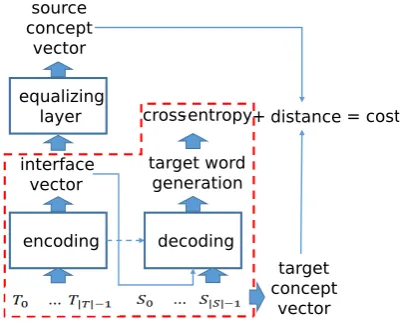
To use the two approaches without problems, we introduce a concept equalization for training NMT where the concept indicates the semantics of source and target sentences and represented as two vectors. A expected role of this approach is to guide NMTs not to train obviously wrong sentences in explicit direct mapping models. The method is illustrated in Fig.1and described in the following sections.
2.3 Concept Equalization Model
We newly propose the following three parts com-pared to typical NMT frameworks.
Raw Concept Vector Representation Repre-senting a target word as a vector, concept equal-ization assigns many variables to indicate the cor-rectness of target word without increasing the di-mension of existing probability vectors for cal-culating cross-entropy. The concept vectorcS of source sentenceSandcT of target sentenceT are defined as
wherehtis the hidden vector generated from the top LSTM stacks at time steptin a NMT encoder andwt is the word vector at timetin a decoder. This raw vector generation process can be easily extended to existing NMTs. For example, in bidi-rectional models,htis replaced byhftkhbt. In bidi-rectional attention models, interface vectors are transformed vectors ofht with alignment model and target word, but we can still usehftkhb
t.
Equalizing Layer In equalization, the biggest risk is the conflict of vector distribution ofht de-sirable for minimizing cross-entropy and for con-cept distance because of quality decrease of lo-cal optima. From the definition, many sentences can be mapped to a concept vector in both sides, which increases ambiguity and their average dis-tances as well. If the average is relatively larger than cross-entropy, distance-cost dominates the parameter updates. If this phenomenon is main-tained near optimal, the converged model will be far from the true optimal. Pros of this mapping is restricting generation of undesirable sentences us-ing many variables and potential cons is the accu-racy decrease by the conflict. To reduce the nega-tive, we use one more linear combination layer for more flexible mapping, which will reduce average distance between the concepts.
vS=WecS+be , vT =cT (1)
The equalizing layer is composed of parameters
We andbe and the concept vectorvS is the out-put vector of the layer from the given raw concept vectorrS.
Cost Function In sentence-level translation, underlying assumption is that the semantics of
matching sentences are so equal that any dis-tributed representation of two sentences in a vec-tor space should be equal. In the assumption, reducing the distance of the concepts is a per-fect goal for maintaining the same true optimal of NMT and therefore we can directly use it as a cost function. To use it, we set a cost function as fol-lowing equation.
new cost(θ, D) =cost(θ, D) +||vS−vT||2 (2)
which uses Euclidean distance of the concept vec-tors as a penalty. θis a parameter set to represent a model and Dis a given training data set. This method adds cost and distance without any scal-ing factors because the equalizscal-ing layer implicitly adapts its scale in updates. In early stages of the updates, the layer gives large distance for all vec-tors by random initialization but the large distance dominates updates and makes NMTs rapidly con-verge to a model to generate small distance over all vectors. Then, the impact of cross-entropy in-creases and the model moves to the true optimal determined by the entropy. Therefore, if the opti-mal distance is sufficiently sopti-mall, then this method will guide the training in early updates and pre-serve the true optimal with respect to cross en-tropy with restriction of generating negative sen-tences.
3 Experiment Setting
We performed translation experiments from En-glish to French to evaluate the impact of concept equalization in a state-of-the-art NMT.
3.1 Data Preparation
We used WMT14 Europarl parallel corpus for training 1 and applied tokenizing, lowercasing,
and limiting token numbers by 40 in a sen-tence through using scripts provided by a ma-chine translation package, MOSES (Koehn et al.,
2007)2. Starting and ending symbol are attached
to each source sentence. Test set is the first 10,000 sentences of the news-commentary set re-leased with the Europarl corpus. Data statistics are shown in Table1. We extracted word vectors from the training set using a neural network lan-guage model implemented in word2vec3 for
En-glish and French. Extracted word vector dictio-naries are imported in training phases.
1http://www.statmt.org/wmt14/ 2http://www.statmt.org/moses/
Table 1: Data Statistics training test
En Fr En Fr
tokens 30.7M 34.2M 0.2M 0.2M
sentences 1.5M 10,000
3.2 Neural Network Structure
Because of the lack of space, we drop full math-ematical description of our model. We built bidi-rection model and passed thehandcfrom the for-ward to backfor-ward pass of the encoder. Then theht of forward andh|S|−t are concatenated to derive
rs. Attention model is equal to (Bahdanau et al.,
2014) except additionally passingcfor initializa-tion of the decoder. The input word vectors are fed on to the second shallowest LSTM stack of the encoder. To boost converging speed, we applied batch normalization through weighted average of original and normalized vectors. The weight is decayed by multiplying 0.8 at each epoch, which becomes almost 0 after 16 epochs. The concept equalization is only applied to the training phase. Sample phase is equal to typical NMTs.
Table 2: Detailed Model and Run Settings LSTM stacks 4 parameter
cells per stacks 250 encoder 3.05M dim. of word 50 decoder 3.10M dim. of attention 250 output 11M dim. of equalizer 50 interface 0.19M
batch size 128 epochs 50
4 Results and Discussions
We evaluated BLEU and NIST (Papineni et al.,
2002; Doddington, 2002) score as shown in Ta-ble3. In the table, we can confirm that applying
Table 3: Translation Quality of NMT with and without Applying Concept Equalization
equalized NMT NMT epoch NIST BLEU NIST BLEU 11 5.7682 22.78 5.3333 20.89 14 6.2776 25.48 5.6247 21.70 17 6.2786 25.31 5.9214 23.98 30 6.5775 26.68 5.9941 23.86 38 6.6466 27.08 6.0282 24.08
concept equalization improves translation quality by 3 BLEU and 0.6186 NIST after 38 epochs
compared to a typical state-of-the-art NMT. The baseline BLEU is 24.08 similar to or smaller than the results of (Bahdanau et al.,2014), but the used training sentences are 8 million in the paper while we used 1.5 million, which may be the reason of the baseline gape.
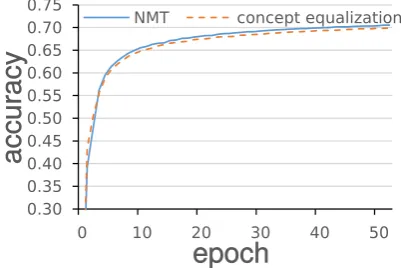
Fig. 2 shows the training accuracy change by epochs. The accuracy is the portion of correctly selected words in the training set through apply-ing argmax to probability vectors generated by the decoder. Applying the concept equalization shows faster convergence before 5 epochs, but converges to lower optimal points after 50 epochs compared to the normal NMT. From this result,
Figure 2: Training Accuracy by Epoch (accuracy: correctly selected token rate in training)
we can confirm the equalization boost the speed of convergence, but the conflict limits the accu-racy near optimals. This is consistent behavior to the properties of the method. A notable point is that the translation quality is significantly im-proved. We guess the cause is the different un-derlying assumptions in decoding. In the case of training accuracy, the decoder assumes receiving correct input at every time step while it uses pre-viously selected word in actual decoding. There-fore, in actual decoding to generate translation for the test set, a selected wrong word in an interme-diate step may cause subsequent errors by strange context generation. Overall, the two results im-ply that the equalization guides the model to be robust to the unseen errors by restricting genera-tion of strange sequences without any regulariza-tion techniques as randomized distorregulariza-tions on some parts of models.
5 Conclusion
NMTs. To resolve it, we introduced concept equalization to learn direct mapping of source and target sentences for guiding the NMT training. In the result, translation quality is significantly im-proved and training speed becomes slightly faster in early epochs. This method is expected to effec-tively discard wrong target composition from the observations.
6 Future Work
We will generalize this work for various direct mapping models and wider empirical tasks. Im-pact of concept equalization to cost landscape in parameter optimization will be more rigorously analyzed.
Acknowledgement
This work was partly supported by Institute for Information & communications Technology Pro-motion(IITP) grant funded by the Korea govern-ment(MSIT) (R7119-16-1001, Core technology development of the real-time simultaneous speech translation based on knowledge enhancement) and the MSIT(Ministry of Science and ICT), Ko-rea, under the ITRC(Information Technology Re-search Center) support program(IITP-2017-2016-0-00465) supervised by the IITP(Institute for In-formation & communications Technology Promo-tion).
References
Sarath Chandar AP, Stanislas Lauly, Hugo Larochelle, Mitesh Khapra, Balaraman Ravindran, Vikas C Raykar, and Amrita Saha. 2014. An autoencoder approach to learning bilingual word representations. InAdvances in Neural Information Processing Sys-tems, pages 1853–1861.
Dzmitry Bahdanau, Kyunghyun Cho, and Yoshua Ben-gio. 2014. Neural machine translation by jointly learning to align and translate. arXiv preprint arXiv:1409.0473.
Yoshua Bengio, Patrice Simard, and Paolo Frasconi. 1994. Learning long-term dependencies with gradi-ent descgradi-ent is difficult.IEEE transactions on neural networks, 5(2):157–166.
George Doddington. 2002. Automatic evaluation of machine translation quality using n-gram co-occurrence statistics. InProceedings of the second international conference on Human Language Tech-nology Research, pages 138–145. Morgan Kauf-mann Publishers Incorporation.
Sepp Hochreiter and J¨urgen Schmidhuber. 1997. Long short-term memory. Neural computation, 9(8):1735–1780.
Sergey Ioffe and Christian Szegedy. 2015. Batch nor-malization: Accelerating deep network training by reducing internal covariate shift. In International Conference on Machine Learning, pages 448–456.
Nal Kalchbrenner, Ivo Danihelka, and Alex Graves. 2015. Grid long short-term memory.arXiv preprint arXiv:1507.01526.
Philipp Koehn, Hieu Hoang, Alexandra Birch, Chris Callison-Burch, Marcello Federico, Nicola Bertoldi, Brooke Cowan, Wade Shen, Christine Moran, Richard Zens, et al. 2007. Moses: Open source toolkit for statistical machine translation. In Proceedings of the 45th Annual Meeting of the ACL on Interactive Poster and Demonstration Sessions, pages 177–180. Association for Computational Lin-guistics.
Minh-Thang Luong, Hieu Pham, and Christopher D Manning. 2015a. Effective approaches to attention-based neural machine translation. arXiv preprint arXiv:1508.04025.
Minh-Thang Luong, Ilya Sutskever, Quoc V Le, Oriol Vinyals, and Wojciech Zaremba. 2014. Addressing the rare word problem in neural machine translation. arXiv preprint arXiv:1410.8206.
Thang Luong, Hieu Pham, and Christopher D Man-ning. 2015b. Bilingual word representations with monolingual quality in mind. InVS@ HLT-NAACL, pages 151–159.
Kishore Papineni, Salim Roukos, Todd Ward, and Wei-Jing Zhu. 2002. Bleu: a method for automatic eval-uation of machine translation. In Proceedings of the 40th annual meeting on association for compu-tational linguistics, pages 311–318. Association for Computational Linguistics.
Marc’Aurelio Ranzato, Sumit Chopra, Michael Auli, and Wojciech Zaremba. 2015. Sequence level train-ing with recurrent neural networks. arXiv preprint arXiv:1511.06732.
Shiqi Shen, Yong Cheng, Zhongjun He, Wei He, Hua Wu, Maosong Sun, and Yang Liu. 2015. Minimum risk training for neural machine translation. arXiv preprint arXiv:1512.02433.
Ilya Sutskever, Oriol Vinyals, and Quoc V Le. 2014. Sequence to sequence learning with neural net-works. InAdvances in neural information process-ing systems, pages 3104–3112.