Improving Sequence to Sequence Neural Machine Translation
by Utilizing Syntactic Dependency Information
An Nguyen Le, Ander Martinez, Akifumi Yoshimoto∗and Yuji Matsumoto
Graduate School of Information Science, Nara Institute of Science and Technology, 8916-5, Takayama, Ikoma, Nara 630-0192, Japan
{nguyen.an.mr9,ander.martinez.zy4,akifumi-y,matsu}@is.naist.jp
Abstract
Sequence to Sequence Neural Machine Translation has achieved significant per-formance in recent years. Yet, there are some existing issues that Neural Machine Translation still does not solve completely. Two of them are translation of long sen-tences and “over-translation”. To address these two problems, we propose an ap-proach that utilize more grammatical in-formation such as syntactic dependencies, so that the output can be generated based on more abundant information. In addi-tion, the output of the model is presented not as a simple sequence of tokens but as a linearized tree construction. Experiments on the Europarl-v7 dataset of French-to-English translation demonstrate that our proposed method improves BLEU scores by 1.57 and 2.40 on datasets consisting of sentences with up to 50 and 80 tokens, respectively. Furthermore, the proposed method also solved the two existing prob-lems, ineffective translation of long sen-tences and over-translation in Neural Ma-chine Translation.
1 Introduction
Our task is to construct a model which learns in-put in sequence form and decodes outin-put as a lin-earized dependency tree. In this work, we propose an approach in which dependency labels are in-corporated into the model to represent more gram-matical information in the output sequence. As we know, the Sequence to Sequence (Seq2Seq) Learning model (Sutskever et al., 2014; Aha-roni et al., 2016) is extremely effective on a
va-∗
This author’s present affiliation is CyberAgent, Inc., Tokyo, Japan, yoshimoto akifumi [email protected]
riety of tasks that require a mapping between a se-quence to sese-quence. Therefore, it is used to solve many tasks in natural language processing. The
Seq2Seqmodel consists of an encoder-decoder neural network which encodes a variable-length input sequence into a vector and decodes it into a variable-length output. Since the model uses the information of the source representation and the previously generated words to produce the next-word token, this distributed representation al-lows the Seq2Seq model to generate appropri-ate mapping between the input and the output (Li et al., 2016). For specific tasks, Neural Machine Translation (NMT) model, which is based on the Seq2Seq learning, has achieved excellent transla-tion performance in recent years (Sutskever et al.,
2014;Bahdanau et al.,2015;Luong et al., 2015;
Firat et al.,2016). In particular, the NMT model which is built upon an encoder-decoder frame-work with attention mechanism (Bahdanau et al.,
2015) can also pay attention and its decoder knows which part of the input is relevant for the word that is currently being translated. Therefore, it has shown competitive results and outperformed conventional statistical methods (Bentivogli et al.,
2016). Despite of these advantages, NMT model still has a couple particular issues to be solved such as dealing with fixed vocabulary, not appli-cable to small-data, additional phrases, wrong lex-ical choice errors, long sentence translation, over and under translation, etc. In this paper, we touch upon the following two major problems:
• Translation of long sentences
• Over-translation
Since the decoder of the Seq2Seq model pro-duces the target language word by word simply based on the previous target words and the source-side representation vector until it reaches the
cial end token, it is incapable in capturing long-distance dependencies in history, so ineffective for long sentences translation (Zhang et al., 2016;
Toral and S´anchez-Cartagena, 2017). Even with an attention mechanism, theSeq2Seqmodel just pays attention to the current alignment informa-tion between the inputs and the output at the cur-rent position but ignores past alignments informa-tion. Therefore, it cannot keep track of the atten-tion history when it updates informaatten-tion at each current time step, leading to the over-production (Tu et al., 2016a,c; Mi et al., 2016; Tu et al.,
2016b).
In order to address the above two issues, it is worth considering that using syntactic dependency information and representing the output as a tree structure would be effective. This approach al-lows the next tokens to be output based on not only the previous tokens but also the syntactic de-pendencies so far, thereby conditioning them on more abundant information so it has the ability to make smarter predictions. Basically, in this paper, we train the model with an encoder-decoder neu-ral network and using dependencies in which the input of the source language is in sequence form and the output of the target language will be gen-erated in a linearized dependency-based tree struc-ture. That is, instead of predicting only words at each time step, the model trains the network to predict both words and their grammatical depen-dencies as a dependency tree at each time step. Therefore, it is hoped that the accuracy of output will be improved.
The major contributions of this work are as fol-lows:
1. To utilize the information of both “head” words and syntactic dependencies between them to produce better output.
2. To settle the problems in the NMT task. In this paper, we desire to solve two tasks. First is the ineffective translation for long sentences. Second is the over-translation in NMT task.
Empirically, to assess the performance of the proposed method, we used Conditional Gated Re-current Unit with Attention mechanism model of Bahdanau (2015) on the French-English portions of the Europarl-v7 dataset. As a result, the BLEU score is improved by 1.57 and 2.40 points for sen-tences of length up to 50 and 80 tokens,
respec-tively. Also, we compare and analyze the results of attention-based Seq2Seqmodel and the pro-posed approach.
2 Related Work
In fact, the effectiveness of using dependency in-formation of words has been reported in some previous NLP tasks, for example, in dependency-based word embeddings, relation classification and sentence classification tasks (Liu et al.,2015;
Socher et al., 2014; Levy and Goldberg, 2014;
Komnios, 2016; Ono and Hatano, 2014). It has been shown that the combination of words and their dependency information can boost perfor-mance. Besides, in the work of Vinyals et al. (Vinyals et al.,2014), they also represent output as a linearized tree structure, but their work showed that generic sequence-to-sequence approaches can achieve excellent results on syntactic constituency parsing. At a glance, our proposed method is a little similar to the works of Dyer et al., Aharoni et al., Eriguchi et al., Wu et al. (Dyer et al.,
2016;Aharoni and Goldberg,2017;Eriguchi et al.,
2017; Wu et al., 2017) in use of parse tree and generation. However, Dyer et al. and Aharoni et al.’s works concern predicting constituent trees. Eriguchi et al.’s model employs syntactic depen-dency parsing but their model is hybridized the de-coder of NMT and the Recurrent Neural Network Grammars, and the target sentences are parsed in transition-based parsing. Wu et al.’s model also employs dependency parsing but their model sep-arately predicts the target translation sequence and parsing action sequence which maps to translation. On the other hand, our proposed model’s decoder directly predicts the linearized dependency tree it-self in a single neural network inDepth-first pre-orderorder so that the next-word token is gener-ated based on syntactic relations and tree construc-tion itself. In other words, our model is able to learn and produce a tree of words and their depen-dency relations by itself.
3 Sequence-to-Dependency Model
N, we want the model to encode the input se-quence X and decode it to a tree structure with both words and dependency information condi-tioned on the encoded vector. Therefore, the out-put will be represented in the form (LY) = (ly1,ly2, . . . ,lyM). The conditional probability p(ly|x)is decomposed as:
p(ly|x) =Y∞ i=1
p(lyi|ly<i, x), (1)
in which (ly1,ly2, ...,lyM) are words or depen-dency labels.
Therefore, the hidden state sj at time step jis
computed as follows:
sj =cGRUatt sj−1,lyj−1,Cj, (2)
and the next token lyj, which may be a word or dependency label, will be generated as follows:
lyj =f sj,lyj−1,Cj, (3)
In this paper, dependencies are defined as the dependency labels which are achieved from the Stanford Dependency Parser (Chen and Manning,
2014). The decoder will decode the next output based on relations between governors and depen-dents in a linearized tree structure. In regards to the order of generating the dependency labels and the words, the decoder will produce these symbols in a manner calledDepth-first pre-order traversal. In this section, we will describe the model step-by-step as follows:
3.1 Processing Data
Since there is no parallel corpus in which the source-side is represented in sequence and target-side is represented in linearized dependency tree, we have to prepare data for training by doing de-pendency parsing for the target-side language. 3.1.1 Dependency Parsing
In this paper, we do experiments on a French-English language pair so we use the Stanford Dependency Parser to obtain dependency parsing results for English. The Stanford Dependency Parser produces results in the form of a tree struc-ture in which each word of the sentence is the de-pendent of exactly one token, either another word in the sentence or the distinguished “ROOT-0” to-ken. The parsing result is represented in the for-mat “abbreviated relation name(governor,
depen-dent)” in which a governor is a head word and de-pendency is a syntactic relation between a gover-nor and a dependent. The govergover-nor and the depen-dent are words in the sentence. This dependency parsing result will be transformed in another step for traversing the tree, which will be described in the next section to create a dependency tree. The dependency tree represents the target language as an ordered tree structure which is necessary for training. The reason we chose the Stanford Depen-dency Parser for the parsing portion of this method is because it can represent the order of words in sentence. This information of the order is useful to traverse tree in the following step.
end-of-Algorithm 1Tree Transform
1: procedureTRANSFORMTREE 2: Transform(T,Labels):
3: forlabel in Labelsdo
4: iflabel.children.size! = 0then 5: RecurTransform(T,Labels)
6: else
7: Compare the order of current 8: label’s parent & children 9: if (label’s children order is larger
than label’s parent order)then
10: INSERTlabel’s parentfirst
11: else
12: INSERTlabel’s children
subtree, that means finishing subtree traversal and returning to the upper layer to continue the next subtree traversal. And these defined tokens do not appear in original source and target datasets. Al-gorithms 1and2 show the definition of transfor-mation and tree traversal in more detail respec-tively. The purpose of usingDepth-first pre-order traversal is as follows:
1. To keep the words of the target language sequence in order when they are generated. With this generating order, the word order of the sentence is preserved, thus, we do not have to do any post-processing subsequently. 2. To utilize both information of the words and the dependency labels generated in the previ-ous rooted subtree to predict the tokens of the next rooted subtree.
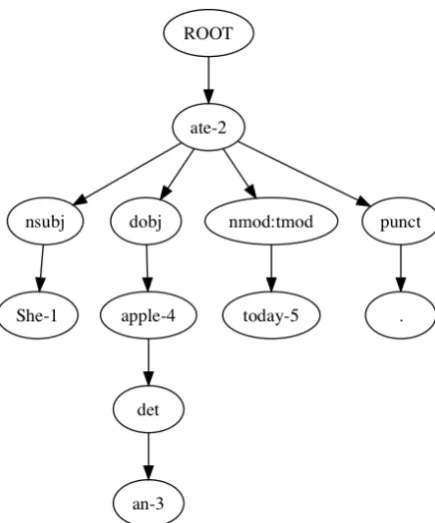
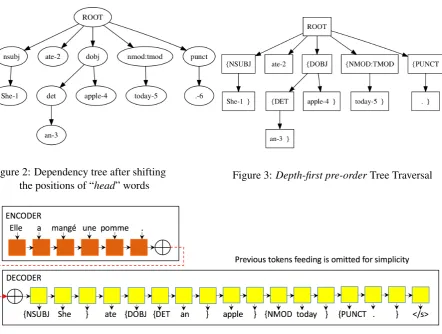
Figures1,2and3show the Stanford dependency parsing tree, tree structure after the positions of “head” words are shifted andDepth-first pre-order Tree Traversal.
3.2 Sequence-to-Dependency Model
The proposed (Seq2Dep) model consists of an en-coder which is a bidirectional GRU layer as in Bahdanau’s model (2015)1. The input
embed-dings of the source sentences are shared by the forward and backward GRU, and the hidden states of the corresponding forward and backward GRU are added to obtain the hidden representation for that time step. The decoder of the model will decode the output as words and dependency la-bels in a linearized dependency tree structure in
1https://github.com/nyu-dl/dl4mt-tutorial
Algorithm 2TreeDepth-first pre-ordertraversal Input: Sentence
Output: Linearized Dependency Tree
1: Stanford Dependency Parsing
2: Make Tree from Dependency Parsing Result 3: Tree transform
4: procedureTRAVERSE TREE 5: Traverse(T,N):
6: N as discovered
7: forall Node not in Ndo
8: ifNode.children.size! = 0then 9: Recursively callTraverse(T,N) 10: inpre-ordertraverse
11: else
12: ifNodeisNonterminalthen
13: OUTPUTNode-opening
14: VISITchildren
15: OUTPUTNode-closing
16: else
17: OUTPUTNode
aDepth-first pre-order traversal. Figure4 shows the decoder which generates both dependency la-bels and words in theSeq2Depmodel. In Figure
4, the previous token and context vector feeding are omitted for simplicity.
4 Experiments 4.1 Dataset
In our experiment, the proposed model was trained on the French-English parallel corpus of the Europarl-v7 dataset. We used newstest2011 and newstest2012of WMT16 as development and test data respectively. To confirm translation for long sentences, the whole test set was used without re-moving any sentences with a maximum length of 50 or 80. We performed experiment on the follow-ing two datasets:
• Europarl-v7 dataset consisting of sentences with a maximum length of 50.
• Europarl-v7 dataset consisting of sentences with a maximum length of 80.
Figure 1: Stanford Dependency Parsing Tree
step would contain multi “{ROOT” tokens for sen-tences which have multiple sensen-tences in one line, while it is necessary to generate the next child nodes starting from just one top{ROOT of a tree. Next, we tokenize and lowercase this dataset and perform dependency parsing. After that, we tra-verse the tree in a Depth-first pre-orderto create the parallel corpus for the training model in which the source language, French is in sequence form, and the target language, English is in a linearized dependency tree structure form. The longer sen-tences are(particularly sensen-tences with a maximum length of 80 tokens), the more CPU’s memory and time cost for this processing data step.
In addition, we built a dictionary of the target language (English) that consists of both words and dependency labels. In this dictionary, we define 74 dependency labels based on the current repre-sentation of grammatical relations of the Stanford Dependency Parser.
4.2 Settings
In order to evaluate the performance of the pro-posed method, we set the same hyperparameters as the attention-based cGRU model in DL4MT-Tutorial and compare the obtained results of both
Seq2SeqandSeq2Depmodels.
The recurrent transformation weights for gates
and hidden state proposal matrices were initial-ized as random orthogonal matrices. Weights were optimized using the Adadelta algorithm and were updated with a mini-batch size of 32 sentences. The vocabulary sizes of both source and target lan-guages were set at 30k words, the beam size was set to 5, dropout was not applied and the gradients were clipped at 1.0. Morever, because the gen-erated tokens are not only words but also depen-dency labels inSeq2Depmodel, the maxlen pa-rameter was set up so that dependency labels are not counted, therefore long sentences will not be removed in training.
4.3 Model Training
In the experiments, we trained the following 2 models on 1.65M sentences with a maximum length of 50 and 1.89M sentences with a maxi-mum length of 80 from the Europarl-v7 French-English bitext.
Baseline Model
This model is aSeq2Seqmodel with atten-tion mechanism as in Firat (2016) that con-sists of an encoder that encodes the source language input in sequence form and a de-coder that decodes target language output in sequence form.
Seq2Dep Model The proposed method. In this model, the model architecture is the same as the attention-based Seq2Seq model but the input is in sequence form and the output is in linearized dependency tree structure.
5 Results
In the Seq2Dep model, because the output consists of both words and dependency labels, we evaluated the result with post-processing, which is the process that removes the depen-dency labels from the translated result. From this section onwards, we will refer to the
Seq2Seq and Seq2Dep models with sen-tences of maximum length 50 and 80 tokens asSeq2Seq-50,Seq2Dep-50,Seq2Seq-80
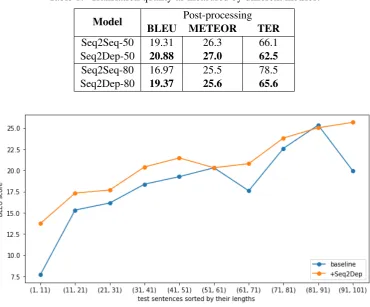
andSeq2Dep-80. As a result, the BLEU score ofSeq2Dep-50with post-processing was 20.88, which is higher than the BLEU score of 19.31 obtained by the attention-based Seq2Seq-50
Figure 2: Dependency tree after shifting
the positions of “head” words Figure 3:Depth-first pre-orderTree Traversal
Figure 4: Encoder and decoder ofSeq2Depmodel
Table 1 shows BLEU and METEOR scores and TER error of the attention-based Seq2Seq and
Seq2Depmodels. Figure5shows the relation be-tween BLEU score and the length of sentence.
Moreover, when we made a trial to evaluate the translation results without post-processing, the BLEU scores without post-processing were 42.76 and 43.41 for both datasets. From these scores, it is thought that the model can predict not only word-based tokens but also dependency labels well.
6 Additional Experiments
In order to verify the ability of the proposed ap-proach to solve the repetition problem of NMT, over-translation, we measured the repetition of words in the translation results of attention-based
Seq2SeqandSeq2Deplearnings in this section. The repetition rate is measured by the following formula:
rep rat= TX(y)
i=1
1 +r(eyi)
1 +r(Y), (4)
in whichyei andYi are theithhypothesis sentence
and ith reference sentence respectively, and r is
the number of the repeated words and is computed by:
r(X) =len(X)−len(set(X)) (5)
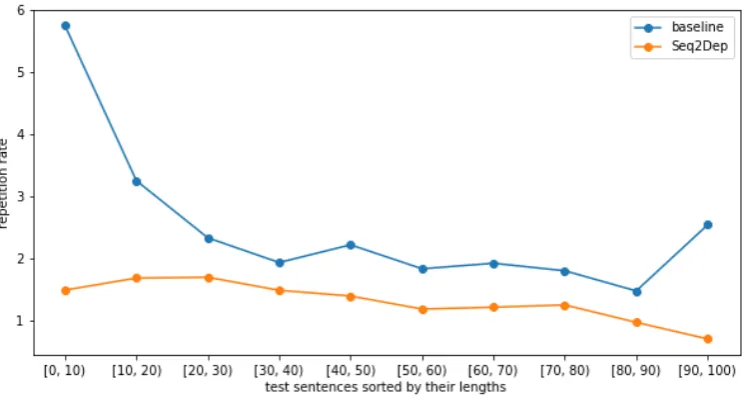
in which len(X) is the length of the sentence X and len(set(X)) is the number of words that are not repeated in sentence X. For example, given the sentence X=“The big fish ate the smaller fish”, in this case, set(X)={The, big, fish, ate, smaller}, len(X)=7, len(set(X))=5. Figure6shows the com-parison of repetition rate in both models in which the horizontal axis is the length of sentences, ver-tical axis is the repetition rate respectively. In Fig-ure 6, the repetition rate in both Seq2Seq and
[image:6.595.75.527.68.209.2]Table 1: Translation quality as measured by different metrics.
Model BLEU METEORPost-processing TER Seq2Seq-50 19.31 26.3 66.1 Seq2Dep-50 20.88 27.0 62.5 Seq2Seq-80 16.97 25.5 78.5 Seq2Dep-80 19.37 25.6 65.6
Figure 5: Comparison of BLEU score with respect to the length of sentences
7 Analysis and Discussion
In figure5, except the span in which the sentence length is between 41 and 51 words, the BLEU score of the Seq2Dep model goes up gradually and almost overcomes that of the attention-based
Seq2Seq model. The BLEU score falls from 19.31 to 16.97 with a 2.34 points difference for the attention-based Seq2Seqmodel while the point difference is 1.51 in theSeq2Depmodel. From the experiments, we confirm that by using the syntactic dependency information, the Seq2Dep
model can learn well and reduce the drop in BLEU score compared to the baseline model even if the sentence is very long. Besides, we can see the BLEU score is low for short sentences which have a length of 10 words or less. This is because of the brevity penalty on short sentences in BLEU ( Pap-ineni et al.,2002).
With regards to the BLEU score without post-processing, we see that the score of the
Seq2Dep-80 model is higher than that of the
Seq2Dep-50model. The reason could be: The longer the sentences are, the more syntactic
de-pendencies the models require for generating bet-ter outputs.
Also, in terms of the over-translation problem, Figure 6 shows that the repetition rates of the two models decrease gradually with respect to the length of the sentences and theSeq2Depmodel has a lower repetition rate. When we checked the translation results, we saw that Node-closing to-ken “}” was almost generated after each subtree. Moreover, we saw that there were some very long sentences which the over-generation of “UNK”s occurred in the translation result of Seq2Seq
model while that did not occur in translation re-sults ofSeq2Deqmodel. Our assumption is that after generating subtree, theSeq2Depmodel can learn that it should generate theNode-closing to-ken “}” next, instead of a chain of words. In other words, as mentioned in Kuncoro et al.’s work (Kuncoro et al.,2016) in which modeling of composition can achieve better performance, the
sen-Figure 6: Comparison of the repetition rate of the baseline andSeq2Depmodels
tences, so it is unlikely to generate the same word repeatedly. Therefore, it is possible to prevent the long repeated words in long sentences. Usually, because the block of the form “Nonterminalword }” is seen as a phrase in sentence or a subtree in tree structure, and it is rare for a phrase to occur repeatedly in sentence or for a subtree to repeat in a tree structure, so it is assumed that repetition of the blocks of form “Nonterminalword}” are also rare.
8 Conclusion
In this work, we proposed a method in which the
Seq2DepNMT model is trained by utilizing syn-tactic dependencies to provide the model more abundant information. In other words,Seq2Dep
model learns the potential internal relative con-nections among tokens and their long term syn-tactic dependencies to predict the next-word to-kens. Furthermore, theSeq2Depmodel can also generate output as a linearized dependency tree structure in a Depth-first pre-order tree traver-sal over words and dependencies. The purpose of this work is to alleviate issues of translat-ing long sentences and repetitive translation. We conduct experiments on the French-English par-allel corpus of the Europarl-v7 dataset to com-pare the performance of the proposed method with the attention-basedSeq2Seqmodel. The results demonstrated that the proposed model achieved a 1.57 and 2.40 points BLEU score improvement for sentences of length at most 50 and 80 tokens
re-spectively. Moreover, experiments verify that the proposed model also reduces the over-translation, particularly long sentences with over-generation of “UNK”s.
9 Future work
• Confirm how accurate theSeq2Depmodel generates the dependency labels and the whole tree structure as well.
• In this paper, to compare performance of the proposed method with the baseline model, we set the same hyperparameters as the attention-based cGRU model in dl4mt-tutorial and trained theSeq2Depmodel on only Europarl-v7 dataset. Since experiments were done on small vocabulary size and dataset, we plan to train the model on larger vocabulary and datasets with subword units segmentation.
• For future work, we plan to train models on datasets which consist of only long sentences with more than 50 or 80 tokens to compare the performance of long-sentences transla-tion of the approach and baseline model. Acknowledgments
[image:8.595.113.486.65.266.2]References
Roee Aharoni and Yoav Goldberg. 2017. Towards string-to-tree neural machine translation. CoRR, abs/1704.04743.
Roee Aharoni, Yoav Goldberg, and Yonatan Belinkov. 2016. Improving sequence to sequence learning for morphological inflection generation: The biu-mit systems for the sigmorphon 2016 shared task for morphological reinflection. In Proceedings of the 14th Annual SIGMORPHON Workshop on Com-putational Research in Phonetics, Phonology, and Morphology, pages 41–48.
Dzmitry Bahdanau, Kyunghyun Cho, and Yoshua Ben-gio. 2015. Neural machine translation by jointly learning to align and translate. In Proceedings of ICLR 2015.
Luisa Bentivogli, Arianna Bisazza, Mauro Cettolo, and Marcello Federico. 2016. Neural versus phrase-based machine translation quality: a case study.
CoRR, abs/1608.04631.
Danqi Chen and Christoher D. Manning. 2014. A fast and accurate dependency parser using neural net-works. InProceedings of EMNLP 2014.
Li Dong and Mirella Lapata. 2016. Language to logi-cal form with neural attention. Proceedings of ACL 2016, pages 33–43.
Chris Dyer, Adhiguna Kuncoro, Miguel Ballesteros, and Noah A. Smith. 2016. Recurrent neural network grammars. CoRR, abs/1602.07776.
Akiko Eriguchi, Yoshimasa Tsuruoka, and Kyunghyun Cho. 2017. Learning to parse and translate improves neural machine translation. CoRR, abs/1702.03525. Orhan Firat, Kyunghyun Cho, and Yoshua Ben-gio. 2016. Multi-way, multilingual neural ma-chine translation with a shared attention mechanism.
arXiv.org1601.01073.
Alexandros Komnios. 2016. Dependency based em-beddings for sentence classification tasks. In Pro-ceedings of NAACL-HLT 2016, pages 1490–1500. Adhiguna Kuncoro, Miguel Ballesteros, Lingpeng
Kong, Chris Dyer, Graham Neubig, and Noah A. Smith. 2016. What do recurrent neural net-work grammars learn about syntax? CoRR, abs/1611.05774.
Omer Levy and Yoav Goldberg. 2014. Dependency-based word embeddings. In Proceedings of ACL 2014, pages 302–308.
Xiaoqing Li, Jiajun Zhang, and Chengqing Zong. 2016. Towards zero unknown word in neural machine translation. InProceedings of IJCAI 2016.
Yang Liu, Furu Wei, Sujian Li, Heng Ji, Ming Zhou, and Houfeng Wang. 2015. A dependency-based neural network for relation classification. In Pro-ceedings of ACL 2015, pages 285–290.
Thang Luong, Hieu Pham, and Christopher D. Man-ning. 2015. Effective approaches to attention-based neural machine translation. In Proceedings of EMNLP 2015, pages 1412–1421.
Haitao Mi, Baskaran Sankaran, Zhiguo Wang, and Abe Ittycheriah. 2016. Coverage embedding mod-els for neural machine translation. InProceedings of EMNLP 2016, pages 955–960.
Kazuki Ono and Kenji Hatano. 2014. Dependency parsing and its application using hierarchical struc-ture in japanese language. International Journal on Advances in Internet Technology, vol 7 no 3, 4. Kishore Papineni, Salim Roukos, Todd Ward, and
Wei-Jing Zhu. 2002. Bleu: a method for automatic eval-uation of machine translation. Proceedings of ACL 2002, pages 311–318.
Richard Socher, Andrej Karpathy, Quoc V. Le, Christo-pher D. Manning, and Andrew Y. Ng. 2014. Grounded compositional semantics for finding and describing images with sentences. InTransactions of the Association for Computational Linguistics, pages 2: 207–218.
Ilya Sutskever, Oriol Vinyals, and Quoc V. Le. 2014. Sequence to sequence learning with neural net-works. Proceedings of NIPS 2014.
Antonio Toral and V´ıctor M. S´anchez-Cartagena. 2017. A multifaceted evaluation of neural versus phrase-based machine translation for 9 language directions.
CoRR, abs/1701.02901.
Zhaopeng Tu, Yang Liu, Lifeng Shang, Xiaohua Liu, and Hang Li. 2016a. Neural machine translation with reconstruction. InProceedings of Association for the Advancement of Artificial Intelligence 2016. Zhaopeng Tu, Zhengdong Lu, Yang Liu, Xiaohua Liu,
and Hang Li. 2016b. Coverage-based neural ma-chine translation. CoRR, abs/1601.04811.
Zhaopeng Tu, Zhengdong Lu, Yang Liu, Xiaohua Liu, and Hang Li. 2016c. Modeling coverage for neural machine translation. InProceedings of ACL 2016, pages 76–85.
Oriol Vinyals, Lukasz Kaiser, Terry Koo, Slav Petrov, Ilya Sutskever, and Geoffrey E. Hinton. 2014. Grammar as a foreign language. CoRR, abs/1412.7449.
Shuangzhi Wu, Dongdong Zhang, Nan Yang, Mu Li, and Ming Zhou. 2017. Sequence-to-dependency neural machine translation. Proceedings of ACL 2017, pages 698–707.