Skeletons in the parser: Using a shallow parser to improve deep parsing
Mary Swift, James Allen, and Daniel Gildea Department of Computer Science
University of Rochester Rochester, NY 14627
swift,allen,[email protected]
Abstract
We describe a simple approach for integrating shallow and deep parsing. We use phrase struc-ture bracketing obtained from the Collins parser as filters to guide deep parsing. Our exper-iments demonstrate that our technique yields substantial gains in speed along with modest improvements in accuracy.
1 Introduction
The detailed linguistic analyses generated by deep parsing are an essential component of spoken dia-log systems that collaboratively perform tasks with users (e.g., (Allen et al., 2001)). For example, inter-pretation in the TRIPS collaborative dialog assistant relies on the representation produced by its parser for word sense disambiguation, constituent depen-dencies, and semantic roles such as agent, theme, goal, etc. Broad coverage unification-based deep parsers, however, unavoidably have problems meet-ing the very high accuracy and efficiency require-ments needed for real-time dialog. On the other hand, parsers based on lexicalized probabilistic con-text free grammars such those of Collins (1999) and Charniak (1997), which we call shallow parsers1,
are robust and efficient, but the structural represen-tations obtained with such parsers are insufficient as input for intelligent reasoning. In addition, they are not accurate when exact match is considered as op-posed to constituent recall and precision and bracket crossing. For example, the standard Collins parser yields an exact match on only 36% on the standard test set (section 23) of the Wall Street Journal Cor-pus.
In this paper we explore the question of whether preprocessing with a shallow parser can produce analyses that are good enough to help improve the speed and accuracy of deep parsing. Previous work on German (Frank et al., 2002) pursued a similar strategy and showed promising results after consid-erable effort transforming the output of the
shal-1We do not intend the “chunking” sense of shallow parsing
— all our parsers return tree structures.
low parser into useful guidance to the deep parser. We were interested in seeing if we could take a shallow parser off the shelf, namely the Collins parser, and use its output fairly directly to improve the performance of the TRIPS parser. It has been reported that stochastic parsers degrade in perfor-mance on domains different than what they were trained on (Hwa, 1999; Gildea, 2001), so there re-ally was an issue whether the output would be good enough. In particular, we are taking the Collins parser trained on the Wall Street Journal and ap-plying it unchanged to spontaneous human-human dialog in an emergency rescue task domain. We have found that there are islands of reliability in the results from the Collins parser that can be used to substantially improve the performance of the TRIPS parser.
The remainder of the paper is organized as fol-lows. Section 2.1 provides background on the Mon-roe corpus, a set of task-oriented dialogs that is the basis for the parser evaluations. In section 2.2 we describe the TRIPS parser and the representation it produces for reasoning. In section 3 we describe the preliminary evaluations we carried out by running the Collins parser over the Monroe corpus. We then describe our experiments in combining the parsers under different conditions. We look at different con-ditions, first seeing how this method can improve overall parsing of our corpus, and then with real-time parsing conditions, as required for spoken di-alog systems. We find we can get substantial effi-ciency improvements on the corpus parsing, which mostly disappear when we look at the semi-real-time case. In the latter, however, we do see some improvement in coverage.
2 Background
2.1 The Monroe Corpus
prob-U We also have to send a road crew there as well
S So we probably can’t actually send the ambulance over the bridge U You’re probably right
U Because it’s going to take another two hours U So we’ll actually run out of time if we wait for that U So I guess we’ll need to send them
U Actually could we send them up fifteen across two fifty two down three eighty three U Take that way around
S Wait
S The generator’s going downtown S Right
U The generator is going to two fifty two S Oh oh I see the problem
U So if we go up fifteen or go south on fifteen S And then go up three eighty three
U Two fifty two S Three eighty three
U And that’ll get us all the way over to the person with pneumonia or the person who needs the generator U Say at the most it takes an hour
U It should take no more than an hour to get the generator over to that person S Okay
S So we have the people taken care of
Figure 1: Excerpt from Monroe dialog
lem solving and mixed initiative interaction involv-ing complex planninvolv-ing and coordination between the participants, so the communication is very sponta-neous and interactive. The corpus is split into utter-ances, and the speech repairs are marked and auto-matically removed for these tests. Utterances that are incomplete or uninterpretable (by humans) are also marked and eliminated from the corpus. The remaining utterances form the set on which we have been developing and testing the grammar. Figure 1 shows an excerpt from one of the dialogs.
The entire Monroe corpus consists of 20 dialogs ranging from about 7 minutes up to 40 minutes in length. Our tests here focus on a subset of five di-alogs that have been used to drive the grammar de-velopment: s2, s4, s12, s16 and s17 (henceforth di-alogs 1, 2, 3, 4 and 5), constituting 1556 parseable utterances.2
2.2 The TRIPS Parser
The deep parser we used is a robust parsing sys-tem developed in the TRIPS syssys-tem over the past five years being driven from five different domains. The grammatical formalism and parsing framework is essentially a lexicalized version of the formalism described in (Allen, 1995). It is a GPSG/HPSG (Pollard and Sag, 1994) inspired unification gram-mar of approximately 1300 rules with a rich model of semantic features (Dzikovska, 2004). The parser
2Parseable utterances exclude utterances that are
incom-plete or ungrammatical (see (Tetreault et al., 2004).)
is an agenda-driven best-first chart parser that sup-ports experimentation with different parsing strate-gies, although in practice we almost always use a straightforward bi-directional bottom-up algorithm. As an illustration of its flexibility, the modifications required to perform this experiment required adding only one function of ten lines of code. The grammar used for these experiments is the same TRIPS gram-mar used in all our applications, and the rules have hand-tuned weights. The weights of newly derived constituents are computed exactly as in a PCFG al-gorithm, the only difference being that the weights don’t necessarily add to 1 and so are not probabil-ities.3 The TRIPS parser does not use a maximum entropy model (cf. the XLE system (Kaplan et al., 2004)) because there is insufficient training data and it is as yet unclear how such as model would per-form at the detailed level of semantic representation produced by the TRIPS parser (see Figure 2 and dis-cussion below).
The rules, lexicon, and semantic ontology are in-dependent of any specific domain but tailored to human-computer practical dialog. The grammar is fairly extensive in coverage (and still growing), and has quite good coverage of a corpus of human-human dialogs in the Monroe domain, an emer-gency management domain (Swift et al., 2004). The
3
SA_TELL LF::FILL-CONTAINER :content
A (SET-OF LF::FRUIT) :theme
:goal
THE (SET-OF LF::FRUIT) :subset
:of
THE LF::LAND-VEHICLE
LF::WEIGHT-UNIT POUND :QUANTITY
LF::QMODIFIER MIN :quan
300 :is
LF::NUMBER
:mods
(SPEECHACT V38109 SA_TELL :CONTENT V37618)
(F V37618 (LF::FILL-CONTAINER LOAD) :GOAL V37800 :THEME V38041 :TMA ((TENSE PAST) (PASSIVE +)))
(THE V37800 (LF::LAND-VEHICLE TRUCK))
(A V38041 (SET-OF (LF::FRUIT ORANGE)) :QUANTITY V37526 :SUBSET V37539) (QUANTITY-TERM V37526 (LF::WEIGHT-UNIT POUND) :QUAN V37479)
(QUANTITY-TERM V37479 LF::NUMBER :MODS (V38268))
(F V38268 (LF::QMODIFIER MIN) :OF V37479 :IS V37523) (QUANTITY-TERM V37523 LF::NUMBER :VALUE 300)
(THE V37539 (SET-OF (LF::FRUIT ORANGE)))
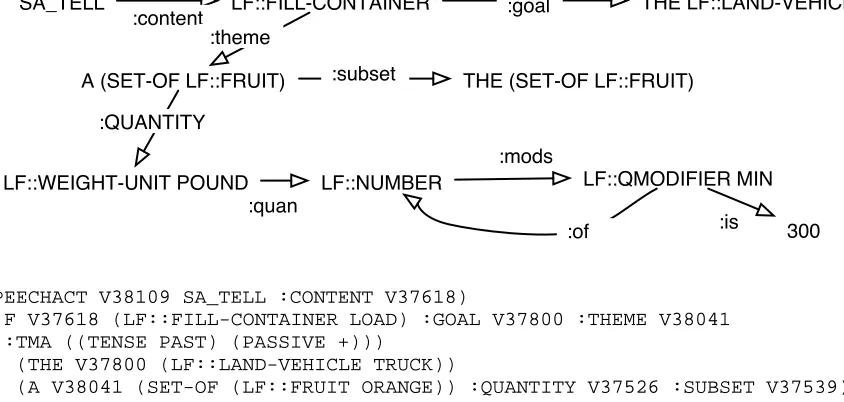
Figure 2: Parser logical form (together with a graphical approximation of the semantic content) for At least three hundred pounds of the oranges were put in the truck.
system is in active use in our spoken dialog un-derstanding work in several different domains. It operates in close to real-time for short utterances, but degrades in performance as utterances become longer than 8 or 9 words. As one way to control ambiguity, the grammar makes use of selectional re-strictions. Our semantic model utilizes two related mechanisms: first, an ontology of the predicates that are used to create the logical forms, and sec-ond, a vector of semantic features associated with these predicates that are used for selectional restric-tions. The grammar computes a flattened and un-scoped logical form using reified events (see also (Copestake et al., 1997) for a flat semantic represen-tation), with many of its word senses derived from FrameNet frames (Johnson and Fillmore, 2000) and semantic roles (Fillmore, 1968). An example of the logical form representation produced by the parser is shown in Figure 2, in both a dependency graph (upper) and the actual parser output (lower).4
4
Term constructors appearing at the leftmost edge of terms in the parser output are F (relation), A (indefinite entity), THE (definite entity) and QUANTITY-TERM (numeric ex-pressions).
3 Collins Parser Evaluation
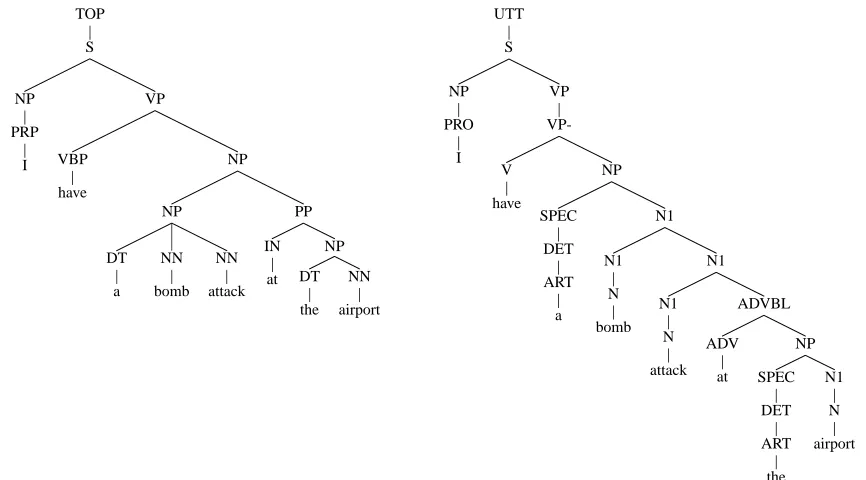
As a pilot experiment, we evaluated the perfor-mance of the Collins parser on a single dialog of 167 sentences from the Monroe corpus, dialog 3. We extracted context-free grammar backbones from our TRIPS gold standard parses to score the Collins’ output against. The evaluation was complicated by difference in tree formats, illustrated in Figure 3. The two parsers use a different (though closely re-lated) set of syntactic categories. The TRIPS struc-ture generally has more levels of strucstruc-ture (roughly corresponding to levels in X-bar theory) than the Penn Treebank analyses (Marcus et al., 1993), in particular for base noun phrases.
TOP
Figure 3: Skeleton tree output from the Collins parser (left) and the TRIPS parser (right) for I have a bomb attack at the airport.
However, 82% of the sentences have no cross-ing brackets in the Collins parse. That is, while the parser may not generate the same set of constituents, it generates very few constituents that straddle the boundaries of any constituent in the TRIPS parse. At this level, the parsers agree about the structure of the sentences to a degree that is perhaps surpris-ing given the very different domain on which the Collins parser is trained. This indicates that the low performance on the other measures has more to do with differences in the annotation style than real mistakes by the Collins parser.
The high level of agreement on unlabeled brack-etings led us to believe that the Collins structure could be used as a filter for constituents generated by the TRIPS parser. We tested this strategy in ex-periments reported in the following section.
4 Experiments
In all the experiments, we used a subset of five di-alogs (consisting of 1326 utterances) from the Mon-roe corpus, described in 2.1. Pilot trials were con-ducted on dialog 3 (167 utterances), and the exper-iments were run with the remaining dialogs (1, 2, 4 and 5).
4.1 Method
The first experiment evaluates whether we can ex-tract information from the Collins output that is reli-able enough to provide significant improvements to the TRIPS parser. In order to compare our
perfor-mance with (Frank et al., 2002), the test only uses utterances for which we have a gold-standard. In addition, we report our experiments only on utter-ances 6 words or longer (with an average of 10.3 words per utterance), as shorter utterances pose lit-tle problem for the TRIPS parser and thus running the Collins pre-processing step would not be pro-ductive.
We parsed dialogs 1, 2, 4 and 5 with the Collins parser, and extracted the phrase-level bracketing for the most reliable constituents (those which has a precision of at least 60%) in our pilot study: NP, VP and ADVP.5From this information we constructed a parse skeleton for each utterance, such as the one shown in Figure 4.
For our experiments we modified the TRIPS parser so that when a constituent is to be added to the chart, if the constituent type and its start and end positions are found in the skeleton then the ranking for that constituent is boosted by a small amount. In pilot trials we determined the optimal boost weight to be 3% (see Table 2).
With a broad coverage grammar, it is possible that the parser could run almost indefinitely on sentences that are difficult to parse. Thus we set an upper limit on the number of constituents that can be added to the chart before the parser quits. The parser runs until it finds a complete analysis or hits this upper
5The Collins parse time for the 309 utterances of 6 words or
label gold recall produced precision crossing
ADJ 2 0.0% 0 0.0% 0.0%
ADJP 17 17.6% 7 42.9% 28.6%
ADVP 106 23.6% 35 71.4% 11.4%
CD 17 0.0% 0 0.0% 0.0%
DT 39 0.0% 0 0.0% 0.0%
FRAG 0 0.0% 2 0.0% 0.0%
INTJ 0 0.0% 19 0.0% 0.0%
N 5 0.0% 0 0.0% 0.0%
NNP 5 0.0% 0 0.0% 0.0%
NP 170 79.4% 225 60.0% 8.9%
NPSEQ 5 0.0% 0 0.0% 0.0%
NX 106 0.0% 0 0.0% 0.0%
PP 4 50.0% 37 5.4% 13.5%
PRED 6 0.0% 0 0.0% 0.0%
PRT 0 0.0% 2 0.0% 0.0%
QP 16 0.0% 1 0.0% 100.0%
RB 5 0.0% 0 0.0% 0.0%
S 75 42.7% 83 38.6% 6.0%
SBAR 18 50.0% 17 52.9% 23.5%
SBARQ 0 0.0% 1 0.0% 0.0%
SINV 0 0.0% 2 0.0% 0.0%
SPEC 61 0.0% 0 0.0% 0.0%
SQ 0 0.0% 2 0.0% 0.0%
UTT 185 0.0% 0 0.0% 0.0%
UTTWORD 15 0.0% 0 0.0% 0.0%
VB 6 0.0% 0 0.0% 0.0%
VP 235 43.8% 124 83.1% 7.3%
WHNP 0 0.0% 3 0.0% 0.0%
Table 1: Breakdown of Collins parser performance by constituent type. Recall refers to how many of the gold-standard TRIPS constituents were produced by Collins, precision to how many of the produced con-stituents matched TRIPS, and crossing brackets to the percentage of TRIPS concon-stituents that were violated by any bracketing produced by Collins.
So [NP I] [VP guess that if [NP we] [VP send [NP one ambulance] to [NP the airport]] [NP we] [VP can [VP get [NP more people off] [ADVP quickly]]]
Figure 4: Skeleton filter for the utterance So I guess that if we send one ambulance to the airport we can get more people off quickly.
Boost weight 1% 2% 3% 4% 5% Speedup factor 1.1 1.3 2.4 2.0 1.2
Table 2: Pilot trials on dialog 3 to determine boost factor.
limit.In the first experiment, this upper limit is set at 10000 constituents. In addition, we performed the same experiments with lower upper limits to explore the question of how much of the parser time is spent on the sentences that hit the maximum chart size limit. In the second experiment we used an upper
limit of 5000, and in the third we used an upper limit of 1500 (the standard value for use in our real-time dialog system to avoid long delays in responding).
4.2 Results
Dialog 1 2 4 5 Total Utts (6+ words) 83 78 78 70 309 Sentence
accu-racy w/ skeleton
57.8 50 37.2 52.9 49.5 Sentence
accu-racy no skeleton
56.6 48.7 35.9 52.9 48.5 Time w/ skeleton 46 85 127 45 303 Time no skeleton 90 190 321 60 661 Speedup Factor 1.9 2.2 2.5 1.3 2.0
Table 3: Sentence accuracy and timing results with maximum chart size 10000 for utterances of 6 or more words.
skeletons. The next two rows show the total time (in seconds) to parse the dialogs with and without the skeletons. The last row shows the speed up fac-tor (computed as time-without-skeletons/time-with-skeletons).6
We see substantial speed-ups in the parser using this technique. The parser using skeletons com-pleted the parses in less than half of the time of the original parser. Looking at individual utterances, 70% were parsed more quickly with the skeletons, while 25% were slower. Overall, our simple ap-proach appears to provide a substantial payoff in speed along with a small improvement in accuracy.
Note that we use a strict criterion for accuracy, so both the correct logical form as well as the cor-rect syntactic structure must be computed by the parser for an analysis to be considered correct in our evaluation. A correct logical form requires cor-rect word sense disambiguation, constituent depen-dencies, and semantic role assignment (see section 2.2). For example, in some cases the parser pro-duces a structurally correct parse, but selects an in-appropriate word sense, in which case the analysis is considered incorrect. One such case is the utter-ance You know where the little loop is, in which the where is assigned the sense TO-LOC (which should only be used for trajectories, as in Where did he go), when in this utterance the correct sense for where is SPATIAL-LOC.
To explore the question of how much of the speed increase is the result of time spent on difficult sen-tences that cause the parser to reach the maximum chart size limit, we performed the same experiment with a smaller maximum chart size of 5000, shown in Table 4. As expected the speed-up gain declined to 1.8, still quite a respectable gain, and again there
6
These experiments were run with CMU Common LISP 18e and a Linux 2.4.20 kernel on a 2 GHz Xeon dual processor with 1.0 GB total memory.
Dialog 1 2 4 5 Total
Utts (6+ words) 83 78 78 70 309 Sentence
accu-racy w/ skeleton
57.8 50 37.2 52.9 49.5 Sentence
accu-racy no skeleton
55.4 48.7 35.9 52.9 48.2 Time w/ skeleton 46 82 126 45 299 Time no skeleton 90 148 286 59 583 Speedup Factor 1.9 1.8 2.3 1.3 1.8
Table 4: Sentence accuracy and timing results with maximum chart size 5000 for utterances of 6 or more words.
Dialog 1 2 4 5 Total
Utts (6+ words) 83 78 78 70 309 Sentence
accu-racy w/ skeleton
57.8 48.7 37.2 52.9 49.2 Sentence
accu-racy no skeleton
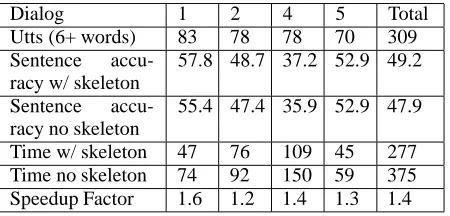
55.4 47.4 35.9 52.9 47.9 Time w/ skeleton 47 76 109 45 277 Time no skeleton 74 92 150 59 375 Speedup Factor 1.6 1.2 1.4 1.3 1.4
Table 5: Sentence accuracy and timing results with maximum chart size 1500 for utterances of 6 more words.
is no loss of accuracy.
As we drop the chart size to 1500, the speed-up drops to just 1.4, as shown in Table 5. However, we have improvements in accuracy using skeletons when we parse with low upper limits. In certain cases the skeleton guides the parser to the correct parse more quickly, so it can be found even when the maximum chart size is reduced. For example, for the utterance And meanwhile we send two am-bulances from the Strong Hospital to take the six wounded people from the airport (from dialog 1), a correct full sentence analysis is found with the larger maximum chart sizes (5000 or more), but with a maximum chart size of 1500 the correct anal-ysis for this utterance is found only with the help of the skeleton.
5 Conclusion
With minimal modifications to our deep parser, we have been able to achieve a substantial increase in parsing speed with this technique along with a small increase in accuracy. The experiments reported here investigated this technique using off-line methods. Given our promising results, we are currently work-ing to integrate an on-line shallow parswork-ing filter into our collaborative dialog assistant.
Acknowledgments
We thank Micha Elsner, David Ganzhorn and Alli-son Rosenberg for verification of accuracy results, and Myroslava Dzikovska and Joel Tetreault for helpful comments and discussion. This research was partially supported by NSF grant IIS-0328810 and DARPA grant NBCH-D-03-0010.
References
James F. Allen, Donna K. Byron, Myroslava O. Dzikovska, George Ferguson, Lucien Galescu, and Amanda Stent. 2001. Towards conversa-tional human-computer interaction. AI Maga-zine, 22(4):27–35.
James F. Allen. 1995. Natural Language Under-standing. Benjamin Cummings, Redwood City, CA.
Eugene Charniak. 1997. Statistical parsing with a context-free grammar and word statistics. In Pro-ceedings of the Fourteenth National Conference on Artificial Intelligence (AAAI-97), pages 598– 603, Menlo Park, August. AAAI Press.
Michael Collins. 1999. Head-Driven Statistical Models for Natural Language Parsing. Ph.D. thesis, University of Pennsylvania.
Ann Copestake, Dan Flickinger, and Ivan A. Sag. 1997. Minimal Recursion Semantics: An intro-duction. Technical report, CSLI, Stanford Uni-versity, CA.
Myroslava O. Dzikovska. 2004. A Practical Se-mantic Representation for Natural Language Parsing. Ph.D. thesis, University of Rochester. Charles J. Fillmore. 1968. The case for case. In
Emmon Bach and Robert Harms, editors, Uni-versals in Linguistic Theory, pages 1–90. Holt, Rinehart and Winston.
Anette Frank, Markus Becker, Berthold Crysmann, Bernd Kiefer, and Ulrich Schaefer. 2002. Inte-grated shallow and deep parsing: TopP meets HPSG. In COLING’02, Taipei.
Daniel Gildea. 2001. Corpus variation and parser performance. In 2001 Conference on Empiri-cal Methods in Natural Language Processing (EMNLP), pages 167–202, Pittsburgh, PA.
Rebecca Hwa. 1999. Supervised grammar induc-tion using training data with limited constituent information. In Proceedings of the 37th Annual Meeting of the ACL, College Park, Maryland. Christopher Johnson and Charles J. Fillmore. 2000.
The FrameNet tagset for frame-semantic and syn-tactic coding of predicate-argument structure. In Proceedings ANLP-NAACL 2000.
Ronald M. Kaplan, Stefan Riezler, Tracy Holloway King, John T. Maxwell III, Alexander Vasser-man, and Richard Crouch. 2004. Speed and ac-curacy in shallow and deep stochastic parsing. In NAACL’04, Boston.
Mitchell P. Marcus, Beatrice Santorini, and Mary Ann Marcinkiewicz. 1993. Building a large annotated corpus of English: The Penn Treebank. Computational Linguistics, 19:313– 330.
Carl Pollard and Ivan Sag. 1994. Head-driven Phrase Structure Grammar. Chicago University Press.
Amanda J. Stent. 2001. Dialogue Systems as Conversational Partners: Applying Conversation Acts Theory to Natural Language Generation for Task-Oriented Mixed-Initiative Spoken Dialogue. Ph.D. thesis, University of Rochester.
Mary Swift, Myroslava Dzikovska, Joel Tetreault, and James Allen. 2004. Semi-automatic syntac-tic and semansyntac-tic corpus annotation with a deep parser. In LREC’04, Lisbon.