Proceedings of the Second ACL Workshop on Effective Tools and Methodologies for Teaching NLP and CL, pages 23–27,
A Core-Tools Statistical NLP Course
Dan Klein
Computer Science Division University of California, Berkeley
Berkeley, CA 94720
Abstract
In the fall term of 2004, I taught a new statistical NLP course focusing on core tools and machine-learning al-gorithms. The course work was or-ganized around four substantial pro-gramming assignments in which the students implemented the important parts of several core tools, including language models (for speech rerank-ing), a maximum entropy classifier, a part-of-speech tagger, a PCFG parser, and a word-alignment system. Using provided scaffolding, students built re-alistic tools with nearly state-of-the-art performance in most cases. This paper briefly outlines the coverage of the course, the scope of the assign-ments, and some of the lessons learned in teaching the course in this way.
1 Introduction
In the fall term of 2004, I taught a new sta-tistical NLP course at UC Berkeley which cov-ered the central tools and machine-learning ap-proaches of NLP. My goal in formulating this course was to create a syllabus and assignment set to teach in a relatively short time the impor-tant aspects, both practical and theoretical, of what took me years of building research tools to internalize. The result was a rather hard course with a high workload. Although the course eval-uations were very positive, and several of the students who completed the course were able to
jump right into research projects in my group, there’s no question that the broad accessibility of the course, especially for non-CS students, was limited.
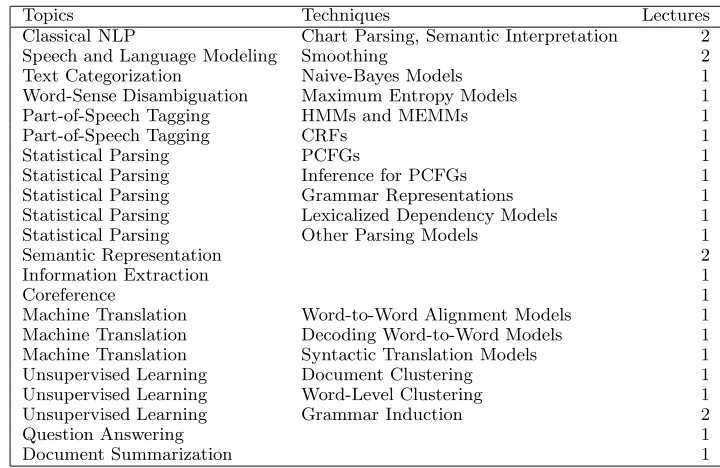
As with any NLP course, there were several fundamental choice points. First, it’s not possi-ble to cover both core tools and end-to-end ap-plications in detail in a single term. Since Marti Hearst was teaching an applied NLP course dur-ing the same term, I chose to cover tools and algorithms almost exclusively (see figure 1 for a syllabus). The second choice point was whether to organize the course primarily around linguis-tic topics or primarily around statislinguis-tical meth-ods. I chose to follow linguistic topics because that order seemed much easier to motivate to the students (comments on this choice in section 3). The final fundamental choice I made in decid-ing how to target this class was to require both substantial coding and substantial math. This choice narrowed the audience of the class, but allowed the students to build realistic systems which were not just toy implementations.
I feel that the most successful aspect of this course was the set of assignments, so the largest section below will be devoted to de-scribing them. If other researchers are inter-ested in using any of my materials, they are en-couraged to contact me or visit my web page (http://www.cs.berkeley.edu/~klein).
2 Audience
a few advanced CS undergrads. What became apparent after the first homework assignment (see section 4.2) was that while the CS students could at least muddle through the course with weak (or absent) linguistics backgrounds, the linguistics students were unable to acquire the math and programming skills quickly enough to keep up. I have no good ideas about how to ad-dress this issue. Moreover, even among the CS students, some of the systems students had trou-ble with the math and some of the AI/theory students had issues with coding scalable solu-tions. The course was certainly not optimized for broad accessibility, but the approximately 80% of students who stuck it out did what I con-sidered to be extremely impressive work. For example, one student built a language model which took the mass reserved for new words and distributed it according to a character n-gram model. Another student invented a non-iterative word alignment heuristic which out-performed IBM model 4 on small and medium training corpora. A third student built a maxent part-of-speech tagger with a per-word accuracy of 96.7%, certainly in the state-of-the-art range.
3 Topics
The topics covered in the course are shown in figure 1. The first week of the course was es-sentially a history lesson about symbolic ap-proaches NLP, both to show their strengths (a full, unified pipeline including predicate logic se-mantic interpretations, while we still don’t have a good notion of probabilistic interpretation) and their weaknesses (many interpretations arise from just a few rules, ambiguity poorly han-dled). From there, I discussed statistical ap-proaches to problems of increasing complexity, spending a large amount of time on tree and se-quence models.
As mentioned above, I organized the lectures around linguistic topics rather than mathemat-ical methods. However, given the degree to which the course focused on such foundational methods, this order was perhaps a mistake. For example, it meant that simple word alignment models like IBM models 1 and 2 (Brown et
al., 1990) and the HMM model (Vogel et al., 1996) came many weeks after HMMs were intro-duced in the context of part-of-speech tagging. I also separated unsupervised learning into its own sub-sequence, where I now wish I had pre-sented the unsupervised approaches to each task along with the supervised ones.
I assigned readings from Jurafsky and Mar-tin (2000) and Manning and Sch¨utze (1999) for the first half of the course, but the second half was almost entirely based on papers from the re-search literature. This reflected both increasing sophistication on the part of the students and insufficient coverage of the latter topics in the textbooks.
4 Assignments
The key component which characterized this course was the assignments. Each assignment is described below. They are available for use by other instructors. While licensing issues with the data make it impossible to put the entirety of the assignment materials on the web, some materials will be linked from
http://www.cs.berkeley.edu/~klein, and the rest can be obtained by emailing me.
4.1 Assignment Principles
The assignments were all in Java. In all cases, I supplied a large amount of scaffolding code which read in the appropriate data files, con-structed a placeholder baseline system, and tested that baseline. The students therefore al-ways began with a running end-to-end pipeline, using standard corpora, evaluated in standard ways. They then swapped out the baseline placeholder for increasingly sophisticated imple-mentations. When possible, assignments also had a toy “miniTest” mode where rather than reading in real corpora, a small toy corpus was loaded to facilitate debugging. Assignments were graded entirely on the basis of write-ups.
4.2 Assignment 1: Language Modeling
Topics Techniques Lectures Classical NLP Chart Parsing, Semantic Interpretation 2 Speech and Language Modeling Smoothing 2 Text Categorization Naive-Bayes Models 1 Word-Sense Disambiguation Maximum Entropy Models 1 Part-of-Speech Tagging HMMs and MEMMs 1
Part-of-Speech Tagging CRFs 1
Statistical Parsing PCFGs 1
Statistical Parsing Inference for PCFGs 1 Statistical Parsing Grammar Representations 1 Statistical Parsing Lexicalized Dependency Models 1 Statistical Parsing Other Parsing Models 1
Semantic Representation 2
Information Extraction 1
Coreference 1
Machine Translation Word-to-Word Alignment Models 1 Machine Translation Decoding Word-to-Word Models 1 Machine Translation Syntactic Translation Models 1 Unsupervised Learning Document Clustering 1 Unsupervised Learning Word-Level Clustering 1 Unsupervised Learning Grammar Induction 2
Question Answering 1
[image:3.612.123.483.69.303.2]Document Summarization 1
Figure 1: Topics Covered. Each lecture was 80 minutes.
the support harness. First, perplexity on held-out WSJ text was calculated. In this evaluation, reserving the correct mass for unknown words was important. Second, their language models were used to rescore n-best speech lists (supplied by Brian Roark, see Roark (2001)). Finally, ran-dom sentences were generatively sampled from their models, giving students concrete feedback on how their models did (or did not) capture formation about English. The support code in-tially provided an unsmoothed unigram model to get students started. They were then asked to build several more complex language mod-els, including at least one higher-order interpo-lated model, and at least one model using Good-Turing or held-out smoothing. Beyond these re-quirements, students were encouraged to acheive the best possible word error rate and perplexity figures by whatever means they chose.1
They were also asked to identify ways in which their language models missed important trends of
En-1
After each assignment, I presented in class an hon-ors list, consisting of the students who won on any mea-sure or who had simply built something clever. I initially worried about how these honors announcements would be received, but students really seemed to enjoy hearing what their peers were doing, and most students made the honors list at some point in the term.
glish and to suggest solutions.
As a second part to assignment 1, students trained class-conditional n-gram models (at the character level) to do the proper name identi-fication task from Smarr and Manning (2002) (whose data we used). In this task, proper name strings are to be mapped to one of{drug,
com-pany, movie, person, location}. This turns
out to be a fairly easy task since the different categories have markedly different character dis-tributions.2
In the future, I will move this part of assignment 1 and the matching part of assign-ment 2 into a new, joint assignassign-ment.
4.3 Assignment 2: Maximum Entropy / POS Tagging
In assignment 2, students first built a general maximum entropy model for multiclass classi-fication. The support code provided a crippled maxent classifier which always returned the uni-form distribution over labels (by ignoring the features of the input datum). Students replaced the crippled bits and got a correct classifier
run-2
ning, first on a small toy problem and then on the proper-name identification problem from as-signment 1. The support code provided opti-mization code (an L-BFGS optimizer) and fea-ture indexing machinery, so students only wrote code to calculate the maxent objective function and its derivatives.
The original intention of assignment 2 was that students then use this maxent classifier as a building block of a maxent part-of-speech tagger like that of Ratnaparkhi (1996). The support code supplied a most-frequent-tag baseline tag-ger and a greedy lattice decoder. The students first improved the local scoring function (keep-ing the greedy decoder) us(keep-ing either an HMM or maxent model for each timeslice. Once this was complete, they upgraded the greedy decoder to a Viterbi decoder. Since students were, in practice, generally only willing to wait about 20 minutes for an experiment to run, most chose to discard their maxent classifiers and build gener-ative HMM taggers. About half of the students’ final taggers exceeded 96% per-word tagging ac-curacy, which I found very impressive. Students were only required to build a trigram tagger of some kind. However, many chose to have smoothed HMMs with complex emission mod-els like Brants (2000), while others built maxent taggers.
Because of the slowness of maxent taggers’ training, I will just ask students to build HMM taggers next time. Moreover, with the relation between the two parts of this assignment gone, I will separate out the proper-name classification part into its own assignment.
4.4 Assignment 3: Parsing
In assignment 3, students wrote a probabilis-tic chart parser. The support code read in and normalized Penn Treebank trees using the standard data splits, handled binarization of n-ary rules, and calculated ParsEval numbers over the development or test sets. A baseline left-branching parser was provided. Students wrote an agenda-based uniform-cost parser essentially from scratch. Once the parser parsed cor-rectly with the supplied treebank grammar, stu-dents experimented with horizontal and vertical
markovization (see Klein and Manning (2003)) to improve parsing accuracy. Students were then free to experiment with speed-ups to the parser, more complex annotation schemes, and so on. Most students’ parsers ran at reasonable speeds (around a minute for 40 word sentences) and got final F1 measures over 82%, which is substantially higher than an unannotated tree-bank grammar will produce. While this assign-ment would appear to be more work than the others, it actually got the least overload-related complaints of all the assignments.
In the future, I may instead have students im-plement an array-based CKY parser (Kasami, 1965), since a better understanding of CKY would have been more useful than knowing about agenda-based methods for later parts of the course. Moreover, several students wanted to experiment with induction methods which required summing parsers instead of Viterbi parsers.
4.5 Assignment 4: Word Alignment
In assignment 4, students built word alignment systems using the Canadian Hansards training data and evaluation alignments from the 2003 (and now 2005) shared task in the NAACL workshop on parallel texts. The support code provided a monotone baseline aligner and eval-uation/display code which graphically printed gold alignments superimposed over guessed alignments. Students first built a heuristic aligner (Dice, mutual information-based, or whatever they could invent) and then built IBM model 1 and 2 aligners. They then had a choice of either scaling up the system to learn from larger training sets or implementing the HMM alignment model.
4.6 Assignment Observations
er-ror output to encourage better erer-ror analysis for the other assignments – it seemed like students were reluctant to write code to display errors, but were happy to look at errors as they scrolled by.3
A very important question raised by an anonymous reviewer was how effectively imple-menting tried-and-true methods feeds into new research. For students who will not be do-ing NLP research but want to know how the basic methods work (realistically, this is most of the audience), the experience of having im-plemented several “classic” approaches to core tools is certainly appropriate. However, even for students who intend to do NLP research, this hands-on tour of established methods has already shown itself to be very valuable. These students can pick up any paper on any of these tasks, and they have a very concrete idea about what the data sets look like, why people do things they way they do, and what kinds of er-ror types and rates one can expect from a given tool. That’s experience that can take a long time to acquire otherwise – it certainly took me a while. Moreover, I’ve had several students from the class start research projects with me, and, in each case, those projects have been in some way bridged by the course assignments. This methodology also means that all of the students working with me have a shared implementation background, which has facilitated ad hoc collab-orations on research projects.
5 Conclusions
There are certainly changes I will make when I teach this course again this fall. I will likely shuffle the topics around so that word align-ment comes earlier (closer to HMMs for tagging) and I will likely teach dynamic programming so-lutions to parsing and tagging in more depth than graph-search based methods. Some stu-dents needed remedial linguistics sections and other students needed remedial math sections, and I would hold more such sessions, and
ear-3
There was also verbose error reporting for assign-ment 4, which displayed each sentence’s guessed and gold alignments in a grid, but since most students didn’t speak French, this didn’t have the same effect.
lier in the term. However, I will certainly keep the substantial implementation component of the course, partially in response to very positive student feedback on the assignments, partially from my own reaction to the high quality of stu-dent work on those assignments, and partially from how easily students with so much hands-on experience seem to be able to jump into NLP research.
References
Thorsten Brants. 2000. TnT – a statistical part-of-speech tagger. InANLP 6, pages 224–231.
Peter F. Brown, John Cocke, Stephen A. Della Pietra, Vincent J. Della Pietra, Fredrick Jelinek, John D. Lafferty, Robert L. Mercer, and Paul S. Roossin. 1990. A statistical approach to machine translation. Computational Linguistics, 16(2):79– 85.
Dan Jurafsky and James H. Martin. 2000. Speech and Language Processing: An Introduction to Nat-ural Language Processing, Computational Linguis-tics and Speech Recognition. Prentice Hall, Engle-wood Cliffs, NJ.
T. Kasami. 1965. An efficient recognition and syn-tax analysis algorithm for context-free languages. Technical Report AFCRL-65-758, Air Force Cam-bridge Research Laboratory, Bedford, MA.
Dan Klein and Christopher D. Manning. 2003. Ac-curate unlexicalized parsing. In ACL 41, pages 423–430.
Christopher D. Manning and Hinrich Sch¨utze. 1999.
Foundations of Statistical Natural Language
Pro-cessing. The MIT Press, Cambridge,
Mas-sachusetts.
Adwait Ratnaparkhi. 1996. A maximum entropy model for part-of-speech tagging. In EMNLP 1, pages 133–142.
Brian Roark. 2001. Probabilistic top-down parsing and language modeling. Computational Linguis-tics, 27:249–276.
Joseph Smarr and Christopher D. Manning. 2002. Classifying unknown proper noun phrases without context. Technical report, Stanford University.