Identifying Concept Attributes Using a Classifier
Massimo Poesio University of Essex Computer Science / Language and Computation
poesio at essex.ac.uk
Abdulrahman Almuhareb University of Essex Computer Science / Language and Computation
aalmuh at essex.ac.uk
Abstract
We developed a novel classification of concept attributes and two supervised classifiers using this classification to iden-tify concept attributes from candidate at-tributes extracted from the Web. Our binary (attribute / non-attribute) classifier achieves an accuracy of 81.82% whereas our 5-way classifier achieves 80.35%.
1 Introduction
The assumption that concept attributes and, more in general, features1 are an important aspect of conceptual representation is widespread in all dis-ciplines involved with conceptual representations, from Artificial Intelligence / Knowledge Represen-tation (starting with at least (Woods, 1975) and down to (Baader et al, 2003)), Linguistics (e.g., in the theories of the lexicon based on typed feature structures and/or Pustejovsky’s Generative Lexi-con theory: (Pustejovsky 1995)) and Psychology (Murphy 2002, Vinson et al 2003). This being the case, it is surprising how little attention has been devoted to this aspect of lexical representation in work on large-scale lexical semantics in Computa-tional Linguistics. The most extensive resource at
1 The term attribute is used informally here to indicate the type of relational information about concepts that is expressed using so-called roles in Description Logics (Baader et al, 2003)—i.e., excluding IS-A style information (that cars are vehicles, for instance). It is meant to be a more restrictive term than the term feature, often used to indicate any property of concepts, particularly in Psychology. We are carrying out a systematic analysis of the sets of features used in work such as (Vinson et al, 2003) (see Discussion).
our disposal, WordNet (Fellbaum, 1998) contains very little information that would be considered as being about ‘attributes’—only information about parts, not about qualities such as height, or even to the values of such attributes in the adjective net-work—and this information is still very sparse. On the other hand, the only work on the extraction of lexical semantic relations we are aware of has con-centrated on the type of relations found in Word-Net: hyponymy (Hearst, 1998; Caraballo, 1999) and meronymy (Berland and Charniak, 1999; Poe-sio et al, 2002).2
The work discussed here could be perhaps best described as an example of empirical ontology: using linguistics and philosophical ideas to im-prove the results of empirical work on lexical / on-tology acquisition, and vice versa, using findings from empirical analysis to question some of the assumptions of theoretical work on ontology and the lexicon. Specifically, we discuss work on the acquisition of (nominal) concept attributes whose goal is twofold: on the one hand, to clarify the no-tion of ‘attribute’ and its role in lexical semantics, if any; on the other, to develop methods to acquire such information automatically (e.g., to supple-ment WordNet).
The structure of the paper is as follows. After a short review of relevant literature on extracting semantic relations and on attributes in the lexicon, we discuss our classification of attributes, followed by the features we used to classify them. We then discuss our training methods and the results we achieved.
2
In work on the acquisition of lexical information about verbs there has been some work on the acquisition of thematic roles, (e.g., Merlo and Stevenson, 2001).
2 Background
2.1 Using Patterns to Extract Semantic Rela-tions
The work discussed here belongs to a line of re-search attempting to acquire information about lexical and other semantic relations other than similarity / synonymy by identifying syntactic constructions that are often (but not always!) used to express such relations. The earliest work of this type we are aware of is the work by Hearst (1998) on acquiring information about hyponymy (= IS-A
links) by searching for instances of patterns such as NP {, NP}* or other NP (as in, e.g., bruises …. broken bones and other INJURIES). A similar approach was used by Ber-land and Charniak (1999) and Poesio et al (2002) to extract information about part-of relations using patterns such as
the N of the N is ….
(as in the wheel of the CAR is) and by Girju and Moldovan (2002) and Sanchez-Graillet and Poesio (2004) to extract causal relations. In previous work (Almuhareb and Poesio, 2004) we used this same approach to extract attributes, using the pattern
“the * of the C [is|was]”
(suggested by, e.g., (Woods, 1975) as a test for ‘attributehood’) to search for attributes of concept C in the Web, using the Google API. Although the information extracted this way proved a useful ad-dition to our lexical representations from a cluster-ing perspective, from the point of view of lexicon building this approach results in too many false positives, as very few syntactic constructions are used to express exclusively one type of semantic relation. For example, the ‘attributes’ of deer ex-tracted using the text pattern above include “the majority of the deer,” “the lake of the deer,” and “the picture of the deer.” Girju and Moldovan (2002) addressed the problem of false positives for causal relations by developing WordNet-based fil-ters to remove unlikely candidates. In this work, we developed a semantic filter for attributes based on a linguistic theory of attributes which does not rely on WordNet except as a source of morpho-logical information (see below).
2.2 Two Theories of Attributes
The earliest attempt to classify attributes and other properties of substances we are aware of goes back
to Aristotle, e.g., in Categories,3 but our classifica-tion of attributes was inspired primarily by the work of Pustejovsky (1995) and Guarino (e.g., (1992)). According to Pustejovsky’s Generative Lexicon theory (1995), an integral part of a lexical entry is its Qualia Structure, which consists of four ‘roles’:4 the Formal Role, specifying what type of object it is: e.g., in the case of a book, that it has a shape, a color, etc.; the Constitutive Role, specifying the stuff and parts that it consists of (e.g., in the case of a book, that it is made of pa-per, it has chapters and an index, etc.); the Telic Role, specifying the purpose of the object (e.g., in the case of a book, reading); and the Agentive Role, specifying how the object was created (e.g., in the case of a book, by writing).
Guarino (1992) argues that there are two types of attributes: relational and non-relational. Rela-tional attributes include qualities such as color and
position, and relational social roles such as son
and spouse. Non-relational attributes include parts
such as wheel and engine. Activities are not viewed as attributes in Guarino’s classification.
3 Attribute Extraction and Classification
The goal of this work is to identify genuine attrib-utes by classifying candidate attribattrib-utes collected using text patterns as discussed in (Almuhareb and Poesio, 2004) according to a scheme inspired by those proposed by Guarino and Pustejovsky.
The scheme we used to classify the training data in the experiment discussed below consists of six categories:
• Qualities: Analogous to Guarino’s qualities and Pustejovsky’s formal ‘role’. (E.g., “the color of the car”.)
• Parts: Related to Guarino’s non-relational attributes and Pustejovsky’s constitutive ‘roles’. (E.g., “the hood of the car”).
• Related-Objects: A new category intro-duced to cover the numerous physical ob-jects which are ‘related’ to an object but are not part of it—e.g., “the track of the deer”.
3
E.g., http://plato.stanford.edu/entries/substance. Thanks to one of the referees for drawing our attention to this.
4
• Activities: These include both the types of activities which are part of Pustejovsky’s telic ‘role’ and those which would be in-cluded in his agentive ‘role’. (E.g., “the re-pairing of the car”.)
• Related-Agents: For the activities in which the concept in question is acted upon, the agent of the activity: e.g., “the writer of the book”, “the driver of the car”.
• Non-Attributes: This category covers the cases in which the construction “the N of the N” expresses other semantic relations, as in: “the last of the deer”, “the majority of the deer,” “the lake of the deer,” and “in the case of the deer”.
We will quickly add that (i) we do not view this classification as definitive—in fact, we already collapsed the classes ‘part’ and ‘related objects’ in the experiments discussed below—and (ii) not all of these distinctions are very easy even for human judges to do. For example, design, as an attribute of a car, can be judged to be a quality if we think of it as taking values such as modern and standard; on the other hand, design might also be viewed as an activity in other contexts discussing the design-ing process. Another type of difficulty is that a given attribute may express different things for different objects. For example, introduction is a part of a book, and an activity for a product. An additional difficulty results from the strong similar-ity between parts and related-objects. For example, “key” is a related-object to a car but it is not part of it. We will return to this issue and to agreement on this classification scheme when discussing the experiment.
One difference from previous work is that we use additional linguistic constructions to extract candidate attributes. The construction “the X of the Y is” used in our previous work is only one exam-ple of genitive construction. Quirk et al (1985) list eight types of genitives in English, four of which are useful for our purposes:
• Possessive Genitive: used to express
quali-ties, parts, objects, and related-agents.
• Genitive of Measure: used to express
quali-ties.
• Subjective & Objective Genitives: used to
express activities.
We used all of these constructions in the work discussed here.
4 Information Used to Classify Attributes
Our attribute classifier uses four types of informa-tion: morphological information, an attribute model, a question model, and an attributive-usage model. In this section we discuss how this informa-tion is automatically computed.
4.1 Morphological Information
Our use of morphological information is based on the noun classification scheme proposed by Dixon (1991). According to Dixon, derivational morphol-ogy provides some information about attribute typ-e. Parts are concrete objects and almost all of them are expressed using basic noun roots (i.e., not de-rived from adjectives or verbs). Most of qualities and properties are either basic noun roots or de-rived from adjectives. Finally, activities are mostly nouns derived from verbs. Although these rules only have a heuristic value, we found that morpho-logically based heuristics did provide useful cues when used in combination with the other types of information discussed below.
As we are not aware of any publicly available software performing automatic derivational mor-phology, we developed our own (and very basic) heuristic methods. The techniques we used involve using information from WordNet, suffix-checking, and a POS tagger.
To find nouns that are derived from adjectives we used simple heuristics based on suffix-checking. (This was also done by Berland and Charniak (1999).) All words that end with “ity” or “ness” are considered to be derived from adjec-tives. A noun not found to be derived from a verb or an adjective is assumed to be a basic noun root.
In addition to derivational morphology, we used the Brill tagger (Brill, 1995) to filter out adjectives and other types of words that can occasionally be used as nouns such as better, first, and whole be-fore training. Only nouns, base form verbs, and gerund form verbs were kept in the candidate at-tribute list.
4.2 Clustering Attributes
Attributes are themselves concepts, at least in the sense that they have their own attributes: for ex-ample, a part of a car, such as a wheel, has its own parts (the tyre) its qualities (weight, diameter) etc. This observation suggests that it should be possible to find similar attributes in an unsupervised fashion by looking at their attributes, just as we did earlier for concepts (Almuhareb and Poesio, 2004). In order to do this, we used our text patterns for find-ing attributes to collect from the Web up to 500 pattern instances for each of the candidate attrib-utes. The collected data were used to build a vecto-rial representation of attributes as done in (Almuhareb and Poesio, 2004). We then used CLUTO (Karypis, 2002) to cluster attributes using these vectorial representations. In a first round of experiments we found that the classes ‘parts’ and ‘related objects’ were difficult to differentiate, and therefore we merged them. The final model clus-ters candidate attributes into five classes: activities, parts & related-objects, qualities, related-agents, and non-attributes. This classification was used as one of the input features in our supervised classi-fier for attributes.
We also developed a measure to identify par-ticularly distinctive ‘attributes of attributes’— attributes which have a strong tendency to occur primarily with attributes (or any concept) of a given class—which has proven to work pretty well. This measure, which we call Uniqueness, actually is the product of two factors: the degree of unique-ness proper, i.e., the probability P(classi |
attrib-utej) that an attribute (or, in fact, any other noun)
will belong to class i given than it has attribute j; and a measure of ‘definitional power’ –the
prob-ability P(attribute j | classi) that a concept belong-ing to a given class will have a certain attribute. Using MLE to estimate these probabilities, the de-gree of uniqueness of attributesj of classi is com-puted as follows:
) count function that counts concepts that are associ-ated with the given attribute. Uniqueness ranges from 0 to 1.
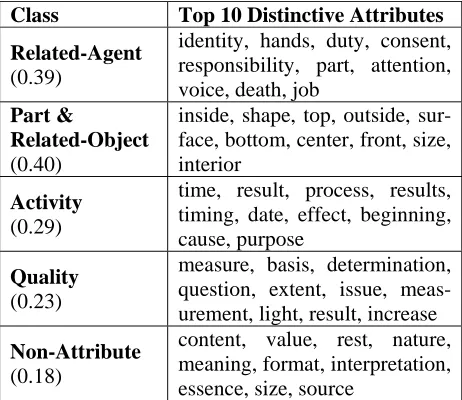
Table 1 shows the 10 most distinctive attributes for each of the five attribute classes, as determined by the Uniqueness measure just introduced, for the 1,155 candidate attributes in the training data for the experiment discussed below.
Class Top 10 Distinctive Attributes
Related-Agent
(0.39)
identity, hands, duty, consent, responsibility, part, attention, voice, death, job
Part &
Related-Object
(0.40)
inside, shape, top, outside, sur-face, bottom, center, front, size, interior
Activity
(0.29)
time, result, process, results, timing, date, effect, beginning, cause, purpose
Quality
(0.23)
measure, basis, determination, question, extent, issue, meas-urement, light, result, increase
Non-Attribute
(0.18)
content, value, rest, nature, meaning, format, interpretation, essence, size, source
Table 1: Top 10 distinctive attributes of the five classes of candidate attributes. Average distinct-iveness (uniqueness) for the top 10 attributes is
shown between parentheses
Most of the top 10 attributes of related-agents, parts & related-objects, and activities are genuinely distinctive attributes for such classes. Thus, attrib-utes of related-agents reflect the ‘intentionality’ aspect typical of members of this class: identity, duty, and responsibility. Attributes of parts are common attributes of physical objects (e.g., inside, shape). Most attributes of activities have to do with temporal properties and causal structure: e.g.,
quality class are less distinctive, but four such at-tributes (measure, extent, measurement, and in-crease) are related to values since many of the qualities can have different values (e.g., small and large for the quality size). There are however sev-eral attributes in common between these classes of attributes, emphasizing yet again how some of these distinctions at least are not completely clear cut: e.g., result, in common between activities and qualities (two classes which are sometimes diffi-cult to distinguish). Finally, as one would expect, the attributes of the non-attribute class are not really distinctive: their average uniqueness score is the lowest. This is because ‘non-attribute’ is a het-erogeneous class.
4.3 The Question Model
Certain types of attributes can only be used when asking certain types of questions. For example, it is possible to ask “What is the color of the car?” but not “∗When is the color of the car?”.
We created a text pattern for each type of ques-tion and used these patterns to search the Web and collect counts of occurrences of particular ques-tions. An example of such patterns would be:
• “what is|are the A of the”
where A is the candidate attribute under investiga-tion. Patterns for who, when, where, and how are similar.
After collecting occurrence frequencies for all the candidate attributes, we transform these counts into weights using the t-test weighting function as done for all of our counts, using the following for-mula from Manning and Schuetze (1999):
2
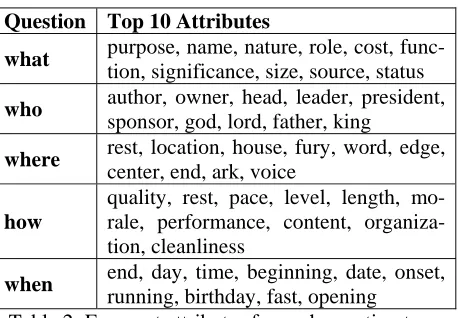
Table 2 shows the 10 most frequent attributes for each question type. This data was collected us-ing a more restricted form of the question patterns and a varying number of instances for each type of questions. The restricted form includes a question mark at the end of the phrase and was used to im-prove the precision. For example, the what-pattern would be “what is the * of the *?”.
Question Top 10 Attributes
what purpose, name, nature, role, cost,
func-tion, significance, size, source, status
who author, owner, head, leader, president,
sponsor, god, lord, father, king
where rest, location, house, fury, word, edge,
center, end, ark, voice
how
quality, rest, pace, level, length, mo-rale, performance, content, organiza-tion, cleanliness
when end, day, time, beginning, date, onset,
running, birthday, fast, opening Table 2: Frequent attributes for each question type
Instances of the what-pattern are frequent in the Web: the Google count was more than 2,000,000 for a query issued in mid 2004. The who-pattern is next in terms of occurrence, with about 350,000 instances. The when-pattern is the most infrequent pattern, about 5,300 instances.
The counts broadly reflected our intuitions about the use of such questions. What-questions are mainly used with qualities, whereas who-questions are used with related-agents. Attributes occurring with when-questions have some tempo-ral aspects; attributes occurring with how-questions are mostly qualities and activities, and attributes in where-questions are of different types but some are related to locations. Parts usually do not occur with these types of questions.
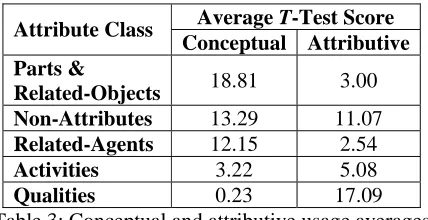
4.4 Attributive Use
Finally, we exploited the fact that certain types of attributes are used more in language as concepts rather than as attributes. For instance, it is more common to encounter the phrase “the size of the
∗” than “the ∗ of the size”. On the other hand, it is
more common to encounter the phrase “the * of
the window” than “the window of the *”.
Gener-ally speaking, parts, objects, and related-agents are more likely to have more attributes than qualities and activities. We used the two patterns “the * of the A” and “the A of the *” to collect Google counts for all of the candidate attributes. These counts were also weighted using the t-test as in the question model.
Average T-Test Score Attribute Class
Conceptual Attributive Parts &
Related-Objects 18.81 3.00 Non-Attributes 13.29 11.07
Related-Agents 12.15 2.54
Activities 3.22 5.08
Qualities 0.23 17.09
Table 3: Conceptual and attributive usage averages for each attribute class
5 The Experiment
We trained two classifiers: a 2-way classifier that simply classifies candidate attributes into attributes and non-attributes, and a 5-way classifier that clas-sifies candidate attributes into activities, parts & related-objects, qualities, related-agents, and non-attributes. These classifiers were trained using de-cision trees algorithm (J48) from WEKA (Witten and Frank, 1999).
Feature
el
ect
io
n
abd
o
m
en
ac
id
it
y
creator pro
b
lem
Cluster Id 1 2 4 0 3
What 0.00 0.00 0.00 0.00 3.80
When 2.62 0.00 0.00 0.00 0.00
Where 0.78 0.94 0.00 0.00 0.00
Who 0.00 0.00 0.00 30.28 0.00
How 2.05 0.00 1.54 0.00 2.61
Conceptual 38.16 20.15 0.00 0.00 135.40
Attributive 0.00 0.00 10.22 1.60 0.00
Morph DV BN DA DV BN
Attribute Class (Output)
Activity Part Quality Related Agent
Non- Attribute
Table 4: Five examples of training instances. The values for morph are as follows: DV: derived from
verb; BN: basic noun; DA: derived from adjective
Our training and testing material was acquired as follows. We started from the 24,178 candidate attributes collected for the concepts in the balanced concept dataset we recently developed (Almuhareb and Poesio, 2005). We threw out every candidate attribute with a Google frequency less than 20; this reduced the number of candidate attributes to 4,728. We then removed words other than nouns
and gerunds as discussed above, obtaining 4,296 candidate attributes.
The four types of input features for this filtered set of candidate attributes were computed as dis-cussed in the previous section. The best results were obtained using all of these features. A train-ing set of 1,155 candidate attributes was selected and hand-classified (see below for agreement fig-ures). We tried to include enough samples for each attribute class in the training set. Table 4 shows the input features for five different training examples, one for each attribute class.
6 Evaluation
For a qualitative idea of the behavior of our classi-fier, the best attributes for some concepts are listed in Appendix A. We concentrate here on quantita-tive analyses.
6.1 Classifier Evaluation 1: Cross-Validation
Our two classifiers were evaluated, first of all, us-ing 10-fold cross-validation. The 2-way classifier correctly classified 81.82% of the candidate attrib-utes (the baseline accuracy is 80.61%). The 5-way classifier correctly classified 80.35% of the attrib-utes (the baseline accuracy is 23.55%). The preci-sion / recall results are shown in Table 5.
Attribute Class P R F
2-Way Classifier
Attribute 0.854 0.934 0.892
Non-Attribute 0.551 0.335 0.417
5-Way Classifier
Related-Agent 0.930 0.970 0.950
Part & Related-Object 0.842 0.882 0.862
Activity 0.822 0.878 0.849
Quality 0.799 0.821 0.810
Non-Attribute 0.602 0.487 0.538 Table 5: Cross-validation results for the two
attribute classifiers
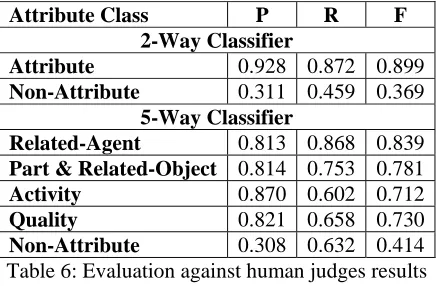
As it can be seen from Table 5, both classifiers achieve good F values for all classes except for the non-attribute class: F-measures range from 81% to 95%. With the 2-way classifier, the valid attribute class has an F-measure of 89.2%. With the 5-way classifier, related-agent is the most accurate class (F = 95%) followed by part & related-object,
respectively). With non-attribute, however, we find an F of 41.7% in the 2-way classification, and 53.8% in the 5-way classification. This suggests that the best strategy for lexicon building would be to use these classifiers to ‘find’ attributes rather than ‘filter’ non-attributes.
6.2 Classifier Evaluation 2: Human Judges
Next, we evaluated the accuracy of the attribute classifiers against two human judges (the authors). We randomly selected a concept from each of the 21 classes in the balanced dataset. Next, we used the classifiers to classify the 20 best candidate atributes of each concept, as determined by their t-test scores. Then, the judges decided if the as-signed classes are correct or not. For the 5-way classifier, the judges also assigned the correct class if the automatic assigned class is incorrect.
After a preliminary examination we decided not to consider two troublesome concepts: constructor and future. The reason for eliminating constructor is that we discovered it is ambiguous: in addition to the sense of ‘a person who builds things’, we discovered that constructor is used widely in the Web as a name for a fundamental method in object oriented programming languages such as Java. Most of the best candidate attributes (e.g., call, arguments, code, and version) related to the latter sense, that doesn’t exist in WordNet. Our system is currently not able to do word sense discrimination, but we are currently working on this issue. The reason for ignoring the concept future was that this word is most commonly used as a modifier in phrases such as: “the car of the future”, and “the office of the future”, and that all of the best candi-date attributes occurred in this type of construction. This reduced the number of evaluated concepts to 19.
According to the judges, the 2-way classifier was on average able to correctly assign attribute classes for 82.57% of the candidate attributes. This is very close to its performance in evaluation 1. The results using the F-measure reveal similar re-sults too. Table 6 shows the rere-sults of the two clas-sifiers based on the precision and recall measures.
According to the judges, the 5-way classifier correctly classified 68.72% on average. This per-formance is good but not as good as its perform-ance in evaluation 1 (80.35%). The decrease in the performance was also shown in the F-measure.
The F-measure ranges from 0.712 to 0.839 exclud-ing the non-attribute class.
Attribute Class P R F
2-Way Classifier
Attribute 0.928 0.872 0.899
Non-Attribute 0.311 0.459 0.369
5-Way Classifier
Related-Agent 0.813 0.868 0.839
Part & Related-Object 0.814 0.753 0.781
Activity 0.870 0.602 0.712
Quality 0.821 0.658 0.730
Non-Attribute 0.308 0.632 0.414 Table 6: Evaluation against human judges results
for the two classifiers
An important question when using human judges is the degree of agreement among them.
The K-statistic was used to measure this
agree-ment. The values of K are shown in Table 7. In the 2-way classification, the judges agreed on 89.84% of the cases. On the other hand, the K-statistic for this classification task is 0.452. This indicates that part of this strong agreement is because that the majority of the candidate attributes are valid attrib-utes. It also shows the difficulty of identifying non-attributes even for human judges. In the 5-way classification, the two judges have a high level of agreement; Kappa statistic is 0.749. The judges and the 5-way classifier agreed on 63.71% of the cases.
Description 2-Way 5-Way
Human Judges 89.84% 80.69%
Human Judges (Kappa) 0.452 0.749
Human Judges & Classifier 78.36% 63.71% Table 7: Level of agreement between the human
judges and the classifiers
6.3 Re-Clustering the Balanced Dataset
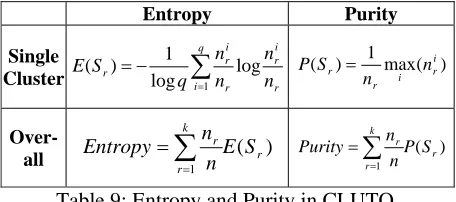
meas-ures: Purity (which measures the degree of cohe-sion of the clusters obtained) and Entropy. The purity and entropy formulas are shown in Table 9.
Description
Purity 0.657 0.672 0.693
Entropy 0.335 0.319 0.302
Vector Size 24,178 4,296 3,824 Table 8: Results of re-clustering concepts using
different sets of attributes
Clustering the concepts using only filtered can-didate attributes improved the clustering purity from 0.657 to 0.672. This improvement in purity is not significant. However, clustering using only the attributes sanctioned by the 2-way classifier proved the purity further to 0.693, and this im-provement in purity from the initial purity was significant (t = 2.646, df = 801, p < 0.05).
Table 9: Entropy and Purity in CLUTO. Sr is a cluster, nr is the size of the cluster, q is the number of classes, nir is the number of concepts from the ith class that were assigned to the rth cluster, n is the number of concepts,
and k is the number of clusters.
7 Discussion and Conclusions
The lexicon does not simply contain information about synonymy and hyponymy relations; it also contains information about the attributes of the concepts expressed by senses, as in Qualia struc-tures. In previous work, we developed techniques for mining candidate attributes from the Web; in this paper we presented a method for improving the quality of attributes thus extracted, based on a classification for attributes derived from work in linguistics and philosophy, and a classifier that automatically tags candidate attributes with such classes. Both the 2-way and the 5-way classifiers achieve good precision and recall. Our work also reveals, however, that the notion of attribute is not
fully understood. On the one hand, that attribute judgments are not always easy for humans even given a scheme; on the other hand, the results for certain types of attributes, especially activities and qualities, could certainly be improved. We also found that whereas attributes of physical objects are relatively easy to classify, the attributes of other types of concepts are harder –particularly with activities. (See the Appendix for examples.) Our longer term goal is thus to further clarify the notion of attribute, possibly refining our classifica-tion scheme, in collaboraclassifica-tion with linguists, phi-losophers, and psycholinguists. One comparison we are particularly interested in pursuing at the moment is that with feature lists used by psycholo-gist, for whom knowledge representation is en-tirely concept-based, and virtually every property of a concept counts as an attribute, including prop-erties that would be viewed as IS-A links and what would be considered a value. Is it possible to make a principled, yet cognitively based distinction?
Acknowledgments
Abdulrahman Almuhareb is supported by King Abdulaziz City for Science and Technology (KACST), Riyadh, Saudi Arabia. We wish to thank the anonymous referees for many helpful sugges-tions.
References
Almuhareb, A. and Poesio, M. (2004). Attribute-Based and Value-Based Clustering: An Evaluation. In Proc. of EMNLP. Barcelona, July.
Almuhareb, A. and Poesio, M. (2005). Concept Learn-ing and Categorization from the Web. In Proc. of CogSci. Italy, July.
Baader, F., Calvanese, D., McGuinness, D., Nardi, D. and Patel-Schneider, P. (Editors). (2003). The De-scription Logic Handbook. Cambridge University Press.
Berland, M. and Charniak, E. (1999). Finding parts in very large corpora. In Proc. of the 37th ACL, (pp. 57–64). University of Maryland.
Caraballo, S. A. (1999). Automatic construction of a hypernym-labeled noun hierarchy from text. In Proc. of the 37th ACL.
Dixon, R. M. W. (1991). A New Approach to English Grammar, on Semantic Principles. Clarendon Press, Oxford.
Fellbaum, C. (Editor). (1998). WordNet: An electronic lexical database. The MIT Press.
Girju, R. and Moldovan, D. (2002). Mining answers for causal questions. In Proc. AAAI.
Guarino, N. (1992). Concepts, attributes and arbitrary relations: some linguistic and ontological criteria for structuring knowledge base. Data and Knowledge Engineering, 8, (pp. 249–261).
Hearst, M. A. (1998). Automated discovery of WordNet relations. In Fellbaum, C. (Editor). WordNet: An Electronic Lexical Database. MIT Press.
Karypis, G. (2002). CLUTO: A clustering toolkit. Tech-nical Report 02-017. University of Minnesota. At
http://www-users.cs.umn.edu/~karypis/cluto/.
Manning, C. D. and Schuetze H. (1999). Foundations of Statistical NLP. MIT Press.
Merlo, P. and Stevenson, S. (2001). Automatic Verb Classification Based on Statistical Distributions of Argument Structure. Computational Linguistics. 27: 3, 373-408.
Murphy, G. L. (2002). The Big Book of Concepts. The MIT Press.
Poesio, M., Ishikawa, T., Schulte im Walde, S. and Vieira, R. (2002). Acquiring lexical knowledge for anaphora resolution. In Proc. Of LREC.
Pustejovsky, J. (1995). The generative lexicon. MIT Press.
Quirk, R., Greenbaum, S., Leech, G., and Svartvik, J. (1985). A comprehensive grammar of the English language. London: Longman.
Sanchez-Graillet, O. and Poesio, M. (2004). Building Bayesian Networks from text. In Proc. of LREC, Lis-bon, May.
Vinson, D. P., Vigliocco, G., Cappa, S., and Siri, S. (2003). The breakdown of semantic knowledge: in-sights from a statistical model of meaning representa-tion. Brain and Language, 86(3), 347-365(19).
Witten, I. H. and Frank, E. (1999). Data Mining: Prac-tical Machine Learning Tools and Techniques with Java Implementations, Morgan Kaufmann.
Woods, W. A. (1975). What’s in a link: Foundations for semantic networks. In Daniel G. Bobrow and Alan M. Collins, editors, Representation and Understand-ing: Studies in Cognitive Science, (pp. 35-82). Aca-demic Press, New York.
Appendix A. 5-Way Automatic Classification of the Best Candidate Attributes of
Some Concepts
Car Class Best Attributes
Activity acceleration, performance, styling, construction, propulsion, insurance, stance, ride,
move-ment
Part & Related-Object
front, body, mass, underside, hood, roof, nose, graphics, side, trunk, engine, boot, frame, bot-tom, backseat, chassis, wheelbase, silhouette, floor, battery, windshield, seat, undercarriage, tank, window, steering, drive, finish
Quality speed, weight, handling, velocity, color, condition, width, look, colour, feel, momentum,
heritage, shape, appearance, ownership, make, convenience, age, quality, reliability
Related-Agent driver, owner, buyer, sponsor, occupant, seller
Non-Attribute
Camel Class Best Attributes
Activity introduction, selling, argument, exhaustion
Part & Related-Object
nose, hump, furniture, saddle, hair, flesh, neck, milk, head, reins, foot, eye, hooves, humps, ass, feet, hoof, flanks, bones, ears, bag, skin, haunches, stomach, legs, urine, meat, penis, load, breast, backside, testicles, rope, corpse, house, nostrils, foam, bell, sight, butt, fur, bod-ies, toe, hoofs, heads, knees, pancreas, mouth, coat, uterus, necks, chin, udders
Quality origins, gait, domestication, usefulness, pace, fleetness, smell, existence, appeal, birth,
awk-wardness
Related-Agent ghost
Non-Attribute gift, rhythm, physiology, battle, case, example, dance, manner, description
Cancer Class Best Attributes
Activity
growth, development, removal, treatment, recurrence, diagnosis, pain, spreading, metastasis, detection, eradication, elimination, production, discovery, remission, advance, excision, pre-vention, evolution, disappearance, anxiety
Part & Related-Object
location, site, lump, nature, root, cells, margin, formation, margins, roots, world, region
Quality
extent, size, seriousness, progression, severity, aggressiveness, cause, progress, symptoms, effects, risk, incidence, staging, biology, onset, characteristics, histology, ability, status, ap-pearance, thickness, sensitivity, causes, prevalence, responsiveness, ravages, frequency, aeti-ology, circumstances, rarity, outcome, behavior, genetics
Related-Agent club, patient
Non-Attribute
stage, spread, grade, origin, course, power, return, area, response, presence, type, particulars, occurrence, prognosis, pathogenesis, source, news, cure, pathology, properties, genesis, boundaries, drama, stages, chapter
Family Class Best Attributes
Activity disintegration, protection, decline, destruction, breakup, abolition, participation,
reunifica-tion, reconciliareunifica-tion, dissolureunifica-tion, composireunifica-tion, restoration
Part & Related-Object
head, institution, support, flower, core, fabric, culture, dimension, food, lineage, cornerstone, community
Quality
breakdown, importance, honor, structure, sociology, integrity, unity, sanctity, health, privacy, survival, definition, influence, honour, involvement, continuity, stability, size, preservation, upbringing, centrality, ancestry, solidarity, hallmark, status, functioning, primacy, autonomy
Related-Agent
father, baby, member, mother, members, patriarch, breadwinner, matriarch, man, foundation, founder, heir, daughter
Non-Attribute