Part of Speech tagging for Amharic using Conditional Random Fields
Sisay Fissaha Adafre
Informatics Institute, University of Amsterdam Kruislaan 403, 1098 SJ Amsterdam, The Netherlands
Abstract
We applied Conditional Random Fields (CRFs) to the tasks of Amharic word seg-mentation and POS tagging using a small annotated corpus of 1000 words. Given the size of the data and the large number of unknown words in the test corpus (80%), an accuracy of 84% for Amharic word segmentation and 74% for POS tagging is encouraging, indicating the applicabil-ity of CRFs for a morphologically com-plex language like Amharic.
1 Introduction
Part-of-speech (POS) tagging is often considered as the first phase of a more complex natural lan-guage processing application. The task is partic-ularly amenable to automatic processing. Specifi-cally, POS taggers that are trained on pre-annotated corpora achieve human-like performance, which is adequate for most applications. The road to such high performance levels is, however, filled with a hierarchy of sub-problems. Most techniques gener-ally assume the availability of large POS annotated corpora. The development of annotated corpora in turn requires a standard POS tagset. None of these resources are available for Amharic. This is due mainly to the fact that data preparation, i.e., devel-oping a comprehensive POS tagset and annotating a reasonably sized text, is an arduous task. Although the POS tagging task, taken as a whole, seems chal-lenging, a lot can be gained by analyzing it into sub-problems and dealing with each one step-by-step,
and also bringing in the experience from other lan-guages in solving these problems, since POS taggers have been developed for several languages resulting in a rich body of knowledge.
Several attempts have been made in the past to develop algorithms for analyzing Amharic words. Among these is the stemming algorithm of Nega (1999), which reduces Amharic words into their common stem forms by removing affixes. Nega’s work focuses on investigating the effective-ness of the stemming algorithm in information re-trieval for Amharic. Abyot (2000) developed a word parser for Amharic verbs that analyses verbs into their constituting morphemes and determines their morphosyntactic categories. Abyot’s work only cov-ers verbs and their derivations. Mesfin (2001) devel-oped a Hidden Markov Model (HMM) based part of speech tagger for Amharic. Building on the work of Mesfin, Atelach (2002) developed a stochastic syn-tactic parser for Amharic. Sisay and Haller (2003a; 2003b) applied finite-state tools, and corpus-based methods for the Amharic morphological analysis. This work provided important insights into the is-sues surrounding the development of Amharic nat-ural language processing applications, especially, in compiling a preliminary POS tagset for Amharic.
In this paper, our aim is to explore recent develop-ments in the morphological analysis of related lan-guages, such as Arabic and Hebrew, and machine learning approaches, and apply them to the Amharic language. Amharic belongs to the Semitic family of languages, and hence shares a number of common morphological properties with Arabic and Hebrew for which active research is being carried out.
ies on these languages propose two alternative POS tagging approaches which differ on the unit of anal-ysis chosen; morpheme-based and word-based (Bar-Haim et al., 2004). The former presupposes a seg-mentation phase in which words are analysed into constituting morphemes which are then passed to the POS tagging step, whereas the latter applies POS tagging directly on fully-inflected word forms. Due to scarce resources, it is impossible for us to fully carry out these tasks for Amharic. Therefore, the segmentation and POS tagging tasks are carried out independently. Furthermore, POS tagging is applied only on fully-inflected word forms. The motivation for doing the segmentation task comes from the need to provide some measure of the complexity of the task in the context of the Amharic language. As regards implementation, new models have been in-troduced recently for segmentation and sequence-labeling tasks. One such model is Conditional Ran-dom Fields (CRFs) (Lafferty et al., 2001). In this paper, we describe important morphosyntactic char-acteristics of Amharic, and apply CRFs to Amharic word segmentation and POS tagging.
The paper is organized as follows. Section 2 pro-vides a brief description of Amharic morphology. Section 3 presents some of the work done in the area of Amharic morphological analysis, and exam-ines one POS tagset proposed by previous studies. This tagset has been revised and applied on a sample Amharic newspaper text, which is discussed in Sec-tion 4. SecSec-tion 5 describes the tasks in greater de-tail. Section 6 provides a brief description of CRFs, the machine learning algorithm that will be applied in this paper. Section 7 describes the experimental setup and Section 8 presents the result of the exper-iment. Finally, Section 9 makes some concluding remarks.
2 Amharic Morphology
Amharic is one of the most widely spoken lan-guages in Ethiopia. It has its own script that is bor-rowed from Ge’ez, another Ethiopian Semitic lan-guage (Leslau, 1995). The script is believed to have originated from the South Sabean script. It is a syl-labary writing system where each character repre-sents an open CV syllable, i.e., a combination of a consonant followed by a vowel (Daniels, 1997).
Amharic has a complex morphology. Word formation involves prefixation, suffixation, infixa-tion, reduplicainfixa-tion, and Semitic stem interdigitainfixa-tion, among others. Like other Semitic languages, e.g., Arabic, Amharic verbs and their derivations con-stitute a significant part of the lexicon. In Semitic languages, words, especially verbs, are best viewed as consisting of discontinuous morphemes that are combined in a non-concatenative manner. Put dif-ferently, verbs are commonly analyzed as consist-ing of root consonants, template patterns, and vowel patterns. With the exception of very few verb forms (such as the imperative), all derived verb forms take affixes in order to appear as independent words.
Most function words in Amharic, such as Con-junction, Preposition, Article, Relative marker, Pronominal affixes, Negation markers, are bound morphemes, which are attached to content words, resulting in complex Amharic words composed of several morphemes. Nouns inflect for the mor-phosyntactic features number, gender, definiteness, and case. Amharic adjectives share some morpho-logical properties with nouns, such as definiteness, case, and number. As compared to nouns and verbs, there are fewer primary adjectives. Most adjec-tives are derived from nouns or verbs. Amharic has very few lexical adverbs. Adverbial meaning is usually expressed morphologically on the verb or through prepositional phrases. While prepositions are mostly bound morphemes, postpositions are typ-ically independent words.
The segmentation task (cf. Section 7.1) consid-ers the following bound morphemes as segments: Prepositions, Conjunctions, Relative Makers, Aux-iliary verbs, Negation Marker and Coordinate Con-junction. Other bound morphemes such as definite article, agreement features (i.e., number, gender), case markers, etc are not considered as segments and will be treated as part of the word. These are chosen since they are commonly treated as separate units in most syntactic descriptions.
3 Amharic POS Tagset
Mesfin (2001) compiled a total of 25 POS tags: N, NV, NB, NP, NC, V, AUX, VCO, VP, VC, J, JC, JNU, JPN, JP, PREP, ADV, ADVC, C, REL, ITJ, ORD, CRD, PUNC, and UNC. These tags capture important properties of the language at a higher level of description. For example, the fact that there is no category for Articles indicates that Amharic does not have independent lexical forms for arti-cles. However, a close examination of the de-scription of some of the tags reveals some miss-classification that we think will lead to tagging in-consistency. For example, the tag JPN is assigned to nouns with the “ye” prefix morpheme that func-tion as an adjective, e.g. yetaywan sahn - A Taiwan made plate(Mesfin, 2001). This ex-ample shows that grammatical function takes prece-dence over morphological form in deciding the POS category of a word. In Amharic, the ye+NOUN con-struction can also be used to represent other kinds of relation such as Possession relation. On the other hand, the ye+NOUN construction is a simple morphological variant of the NOUN that can easily be recognized. Therefore, treating ye+NOUN con-struction as a subclass of a major noun class will re-sult in a better tagging consistency than treating it as an adjective. Furthermore, a hierarchical tagset, or-ganized into major classes and subclasses, seems to be a preferred design strategy (Wilson, 1996; Khoja et al., 2001). Although it is possible to guess (from the tagset description) some abstract classes such as, N* (nouns), V* (verbs), J* (adjectives), etc., such a hierarchical relation is not clearly indicated. One ad-vantage of such a hierarchical organization is that it allows one to work at different levels of abstraction. The POS tags that are used in this paper are ob-tained by collapsing some of the categories proposed by Mesfin (2001). The POS tags are Noun (N), Verb (V), Auxiliary verbs (AUX), Numerals (NU), Ad-jective (AJ), Adverb (AV), Adposition (AP), Inter-jection (I), Residual (R), and Punctuation (PU). The main reason for working with a set of abstract POS tags is resource limitation, i.e., the absence of a large annotated corpus. Since we are working on a small annotated corpus, 25 POS tags make the data sparse and the results unreliable. Therefore, we have found it necessary to revise the tagset.
4 Application of the Revised Tagset
The above abstract POS tags are chosen by tak-ing into account the proposals made in Amharic grammar literature and the guidelines of other lan-guages (Baye, 1986; Wilson, 1996; Khoja et al., 2001). It is, however, necessary to apply the revised tagset to a real Amharic text and see if it leads to any unforeseeable problems. It is also useful to see the distribution of POS tags in a typical Amahric news-paper text. Therefore, we selected 5 Amharic news articles and applied the above tagset.
All the tokens in the corpus are assigned one of the tags in the proposed tagset relatively easily. There do not seem to be any gaps in the tagset. Unlike Mesfin (2001), who assigns collocations a single POS tag, we have assumed that each token should be treated separately. This means that words that are part of a collocation are assigned tags indi-vidually. This in turn contributes towards a better tagging consistency by minimizing context depen-dent decision-making steps.
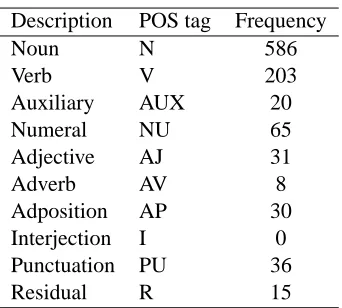
Table 1 shows the distribution of POS tags in the corpus. Nouns constitute the largest POS category in the corpus based on the above tagging scheme. This seems to be characteristic of other languages too. However, Amharic makes extensive use of noun clauses for representing different kinds of subordi-nate clauses. Noun clauses are headed by a verbal noun, which is assigned a noun POS tag. This adds to the skewedness of POS tag distributions which in turn biases the POS tagger that relies heavily on morphological features as we will show in Section 7. Interjections, on the other hand, do not occur in the sample corpus, as these words usually do not appear often in newspaper text.
Once the POS tagset has been compiled and tested, the next logical step is to explore automatic methods of analyzing Amharic words, which we ex-plore in the next section.
5 POS Tagging of Amharic
Description POS tag Frequency
Noun N 586
Verb V 203
Auxiliary AUX 20
Numeral NU 65
Adjective AJ 31
Adverb AV 8
Adposition AP 30
Interjection I 0
Punctuation PU 36
[image:4.612.101.272.54.208.2]Residual R 15
Table 1: Distribution of POS tags
diacritics that represent most vowels and gemina-tion patterns are missing in written texts. Although Amharic does not have a special marker for gem-ination, the Amharic script fully encodes both the vowels and the consonants, hence it does not suffer from the ambiguity problem that may arise due to the missing vowels.
As mentioned briefly in Section 1, the morpho-logical complexity of these languages opens up dif-ferent alternative approaches in developing POS taggers for them (Bar-Haim et al., 2004; Diab et al., 2004). Bar-Haim et al. (2004) showed that morpheme-based tagging performs better than word-based tagging; they used Hidden Markov Models (HMMs) for developing the tagger.
On the basis of the idea introduced by Bar-Haim et al. (2004), we formulate the following two related tasks for the analysis of Amharic words: segmen-tation and POS tagging (sequence labeling). Seg-mentation refers to the analysis of a word into con-stituting morphemes. The POS tagging task, on the other hand, deals with the assignment of POS tags to words. The revised POS tags that are introduced in Section 3 will be used for this task. The main reason for choosing words as a unit of analysis and adopting the abstract POS tags is that the limited re-source that we have prohibits us from carrying out fine-grained classification experiments. As a result of this, we choose to aim at a less ambitious goal of investigating to what extent the strategies used for unknown word recognitions can help fill the gap left by scarce resources. Therefore, we mainly focus on word-based tagging and explore different kinds of
features that contribute to tagging accuracy.
Although the segmentation and POS tagging tasks look different, both can be reduced to sequence la-beling tasks. Since the size of the annotated cor-pora is very small, a method needs to be chosen that allows an optimal utilization of the limited sources that are available for Amharic. In this re-spect, CRFs are more appropriate than HMMs since they allow us to integrate information from different sources (Lafferty et al., 2001). In the next section, we provide a brief description of CRFs.
6 Conditional Random Fields
Conditional Random Fields are conditional proba-bility distributions that take the form of exponential models. A special case of CRFs, linear chain CRF, which takes the following form, has been widely used for sequence labeling tasks.
P(y|x) = 1
Z(x)exp
X
t=1 X
k
λkfk(t, yt−1, yt, x) !
,
where Z(x) is the normalization factor, X =
{x1, . . . , xn} is the observation sequence, Y = {y1, . . . , yT} is the label sequences, fk and λk
are the feature functions and their corresponding weights respectively (Lafferty et al., 2001).
An important property of these models is that probabilities are computed based on a set of feature functions, i.e. fk, (usually binary valued), which
are defined on both the observationXand label se-quencesY. These feature functions describe differ-ent aspect of the data and may overlap, providing a flexible way of describing the task. CRFs have been shown to perform well in a number of natural language processing applications, such as POS tag-ging (Lafferty et al., 2001), shallow parsing or NP chunking (Sha and Pereira, 2003), and named entity recognition (McCallum and Li, 2003).
7 Experiments
There are limited resources for the Amharic lan-guage, which can be used for developing POS tag-ger. One resource that may be relevant for the cur-rent task is a dictionary consisting of some 15,000 entries (Amsalu, 1987). Each entry is assigned one of the five POS tags; Noun, Verb, Adjectives, Ad-verb, and Adposition. Due to the morphological complexity of the language, a fully inflected dic-tionary consisting only of 15,000 entries is bound to have limited coverage. Furthermore, the dictio-nary contains entries for phrases, which do not fall into any of the POS categories. Therefore the actual number of useful entries is a lot less than 15,000.
The data for the experiment that will be described below consists of 5 annotated news articles (1000 words). The Amharic text has been transliterated us-ing the SERA transliteration scheme, which encodes Amharic scripts using Latin alphabets (Daniel, 1996). This data is very small compared to the data used in other segmentation and POS tagging experi-ments. However, it is worthwhile to investigate how such a limited resource can meaningfully be used for tackling the aforementioned tasks.
7.1 Segmentation
The training data for segmentation task consists of 5 news articles in which the words are annotated with segment boundaries as shown in the following ex-ample.
. . .<seg>Ind</seg><seg> astawequt</seg>#
<seg>le</seg><seg>arso </seg>#<seg> aderu </seg># <seg>be</seg> <seg>temeTaTaN</seg>. . .
In this example, the morphemes are enclosed in
<seg>and</seg>XML tags. Word-boundaries are indicated using the special symbol#. The reduc-tion of the segmentareduc-tion task to a sequence labeling task is achieved by converting the XML-annotated text into a sequence of character-tag pairs. Each character constitutes a training (test) instance. The following five tags are used for tagging the char-acters; B(egin), C(ontinue), E(nd), U(nique) and
N(egative). Each character in the segment is as-signed one of these tags depending on where it ap-pears in the segment; at the beginning (B), at the end (E), inside (C), or alone (U). While the tags BCE are used to capture multi-character morphemes, the U tag is used to represent single-character morphemes. The negative tag (N) is assigned to the special sym-bol # used to indicate the word boundary. Though experiments have been carried out with less elab-orate tagging schemes such as BIO (Begin-Inside-Outside), no significant performance improvement has been observed. Therefore, results are reported only for the BCEUN tagging scheme.
The set of features that are used for training are composed of character features, morphological fea-tures, dictionary feafea-tures, the previous tag, and char-acter bi-grams. We used a window of eleven ters centered at the current character. The charac-ter features consist of the current characcharac-ter, the five characters to the left and to the right of the current characters. Morphological features are generated by first merging the set of characters that appear be-tween the word boundaries (both left and right) and the current character. Then a binary feature will be generated in which its value depends on whether the resulting segment appears in a precompiled list of valid prefix and suffix morphemes or not. The same segment is also used to generate another dictionary-based feature, i.e., it is checked whether it exists in the dictionary. Character bi-grams that appear to the left and the right of the current character are also used as features. Finally, the previous tag is also used as a feature.
7.2 POS Tagging
The experimental setup for POS tagging is similar to that of the segmentation task. However, in our cur-rent experiments, words, instead of characters, are annotated with their POS tags and hence we have more labels now. The following example shows the annotation used in the training data.
. . .<V>yemikahEdut</V> <N>yemrmr</N>
<N>tegbarat</N> <V>yatekorut</V>
<N>bemgb</N> <N>sebl</N>
Each word is enclosed in an XML tag that denotes its POS tag. These tags are directly used for the training of the sequence-labeling task. No additional reduc-tion process is carried out.
The set of features that are used for training are composed of lexical features, morphological fea-tures, dictionary feafea-tures, the previous two POS tags, and character bi-grams. We used a window of five words centered at the current word. The lex-ical features consist of the current word, the two words to the left and to the right of the current word. Morphological features are generated by extracting a segment of length one to four characters long from the beginning and end of the word. These segments are first checked against a precompiled list of valid prefix and suffix morphemes of the language. If the segment is a valid morpheme then an appropriate feature will be generated. Otherwise the null pre-fix or sufpre-fix feature will be generated to indicate the absence of an affix. The dictionary is used to gen-erate a binary feature for a word based on the POS tag found in the dictionary. In other words, if the word is found in the dictionary, its POS tag will be used as a feature. For each word, a set of character grams has been generated and each character bi-gram is used as a feature. Finally, the last two POS tags are also used as a feature.
8 Results
We conducted a 5-fold cross-validation experiment. In each run, one article is used as a test dataset and the remaining four articles are used for training. The results reported in the sections below are the average of these five runs. On average 80% of the words in the test files are unknown words. Most of the un-known words (on average 60%) are nouns.
8.1 Segmentation Result
As mentioned in Section 7.1, four sets of features, i.e., character features, morphological features, dic-tionary features, and previous label, are used for the segmentation task. Table 2 shows results for some combinations of these features. The results without the previous label feature are also shown (Without Prev. Label).
The simple character features are highly informa-tive features, as can be seen in Table 2 (Row 1).
Using only these features, the system with previous label feature already achieved an accuracy of 0.819. The dictionary feature improved the result by 2% whereas the morphological features brought minor improvements. As more features are added the vari-ation between the different runs increases slightly. Performace significantly decreases when we omit the previous label feature as it is shown in Without Prev. Label column.
8.2 POS Tagging Results
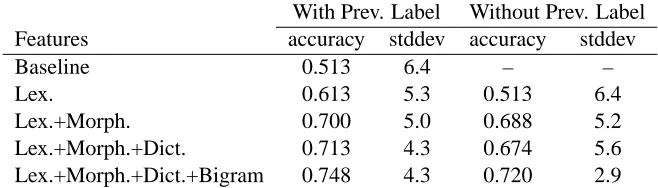
Table 3 shows the word-based evaluation results of the POS tagging experiment. The baseline (Row 1) means assigning all the words the most frequently occurring POS tag, i.e., N (noun). The result ob-tained using only lexical features (Row 2) is bet-ter than the baseline. Adding morphological fea-tures improves the result almost by the same amount (Row 3). Incorporation of the dictionary feature, however, has brought only slight improvement. The addition of bi-gram features improved the result by 3%.
As mentioned before, it is not possible to com-pare the results, i.e. 74% accuracy (With Prev. La-bel), with other state of the art POS taggers since our data is very small compared to the data used by other POS taggers. It is also difficult to claim with abso-lute certainty as to the applicability of the technique we have applied. However, given the fact that 80% of the test instances are unseen instances, an accu-racy of 74% is an acceptable result. This claim ceives further support when we look at the results re-ported for unknown word guessing methods in other POS tagging experiments (Nakagawa et al., 2001). As we add more features, the system shows less vari-ation among the different folds. As with segmenta-tion task, the omission of the previous label feature decreases performace. The system with only lexical features and without previous label feature has the same performace as the baseline system.
8.3 Error Analysis
charac-With Prev. Label Without Prev. Label
Features accuracy stddev accuracy stddev
Char. 0.819 0.7 0.661 4.7
Char.+Dict. 0.837 1.6 0.671 4.1
[image:7.612.151.455.59.134.2]Char.+Dict.+Morph. 0.841 1.7 0.701 3.9
Table 2: Segmentation Results
With Prev. Label Without Prev. Label
Features accuracy stddev accuracy stddev
Baseline 0.513 6.4 – –
Lex. 0.613 5.3 0.513 6.4
Lex.+Morph. 0.700 5.0 0.688 5.2
Lex.+Morph.+Dict. 0.713 4.3 0.674 5.6
Lex.+Morph.+Dict.+Bigram 0.748 4.3 0.720 2.9
Table 3: Word-based evaluation results of POS tagging
ters as words with affix morphemes. Increasing the size of the lexical resources, such as the dictionary, can help the system in distinguishing between words that have affixes from those that do not.
The POS tagging system, on the other hand, has difficulties in distinguishing between nouns and other POS tags. This in turn shows how similar nouns are to words in other POS tags morpholog-ically, since our experiment relies heavily on mor-phological features. This is not particularly sur-prising given that most Amharic affixes are shared among nouns and words in other POS tags. In Amharic, if a noun phrase contains only the head noun, most noun affixes, such as prepositions, def-inite article, and case marker appear on the head noun. If, on the other hand, a noun phrase contains prenominal constituents such as adjectives, numer-als, and other nouns, then the above noun affixes appear on prenominal constituents, thereby blurring the morphological distinction between the nouns and other constituents. Furthermore, similar sets of morphemes are used for prepositions and subor-dinate conjunctions, which again obscures the dis-tinction among the nouns and verbs. This, together with the fact that nouns are the dominant POS cate-gory in the data, resulted in most words being miss-classified as nouns.
In general, we believe that the above problems can be alleviated by making more training data available to the system, which will enable us to determine
im-proved parameters for both segmentation and POS tagging models.
9 Concluding Remarks
In this paper, we provided preliminary results of the application of CRFs for Amharic word segmentation and POS tagging tasks. Several features were exam-ined for these tasks. Character features were found to be useful for the segmentation task whereas mor-phological and lexical features significantly improve the results of the POS tagging task. Dictionary-based features contribute more to the segmentation task than to the POS tagging task. In both experi-ments, omition of previous label feature hurts per-formance.
Although the size of the data limits the scope of the claims that can be made on the basis of the re-sults, the results are good especially when we look at them from the perspective of the results achieved in unknown word recognition methods of POS tag-ging experiments. These results could be achieved since CRFs allow us to integrate several overlapping features thereby enabling optimum utilization of the available information.
[image:7.612.141.470.160.254.2]allows for fine-grained POS tagging of Amharic words. Parallel to this, resource development needs to be given due attention. As mentioned, the lack of adequate resources such as a large POS annotated corpus imposes restrictions on the kind of methods that can be applied. Therefore, the development of a standard Amharic POS tagset and annotation of a reasonably sized corpus should be given priority.
Acknowledgements
This research was supported by the Netherlands Organization for Scientific Research (NWO) under project number 220-80-001.
References
Nega Alemayehu. 1999. Development of stemming
al-gorithm for Amharic text retrieval. PhD Thesis,
Uni-versity of Sheffield.
Atelach Alemu. 2002. Automatic Sentence Parsing for Amharic Text: An Experiment using Probabilistic Context Free Grammars. Master Thesis, Addis Ababa
University.
Amsalu Aklilu. 1987. Amharic-English Dictionary. Ku-raz Publishing Agency.
Roy Bar-Haim, Khalil Simaan and Yoad Winter. 2004. Part-of-Speech Tagging for Hebrew and Other Semitic Languages. Technical Report.
Abiyot Bayou. 2000. Developing automatic word parser
for Amharic verbs and their derivation. Master
The-sis, Addis Ababa University.
W. Cohen. 2004. Methods for Identifying Names and Ontological Relations in Text using Heuristics for Inducing Regularities from Data. http:// minorthird.sourceforge.net
Peter T. Daniels, 1997. Script of Semitic Languages in: Robert Hetzron, editor,Proceedings of the Corpus
Lin-guistics. 16–45.
Mona Diab, Kadri Hacioglu and Daniel Jurafsky. 2004. Automatic tagging of Arabic text: From row text to base phrase chunks. In Daniel Marku, Susan Dumais and Salim Roukos, editors, HLT-NAACL 2004: Short
papers, pages 149–152, Boston, Massachusetts, USA,
May 2–May 7. Association for Computational Lin-guistics
Sisay Fissaha Adafre and Johann Haller. 2003a. Amharic verb lexicon in the context of machine trans-lation. Traitement Automatique des Langues Na-turelles 2:183–192
Sisay Fissaha Adafre and Johann Haller. 2003b. Ap-plication of corpus-based techniques to Amharic texts.
Machine Translation for Semitic languages MT
Sum-mit IX Workshop, New Orleans
Mesfin Getachew. 2001. Automatic part of speech tagging for Amharic language: An experiment using stochastic HMM. Master Thesis, Addis Ababa
Uni-versity.
Wolf Leslau. 1995. Reference Grammar of Amharic. Otto Harrassowitz, Wiesbaden.
A. McCallum and W. Li. 2003. Early results for Named Entity Recognition with conditional random fields, feature induction and web-enhanced lexicons.
Pro-ceedings of the 7th CoNLL.
Tetsuji Nakagawa, Taku Kudo and Yuji Matsumoto. 2001. Unknown Word Guessing and Part-of-Speech Tagging Using Support Vector Machines. NLPRS pages 325-331, Boston, Massachusetts, USA, May 2–May 7. http://www.afnlp.org/ nlprs2001/pdf/0053-01.pdf
J. Lafferty, F. Pereira and A. McCallum. 2001. Con-ditional random fields: Probabilistic models for seg-menting and labeling sequence data. Proceedings of
the International Conference on Machine Learning.
F. Sha and F. Pereira. 2004. Shallow parsing with con-ditional random fields. Proceedings of Human
Lan-guage Technology-NAACL.
Khoja S., Garside R., and Knowles G. 2001. A Tagset for the Morphosyntactic Tagging of Arabic Proceedings
of the Corpus Linguistics. Lancaster University (UK),
Volume 13 - Special issue, 341.
Leech G. Wilson. 1996. Recommendations for the Morphosyntactic Annotation of Cor-pora. EAGLES Report EAG-TCWG-MAC/R, http://www.ilc.pi.cnr.it/EAGLES96/ annotate/annotate.html
Daniel Yacob. 1996. System for Ethiopic Representation
in ASCII. http://www.abyssiniagateway. net/fidel
Baye Yimam. 1999. Root. Ethiopian Journal of
Lan-guage Studies, 9:56–88.