Revisiting Distant Supervision for Relation Extraction
Tingsong Jiang
†
, Jing Liu
‡
, Chin-Yew Lin
§
, Zhifang Sui
†
†Key Laboratory of Computational Linguistics, Ministry of Education School of Electronics Engineering and Computer Science, Peking University‡Baidu Inc., Beijing, China
§Microsoft Research
[email protected], [email protected], [email protected],[email protected]
Abstract
Distant supervision has been widely used in the task of relation extraction (RE). However, when we carefully examine the experimental settings of previous work, we find two issues: (i) The compared models were trained on different training datasets. (ii) The existing testing data contains noise and bias issues. These issues may affect the conclusions in previous work. In this paper, our primary aim is to re-examine the distant supervision-based approaches under the experimental settings without the above issues. We approach this by training models on the same dataset and creating a new testing dataset annotated by the workers on Amzaon Mechanical Turk. We draw new conclusions based on the new testing dataset. The new testing data can be obtained fromhttp://aka.ms/relationie.
Keywords:relation extraction, distant supervision
1.
Introduction
In recent years, knowledge bases (KBs) like Freebase (Bol-lacker et al., 2008), DBpedia (Lehmann et al., 2015) and NELL (Carlson et al., 2010) have become extremely use-ful resources for many natural language processing (NLP) tasks. These KBs are mostly composed of relational facts between entities, which are typically represented as triples with the format (head entity, relation, tail entity), e.g., (Paris, capitalOf, France). Although existing KBs may contain billions of relational facts, they are still far from complete and missing many crucial facts. To en-rich KBs, relation extraction (RE),i.e., the task of extract-ing relations between entities from plain texts, has thus at-tracted increasing attention. For example, here is a sen-tence:Paris is the capital city of France. whereParisandFranceare two entity mentions. A re-lation extractor or classifier takes the sentence and the two entity mentions as inputs, and determines the semantic rela-tion that it expresses, if any. In the above example, a correct prediction may becapitalOfrelation.
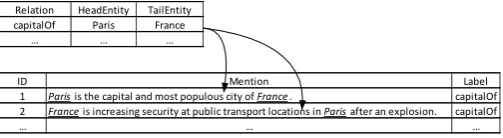
Most existing approaches formulate RE as a classification task and use supervised learning on relation-specific train-ing data, which is very expensive to acquire. To address this issue, distant supervision is proposed to automatically gen-erate training data via aligning facts in KBs and texts (Wu and Weld, 2007; Mintz et al., 2009). Thedistant supervi-sion assumptionis that if two entities preserve a relation in a KB, then all sentencesthat mention the two entities express the relation. Figure 1 shows an example of the automatic labeling of data via distant supervision. In this example,Paris andFranceare two entities with a rela-tion typecapitalOfin a KB. All sentences contain these two entities are labeled with capitalOf. Although dis-tant supervision provides a cheap way to automatically la-bel training data, it leads to a noise problem with the data. The noisy data can be mainly classified into two categories:
This work was done when Tingsong Jiang and Jing Liu were working at Microsoft Research.
Relation HeadEntity TailEntity capitalOf Paris France
… … …
ID Mention Label
1 Paris is the capital and most populous city of France. capitalOf
2 France is increasing security at public transport locations in Parisafter an explosion. capitalOf
… … …
Figure 1: Training instances generated via distant supervi-sion. The first sentence has a correct label, but the second sentence has a wrong label.
(i) False positive instances. Not necessarily all sentences that mention an entity pair express the target relation. As shown in Figure 1, the second sentence is a false positive instance. (ii) Multiple labels instances. An entity pair may preserve multiple relation types in a KB. For exam-ple, (Bill Gates,founderOf,Microsoft) and (Bill Gates,ceoOf,Microsoft) are clearly true.
To deal with the two major issues, instance multi-label learning (MIML) was proposed for RE by relaxing the distant supervision assumption and making theat-least-one assumption: if two entities preserve a relation in a KB,at least one sentencethat mentions the entity pair expresses the relation (Riedel et al., 2010; Hoffmann et al., 2011; Surdeanu et al., 2012). The previous work of MIML-based approaches can be mainly categorized into two folds: (i)
feature-based approaches (Hoffmann et al., 2011;
Sur-deanu et al., 2012) and (ii) neural network-based
ap-proaches (Zeng et al., 2015; Lin et al., 2016).
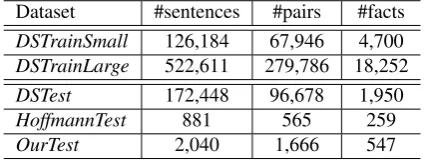
were trained on a small dataset containing 126,184 sen-tences. We will give the details of the two training datasets in Section 2.. It is important to re-examine the perfor-mances of the models that are trained on the same train-ing dataset. The new experimental results will be shown in Section 3.4.. (ii) Most MIML-based approaches (Hoff-mann et al., 2011; Zeng et al., 2015; Lin et al., 2016) were evaluated on the testing data generated by distant supervi-sion. However, the automatically generated labels in the testing data could be wrong due to the limitation of dis-tant supervision assumption. The quality of the testing data may affect the experimental results. Although Hoffmann et al. (2011) released a testing dataset which was manually annotated, the dataset was sampled from the union of the extraction results by the model of (Hoffmann et al., 2011) and the data generated by distant supervision. If the exper-iments are conducted on this testing data, the results may be biased towards to the model of (Hoffmann et al., 2011). To address these issues, similar to the slot filling task of TAC KBP, we develop a new testing dataset which is sam-pled from a set by pooling the extraction results from all compared models and the data generated by distant super-vision. We will show our new observations based on the new testing data in Section 3.4..
The above issues may affect the conclusions in previous work. In this paper, we revisit the distant supervision for relation extraction. Specifically, our contributions include:
• We carefully re-examine the experimental settings of previous MIML-based work for RE. We find the issues with the training data size and the testing data used in the experiments.
• We create a new testing dataset by pooling the extrac-tion results from all compared models (Hoffmann et al., 2011; Zeng et al., 2015; Lin et al., 2016) and the data generated by distant supervision on NYT corpus, and using Amazon Mechanical Turk1(MTurk) to an-notate the data in a crowdsourcing way.
• We conduct extensive experiments to examine the MIML-based approaches (Hoffmann et al., 2011; Zeng et al., 2015; Lin et al., 2016). All models are trained on the same training dataset and evaluated on our new testing dataset. We draw new conclusions based on the new testing dataset.
2.
Datasets
As we discussed in Section 1., we find two issues of pre-vious MIML-based approaches to relation extraction: (i) The compared models were trained on different training datasets. (ii) The existing testing data contains noise and bias issues. In this section, we will give the details of the datasets used in previous work, and create a new testing dataset.
Data Source. Most previous work uses New York Times
(NYT) dataset2 developed by (Riedel et al., 2010)3. The NYT corpus contains about 1.8 million news articles.
1
https://https://www.mturk.com/
2
http://iesl.cs.umass.edu/riedel/ecml/
3
Apart from the NYT dataset released by (Riedel et al., 2010),
Dataset #sentences #pairs #facts
DSTrainSmall 126,184 67,946 4,700 DSTrainLarge 522,611 279,786 18,252
DSTest 172,448 96,678 1,950
HoffmannTest 881 565 259
OurTest 2,040 1,666 547
Table 1: Statistics about the datasets.
When constructing the dataset, named entity mentions were first extracted from the text of NYT articles by using Stan-ford Named Entity Tagger (Finkel et al., 2005). Then, the named entity mentions were linked to the entities in Free-base by using exact string matching. If a sentence mentions two entities that have a relation in Freebase, then a corsponding instance will be generated and labeled as the re-lation type. Otherwise, an instance with a labelNAwhich indicates that there is no relation between the entity pair, will be generated. Riedel et al. (2010) mainly focus on the relations related to “people”, “business”, “person” and “lo-cation”. There are53relation labels including the special labelNAin the corpus. The Freebase relations were divided into two parts, one for training and one for testing. The for-mer is aligned to the2005−2006articles of NYT corpus, and the latter to the2007articles.
Training Data. In previous work, there are two training
datasets sampled from the aligned sentences of2005−2006
NYT articles. (i) Riedel et al. (2010) sampled a small train-ing dataset containtrain-ing 126,184 sentences, 67,946 entity pairs and4,700facts. We denote this dataset as DSTrainS-mall. (ii) Zeng et al. (2015; Lin et al. (2016) sam-pled a large training dataset containing522,611sentences,
279,786entity pairs and18,252facts which covers all sen-tences inDSTrainSmall. We denote this dataset as DSTrain-Large. The details of these two training datasets have been given in Table 1. In the experiments of Zeng et al. (2015; Lin et al. (2016), the neural network-based mod-els were trained onDSTrainLarge, while the feature-based models were trained on DSTrainSmall. The comparison might be not fair. We will train and compare these mod-els on the two training datasets respectively.
The Existing Testing Data. In previous work, there are
two popular testing datasets. (i) One is the dataset gen-erated by distant supervision. We denote this dataset as DSTest. However, as we discussed previously, the automat-ically generated labels in the testing data could be wrong due to the limitation of distant supervision assumption. The quality of the testing data may affect the experimental re-sults. (ii) Although Hoffmann et al. (2011) released a test-ing dataset which was manually annotated, the dataset was sampled from the union of the extraction results from Mul-tiR (Hoffmann et al., 2011) and the data generated from dis-tant supervision. We denote this dataset asHoffmannTest. The evaluation conducted on this dataset may be biased
Window size Word dim. Position dim. Batch size Learning rate Dropout prob. Sentence dim.
l=3 dw=50 dp=5 160 0.001 0.5 dc=230
Table 2: The parameters of neural networks-based approaches used in our experiments.
wards MultiR.
A New Testing Data. Since the existing testing datasets
have noise and bias issues, we develop a new testing dataset. Our aim is to guarantee the quality of the data and make it not biased towards any of the compared mod-els. Because the instances with non-“NA” labels are quite sparse in the data, it is difficult for us to directly sample enough non-“NA” instances from the corpus to annotate. Similar to the slot filling task of TAC KBP, the key idea of creating the dataset is pooling the top predicted results from all compared models and the data generated from dis-tant supervision.
In the testing corpus DSTest, distant supervision labels
172,448 sentences and only 6,444 sentences are labeled as non-“NA”. We first pool the6,444non-“NA” sentences given by distant supervision and the top 10,000 non-“NA” sentences predicted by each of the compared sys-tems (including MultiR, CNNONE, PCNNONE, CNNATT and PCNNATT that will be described in Section 3.1.). The pooling results contain 17,147 sentences. Then we randomly sample 2,040 sentences from the pooling re-sults, and utilize Amazon Mechanical Turk to annotate the dataset in a crowdsourcing way. We divide the2,040 sen-tences into120tasks, and each task contains17sentences to be labeled and 3 controls. Each control is a sentence that we already know its label. All the controlled sentences are sampled from the set of HoffmannTest (Hoffmann et al., 2011). Since it is important to control the annotation quality, we use the controls to detect the unqualified work-ers. If a worker fails on more than one control in a task, we will discard all his annotations for the task. Then the task will be automatically re-assigned to a new worker to complete. Besides, we request5workers to annotate each sentence, and use the majority votes to get the ground truth label. The agreements between workers are high. There are
99.7% sentences to which3/5 or more workers give the same label. If there is a tie, we will ask another annotator to break it. There are only6tie sentences. The details of the three testing datasets have been shown in Table 1.
3.
Experiments
In this section, we will examine that how the two data issues will affect the conclusions in previous work, and we will give our new observations based on the new testing dataset.
3.1.
Systems
In our experiments, we revisit and compare the following feature-based and neural network-based MIML systems:
• MultiR (Hoffmann et al., 2011) which is a
feature-based MIML approach.
• CNNONE(Zeng et al., 2015) which is a convolutional
neural networks (CNN) based MIML model. ONE
means that only one sentence is active in each bag (for one entity pair).
• PCNNONE (Zeng et al., 2015) which is a picewise
convolutional neural networks (PCNN) based MIML model.
• CNNATT(Lin et al., 2016) which extends the model
of CNNONE by introducing sentence-level attention over multiple instances.
• PCNNATT(Lin et al., 2016) which extends the model
of PCNNONE by introducing sentence-level attention over multiple instances.
We use the implementations of these systems shared by the authors (Hoffmann et al., 2011; Lin et al., 2016)4.
3.2.
Parameters Settings
In this section, we describe the parameters settings of the neural network-based approaches.
Word Embeddings. In this paper, we follow Lin et al.
(2016) and use the word2vec tool5to train the word embed-dings to on NYT corpus. We keep the words which appear more than100times in the corpus as vocabulary. Besides, when training the word embeddings, an entity mention will be considered as one token if it has multiple words.
Model Parameters.Following (Surdeanu et al., 2012), we
use three-fold validation on the training set to tune the pa-rameters of all models. We use grid search to determine the optimal parameters and manually specify spaces of the fol-lowing parameters: the sliding window sizel∈ {1,2,...,8}, the size of sentence embeddingn∈{50,60,..., 300}and the batch sizeBamong{40, 160, 640, 1280}. For other param-eters, we follow the settings used in (Zeng et al., 2015; Lin et al., 2016). Table 2 summarizes the parameters of neural networks-based approaches used in our experiments.
3.3.
Evaluation Metrics
In the experiments, we compare the precision and recall curve of each system. The curve of each system is drawn by (i) ranking all predicted instances according to their con-fidence scores given by the system, and (ii) traversing the ranking list from the high score to low score to measure the precision and recall at each position.
Additionally, in previous work, the evaluation were usu-ally conducted in two levels:entity pair levelandsentence
level. By entity pair level, we mean that the system should
determine the relation of one bag (i.e., a set of sentences that mention the same entity pair). When using the testing data generated by distant supervision (DSTest), we use en-tity pair level evaluation. BecauseDSTesthas less noise at
4http://www.cs.washington.edu/ai/raphaelh/mr and
https://github.com/thunlp/NRE
5
0.00 0.05 0.10 0.15 0.20 0.25 0.30 0.35 0.40
(a) The results of models trained onDSTrainSmall.
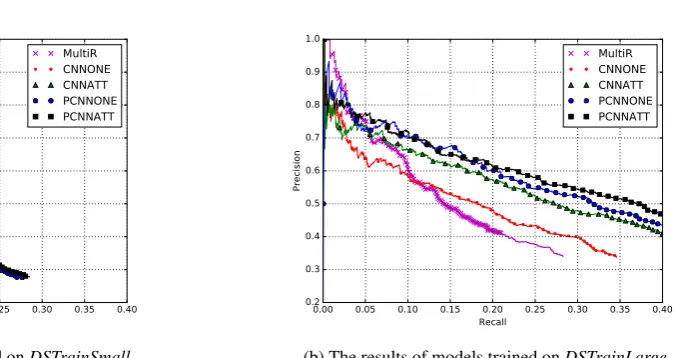
0.00 0.05 0.10 0.15 0.20 0.25 0.30 0.35 0.40 Recall
(b) The results of models trained onDSTrainLarge.
Figure 2: The experimental results on the testing data generated by distant supervision (i.e.DSTest).
0.0 0.2 0.4 0.6 0.8 1.0
(a) The results of models trained onDSTrainSmall.
0.0 0.2 0.4 0.6 0.8 1.0
(b) The results of models trained onDSTrainLarge.
Figure 3: The experimental results on the manual testing data created by Hoffmann (i.e.HoffmannTest).
0.0 0.2 0.4 0.6 0.8 1.0
(a) The results of models trained onDSTrainSmall.
0.0 0.2 0.4 0.6 0.8 1.0
(b) The results of models trained onDSTrainLarge.
Figure 4: The experimental results on the manual testing data created in this paper (i.e.Ours).
entity pair level while more noise at sentence level, it is bet-ter to use the bag level label under the at-least-one assump-tion. By sentence level, we mean that the system should determine the relation of one instance (i.e., a sentence that mentions an entity pair). When using the testing data that
3.4.
Experimental Results
As we discussed in the Section 1., there are two issues with the experimental settings of previous work (Zeng et al., 2015; Lin et al., 2016): (i) the compared models were trained on the data with different size. (ii) the quality of the existing testing data is not good. In this paper, we conduct three experiments. In the first two experiments, we try to examine that how the two issues may affect the conclusions in previous work (Zeng et al., 2015; Lin et al., 2016). The third experiment is conducted on our new testing dataset, and we will give our new observations based on the results.
Experiment 1. In the experiments of (Zeng et al., 2015;
Lin et al., 2016), the main evaluations were conducted on the testing data of DSTest. When Zeng et al. (2015; Lin et al. (2016) compare different models, the feature-based model (MultiR) was trained on the small training dataset DSTrainSmall, while the neural network-based approaches (including CNNONE, PCNNONE, CNNATT and PCN-NATT) were trained on the large training dataset DSTrain-Large. Their major conclusion is that neural network-based approaches significantly outperform the feature-based ap-proaches. However, it might be not fair to compare these models that were trained on the datasets with different size. In Experiment 1, we train all models on two training datasets (DSTrainSmall, DSTrainLarge) respectively and compare their performance on testing datasetDSTest. Fig-ure 2 shows the experimental results. We can observe that (i) In Figure 2a, the feature-based approach MultiR outper-forms the neural network-based approaches, when all mod-els are trained on the small training dataDSTrainSmall. (ii) In Figure 2b, when all models are trained onDSTrainLarge, MultiR outperforms the neural network-based approaches at the low recall positions. While MultiR performs worse at the high recall positions. (iii) All models benefit from enlarging the training data.
Experiment 2. Since there is a noise problem with the
test-ing datasetDSTest, we further conduct the evaluation based on the testing dataHoffmannTestwhich was manually an-notated by Hoffmann et al. (2011). Figure 3 shows the experimental results. From Figure 3, we can observe that (i) MultiR is comparable to the the neural network-based approaches, when all models are trained onDSTrainSmall. (ii) MultiR significantly outperforms the neural network-based approaches when all models are trained on DSTrain-Large. (iii) Only MultiR benefits from enlarging the train-ing data. The reason might be that the sampltrain-ing strategy of the testing dataHoffmanTestis biased towards MultiR.
Experiment 3. In this experiment, we conduct the
eval-uation on our new manual testing dataset, which tries to avoid the bias issue. Figure 4 shows the experimental re-sults. From Figure 4, we have the following observations:
• Comparing to Figure 4a and Figure 4b, neural network-based approaches benefit more when the size of training data increases. The gap between MultiR and neural network-based approaches becomes larger when increasing the training data.
• According to Figure 4b, neural network-based ap-proaches outperforms the feature-based apap-proaches,
but the gap is much smaller as compared to the obser-vations in previous work. In the experimental results of (Lin et al., 2016), the precision gap between Mul-tiR and PCNNATT is more than0.3given the recall
0.2. In contract, the precision gap is around0.1at the same recall position in our experiments according to Figure 4b.
• Lin et al. (2016) concludes that sentence-level at-tention brings performance gains for both CNN and PCNN. However, according to Figure 4b, sentence-level attention brings significant gains for CNN only. We cannot observe significantly improvements on PCNN.
4.
Conclusions
In this paper, we carefully re-examine the experimental set-tings of previous work, and we find two issues: (i) the compared models were trained on the data with different size. (ii) the quality of the existing testing data is not good. We conduct experiments by training models on the same dataset and creating a new manual testing dataset anno-tated by the workers on Amzaon Mechanical Turk. Our major new observations include: (i) Neural network-based approaches benefit more when the size of training data in-creases. (ii) The performance gap between feature-based approaches and neural network-based approaches is much smaller as compared to the observations in previous work. (iii) Sentence-level attention brings significant improve-ment for CNN but not for PCNN. We also share the new testing data with the research community.
5.
Acknowledgments
We thank the anonymous reviewers for their valuable com-ments. The research work is supported by the National Key Research and Development Program of China under Grant No. 2017YFB1002101 and the National Science Founda-tion of China under Grant No. 61772040. The contact au-thor is Zhifang Sui.
6.
Bibliographical References
Bollacker, K., Evans, C., Paritosh, P., Sturge, T., and Tay-lor, J. (2008). Freebase: a collaboratively created graph database for structuring human knowledge. In Proceed-ings of SIGMOD, pages 1247–1250. AcM.
Carlson, A., Betteridge, J., Kisiel, B., Settles, B., Hr-uschka Jr, E. R., and Mitchell, T. M. (2010). Toward an architecture for never-ending language learning. In Proceedings of AAAI, page 3.
Finkel, J. R., Grenager, T., and Manning, C. (2005). In-corporating non-local information into information ex-traction systems by gibbs sampling. In Proceedings of the 43rd annual meeting on association for computa-tional linguistics, pages 363–370. Association for Com-putational Linguistics.
Technologies-Volume 1, pages 541–550. Association for Computational Linguistics.
Lehmann, J., Isele, R., Jakob, M., Jentzsch, A., Kon-tokostas, D., Mendes, P. N., Hellmann, S., Morsey, M., Van Kleef, P., Auer, S., et al. (2015). Dbpedia–a large-scale, multilingual knowledge base extracted from wikipedia.Semantic Web, 6(2):167–195.
Lin, Y., Shen, S., Liu, Z., Luan, H., and Sun, M. (2016). Neural relation extraction with selective attention over instances. InProceedings of the 54th Annual Meeting of the Association for Computational Linguistics (Volume 1: Long Papers), volume 1, pages 2124–2133.
Mintz, M., Bills, S., Snow, R., and Jurafsky, D. (2009). Distant supervision for relation extraction without la-beled data. In Proceedings of the Joint Conference of the 47th Annual Meeting of the ACL and the 4th Interna-tional Joint Conference on Natural Language Processing of the AFNLP: Volume 2-Volume 2, pages 1003–1011. Association for Computational Linguistics.
Riedel, S., Yao, L., and McCallum, A. (2010). Modeling relations and their mentions without labeled text. In Ma-chine Learning and Knowledge Discovery in Databases, pages 148–163. Springer.
Surdeanu, M., Tibshirani, J., Nallapati, R., and Manning, C. D. (2012). Multi-instance multi-label learning for re-lation extraction. InProceedings of the 2012 Joint Con-ference on Empirical Methods in Natural Language Pro-cessing and Computational Natural Language Learning, pages 455–465. Association for Computational Linguis-tics.
Wu, F. and Weld, D. S. (2007). Autonomously semanti-fying wikipedia. In Proceedings of the sixteenth ACM conference on Conference on information and knowledge management, pages 41–50. ACM.